Applying Possibilistic Linear Programming to
Multi-objective New Ship of Sign on Proceeding
Project Management Problem
C.M. Su, K.Y. Chang & Y.H. Chang
Abstract—In this paper, we apply possibilistic linear
programming (PLP) [2] to establish a fuzzy model for the
multi-objective new ship of sign on proceeding problems and
the model try to minimize total project cost, total completion
time and total crashing cost in same time with reference to
direct, indirect cost and relevant constraints. In addition, the
proposed PLP applies the signed distance method [4] to
transform fuzzy numbers into crisp values and in the paper
we provide a defuzzification PLP model.
Keywords
:
shipbuilding;
PLP
method;
fuzzy;
project
management
I
Introduction
With new ship demand increasing rapidly, shipbuilding
enterprises must be step up cost management practice, and
improve the ability of cost control [8]. In order to achieve
these goals, researchers introduce project management to
achieve the goal and to meet the requirement. But in
real-world project management problems, input data and/or
related parameters are usually imprecise over the planning
horizon owing to incomplete or unavailable information,
and the decision maker generally faces a fuzzy project
management problems in uncertain environments, so
researchers apply fuzzy theory to solve the kind of problem
and develop several fuzzy optimization techniques.
M.F.Yang and Yi.Lin[1] presented a fuzzy PERT (FPERT)
technique that can derive the possibility distribution of the
project completion time in the situation when particular
activity duration times were given in the form of fuzzy
variables on the time space.
In this paper, we consider a fuzzy multi-objective new
ship of sign on proceeding project management problem
and we utilize the PLP method [2] to develop a model that
attempts to simultaneously minimize total project cost, total
completion time and total crashing cost with reference to
direct, indirect cost and relevant constraints.
Chang Yun-Hsiang is with National Taiwan Ocean University, Taiwan (email: [email protected])
II
The model of PLP
The assumptions of PLP model:
1.
All of the objective functions and constraints are
linear.
2.
Direct costs increase linearly as the duration of an
activity is reduced from its normal value to its crash
value.
3.
The normal time and shortest possible time for each
activity and the cost of completing the activity in the
normal time and crash time are certain over the
planning horizon.
4.
Indirect cost can be divided into two categories, i.e.,
fixed cost and variable cost, and the variable cost per
unit time is the same regardless of project completion
time.
5.
The decision-makers adopted the pattern of triangular
possibility distribution to represent the imprecise
objectives and related imprecise numbers.
6.
The minimum operator is used to aggregate all fuzzy
sets.
Notation:
(i, j) activity between event i and event j
1
~
Z fuzzy total project cost ($)
2 ~
Z fuzzy total completion time (days)
3 ~
Z fuzzy total crashing cost ($)
ij
D normal time for activity (i, j) (days)
ij
d
minimum crashed time for activity (i,j)
CDij normal (direct) cost for activity (i, j)
($)
Cdij minimum crashed (direct) cost for
k ij fuzzy incremental crashing costs for
activity (i, j)(representing the cost-time
slopes) ($/day)
ij
t duration time for activity (i, j)
(days)(difference between normal time
and crash time)
ij
Y crash time for activity (i, j)
(days)(difference between normal time
and duration time)
i
E earliest time for event i (days)
1
E project start time (days)
n
E
project completion time (days)o
T project completion time under normal
conditions (days)
T~ fuzzy specified project completion
time (days)
I
C fixed indirect cost under normal
conditions ($)
m
~
fuzzy variable indirect cost per unit time ($/day)b
~
fuzzy total allocated budget ($)γ cut level
Z1m the most likely value of Z 1
Z1o the most optimistic value of Z 1
Z1p the most pessimistic value of Z 1
Z3m the most likely value of Z 3
Z3o the most optimistic value of Z 3
Z3p the most pessimistic value of Z 3
kijm the most likely value of k ij
kijo the most optimistic value of k ij
kijp the most pessimistic value of k ij
Tγm the most likely value of T in γ cut level
Tγo the most optimistic value of T in γ cut level
Tγp the most pessimistic value of T in γ cut level
Z11PIS the positive ideal solutions (PIS) of Z 11
Z11NIS the negative ideal solutions (NIS) of Z 11
Z12PIS the positive ideal solutions (PIS) of Z 12
Z12NIS the negative ideal solutions (NIS) of Z 12
Z13PIS the positive ideal solutions (PIS) of Z 13
Z13NIS the negative ideal solutions (NIS) of Z 13
Z2PIS the positive ideal solutions (PIS) of Z 2
Z2NIS the negative ideal solutions (NIS) of Z 2
Z31PIS the positive ideal solutions (PIS) of Z 31
Z31NIS the negative ideal solutions (NIS) of Z 31
Z32PIS the positive ideal solutions (PIS) of Z 32
Z32NIS the negative ideal solutions (NIS) of Z 32
Z33PIS the positive ideal solutions (PIS) of Z 33
Z33NIS the negative ideal solutions (NIS) of Z 33
Zkq∗ the optimal solution of objective functions of Z kq , k =
1, and 3; q = 1 and 3
Z2∗ the optimal solution of objective function of Z2
Mathematical model:
First
we
establish
the
multi-objective
linear
programming
model
(MOLP
model)
and
the
defuzzication method be used in the MOLP model is the
signed distance method [4]. In this paper, we provide the
defuzzification MOLP model.
Defuzzification objective:
Min Z11 = Z1m = Ci j Dij+ ki j mijYij+CI+mm En− To
Max Z12= Z1m− Z1o = ki j ijm− kijo Yij+ mm− mo En− To
Min Z13= Z1 p
− Z1m = kij p
− kijm j
i Yij+ mp− mm En− To
Min Z2 = En− E1
Min Z31= Z3m= ki j ijmYij
Max Z32= Z3m− Z3o = ki j ijm− kijo Yij
Min Z33= Z3 p
− Z3m = kij p
− kijm j
i Yij
Defuzzification constraints:
Ei+tij− Ej≦0 ∀i , ∀j
tij = Dij− Yij ∀i , ∀j
Yij≤ Dij− dij ∀i , ∀j
E1=0
En≤ Tγo+ 2Tγm+ Tγp 4
CDij+ kij,oγ+ 2kij,mγ+ kij,γ
p
4
j i j
i Yij+ CI+
mγo+ 2mγm+ mγp 4 En− To ≤ bγo+ 2bγm+ bγp 4
tij,Yij,Ei,Ej≥0 ∀i , ∀j
III
Solution procedure
Step 1: Apply defuzzification MOLP model to get (ZkqPIS, ZkqNIS) and
(Z2PIS, Z2NIS); k =1, 3 and q =1, 2, 3.
Step 2: Apply (ZkqPIS, ZkqNIS) and (Z2PIS, Z2NIS) to define
μkq Zkq x andμ2 Z2 x .
IV
The
new ship of sign on proceeding
problem
[image:3.595.314.551.121.194.2]The new ship of sign on proceeding problem apply PLP
model to solve the PM problems. The purpose of this PM
decision are to minimize simultaneously total project cost,
total completion time and total crashing cost, with
reference to direct cost, indirect cost, duration of activities
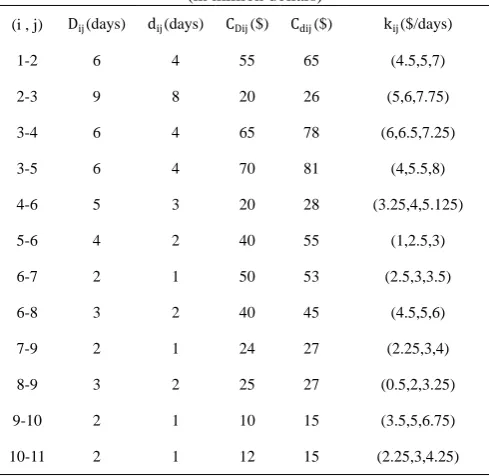
and budget constraint. Table I shows the program of new
ship of sign on proceeding and Table II summarizes the
basic data of the numerical new ship of sign on proceeding
problem.
Table I. Program of new ship of sign on proceeding
new ship of sign on proceeding
1. store proceeding
2. certificate application
3. crewman hire
4. archiving
5. ownership of ship on proceeding
6. insurance arrangement
7. oil proceeding
8. paperwork
9. ship certificate
10. food supply
11. water supply
Table II. Summarized data for new ship of sign on proceeding
(in million dollars)
(i , j) Dij(days) dij(days) CDij($) Cdij($) kij($/days)
1-2 6 4 55 65 (4.5,5,7)
2-3 9 8 20 26 (5,6,7.75)
3-4 6 4 65 78 (6,6.5,7.25)
3-5 6 4 70 81 (4,5.5,8)
4-6 5 3 20 28 (3.25,4,5.125)
5-6 4 2 40 55 (1,2.5,3)
6-7 2 1 50 53 (2.5,3,3.5)
6-8 3 2 40 45 (4.5,5,6)
7-9 2 1 24 27 (2.25,3,4)
8-9 3 2 25 27 (0.5,2,3.25)
9-10 2 1 10 15 (3.5,5,6.75)
10-11 2 1 12 15 (2.25,3,4.25)
Other relevant data are as follows: fixed indirect cost $15,
saved daily variable indirect cost ($3.5, $4, $4.25), total
budget ($400, $450, $500), and project completion time
under normal conditions 36 days. The project start time (
𝐸
1)
is set to zero. The γ-cut level for all imprecise numbers is
[image:3.595.90.251.204.431.2]specified as 0.3. The specified project completion time is
set to (28, 32, 35) days based on contractual information,
resource allocation and economic considerations, and
related factors. Figure I shows the Activity On-Arrow
network.
Fig. I. the project network of new ship of sign on proceeding problem.
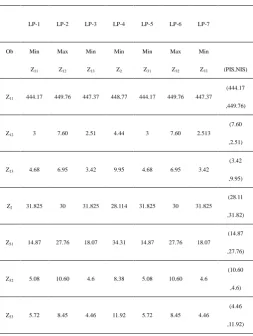
We run (phase I) to get (PIS, NIS) by using Lingo
computer software. Additionally, specify the PIS and NIS
of the imprecise/fuzzy objective functions with a payoff
table (see Table III).
(phase I)
Min Z11=
431+5Y12+6Y23+6.5Y34+5.5Y35+4Y46+2.5Y56+3Y67+5Y68+3Y79+2Y89+5
Y910
+3Y1011+4 E11− 36 +15
Max Z12=
0.5Y12+Y23+0.5Y34+1.5Y35+1.25Y46+1.5Y56+0.5Y67+1.5Y68+1.25Y79+1.5
Y89+1.5Y910+0.75Y1011+0.5 E11− 36
Min Z13=
2Y12+1.75Y23+0.75Y34+2.5Y35+1.125Y46+0.5Y56+0.5Y67+Y68+Y79+1.25
Y89+1.75Y910+1.25Y1011+0.25 E11− 36
Min Z2= E11− E1
Min Z31=
5Y12+6Y23+6.5Y34+5.5Y35+4Y46+2.5Y56+3Y67+5Y68+3Y79+2Y89+5Y910
+3Y1011
Max Z32=
0.5Y12+Y23+0.5Y34+1.5Y35+1.25Y46+1.5Y56+0.5Y67+1.5Y68+1.25Y79+1.5
Y89+1.5Y910+0.75Y1011
Min Z33=
2Y12+1.75Y23+0.75Y34+2.5Y35+1.125Y46+0.5Y56+0.5Y67+Y68+Y79+1.25
Y89 +1.75Y910+1.25Y1011
s.t. Ei+tij− Ej ≦ 0 ∀i =1~10 , ∀j =2~11
[image:3.595.39.284.467.705.2]Yij≤ Dij− dij ∀i =1~10 , ∀j =2~11
E1=0
E11≤R
29.2+2∗32+34.1
4 = 31.825
431+5.2625Y12+6.13125Y23+6.54375Y34+5.675Y35+4.065625Y46+2.325
Y56+3Y67+5.0875Y68+3.04375Y79+1.95625Y89+5.04375Y910+3.0875Y1011
[image:4.595.309.541.64.576.2]+3.95625 E11− 36 +15 ≦ 450
Table III. The corresponding PIS and NIS for the fuzzy objective
functions
LP-1 LP-2 LP-3 LP-4 LP-5 LP-6 LP-7
Ob Min
Z11
Max
Z12
Min
Z13
Min
Z2
Min
Z31
Max
Z32
Min
Z33 (PIS,NIS)
Z11 444.17 449.76 447.37 448.77 444.17 449.76 447.37
(444.17
,449.76)
Z12 3 7.60 2.51 4.44 3 7.60 2.513
(7.60
,2.51)
Z13 4.68 6.95 3.42 9.95 4.68 6.95 3.42
(3.42
,9.95)
Z2 31.825 30 31.825 28.114 31.825 30 31.825
(28.11
,31.82)
Z31 14.87 27.76 18.07 34.31 14.87 27.76 18.07
(14.87
,27.76)
Z32 5.08 10.60 4.6 8.38 5.08 10.60 4.6
(10.60
,4.6)
Z33 5.72 8.45 4.46 11.92 5.72 8.45 4.46
(4.46
,11.92)
Final we run to get initial solutions by using Lingo
computer software. The initial solutions are
Z
1= (441.472,
446.016, 452.194),
Z
2= 30.347 and
Z
3= (15.260, 22.630,
30.221). Besides, if the decision-maker is dissatisfied with
the initial solutions, they can try to modify the results by
adjusting the related parameters (PIS, NIS) until a set of
preferred satisfactory solution is found (see Table IV.).
Table IV. PLP solutions for new ship of sign on proceeding
Initial solutions
Yij(days)
Y12=0.412, Y46=1.241
Y56=0.241, Y68=1
Y89=1, Y910=1, Y1011=1, Otherwise is zero.
Objective values
Z11= 446.016, Z12= 4.543
Z 1= (441.472, 446.016, 452.194)
Z13= 6.178, Z2 = 30.347
Z 2= 30.347
Z31= 22.630, Z32= 7.370
Z 3= (15.260, 22.630, 30.221)
Z33= 7.591
Improved solutions
Yij(days)
Y12=0.291, Y23=0.363
Y46=1, Y68=1
Y89=1, Y910=1, Y1011=1, Otherwise is zero.
Objective values
Z11= 446.016, Z12= 4.181
Z 1= (441.834, 446.016, 452.193)
Z13= 6.177, Z2 = 30.347
Z 2= 30.347
Z31= 22.629, Z32= 7.008
Z 3= (15.621, 22.629, 30.219)
Z33= 7.591
V
Conclusion
[image:4.595.42.296.225.562.2]Consequently, the proposed PLP approach yields a set of
efficient compromise solutions and the overall degree of
DM satisfaction with determined goal values. Based on the
results of examples, the proposed PLP model and
two-phase approach can minimize total project costs, total
completion time, and total crashing costs. Based on our
results, this article provides a practical example of a project
which we obtain the data by using Lingo computer
software to prove the validity of the method, and the
method can be applied in more issues to get more
appropriate solution.
References
[1] M.F. Yang and Yi Lin, Applying fuzzy multi-objective linear programming to project management decisions with the interactivetwo-phase method, Computers & Industrial Engineering 66, (2013) 1061-1069.
[2] S.H. Yang, M.F. Yang, M.Z. Wang, Application of Signed Distance Method to Integrated Linear Programming for Fuzzy Multi-Objective Project Management Problems, National Taipei University of Technology (2009). [3] Dlugokecki Victoria, Fanguy Dennis, Hepinstall Lisa, Tilstrom
David, Transforming the shipbuilding and ship repair project environment, Journal of Ship Production 26 (2010) 265-272. [4] Yao J.S., K. Wu, Ranking fuzzy numbers based on decomposition
principle and signed distance, Fuzzy Sets and Systems 116 (2000) 275-288.
[5] Liang, T.F., Application of fuzzy sets to multi-objective project management decisions, International Journal of General Systems (2008).
[6] M.J. Wang and M.F. Yang, Application of signed distances method to integrated linear programming for fuzzy multi-objective project management, International Journal of Innovative Computing Information and Control (2011), ISSN 1349-4198, 237-252 [7] T. F. Liang, T. S. Huang, and M. F. Yang, Application of fuzzy
mathematical programming to imprecise project management decisions, Quality and Quantity (2012) Volume 46, Issue 5, 1451-1470.