Architectural Design for Allocation, Storage and
Retrieval of Distributed Multimedia Data
Nithya.K, B. Vijayakumar
Abstract—The information retrieval of multimedia data in a distributed environment remains an active area of research. This paper draws upon the functions relating to allocation, storage and retrieval of multimedia data that is stored at one or more sites in a distributed environment. The multimedia data considered in the current work are texts, images, videos, audios and graphical objects. The user queries and multimedia types can vary to a greater extent depending upon the application and deployment scenario. Online learning has increased considerably in recent times. This places a heavy demand on retrieving the most relevant multimedia information with reasonably good response time. This paper deals with an architectural design for improving the efficiency of multimedia data retrieval in a distributed environment. It includes the development of allocation manager, multimedia storage manager, query evaluation plan generator, query execution manager and query interface manager. The allocation manager allocates multimedia data to one or more sites. The multimedia storage manager controls the indexing mechanism and schema information. The query evaluation plan generator prepares a query plan for user queries. The query execution manager facilitates execution of query plan. The query interface manager handles user input and output.
Index Terms—Content Based Information Retrieval, Fragmentation, Multimedia Indexing, Query Execution, Replication.
I.
INTRODUCTIONT
he emergence of multimedia distributed database technologies and the rapid expansion of text, image, video, audio and graphical database collections have attracted significant research efforts in providing distinct tools and algorithms for effective allocation, storage, indexing, searching and retrieval of multimedia data. The vital role to establish distributed multimedia database includes the development of query languages, data modeling techniques, metadata management techniques, mapping the stored objects and improving the efficiency of data retrieval methods [1].Nithya.K, Birla Institute of Technology and Science Pilani, Dubai campus, 345055 Dubai, U.A.E. (E-mail: [email protected]). B. Vijayakumar, Birla Institute of Technology and Science Pilani, Dubai campus, 345055 Dubai, U.A.E. (E-mail: vijay @dubai.bits-pilani.ac.in).
Conventional information retrieval has been based merely on text, and those approaches to textual information retrieval have been extended to retrieval of images, audio, video and graphic objects. Current technologies rely on the comparison of color, texture, shape, and spatial features of objects in the images. Segmentation of video clips into shots and scenes are essentially important for indexing, searching and computing the temporal properties of videos [2].
Audio information retrieval became a prominent mechanism and it deals with retrieval of similar pieces of music, instruments, musical genres, artists and analysis of other acoustical structures. Audio retrieval process involves extraction of pitch, attack, signal source and duration of each sound in a music chunk. Hence the requirement of searching and retrieving audio files allow users to interact with large collections of audio databases [3]. In order to have an effective audio retrieval from these collections, the system should be able to differentiate among various sounds which remain as a dominant problem of audio retrieval process.
Computer Aided Design (CAD) objects have various attributes like shape, font, color, texture and so on. Three dimensional CAD models store large volumes of semantic information attached to geometric shapes [4]. Information retrieval methods typically involve input from 2D model or 3D engineering drawing to search for similar objects stored at one or more sites.
Data allocation is an important process in any distributed system. Finding an optimal allocation for distributed multimedia data is computationally hard problem when the number of sites and size of the data increase. This is mainly because many allocation design factors are considered for optimal data distribution [5]. A designer has to consider carefully the issues relating to fragmentation and replication of data at various sites on network. It is also necessary to determine which copy or copies of data to access, where to process and how to route the data. Multimedia indexing and searching are multi-step processes and they rely on content type and characteristics. An initial step of multimedia indexing is extraction of characteristic features from content [6].
These types of retrieving techniques are highly beneficial for education, commercials, entertainment, publications, design, controlling, monitoring and so on. The users can use these techniques to retrieve different types of multimedia objects efficiently. This paper is organized into the following sections: Objectives, Motivation, Related Work, Proposed Architecture Design, Typical Queries over Multimedia Data and Conclusions.
II. OBJECTIVES
The current work proposes a model for handling multimedia data in a distributed environment. The multimedia data refer to documents, images, video, audio and graphical objects. These data are stored at one or more sites in a network. The user can gain access to the above data using specific queries.
The specific objectives are listed below.
Specify the type of queries for distributed multimedia data.
Propose an architectural design for information retrieval of distributed multimedia data.
III. MOTIVATION
The user queries and multimedia types can vary to a greater extent in information retrieval of current systems. Consider a sample application of online learning system. The above application may generate the following types of data:
Video and audio data of eminent lectures/speakers who have given talks on any specific topic related to a course.
Image data corresponding to explanatory figures, graphs and CAD images.
Documents data in PPT/PDF/Text format on a given topic related to the course.
The above specified multimedia data is stored in one or more sites in the internet or intranet. Hence it is very much essential to design a suitable architecture to realize such application scenarios.
IV. RELATED WORK
This section gives an overview of existing literature related to the architectural design for information retrieval of multimedia data, scalability and adaptability approaches to explore multimedia objects. It also includes a brief outline of search and retrieval operations that are involved in rich media objects.
A Visual exploration system is enabled with an average efficiency factor which supports the users to search, browse and explore multimedia databases in an interactive and playful manner [7]. A functional approach was produced to solve image database generation problem for content based image retrieval systems. Scalability and adaptability should be researched on both conceptual as well as technical level in order to develop a user-centric multimedia exploration approaches which are able to cope with millions of multimedia objects in real-time [8]. The adaptation of this process enables users to change continuously their preferences. It was considered to establish anytime
browsing of large multimedia databases with customized similarity measures.
Multimodal queries for search and retrieval operations are involved in rich media objects. These queries are executed over online media databases. Multimodal query and retrieval allows the users to enter multiple queries simultaneously [9].
A content based music retrieval system accepts a query with multiple tags and multiple levels of preferences. It has been derived from a predefined music tag set to search and retrieve music in an untagged music database. Tag based music accept models jointly to design the auditory features and tag based text features of music [10]. Thus multiple tags with multiple levels of content based music retrieval system on major, miner dataset and learned tag-based music contents are evaluated.
Content Based Multimedia Exploration Systems ought to fulfill the required properties such as usability, effectiveness and efficiency of quality retrieval during exploration process. It allows users to change the visualization in a user friendly way by zooming in or out, by removing already visualized objects, or by updating the visualization with new database objects [11]. This exploration systems offer users the abilities to select different similarity models and query evaluation strategies in order to adapt the system according to individual user’s requirement.
Alaelddin M, et al. [12] discusses about the evaluation of interface and functions of audio and visual multimedia query applications which are based on MPEG-7 query format. Different modules of this existing work are discussed and listed below:
Module 1: Select, insert and update diverse kinds of data.
Module 2: Adaptation of Object-Oriented Database Management System which provides facility to define new data types and operators appropriate for new kinds of media. Here Multimedia Database Management System works as an extensible system for Object Oriented Database Management System to manage image, audio, video and spatial objects in a common framework.
Module 3: Content based retrieval and semantic querying application was emphasized which relies on MPEG-7 standards.
A query-level analysis indicates individual content-based retrieval methods such as transcript-based retrieval and concept-based retrieval which yield approximately equal performance gain [15]. When these methods are combined, the content-based video retrieval method incorporated into archive’s practice and results in significant performance. This method is increasingly used for video shots retrieval and television programs retrieval process.
Illustration of most existing graphics retrieval methods use contour-based rather than pixel based approaches [16]. A contour-based method is concerned with lot of lines or curves which is not proper for image retrieval. This existing method uses Histograms of Oriented Gradient as pixel based features. Important concepts and data are presented using graphics and images, users could use graphics and images from videos as photographs to access information from an electronic database, ultimately increasing the level of users’ efficiency.
Pacharaney, et al. [17] analyze a method to perform dimensionality reduction in both phases of video search and retrieval system by extracting appropriate features. The high dimensionality of video sequence poses a major challenge of video indexing and retrieval. The authors’ used Principal Component Analysis to transform the original data of high dimensionality into new co-ordinate system with low dimensionality, because if dimensionality increases, then query performance degrades. Sparse representation method was also used for fast, accurate search and retrieval of videos.
Analyzing annotation-based retrieval, feature-based retrieval and feature integration based retrieval systems take the annotator a lot of effort and time. The authors of this article developed a new interactive tool for multimedia content acquisition and classification. In this method, user can mold a given multimedia content into units and easily annotate the content until adding basic information such as place, time, locate, etc. as well classification information such as event type, relationship type, etc. according to the MPEG-7 standard [18]. The idea of this existing work is to combine the intrinsic semantics of each annotated unit with implicit semantic information derived from structural descriptions.
An efficient algorithm for video sequence matching using modified Hausdorff distance and directed divergence of histograms between successive frames were analyzed [19]. To effectively match the video sequences with a low computational load, the authors’ used the key frames extracted by cumulative directed divergence. A set of key frames are compared using modified Hausdorff distance.
The intention of data allocation algorithm is determined to assign fragments at different sites so as to minimize the total data transfer cost incurred in executing a set of queries. This is equivalent to minimizing the average query execution time [20] [21]. Fragment allocation method illustrates which fragments are used by each query that has been hosted at specific sites such that all queries are satisfied by minimizing the communication cost, processing time and storage costs, at the same time not violating storage capacity and processing time constraints.
A novel based technique combines both fragmentation and allocation processes into one composite process that relies on cost-based model rather than an affinity model. The vertical fragmentation of object oriented database has been focused [22]. As many of the users’ applications running at each site and get all needed data at that site without accessing irrelevant data or requiring further communication with other sites, it is proved that the performance of Distributed Object Based System can be greatly enhanced if the data is stored at local sites.
Modularization algorithms are accomplished by optional modularization of sites in which the data is located [23]. During data transmission and allocation to sites, the modularization algorithms supported to reduce the memory overheads, query execution time as well as the amount of unrelated demanded data.
Multi-curves method is described to establish an index which is able to handle high-dimensional image descriptors. Multi-curves are based on space-filling curves [24]. This is a technique which has attracted substantial attention on the field of its ability to create a “vicinity- sensitive” total order on data. It allows the adaptation of efficient one-dimensional indexing techniques to multione-dimensional data.
Temporal attributes capture the temporal extension of entities which is represented as time points or time intervals. To efficiently manipulate spatio-temporal predicates for queries with respect to time, the use of persistent indexing schemes have been introduced [25]. This indexing structure enables an efficient maintenance of versions of lists that are created by update operations.
Shape of an object in database is indexed based on a variety of simple and easily computable features which are invariant to articulations, rigid transformations, etc. The features describe the pair wise geometric relationships between intersect points on shape [26]. The fact that each shape is represented using a number of distributed features instead of single global feature that captures the shape in its entirety and provides robustness to this approach. This is the background against which the proposed research work will investigate the objectives listed earlier.
V. PROPOSED ARCHITECTURAL DESIGN FOR INFORMATION RETRIEVAL OF DISTRIBUTED
MULTIMEDIA DATA
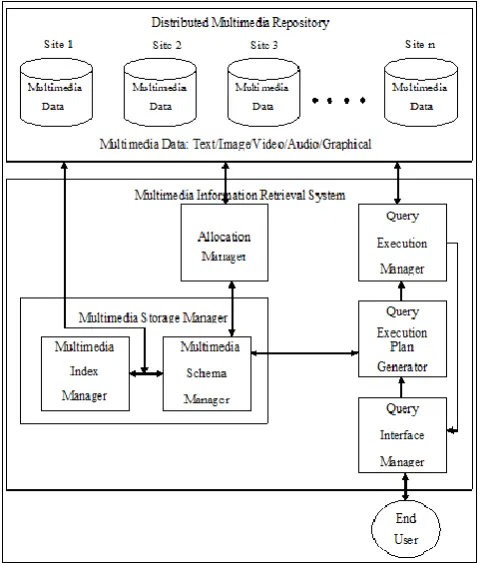
The architectural design of the proposed system is shown in Fig 1. The main components are Distributed Multimedia Repository and Multimedia Information Retrieval System. The Distributed Multimedia Repository consists of heterogeneous data that is stored at one or more sites in internet/intranet. The heterogeneous data comprises of text, image, video, audio and graphical elements. The Multimedia Information Retrieval system consists of the following components:
the logical structure of multimedia content.
Allocation Manager – Allocates multimedia data to one or more sites.
Multimedia Storage Manager – Manages indexes and schema information.
Query Evaluation Plan Generator – Prepares a query plan for user queries.
Query Execution Manager – Facilitates execution of query plan.
Query Interface Manager – Handles user input/output.
The above application involves efficient query processing strategies over media objects stored at one or more sites in a network/internet. Hence, the current work assumes significance in the context of heterogeneous queries. The types of query that can be specified for the above scenario are shown in Table I.
Fig 1: Architectural Design for Information Retrieval of Distributed Multimedia Data.
The end user can perform search over the distributed multimedia data using queries. The queries can be based on keyword or content. The following steps narrate the sequence of actions performed while processing a query given by the end user.
i. The Allocation Manager handles the data allocation based on user criteria, information provided by multimedia storage manager and distributed multimedia repository.
ii. The end user submits a query over multimedia data from the Query Interface Manager.
iii. The Query Execution Plan Generator references the multimedia storage manager and generates a query execution plan. It passes the query execution plan to Query Execution Manager.
iv. Query Execution Manager collaborates with Distributed Multimedia Repository and executes the user query. It returns the results to Query Interface Manager.
v. The end user accesses the query results through Query Interface Manager.
The semantic features of metadata are listed in Table I.
The architectural design for the above scenario can be depicted as shown in Fig 1.
VI. CONCLUSION
The current work deals with an architecture design that will significantly assist the multimedia designers in efficiently carrying out allocation, storage, indexing, searching and retrieval of multimedia data from distributed multimedia database. This design would considerably reduce the time complexity and cost effectiveness of the retrieval method. The primary goal of the proposed system is to improve the overall quality and efficiency of the retrieval process from distributed multimedia database.
REFERENCES
[1] Harald Kosch, “Distributed Multimedia Database Technologies
Supported MPEG-7 & by MPEG-21”, CRC Press LLC, 2004.
[2] Timothy K.Shih, “Distributed Multimedia Databases”, Idea Group
Publishing, 2003.
[3] Mitrović, Dalibor, Matthias Zeppelzauer, and Christian Breiteneder. "Features for content-based audio retrieval." Advances in computers 78: 71-150; 2010.
[4] Yong-Jin Liu ; Xi Luo ; Joneja, A. ; Cui-Xia Ma; “User-Adaptive
Sketch-Based 3-D CAD Model Retrieval”, Automation Science and
Engineering, IEEE , 2013.
[5] Abdalla, Hassan Ismail. "An efficient approach for data placement in distributed systems." Multimedia and Ubiquitous Engineering (MUE), 5th FTRA International Conference on, 2011.
[6] Stefan Ruger, “Multimedia Information Retrieval”, ISBN ebook,
[image:4.595.50.291.277.559.2][7] Ambika, P., and J. A. Samath. "Visual query exploration process and generation of voluminous Image database for CBIR Systems." Third International Conference.onComputing Communication &
Networking Technologies (ICCCNT), IEEE, 2012.
[8] Beecks, Christian, Tomáš Skopal, Klaus Schöffmann, and Thomas Seidl. "Towards large-scale multimedia exploration." InProceedings of the 5th International Workshop on Ranking in Databases (DBRank), pp. 31-33. 2011.
[9] Daras, Petros, Stavroula Manolopoulou, and Apostolos Axenopoulos. "Search and retrieval of rich media objects supporting multiple multimodal queries." IEEE Transactions onMultimedia,14, no. 3: 734 -746; 2012.
[10] Wang, Ju-Chiang, Meng-Sung Wu, Hsin-Min Wang, and Shyh-Kang Jeng. "Query by multi-tags with multi-level preferences for content- based music retrieval." IEEE International Conference onMultimedia and Expo (ICME), pp. 1-6, 2011.
[11] Christian Beecks, Merih Seran Uysal, Philip Driessen and Thomas Seidl “Content-Based Exploration of Multimedia Databases,” In Proceedings of 11th international workshop on content-based multimedia indexing (CBMI), Springer-Verlag, pp. 17-19, 2013. [12] Mohammed, Alaelddin, and Youan Jiang. "Evaluation of MPEG-7 audiovisual query applications.”, 13th International Conference on
Advanced Communication Technology (ICACT), pp. 670-673, 2011.
[13]Beecks, Christian, Sascha Wiedenfeld, and Thomas Seidl.
"Improving the efficiency of content-based multimedia exploration."
20th International Conference on - In Pattern Recognition (ICPR),
pp. 3163-3166, 2010.
[14] Presti, Liliana Lo, Stan Sclaroff, and M. L. Cascia. "Path modeling and retrieval in distributed video surveillance databases." IEEE Transactions onMultimedia,14, no. 2: 346-360, 2012.
[15] Huurnink, Bouke, Cees GM Snoek, Maarten de Rijke, and Arnold WM Smeulders. "Content-based analysis improves audiovisual archive retrieval." IEEE Transactions on Multimedia 14, no. 4: 1166-1178, 2012.
[16] Li, Shang-An, Shu-Yuan Chen, Songzhi Su, Der-Jyh Duh, and Shaozi Li. "Graphics/Image Retrieval Method." International Conference on Technologies and Applications of Artificial Intelligence (TAAI),, pp. 19-24, 2011.
[17] Pacharaney, Utkarsha S., Pritam S. Salankar, and Saradadevi Mandalapu. "Dimensionality reduction for fast and accurate video search and retrieval in a large scale database." International Conference on - In Engineering (NUiCONE), Nirma University, pp.1- 9,2013.
[18] An, Hyoung-Geun, and Jae-Jin Koh. "Semantic multi-layer metadata for image annotation." 6th International Forum on - In Strategic Technology (IFOST), vol. 2, pp. 1122-1124, 2011.
[19] Shankar, R. SHIVA, A. BALA Krishna, J. Rajanikanth, and CH SOMESWARA Rao. "Dept. of CSE, SRKR Eng. Coll., Bhimavaram, India." National Conference on Computing and Communication Systems (NCCCS), pp. 1-5, 2012.
[20] Mamaghani, Ali Safari, et al. "A novel evolutionary algorithm for solving static data allocation problem in distributed database systems." Second International Conference on Network Applications Protocols and Services (NETAPPS), 2010.
[21] Abdalla, Hassan Ismail. "An efficient approach for data placement in distributed systems." 5th FTRA International Conference on Multimedia and Ubiquitous Engineering (MUE) , 2011.
[22] Faheem, M. T., Amany Sarhan, and R. L. Ibrahem. "Fragmentation and allocation of object-oriented databases for simple attributes and complex methods: a cost-based technique." Information and Communications Technology, Enabling Technologies for the New Knowledge Society: TI 3rd International Conference onIEEE, 2005. [23] Mahmoudie, Rezvam, and Sa Eed Parsa. "Data Allocation in Distributed Data Base in the Network Using Modularization Algorithm." 12th International Conference on Computer Modelling and Simulation (UKSim), IEEE, 2010.
[24] Valle, Eduardo, Matthieu Cord, Sylvie Philipp-Foliguet, and David Gorisse. "Indexing personal image collections: a flexible, scalable solution." IEEE Transactions onConsumer Electronics, 56, no. 3: 1167-1175, 2010.
[25] Lagogiannis, G., Lorentzos, N., Sioutas, S., & Theodoridis, E. (2010). A time efficient indexing scheme for complex
Spatio-temporal retrieval. ACM SIGMOD Record, 38(3), 11-16, 2010.