Functorial Models for Petri Nets
1Roberto Bruni
Dipartimento di Informatica, Universit`a di Pisa, Italy E-mail: [email protected]
Jos´e Meseguer
Computer Science Laboratory, SRI International, Menlo Park, California E-mail: [email protected]
Ugo Montanari
Dipartimento di Informatica, Universit`a di Pisa, Italy E-mail: [email protected]
and
Vladimiro Sassone
Dipartimento di Matematica e Informatica, Universit`a di Catania, Italy E-mail: [email protected]
Received March 1, 2000
We show that although the algebraic semantics of place/transition Petri nets under the collective token philosophy can be fully explained in terms of strictly symmetric monoidal categories, the analo-gous construction under the individual token philosophy is not completely satisfactory, because it lacks universality and also functoriality. We introduce the notion of pre-nets to overcome this, obtaining a fully satisfactory categorical treatment, where the operational semantics of nets yields an adjunction. This allows us to present a uniform logical description of net behaviors under both the collective and the individual token philosophies in terms of theories and theory morphisms in partial membership equational logic. Moreover, since the universal property of adjunctions guarantees that colimit con-structions on nets are preserved in our algebraic models, the resulting semantic framework has good compositional properties. °C2001 Academic Press
Key Words: PT Petri nets; pre-nets; collective/individual token philosophy; monoidal categories; partial membership equational logic; configuration structures; concurrent transition systems.
INTRODUCTION
Petri nets, introduced by Petri in [29] (see also [32]), are one of the most widely used and evocative models for concurrency, because of the simple formal description of the net model and its natural characterization of concurrent and distributed systems. We will focus on place/transition Petri nets (PT nets). The extensive use of PT nets has given rise to different schools of thought regarding their semantical interpretation. In particular, there is an overall distinction between collective and individual
token philosophies (see, e.g., [13]). According to the collective token philosophy (CTph), net semantics should not distinguish between different instances of the idealized resources which are positioned
1This research has been partly supported by the Office of Naval Research Contracts N00014-95-C-0225, N00014-96-C-0114
and N00014-99-C-0198, by a National Science Foundation Grant CCR-9633363, and by the Information Technology Promotion Agency, Japan, as part of the Industrial Science and Technology Frontier Program ‘New Models for Software Architecture’ sponsored by NEDO (New Energy and Industrial Technology Development Organization). Also the research was supported in part by CNR Integrated Project Progettazione e Verifica di Sistemi Eterogenei Connessi mediante Reti di Comunicazione; by Esprit Working Groups CONFER2 and COORDINA; and by MURST project TOSCa: Tipi, Ordine Superiore e Concorrenza. The fourth author would like to thank BRICS, Centre of the Danish National Research Foundation for their support.
207
0890-5401/01 $35.00 Copyright°C2001 by Academic Press
at the same place, because any such instance (called a token) is operationally equivalent to all the others. This view chooses to ignore that operationally equivalent resources may have different origins and histories, carrying different causality information. Selecting one instance of a resource rather than another may be as different as being or not being causally dependent on some previous event, and this may well be information which one is not ready to discard, which is the point of view of the individual token philosophy (ITph). Of course, causal dependencies may influence the degree of concurrency in the computations, and therefore theCTphand theITphlead to different concurrent semantics.
The paper [21] proposed an algebraic approach to the analysis of concurrent net computations based on the observation that the monoidal structure of PT net states—multisets over the set of places form a free commutative monoid, where the monoidal operation is the multiset union and the unit is the empty multiset—can be lifted to transitions (and then to computations) in such a way that the suitably axiomatized terms of the new algebra yield an initial model for the concurrent semantics of the nets (according to theCTph). This construction respects the intuitive simulation morphisms between nets, when these are seen as graphs with structured nodes, as it can be expressed as a functor from the category
Petri of PT nets (as objects) and simulation morphisms (as arrows) to the category CMonCat of strictly
symmetric strict monoidal categories (as objects) and symmetric monoidal functors (as arrows), where computation models live. Moreover, when one considers the full subcategory of CMonCat consisting of categories whose objects are the elements of a free monoid, then the functorial construction of the concurrent model of computations is the left adjoint to an obvious forgetful functor. Thus, the universal properties of the adjunction guarantee the compositionality of the semantic framework: The semantics of all net compositions that can be expressed via colimit constructions in Petri (e.g., via pushouts) is given by taking the corresponding colimit in the category of models.
In this paper we investigate the operational, algebraic and logical aspects of PT nets under both the CTphand theITph, exploiting the features of the algebraic approach to establish formal relationships between different proposals. As in [21], an important feature of our comparison and integration of different approaches to Petri net semantics in both the collective and individual token philosophies is that we emphasize the functorial character of the different semantic constructions. This is important for at least two reasons. First, by defining the appropriate categories, we make explicit the associated morphisms, which correspond to appropriate notions of simulation or refinement between nets. Second, by seeking functorial constructions, we ensure that they behave properly not only on the objects, but also on the simulation maps, and, furthermore, by making such constructions adjunctions we achieve a high degree of modularity because of the colimit-preserving nature of left adjoints. The abstract formulation of the algebraic semantics facilitates its comparison with other proposals, providing helpful mathematical tools for net analysis. Moreover, several efficient languages have been developed that support algebraic specifications and hence can be used to manipulate and reason about semantics models automatically.
used to support both execution and reasoning on the models they characterize. For example, there are mechanical tools for manipulating and simplifying expressions that represent concurrent computations and which can test for equality automatically. Moreover, working at a theory level leads to quite simple descriptions and allows one to use standard results to prove the existence of adjunctions, e.g., a theory morphism from a theory of programs (i.e., nets) to a theory of models induces an obvious forgetful functor (in the reverse direction) between the categories of algebras associated with the theories, which has a left adjoint providing the free construction of models for programs. It also allows one to compare different models.
The Collective Token Philosophy
The algebraic net theory developed under theCTphis well established [11, 21] and we are going to use it directly in order to present a detailed understanding of the relationships among the computational, algebraic, and logical interpretations of theCTph.
Starting with classical token-game semantics, many behavioral models for Petri nets have been proposed that follow the collective token philosophy. In fact, there are too many to be systematically reviewed here. Among these, however, there is a relatively recent study by van Glabbeek and Plotkin based on configuration structures [13]. Clearly inspired by the domains of configurations of event
structures [36], configuration structures are simply collections of (multi)sets which, at the same time,
represent the legitimate system states and the system dynamics, i.e., the transitions between these states. One of the themes of this paper is a comparison of configuration structures with the algebraic model of [21], which adopts theCTphand provides a precise algebraic reinterpretation of yet anotherCTph model, namely, the commutative processes of Best and Devillers [3]. In particular, we observe that configuration structures are too abstract a model, i.e., that they make undesirable identifications of nets, and we conclude that strictly symmetric monoidal categories provide a superior model of net behavior. To better illustrate the differences between the two semantic frameworks mentioned above, we adopt
concurrent transition systems (CTS) as a bridge model. These provide a much more simplified version
of higher dimensional transition systems [9]. In fact we choose these systems as the simplest bridge models to best convey our ideas.
Concurrent transition systems resemble configuration structures, but they are more expressive. They also draw on earlier very significant models, such as distributed transition systems [18], step and PN transition systems [26], and local event structures [15]. Moreover, the equivalence of the behavioral semantics of concurrent transition systems and the algebraic semantics of monoidal categories can be stated very concisely.
As a first result of our research, in this paper we show that Best–Devillers commutative processes, the algebraic model of [21] based on monoidal categories, and the concurrent transition system behavioral model all coincide, in the precise sense of being related by equivalences of categories. We also show how the behavioral model provided by configuration structures is too abstract, but it is related to all the above models by a natural transformation that characterizes the identification of inequivalent nets and behaviors caused by configuration structures.
We then observe that the construction of the concurrent operational behavior formulated via com-mutative processes exactly corresponds (1) at a semantic level, to the universal constructionT( ) of a strictly symmetric (strict) monoidal category2(the arrows ofT(N ) represent the commutative processes of the net N ), and (2) at a logical level, to an adjunction induced by a suitable morphism between theories in PMEqtl.
Though the first observation is a well-known fact [11], the second point has only been outlined in [7] and is fully discussed in this paper. The features of PMEqtl (partiality, poset of sorts, membership assertions) offer a natural framework for the specification of categorical structures. For example, the sequential composition of arrows is a partial operation, and objects can be more easily modeled as a subsort of arrows, instead of using an injective embedding id . Moreover, a notion of tensor product for partial algebraic theories is used in [22] to obtain, among other things, an elegant definition of the theory of monoidal categories.
The Individual Token Philosophy
When theITphis assumed, it is more difficult to give a precise account of the relationships between the different interpretations. Building on the notion of process presented in [14], it has been shown that the semantics of a net can still be understood in terms of symmetric monoidal categories, but none of the proposed constructions work properly in the large, i.e., they fail to preserve at the semantic level some ordinary simulation morphisms between nets given at the level of theories (cf. [11, 34]; see [24] for an overview). As recalled above, the functoriality (and hence the lifting of simulation morphisms on nets to the level of computation models) is, on the other hand, an essential property for guaranteeing the compositionality of the semantic framework.
More precisely, a simple variation on the Goltz–Reisig processes, called concatenable processes, is introduced in [11]. Concatenable processes admit sequential composition and yield a symmet-ric monoidal category P(N ) for each net N , but their construction is not functorial. Indeed, for N and N0 two nets such that the structure of N can be embedded in that of N0, it may be the case that the concurrent behavior of N cannot be recovered from that of N0, because equivalent com-putations in N should now be distinguished when they are simulated as comcom-putations in N0 (see Example 1.1).
In [34] the situation is improved by introducing the notion of strongly concatenable processes as a slight refinement of concatenable processes, where a linear ordering is allocated to minimal and maximal places (whereas in concatenable processes, only instances of the same resource are ordered). Strongly concatenable processes can be expressed via a pseudo-functorQ( ), i.e., a mapping between categories that preserves identities and composition up to a natural isomorphism. In particular, the pseudo-functor Q( ) is a mapping of net morphisms to symmetric monoidal functors that strictly preserves identities. This construction is almost satisfactory, and indeed it extends to a functor from Petri, the category introduced in [21], to a quotient category of a suitable full subcategory of SSMC, the category of symmetric monoidal categories (as objects) and symmetric monoidal functors (as arrows); furthermore, it defines a left adjoint to a subcategory of such a quotient characterized by axiomatizing the role of transitions inQ(N ).
The main difficulty in extending this nice algebraic framework to theITphis that net morphisms in
Petri allow one to replace two different resources a and b by two possibly nondisjoint multisets u and
vin the target net in such a way that tokens in their union u+vcan be partitioned into u andvonly up to a certain degree of ambiguity, whereas theITphrequires a precise correspondence between the instances of such resources. In [34] this is solved by including information about the mappings of all the possible linear implementations of a multiset. That is, for each transition t : u →v, a basic arrow
t¯u,v¯: ¯u→v¯is introduced (and suitably axiomatized) in the semantic model, for any linearizations ¯u and ¯
v(i.e., strings of places) of multisets u andv. Although this settles the ambiguity problem, it gives a construction that, as mentioned above, is functorial only up to isomorphism, thus raising the need for a complex quotient operation.
We present an analogous construction centered on the notion of a pre-net. A pre-net can be thought of as a precise implementation of a net, where the abstract data structure of multisets is refined into a more concrete string structure, and where each transition t : u→vis simulated by one arbitrarily fixed (instead of all) linear implementation t¯u,v¯: ¯u→v¯for some linearizations ¯u and ¯vof u andv. Note that pre-nets have a different computational interpretation than phrase-structure grammars, since we do not distinguish between terminal and nonterminal symbols, and strings can be permuted before performing any step, i.e., ordinary grammars would only generate monoidal categories, without symmetries. Al-though abandoning multisets might at first appear unnatural to net enthusiasts, our formal approach to theITphbenefits from several good properties:
B All the pre-net implementations of the same net share the same semantic model, i.e., the semantics is independent of the choice of linearizations.
B Algebraic models of pre-nets are freely generated and therefore preserve colimit constructions on nets, adding compositionality to the framework.
B The semantic model for the implemented net given by the constructionQ( ) can be recovered from any pre-net implementation.
This means that the investigation of the behavioral, algebraic, and logical aspects of PT nets already de-veloped for theCTphcan be successfully extended to the individual token approach, using pre-nets rather than PT nets to accomplish a better categorical construction which fully supports an algebraic viewpoint. By using PMEqtl techniques, we are able to formalize the construction as the free construction associated with a straightforward theory morphism from the theory of pre-nets to the theory of sym-metric monoidal categories. Finally, theory morphisms can be exploited to reconcile theITphview of pre-nets and theCTphview of PT nets, in the sense that, starting from the category of pre-nets, one can either view them as PT nets and take theCTphsemantics or take the ITphsemantics and then forget about causality information, always obtaining the same result. Note that, from the property of theory morphisms, this result holds not only at the object level (as was shown in [11] for the construc-tionsT( ) andP( )), but also at the arrow level, resulting in a commuting square of adjunctions (see Proposition 4.10).
Origin and structure of the paper. This paper improves and slightly extends our earlier research in [7, 8], regarding both collective and individual token philosophies, thus providing a structured and uniform presentation of all concepts and details of both philosophies.
In Section 1 we look at the basic definitions of PT nets, explain the distinction between their two computational interpretations (individual vs. collective), and summarize the approaches presented in the literature to accommodate these two views. The corresponding two semantics given in the literature are presented in Sections 1.1 and 1.2, respectively.
Section 2 compares configuration structures, monoidal categories, and concurrent transition systems. Section 3 introduces pre-nets, defining their algebraic semantics and the relationship with ordinary PT nets. In Section 4 we employ PMEqtl to formalize the logical aspects of both PT net and pre-net semantics, reconciling the two views. The basics of partial membership equational logic and the tensor product construction of theories are covered in the Appendix to make the paper practically self-contained.
1. PT NETS
Place/transition Petri nets, the most widespread flavor of Petri nets, are graphs with distributed states described by (finite) distributions of resources (tokens) in places. These are usually called markings, and are represented as multisets u : S→N, where u(a) indicates the number of tokens that place a carries in u. To some extent, places can be seen as the different types of usable resources.
We shall useµ(S) to indicate the set of finite multisets on S, i.e., multisets that yield a zero on all but finitely many a ∈ S. Multiset union, which we denote by+with (u+v)(a) = u(a)+v(a) for any place a, makesµ(S) a free commutative monoid on S (whose unit is the empty multiset, denoted byØ).
DEFINITION1.1. A place/transition Petri net (PT net) is a tuple N =(∂0, ∂1,S,T ), where S is a set of places, T is a set of transitions, and the functions∂0, ∂1: T →µ(S) assign, respectively, source and target to each transition.
Informally,∂0(t) prescribes the minimum amount of resources needed to enable the transition t, whilst ∂1(t ) describes the resources that the occurrence of t contributes to the overall state. This is made explicit in the following definition, where we shall indicate multiset inclusion and difference by, respectively,
⊆and−, where u⊆vif u(a)≤v(a) for any place a andv−u is only defined when u⊆vand returns the unique multiset u0such thatv=u+u0.
DEFINITION1.2. Let u andvbe markings, and let X : T→Nbe a finite multiset of transitions in a net N . We say that u evolves tov under the step X , in symbols u [Xi v, if the transitions in X are concurrently enabled at u, i.e.,Pt∈T X (t)·∂0(t )⊆u, and
v=u−X
t∈T
X (t )·∂0(t )+X t∈T
X (t )·∂1(t).
FIGURE 1
PT nets are often taken together with an initial state: a marked PT net N is a PT net (∂0, ∂1,S,T )
together with an initial marking u0∈µ(S). In order to equip PT nets with a natural notion of morphism, we consider maps of transition systems that preserve the monoidal structure of states.
DEFINITION1.3. A net morphism from N =(∂0, ∂1,S,T ) to N0=(∂0, ∂0 1,0 S0,T0) is a pair f = hft, fpi where ft: T →T0is a function, and fp:µ(S)→µ(S0) is a monoid homomorphism such that∂i0◦ ft=
fp◦∂i, for i=0,1. A morphism of marked nets is a morphism of nets such that fp(u0)=u00.
To shorten the notation we will omit the subscripts from morphism components. We use Petri (respectively Petri∗) to indicate the category of (respectively marked) PT nets and their morphisms, with the obvious componentwise composition of arrows.
Several different proposals of net morphisms can be found in the literature that give rise to different categories of nets, e.g., [1, 5, 6, 26]. Comparing these categories to Petri is not so straightforward, and we cannot address here the question as to whether and to what extent our results would fit in with these choices. We limit ourselves to remarking that our morphisms follow the two main alge-braic approaches to nets—namely Winskel’s [35] and Meseguer-Montanari’s [21]—and their strength lies in their naturality, which stems directly from viewing nets as algebras and graphs at the same time.
To compare the effects of collective and individual token philosophies on observing causal relations between fired transitions, let us consider the example in Fig. 1, adapted from [13]. (As usual, boxes stand for transitions, circles for places, dots for tokens, and weighted oriented arcs represent the functions∂0 and∂1.) Both transitions t and t0are enabled in the initial marking{a,b,c}, but observe that the firing of
t produces a second token in place b. According to theITph, it makes a difference whether t0consumes the token in b originated from the firing of t , or the one coming from the initial marking. In the first case the occurrence of t0causally depends on that of t , whereas in the second case the two firings are independent. In theCTph, instead, the two firings are always taken as concurrent, because the firing of
t does not affect the enabling condition of t0.
1.1. Collective Token Semantics
Several interesting aspects of Petri net theory can be profitably developed within category theory; see, e.g., [5, 21, 35]. We focus on the approach initiated in [21] (other relevant references are [11, 23, 24, 33, 34]) which reveals the monoidal structure of Petri nets under the operation of parallel composition. In [11, 21] it is shown how the sets of transitions can be endowed with appropriate algebraic structures in order to capture some basic constructions on nets. In particular, the commutative processes of Best and Devillers [3]—or equivalently, step and firing sequences up to diamond transformation equivalence— which represent the natural behavioral model for PT nets under the collective token philosophy, can be characterized by adding a functorial sequential composition on the monoid of steps, thus giving a strictly symmetric monoidal categoryT(N ) (it is called strictly symmetric because the monoidal operation is commutative).
Denoting by CMonCat the category of strictly symmetric monoidal categories (as objects) and monoidal functors (as arrows),T( ) extends to a functor from Petri to CMonCat.
Remark. All the functors that we present, from a category of nets to a category of models (viewed as suitable monoidal categories) are faithful but not full, as is common in the construction of free models. For example, the functorT( ) is faithful but not full, since in CMonCat transitions can be mapped to computations (giving the so-called implementation morphisms [21]), whereas in Petri transitions can only be mapped to transitions.
TABLE 1 Inference Rules forT(N ) u∈µ(SN)
idu: u→u∈T(N )
t∈TN, ∂0(t)=u, ∂1(t)=v
t: u→v∈T(N )
α: u→v, β: u0→v0∈T(N )
α⊕β: u+u0→v+v0∈T(N )
α: u→v, β:v→w∈T(N )
α;β: u→w∈T(N )
they must be satisfied by all arrowsα,α0,β,β0,δ(that can be composed correctly) and all multisets u andv.
The intuition here is that objects are multisets of places, arrows are step sequences, and arrow composition is their concatenation, whereas the monoidal operator ⊕ allows such sequences to be composed in parallel. It turns out that this algebraic structure describes precisely the processes `a la Best and Devillers.
PROPOSITION1.1 (cf. [21]). The presentation ofT(N ) given above precisely characterizes the algebra
of commutative processes of the PT net N,i.e.,the (equivalence classes of ) arrows inT(N ) are in
bijective correspondence with the commutative processes of N , and the correspondence commutes with the operation of the algebra, defining a homomorphism.
In other words, if we denote byCP(N ) the monoidal category whose objects are multisets of places and whose arrows are the commutative processes of N , thenCP(N ) andT(N ) are isomorphic in CMonCat. Moreover, if one considers the full subcategory of CMonCat consisting of categories whose monoids of objects are freely generated, then there is an obvious forgetful functor from this subcategory to Petri, which is a right adjoint toT( ).
When we are interested in marked nets, by analogy with Petri∗, we take a pointed category (C,c0) to be a category C together with a distinguished object c0 ∈C. Similarly, a pointed functor from (C,c0) to (D,d0) is a functor F : C→D which maps the distinguished object c0to the distinguished object d0. Then, when CMonCat∗is used to denote the category of pointed strictly symmetric monoidal categories and their pointed functors, the previous construction extends immediately to a functorT∗(N ) : Petri∗ →
CMonCat∗, such that for N =(∂0, ∂1,S,T,u0) a marked PT net, then
T∗(N )=(T(∂0, ∂1,S,T ),u0).
As an alternative proposal for representing the behavior of nets according to theCTph, in the same paper where they introduce the distinction between collective token and individual token philosophy, van Glabbeek and Plotkin define configuration structures. These are structures inspired by event struc-tures [36] whose dynamics are uniquely determined by an explicitly given set of possible configurations of the system. However, the structures that they end up associating with nets are not exactly config-uration structures. They enhance them in two ways: first, by considering multisets instead of sets of occurrences, and second, by using an explicit transition relation between configurations. While the first point can be handled easily, as we do below, the second one seems to compromise the basic ideas underlying the framework and to show that configuration structures do not offer a faithful representation of the concurrent behavior of nets.
DEFINITION1.4. A configuration structure is given by a set E and a collection C of finite multisets over the set E. The elements of E are called events and the elements of C configurations.
TABLE 2 Axioms forT(N )
Neutral idØ⊕α=α
Commutativity α⊕β=β⊕α
The idea is that an event is an occurrence of an action the system may perform and that a configuration
X represents a state of the system, which is determined by the collection X of occurred events. The set C of admissible configurations yields a relation representing how the system can evolve from one state
to another.
DEFINITION1.5. Let (E,C) be a configuration structure. For X , Y in C we write X→Y if
(1) X⊂Y ,
(2) Y −X is finite,
(3) for any multiset Z such that X ⊂Z ⊂Y , we have Z ∈C.
The relation→is called the step transition relation.
Intuitively, X→Y means that the system can evolve from state X to state Y by performing the events
in Y−X concurrently. To stress this we shall occasionally write X →L Y , with L=Y−X . Observe that
the last condition essentially means that the events in Y−X can be performed concurrently if and only if
they can be performed in any order. In our opinion, this requirement embodies an interleaving-oriented view, as it reduces concurrency to nondeterminism. As we explain below, we view this as the main weakness of configuration structures.
In the following definition we slightly refine the notion of net configuration proposed in [13], since the original definition may improperly include multisets of transitions that cannot be fired from the initial marking.
DEFINITION1.6 (From PT nets to configuration structures). Let N =(∂0, ∂1,S,T,u0) be a marked PT net. A finite multiset X of transitions is called fireable if a partition X1, . . . ,Xn of X exists such that u0 [X1i u1. . .un−1 [Xniun is a step sequence. A configuration of N is a fireable multiset X of transitions. The configuration structure associated with N iscs(N )=(T,CN), where CN is the set of configurations of N .
It follows that for each configuration X the function uX: S→Zgiven by
uX =u0+ X
t∈T
X (t )·∂1(t )−X t∈T
X (t )·∂0(t )
is a (reachable) marking; i.e., 0≤uX(a) for all a∈S. Moreover, if X is a configuration and uX [Uiv, then X+U is also a configuration andv=u(X+U ).
Generally speaking, if N is a pure net, i.e., a net with no self-loops, thencs(N ) can be considered a reasonable semantics for N . Otherwise, as observed also in [13], it is not a good idea to reduce N to
cs(N ). Consider, for example, the marked nets N and M of Fig. 2. They have very different behaviors. In fact, in N the actions t0and t1are concurrent, whereas in M they are mutually exclusive. However, since in M any interleaving of t0and t1is possible, the diagonalØ→ {t0,t1}sneaks into the structure by definition. As a result, both N and M yield the configuration structure represented in Fig. 3, even though{t0,t1}is not an admissible step for M. The limit case is the marked net consisting of a single self-loop: readers can check for themselves that, according tocs( ), it can fire arbitrarily large steps.
These problems have prompted us to look for a similar semantic framework that represents net behaviors more faithfully than configuration structures. The key observation is that there is nothing
FIG. 3. The configuration structurecs(N )=cs(M) for the nets N and M.
wrong with the assumption that if a step involving many parallel actions can occur in a certain state, then all the possible interleaving sequences of those actions can also occur from that state. The problematic bit is assuming the inverse implication, because it actually reduces concurrency to nondeterminism and makes the set of configurations uniquely determine the transition relation. Our proposed solution is the notion of concurrent transition systems, which will be discussed in Section 2.
1.2. Individual Token Semantics
Since theITphmakes a distinction between resources in the same class that have different origins and histories, it is well supported by the process-based approach. Ideally, (deterministic) processes are computations that carry some explicit causal information between transition firings (called events). This corresponds to an abstract view of processes as posets whose elements are labeled by transitions of the net [27, 35, 36], i.e., as pomsets. Concretely, such computations are represented by suitable, structure-preserving maps from a special class of nets in the net under inspection. The role of such maps is to disambiguate different firings of the same transition, and, at the same time, to give a precise account of the causal and distributed nature of the computations they represent.
DEFINITION 1.7. A process net (also called deterministic occurrence net) is a finite, acyclic net
P=(∂0, ∂1,S,T ) such that for all t∈T ,∂0(t ) and∂1(t ) are sets (as opposed to multisets), and for all
t0 6=t1∈T ,∂i(t0)∩∂i(t1)=Ø, for i =0,1.
DEFINITION1.8. A process of N ∈ Petri is a morphismπ: P → N , where P is a process net and π is a net morphism which maps places to places (as opposed to more general morphisms which map places to markings).
Two processesπ: P→N andπ0: P0→N are isomorphic, and thus identified, if a net isomorphism
ψ: P→P0exists such thatπ=ψ;π0. We shall use O(P) and D(P) to denote the minimal (i.e., with em-pty pre-set) and maximal (i.e., with emem-pty post-set) places of a process net P. (O stands for origins, D for destinations.) For a processπ: P→N , the multisetπ(O(P)) (withπ(O(P))(a)= |π−1(a)∩O(P)|, for each place a ∈ N ) represents the resources available to N before the execution ofπ, and we can similarly defineπ(D(P)) as those resources available in N when the execution ofπis completed.
Two processes for the (marked) net of Fig. 1 are represented by the mappingsπ0 andπ1from the process nets P0and P1 in Fig. 4, where dotted arrows show the images of places and transitions (for readability, we omit the names of the elements of P0and P1).
Since processes represent computations, it is natural to seek a notion of a sequential composition of those processesπandπ0withπ(D(P))=π0(O(P0)), that is,π0starts from the markingπterminates
[image:9.612.100.345.579.676.2]in. There can be several ways to do this, each corresponding to a different assignment of instances of the same place between D(P) and O(P0). To overcome this ambiguity, concatenable processes were introduced in [11] by imposing a total ordering of origins and destinations that are instances of the same place.
DEFINITION1.9. Given a labeling function l : X→Y , a label-indexed ordering function for l is a familyβ= {βy}y∈Yof bijections indexed by the elements of Y , whereβy: l−1(y)→ {1, . . . ,|l−1(y)|}.
The idea is that Y is the set of places of a given net N , while X is (a subset of ) the set of places of a processπfor N such that l coincides withπon X . Then, for each place y in Y , we consider its inverse image through l, given by the set l−1(y)= {x∈ X |l(x)= y}. Basically, eachβ
yyields a total order over the elements in l−1(y) by stating a (bijective) correspondence with their positions in the ordering.
DEFINITION1.10. A concatenable processθfor a PT net N is a triple (π, `O, `D), whereπ: P→N is a process for N and`O,`Dare label-indexed ordering functions for the labeling functionπrestricted to O(P) and D(P), respectively.
A partial operation ; (associative and with identities) of concatenation can be defined for concaten-able processes. They also admit a monoidal parallel composition ⊗ , yielding a symmetric monoidal category whose symmetries are given by concatenable processes consisting only of places—see [11] for the formal definitions of such operations.
We saw in Section 1.1 that the definition of commutative processes can be nicely expressed via a categorical adjunction. Under theITph, one might expect some analogous results to hold between symmetric monoidal categories and concatenable processes. We recall in fact that symmetric monoidal categories possess some auxiliary arrows called symmetries that can model the possible reorganization of minimal and maximal places of a process. It is worth noting that, in concatenable processes, the ordering of minimal and maximal places is only imposed on instances of the same place. We recall here the definition of the categoryP(N ) introduced in [11] and finitely axiomatized in [33].
DEFINITION1.11. Let N be a PT net. The categoryP(N ) is the monoidal quotient of the free symmetric monoidal categoryF(N ) generated by N , modulo the axioms
γa,b =i da⊗i db if a,b∈SN, and a6=b
s; t; s0=t if t∈TNand s,s0are symmetries,
whereγ, , id , ⊗ , and ; are, respectively, the symmetry isomorphism, the identities, the tensor product, and the composition ofF(N ) (see Table 3).
We note that inF(N ) the tensor product is not commutative and the symmetries satisfy the naturality axiom
(α⊗α0);γv,v0 =γu,u0; (α0⊗α) (1)
for all arrowsα: u→vandα0: u0→v0and also the MacLane coherence axioms [19]
γu,v;γv,u =i du+v (2) γu,v+v0 =(γu,v⊗i dv0); (i dv⊗γu,v0) (3)
TABLE 3 Inference Rules forF(N ) u∈µ(SN)
idu: u→u∈F(N )
u,u0∈µ(SN)
γu,u0: u+u0→u0+u∈F(N )
t∈TN, ∂0(t )=u, ∂1(t)=v
t : u→v∈F(N )
α: u→v, β: u0→v0∈F(N )
α⊗β: u+u0→v+v0∈F(N )
α: u→v, β:v→v0∈F(N )
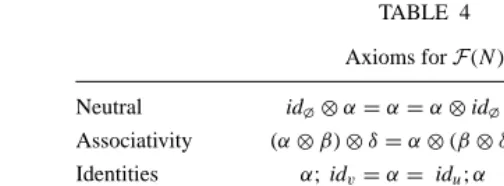
TABLE 4 Axioms forF(N ) Neutral idØ⊗α=α=α⊗idØ
Associativity (α⊗β)⊗δ=α⊗(β⊗δ) (α;β);δ=α; (β;δ) Identities α; idv=α= idu;α idu⊗ idv= idu+v Functoriality (α;β)⊗(α0;β0)=(α⊗α0); (β⊗β0)
Naturality (α⊗α0);γv,v0=γu,u0; (α0⊗α)
Coherence γu,v+v0=(γu,v⊗i dv0); (i dv⊗γu,v0) γu,v;γv,u=i du+v
for all markings u,v, andv0. Notice that from these axioms the equationγu,Ø=i ducan also be easily inferred, since the tensor product ofF(N ) is strict. For the reader’s convenience, the axioms ofF(N ) are gathered in Table 4.
Though the constructionP(N ) precisely characterizes the concatenable processes of N (asT(N ) characterizes commutative processes), it lacks functoriality, as shown by the following example.
EXAMPLE1.1. Consider the nets N and N0shown in Fig. 5 and the net morphism f : N → N0such that f (ti) =ti0, f (ai) =a0, and f (bi)=bi0, for i ∈[0,1]. The morphism f cannot be extended to a monoidal functorP( f ) :P(N )→P(N0). In fact, if such an extension F existed, then
F (t0⊗t1)=F (t0)⊗F (t1)=t00⊗t10
F (t1⊗t0)=F (t1)⊗F (t0)=t10⊗t00
by the monoidality of F , but sinceγa0,a1 =i da0⊗i da1andγb0,b1 =i db0⊗i db1 inP(N ) (by the first
axiom in Definition 1.11), then
t0⊗t1=(t0⊗t1);γb0,b1=γa0,a1; (t1⊗t0)=t1⊗t0
inP(N ) (by the naturality ofγ). Thus, it would follow that t00⊗t10=t10⊗t00inP(N0), which is absurd becauseγa0,a06=i da0⊗i da0.
The problem is of course due to the fact that, when two different places a0and a1are mapped onto the same place a0via a net morphism, then it should be the case thatγa,b =i da⊗i dbis mapped onto γa0,a0 6=i da0⊗i da0 via a monoidal functor that extends such a net morphism, which is not possible. Therefore, concatenable processes are still not completely satisfactory, because several net morphisms cannot be lifted to a behavior level.
To improve such a situation, the notion of strongly concatenable processes was introduced in [34], where a total order is imposed on origins and destinations and not only on the instances of the same place. Strongly concatenable processes also admit a sequential and parallel composition, yielding a symmetric monoidal category.
DEFINITION1.12. A strongly concatenable process for a PT net N is a triple (π, `O, `D), where π: P→N is a process for N , while the labeling functions`O: O(P)→ {1, . . . ,|O(P)|}and`D: D(P)→
[image:11.612.94.346.56.149.2]{1, . . . ,|D(P)|}are bijections.
The pseudo-functorial constructionQ( ) : Petri→SSMC of [34], recovering strongly concatenable
processes, improves the situation, in the sense that it strictly preserves identities and composition only up to a monoidal natural isomorphism (details in [34]).
DEFINITION1.13. Let N be a PT net. The categoryQ(N ) is obtained from the symmetric monoidal category freely generated from the places of N and, for each transition t : u→vof N , arrows t¯u,v¯: ¯u→v¯ for each pair of linearizations (as strings) of the pre- and post-sets of t , by quotienting modulo the axiom
s; t¯u,v¯; s0=t¯u0,v¯0 for s : ¯u0→¯u and s0: ¯v→v¯0symmetries. (4)
Our point in this paper is that functoriality is lacking in these constructions because PT nets rely on a “state as multiset” paradigm, whereas theITphimposes a distinction between different instances of the same resource. Hence, as a solution to this problem, we propose a refined view of nets, so that the associated notion of morphism behaves better w.r.t. the construction of the category of processes.
The paradigm we propose is called pre-net and is presented in Section 3.
2. A COMPARISON OF COLLECTIVE TOKEN SEMANTICS
The analysis of configuration structures suggests seeking a model that enforces the existence of all appropriate interleavings of steps, without allowing this to completely determine the set of transitions. Several such models appear in the literature. Among those that inspired us the most were distributed transition systems [18], step transition systems [26], PN transition systems [26], and higher dimensional transition systems [9]. Also closely related are the local event structures of [15], a model that extends event structures (rather than transition systems) by allowing the firing of sets (but not multisets) of events. Drawing on all of these, here we have chosen the simplest definition to suit our current aims.
DEFINITION2.1. A concurrent transition system (CTS) is a structure H =(S,L, trans,s0), where
S is a set of states, L is a set of actions, s0∈ S is the initial state, and trans⊆S×(µ(L)− {Ø})×S is a set of transitions such that:
(1) if (s,U,s1),(s,U,s2)∈ trans, then s1=s2,
(2) if (s,U,s0)∈ trans and U1, U2is a partition of U , thenv1, v2∈ S exist such that (s,U1, v1), (s,U2, v2),(v1,U2,s0),(v2,U1,s0)∈ trans.
Condition (1) above states that the execution of a multiset of labels U in a state s deterministically leads to a different state, as this reflects our view of actions as transitions. The second condition guarantees that all the possible interleavings of the actions in U are possible paths from s to s0if (s,U,s0)∈ trans.
Notice that, by (1), the statesv1andv2of (2) are uniquely determined.
We formalize the idea that different paths which are different interleavings of the same concurrent step can be considered equivalent.
DEFINITION2.2. A path in a CTS is a sequence of contiguous transitions
(s,U1,s1)(s1,U2,s2)· · ·(sn−1,Un,sn).
A run is a path that originates from the initial state.
DEFINITION2.3. Given a CTS H , adjacency is the least reflexive, symmetric, binary relation↔Hon the paths of H which is closed under path concatenation and such that (s,U1,s1)(s1,U2,s2) ↔H (s,U1+U2,s2). Then, the homotopy relation↔−H on the paths of H is the transitive closure of↔H. The equivalence classes of runs of H with respect to the homotopy relation are called computations. The computation associated with a generic runπis denoted by [π]↔−H.
DEFINITION2.4. A CTS is uniform if all its states are reachable from the initial state and the unions of the actions along any two cofinal runs yield the same multiset, where cofinal means ending in the same state.
In a uniform CTS H=(S,L, trans,s0) each state s can be associated with the multiset of actions on any run to s. Precisely, we shall useςsto indicate
Pn
i=1Ui, for
(s0,U1,s1)(s1,U2,s2)· · ·(sn−1,Un,s)
a run of H .
The length of any runπ ending in s is denoted by len(π) and is defined as equal to the cardinality ofςs. By condition (2) in Definition 2.1, it follows that for each runπ there always exists at least one homotopic run consisting of exactly len(π) sequential transitions. Observe also that uniform CTSs must be acyclic, because any cycle (s,U0,s1)· · ·(sn,Un,s) would imply the existence of runs to s carrying different actions. In the rest of the paper, we shall consider only uniform concurrent transition systems. Introducing the natural notion of computation-preserving morphism for CTSs, we define a category of uniform CTSs. In the following, for functions f : A → B, we denote by fµ:µ( A) → µ(B) the unique multiset homomorphism extending f ; i.e., fµ(X )(b)=Pa∈f−1(b)X (a).
DEFINITION2.5. For H1 and H2 CTS, a morphism from H1 to H2 consists of a map f : S1→S2 that preserves the initial state and a function α: L1→L2 and such that (s,U,s0) ∈ trans1 implies ( f (s), αµ(U ), f (s0))∈ trans2.
We denote by CTS the category of uniform CTSs (as objects) and their morphisms (as arrows).
DEFINITION2.6 (From PT Nets to CTSs). Let N =(∂0, ∂1,S,T,u0) be a marked PT net. The con-current transition system associated with N is
ct(N )=(MN,T, transN,Ø),
where MNis the set of fireable multisets of transitions of N and
(X,U,X0)∈ transNif and only if uX [UiuX0.
(Recall that uX: S→Zis by definition a reachable marking.)
Although this construction is formally very close to the one proposed for configuration structures, the difference is that a CTS does not enforce diagonals to fill the squares: these are introduced if and only if the associated step is actually possible (see Fig. 6).
We give a precise categorical characterization of the representations of nets in the CTS framework in Section 2.1. For the time being, we note the following.
PROPOSITION2.1. ct( ) is a functor from Petri∗to CTS.
[image:13.612.86.358.590.678.2]Proof. The mapping ct( ) is already defined on objects. Let f : N→N0be a marked net morphism. Then ct( f ) is defined as f on the labels of ct(N ) and as ftµon the states of ct(N ). In fact it is easy to
verify that the image through ftµof each fireable multiset X in N is also a fireable multiset in N0. It is obvious that ct( ) preserves morphism composition and identities.
Although all cofinal runs of a CTS carry the same multiset of actions, not all such runs are homotopic, i.e., they do not necessarily represent the same computation. The enforcement of this condition is the purpose of the next definition.
DEFINITION2.7. An occurrence concurrent transition system is a concurrent transition system H in which all pairs of cofinal transitions
(s1,U1,s),(s2,U2,s)∈ transH
are the final steps of homotopic runs.
It can be shown that the previous definition implies the following property.
PROPOSITION2.2. All cofinal runs of an occurrence CTS are homotopic.
Proof. We proceed by contradiction. Letπ1 andπ2 be two nonhomotopic cofinal runs of an oc-currence CTS and let n be their minimum length, withπ1andπ2such that for any two nonhomotopic cofinal runsπ10andπ20whose minimum length is m we have n ≤m. We can assume, without loss of
generality, that len(π1)=n. If n=0 thenπ1andπ2are empty paths, thus contradicting the hypothesis. If n>0 thenπ1 =π10(s1,{l1},s) andπ2=π20(s2,{l2},s) for some shorter runsπ10andπ20. If s1 =s2 then l1=l2andπ10is homotopic toπ20, because the minimum of their lengths is n−1. But this would imply thatπ1↔− π2, thus contradicting the hypothesis. Hence we must have s16=s2. By the definition of occurrence concurrent transition systems, we know that two runsπ3andπ4exist leading to s1and s2 re-spectively, such thatπ3(s1,{l1},s) is homotopic toπ4(s2,{l2},s) and thus len(π4)= len(π3). Moreover, it must be the case thatπ10↔− π3, because len(π10)< len(π1). Therefore, len(π3)= len(π10)=n−1 and π0
2 ↔− π4, otherwise we would contradict the hypothesis of minimality for n. From the closure prop-erties of↔− we have of course thatπ10(s1,{l1},s)↔− π3(s1,{l1},s) andπ20(s2,{l2},s)↔− π4(s2,{l1},s). By the transitivity of↔− we therefore haveπ1↔− π2, contradicting the hypothesis and concluding the proof.
Figure 7 illustrates the proof of Proposition 2.2.
We shall use oCTS to indicate the full subcategory of CTS consisting of occurrence CTSs. Clearly, a uniform CTS can be unfolded into an occurrence CTS.
DEFINITION2.8 (From CTSs to occurrence CTSs). Let H =(S,L, trans,s0) be a concurrent tran-sition system. Its unfolding is the occurrence concurrent trantran-sition systemO(H )=(S0,L, trans0, ²), where S0is the collection of computations of H and
trans0= {([π]↔−,U,[π0]↔−)| ∃s,s0∈S, [π0]↔−∈S0, π0↔−Hπ(s,U,s0)}.
[image:14.612.181.264.574.678.2]This makes oCTS a coreflective subcategory of CTS.
PROPOSITION2.3. The constructionO( ) extends to a right adjoint to the inclusion of oCTS in CTS.
Proof. For H a concurrent transition system, we take the CTS morphismεH:O(H ) → H that maps each [π]↔−∈SO(H ) to its final state s∈SH. It is easy to verify that this forms the counit of the adjunction.
2.1. Concurrent Transition Systems and Monoidal Categories
In this section we look at the faithfulness of the CTS representation of nets, as given in Definition 2.6, with respect to the collective token philosophy. To accomplish this aim, we show that both the ct( ) and theT( ) constructions yield two equivalent categories of net behaviors.
Regarding the monoidal approach, the obvious choice is to take the comma category ofT(N ) with respect to the initial marking, thus yielding a category whose objects are the commutative processes of N from its initial marking. An arrow from process p to process q is then the unique commutative process r such that p; r =q inT(N ). We denote the resulting category by (u0↓T(N )).
An analogous construction can be defined starting from ct(N ). The first step is to observe that the paths of a generic CTS under the homotopy relation define a category.
DEFINITION2.9. For H =(S,L, trans,s0) a CTS, we define the category of computations of H to be the categoryC(H ) whose
F objects are computations [π]↔− of H ,
F arrows are the homotopy equivalence classes of paths in H such that
[ψ]↔−: [π]↔− →[π0]↔− iffπ0↔−Hπψ,
F composition is defined as the homotopy class of path concatenation, i.e.,
[ψ]↔−; [ψ0]↔− =[ψψ0]↔−,
F identity arrow at [π]↔− is²[π]↔−, the homotopy class of the empty path at the final state ofπ.
This construction extends easily to a functorC( ) from CTS to Cat, the category of (small) categories and functors, yielding a functor C(ct( )) from Petri∗ to Cat. Observe also thatC( ) factors through O: CTS→oCTS via the obvious path construction.
THEOREM2.1. Let N be a marked PT net with initial marking u0. Then, the categoriesC(ct(N )) and (u0↓T(N )) are isomorphic.
Proof. We sketch the definition of functors
F: (u0↓T(N ))→C(ct(N )) and G:C(ct(N ))→(u0↓T(N ))
that are inverses to each other. The functorFmaps an object of the comma category to the homotopy class of any of the object’s interleavings (which is well defined because of the diamond equivalence of [3]). Its action on morphisms is analogous.
On the other hand, for a computation [π]↔− inC(ct(N )), starting from the initial marking we can uniquely determine the corresponding arrow on T(N ) and therefore define the action of Gon both objects and arrows.
The categories of computations for the concurrent transition systems associated with nets N and
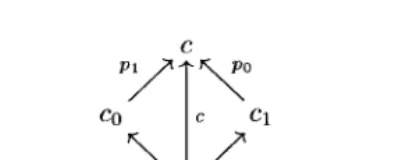
M in Fig. 2 are shown in Fig. 8, where we use c0 and c1 to denote, respectively, the computations [(Ø,{t0},{t0})]↔−, and [(Ø,{t1},{t1})]↔− in both ct(N ) and ct(M). Analogously, p1and p0indicate re-spectively the homotopy classes of the paths [({t0},{t1},{t0,t1})]↔−and [({t1},{t0},{t0,t1})]↔−. However,
c0; p1 and c1; p0yield the same result c =[(Ø,{t0,t1},{t0,t1})]↔− inC(ct(N )), whereas inC(ct(M)) they denote two different objects:
c0=[(Ø,{t0},{t0})({t0},{t1},{t0,t1})]↔−, and
FIG. 8. The categoriesC(ct(N )) andC(ct(M)) for the nets in Fig. 2.
2.2. Configuration Structures and Concurrent Transition Systems
In this section we first give a categorical structure to the class of configuration structures and then show that the obvious injection of configuration structures in CTS yields a reflection.
DEFINITION2.10. Given two configuration structures (E1,C1) and (E2,C2), a cs-morphism from (E1,C1) to (E2,C2) is a function g : E1→E2such that for each configuration X∈C1, then gµ(X )∈C2. We denote by CSCat the category of configuration structures (as objects) and cs-morphisms (as arrows).
The obvious injection functorJ( ) from CSCat to CTS maps a configuration structureCS =(E,C)
onto the concurrent transition system
J(CS)=(C,E, transCS,s0),
where transCS = {(X,L,Y ) | X L
→ Y}, and maps a cs-morphism g: E1 → E2onto the morphism (g0,g), where g0: C1→C2is the obvious extension gµof g to multisets, with a domain restricted to C1.
THEOREM2.2. The functorJ( ): CSCat→CTS has a left adjointR( ): CTS→CSCat. Moreover,
since the counit of the adjunction is the identity,J( ) andR( ) define a reflection.
Proof. We sketch the proof, giving the precise definition of the reflection functor. The reflection functorR( ) maps a uniform CTS H = (S,L, trans,s0) onto the configuration structureR(H ) = (L,CS) such that CS = {ςs|s∈S}(recall thatςsis the multiset union of the actions of any run leading to s).
We denote byρH: H→J(R(H )) the component at H of the unit of the adjunction.
THEOREM 2.3 (Configuration Structures via CTSs). Let N be a marked PT net. Then cs(N ) = R(ct(N )).
Proof. The events of cs(N ), the actions of ct(N ), and, therefore, the events ofR( ct(N )) are the transitions of N . The states S of the uniform CTS ct(N ) are exactly the configurations of cs(N ), and for each s∈S, we haveςs=s. This is sufficient, since a configuration structure is entirely determined by its set of configurations.
These results support our claim that configuration structures do not offer a faithful representation of net behaviors. In fact,R( ) clearly collapses the structure excessively, since the natural transformation associated with the reflection mapρcan identify nonhomotopic runs (e.g., c0and c00of Fig. 8).
3. PRE-NETS
Pre-nets are nets whose states are strings of tokens (as opposed to multisets). Such states can be seen as totally ordered markings and also as a more concrete representation of multisets. The idea is that each transition of a pre-net must specify the precise order in which the required resources are fetched and the results are produced, as if it were an elementary strongly concatenable process.
DEFINITION3.1. A pre-net is a tuple R=(ζ0, ζ1,S,T ), where S is a set of places, T is a set of transi-tions, andζ0, ζ1: T→λ(S) are functions assigning, respectively, source and target to each transition.
The idea is that, given a PT net N , we can arbitrarily choose a pre-net representation of N . This corresponds to fixing a total order for the pre- and post-set of each transition. This differs from the approach proposed in [34], where, in order to avoid a choice, all the possible linearizations of the pre-and post-sets are considered in the alternative presentation of the net. We will show that to recover the process semantics of N it is enough to choose one representative for each transition.
DEFINITION3.2. A morphism of pre-nets from (ζ0, ζ1,S,T ) to (ζ00, ζ10,S0,T0) is a pairhgt,gpiwhere
gt: T→T0is function, and gp:λ(S)→λ(S0) is a monoid homomorphism such thatζi0◦gt=gp◦ζi, for
i=0,1. We denote by PreNet the category of pre-nets and their morphism with the obvious composition.
The notion of morphism for pre-nets is therefore tighter than that for PT nets, because mappings must preserve the ordering in which the tokens are produced and consumed by each transition. Within this view, there is a trivial forgetful functor from PreNet to Petri that forgets about such orderings.
PROPOSITION3.1. The mapA,from pre-nets to PT nets, sending each pre-net R=(ζ0, ζ1,S,T ) to
the netA(R)=(∂0, ∂1,S,T ) with∂i(t) =µ(ζi(t)) for each t∈T and i =0,1, extends to a functor
from PreNet to Petri.
The functorA( ) : PreNet→Petri is neither full nor faithful. However, if we consider a category Net whose objects are either PT nets or pre-nets and whose morphisms are graph morphisms with
monoid homomorphism for node components, then Petri and PreNet are full subcategories of Net and the inclusion of Petri into Net has a left inverse left adjoint ˆA: Net→Petri (with ˆA|PreNet =Aand
ˆ
A|Petri =1Petri), yielding a reflection; i.e., Petri is the quotient of Net modulo commutativity of the
monoidal structure of nodes. This establishes a strong relationship between PT nets and pre-nets, which supports and further explains the rationale behind our proposed approach to theITph.
Under theITph, the natural algebraic models for representing concurrent computations on pre-nets belong to the category SSMC. More precisely, we are only interested in the full subcategory consisting of categories whose monoid of objects is freely generated. This is of course the most natural choice supporting the notion of a distributed state as a collection of atomic entities (tokens in places) which the net theory is based on. We denote such a category by FSSMC.
PROPOSITION3.2. The obvious forgetful functor from the category FSSMC to the category PreNet
admits a left adjointZ.
Proof. The categoryZ(R) has the elements inλ(SR) as objects, and as arrows those generated by the rules in Table 5, modulo the axioms of monoidal categories (associativity, functoriality, identities, unit), including the coherence axioms that make c , the symmetry natural isomorphism.
The above construction is of course well known; it can be traced back to work on coherence by MacLane and others and even more closely to Pfender’s construction of a free S-monoidal category [30]. In computer science similar constructions were given by Hotz’s X -categories [16] and by Benson [2], with grammars as the primary area of application, and therefore for categories that are not necessarily symmetric.
In our case the symmetric structure is essential; in fact it means that the construction is independent of the choice of linearization (Theorem 3.1). Furthermore, what we really want is a quotient of the free construction, as explained in Theorem 3.2. The main result is that any two pre-nets representing isomorphic PT nets yield the same algebraic net semantics.
TABLE 5 Inference Rules forZ(R)
w∈λ(SR) idw:w→w∈Z(R)
w, w0∈λ(SR)
cw,w0:ww0→w0w∈Z(R)
t∈TR, ζ0(t )=¯u, ζ1(t)=v¯
t : ¯u→v¯∈Z(R)
α: ¯u→v, β¯ : ¯u0→v¯0∈Z(R)
α⊗β: ¯u ¯u0→v¯v¯0∈Z(R)
α: ¯u→v, β¯ : ¯v→v¯0∈Z(R)
THEOREM3.1. Let R,R0∈PreNet withA(R)'A(R0), thenZ(R)'Z(R0).
Proof. Letφbe a net isomorphism betweenA(R) andA(R0) (e.g.,φ=i dNifA(R)=A(R0)=N ). Thus,φmaps places onto places. Then, for each transition t of R and i =0,1,φ(ζi(t ))=ζi(φ(t)) up to a permutation, sayγ(i,t ) :φ(ζi(t ))→ζi(φ(t )). Therefore, the monoidal functor8fromZ(R) toZ(R0) defined as
B 8(a)=φ(a) for each place a of R,
B 8(cw,w0)=cφ(w),φ(w0)for any stringsw, w0inλ(S),
B 8(t)=γ(0,t );φ(t );γ(1,t )−1for each transition t in R,
is an isomorphism of symmetric monoidal categories.
THEOREM3.2. Let R be a pre-net. The categoryZ(R) quotiented out by the axiom t=s0; t; s1, for
any transition t : ¯u→v¯and symmetries s0: ¯u→¯u and s1: ¯v→v¯, is equivalent to the categoryQ(A(R))
of strongly concatenable processes.
Proof. This is straightforward according to the following argument. InQ(A(R)) we add a transition
t¯u,v¯ for each transition of N and each pair of linearizations ¯u and ¯v of its pre- and post-set, and we quotient out by the axiom (4). On the other hand, inZ(R) we arbitrarily fix only one linearization of t , say t¯u,v¯, but we get all the others for free by composing t¯u,v¯ with symmetries (as s and s0in the axiom (4) of Definition 1.13).
This result highlights an important point: any pre-net representation of the netA(R) is as good as
R. More important, since left adjoints preserve colimits, it follows that the semantics of the (colimit)
composition of pre-nets (e.g., seen as programs) can be studied just by mimicking such a composition on their semantic interpretations.
One interesting question concerns relating morphisms of PT nets, rather than pre-nets, to the algebraic models obtained by pre-nets. For this purpose, for f : N→N0a morphism in Petri, consider the PT net Nf which has the same transitions as N and the same places as N0 with a t : f (u)→ f (v) in
Nf corresponding to t : u→v in N . It can be easily verified that f is decomposable as f = g; h with
g =i dTN, fp ®
: N→Nf;
h =ft,i dµ(SN0) ®
: Nf→N0.
It is straightforward that, for any pre-net R such thatA(R)=N and for any linearization g0pof gp= fp, we can always find a pre-net Rf such that A(Rf) = Nf and ¯g = hi dt,gp0i: R→Rf. Likewise, for any pre-net R0 such thatA(R0) = N0 we can find a pre-net R0f such that A(R0f) = Nf with ¯h = hft,i dλ(SN0)i: R0f→R0. It so happens that, in general, there might be no morphism in PreNet between Rf and R0f for simulating f .
However, resorting to the semantics models for pre-nets, the proof of Theorem 3.1 points us to a constructive way of relating Z(Rf) andZ(R0f), thus yielding a lifting of f to a monoidal functor
F =Z( ¯g);8;Z( ¯h) betweenZ(R) andZ(R0).
4. ALGEBRAIC SEMANTICS OF NETS VIA THEORY MORPHISMS
The algebraic semantics of PT nets and pre-nets can be conveniently expressed by means of morphisms between theories in PMEqtl [20], a logic of partial algebras with subsorts and subsort polymorphism whose sentences are Horn clauses on equationst = t0and membership assertionst:S, and whose
features (partiality, poset of sorts, membership assertions) offer a natural framework for the specification of categorical structures. Among the advantages mentioned in the Introduction, we recall that PMEqtl specifications can be made executable, e.g., by using the logic language Maude,3and therefore facilitate
3Maude [10] is a language of the OBJ-family, recently developed at SRI International; it is based on rewriting logic and