A case study of human reasoning
Alice Toniolo1, Timothy J. Norman2, and Nir Oren3
1
School of Computer Science, University of St Andrews, Scotland, UK
2 Department of Electronics and Computer Science, University of Southampton, UK 3
Department of Computing Science, University of Aberdeen, Scotland, UK
Abstract. This paper seeks to better understand the links between hu-man reasoning and preferred extensions as found within formal argumen-tation, especially in the context of uncertainty. The degree of believability of a conclusion may be associated with the number of preferred exten-sions in which the conclusion is credulously accepted. We are interested in whether people agree with this evaluation. A set of experiments with human participants is presented to investigate the validity of such an as-sociation. Our results show that people tend to agree with the outcome of the probabilistic semantics in purely qualitative domains as well as in domains in which conclusions express event likelihood. Furthermore, we are able to characterise this behaviour: the heuristics employed by people in understanding preferred extensions are similar to those employed in understanding probabilities.
Keywords: Argumentation, Probabilistic Semantics, User Evaluation
1
Introduction
One of the strengths of argumentation theory is its qualitative nature. For exam-ple, in Dung’s theory, arguments are either within, or outside an extension, and no notion of argument strength is required in order to obtain desirable features — such as reinstatement — from the system. More recently, researchers have begun considering more quantitative frameworks, particularly in the context of probabilistic argumentation (e.g., [8, 10, 11, 18]), through weighted argumen-tation systems [2, 7] and graduality within argumenargumen-tation [4]. The immediate question then arises as to whether such quantitative representations appropri-ately capture human reasoning and intuitions, as well as questions regarding the relationship between formal qualitative representations and human quantitative (or semi-quantitative) reasoning. As a concrete example — which we focus on in this paper — one could view multiple extension semantics, such as the preferred semantics, as capturing different possible worlds. This would then suggest that even qualitative argumentation can capture some notion of uncertainty.
purely qualitative domains (represented through logical argumentation), where no quantified information exists, the degree of acceptability of a conclusion is associated with the number of preferred extensions in which the conclusion is credulously accepted. This paper investigates the validity of this claim, by means of an experiment with human participants.
The remainder of the paper is structured as follows. In Section 2, we expand the motivations of this work. In Section 3, we introduce an ASPIC-like argu-mentation framework followed by an overview of its use and key assumptions underpinning our experiments (Section 4). Section 5 details our experimental settings. In Section 6, methodology, hypotheses and results are discussed. We present our conclusions in Section 7.
2
Background and motivation
Haenni [8] considers uncertainty as being an evaluation of probability on the premises which propagates throughout the argumentation system. Similarly, other studies such as [18] and [15] model uncertainty on the premises as be-ing associated with the uncertainty of the sources, in the latter case due to the different degrees of trustworthiness of the sources themselves. Li et al [11] con-sider a different take on probability, namely that the probability of an argument represents a prediction on how likely it is that the argument is justified.
In this work, we are interested in studying the links between the preferred extensions as used in argumentation, and how these are interpreted as proba-bilities by people with regards to the acceptability of a conclusion. Let us con-sider a conclusion of an argument within a structured argumentation framework. Generally, argumentation frameworks presented in the literature use extensions to decide whether a conclusion is accepted. In purely qualitative argumentation frameworks, this acceptance is either credulous (when there is at least one exten-sion in which the argument under consideration is accepted), or sceptical (when the argument is accepted in all extensions) [13]. As dictated by the nature of qualitative frameworks, the enumeration of extensions in which a conclusion is accepted does not influence the decision as to whether a conclusion is accepted. However, here we claim that the number of extensions in which a conclusion is accepted has an effect on deciding whether the conclusion is to be considered justified, even if the argumentation framework is fully qualitative4.
The problem of understanding the role of enumeration of extensions has been studied by Thimm [16] in abstract argumentation. Thimm presents a novel ar-gumentation framework in which a probabilistic semantics is used to associate an argument with a degree of belief. This belief is computed as function of the number of extensions in which the argument appears to be justified. In our work, we use a similar approach where we consider the enumeration of preferred
4 Note that we use the terms argument and conclusion somewhat interchangeably as
extensions in evaluating the believability of a conclusion. Thimm claims that this assessment provides a degree of confidence when selecting an option. Here we want to understand whether this is the case, i.e., whether people do use a similar heuristic to make a decision on what conclusions are the most believ-able. In Thimm’s work, a probability is associated with each extension, and this influences the degree of belief placed in an argument. In our study we want to understand whether doing so is comparable to human reasoning with probability. Unlike Thimm’s work, we use structured argumentation frameworks, as we are interested in the believability of conclusions rather than arguments. Our core research question is then as follows: do people agree with the evaluation given by probabilistic interpretation of argumentation semantics? To address this question, we define an ASPIC-like structured argumentation framework from which we can formalise the problem.
3
An ASPIC-like framework with probabilistic semantics
In order to identify plausible conclusions, we use a simplified ASPIC-like ar-gumentation framework with ordinary premises and defeasible rules without preferences or undercuts [13, 14]. We derive the degree of belief in a conclu-sion obtained by applying argumentation semantics to arguments obtained from the framework, and considering a probabilistic interpretation of the results.
3.1 Argumentation framework
Definition 1. An argumentation system AS is a tuple hL,¯,Ri where L is a logical language,¯is a contrariness function, and Ris a set of defeasible rules. The contrariness function¯is defined from L to2L, such that given ϕ∈φ¯ with
ϕ, φ ∈ L, if φ 6∈ϕ¯, ϕ is called the contrary of φ, otherwise if φ ∈ ϕ¯ they are
contradictory(including classical negation ¬). Adefeasible ruleisϕ0, . . . , ϕj ⇒ ϕn where ϕi ∈ L.
Definition 2. A knowledge-base K in AS is a subset of the language L. An
argumentation theory is a pairAT =hK, ASi.
Anargument Ais derived from K of theoryAT. LetPrem(A) indicate the premises ofA,Conc(A) the conclusion, andSub(A) the subarguments:
Definition 3. Given a set of arguments Arg, argument A∈Arg is defined as:
– A={ϕ} withϕ∈K where Prem(A) ={ϕ}, Conc(A) =ϕ, Sub(A) ={ϕ}.
– A={A1, . . . ,An ⇒φ}if there exists a defeasible rule inAS s.t. Conc(A1),
. . . ,Conc(An)⇒φ∈ Rwith Prem(A) =Prem(A1)∪ · · · ∪Prem(An),
Conc(A) =φand Sub(A) =Sub(A1)∪ · · · ∪Sub(An)∪A.
Attacks are defined as those arguments that challenge others, while defeats are those attacks that succeed:
– AA rebuts AB on ArgB0 iff Conc(AA) ∈ ϕ¯ for AB0 ∈ Sub(AB) such that
AB0 ={AB1”, . . . ,ABn”⇒ϕ}.
– AA underminesAB onϕiff Conc(AA)∈ϕ¯ such thatϕ∈Prem(AB).
Definition 5. Defeat is a binary relationship Def :Arg×Arg where a defeat is represented as (AA,AB)∈Def . An argument AA defeats an argument AB iff:
i)AA rebuts AB on AB0; or ii)AA undermines AB on ϕ.
Definition 6. An abstract argumentation framework AF = (Arg,Def) corre-sponding to anAT contains the set of arguments Arg as defined in Definition 3 and a set of defeats Def as in Definition 5.
Sets of acceptable arguments (i.e., extensionsξ) in anAF can be computed according to a semantics. Here we use the preferred semantics. The set of cred-ulous preferred extensions is ˆξP ={ξ1, ..., ξn}, where every ξi is a maximal set
of arguments (with respect to set inclusion) that is conflict free and admissible.
Definition 7. Given an abstract argumentation framework AF = (Arg,Def), a set of arguments S⊆Arg is conflict-free iff there is noAA, AB∈S such that
(AA, AB)∈Def . An argumentAA ∈S is admissible iff for everyAB such that
(AB, AA)∈Def , there is aAC ∈S such that (AC, AB)∈Def .
3.2 Probabilistic semantics for an argument theory
Having described a simple ASPIC-like framework, we now describe how Thimm’s probabilistic semantics [16] is used to associate probabilities with conclusions.
The set of all possible sets of arguments is referred to asK= 2Arg, and the set of preferred extensions ˆξP is a subset ofK. A probability function of the form P : 2K →[0,1] assigns to each set of possible extensions ofAF a probability.
Forξ∈ K,P(ξ) is the probability thatξis an extension. For now, we make the assumption that extensions are equiprobable. Then the probability ofξ is:
P(ξ) =
1/|ξˆP| ξ∈ξˆP
0 ξ6∈ξˆP
(1)
ForP(ξ) and argumentA∈Arg:
ˆ
P(A) = X
A∈ξ⊆Arg
P(ξ) (2)
Given the probability functionP, ˆP(A) represents the degree of belief that an argumentAis in an extension according toP.
As Thimm suggests we now have an indication of the degree of belief of each argument that gives a characterisation of the uncertainty which is inherent in the AF. We must define several additional concepts in order to describe the acceptability of conclusions within the argumentation framework.
K={r1;r2;r3;r4} R={r4⇒r5} ¯={(r2, r3); (r3, r2); (r2, r1); (r3, p1); (r5, r1)}
Arguments:
A1:r4 A2:r2 A3:r3 A4:r1 A5:A1⇒r5
Preferred extensions:ξ1={A1,A3,A5} ξ2={A1,A2,A5}
A3
A2
A4 A5 A1
Fig. 1.Example of argumentation theory
Definition 8. Given a set of arguments A = {A1, . . . , An} such that for any Ai, Conc(Ai) =ϕ, we define the justification ratioasµ(ϕ) =PAi∈APˆ(Ai).
The justification ratio µ(φ) captures the probability of a conclusion being jus-tified based on the likelihood of the arguments which justify it. If equiprobable extensions are assumed, then we obtain:
µ(ϕ) = ˆP(A) = X
A∈ξ⊆Arg
1/|ξˆP| whereϕ∈Conc(A)
Example 1. We now illustrate the framework with the following example. Con-sider the AT presented in Figure 1. We obtain two preferred extensions ξ1, ξ2 withP(ξ1) =P(ξ2) = 0.5. The justification ratios are then as follows:
µ(r1) = 0 µ(r2) =µ(r3) = 0.5 µ(r4) =µ(r5) = 1
4
Characterising reasoning with extensions
In the previous section, we explored a method to assign a degree of belief to a conclusion (which we denoted as the justification ratio) in relation to the enumeration of extensions by adapting Thimm’s probabilistic semantics. Our main objective is to determine whether people agree with these probabilistic semantics; i.e., whether the justification ratio has a correlation with people’s opinion of the believability of a conclusion. We believe that this is the case on the basis of the assumption that people’s reasoning with extensions may be understood in relation to reasoning with the rules of classical probability. This assumption serves us as second objective, i.e., that of characterising how people rate the believability of a conclusion.
information and associated likelihood of this information being shared in the social network. The more likely it is that a piece of information is shared, the more likely is that this will be known by some users in the network.
In more formal terms, our analysis is based on the following observations:
– Classical probability assigns the likelihood to a piece of information ϕ on the basis of the ratio of the number of cases favourable to an event to un-favourable cases. In the above example, the event may be considered as that of the information being shared. Hence, consider a set of possible worldsW
and a subset of the worldsV ⊂W in which a propositionri∈ Lholds, the
probability ofri is as follows.
p(ri) =
# of worlds whereri holds
total # possible worlds =
|V|
|W|
– Similarly, if we consider the set of preferred extensions ˆξP as the set of
possible explanations of a world, and the degree of belief of a conclusionriis
given by the justification ratioµ(ri). Let us refer to the subset of extensions
in whichri is acceptable as ˆξPri. From Definition 8 we obtain the following.
µ(ri) =
X
A∈ξ⊆Arg
1/|ξˆP|=
# extensions in whichri is acceptable
total # extensions =
|ξˆri
P|
|ξˆP|
In the above situation, we assume that the information is purely qualitative. However, the information may refer to the likelihood of an event or a fact [1]. For example, an eventEdescribed inrican be subject of a propositionrj=“there
is aω chance that eventE may occur”. Continuing with the similarity between reasoning with extensions and reasoning with probability, we also seek to under-stand the behaviour in the case in which the user is presented with information that is about the likelihood of events, as well as the uncertainty introduced via the possibility of some information being or not being inferred. In this case, the believability of a conclusion may be explained by two heuristics depending on whether people consider these as dependent or independent events. The similar-ity with an argumentation framework outcome can then be established in the former case through the use of conditional probability, or in the latter by us-ing the multiplication law of probability. For this research, we assume that the second heuristic is adopted, resulting in the following observations:
– ωindicates the probability of the eventp(E). Givenp(ri), the probability of rj using the multiplication law for independent events is:p(rj) =ω∗p(ri)
– Similarly, in an argumentation framework with probabilistic semantics, given the justification ratioµ(ri), the justification ratio of rj is:µ(rj) =ω∗µ(ri)
5
Experiment Design
Our overall objective is to understand whether people agree with the outcome of probabilistic semantics. In our experiments, we asked a participant to rate the believability of a propositions under different experimental conditionsα. While considering different experimental conditions, we posed the following question to our subjects: “Given the conditionα, how likely is that you believeri”? The
subjects were asked to respond on a 5-points Likert scale, a commonly used scale for user studies, recorded as user evaluationu(ri) of a conclusionri (with
1: Extremely Unlikely – 5: Extremely Likely). Our hypothesis is that there is a positive correlation between the user rating uµ(ri) and the justification ratio µ(ri). We also hypothesise that there is a positive correlation between the user
evaluation of the likelihood of a piece of information ri — up(ri) — and its
associated probabilityp(ri). Finally, we intend to show that there is a similarity
between the two ratingsup(ri) anduµ(ri).
Definition 9. An experimental conditionα can is a tuple α=hDomain, Sce-nario, Proposition, Interpretation, Percentage, Fraction, Ratioi.
We now define the components of an experimental conditionα.
5.1 Two Types of Information
As discussed in Section 4, information — represented via propositions — can be classified into two categories, or domain types in the context of the experiment.
Domain 1: Purely qualitative propositionsri∈ Lin which the text is about a
piece of information.
Domain 2: Propositionsrj∈ Lin which the text is about a piece of information
and its probability of occurring.
In the former, we want to demonstrate that even in purely qualitative scenarios, people agree with the outcome of the probabilistic semantics: the believability of a conclusion is related to the number of extensions in which that conclusion is accepted. With the latter, we want to demonstrate that in scenarios in which conclusions are about the probability of some information, the outcome of the probabilistic semantics is still an important factor in assessing the believability of a conclusion. The two types of propositions lead to two sets of experiments.
5.2 Scenarios and Propositions
Each scenario is referred to as Xi with i = 1–7 and designed as a set of propositions ri ∈ L. In order to collect a relatively large amount of data with
less cognitive effort for the user, two propositions per scenario are chosen as tested propositions subjects of our experiments. We combine proposition and scenario using the same notation, writing Xi j, where j = 0,1 refers to the proposition being tested. For convenience, we callXi ja scenario. Given 7 base scenarios and 2 propositions, we obtain a total of 14 scenarios.
5.3 Interpretations
For each scenario, two interpretations can be made:
At: An interpretation building on the number of extensions in which the conclu-sion is acceptable, and which considers the total number of extenconclu-sions (via an argument theoryAT, with rules and contraries between propositions), in which a justification ratioµ(ri) is associated with each propositionri. P t: A possible worlds based probabilistic interpretation, in which each
proposi-tionriis associated with a probabilityp(ri) of its information being verified.
We associate the justification ratio of a conclusionrias the outcome of the
prob-ability semantics, with the likelihood that that piece of information is verified (e.g., is shared). Given that both interpretations are based on the same set of propositions, the key design link is such that the justification ratio ofriwithinAt
is the same as the probability ofriinP t, referred to as a ratioτ =µ(ri) =p(ri).
With two interpretations per scenario, we obtain 28 experimental conditionsα.
5.4 Fractions, Percentages, and Ratios
In Domain 1, the ratio τ of a proposition is an irreducible fraction varied be-tween 1/6 and 2/3. That is, we ensured that the conclusion occurred in τ of the extensions. Besides the main objectives of the experiments, we want to show two further properties: that the scenario has limited influence on the results, and that the ratio — rather than the number of extensions — is the key factor that influences user believability ratings. For demonstrating the latter, we introduce redundant equivalent fractionsγ(e.g., 1/2,2/4,3/6) corresponding to the ratios
τ using experimental conditions with 2,3,4, or 6 extensions. Each scenarioXi j
is associated with a fractionγ.
In Domain 2, we maintain the same fractionsγ but also introduce another value, ω, representing the likelihood of the event described within the content of a proposition. For example, a propositionra=“Joe is a Republican” becomes rb=“There is 70% chance that Joe is a Republican”. We varyωbetween 20% and
80% percent and the overall ratio is given by the productτ =γ∗ω. Fractions
γand percentagesω in a scenario are associated using different combinations of both low or highω andγ, or highω and lowγand vice-versa.
from which arguments can be formed. We then only presented the conclusions of arguments from the preferred extensions which result from our framework. In this scenario, 6 preferred extensions existed referred to as possible worlds, and the conclusionra=“Joe is a Republican” was valid in two of these extensions5.
The user’s response to the questionGiven the 6 stated possible worlds, how likely is that you would believe that “Joe is a Republican”? then representeduµ(ra).
To obtain a probabilistic interpretation, we presented the set of propositions to the user as a list of hypothetical messages, which included both premises and conclusions of the above argumentation framework with no particular order. We informed the users that 2 out of the 6 messages reported that “Joe is a Republican”. To determineup(ra), the user was asked the questionIf 6 messages
are released, how likely is that a message would state that “Joe is a Republican”?
For these scenarios, τ = 1/3, and γ = 2/6. The justification ratio of a proposition in At corresponds to the probability inP t in Domain 1 such that
p(ra) =µ(ra) =γ =τ. In Domain 2,rb is used instead, with ω = 0.7 in both
interpretations andω∗p(ra) =ω∗µ(ra) =ω∗γ=τ.
6
Methodology and results
We ran our experiments using Amazon Mechanical Turk6, a web service that recruits participants to complete tasks. We recruited 420 participants for the experiment from the USA7. Data collection was performed with a questionnaire including four experimental conditions, such that a participant would see two different scenarios, respond to questions of both problems and interpretations. Initially participants were shown a training example for the argumentation the-ory to provide them with a basic understanding of argumentation. Each partic-ipant was then asked to respond to four combinations of different experimental conditions (αas described in Section 5).
– Domain 1: two questions within a scenario Xi, related to conditions Xi0 andXi1 and an interpretationAt(orP t).
– Domain 2: two questions within a scenario Xj, where i 6= j, related to conditionsXj 0 andXj 1, and an interpretationP t(orAtrespectively).
Hence, no user would respond to an interpretation At and its corresponding interpretation P t, and each user would see two different domains. We obtained 30 responses per condition α. In the remainder of the section, we detail they hypotheses associated with each type of problem, and describe our results.
6.1 Domain 1: Hypotheses
The aim of the first set of experiments is to understand whether people agree with the outcome of the probabilistic semantics when the propositions are purely
5 A complete experiment example can be found athttp://tinyurl.com/mtck246 6
Amazon Mechanical Turk:https://www.mturk.com/
7 Ethical approval for these experiments was granted by the College Ethics Review
qualitative. We study the believability rating of a propositionriin interpretation Atas the outcome of the probabilistic semanticsuµ(ri), and in the corresponding
probabilistic interpretationP t,up(ri). Our hypotheses are as follows.
H1.1: There is a correlation between the believability rating ofAt,uµ(ri), and the
justification ratio of the conclusions,µ(ri), obtained via the outcome of the
probabilistic semantics.
H1.2: There is a correlation between the believability rating ofP t,up(ri), and the
probability of the information being verifiedp(ri).
H1.3: The two correlations inAtandP tare similar.
We also test the following secondary hypotheses:
H1.4: The scenario does not influence the results: for any two scenarios with the same fractionγ there is no difference in the believability rating.
H1.5: The number of extensions does not influence the results: for any two scenarios with sameτ but differentγthere is no difference in the believability rating.
6.2 Domain 1: Results
Figure 2 presents the believability ratingsuµ(ri) andup(ri) recorded for Domain
1. The horizontal axis is ordered according to the fractionγ associated with the experimental conditions. We also report the ratioτcorresponding to the fraction. For each scenario, uµ(ri) of At is shown besides up(ri) of P t. The graph uses
a divergent colour palette; the neutral rating is associated with the brightest colour, ratings below correspond to participants who consider the proposition unlikely, ratings above correspond to those who consider the conclusion likely. Moving from lower to higherγ (left to right), we observe that the darker area above the neutral bars increases for both At and P t interpretations. Within each scenario, the neutral bar is approximately within the same range, with some exceptions. This provides some initial evidence that there is a correlation between the believability ratings and fractions γ.
A Spearman’s rank-order correlation was run for each scenarioXi j to de-termine the relationship between the believability ratings uµ(ri) inAt and the
justification ratios µ(ri) =γ, the outcome of the probabilistic semantics. This
non-parametric test is used since the results are not normally distributed. The test showed a positive correlation value, rs, which was statistically significant (rs(418) =.288, p0.001). This provides evidence for hypothesis H1.1 — that there is a correlation between the probabilistic semantics and the user believabil-ity rating of a conclusion. A similar test determined that there is a statistically significant positive correlation between the believability ratingsup(ri) inP tand
the probabilitiesp(ri) =γ (rs(418) =.280, p0.001). This validates
X6_0 X3_1 X4_1 X1_1 X2_0 X7_0 X5_0 X5_1 X3_0 X4_0 X6_1 X1_0 X2_1 X7_1
At Pt At Pt At Pt At Pt At Pt At Pt At Pt At Pt At Pt At Pt At Pt At Pt At Pt At Pt 0
10 20 30
cat
value
variable
avalue5 avalue4 avalue3 avalue2 avalue1 pvalue5 pvalue4 pvalue3 pvalue2 pvalue1
Count
Interpretation
1/6 1/4 1/3 2/6 1/2 2/4 3/6 2/3 4/6
1/6 1/4 1/3 1/2 2/3
Ratio τ:
Fraction γ:
Scenario:
Extremely Likely
Likely
[image:11.595.149.455.117.336.2]
Neutral Unlikely Extremely Unlikely Believability:
Fig. 2.Believability ratingsuµ(ri) andup(ri) - Domain 1
Table 1.Mann-Whitney U tests onuµ(ri) vs.up(ri) within scenarios
Scenario X6 0 X3 1 X4 1 X1 1 X2 0 X7 0 X5 0 p-value 0.824 0.516 0.010* 0.265 0.888 0.247 0.744
Scenario X5 1 X3 0 X4 0 X6 1 X1 0 X2 1 X7 1 p-value 0.005* 0.015* 0.254 0.710 0.771 0.357 0.014*
correlations are not significantly different. This confirms hypothesis H1.3, and characterises how people interpret the outcome of the probabilistic semantics.
There are, however, some outliers that can be noticed in Figure 2. This was investigated with a post-hoc analysis using a series of Mann-Whitney U tests for each scenario Xi j comparing uµ(ri) and up(ri). Table 1 reports only the
p-values, where we consider significance at p <0.001. None of the comparisons shows a significant difference, however, for the three scenarios marked with a star, the p-value tends to be low indicating the outliers.
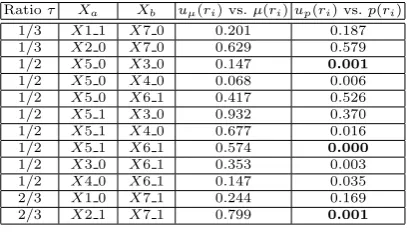
Similar tests are used for the two secondary hypotheses. H1.4 seeks to prove that given the same fraction γ (e.g. 1/3), there is no difference between the believability rate of different scenarios associated to that fraction (e.g. X1 1 vs. X2 0). In Table 2 we report the p-values of comparisons between different conditions, where significant values are highlighted in bold. Hypothesis H1.4 is only partially supported: the scenario tends not to influence the results in P t, however, inAt, the hypothesis is only supported in 3 out of 5 conditions.
Table 2.Mann-Whitney U tests onAtandP tbetween scenarios with similarγ
Fractionγ Xa Xb uµ(ri) vs.µ(ri)up(ri) vs.p(ri)
1/4 X3 1 X4 1 0.403 0.000
1/3 X1 1 X2 0 0.407 0.660 1/2 X5 0 X5 1 0.259 0.000
2/4 X3 0 X4 0 0.669 0.208 2/3 X1 0 X2 1 0.147 0.056
Table 3.Mann-Whitney U tests onAtandP tbetween scenarios with similarτ
Ratioτ Xa Xb uµ(ri) vs.µ(ri)up(ri) vs.p(ri)
1/3 X1 1 X7 0 0.201 0.187 1/3 X2 0 X7 0 0.629 0.579 1/2 X5 0 X3 0 0.147 0.001
1/2 X5 0 X4 0 0.068 0.006 1/2 X5 0 X6 1 0.417 0.526 1/2 X5 1 X3 0 0.932 0.370 1/2 X5 1 X4 0 0.677 0.016 1/2 X5 1 X6 1 0.574 0.000
1/2 X3 0 X6 1 0.353 0.003 1/2 X4 0 X6 1 0.147 0.035 2/3 X1 0 X7 1 0.244 0.169 2/3 X2 1 X7 1 0.799 0.001
between these conditions. H1.5 is mainly supported, with the exception of three cases in At. This provides partial evidence that it is the ratio rather than the fraction that influences the believability ratings among different conditions.
6.3 Domain 2: Hypotheses
The second problem focusses on understanding whether the outcome of the prob-abilistic semantics is a factor in assessing the believability of conclusions that are about event likelihood. We hypothesised that the product between the jus-tification ratio of a conclusion and its likelihood influences people’s believability ratings in theAtinterpretation and is comparable with the multiplication law in the probability interpretationP t. We consider similar hypotheses as in Domain 1, with the difference that the believability ratings is now tested for correlation with the product of the fraction γ and the likelihood ω expressed within the content of a proposition (τ =γ∗ω). Hypothesis H2.1 tests for correlation in the interpretation Atwhere µ(rj) =τ. Hypothesis H2.2 tests for correlation in P t
wherep(rj) =τ and H2.3 tests for similarity between the two correlations.
6.4 Domain 2: Results
Our initial tests study the correlation between the believability ratings and the fractionsγ or the likelihoodω alone. Statistical tests were performed using the Spearman’s rank-order correlation, and similarity is tested using the Fisher’s r-to-z transformation, with significance at p < 0.001. We observed no correla-tion for fraccorrela-tion γ in both interpretations At (rs(418) = .59, p = 0.228) and
[image:12.595.206.410.218.334.2]X2_0 X2_1 X3_0 X4_0 X5_0 X6_1 X6_0 X3_1 X4_1 X1_1 X7_0 X5_1 X1_0 X7_1
At Pt At Pt At Pt At Pt At Pt At Pt At Pt At Pt At Pt At Pt At Pt At Pt At Pt At Pt 0
10 20 30
cat
value
variable avalue5
avalue4 avalue3
avalue2
avalue1 pvalue5
pvalue4 pvalue3
pvalue2 pvalue1
Count
Interpretation
1/3 2/3 2/4 1/2 1/6 1/4 1/3 1/2 4/6
20 10 25 95 80
Percent ω:
Fraction γ:
Scenario:
0.067 0.125 0.225
Ratio τ:
3/6 2/6 2/3
90
0.158 0.3 0.4 0.533
[image:13.595.151.456.116.349.2]Extremely Likely Likely Neutral Unlikely Extremely Unlikely Believability:
Fig. 3.Believability ratinguµ(ri) andup(ri) - Domain 2
both At (rs(418) =.193, p 0.001) and P t (rs(418) =.184, p 0.001) with high similarity (z= 0.13, p= 0.448). More interestingly, we found a correlation between the product of γand ω reflecting the multiplication law of probability in bothAt(rs(418) =.293, p0.001) andP t(rs(418) =.250, p0.001) with similar behaviour (z= 0.67, p= 0.251). We now focus on this last result.
In Figure 3, we present the believability rating uµ(ri) and up(ri) recorded
for Domain 2. The horizontal axis is ordered according toτ=γ∗ω. The results support hypothesis H2.1 forAt: there is a positive correlation between the be-lievability rating and the product of the likelihood expressed within a conclusion and the justification ratio due to the probabilistic semantics. The outcome of the probabilistic semantics is a factor required to interpret the believability ratings: the correlation with the likelihood expressed within a conclusion alone is low (rs=.193) and moderately improves when the product is used (rs=.293). A similar behaviour is observed in P t supporting H2.2: there is a correlation be-tween the believability rating and the product of the likelihood expressed within the proposition and its probability of occurring. This is stronger than the corre-lation with the former only (rs=.250 vs.rs=.184). Finally, H2.3 is supported as no significant difference between the two correlations values is observed.
6.5 Discussion
even in the case in which a proposition is about the likelihood of an event. The results indicate that people tend to agree with the outcome of the probabilistic semantics. Furthermore, our results confirm that the outcome of the probability semantics may be understood by people in a way similar to the understanding of probability. In the second problem, we showed that this similarity is due to a heuristic associating the product of probabilities to the believability of con-clusions. Note that as discussed in Section 4, the multiplication law assumes that there is independence between the event reported by the proposition and it being inferred. We also tested for τ representing dependent events, using the law of conditional probability. The results showed no correlation with the be-lievability ratings. Due to space constraints, we have omitted these results. The results presented here are — in a sense — preliminary. There are many aspects of this research that need further investigation. To name some, both correlation coefficients are significantly positive but show a moderate correlation between the degree of believability and the justification ratio or associated probability. This suggests that other factors need to be investigated further in the future. One of these aspects is the role of the domains used within the scenarios as we have shown that in the argumentation interpretation this has a more significant role than in the probabilistic view. From an argumentation perspective, further studies should focus on considering other semantics, such as the ranking-based semantics [3]. Further studies should also focus on understanding how people combine probabilities and on analysing human factors, for example, by consid-ering the background of participants involved.
7
Conclusions
We investigated whether qualitative argumentation captures some notion of un-certainty by associating a degree of believability of conclusions with the number of preferred extensions. To do so, we examined whether people agree with the outcome of the probabilistic semantics. More broadly, our work can be seen to follow a strand of research similar to that of Cerutti et al. [5], aiming to study the alignment between argumentation semantics and human intuition. The novelty of our work is in that we focus on the particular role that multiple extensions play in evaluating the believability of a conclusion.
In this paper, we designed our experiments with a two-fold objective: to determine whether our claim was valid; and to investigate whether there is a similarity between probabilistic and argumentation-based reasoning. Our results showed that people tend to agree with the outcome of the probabilistic seman-tics and that people employ a similar heuristic in understanding both preferred extensions and probabilities. Through our experiments, we obtained some initial promising insights into the use of probability within argumentation frameworks that may guide researchers in better supporting human reasoning in their work.
Acknowledgements. This work was partially funded by a grant to the
References
1. Bailin, S., Battersby, M.: Conductive argumentation, degrees of confidence, and the communication of uncertainty. In: van Eemeren, F.H., Garssen, B. (eds.) Re-flections on Theoretical Issues in Argumentation Theory, pp. 71–82. Springer In-ternational Publishing (2015)
2. Bench-Capon, T.J.M.: Persuasion in practical argument using value-based argu-mentation frameworks. Journal of Logic and Computation 13(3), 429–448 (2003) 3. Bonzon, E., Delobelle, J., Konieczny, S., Maudet, N.: A comparative study of
ranking-based semantics for abstract argumentation. In: Proceedings of the 30th AAAI Conference on Artificial Intelligence. pp. 914–920 (2016)
4. Cayrol, C., Lagasquie-Schiex, M.C.: Graduality in argumentation. Journal of Ar-tificial Intelligence Research 23(1), 245–297 (2005)
5. Cerutti, F., Tintarev, N., Oren, N.: Formal arguments, preferences, and natural language interfaces to humans: an empirical evaluation. In: Proceedings of the 21st European Conference on Artificial Intelligence. pp. 207–212 (2014)
6. Croitoru, M., Vesic, S.: What can argumentation do for inconsistent ontology query answering? In: Liu, W., Subrahmanian, V.S., Wijsen, J. (eds.) Scalable Uncertainty Management, Lecture Notes in Computer Science, vol. 8078, pp. 15–29. Springer Berlin Heidelberg (2013)
7. Dunne, P.E., Hunter, A., McBurney, P., Parsons, S., Wooldridge, M.: Weighted argument systems: Basic definitions, algorithms, and complexity results. Artificial Intelligence 175(2), 457 – 486 (2011)
8. Haenni, R.: Probabilistic argumentation. Journal of Applied Logic 7(2), 155–176 (2009)
9. Heatherly, R., Kantarcioglu, M., Thuraisingham, B.: Preventing private informa-tion inference attacks on social networks. IEEE Transacinforma-tions on Knowledge and Data Engineering 25(8), 1849–1862 (2013)
10. Hunter, A., Thimm, M.: Probabilistic argument graphs for argumentation lotteries. In: Computational Models of Argument, Frontiers in Artificial Intelligence and Applications, vol. 266, pp. 313–324. IOS Press (2014)
11. Li, H., Oren, N., Norman, T.J.: Probabilistic argumentation frameworks. In: Mod-gil, S., Oren, N., Toni, F. (eds.) Theory and Applications of Formal Argumentation, Lecture Notes in Computer Science, vol. 7132. Springer Berlin Heidelberg (2012) 12. Mayer, J.M., Schuler, R.P., Jones, Q.: Towards an understanding of social inference
opportunities in social computing. In: Proceedings of the 17th ACM International Conference on Supporting Group Work. pp. 239–248 (2012)
13. Modgil, S., Prakken, H.: The ASPIC+ framework for structured argumentation: A tutorial. Argument & Computation 5(1), 31–62 (2014)
14. Prakken, H.: An abstract framework for argumentation with structured arguments. Argument & Computation 1(2), 93–124 (2010)
15. Tang, Y., Cai, K., McBurney, P., Sklar, E., Parsons, S.: Using argumentation to reason about trust and belief. Journal of Logic and Computation 22(5), 979 (2012) 16. Thimm, M.: A probabilistic semantics for abstract argumentation. In: Proceedings
of the 20th European Conference on Artificial Intelligence. pp. 750–755 (2012) 17. Walton, D., Reed, C., Macagno, F.: Argumentation schemes. Cambridge University
Press (2008)