Association between hormone replacement therapy and subsequent stroke: a meta analysis.
Philip M W Bath
Stroke Association Professor of Stroke Medicine
Institute of Neuroscience, Queen’s Medical Centre, University of Nottingham, NG7 2UH Guarantor for paper.
Contribution: Drafted paper, collated data
Laura J Gray Medical statistician
Institute of Neuroscience, Queen’s Medical Centre, University of Nottingham, NG7 2UH Contribution: Reviewed paper, collated data, statistical analysis
Correspondence to: Professor Philip Bath Division of Stroke Medicine University of Nottingham Queen’s Medical Centre Nottingham NG7 2UH
Tel: 0115 970 9348 Fax: 0115 875 4506
Email: [email protected]
All authors declare that the answer to the questions on your competing interest form
ABSTRACT
Objectives: To review systematically completed trial evidence assessing hormone replacement therapy (HRT) to subsequent stroke risk, in particular assessing stroke by pathological type, severity and outcome. Data sources: Randomised controlled trials of HRT were identified from the Cochrane Library, reviews and reference lists of relevant papers.
Review methods: Rates for cerebrovascular events were extracted, combined and analysed using a random effects model. Sensitivity analyses were defined to explain any heterogeneity, including phase of prevention (primary, secondary), type of HRT (mono/unopposed oestrogen, dual/opposed), type of oestrogen (estradiol, conjugated equine oestrogen), size of trial (<5000, >5000 patients), length of follow-up (≤3 years, >3 years), and gender.
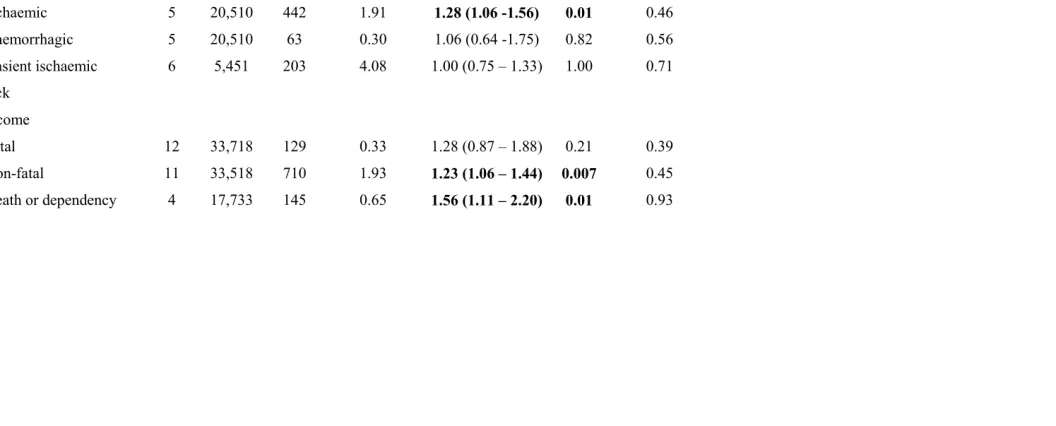
Results: Fourteen trials (t), involving 34,976 subjects, were identified. HRT was associated with significant increases in total stroke, odds ratio (95% confidence intervals) 1.29 (1.12-1.47, t=14), non-fatal stroke 1.23 (1.06-1.44, t=11) stroke leading to death or disability/dependency 1.56 (1.11-2.20, t=4), ischaemic stroke 1.28 (1.06-1.56, t=5), and a trend to more fatal stroke 1.28 (0.87-1.88, t=12). HRT was not associated with haemorrhagic stroke 1.06 (0.64-1.75, t=5), or transient ischaemic attack 1.00 (0.75-1.33, t=6). No
heterogeneity was present in any analysis.
INTRODUCTION
Sex steroid hormones are believed to provide women with endogenous protection against cerebrovascular events. Pre-menopausal women have a lower risk of stroke relative to men of the same age 1 2 whilst the incidence of stroke increases rapidly following the menopause, 3 coincident with diminished circulating levels of oestrogen and progesterone. As a result, hormone replacement therapy (HRT) has been used widely for vascular prophylaxis in parallel with its known effects in reducing menopausal symptoms and bone loss. Longitudinal observational studies have suggested that HRT may reduce cardiovascular and cerebrovascular disease. 4 However, a review of these studies (which also included two randomised trials) found that the number of strokes was increased. 5 Furthermore, the results of randomised controlled trials (RCT) have given conflicting results with studies either finding no benefit or even apparent hazard. A recent non-systematic review of RCTs found that treatment with HRT was associated with an increased risk of stroke. 6
METHODS
Searching
Publications were identified from searches of The Cochrane Library, Embase and Medline (from 1966 to May 2004), in addition the reference lists of previous reviews 7-9 and reference the identified articles were made.
Selection
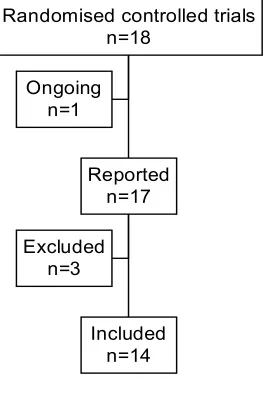
All completed and published randomised controlled trials of HRT against a control group reporting stroke events were included. Publications not reported in English or where event numbers were given for stroke or transient ischaemic attack and not separately were excluded. Trials were found which included both males and females, and in one case males exclusively. It was decided to include both genders in the review but to analyse those trials which included males separately to those which included females only. From the search 18 trials were identified, of which fourteen met our criteria for inclusion. Four trials did not meet our inclusion criteria (table 1).
Quality assessment
Studies were assessed in five areas, including method of randomisation, blinding, reporting of withdrawals, generation of random numbers and allocation concealment. Trials scored one point for each area addressed, therefore receiving a score between 0-5, with 5 reflecting the highest level of quality. 10
Data abstraction
All data were independently extracted by the two authors (LG and PB). Disparities were resolved by consensus.
Study characteristics
Information on trial size, treatment regimen (oestrogen + progesterone), length of follow-up and outcome were recorded. Outcomes included stroke events (fatal and non fatal), type of stroke (ischaemic,
haemorrhagic, not known), functional outcome (combined death and disability/dependency), and case fatality. Where available, data were also collected on the number of transient ischaemic attacks, but these were not included in the overall stroke outcome. Where obtainable, data related to intention-to-treat analyses.
Quantitative data synthesis
RESULTS
Study characteristics
Fourteen trials were identified for inclusion involving 34,976 subjects (table 1, figure 1). The trials varied in size between 134 12 and 16,608. 13 The trials included four investigating primary vascular prevention 13-16 and nine in patients with prior vascular events: stroke 17-19, ischaemic heart disease 20-23 and venous
thromboembolism. 24 The average age of the patients varied between 55 and 71; three trials not only included post menopausal women but also included men, with one trial including men exclusively. 12 18 19 Two trials required that women should not have had a hysterectomy.13 21 Follow-up varied between 0.9 and 6.8 years. Mono-HRT (oestrogen alone) was studied in seven trials and dual (or opposed) HRT in the others. Both mono and dual comparison arms of the ‘Women’s Health Initiative Trial’ were terminated prematurely due to HRT treatment being associated with hazard.13 15 All trials, apart from two 23 25, were placebo controlled.
Data quality
Quantitative data synthesis
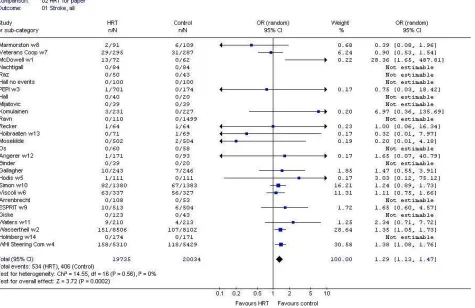
Stroke occurred in 2.3% of the participants randomised to no HRT and was significantly increased by one-third in those randomised to HRT (figure 2). This increase in stroke resulted from excess ischaemic strokes but not primary intracerebral haemorrhage, as also seen in WHI dual alone.13 An early increase in stroke occurred during the first 6 months of treatment in the WEST trial of secondary stroke prevention,17 analogous to the early increase in CHD events seen in the HERS trial of secondary CHD prevention.21
A poor outcome after stroke, judged as combined death and dependency, was increased by half with HRT; a non-significant increase in fatal stroke was also seen. This relationship between HRT and severe stroke was present individually in three trials – HERS, WEST, WHI dual (figure 3).13 21 26 HRT did not alter the rate of transient ischaemic attack (table 2). No statistical heterogeneity was seen for any of the stroke outcomes.
Pulmonary embolism was increased by three-quarters in those randomised to HRT (table 2). In contrast, CHD events were not more frequent with HRT. No statistical heterogeneity was observed for either PE or CHD.
DISCUSSION
This systematic review supports the results of individual trials and previous reviews finding that HRT does not reduce the risk of stroke in post-menopausal women. Indeed, HRT was associated with an overall increase in the risk of stroke of 27%. This effect was driven by an increase in ischaemic but not haemorrhagic stroke. Importantly, the severity of stroke was increased since the frequency of a poor functional outcome, judged as combined death and disability/dependency, was 56% higher in those randomised to HRT. Similarly, fatal stroke was non-significantly increased.
Why HRT should increase ischaemic stroke and its severity when biological plausibility and previous observational studies suggested it might protect against cerebrovascular events remains unclear. This discrepancy between observational and intervention studies is not unique; for example, whilst antioxidant vitamins might on biological grounds have been expected to protect against vascular disease with
observational studies supporting this hypothesis, several large RCTs involving antioxidant vitamins found no beneficial effect.27 A number of possible explanations exist for why HRT promoted stroke. First, it is
possible that the results of the RCTs are wrong although this is unlikely since none of the studies were positive, i.e. HRT did not reduce stroke in any study, with 11 trials being neutral and 3 negative. The absence of a beneficial effect on stroke was mirrored for VTE and CHD. If the trials are correct then the
observational studies must have been falsely positive. Second, the trials involved either mono or dual HRT. Whilst long-term unopposed oestrogen therapy can promote cause uterine cancer, this would not explain an increase in stroke. In contrast, adding a progestogen could have had detrimental effects since this class of drugs can promote atherogenesis and vasoconstriction.28 This is particularly true for medroxyprogesterone acetate which was used in most of the trials involving dual HRT. Nevertheless, no heterogeneity between trials of mono and dual HRT was present suggesting that oestrogen itself, given as oestradiol or CEE, might be the culprit. Third, within-class differences in HRT may mean that the most appropriate type of oestrogen has yet to be tested adequately; the RCTs assessed either conjugated equine oestrogens or estradiol but not other types such as phytoestrogen.29 However, there was no evidence for statistical heterogeneity between the trials with respect to type of oestrogen.
revealed long term benefit. An analogous situation exists with statin therapy whereby benefit was found in trials with longer rather than shorter follow-up.30 Nevertheless, the largest two of the HRT trials, WHI dual and WHI mono, had follow-up for more than 5 years and yet found no beneficial effect on stroke risk.
In summary we have found that the use of HRT is associated with an increased risk of stroke, typically ischaemic in type and severe in nature. HRT cannot be recommended for the primary or secondary prevention of stroke. Extrapolation of the data suggest that patients at high risk of stroke, e.g. those with previous stroke, coronary heart disease, or multiple vascular risk factors, should cease taking it unless there is a strong contrary medical reason.
ACKNOWLEDGEMENTS
REFERENCES
1. Barrett-Connor E, Bush TL. Estrogen and coronary heart disease in women. JAMA
1991;265(14):1861-7.
2. Kannel WB, Thom TJ. Incidence, prevalence, and mortality of cardiovascular diseases. Heart
1994:185-197.
3. Wenger N, Speroff L, Packard B. Cardiovascular health and disease in women. New Engl J Med
1993;329(4):247-256.
4. Paganini-Hill A. Hormone replacement therapy and stroke: risk, protection or no effect?
Maturitas Journal of the Climacteric and Postmenopause 2001;38:243-261.
5. Nelson HD, Humphrey LL, Hygren P, Teutsch SM, Allan JD. Postmenopausal hormone replacement therapy. Scientific review. Journal of the American Medical Association
2002;288(7):872-81.
6. Beral V, Banks E, Reeves G. Evidence from randomised trials on the long-term effects of hormone replacement therapy. Lancet 2002;360:942-44.
7. Wren BG. Megatrials of Hormonal Replacement Therapy. Drugs & Aging 1998;12(5):343-348. 8. Zec RF, Trivedi MA. Effects of hormone replacement therapy on cognitive aging and dementia risk in postmenopausal women: a review of ongoing large-scale, long-term clinical trials.
Climacteric 2002;5:122-134.
9. Collins P. Clinical cardiovascular studies of hormone replacement therapy. Am J Cardiol
2002;90(supplement):30F-34F.
10. Moher D, Pham B, Jones A, Cook DJ, Jadad AR, Moher M, et al. Does quality of reports of randomised trials affect estimates of intervention efficacy reported in meta-analyses? Lancet
1998;352:609-13.
11. Egger M, Davey Smith G, Schneider M, Minder C. Bias in meta-analysis detected by a simple, graphical test. BMJ 1997;315:629-634.
12. McDowell F, Louis S, McDevitt E. A clinical trial of Premarin in cerebrovascular disease. J
Chron Dis 1967;20:679-84.
13. Wassertheil-Smoller S, Hendrix SL, Limacher M, Heiss G, Kooperberg C, Baird A, et al. Effects of estrogen plus progestin on stroke in postmenopausal women. A women's health initiative: A randomized trial. JAMA 2003;289(20):2673-2684.
14. The writing group for the PEPI Trial. Effects of estrogen or estrogen/progestin regimens on heart disease risk factors in postmenopausal women. The Postmenopausal
Estrogen/Progestin Interventions (PEPI) Trial. JAMA 1995;18(273):199-208.
15. The Women's Health Intiative Steering Commitee. Effects of conjugated equine estrogen in postmenopausal women with hysterectomy. JAMA 2004;291(14):1701-12.
16. Hodis HN, Mack WJ, Lobo RA, Shoupe D, Sevanian A, Mahrer PR, et al. Estrogen in the prevention of atherosclerosis. A randomized, double blind, placebo-controlled trial. Ann
Intern Med 2001;135:939-53.
17. Estrogen after ischemic stroke: effect of estrogen replacement on risk of recurrent stroke and death in the Women's Estrogen for Stroke Trial (WEST). Stroke; 2001.
18. Report of the Veterans Administration Cooperative Study of Atherosclerosis. An evaluation of estrogenic substances in the treatment of cerebral vascular diseases. Circulation
1966;XXXIII and XXXIV:II-3 - II-9.
19. Effect of estrogen treatment in cerebrovascular diseases. Cerebral vascular diseases; 1965; New Jersey. Grune & Stratton.
20. The ESPRIT Team. Oestrogen therapy for the prevention of reinfarction in postmenopausal women: a randomised placebo controlled trial. Lancet 2002;360:2001-08.
22. Waters DD, Alderman EL, Hsia J, Howard BV, Cobb FR, Rogers WJ, et al. Effects of hormone replacement therapy and antioxident vitamin supplements on coronary atherosclerosis in postmenopausal women. A randomized controlled trial. JAMA 2002;288:2432-2440. 23. Angerer P, Stork S, Kothny W, Schmitt P, von Schacky C. Effects of oral postmenopausal
hormone replacement on progression of atherosclerosis. A randomized controlled trial.
Arterioscler Thromb Vasc Biol 2001;21:262-268.
24. Hoibraaten E, Qvigstad E, Arnesen H, Larsen S, Wickstrom E, Sandset PM. Increased risk of recurrent venous thromboembolism during hormone replacement therapy. Thromb Haemost
2000;84:961-7.
25. Holmberg L, Anderson H, For the HABITS steering and data monitoring commitees. HABITS (hormonal replacement therapy after breast cancer-is it safe?), a randomised comparison: trial stopped. Lancet 2004;363:453-55.
26. Viscoli CM, Brass LM, Kernan WN, Sarrel PM, Suissa S, Horwitz RI. A clinical trial of estrogen-replacement therapy after ischemic stroke. The New England Journal of Medicine
2001;345(17):1243-1249.
27. Yusuf S. Two decades of progress in preventing vascular disease. Lancet 2002;360:2-3.
28. Badimon L, Bayes-Genis A. Effects of progestogens on thrombosis and atherosclerosis. Human
Reproduction Update 1999;5(3):191-199.
29. Glazier MG, Bowman MA. A review of the evidence for the use of phytoestrogens as a replacement for traditional estrogen replacement therapy. Archives of Internal Medicine
2001;161(9):1161-72.
30. Collins R, Armitage J. High-risk elderly patients prosper from cholesterol-lowering therapy (Commentary). The Lancet 2002;360:1618-1619.
31. Vickers M, Meade T, Darbyshire J. WISDOM: history and early demise - was it inevitable?
Climatreric 2002;5:317-325.
32. de Kleijn MJJ, Bots ML, Bak AAA, Westendorp ICD, Planellas J, Coelingh Bennink HJT, et al. Hormone replacement therapy in perimenopausal women and 2-year change of carotid intima-media thickness. Maturitas 1999;32:195-204.
33. Herrington DM, Reboussin DM, Brosnihan KB, Sharp PC, Shumaker SA, Snyder TE, et al. Effects of estrogen replacement on the progression of coronary-artery atherosclerosis. The
New England Journal of Medicine 2000;343(8):522-529.
34. Clarke SC, Kelleher J, Lloyd-Jones H, Slack M, Schofield PM. A study of hormone
TABLE 1
Randomised controlled trials excluded from the review
Trial & year Indication Subjects Intervention
(daily dose)
Reason for exclusion
WISDOM 31 Healthy 5,664 CEE + MPA
CEE
Trial completed but not reported at time of writing
De Kleijn et
al, 1999 32
Healthy 121 E2 (1.5 mg) +DG (0.15 mg), or
CEE (0.625 mg) + N (0.15 mg)
No stroke events reported
Herrington et
al, 2000 33
Coronary disease 309 CEE (0.625 mg), or CEE (0.625 mg + MPA (2.5 mg) Numbers only given for stroke or TIA and not
separately
Clarke et al,
2002 34
IHD 255 E2 (2.5 mg) or E2 (3 mg) + NG (4 mg) Numbers only given for stroke or TIA and not
TABLE 1
Randomised controlled trials of hormone replacement therapy in the primary and secondary prevention of vascular disease included in the meta analysis.
Trial & year Indication Subjects Age
(years) Female (%) Ethnicity white (%) Uterus present (%) Follow-up (years) Stroke rate (control group, %/year) Intervention (daily dose) Compliance (%) Quality score (0-5) Marmorston,
1965 19
Cerebral thrombosis
200 62.1 37 ? ? ? ? Females: CEE
(0.625mg) Males: CEE (0.625-2.5 mg)
? 2
Veterans Administration Cooperative, 1966 18
Cerebrovasc ular disease
592 ? 0 79.2 ? 1.4 7.72 CEE (1.25 mg)
after 1 year CEE (2.5 mg)
94 5
McDowell et al, 1967 12
Non-embolic cerebral infarction
134 64 25 ? ? Treated 0.9,
control 1.2
0 CEE (1.25mg) 84 3
PEPI Writing Group, 1995 14
Healthy 875 56 100 ? 68 3 0 CEE
+ MPA or MP
76 5
Simon et al, 1998 21
IHD 2,763 67 100 ? 100 4.1 1.18 CEE (0.625 mg)
+ MPA (2.5 mg)
78 5
Høibraaten et al, 2000 24
VTE 140 56 100 ? ? 1.3 1.11 E2 (2mg)
+ NTA (1mg)
76 5
Hodies et al, 2001 16
Healthy 222 62 100 58 62 2.0 0 E2 (1 mg) 94 5
Angerer et al, 2001 23
Carotid athero
264 ? 100 ? ? 1 0 E2 (1 mg)
+ GG (0.025 mg)
98 4
Viscoli et al, 2001 26
Stroke 664 71 100 ? 55 2.7 6.34 E2 (1 mg) 66 5
The ESPRIT team, 2002 20
MI 1,017 62.3/6
2.9
100 ? ? 2.0 0.59 E2 (2 mg) 53 5
Waters et al, 2002 22
IHD 423 65 100 ? 41 2.8 0.67 CEE (0.625 mg)
+ MPA (2.5 mg) †
69 5
Wassertheil-Smoller et al,
Healthy 16,608 63 100 84 100 5.6 0.24 CEE (0.625 mg)
+ MPA (2.5 mg)
2003 13
Holmberg et al, 2004 25
Breast cancer
345 55 100 ? ? 2.1 0 No specified
treatment
? 3
WHI Steering Committee, 2004 15
Healthy 10,739 63.6 100 75.3 0 6.8 0.32 CEE (0.625 mg) 46.2 5
TABLE 2
Effect of hormone replacement therapy on stroke, its type and outcome. Odds ratio (95% confidence intervals) using random effects model, and heterogeneity
Trials Subjects Events Control event
rate (%)
Odds ratio
(95% CI)
p Heterogeneity
p
Stroke, all 14 34,976 916 2.32 1.29 (1.12 – 1.47) 0.0003 0.46
Ischaemic 5 20,510 442 1.91 1.28 (1.06 -1.56) 0.01 0.46
Haemorrhagic 5 20,510 63 0.30 1.06 (0.64 -1.75) 0.82 0.56
Transient ischaemic
attack
6 5,451 203 4.08 1.00 (0.75 – 1.33) 1.00 0.71
Outcome
Fatal 12 33,718 129 0.33 1.28 (0.87 – 1.88) 0.21 0.39
Non-fatal 11 33,518 710 1.93 1.23 (1.06 – 1.44) 0.007 0.45
TABLE 3
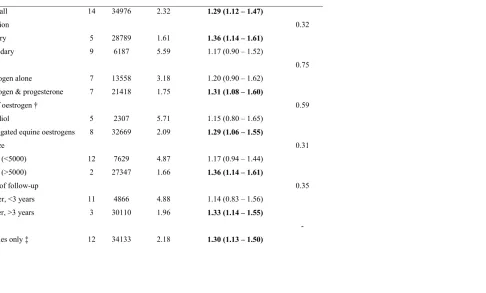
Sensitivity analyses of the effect of hormone replacement therapy on total stroke
Trials Subjects Control event
Rate %
Odds ratio
(95% CI)
χ2
Interactio
n
Stroke, all 14 34976 2.32 1.29 (1.12 – 1.47)
Prevention 0.32
Primary 5 28789 1.61 1.36 (1.14 – 1.61)
Secondary 9 6187 5.59 1.17 (0.90 – 1.52)
HRT 0.75
Oestrogen alone 7 13558 3.18 1.20 (0.90 – 1.62)
Oestrogen & progesterone 7 21418 1.75 1.31 (1.08 – 1.60)
Type of oestrogen † 0.59
Estradiol 5 2307 5.71 1.15 (0.80 – 1.65)
Conjugated equine oestrogens 8 32669 2.09 1.29 (1.06 – 1.55)
Trial size 0.31
Small (<5000) 12 7629 4.87 1.17 (0.94 – 1.44)
Large (>5000) 2 27347 1.66 1.36 (1.14 – 1.61)
Length of follow-up 0.35
Shorter, <3 years 11 4866 4.88 1.14 (0.83 – 1.56)
Longer, >3 years 3 30110 1.96 1.33 (1.14 – 1.55)
Gender -
Quality
Score of 5 only 10 1.28 (1.12 – 1.46)
Score 0-4 4 2.11 (0.14 – 32.18)
† Habits 25 not included as type of oestrogen left to investigators judgement
FIGURE 1
Flow diagram of search strategy
Ongoing
n=1
Excluded
n=3
Included
n=14
Reported
n=17
FIGURE 2