NOT FINAL VERSION
1
Age-related differences in Selection by Visual Saliency
2Kamen A. Tsvetanov1, Carmel Mevorach1, Harriet Allen2 and Glyn W. Humphreys3 3
1 School of Psychology, University of Birmingham, Birmingham B15 2TT, UK; 2 School of
4
Psychology, University of Nottingham, Nottingham NG7 2RD; 3 Department of Experimental 5
Psychology, University of Oxford, Oxford OX1 3UD 6
7
Author note: 8
This work was supported by the BBSRC (UK) and contributed to a PhD by the first author at 9
the University of Birmingham. 10
11
Short Title: Saliency processing in ageing 12
Corresponding Author: Kamen Tsvetanov 13
School of Psychology, University of Birmingham, Birmingham 14
B15 2TT, United Kingdom 15
Tel: (+44) 121 414 3679 16
Fax: (+44) 121 414 4932 17
Email: [email protected] 18
19
Word count: 5139 20
1
Abstract
2We examined the ability of older adults to select local and global stimuli varying in 3
perceptual saliency – a task requiring non-spatial visual selection. Participants were asked to 4
identify in separate blocks a target at either the global or local level of a hierarchical stimulus, 5
while the saliency of each level was varied (across different conditions either the local or the 6
global form was the more salient and relatively easier to identify). Older adults were less 7
efficient than young adults in ignoring distractors that were higher in saliency than targets, 8
and this occurred across both the global and local levels of form. The increased effects of 9
distractor saliency on older adults occurred even when the effects were scaled by overall 10
differences in task performance. The data provide evidence for an age-related decline in non-11
spatial attentional selection of low-salient hierarchical stimuli, not determined by the (global 12
or local) level at which selection was required. We discuss the implications of these results 13
for understanding both the interaction between saliency and hierarchical processing and the 14
effects of aging on non-spatial visual attention. 15
16
Keywords: Saliency, non-spatial visual attention, aging, global and local processing, 17
inhibition deficit theory, distraction 18
Introduction
1In order to survive in complex, dynamic environments we need efficient mechanisms of 2
attention to select information relevant to our behavioural goals. Current theories of visual 3
attention hold that selection is determined by the interaction between bottom-up and top-4
down signals. Bottom-up signals act to draw attention to salient items that differ from their 5
local surroundings (Theeuwes, 2005; Theeuwes, 1992). Top-down forms of selection become 6
involved when participants have particular expectations about the target they are required to 7
select (e.g., knowing its location or one of its features)(Wolfe et al., 2003) and/or when the 8
target is less salient than particular distractors – when the bottom-up attraction of attention to 9
the salient distractors must be overcome. In addition, top-down selection itself can be 10
fractionated into excitatory processes, that guide attention to targets, and inhibitory processes, 11
which can filter out irrelevant distractors (see Braithwaite et al., 2005; Dent et al., 2012). The 12
inter-play between these selection processes can change as we age. For example, there is 13
evidence that the role of top-down expectations for targets, and of excitatory guidance, may 14
be stronger in older than younger adults (Madden et al., 1999). On the other hand, the ability 15
to suppress irrelevant distractors may decrease – as argued by the inhibition deficit theory of 16
cognitive ageing (Lustig et al., 2007). According to this account, cognitive ageing is 17
associated with a selective decrease in the ability to inhibit irrelevant stimuli and responses, 18
worsening attentional selection in older adults. Though the loss of inhibitory control may be 19
compensated for by increased top-down excitatory guidance, problems will emerge under 20
conditions in which distractors strongly compete for selection with targets (e.g., under 21
Inhibitory Deficits in Visual Selection 1
Evidence for the inhibitory deficit theory emerges from studies using negative priming. 2
Negative priming tasks measure the unfavourable influence of a prior exposure to a distractor 3
stimulus on the response to the same stimulus when a target. Classic studies of negative 4
priming have contrasted cases where an item’s identity is inhibited, slowing its subsequent 5
identification (Tipper & Cranston, 1985). Reduced negative priming in older adults might 6
reflect less efficient inhibition when the stimuli are first encountered as distractors (Hasher et 7
al., 1991). In addition, there is evidence for age-related changes in location-based inhibition, 8
for example in preview search tasks. Preview search typically uses conjunction-like displays 9
but presents distractors with one common set of properties prior to the second set of 10
distractors plus the target (Watson & Humphreys, 1997). Provided there is a sufficient period 11
between the two sets of distractors (of the order of 400ms or so), the first set of distractors 12
can be efficiently ignored (Humphreys et al., 2004). There is substantial evidence that the 13
lack of impact of the initial distractors is dependent, at least in part, on a process of active 14
distractor suppression of its location (Watson & Humphreys, 2000; Humphreys et al., 2004; 15
Allen et al., 2008) and features (Olivers & Humphreys, 2003). As in studies of negative 16
priming it has been shown that older participants can show a selective reduction in the 17
efficiency of preview search, particularly under conditions where distractor inhibition is 18
challenged (e.g., with moving distractors). This is consistent with reduced inhibition of 19
distractor locations and/or features in older adults relative to young adults (Watson & Maylor, 20
2002). 21
However there are many instances in everyday life where selection is neither feature 22
nor space-based, but rather dependent on the ability to select the appropriate level of a form. 23
select the whole face to take advantage of configural relations between features, but in doing 1
this we may not want to attend to the local features themselves. On the other hand, when we 2
make a judgement about part of a face (is the person smiling?), we may want to focus 3
attention on the local part without processing the whole. For such cases, we need to be able to 4
flexibly select the local or the global level of a form, an ability that likely depends on 5
different underlying mechanisms to those studied through feature or space-based selection. 6
For example, while there is much evidence for spatial selection being dependent on a largely 7
bilateral fronto-parietal network (Corbetta & Shulman, 2002), the selection of local and 8
global forms has been associated with lateralized brain recruitment, with the left hemisphere 9
being selectively linked to local processing and the right hemisphere to global processing 10
(Lux et al., 2004). In addition, other regions may be recruited irrespective of whether the 11
local or global level of form needs to be selected, as a function of whether the target level 12
(local or global) is high or low in salience. For example, the right posterior parietal cortex 13
(PPC) has been linked to the guidance of attention towards the more salient of the levels 14
when the target is at that level (Hodsoll et al., 2009), while the left PCC is involved when the 15
target is at the less salient level and the distractor at the higher level of salience (Mevorach et 16
al., 2009b). This PPC system has been linked also to a ’down regulation’ of the early visual 17
regions which would otherwise respond differentially to the salient stimulus (in this case the 18
distractor level). For example, under conditions where high saliency distractors have to be 19
ignored, there is increased activity in the left PPC which in turn is associated with decreased 20
activity in left occipital cortex (using psycho-physiological interaction analysis; Mevorach et 21
al., 2009b). Consistent with the left PPC inhibiting high saliency distractors, the application 22
of suppressive transcranial magnetic stimulation (TMS) to the left PPC (to suppress activity 23
there) leads to increased activity in left occipital cortex under conditions with high-salient 24
salient distractors, as a function of age, has been conducted under conditions of spatial 1
selection and we know little about how ageing affects the ability to suppress irrelevant 2
distractors when other forms of selection are demanded, such as selecting the level of form 3
and/or selecting hierarchical stimuli according to their relative salience. Here we set out to 4
address this issue by evaluating how cognitive ageing alter an individual's ability to select a 5
low saliency target in a hierarchical form, compared to when the target is highly salient. 6
Global and Local Processing in Ageing 7
There are several previous studies of the effects of cognitive ageing on the ability to select 8
local and global levels of form. However the results are very mixed. Roux and Ceccaldi 9
(2001), for example, used stimuli that showed an overall global processing advantage and 10
reported that older participants had stronger global interference (when responding to local 11
targets) than younger observers. In direct contrast, Muller-Oehring et al. (2007), employing 12
stimuli with an overall local advantage, found greater local-on-global interference in older 13
participants. Others have reported null effects of ageing on local and global interference 14
(Bruyer et al., 2003). These contradictory results may be understood if cognitive ageing 15
affects the ability to select stimuli varying in saliency rather than the ability to select local 16
and global forms per se. For example, in studies showing greater interference effects in older 17
participants, the interfering distractors were typically more salient than the target (global 18
distractors in Roux & Ceccaldi, 2001; local distractors in Muller-Oehring et al., 2007), while 19
experiments showing no differential interference effects have tended to have local and global 20
forms more balanced for saliency (e.g., judged by overall RTs; Bruyer et al., 2003). The 21
conflicting results may be accounted for by differential selection of stimuli varying in 22
saliency, with older participants finding it particularly difficult to suppress high-salient 23
investigated this for the first time in this paper, using stimuli modelled on investigations of 1
selection by saliency by Mevorach and colleagues. 2
Saliency Processing in Global/Local Level 3
In contrast to prior studies in this field, Mevorach orthogonally varied whether the 4
target was at the local or global level of the forms and whether it had high or low saliency (in 5
relation to the distractor level of form) (Mevorach et al., 2006b; Mevorach et al., 2005; 6
Mevorach et al., 2009b; Mevorach et al., 2006a; Mevorach et al., 2009a). The saliency of the 7
forms was varied by either presenting high contrast local forms in alternating colours (high 8
local saliency, low global saliency) or by blurring the hierarchical letter and presenting the 9
local forms in uniform colour (high global saliency, low local saliency; See Figure 1Figure 10
1). Performance was analysed by pooling the data across conditions where the target was at 11
the local level and when it was at the global level and contrasting the results when the target 12
had high salience (distractor low salience) and when it had low salience (and the distractor 13
high salience). When the target level was high in salience, the demands on inhibition of the 14
distractor level were low as selection could have been driven by bottom-up cues; however 15
when the target was low in salience and the distractors had high salience, then the demands 16
on distractor inhibition would be high in order to overcome bottom-up cues biasing selection 17
in favour of the distractor. Consistent with the argument for the inhibition of high-salient 18
distractors, Mevorach et. al. used psycho-physiological interaction analysis to demonstrate 19
that there was increased activation of left PPC when high saliency distractors had to be 20
ignored, and this co-occurred with reduced activation of left occipital cortex. They argued 21
that the selection of the low-salient target was mediated by the left PPC suppressing 22
distractor-related activity in early occipital cortex. In support of this, suppressive TMS to the 23
presnt, suggesting that there was then reduced down-regulation of occipital cortex. The 1
behavioural evidence indicated that there was increased interference from salient distractors 2
and this effect was greatest when TMS was applied prior to the onset of the stimulus 3
(Mevorach et al., 2009a, 2010). In this case, TMS appeared to block the top-down setting up 4
of perceptual suppression. 5
Figure 1 about here 6
7
The Present Study
8
In the present study, we report a novel analysis of selection by level of hierarchical form 9
(global/local) and saliency in young and older adults, assessing whether older adults have 10
particular problems selecting low-salient targets in the face of high-salient distractors, and 11
whether this occurs independently of the global or local level of the stimulus. To do this, we 12
had participants select local and global letters under conditions of varying saliency using a 13
blocked design – with either the target level being highly salient and the distractor having low 14
saliency, or the distractor level having high saliency and the target low (see Figure 1). When 15
the target has relatively high saliency there should be bottom-up guidance of attention to 16
targets coupled to a role of top-down excitatory guidance (to the blocked target level), On the 17
other hand, when the target had relatively low saliency (and the distractor high salience), 18
there would be demands on top-down inhibition of the distractor level to prevent attention 19
being drawn in a bottom-up manner to the distractor. We hypothesized that the ability to 20
inhibit high-salient distractors for successful processing of low-salient targets is reduced with 21
ageing, in which case performance should be disrupted for older relative to younger adults 22
when distractors have high saliency. On the other hand, if there is increased bottom-up 23
participants should be relatively faster at selecting high-salient targets. By varying saliency 1
orthogonally across the global and local levels of form, we tested too whether older adults 2
had difficulties confined to one level of form. 3
4
Methods
5Participants
6
The participants were twenty-four young (eleven males; group mean age, 24 years; age range 7
19 to 29) and nineteen older (ten males; group mean age, 74 years; age range, 65 to 84) 8
healthy volunteers who either received course credits or cash (£6 per hour). The participants 9
were recruited by advertisements in local communities, word-of-mouth information and 10
advertisements on an online experiment management system (Research Participation Scheme, 11
University of Birmingham). All the subjects had normal or corrected-to-normal vision 12
(assessed in laboratory environment using Snellen chart) and were healthy with no history of 13
psychiatric or neurological disease (self-report). 14
Stimuli
15
Two sets of compound-letter stimuli were created to have either high global saliency or high 16
local saliency. The stimuli comprised the letters “H” and “S” and their combinations created 17
figures in the shape of large orthogonal “H” and “S” letters (see Figure 1). 18
In the set of stimuli where local information was to be salient, the compound letters were 19
made of red (RGB, 255 0 0) and white local letters (Figure 1, top row). The size of the local 20
between the letters of 0.46°. The total width and height of the global letters was 6.7° × 10.81° 1
of visual angle, respectively. 2
When the compound letters were weighted for global processing, the local stimuli consisted 3
of red blurred letters (Figure 1, bottom row). The width and the height of the local letters was 4
1.34° × 1.76° of visual angle respectively, with an inter-letter distance of 0.15°, resulting in a 5
global letter subtending 5.83° × 9.22° of visual angle (in width and height, respectively). 6
These images were additionally blurred in MATLAB using a Gaussian lowpass filter 7
(FWHM of 1.56 mm). Mean display luminance for white, red and black colours were 118.44, 8
25.77 and > 0.01, respectively. Luminance measures were performed using a Minolta LS 110 9
photometer. 10
To reduce strategic focusing on a local area of the screen there were three possible positions 11
for presentation of the stimuli – the centre or 13.16° to the left or right of the centre of the 12
screen. 13
Procedure
14
In a selective attention task, participants undertook different trial blocks in which they were 15
asked to concentrate only on the global or the local letters across a block of trials while 16
ignoring the information at the other level. The task was to identify the letter (H or S) on the 17
designated target level by pressing pre-specified buttons on a USB mouse (e.g., “Is the letter 18
on the global level H or S?”). The experiment had four types of blocks formed from the 19
orthogonal combination of task and saliency, each block containing one condition (see Figure 20
1). There were target-salient blocks: (i) identify the global letters in stimuli where global 21
information is more salient than local information (Figure 1, bottom pair); and (ii) identify 22
the local letters in stimuli where local information pops is more salient than global (Figure 1, 23
where the local letters were more salient (Figure 1, top pair); and (ii) identify the local letters 1
in stimuli where the global letters were more salient (Figure 1, bottom pair). The target level 2
was blocked to allow participants to adopt a top-down set to the designated target level1. The 3
first two blocks and the last two blocks of the experiment were both either globally salient 4
displays or locally salient displays. Each block had 48 trials. On half of the trials the same 5
letters appeared on the global and local levels (congruent trials), whereas on the other half 6
there were different letters on the two levels (incongruent trials). Each pair of these blocks 7
consisted of a global and a local identification task. The order of the blocks was randomized 8
across participants. Each experimental trial started with a white fixation point presented for 9
2000ms followed by a 150ms presentation of a compound letter on a black background. The 10
trial ended after the participant identified the letter (H or S) on the target level (global or 11
local) and gave a speeded response by pressing one of the two mouse buttons (one for each 12
letter). The inter-stimulus interval was variable (1 - 4 seconds from the response of the 13
subject in one trial to the onset of the stimulus in the next trial) to avoid possible predictions 14
of stimulus onset. The viewing distance was controlled with a chinrest at 65cm from the 15
monitor. Psychophysics Toolbox for Matlab (Kleiner et al., 2007; Brainard, 1997; Pelli, 16
1997) was used for the presentation of the paradigm and the collection of the responses. 17
Response times and performance accuracy were recorded. Incorrect responses were excluded 18
from the analysis. RTs were screened for outliers after mean and standard deviation were 19
1 Example scenario of block order: 1st Block - Target salient condition, global task using the set of stimuli with
global focus (Figure 1, bottom pair); 2nd Block - Distractor salient condition, local task using the set of stimuli
with global focus (Figure 1, bottom pair); 3rd Block - Distractor salient condition, global task using the set of
stimuli with local focus (Figure 1, top pair); 4th Block – Target salient condition, local task using the set of
estimated based on a convolved exGaussian function fit to each subjects data. RTs over 3.5 1
standard deviations away from the mean were rejected (Heathcote et al., 1991). 2
Results
1Left vs Right Visual Field
2
An initial ANOVA on data from the left and right field locations (excluding centrally 3
presented stimuli) assessed whether there were differential effects of visual field on 4
performance. There was a reliable main effect of field, with RT values lower to targets in the 5
left field [left: 842ms, right: 858ms, F (1, 41) = 5.39, p = 0.025]. However, there were no 6
other significant interactions with other factors, including age group, and the data were 7
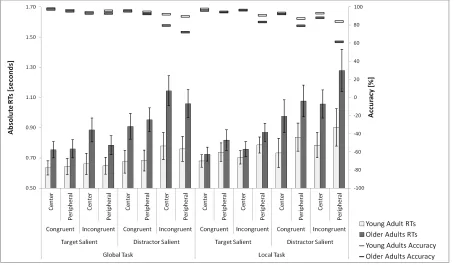
subsequently pooled across hemispheric field (Figure 2). 8
Main Analysis
9
Absolute RT 10
A five-way ANOVA was carried out on the absolute RTs and accuracy with the within-11
subject factors being target task (select Global or Local targets), saliency (Target-salient (e.g. 12
global task with global saliency) vs. Distractor-salient (e.g. global task with local saliency)), 13
congruency (Congruent vs. Incongruent) and visual field (VF, Central vs. Peripheral). There 14
was a between-subject factor of age group (young adults vs older adults). F- and p-values for 15
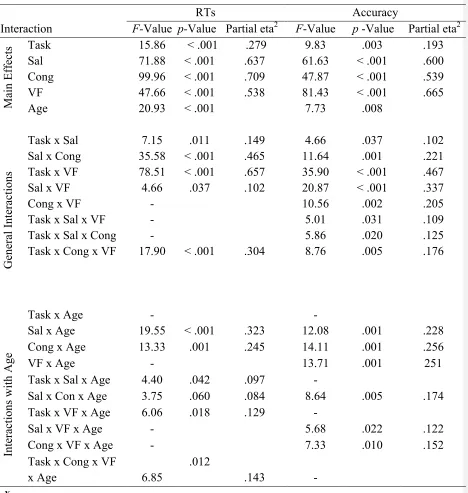
significant main effects and interactions are displayed in Table 1. 16
Overall, RTs were faster and accuracy higher in the global task compared to the local task 17
(796ms vs 858ms), in target-salient compared to distractor-salient trials (740ms vs 913ms), in 18
congruent compared to incongruent trials (787ms vs 866ms), central vs peripheral 19
presentations (804 vs 850ms) and in young compared to older adults (728ms vs 926ms). 20
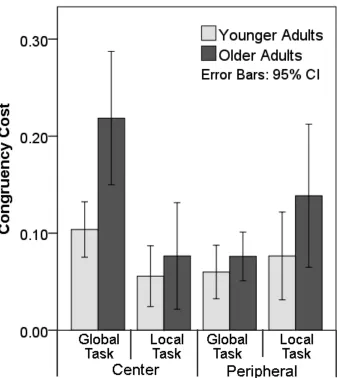
To investigate the highest order interaction in the RT data was between task, congruency, VF 21
from the difference in RTs for each task and VF conditions separately within each group. We 1
then analysed a three-way ANOVA with the within-subject factors of task and VF and the 2
between subject-factor of age (Figure 3). There were reliable main effects of age (F(1, 41) = 3
8.18, p = .007) task (F(1,41) = 3.96, p = .053) and VF, (F(1,41) = 3.44, p = .071). Significant 4
interactions were observed between task and VF (F(1, 41) = 20.71, p < .001) and task, VF 5
and age (F(1, 41) = 5.60, p = .023). The three way interaction was further broken down for 6
each visual field using two separate two-way ANOVAs with the within-subject factor of task 7
and a between-subject factor of age. The analysis for data with peripherally stimuli showed 8
no significant effects (age, F(1, 41) = 3.08, p = .087; task, F (1, 41) = 3.39, p = .073; task x 9
age, F (1, 41) = 1.14, p = .291), whereas the analysis for data for centrally presented stimuli 10
generated a significant main effect of task (task, F (1, 41) = 24.82, p < .001) and an 11
interaction between task and age (F (1, 41) = 6.06, p = .018). A post-hoc analysis revealed 12
that the interaction was mainly driven by larger congruency effects in the global task with 13
central presentation for older adults relative to young adults (F (1, 41) = 12.16, p = .001 and 14
F (1, 41) = .525, p = .473, congruency cost at global and local level for central presentation, 15
respectively). 16
Efficiency 17
Apart from the high-order interaction (task x congruency x VF x age), there was an additional 18
three-way interaction (saliency x congruency x age) which approached significance in the RT 19
data (F (1, 41) = 3.75, p = .060), and this was also highly significant in the accuracy data (F 20
(1, 41) = 8.64, p = .005) (Table 1). In order to provide an overall analysis accounting for any 21
speed/accuracy tradeoffs in the analysis the data were analyzed by combining RTs and 22
accuracy into a single “efficiency” measure (RT/proportion correct, see Townsend & Ashby, 23
Performance was assessed in mixed design ANOVAs using the mean efficiency data for each 1
participant. The within-subject factors were task (select Global or Local targets), saliency 2
(Target-salient (e.g. global task with global saliency) vs. Distractor-salient (e.g. global task 3
with local saliency)), congruency (Congruent vs. Incongruent) and visual field (Central vs. 4
Peripheral). The between-subject factor was age group (Young adults vs. Older adults). F- 5
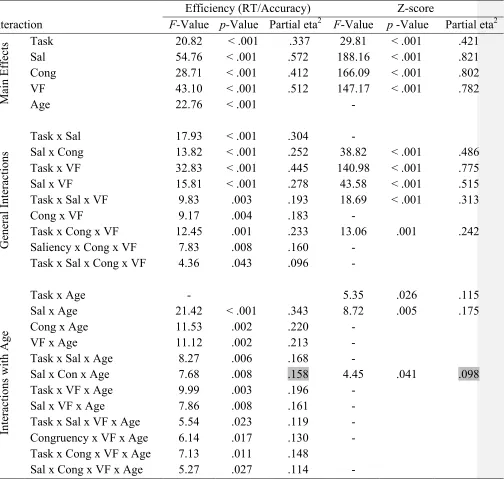
and p-values for significant main effects and interactions are displayed in Table 2. 6
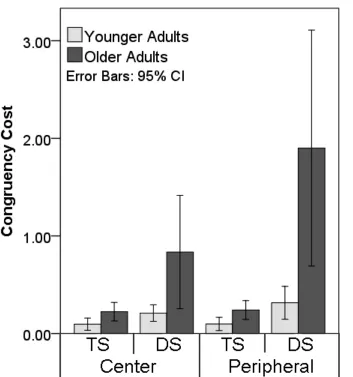
There was a four-way interaction between saliency, congruency, VF and age, which suggests 7
again that there may be a differential effect of congruency for older adults. To quantify this, 8
the effect of congruency was calculated from the difference in mean efficiency for the 9
congruent and incongruent conditions for each variation in target saliency and VF, for each 10
age group, see Figure 4. A three-way ANOVA was estimated with the within-subject factor 11
of salience (Target-salient vs Distractor-salient), VF (central vs peripheral presentation) and 12
the between-subject factor of age group. All main effects and interactions were significant. 13
Further breakdown of the higher order interaction (saliency x VF x age) included two 14
separate two-way ANOVAs, one for each visual field (central and peripheral presentation), 15
with the within-subject factor of saliency (Target-salient vs Distractor-salient) and the 16
between-subject factor of age. Stimuli presented centrally produced main effects of saliency 17
(F (1, 41) = 8.37, p = .006) and age (F (1, 41) = 8.43, p = .006) and a marginally significant 18
interaction between saliency and age ( F (1, 41) = 3.94, p = .054). ). There was a similar set 19
of results with peripheral presentations (main effects of age, F (1, 41) = 10.78, p = .002; and 20
saliency, F (1, 41) = 13.20, p = .001; and an age x saliency interaction, F (1, 41) = 7.80, p = 21
.008). For both central and peripheral stimuli, older participants showed stronger effects of 22
congruentcy than younger participants particularly when the target was low-salient and the 23
One difficulty for comparisons between younger and older participants is that older 1
participants can show general deficits in processing and generalized slowing play a major 2
role in cognitive decline (Linden-berger & Baltes, 1994; Salthouse, 2000). These generalized 3
effects may differentially affect performance as the task conditions become harder – a result 4
that can masquerade a selective effect of the conditions on older relative to younger adults. 5
For example, the stronger effects of saliency apparent here may be due to generalized sensory 6
loss/slowing, and not a selective problem in ignoring highly-salient distractors. In order to 7
examine whether there is indeed a selective effect in the two age groups, we analysed the 8
efficiency data using Z-transformations. The Z transformations aim to dissociate group 9
differences from effects of generalized slowing/decreases in processing efficiency by 10
examining effects of task conditions normalised by the average performance for each 11
participant (Faust et al., 1999)2. Specifically, the difference of mean efficiency of all trials in
12
one condition cell and the mean efficiency across all condition cells was normalized to the 13
standard deviation of efficiency across all conditions cells within a subject. This procedure 14
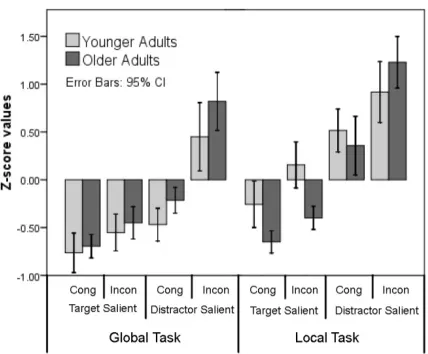
was repeated for each condition cells and subject separately (Figure 5). 15
Performance was assessed in mixed design ANOVAs over the mean Z-transformation data 16
with the within-subject factors of task (select Global or Local targets), saliency (Target-17
salient (e.g. global task with global saliency) vs. Distractor-salient (e.g. global task with local 18
saliency)), congruency (Congruent vs. Incongruent) and visual field (Central vs. Peripheral). 19
2 To the best of our knowledge this is the first time that analyses based on Z transformation have been conducted
on measures of performance efficiency rather than reaction time. However, since efficiency is likely to have the
same distribution as the reaction time data from which it is derived then it should be applicable here. In addition,
to have analyzed the RT data alone would have been to miss the critical trade-off in accuracy in older
The between-subject factor was age group (Young adults vs. Older adults). F- and p-values 1
for significant main effects and interactions are displayed in Table 2. 2
In these analyses all higher-order interactions including VF became non-significant, 3
suggesting that interactions including VF in the non-transformed efficiency data were 4
probably influenced by generalised effects of ageing. 5
The three way interaction between saliency, congruency and age was replicated. This 6
suggests that there may be a differential effect of congruency for older adults. Performance 7
on trials with low-salient targets (e.g. select the local element in a stimulus with a high-salient 8
global distractor), in particular, may be difficult for older adults if they have reduced ability 9
to suppress high-salient distractors – a result mimicking the effects of TMS on left PPC 10
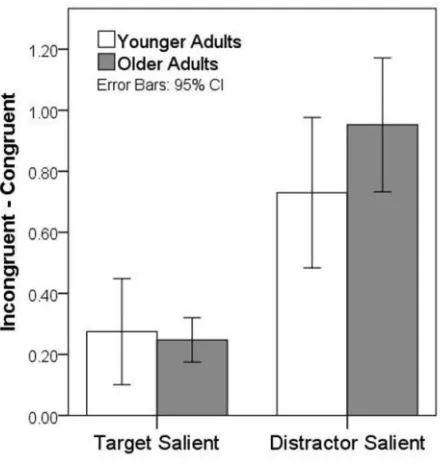
(Mevorach et al., 2010). To quantify this, the effect cost of congruency was calculated for 11
each individually for each target saliency condition from the difference in the Z-scores 12
between incongruent and congruent trials (incongruent - congruent), see Figure 6. A two-way 13
ANOVA was conducted with a within-subject factor of salience (Target-salient vs. 14
Distractor-salient) and a between-subject factor of age. This revealed significant main effects 15
of salience and aging [F (1, 41) = 38.82, p < 0.001, F (1, 41) = 8.72, p = 0.005] and a 16
significant interaction [F (1, 41) = 4.45, p = 0.041] (Figure 6Error! Reference source not
17
found.). Further t-tests revealed that there was a reliable effect of age group on performance 18
in the distractor-salient condition but not in the target-salient condition [t (1, 41) = -2.11, p = 19
0.041 and t (1, 41) = 0.51, p = 0.510 for distractor-salient and target-salient conditions, 20
respectively]. Thus, the older participants had a larger congruency effect compared to the 21
young group but only when low-salient targets had to be selected and high-salient distracters 22
ignored (e.g. select the local element in a stimulus weighted to the global level). Importantly, 23
global) and therefore indicates a general problem in suppressing high-salient distractor 1
irrespective of the level of form involved. 2
Separate from the 3-way interaction between saliency, congruency and age, there was an 3
overall effect of task and a reliable interaction between task and age (
4
Interaction
RTs Accuracy
F-Value p-Value Partial eta2 F-Value p -Value Partial eta2
M
ai
n E
ff
ec
ts Task 15.86 < .001 .279 9.83 .003 .193
Sal 71.88 < .001 .637 61.63 < .001 .600
Cong 99.96 < .001 .709 47.87 < .001 .539
VF 47.66 < .001 .538 81.43 < .001 .665
Age 20.93 < .001 7.73 .008
G ene ra l Int era ct ions
Task x Sal 7.15 .011 .149 4.66 .037 .102
Sal x Cong 35.58 < .001 .465 11.64 .001 .221
Task x VF 78.51 < .001 .657 35.90 < .001 .467
Sal x VF 4.66 .037 .102 20.87 < .001 .337
Cong x VF - 10.56 .002 .205
Task x Sal x VF - 5.01 .031 .109
Task x Sal x Cong - 5.86 .020 .125
Task x Cong x VF 17.90 < .001 .304 8.76 .005 .176
Task x Age - -
Int era ct ions w it h A ge
Sal x Age 19.55 < .001 .323 12.08 .001 .228
Cong x Age 13.33 .001 .245 14.11 .001 .256
VF x Age - 13.71 .001 251
Task x Sal x Age 4.40 .042 .097 -
Sal x Con x Age 3.75 .060 .084 8.64 .005 .174
Task x VF x Age 6.06 .018 .129 -
Sal x VF x Age - 5.68 .022 .122
Cong x VF x Age - 7.33 .010 .152
Task x Cong x VF
x Age 6.85
.012
.143 -
v
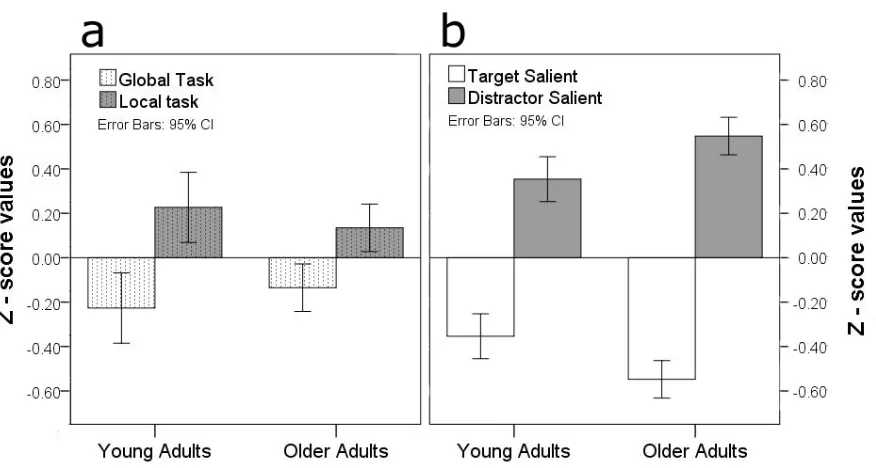
Table 2). The main effect of task occurred because, overall, responses to global targets were 1
more efficient than responses to local targets. However, this effect varied with age (Figure 2
7a). Relative to the overall average of performance for their age group, the young participants 3
showed a larger difference between the global and local tasks (relatively fast for global and 4
relatively slow for local, a Z difference of 0.67 in efficiency), when compared with the older 5
participants (a Z difference of 0.27 in efficiency) [F (1, 41) = 5.35, p = 0.026]. Interestingly, 6
the contrasting variation in performance across the age groups as a function of the task 7
(Figure 7a) went in the opposite direction to their respective variation as a function of 8
stimulus saliency (Figure 7Figure 7b). We take up this point in the Discussion section below. 9
10
Harriet Allen 12/11/2014 09:37
Deleted: Table 1
Discussion
1The main finding was that, relative to young adults, older adults were more affected 2
by salient incongruent distractors (producing higher congruency costs in the distractor-salient 3
condition), and this held even with the analysis scaled for the effects of aging on overall 4
efficiency (using Z transformations). The effect sizes show that this was relatively small 5
effect, which is to be expected since general slowing have accounted for much of the age 6
related changes, none-the-less it is relevent and significant. This age-related decline in the 7
ability to select a low-salient target in the presence of a high-salient distractor held for both 8
levels of target identification, both with local and global stimuli (respectively when the global 9
or the local saliency of the distractor was high). Importantly, this increased congruency effect 10
in distractor salient displays cannot be attributed to generally heightened susceptibility to 11
salience in old age. If heightened sensitivity to salience was driving the effect, then our old 12
participants should have also shown a difference in performance in the target salient 13
conditions (e.g., a reduced congruency effect when salient targets were reported, since older 14
adults would be less sensitive to target saliency). We therefore conclude that performance in 15
the old group most likely represents reduced down-regulated inhibition of saliency, 16
encountered particularly under conditions where distractors are salient. We note that this 17
result mimics the effects of TMS suppression reported by Mevorach et al. (2010), where the 18
loss of inhibitory control was most evident with salient distractors. 19
Our findings are concordant with the inhibition deficit theory (Hasher & Zacks, 1988), 20
which posits that older adults are generally less able to inhibit unwanted information – though 21
here we show for the first time that this applies to non-spatial selection of local and global 22
forms. According to the inhibition deficit framework, early bottom-up responses to salient, 23
irrelevant (i.e. to ignore the conversation of nearby passengers while reading a newspaper in a 1
train). Deficits in the efficiency of inhibiting irrelevant distractors may disrupt the ability to 2
focus attention on stimuli of interest, resulting in the dilution of selection across distractors as 3
well as targets. As noted in the Introduction, deficits in filtering out distractors have been 4
observed across a range of conditions, with different types of stimuli (e.g., in reading 5
(Carlson et al., 1995), language comprehension and production (Burke & Mackay, 1997; 6
Burke, 1997; Tun et al., 2002), visual memory (Gazzaley et al., 2005) and spatial visual 7
selection (Watson & Maylor, 2002; Schlaghecken et al., 2012)). and non-spatial visual 8
selection of stroop task (Hartley, 1993; West and Bell, 1997;West and Alain, 2000; Davidson
9
et al., 2003; Rush et al., 2006). To our knowledge this is the first study showing that age-10
related deficits in inhibition in non-spatial selection of hierarchical forms3. 11
In addition, our findings link the inhibitory deficit theory with observations from 12
neuroimaging. There is a striking parallel between our data and prior studies in which TMS 13
was applied to the left PPC, to reduce its influence on suppressing perceptual representations 14
of distractors (Mevorach et al., 2010; Mevorach et al., 2006b). Mevorach et al. report that, 15
across both local and global levels, low-salient targets became difficult to select after the left 16
PPC received TMS, and this was associated with increased activation in early occipital 17
cortex. These data are consistent with low-salient targets being selected through modulated 18
inhibition of high-salient distractors via the left PPC, and with this top-down selection 19
process being compromised with age. The data also fit with the Posterior-Anterior Shift with 20
Aging (PASA) model, which posits an age-decline in the occipito-parietal networks involved 21
in attention (Cabeza et al., 2004; Davis et al., 2008). We may speculate that the age-related 22
3 Note that the selection of a global stimulus, and ignoring of a local stimulus, cannot be explained in terms of
spatial selection, since any ‘fitting’ of a spatial window of attention on a global stimulus would also lead to local
decline in the suppression of salient information may be due to age-related decreases in the 1
effectiveness of connectivity between occipital and parietal cortices. Irrespective of this, our 2
behavioural data suggest that altered control of attention to low-salient signals may be a 3
critical factor in cognitive aging and, at least in our results, something that is more important 4
than alterations in the selection of local and global targets. 5
Problems in selecting low-salient stimuli may have been critical to findings from 6
studies using distraction as a measure of top-down attentional control in aging. The inhibition 7
of task-irrelevant information in aging has been assessed from responses to task-irrelevant 8
abrupt onsets (Kramer et al., 1999) and the inhibition of cued information in top-down visual 9
search (Madden et al., 2004; Madden et al., 2007). Although there are results suggesting that 10
there is preservation of top-down attentional control with ageing (Kramer et al., 1999; 11
Whiting et al., 2007; Whiting et al., 2005; Madden et al., 2004), this has not been established 12
in cases where distractors have relatively high saliency (compared with targets) (Kramer et 13
al., 2000; Madden et al., 2004). The current results go beyond these data by suggesting 14
impairments in rejecting high-salient distractors at different levels of stimulus representation. 15
It is perfectly possible that other forms of top-down processing, such as the guidance of 16
attention from positive expectancies of targets, remains intact. 17
One somewhat different account of the present results can also be put forward. This is 18
that older adults suffered more interference from salient distractors because they had more 19
efficient parallel processing of both levels of the hierarchical forms. This more efficient 20
parallel processing would mean that distractors are processed more deeply and thus create 21
more interference. However, on this account we would expect that RTs on congruent trials 22
would be notably fast for older adults, since they would gain more from redundancy at the 23
congruent trials for older participants also goes against the idea older adults show increased 1
congruency effects due to congruent trials being speeded. 2
3
Aside from the effects of saliency, the old and young age groups differed in how their 4
performance varied in the global and local identification tasks. The young participants 5
showed relatively large differences in performance in the global compared to the local task, 6
when compared with their overall performance. The older participants showed relatively 7
small changes between the global and local tasks, compared with their overall performance. 8
On the other hand, the older participants showed larger variation than the young participants 9
as stimulus saliency changed (Figure 7 a and b). These data suggest that, for older but not for 10
young participants effects of saliency produce stronger shifts in performance than effects of 11
task (global vs. local). Our results, stressing the effects of saliency across different levels of 12
form, also help to explain previous inconsistencies in the literature, where opposite effects of 13
ageing have been reported under conditions where the saliency of the local and global forms 14
was varied (cf. Muller-Oehring et al., 2007; Roux & Ceccaldi, 2001). Our data also cannot be 15
linked to an argument that younger participants showed stronger effects of global precedence 16
than older participants (Roux and Ceccaldi, 2001). Note that our effects occurred across the 17
local and global recognition tasks, and we would then have expected a relatively larger 18
congruency effect in young participants in the local task with distractor salient stimuli. We 19
observed the opposite (Figure 5). 20
Finally, the advantage of left over right visual field was unsurprising. Prior studies 21
have reported a left visual field advantage (Orr & Nicholls, 2005) most probably reflecting 22
right hemisphere dominance for attentional processing (Siman-Tov et al., 2007). Critically 23
this did not interact with age. Furthermore, there were no interactions between visual fields 24
with loss of visual acuity in the periphery. We conclude that age has a selective effect on 1
rejecting high-salient distraction, an ability associated with distractor suppression through the 2
left PPC in our task. 3
4 5 6
Acknowledgements 7
8
This work was carried in partial completion of a PhD at the University of Birmingham by 9
Reference List
Allen, H. A., Humphreys, G. W., & Matthews, P. M. (2008). A neural marker of content-specific active ignoring. J.Exp.Psychol.Hum.Percept.Perform., 34, 286-297.
Brainard, D. H. (1997). The Psychophysics Toolbox. Spatial Vision, 10, 433-436.
Braithwaite, J. J., Humphreys, G. W., & Hulleman, J. (2005). Color-based grouping and inhibition in visual search: evidence from a probe detection analysis of preview search. Percept.Psychophys., 67, 81-101.
Bruyer, R., Scailquin, J. C., & Samson, D. (2003). Aging and the locus of the global precedence effect: a short review and new empirical data. Exp.Aging Res., 29, 237-268.
Burke, D. M. (1997). Language, aging, and inhibitory deficits: evaluation of a theory. J.Gerontol.B Psychol.Sci.Soc.Sci., 52, 254-264.
Burke, D. M. & Mackay, D. G. (1997). Memory, language, and ageing. Philos.Trans.R.Soc.Lond B Biol.Sci., 352, 1845-1856.
Cabeza, R., Daselaar, S. M., Dolcos, F., Prince, S. E., Budde, M., & Nyberg, L. (2004). Task-independent and task-specific age effects on brain activity during working memory, visual attention and episodic retrieval. Cereb.Cortex, 14, 364-375.
Corbetta, M. & Shulman, G. L. (2002). Control of goal-directed and stimulus-driven attention in the brain. Nat.Rev.Neurosci., 3, 201-215.
Davis, S. W., Dennis, N. A., Daselaar, S. M., Fleck, M. S., & Cabeza, R. (2008). Que PASA? The posterior-anterior shift in aging. Cerebral Cortex, 18, 1201-1209.
Dent, K., Allen, H. A., Braithwaite, J. J., & Humphreys, G. W. (2012). Parallel distractor rejection as a binding mechanism in search. Front Psychol., 3, 278.
Faust, M. E., Balota, D. A., Spieler, D. H., & Ferraro, F. R. (1999). Individual differences in information-processing rate and amount: implications for group differences in response latency. Psychol.Bull., 125, 777-799.
Gazzaley, A., Cooney, J. W., Rissman, J., & D'Esposito, M. (2005). Top-down suppression deficit underlies working memory impairment in normal aging. Nat.Neurosci., 8, 1298-1300.
Hasher, L., Stoltzfus, E. R., Zacks, R. T., & Rypma, B. (1991). Age and inhibition. J.Exp.Psychol.Learn.Mem.Cogn, 17, 163-169.
Hodsoll, J., Mevorach, C., & Humphreys, G. W. (2009). Driven to less distraction: rTMS of the right parietal cortex reduces attentional capture in visual search. Cereb.Cortex, 19, 106-114.
Humphreys, G. W., Stalmann, B. J., & Olivers, C. (2004). An analysis of the time course of attention in preview search. Percept.Psychophys., 66, 713-730.
Kramer, A. F., Hahn, S., Irwin, D. E., & Theeuwes, J. (1999). Attentional capture and aging: implications for visual search performance and oculomotor control. Psychology and Aging, 14, 135-154.
Kramer, A. F., Hahn, S., Irwin, D. E., & Theeuwes, J. (2000). Age differences in the control of looking behavior: do you know where your eyes have been? Psychol.Sci., 11, 210-217.
Lustig, C., Hasher, L., & Zacks, R. (2007). Inhibitory deficit theory: Recent developments in a "new view". In D.S.Gorfein & C. M. MacLeod (Eds.), The place of inhibition in cognition (pp. 145-162). Washington: American Psychological Association.
Lux, S., Marshall, J. C., Ritzl, A., Weiss, P. H., Pietrzyk, U., Shah, N. J. et al. (2004). A functional magnetic resonance imaging study of local/global processing with stimulus presentation in the peripheral visual hemifields. Neuroscience, 124, 113-120.
Madden, D. J., Gottlob, L. R., & Allen, P. A. (1999). Adult age differences in visual search accuracy: attentional guidance and target detectability. Psychol.Aging, 14, 683-694.
Madden, D. J., Spaniol, J., Bucur, B., & Whiting, W. L. (2007). Age-related increase in top-down activation of visual features. Q.J.Exp.Psychol.(Hove.), 60, 644-651.
Madden, D. J., Whiting, W. L., Cabeza, R., & Huettel, S. A. (2004). Age-related preservation of top-down attentional guidance during visual search. Psychol.Aging, 19, 304-309.
Mevorach, C., Humphreys, G. W., & Shalev, L. (2005). Attending to local form while ignoring global aspects depends on handedness: evidence from TMS. Nat.Neurosci., 8, 276-277.
Mevorach, C., Humphreys, G. W., & Shalev, L. (2006a). Effects of saliency, not global dominance, in patients with left parietal damage. Neuropsychologia, 44, 307-319.
Mevorach, C., Humphreys, G. W., & Shalev, L. (2006b). Opposite biases in salience-based selection for the left and right posterior parietal cortex. Nat.Neurosci., 9, 740-742.
Mevorach, C., Humphreys, G. W., & Shalev, L. (2009a). Reflexive and preparatory selection and suppression of salient information in the right and left posterior parietal cortex. J.Cogn Neurosci., 21, 1204-1214.
Mevorach, C., Shalev, L., Allen, H. A., & Humphreys, G. W. (2009b). The left intraparietal sulcus modulates the selection of low salient stimuli. J.Cogn Neurosci., 21, 303-315.
Muller-Oehring, E. M., Schulte, T., Raassi, C., Pfefferbaum, A., & Sullivan, E. V. (2007). Local-global interference is modulated by age, sex and anterior corpus callosum size. Brain Res., 1142, 189-205.
Olivers, C. N. & Humphreys, G. W. (2003). Visual marking inhibits singleton capture. Cogn Psychol., 47, 1-42.
Pelli, D. G. (1997). The VideoToolbox software for visual psychophysics: transforming numbers into movies. Spatial Vision, 10, 437-442.
Roux, F. & Ceccaldi, M. (2001). Does aging affect the allocation of visual attention in global and local information processing? Brain Cogn, 46, 383-396.
Schlaghecken, F., Birak, K. S., & Maylor, E. A. (2012). Age-related deficits in efficiency of low-level lateral inhibition. Front Hum.Neurosci., 6, 102.
Siman-Tov, T., Mendelsohn, A., Schonberg, T., Avidan, G., Podlipsky, I., Pessoa, L. et al. (2007). Bihemispheric leftward bias in a visuospatial attention-related network. J.Neurosci., 27, 11271-11278.
Theeuwes, J. (1992). Perceptual selectivity for color and form. Percept.Psychophys., 51, 599-606.
Theeuwes, J. (2005). Irrelevant Singletons Capture Attention. In L.Itti, G. Rees, & J. K. Tsotsos (Eds.), Neurobiology of attention (pp. 418-424). San Diego: Elsevier.
Tipper, S. P. & Cranston, M. (1985). Selective attention and priming: inhibitory and facilitatory effects of ignored primes. Q.J.Exp.Psychol.A, 37, 591-611.
Townsend, J. T. & Ashby, FG. (1983). The stochastic modelling of elementary psychological processes. Cambridge University Press.
Tun, P. A., O'Kane, G., & Wingfield, A. (2002). Distraction by competing speech in young and older adult listeners. Psychol.Aging, 17, 453-467.
Watson, D. G. & Humphreys, G. W. (2000). Visual marking: evidence for inhibition using a probe-dot detection paradigm. Percept.Psychophys., 62, 471-481.
Watson, D. G. & Maylor, E. A. (2002). Aging and visual masking: selective deficits for moving stimuli. Psychol.Aging, 17, 321-339.
Whiting, W. L., Madden, D. J., & Babcock, K. J. (2007). Overriding age differences in attentional capture with top-down processing. Psychology and Aging, 22, 223-232.
Whiting, W. L., Madden, D. J., Pierce, T. W., & Allen, P. A. (2005). Searching from the top-down: ageing and attentional guidance during singleton detection. Q.J.Exp.Psychol.A, 58, 72-97.
Table 1. F- and p-values for significant main effects and interactions from a five-way ANOVA over the
mean RTs and accuracy. The within-subject factors included task (select Global/Local targets), saliency
level (Target-salient (e.g. global task with global saliency) vs. Distractor-salient (e.g. global task with local
saliency)), congruency (Congruent vs. Incongruent) and visual field (Central vs. Peripheral). The
between-subject factor was age group (Young adults vs. Older adults). Sal - saliency; Cong – congruency;
VF – visual field
Interaction
RTs Accuracy
F-Value p-Value Partial eta2 F-Value p -Value Partial eta2
M
ai
n E
ff
ec
ts Task 15.86 < .001 .279 9.83 .003 .193
Sal 71.88 < .001 .637 61.63 < .001 .600
Cong 99.96 < .001 .709 47.87 < .001 .539
VF 47.66 < .001 .538 81.43 < .001 .665
Age 20.93 < .001 7.73 .008
G ene ra l Int era ct ions
Task x Sal 7.15 .011 .149 4.66 .037 .102
Sal x Cong 35.58 < .001 .465 11.64 .001 .221
Task x VF 78.51 < .001 .657 35.90 < .001 .467
Sal x VF 4.66 .037 .102 20.87 < .001 .337
Cong x VF - 10.56 .002 .205
Task x Sal x VF - 5.01 .031 .109
Task x Sal x Cong - 5.86 .020 .125
Task x Cong x VF 17.90 < .001 .304 8.76 .005 .176
Task x Age - -
Int era ct ions w it h A ge
Sal x Age 19.55 < .001 .323 12.08 .001 .228
Cong x Age 13.33 .001 .245 14.11 .001 .256
VF x Age - 13.71 .001 251
Task x Sal x Age 4.40 .042 .097 -
Sal x Con x Age 3.75 .060 .084 8.64 .005 .174
Task x VF x Age 6.06 .018 .129 -
Sal x VF x Age - 5.68 .022 .122
Cong x VF x Age - 7.33 .010 .152
Task x Cong x VF
x Age 6.85
.012
.143 -
Table 2. Significance levels (F- and p-values) for the main effect and interactions involving the factors
task, saliency (Sal), congruency (Cong), visual field (VF) and age.
Interaction
Efficiency (RT/Accuracy) Z-score
F-Value p-Value Partial eta2 F-Value p -Value Partial eta2
M
ai
n E
ff
ec
ts Task 20.82 < .001 .337 29.81 < .001 .421
Sal 54.76 < .001 .572 188.16 < .001 .821
Cong 28.71 < .001 .412 166.09 < .001 .802
VF 43.10 < .001 .512 147.17 < .001 .782
Age 22.76 < .001 -
G ene ra l Int era ct ions
Task x Sal 17.93 < .001 .304 -
Sal x Cong 13.82 < .001 .252 38.82 < .001 .486
Task x VF 32.83 < .001 .445 140.98 < .001 .775
Sal x VF 15.81 < .001 .278 43.58 < .001 .515
Task x Sal x VF 9.83 .003 .193 18.69 < .001 .313
Cong x VF 9.17 .004 .183 -
Task x Cong x VF 12.45 .001 .233 13.06 .001 .242
Saliency x Cong x VF 7.83 .008 .160 -
Task x Sal x Cong x VF 4.36 .043 .096 -
Int era ct ions w it h A ge
Task x Age - 5.35 .026 .115
Sal x Age 21.42 < .001 .343 8.72 .005 .175
Cong x Age 11.53 .002 .220 -
VF x Age 11.12 .002 .213 -
Task x Sal x Age 8.27 .006 .168 -
Sal x Con x Age 7.68 .008 .158 4.45 .041 .098
Task x VF x Age 9.99 .003 .196 -
Sal x VF x Age 7.86 .008 .161 -
Task x Sal x VF x Age 5.54 .023 .119 -
Congruency x VF x Age 6.14 .017 .130 -
Task x Cong x VF x Age 7.13 .011 .148
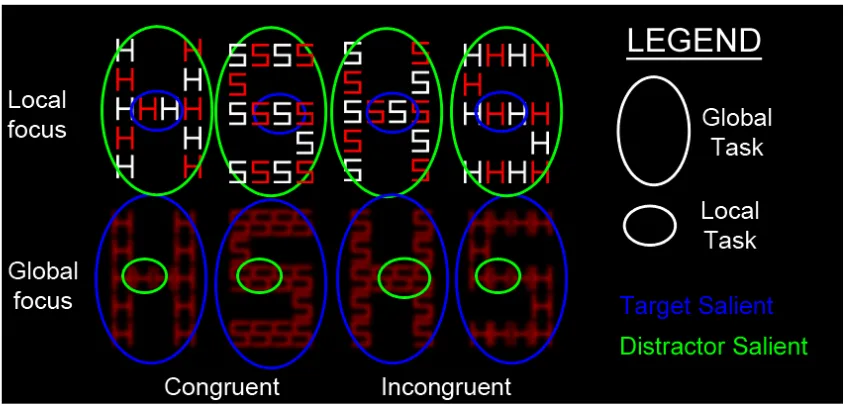
Figure 1. All compound letters with either high local saliency (top row) or high global saliency (bottom
row) used in the experiment. Target saliency was varied orthogonally with the task (Local task [small
circles] / Global task [Large ellipses]). The colour of the ellipse denotes the saliency level in particular
condition - target salient in blue (e.g. in a block with global task using the set of stimuli with global focus,
bottom row) and distractor salient in green (e.g. in a block of local task using the set of stimuli with global
Figure 5. Mean Z-score values (± 95% confidence interval) as a function of congruency,
Figure 7. Mean Z-score values (± 95% confidence interval) as a function of task (Global /