The range, abundance and habitat of Hinde’s Babbler Turdoides hindei: fine-scale changes in
abundance during 2000–2011 reflect temporal variation in scrub cover
PHIL SHAW, PETER NJOROGE, VINCENT OTIENO and EDSON MLAMBA
Running head: Changing status of Hinde’s Babbler Author head: P. Shaw et al.
Keywords: demography range habitat change land sharing Lantana
Summary
In developing countries ‘land sparing’ may be more effective than ‘land sharing’ in partially mitigating the impacts of farming on bird species diversity. We examined the pattern of change in the global and local distribution of Hinde’s Babbler Turdoides hindei, a ‘Vulnerable’ Kenyan endemic whose local abundance is dependent on a passive form of land sharing, in which farmland is left fallow or abandoned, enabling Lantana
scrub to colonise. In 2011 we assessed the species’ global range and resurveyed three IBAs, surveyed previously in 2000–01, to determine whether fine-scale changes in abundance reflected temporal changes in habitat quality. Although the babbler’s known range increased between 1900–70 and 1991–2011, we suggest that this apparent expansion largely reflects an improved knowledge base, and that several recently discovered sites are likely to have been overlooked in the past. In combination, the three IBAs surveyed in 2000-01 and 2011 showed little net change in the number of individuals (+1.3%) or groups (-3.8%) encountered, despite a 68% decline in the number individuals recorded at one site. Within 1-km transect sections there was a positive correlation between change in Hinde’s Babbler abundance and change in the amount of scrub cover available, such that a reduction in scrub cover of 22 and 6 percentage points, respectively, was associated with the loss of one group or one individual. The availability of scrub cover was dependent mainly on the amount land left uncultivated, perhaps in response to changes in the value of coffee and other crops. Since the babbler’s abundance thus currently depends mainly on land sharing by default, rather than by design, we suggest that a more proactive approach, involving land purchase or payments for land set aside, might help to secure its future.
Introduction
2005). Hinde’s Babbler Turdoides hindei, a ‘Vulnerable’ Kenyan endemic, is one such species, being associated mainly with residual patches of scrub and riverine thickets, interspersed with food crops, coffee plantations and pasture (Njoroge et al. 1998, Stattersfield et al. 1998, BirdLife International 2012). Despite the ubiquity of these broad habitat features the species is restricted mainly to the moist, southern slopes of Mt Kenya and the foothills of the Aberdares, with small, outlying populations in the catchments of the Tana and Athi Rivers (Njoroge & Bennun 2000, Shaw et al. 2003). First described by Sharpe (1900), its range was thought to have contracted substantially by the 1970s (Plumb 1979), apparently as a result of scrub clearance, perhaps compounded by human disturbance and hunting (Njoroge et al. 1998, Njoroge & Bennun 2000). By 1980–2001 its Area of Occupancy had fallen by 30%, and in 2000-01 its global population was estimated at 1,500–5,600 birds (Shaw et al. 2003).
During 1994 and 2000–01 surveys were conducted at six Hinde’s Babbler sites, to estimate population sizes and to investigate the relationship between scrub cover, babbler density and breeding success (Njoroge & Bennun 2000, Shaw & Musina 2003, Shaw et al. 2003). Relatively high densities of Hinde’s Babbler were recorded at two intensively cultivated, high-rainfall sites that had retained small amounts of scrub cover, mainly of the exotic Lantana camara (Njoroge et al. 1998, Shaw & Musina 2003). The distribution of babbler groups on these two sites showed a positive, non-linear relationship with scrub cover, levelling out where cover exceeded 15–20% (Shaw & Musina 2003). Breeding success (the proportion of young birds present) also varied in relation to the amount of scrub available, being significantly higher within areas retaining at least 10% cover (Shaw & Musina 2003). In contrast, babbler densities were much lower on less cultivated, semi-arid sites, despite these having retained larger amounts of scrub. Overall, the bulk of the species’ global population appeared to lie within fertile, intensively farmed areas that support high human population densities, and consequently offer limited scope for conservation through statutory site protection (Shaw & Musina 2003).
In North America and, particularly, in Europe, the negative impacts of farming on biodiversity have been mitigated partially through ‘land sharing’: the adoption of wildlife-friendly farming techniques, including the retention of extensively farmed semi-natural habitats (Pain & Pienkowski 1997, Krebs et al. 1999, Donald
et al. 2001). Since wildlife-friendly practices often require the landowner to forego opportunities for higher crop yields, such schemes can usually be sustained only through the payment of financial compensation. A second approach, ‘land-sparing’, involves attempting to maximise yields on existing farmland, while setting aside areas of land that support intact, natural habitats, or on which natural habitats may be restored (Balmford
et al. 2005, Green et al. 2005).
Examples of land sparing in the tropics (e.g. Phalan et al. 2011, Chandler et al. 2013, Hulme et al.
2013), and models comparing the likely benefits of land sparing versus land sharing worldwide (Green et al.
high-yield farming, if the latter is used as part of a strategy to reduce forest loss. A broadly similar pattern has been reported from Costa Rica, where the richness and diversity of forest-dependent birds was higher in a land-sparing coffee system than on land-sharing farms with shade-tolerant coffee plantations (Chandler et al.,
2013).
Here we describe changes in the known range of Hinde’s Babbler, its response to local changes in the distribution of scrub cover, and consider whether a more proactive approach is required, in which land sharing occurs more by design than by default. We determined changes in the status of Hinde’s Babbler at two spatial scales: by measuring trends in the global distribution of Hinde’s Babbler records during 1900–2011; and by assessing changes in the species’ abundance and demography at three Important Bird Areas (IBAs), surveyed in 2000–01 and 2011. To determine the likely causes of any change in abundance we compared the
distribution of scrub cover and of babbler groups within 1-km transect sections at each site. Specifically, we sought to determine the average change in scrub cover associated with an increase or a reduction in the number of Hinde’s Babbler groups, adults and offspring.
Methods
Geographic range
We measured the distribution of Hinde’s Babbler records during 1900–70, 1971–90 and 1991–2011, based on information presented in Plumb (1979), Lewis (1983, 1984), Collar & Stuart (1985), Lewis & Pomeroy (1989), Turner (1992), Shaw (1996), Bennun & Njoroge (1999), Burrell (1999), Mallalieu (1999), Maina & Eshiamwata (2000), Njoroge & Bennun (2000), Shaw et al. (2001, 2002) and Mulwa (2007). Recent records were also drawn from sightings submitted to Kenya Birds Net and the National Museums of Kenya, Nairobi. All records were aggregated into 10x10 km squares (hectads) on the UTM grid. Range size changes were quantified by counting the number of hectads within the species’ Area of Occupancy (AoO: hectads known to be occupied) and Extent of Occurrence (EoO: the area bounded by occupied hectads) (Gaston 1991) in each period.
Abundance, demography and habitat
During 1–21 July 2011, Hinde’s Babblers were surveyed at three sites previously surveyed in June-July 2000– 01: at Mukurweini, Kianyaga and Machakos Valleys IBAs. Both surveys were timed to follow the long rains, and hence were likely to coincide with an annual peak in the number of recently fledged young, providing a measure of breeding success (Shaw et al. 2003). At each site a recording of Hinde’s Babbler calls was played
previous surveys having shown no significant diurnal variation in the ratio of survey effort to detection rate (Shaw et al. 2002). The size and age composition of each babbler group was recorded. Most groups were watched for a minimum of 10–15 minutes, allowing time for stragglers to arrive. Individuals were assigned to one of three age classes (adult, juvenile or fledgling) according to eye colour, gape and plumage, as described in Shaw and Musina (2003).
Habitat features were assessed by one observer (P.S.) at 250 m intervals along each transect. A Garmin 12 GPS was used to relocate habitat points surveyed in 2000–01. The median distance between each habitat point in 2011 and its nearest equivalent in 2000–01 was 11m. At each point vegetation cover was estimated in four contiguous 50x50 m quadrats, in two pairs, on opposite banks of the watercourse. The following features were measured: altitude (to the nearest 20 m); topography (ridgetop, hillside, valley floor); slope (<30°; >30°); land use (uncultivated/semi-natural, part cultivated, intensively cultivated); presence/absence of food crop, coffee crop, banana crop; watercourse width category (<5 m; >5 m), whether dry or wet. Within each quadrat, tree cover (> 5 m high), scrub cover (< 5 m high) and coffee cover were estimated by eye, by pacing, or using a Leica LRF 800 Rangefinder. A total of 321 habitat points were surveyed.
To determine the relationship between habitat composition and the distribution of Hinde’s Babbler
groups, transects were divided into consecutive 1-km sections. Each habitat point and babbler group was assigned to its respective section, most sections encompassing four habitat points. Mean and modal values for each 1-km section were calculated for continuous and categorical habitat variables respectively, pooled from the 2000–01 and 2011 surveys. The presence/absence of Hinde’s Babbler groups was treated as the dependent variable in a forward, stepwise logistic regression model, fitted using SPSS 19.0. Although the same 1-km sections from each survey were thus treated as independent samples, we feel that this treatment is justified, given the likely turnover in Hinde’s Babbler numbers and habitat composition over the 10–11 yr interval
between surveys. Variables were retained in the model if the probability associated with their alpha value was less than 0.10.
Results
Changes in geographic range
Since 1900, Hinde’s Babbler has been recorded at sites spanning 650 m (Meru National Park) to 1,780 m a.s.l.
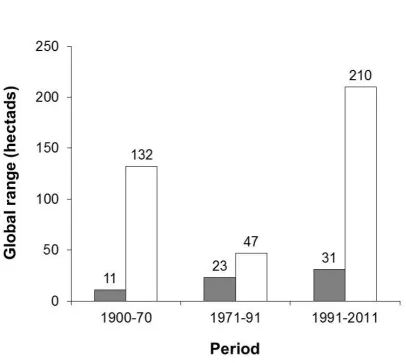
and near to Wote, SE of Machakos. Conversely, no records were received from several outlying sites, at Athi River, Ruiru and Nziu River. As a result, the babbler’s EoO and AoO have shown disparate trends (Figure 2), although both have increased since 1900-71; by 59% (EoO) and 182% (AoO). Note, however, that during 1991-2011 no records were received from 65% of hectads known to be occupied during 1971-90. Also, hectads known to be occupied during 1991–2011 represented just 58% of all hectads from which the species has been recorded.
Changes in abundance and demography
Surveys along 74 km of transects at Mukurweini, Kianyaga and Machakos Valleys IBAs in 2000–01 yielded a composite total of 304 Hinde’s Babblers in 78 groups. In 2011, the same transects yielded 308 individuals in
75 groups, indicating little overall change in the number of individuals (+1.3%) or groups (-3.8%). There was, however, a marked change in the species’ demography, with a 12% rise in the number of adults present (from
232 to 260) and a 30% reduction in the number of offspring (from 54 to 38).
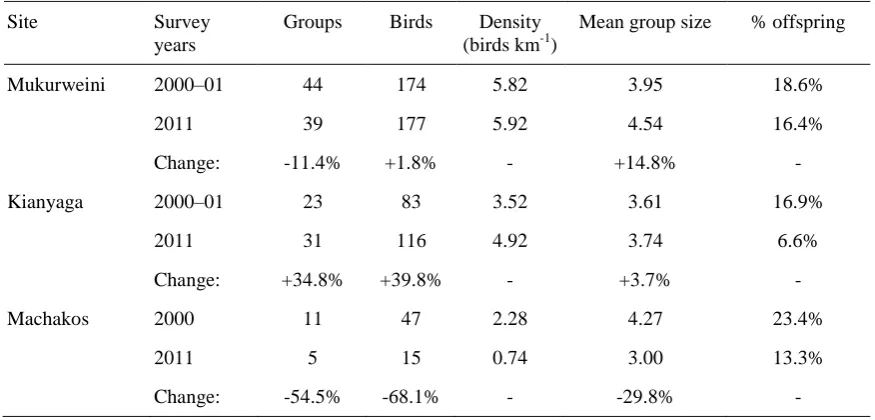
These combined figures mask differing trends at the three sites (Table 1). At Mukurweini, the number of individuals detected had increased slightly (+2%), while the number of groups present had declined (-11%), as had the percentage of offspring in the population (from 19% to 16%). At Kianyaga, the number of individuals and groups recorded had risen; by 40% and 35%, respectively, while the percentage of offspring present had declined; from 17% to 7%. In contrast, the numbers of individuals and groups recorded at Machakos had fallen by 68% and 55%, respectively, since 2000–01. The percentage of young birds in the population had likewise declined; from 23% to 13% (Table 1).
Group size and age composition
Based on data pooled from the 2000–01 and 2011 surveys, Hinde’s Babbler groups averaged 4.02 individuals (range 1–9; n = 211 groups), comprising a mean of 3.39 adults (mode: 3) and 0.63 juveniles or recent
fledglings (mode: 0; n = 205 aged groups). Young birds accounted for 15.7% of all birds aged (n = 824) and were present in 42.9% of all groups fully aged during the two surveys. Collectively, breeding success at Mukurweini, Kianyaga and Machakos was slightly lower in 2011 than in 2000–01 (13.0% vs. 18.9% offspring; χ2
1 = 0.816; n.s.), although differences at each site were not statistically significant.
The percentage of groups containing at least one juvenile or recent fledgling varied in relation to the number of adults present. Young birds were present in 32.8% of ‘small’ groups (of 1–3 adults) compared with 59.5% of ‘large’ groups (4–8 adults; χ2
1 = 14.165; P<0.001). Similarly, small groups contained significantly
Population change in relation to habitat change
The presence of Hinde’s Babbler groups within 1-km transect sections at Mukurweini and Kianyaga was positively correlated with watercourse width category (Wald = 5.936, 1 d.f., P = 0.015). This feature is unlikely to influence abundance directly, however, and was also strongly related to scrub cover (Mann-Whitney U = 445.00; P < 0.001). When watercourse width was excluded from the model, Hinde’s Babbler
presence showed a positive correlation with scrub cover only (Wald = 3.971, 1 d.f., P = 0.046).
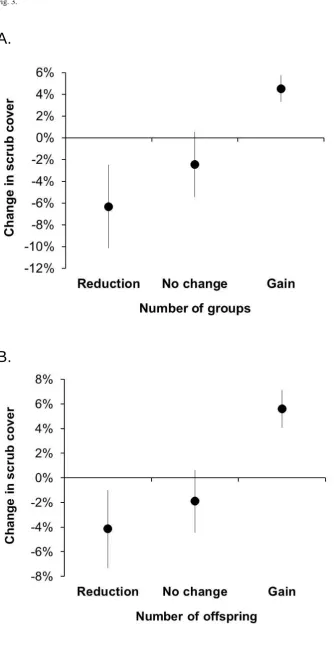
Change in percentage scrub cover within 1-km sections between 2000–01 and 2011 was positively related to the direction of change in the number of Hinde’s Babblers detected (Figure 3). Sections in which
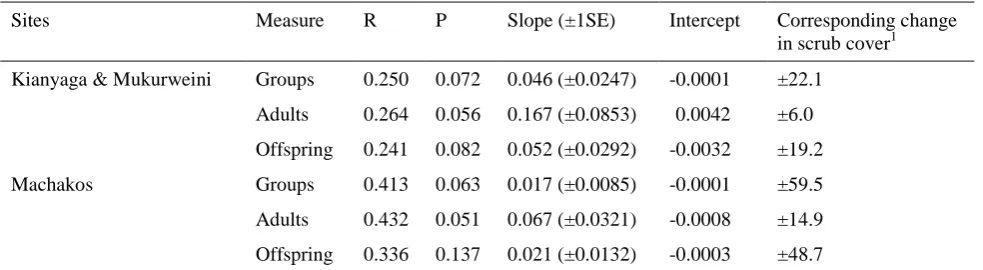
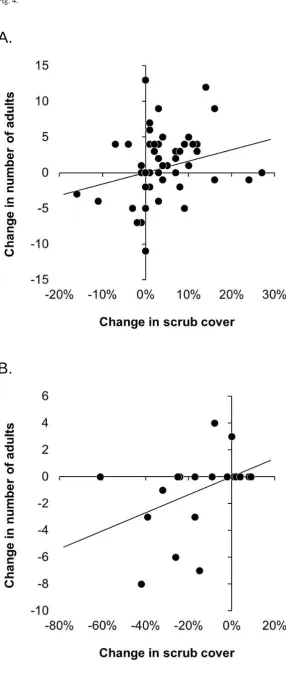
Hinde’s Babbler numbers had either increased or decreased showed a corresponding change in scrub cover, in the case of number of groups (Mann-Whitney U = 113.50; P = 0.002), adults (Mann-Whitney U = 167.00; P = 0.003) and offspring present (Mann-Whitney U = 63.00; P = 0.003). Changes in scrub cover were also correlated with the degree of change in the numberof Hinde’s Babbler groups and individuals encountered (Figure 4), although at a level only approaching statistical significance (Table 2). At Mukurweini and Kianyaga, the gain or loss of one group within a 1-km transect section was associated with a corresponding change in scrub cover of c.22 percentage points (P = 0.072). Similarly, the gain or loss of individual Hinde’s Babbler adults or offspring was associated with a change in scrub cover of c.6 percentage points (P = 0.056) and c.19 percentage points (P = 0.082), respectively. A similar relationship was evident at Machakos, where changes in babbler numbers were associated with more substantial changes in scrub cover (Table 2).
Discussion
A marked reduction in the distribution of Hinde’s Babbler sightings during the 1970s suggested that its global
range had contracted, giving rise to concerns over its status. In addition, increasingly intensive cultivation within the babbler’s known range, coupled with its evident dependence on scrub for cover and nesting, offered
a plausible explanation for its decline (Plumb 1979,Njoroge et al. 1998). In contrast, we show that the known range of Hinde’s Babbler has increased since 1900–70, perhaps as a result of improved data quality, and that
its abundance increased at two key sites during 2001–2011, while declining markedly at a third.
Bigger range or better data?
Machakos, Athi River, Kitui and Nziu River. A polygon fitted around known sites from 1900–1971 indicated a global Extent of Occurrence of 17,500 km2, whereas by 1979 it was considered to be ‘fairly common’ only within an area of 1,050 km2 (Plumb 1979). Our findings show that the species’ known EoO fell by 64% between 1900–1970 and 1971–90, but has since expanded markedly, due mainly to discoveries on the periphery of its known range. In contrast, its known AoO has risen progressively over the three time periods. Although both measures suggest that the global range of Hinde’s Babbler expanded between 1900–70 and
1991–2011, this change could reflect an improved knowledge base rather than a genuine expansion, having coincided with a period in which observer mobility, communications (e.g. by e-mail), and the collation of species records have all improved markedly. Despite this, observer coverage throughout most of the species’ range remains poor, as indicated by the disparity between its EoO and AoO, which differ by a factor of 4.3. Also, since Turdoides species tend to show limited dispersal (Gaston 1978a,b, Zahavi 1990, Monadjem et al.
1995, Raihani et al. 2010), Hinde’s Babblers are unlikely to rapidly colonise new areas far from established populations. There is, therefore, a strong likelihood that sites newly discovered during 1991–2011, which include the largest known population (at Mukurweini), had been occupied hitherto, but overlooked.
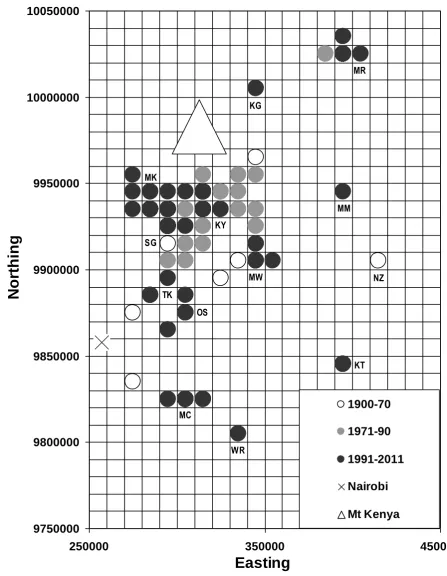
Notwithstanding the recent additions to its known range, several aspects of the species’ status give cause for concern. Despite an assumed improvement in observer coverage, Hinde’s Babblers were recorded from just 31 hectads during 1991–2011, representing 58% of its historical AoO. Also, no records were received from 65% of the hectads occupied during 1971–90, most of them within intensively cultivated areas between Embu and Chuka, and between Sagana and Thika (Figure 1). The absence of recent records from at least some of these hectads is likely to represent a genuine decline.
Temporal variation in babbler abundance and scrub cover
Turdoides species in East Africa lay mainly during months of high rainfall, particularly in March-May (Shaw & Musina 2003). The two surveys, in June-July 2000-01 and 2011, were therefore timed to provide an indication of breeding success over the preceding wet season. Since rainfall level is likely to have a positive influence on breeding success, the prolonged drought that affected much of Kenya during 2008-2011 (PDNA 2012) may explain the decline in breeding success recorded at all three sites in 2011.
During 2000-2011 the number of Hinde’s Babblers recorded at Machakos Valleys IBA declined by 68%. While low rainfall during 2008-11 may have contributed to this decline, the amount of scrub available at Machakos Valleys had also declined substantially; from 35% to 21% cover. Shaw and Musina (2003) demonstrated a positive spatial correlation between scrub cover and the presence and productivity of Hinde’s
During the 2011 survey signs of recent scrub clearance and regeneration were encountered often, particularly at Mukurweini, suggesting that there is a rapid turnover in the distribution of suitable habitat within Hinde’s Babbler territories. Figures 3 and 4 illustrate the dynamic nature of the relationship between
scrub presence and Hinde’s Babbler abundance, and provide the first evidence of a temporal correlation between these two measures, at a scale close to that of individual babbler territories. While the direction of change in Hinde’s Babbler numbers was strongly correlated with a change in mean scrub cover, the degree of
change in babbler numbers was only weakly correlated with scrub cover change (Table 2), suggesting that the loss of one group was associated with a reduction in scrub cover of between 14 and 48 percentage points (mean±1SE).
Scrub retention through land sharing
While studies contrasting the potential benefits of land sharing and sparing in tropical farmland have focused on the greater species diversity associated with forest fragments (e.g. Phalan et al. 2011, Chandler et al. 2013, Hulme et al. 2013), Hinde’s Babblers are strongly dependent on the persistence of scrub: a non-climax habitat whose distribution within the landscape is likely to change relatively rapidly. Currently, the species achieves its greatest densities where patches of scrub are set within a matrix of food crops and coffee plantations, as at Mukuweini and Kianyaga Valleys (Njoroge et al. 1998, Shaw et al. 2003). In 2000-01 and 2011 most of the scrub remaining at these sites consisted of small stands, typically of <0.05 ha, dominated by
Lantana camara; an invasive, exotic shrub whose ability to rapidly colonise set-aside land may largely account for the babbler’s persistence at these sites (Njoroge & Bennun 2000). That the babbler appears to benefit from
the presence of Lantana is unusual, although not unique; elsewhere, bird species also reported to benefit include dispersing juvenile Australian Brush-turkeys Alectura lathami (Göth & Vogel 2003), Kirtland’s Warblers Dendroica kirtlandii wintering in the Bahamas (Wunderle et al. 2010), Darwin’s Finches Geospiza
spp. in the Galapagos (Carrión-Tacuri et al. 2012) and four frugivores in South Africa (Mokotjomela et al.
2013). However, Hinde’s Babbler is the only globally threatened bird species we are aware of whose local abundance is positively correlated with the shrub’s distribution.
At Mukurweini, one small patch of land have been set aside deliberately to allow scrub to regenerate, for the benefit of Hinde’s Babbler (C. Kabiru and C. Kariuki, pers. comm. 2011). Other than this, the scrub
conservation groups might provide greater long-term security, and a more flexible approach to their management.
In conclusion, a recent expansion in the known range of Hinde’s Babbler is thought likely to reflect an improved knowledge base, rather than a genuine range extension. Conversely, further survey work is required to determine whether the species’ apparent absence from hectads occupied prior to 1991 represents a genuine contraction, and to monitor any further changes in the small population remaining at Machakos Valleys IBA. Our findings help to quantify the local impact of scrub creation or removal on Hinde’s Babbler abundance, and hence provide an indication of the potential value of small-scale set-aside within intensively cultivated areas. Further work is required to determine an optimum rotation length, patch size, distribution and species composition for the scrub cover on which Hinde’s Babblers depend at these sites.
Acknowledgements
We are extremely grateful to the British Ornithologists’ Union and the African Bird Club Conservation Fund, which generously co-funded fieldwork costs during 2011, to C. Kabiru and C. Kariuki of the Mukurweini IBA Site Support Group, for their able assistance in the field, and to the many observers who have submitted sightings of Hinde’s Babbler to the National Museums of Kenya or Kenya Birds Net. We would also like to
thank Phil Atkinson and two reviewers for their valuable comments on the manuscript.
References
Balmford, A., Green, R. E. & Scharlemann, J. P. W. (2005) Sparing land for nature: exploring the potential impact of changes in agricultural yield on the area needed for crop production. Global Change Biology 11: 1594–1605.
Bennun, L. & Njoroge, P. (1999) Important Bird Areas in Kenya. Nairobi, Kenya: East African Natural History Society.
BirdLife International (2012) Species factsheet: Turdoides hindei. Downloaded from http://www.birdlife.org on 01/03/12.
Burrell, J. H. (1999) Birding in … Embu. Kenya Birds 7(1&2): 23–28.
Carrión-Tacuri, J., Berjano, R., Guerrero, G., Figueroa, E., Tye, A. & Castillo, J. M. (2012) Predation on Seeds of Invasive Lantana camara by Darwin's Finches in the Galapagos Islands. The Wilson Journal of
Chandler, R. B., King, D. I., Raudales, R., Trubey, R., Chandler, Chávez, V. J. A. (2013) A small-scale land-sparing approach to conserving biological diversity in tropical agricultural landscapes. Conservation Biology 27(4): 785–795.
Collar, N. J. & Stuart, S. N. (1985) Threatened Birds of Africa and Related Islands. The ICBP/IUCN Red Data Book, Part 1. Cambridge, UK: ICBP & IUCN.
Donald, P. F., Green, R. E. & Heath, M. F. (2001) Agricultural intensification and the collapse of Europe's farmland bird populations. Proc. R. Soc. Lond. B. 268: 25-29.
Ewers, R. M., Scharlemannz, J. P. W., Balmford, A. & Green, R. E. (2009) Do increases in agricultural yield spare land for nature? Global Change Biology 15: 1716–1726.
Gaston, A. J. (1978a) Ecology of the common babbler Turdoides caudatus. Ibis 120: 415–432.
Gaston, A. J. (1978b) Demography of the jungle babbler Turdoides striatus. Journal of Animal Ecology 47: 845–870.
Gaston, K. J. (1991) How large is a species’ geographic range? Oikos 61(3): 434–437.
Göth, A. & Vogel, U. (2003). Juvenile dispersal and habitat selectivity in the megapode Alectura lathami
(Australian brush-turkey). Wildlife Research 30(1): 69–74.
Green, R. E., Cornell, S. J., Scharlemann, J. P. W. & Balmford, A. (2005) Farming and the fate of wild nature.
Science 307: 550-555.
Hall, B. P. & Moreau, R. E. (1970) An atlas of speciation in African passerine birds. London: British Museum (Natural History).
Hulme, M. F., Vickery, J. A., Green, R. E., Phalan, B., Chamberlain, D. E., Pomeroy, D. E., Nalwanga, D., Mushabe, D., Katebaka, R., Bolwig, S. & Atkinson, P. A. (2013) Conserving the Birds of Uganda’s Banana-Coffee Arc: Land Sparing and Land Sharing Compared. PLoS ONE 8(2): e54597.
doi:10.1371/journal.pone.0054597.
Krebs, J. R., Wilson, J. D. & Bradbury, B. & Siriwardena, G. M. (1999) The second Silent Spring? Nature
400: 611-612.
Lewis, A. D. (1983) Old records of some scarce or little-known species from Kenya. Scopus 7: 89–90. Lewis, A. D. (1984) Hinde’s Pied Babbler Turdoides hindei south of Machakos, Kenya. Scopus 8: 48–49.
Lewis, A. D. & Pomeroy, D. (1989) A Bird Atlas of Kenya. Rotterdam, the Netherlands: A.A. Balkema. Mallalieu, M. (1999) Hinde’s Babblers and Blue Quail near Thika. Kenya Birds 7(1&2): 60–61. Maina, M. & Eshiamwata, G. (2000) Ringing in Kindani, Meru. Kenya Birds 8(1): 9–10.
Mokotjomela, T. M., Musil, C. F. & Esler, K. J. (2013). Do frugivorous birds concentrate their foraging activities on those alien plants with the most abundant and nutritious fruits in the South African Mediterranean-climate region? Plant Ecol. 214: 49–59.
Monadjem, A., Owen-Smith, N. & Kemp, A. C. (1995) Aspects of the breeding biology of the Arrowmarked Babbler Turdoides jardineii in South Africa. Ibis 137: 515–518.
Njoroge, P. & Bennun L. (2000) Status and conservation of Hinde’s Babbler Turdoides hindei, a threatened species in an agricultural landscape. Ostrich 71(1&2): 69–72.
Njoroge, P. & Mutinda, D. (1996) Notes on nesting of Hinde’s Babbler Turdoides hindei and Northern Pied
Babbler T. hypoleucus in Central Kenya. Ostrich 67: 170–172.
Njoroge, P., Bennun, L. A. & Lens, L. (1998) Habitat use by the globally endangered Hinde’s Babbler
Turdoides hindei and its sympatric relative, the Northern Pied Babbler T. hypoleucus. Bird Conserv. Internatn. 8: 59–65.
Pain, D. J. & Pienkowski, M. W. (1997) Farming and Birds in Europe: The Common Agricultural Policy and Its Implications for Bird Conservation. London: Academic Press.
PDNA (2012) Kenya Post-Disaster Needs Assessment (PDNA). 2008-2011 Drought. Nairobi, Kenya: http://www.gfdrr.org/sites/gfdrr.org/files/Kenya_PDNA_Final.pdf
Perfecto, I. & Vandermeera, J. (2008) Biodiversity Conservation in Tropical Agroecosystems: A New Conservation Paradigm. Ann. N.Y. Acad. Sci. 1134: 173–200.
Phalan, B., Onial, M., Balmford, A. & Green, R. E. (2011) Reconciling Food Production and Biodiversity Conservation: Land Sharing and Land Sparing Compared. Science 333: 1289-1291.
Plumb, W. J. (1979) Observations on Hinde’s Babbler Turdoides hindei. Scopus 3(3): 61–67. Raihani, N. J., Nelson-Flower, M. J., Golabek, K. A. & Ridley, A. R. (2010) Routes to breeding in
cooperatively breeding pied babblers Turdoides bicolour. Journal of Avian Biology 41: 681–686. Sharpe, R. B. (1900) [Several new species of bird from Africa.] Bull. Brit. Orn. Club. 11: 28–29. Shaw, P. (1996) A search for Hinde’s Babbler north of Embu. Kenya Birds 5(1): 34–35.
Shaw, P. & Musina, J. (2003) Correlates of abundance and breeding success in the globally threatened Hinde’s Babbler Turdoides hindei and its congener, Northern Pied Babbler T. hypoleucus. Biol. Conserv. 114: 281–288.
Shaw, P., Musina, J. & Gichuki, P. (2001) Surveys of Hinde’s Babbler Turdoides hindei and Northern Pied Babbler T. hypoleucus in four Important Bird Areas. Research Reports of the Centre for Biodiversity, National Museums of Kenya: Ornithology 40.
Shaw, P., Gichuki, P. & Musina, J. (2002) A survey of Hinde’s Babbler Turdoides hindei at five sites, June– July 2001. Research Reports of the Centre for Biodiversity, National Museums of Kenya: Ornithology 42. Shaw, P., Musina, J. & Gichuki, P. (2003) Estimating change in the geographical range and population size of
Hinde’s Babbler Turdoides hindei. Bird Conserv. Internatn. 13: 1–12.
Stattersfield, A. J., Crosby, M. J., Long, A. J. & Wege, D. C. (1998) Endemic Bird Areas of the World. Priorities for Biodiversity Conservation. Cambridge, UK: BirdLife International. (BirdLife Conservation Series No. 7.)
Wunderle, J. M., Currie, D., Helmer, E. H., Ewert, D. N., White, J. D., Ruzycki, T. S., Parresol, B., Kwit, C. (2010) Kirtland’s Warblers in anthropogenically disturbed early-successional habitats on Eleuthera, the Bahamas. The Condor 112(1): 123-137.
Zahavi, A. (1990) Arabian Babblers: the quest for social status in a cooperative breeder. Pp. 103–130, in P. B. Stacey & W. D. Koenig, eds. Cooperative breeding in birds: long-term studies of ecology and behavior. Cambridge, UK: Cambridge University Press.
PHIL SHAW*
School of Biology, University of St Andrews, St Andrews, Fife KY16 9TS. UK
PETER NJOROGE, VINCENT OTIENO and EDSON MLAMBA
Department of Zoology, National Museums of Kenya, PO Box 40658 – 00100, Nairobi, Kenya
Table 1. Changes in the number and demography of Hinde’s Babbler groups at three IBAs between 2000–01 and 2011.
Site Survey years
Groups Birds Density (birds km-1)
Mean group size % offspring
Mukurweini 2000–01 44 174 5.82 3.95 18.6%
2011 39 177 5.92 4.54 16.4%
Change: -11.4% +1.8% - +14.8% -
Kianyaga 2000–01 23 83 3.52 3.61 16.9%
2011 31 116 4.92 3.74 6.6%
Change: +34.8% +39.8% - +3.7% -
Machakos 2000 11 47 2.28 4.27 23.4%
2011 5 15 0.74 3.00 13.3%
[image:13.595.56.494.136.346.2]Table 2. Linear regression coefficients relating change in percentage scrub to change in the number of Hinde’s Babbler groups, adults and offspring recorded within 1-km sections of transect.
Sites Measure R P Slope (±1SE) Intercept Corresponding change in scrub cover1 Kianyaga & Mukurweini Groups 0.250 0.072 0.046 (±0.0247) -0.0001 ±22.1
Adults 0.264 0.056 0.167 (±0.0853) 0.0042 ±6.0
Offspring 0.241 0.082 0.052 (±0.0292) -0.0032 ±19.2
Machakos Groups 0.413 0.063 0.017 (±0.0085) -0.0001 ±59.5
Adults 0.432 0.051 0.067 (±0.0321) -0.0008 ±14.9
Offspring 0.336 0.137 0.021 (±0.0132) -0.0003 ±48.7
1
[image:14.595.54.546.143.278.2]List of Figures
Figure 1. The distribution of Hinde’s Babbler sightings during 1900–2011, at a resolution of 10x10 km. The most recent period in which Hinde’s Babblers have been recorded in each hectad is indicated as follows:
1900–1970; 1971–90; 1991–2011. UTM coordinates are shown on the axes.
Localities shown: KG: Kaaga; KT: Kitui; KY: Kianyaga; MC: Machakos; MK: Mukurweini; MM: Muumoni Hills; MR: Meru NP; MW: Mwea NR; NZ: Nziu River; OS: Ol Donyo Sabuk; SG: Sagana; TK: Thika; WR: Wote Road.
Figure 2. Changes in the estimated range of Hinde’s Babbler over three time periods. : Area of Occupancy (the number of hectads known to be occupied); : Extent of Occurrence (the number of hectads encompassed by a polygon fitted around hectads known to be occupied).
Figure 3. Changes in the mean (SE) percentage scrub cover within 1-km sections of transect in relation to the direction of change in the number of Hinde’s Babblers present between 2000–01 and 2011. Data pooled from all three sites. A: number of groups present; B: number of juveniles and fledglings present.
Fig. 1.
9750000 9800000 9850000 9900000 9950000 10000000 10050000
250000 350000 450000
Easting
N
o
rth
in
g
1900-70
1971-90
1991-2011
Nairobi
Mt Kenya MR
MM
NZ
KT
WR MC
MW TK
SG
KY
OS
KG
Fig. 2.
Fig. 3.
A.
Fig. 4.