ISSN Online: 2164-5175 ISSN Print: 2164-5167
DOI: 10.4236/ajibm.2019.912140 Dec. 11, 2019 2112 American Journal of Industrial and Business Management
The Impact of Financial Development on
Manufacturing Structural Upgrading: Quantity
or Quality
Xu Zhang
1,2, Xinfeng Li
1,2, Lintao Ding
1,2, Xiaoyan Zhang
1,21Postdoctoral Workstation of China Construction Bank, Beijing, China 2Postdoctoral Research Station of Renmin University of China, Beijing, China
Abstract
Financial development plays a promotive role in improving capital allocation effect of industrial sectors, promoting new industrial technologies and choosing leading industries. Studying the relationship between financial de-velopment and structural upgrading of the manufacturing industry in the transition period of “high-quality development of manufacturing industry in China” is meaningful and important. To achieve high-quality development, we must simultaneously improve the efficiency of capital allocation and technological innovation, both of which need the support and the promotion of financial development. This paper systematically analyzes the impact me-chanism of financial development on the upgrading of manufacturing indus-try structure. Based on the panel data of 121 cities with active industries in China from 2006 to 2018, the impact of financial development on the up-grading of manufacturing industry structure is studied from three aspects: fi-nancial scale, fifi-nancial efficiency and fifi-nancial agglomeration degree. The empirical results show that there is a positive correlation between financial efficiency and structural upgrading of manufacturing industry, and a negative correlation between financial scale or financial agglomeration and structural upgrading. Further analysis shows that financial development has an effect on manufacturing industry structural upgrading effectively. However, this effect is mainly driven by the development of “quality” of the financial industry, while the development of “quantity” plays a reverse inhibitory role.
Keywords
Financial Development, Manufacturing Industry Structural Upgrading, High-Quality Development
How to cite this paper: Zhang, X., Li, X.F., Ding, L.T. and Zhang, X.Y. (2019) The Impact of Financial Development on Man-ufacturing Structural Upgrading: Quantity or Quality. American Journal of Industrial and Business Management, 9, 2112-2128. https://doi.org/10.4236/ajibm.2019.912140
Received: October 8, 2019 Accepted: December 8, 2019 Published: December 11, 2019
Copyright © 2019 by author(s) and Scientific Research Publishing Inc. This work is licensed under the Creative Commons Attribution International License (CC BY 4.0).
http://creativecommons.org/licenses/by/4.0/
DOI: 10.4236/ajibm.2019.912140 2113 American Journal of Industrial and Business Management
1. Introduction
“Made in China 2025” is the first ten-year action plan of the Chinese govern-ment to implegovern-ment the strategy of manufacturing power. Based on the trend of international industrial transformation, the strategic plan is formulated to com-prehensively improve the quality and production level of China’s manufacturing industry. Its fundamental goal is to change the current situation of “big but not strong” in China’s manufacturing industry by making extensive efforts to build China into a manufacturing powerhouse with global leadership and influence by 2045.
In the past, China’s manufacturing industry structural upgrading was driven by the growth of the input of production factors, which was unsustainable. Dur-ing the recent economic downturn, the operatDur-ing environment of manufacturDur-ing enterprises deteriorated, and the non-performing rate in bank loans from the manufacturing sector remained high and continued to rise sharply in 2018. The data show that the non-performing rate rose from 5.70% to 6.02% in Agricultur-al Bank of China, from 4.80% to 5.76% in IndustriAgricultur-al and CommerciAgricultur-al Bank of China, and from 6.36% to 7.27% in China Construction Bank. Also, the financial institutions decline in business performance due to the failure in meeting the high-quality development concept of the manufacturing industry and the poor operating conditions of enterprises in areas with severe overcapacity. By the end of 2018, the proportion of manufacturing loans in the Bank of China decreased from 15.98% to 13.98%, and the loan balance was reduced from 1371.246 billion Yuan to 1296.509 billion Yuan.
In fact, the proportion of China’s manufacturing industrial value added to GDP has begun to decline since 2006. It dropped from 31.5% in 2010, which was the peak, to 29% in May 2019. China’s economic security policy is stated that the manufacturing industrial value-added shall not account for less than 30% of GDP. Therefore, financial support is urgently needed to improve the efficiency of resource allocation, such as capital and technology, to promote the upgrading of manufacturing industry structure and increase the proportion of the value added of the manufacturing industry to GDP. The financial system has become a driving force and means to upgrade the manufacturing industry structure by unblocking the channels of transformation between the capital surplus depart-ment and the capital shortage departdepart-ment, thereby smoothing the manufactur-ing innovation and financmanufactur-ing channels, regulatmanufactur-ing the coordinated development of macroeconomic operation and micro-enterprise operation. Therefore, it is meaningful and important to study the relationship between the financial de-velopment and structural upgrading of the manufacturing industry in the transi-tion period of “high-quality development” of the manufacturing industry in China.
1.1. Literature Review
indus-DOI: 10.4236/ajibm.2019.912140 2114 American Journal of Industrial and Business Management
trial structural upgrading and economic growth. The role of finance in industrial development was first studied by Bagehot, who studied financial factors as an exogenous variable of the industrial structure change [1]. He believed that the financial system provided capital support for large-scale industrial projects in the process of the British Industrial Revolution. Rostow put forward the six-stage theory of economic growth according to technical standards by using the method of gross sector analysis [2]. He believed that a country should choose sectors with diffusion effect as the leading industrial sector, transfer the indus-trial advantages of the leading industries to other related industries, and then promote the development of other industries. The adjustment and upgrading of industrial structure was the key to economic and social development. Goldsmith believed that financial development and economic growth were parallel, and this period was mainly driven by changes in industrial structure [3].
In the 1990s, it was focused on that financial factors were endogenous in-fluencing variables of the industrial structure change. It was emphasized that fi-nancial development was a necessary means and an important driving force for industrial structure adjustment [4] [5], which had been proved by empirical re-search [6] [7]. Upon further investigation of the interaction between financial development and industry structural upgrading, their conclusions showed sig-nificant differences. Gehrig and Levine et al. found that there was a sigsig-nificant correlation between financial development and economic growth, but there was no clear causal relationship [8] [9], while Luintel and Khan found that there was a significant two-way causal relationship between financial development and economic growth [10]. Also, it was shown that the relationship between the two was different at different stages of development and could not be summarized as a single linear relationship [11]. There were obviously different conclusions in the relationship between financial development and economic growth. Cao, Wu and Shan believed that there was a one-way causal relationship between them
[12] [13]. Mao, Wang and Sun believed that there was a reciprocal causal
rela-tionship between them [14] [15]. Chen and Du believed that the financial de-velopment was inhibiting to the economic growth [16]. However, a significant positive effect was found between financial intermediation and economic growth
[17] [18] [19].
de-DOI: 10.4236/ajibm.2019.912140 2115 American Journal of Industrial and Business Management
veloped countries. It was also found that a sound financial system promoted the upgrading of manufacturing industry structure by several means, including im-proving the efficiency of savings-investment conversion, optimizing resource al-location, encouraging corporate finance dominated by stock and bond financing, opening up to the foreign economy, promoting technological innovation and stimulating entrepreneurship [22]-[26].
Another view was that the role of financial development in the development of the manufacturing industry is not obvious. Robinson (1952) believed that the financial industry and the real economy were separated from each other. The di-vision of economic functions and the professional development of the financial industry would also lead to the separation of finance and manufacturing [27]. It would hinder the development of manufacturing industry, once the finance was separated from the manufacturing industry. First, financial development brought turbulence to the manufacturing industry [28], and financial innovation would delay economic development [29]. Second, the problems of financial in-stitutions lead to the instability of related manufacturing industries [30], and the limited role of external financing which linked the financial industry with the manufacturing industry had limited promotion to the manufacturing industry. All these led to the failure of the financial industry to promote the development of manufacturing industry [31]. Third, distortions such as government interven-tion and mandatory loans caused non-market behaviors to support backward industries by financial market capitals, while industries with economic advan-tages and technological prospects did not receive sufficient financial support
[32]. Fourth, the financing needs of the manufacturing industry could be met only when the financial structure matched the scale of the manufacturing
indus-try [33]; Carlin and Mayer believed that the market-oriented financial structure
was conducive to promoting the growth of high-tech and high-risk industries, and the bank-oriented financial structure was conducive to promoting the growth of traditional and low-risk industries [34]. The current financial support system lagged behind the development needs of the equipment manufacturing industry. The finance failed to support the development of manufacturing in-dustry fully, for the financial support was insufficient, and did not play a good role in the manufacturing industry. Fifth, financial repression hinders the nor-mal transformation of China’s economic structure [35].
DOI: 10.4236/ajibm.2019.912140 2116 American Journal of Industrial and Business Management
1.2. Paper Structure
In view of above points, the level of financial development and the upgrading of manufacturing industry structure are systematically measured in the second and third parts of this paper. Based on this, an empirical test is made in the fourth part using a panel data of 121 cities with strong industries in China from the year 2006 to 2018. Conclusions are drawn, and policy recommendations are given in the fifth part. The marginal contribution of this paper lies in: First, based on the three dimensions of financial scale, financial efficiency and finan-cial agglomeration degree, the impact of finanfinan-cial development on manufactur-ing industry structural upgradmanufactur-ing is explored in urban areas; second, it is ans-wered in this paper whether the impact of financial development on the up-grading of China’s manufacturing industry is driven by financial “quality” or “quantity”, and also the question which aspect of the driving effect is more sig-nificant.
2. Measurement of Financial Development Level
Goldsmith first proposed the financial development level evaluation index— “Financial Interrelations Ratio (FIR)”, which was defined as the ratio of the total value of financial assets to that of real assets [3]. He believed that changes in the index level reflected the relationship between the financial superstructure and economic infrastructure in scale. The disadvantage of the index was that only the scale of financial intermediation was considered. According to this idea, King and Levine measured the level of financial development from four aspects: Depth, Bank, Private and Privy [7]. The indicators of stock market value, insur-ance depth, and the ratio of bank deposit or loan to GDP were used to describe the level of financial development [36] [37] [38] [39], when the role of financial development in upgrading industrial structure was studied. Although the indi-cators had been improved from one-dimensional to multi-dimensional, the measurements of financial development level were made separately in one or several aspects and cannot be described on the whole. Based on the existing re-search results, the three dimensions and multi-variable comprehensive evalua-tion index are established to describe financial development level using financial scale, financial efficiency and financial agglomeration degree.
2.1. Financial Scale
DOI: 10.4236/ajibm.2019.912140 2117 American Journal of Industrial and Business Management
It is shown in Figure 1 that in recent years, the proportion of added value of China’s financial industry to total value added of the tertiary industry has been steadily sustained at about 10%, and shows a steady upward trend, reaching a maximum of 18.05% by 2016, indicating that the scale of the financial industry is increasing, and the impact on the real economy will be more significant.
2.2. Financial Efficiency
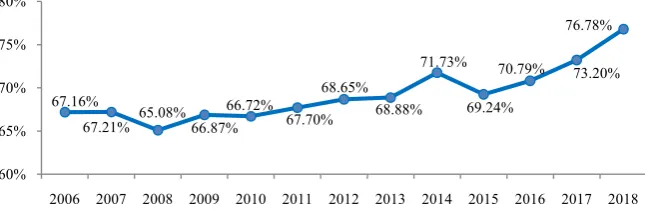
[image:6.595.217.533.386.540.2]Financial efficiency can measure the maturity of financial development. The cri-terion is the effectiveness of financial institutions in allocating funds in econom-ic activities. Xiong and Tan equate financial effeconom-iciency with the added value of the financial sector [41], using the per capita added value of the financial sector (the added value of the regional financial industry/the regional population) and the average wage of the financial industry (the on-the-job employees of the fi-nancial industry) as indicators. The loan/deposit of fifi-nancial institutions is used to reflect the conversion efficiency of deposit and loan, and also the efficiency of financial institutions’ support to the real economy. It is shown in Figure 2 that in 2008, there was a record low value of 65.08% (affected by the subprime mort-gage crisis in the United States), followed by a significant rebound. It shows that the efficiency of financial intermediaries improved and the effectiveness of sup-porting the real economy by finance was indeed working.
Figure 1. The calendar year data on China’s financial scale from 2006 to 2018. Data
source: WIND DATABASE.
Figure 2. The calendar year data of China’s financial efficiency from 2006-2018. Data
source: WIND DATABASE.
10.97% 13.24%
13.54% 14.24%
14.26% 14.35%
14.53% 14.98%
15.30% 16.87%
18.05% 17.48%
16.90%
8% 10% 12% 14% 16% 18% 20%
2006 2007 2008 2009 2010 2011 2012 2013 2014 2015 2016 2017 2018
67.16%
67.21% 65.08%66.87% 66.72%
67.70% 68.65%
68.88% 71.73%
69.24%
70.79% 73.20% 76.78%
60% 65% 70% 75% 80%
[image:6.595.212.535.589.694.2]DOI: 10.4236/ajibm.2019.912140 2118 American Journal of Industrial and Business Management
2.3. Financial Agglomeration Degree
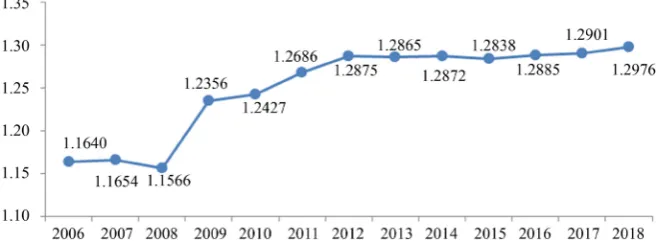
The financial agglomeration is the common phenomenon of financial develop-ment in modern countries. As a new interpretation reflecting the economy of scale, the economy of scope and division of regional specialization, financial ag-glomeration promoted the rapid upgrading of many industrial clusters, behind the rapid growth of regional financial agglomeration (Sun and Li, 2012). Loca-tion entropy was usually used to measure the agglomeraLoca-tion degree of an indus-try, which was also a method to measure the scale efficiency of industrial layout and the level of industrial specialization [42]. The financial aggregate degree of China from 2006 to 2018 is outlined in Figure 3.
3. Measuring the Manufacturing Industry Structural
Upgrading
Li analyzed the three measurement criteria of technological innovation capabili-ty, human capital accumulation level and resource utilization efficiency of the industrial system, and constructed a comprehensive index system for industrial structure upgrading to measure industrial structure upgrading [43]. The ratio of the value added by the secondary industry to GDP and the value added by the tertiary industry to GDP was used to measure the industry structural upgrading
[40]-[44]; Li and Ping [45], Wang and Chen [46] selected technology-intensive
[image:7.595.209.541.574.698.2]level, ecological level, high value-added level, scale level and high processing lev-el in heavy industry, etc., as indicators respectivlev-ely from the dimensions of in-dustrial structure heightening and rationalization, in order to measure the level of manufacturing industry upgrading by industry and sub-region. Cheng be-lieved that advanced production factors such as technology play a prominent role in the manufacturing industry, indicating that the manufacturing industry structure is constantly upgrading [47]; Yang believed that manufacturing indus-try structural upgrading referred to the change of the three types of industries: labor-intensive, capital-intensive and technology-intensive manufacturing in-dustries [48]. The manufacturing industry structural upgrading was the process that the proportion of labor-intensive manufacturing output to the to-tal output value of the manufacturing industry was declining, and that the
Figure 3. The calendar year data of China’s financial agglomeration from 2006 to 2018.
DOI: 10.4236/ajibm.2019.912140 2119 American Journal of Industrial and Business Management
proportion of technology-intensive manufacturing was rising and that the pro-portion of capital-intensive manufacturing was ascending initially and then des-cending.
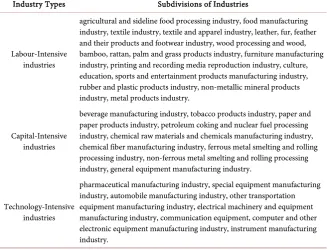
Based on the above measurement and standards for manufacturing industry upgrading, this paper started from the requirement of “high-quality develop-ment of China’s manufacturing industry”, followed the important path of “big manufacturing country” to “strong manufacturing country”, which is “innova-tion-driven, intelligent transformation”, and took the proportion of intensive industries with advanced production factors to the total manufacturing indus-tries as an indicator for measuring the transformation and upgrading of China’s manufacturing industry. According to the difference in the density of factors in the manufacturing industry, it was divided into three categories: labor, capital and technology-intensive industries, and then analyzed how capital, technology and production factors flew from low-end manufacturing to high-end manufac-turing. Wang and Dong used laborers, their remuneration, capital stock, and R&D investment to indicate the labor, capital, and technology intensity of each industry in the manufacturing industry [49]. Using this method, the data of 28 subdivisions of China’s manufacturing industry in 2006-2018 corresponding to each indicator are used (the data came from China Population and Employment Statistics Yearbook and China Industry Economy Statistical Yearbook) and clas-sified into labor, capital and technology by calculating the proportion of labor, capital and technology elements in each sub-sector (Table 1).
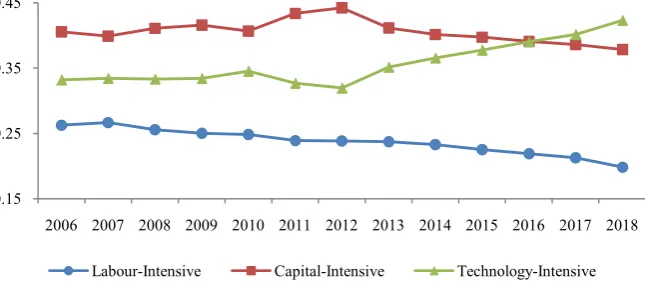
[image:8.595.211.543.464.714.2]According to Table 1, the ratio of the three major industries in China’s man-ufacturing industry is calculated, and the results are shown in Figure 4. Through
Table 1. Manufacturing industry classification.
Industry Types Subdivisions of Industries
Labour-Intensive industries
agricultural and sideline food processing industry, food manufacturing industry, textile industry, textile and apparel industry, leather, fur, feather and their products and footwear industry, wood processing and wood, bamboo, rattan, palm and grass products industry, furniture manufacturing industry, printing and recording media reproduction industry, culture, education, sports and entertainment products manufacturing industry, rubber and plastic products industry, non-metallic mineral products industry, metal products industry.
Capital-Intensive industries
beverage manufacturing industry, tobacco products industry, paper and paper products industry, petroleum coking and nuclear fuel processing industry, chemical raw materials and chemicals manufacturing industry, chemical fiber manufacturing industry, ferrous metal smelting and rolling processing industry, non-ferrous metal smelting and rolling processing industry, general equipment manufacturing industry.
Technology-Intensive industries
pharmaceutical manufacturing industry, special equipment manufacturing industry, automobile manufacturing industry, other transportation equipment manufacturing industry, electrical machinery and equipment manufacturing industry, communication equipment, computer and other electronic equipment manufacturing industry, instrument manufacturing industry.
DOI: 10.4236/ajibm.2019.912140 2120 American Journal of Industrial and Business Management
Figure 4. Trends in manufacturing structure change in 2006-2018. Data source: WIND
DATABASE.
the analysis of the trend of China’s manufacturing industry structure change in the 13 years from 2006 to 2018, it can be seen that among the three major indus-tries, the proportion of the total output value of capital-intensive industries maintains at over 40% of the total output value of the manufacturing industry until 2016. The total output value of technology-intensive industries is in the middle, showing a rising trend in general, and exceeding the proportion of capi-tal-intensive output value for the first time in 2016. At the same time, the total output value of labor-intensive industries accounts for the least proportion of total output value, and the proportion continues to decline over the years. The overall development of the manufacturing industry shows a trend of structural upgrading.
4. Model and Empirical Analysis
4.1. Basic Model Specification
Based on the above analysis, it can be concluded that financial development fac-tors, such as financial scale, financial efficiency and financial agglomeration de-gree, have an important impact on the transformation and upgrading of manu-facturing industry. In addition, the government financial investment, foreign investment, technology innovation and other factors also affect the upgrading of industrial structure. The upgrading of manufacturing industry structure is the result of a combination of factors. The following econometric models are con-structed:
1 2 3
ln TCit = +C α ln FGit+α ln FXit+α ln FJit+δlnXit+εit (1)
In formula (1), TCit is the proportion of technology-intensive industries for
the city i in year t. C is the intercept term, representing a fixed value that doesn’t vary with the individual. FGit, FXit and FJit represent financial scale,
fi-nancial efficiency and fifi-nancial agglomeration degree for the city i in year t re-spectively. Xit is the control variable, indicating other factors that affect the
upgrading of manufacturing industry structure. εit represents the error term.
In order to ensure that financial development can explain the structural
up-0.15 0.25 0.35 0.45
2006 2007 2008 2009 2010 2011 2012 2013 2014 2015 2016 2017 2018
DOI: 10.4236/ajibm.2019.912140 2121 American Journal of Industrial and Business Management
grading of manufacturing industry to the greatest extent, Equation (1) is de-composed into four different models: the original equation is defined as model 1; Given α2 =α3 =0, the equation is defined as model 2; Given α1 =α3 =0, the
equation is defined as model 3; Given α1=α2 =0, the equation is defined as
model 4.
4.2. Data Source and Control Variable Selection
The relationship focuses on financial development and the upgrading of manu-facturing industry structure at the regional level. The existing literature studies on the relationship between them mainly focused on the scale of provincial re-gions. Compared with the provincial regions, the division of municipal regions is more accurate as the scope of regions can measure and reflect the financial development degree and manufacturing development status of a region. There-fore, the relationship is analyzed from the level of municipal regions in this pa-per. By consulting the data of about 293 cities in CHINA CITY STATISTICAL YEARBOOK from 2007 to 2018 and 2018 STATISTICAL COMMUNIQUE, 121 cities whose total industrial output value have been maintained in the top 50% in 13 years are selected as samples for analysis.
Based on the existing research literature, the control variables of regression model includes the following variables: 1) The ratio of foreign direct investment (actual utilization of foreign capital) to regional GDP, which was used to meas-ure the adjustment effect of FDI in industrial structmeas-ure; 2) Human capital stock, by the proportion of the total students in universities to the total employment population, was used to measure the level of human capital development (HMC); 3) Government investment, using the proportion of regional government finan-cial investment in GDP to measure (FIS). The data of the indicators come from CHINA CITY STATISTICAL YEARBOOK, CHINA INDUSTRY STATISTICAL YEARBOOK, Almanac of China’s Finance and Banking from 2007 to 2018 and 2018 STATISTICAL COMMUNIQUE of 121 cities.
4.3. Analysis of Empirical Result
In order to avoid false regression of panel data due to non-stationary in the time dimension, a fixed-effect model with variable intercepts is used for regression analysis. The empirical relationship between financial development and struc-tural upgrading of the manufacturing industry is shown in Table 2.
DOI: 10.4236/ajibm.2019.912140 2122 American Journal of Industrial and Business Management
Table 2. Empirical analysis results.
Variables Model 1 Model 2 Model 3 Model 4
FG −0.1261*** (−4.44) −0.1145*** (−4.52) - -
FX 0.2049** (2.72) - 0.2533*** (4.71) -
FJ −0.0176** (2.65) - - −0.1198** (4.04)
FIS −0.0206 (−0.32) −0.0021 (−0.06) −0.0713 (−1.19) −0.0539 (−0.91)
FDI 0.0132 (0.68) 0.0089 (0.48) 0.0011 (0.08) 0.0005 (0.03)
HMC 0.0681** (2.37) 0.0670** (2.29) 0.0340 (1.28) 0.0376** (2.23)
C −0.7766*** (−5.42) −0.7177*** (−5.04) −0.7507*** (−5.02) −0.6866*** (−4.63)
Note: T test value of regression coefficient is shown in brackets. ***, ** and * respectively represent signi-ficance levels of 1%, 5% and 10%.
From the regression results of Model 1 and Model 3, the T statistics of finan-cial efficiency variables are all significant and the coefficients are positive, which indicates that the improvement of financial efficiency would promote the up-grading of regional manufacturing structure to a certain extent, and the positive effect was about 0.25%.
From the regression results of Model 1 and Model 4, the T statistics of the fi-nancial agglomeration degree variables are significant at 5% significance level and the coefficients are negative, which indicates that the regional financial ag-glomeration degree has a certain inhibitory effect on the upgrading of manufac-turing structure. It shows that every 1% increase of regional financial agglomera-tion degree would make the proporagglomera-tion of technology-intensive model in manu-facturing structure industries decline by about 0.2%.
Comparing the effects of three factors, it can be seen that regional financial scale and financial agglomeration inhibits the increase of technology-intensive industries in manufacturing structure. The two indicators essentially reflect the development of regional financial volume level. Empirical results show that China’s regional finance cannot effectively promote the transformation and up-grading of regional manufacturing structure by relying on the “quantitative” de-velopment, indicating that the capital doesn’t flow into the manufacturing sector effectively, which may be related to the development of China’s real estate mar-ket.
ef-DOI: 10.4236/ajibm.2019.912140 2123 American Journal of Industrial and Business Management
ficiency can effectively promote the upgrading of the manufacturing industry. From Model 1, it can be further found that the coefficients of financial scale and financial agglomeration are both less than the coefficient of financial effi-ciency, indicating that regional financial development can effectively promote the upgrading of regional manufacturing structure on the whole, but this role is mainly promoted by the development of financial industry in terms of quality. The development of quantitative, on the contrary, acts as a negative inhibitor. The reverse effect of “quantity” also suggests that the improvement of financial scale and financial agglomeration degree makes more funds to flow into real es-tate and other industries, which should be used to support the upgrading of manufacturing structure.
4.4. Robustness Test
The regression results are tested for robustness in this paper. On one hand, con-sidering the correlation between financial development and industrial structure, the ratio of bank deposits and loans to GDP, which can reflect the supporting role of regional financial development to economic growth, is adopted univer-sally. In this paper, the index of Financial Correlation Ratio, the sum of bank deposits and loans to GDP, is used to measure financial development and carry out a regression test. On the other hand, considering that the data of developed financial areas may have an impact on the regression results, regression analysis is re-performed to test the robustness of previous results, excluding 11 relatively special regional data of financial development such as Beijing, Shanghai, Shenz-hen, Guangzhou, Hangzhou, Chongqing, Tianjin, Suzhou, Wuhan, Qingdao and Ningbo. The regression results were shown as follows:
The regression results in Table 3 show that the regression results of the im-pact of various financial development indicators on the upgrading of manufac-turing industry structure are still significant after adding the variable of “finan-cial correlation ratio” in Equation (1).
The regression results of Model 5 indicates that the negative effects of finan-cial scale and finanfinan-cial agglomeration degree on the upgrading of manufacturing industry structure are statistically weaker than the financial correlation ratio, while the positive effect of financial efficiency is obvious.
From the regression results of Model 6, financial development plays a signifi-cant role in the upgrading of manufacturing industry structure when Financial Correlation Ratio is taken as a single indicator to measure financial development for regression. In Model 5 and Model 6, the regression results of government fi-nancial investment, foreign direct investment and human capital show that gov-ernment financial investment and foreign direct investment don’t significantly affect the upgrading of regional manufacturing industry structure in China, while the human capital stock plays a substantial role in promoting the upgrad-ing of manufacturupgrad-ing industry structure.
DOI: 10.4236/ajibm.2019.912140 2124 American Journal of Industrial and Business Management
Table 3. Regression results after adding financial correlation ratio.
Variables Model 5 Model 6
FD −0.0875**
FG (−2.39) −0.0601*
FX (−1.89)
FJ −0.1248***
FIS (−4.53) −
FDI 0.0764**
HMC (2.74) −
C −0.1721***
Note: T-test value of regression coefficient was shown in brackets. ***, ** and * respectively represent signi-ficance levels of 1%, 5% and 10%.
Table 4. Regression results after excluding financial developed cities.
Variables Model 7 Model 8 Model 9 Model 10
FG −0.1229*** (4.76) −0.1254*** (4.66) - -
FX 0.1983** (2.32) - 0.2268*** (3.76) -
FJ −0.0159** (−2.33) - - −0.1974*** (−3.10)
FIS −0.0128 (−0.24) 0.0011 (0.05) −0.0794 (−1.23) −0.0481 (−0.91)
FDI 0.0057 (0.41) 0.0036 (0.07) −0.0037 (−0.31) −0.0049 (−0.27)
HMC 0.0649** (2.56) 0.0645** (2.43) 0.0338 (1.16) 0.0376 (1.21)
C −0.8429*** (−5.87) −0.7191*** (−4.95) −0.7332*** (−4.89) −0.6717*** (−4.44)
FG −0.1229*** (4.76) −0.1254*** (4.66) - -
Note: T-test value of regression coefficient was shown in brackets. ***, ** and * respectively represent signi-ficance levels of 1%, 5% and 10%.
degree have a significant negative inhibition on the proportion of technolo-gy-intensive industries in the manufacturing industry, while financial efficiency has a significant positive promotional effect.
The results of robustness regression are consistent with those of the basic re-gression models.
5. Conclusions
[image:13.595.210.539.300.534.2]DOI: 10.4236/ajibm.2019.912140 2125 American Journal of Industrial and Business Management
scale, financial efficiency and financial agglomeration. The empirical results show that: 1) Among the selected financial development indicators, financial scale, financial efficiency and financial agglomeration have a significant impact on the upgrading of manufacturing industry structure; 2) Financial efficiency has a positive role in promoting the upgrading of manufacturing industry struc-ture, while financial scale and financial agglomeration have a negative inhibitory effect on the upgrading of manufacturing industry structure. Meanwhile, the absolute value of financial efficiency is greater than that of financial scale and fi-nancial agglomeration degree; 3) Fifi-nancial development can effectively promote the upgrading of regional manufacturing structure on the whole, but this role is mainly driven by the development of the financial industry in terms of “quality”, while the development in terms of “quantity” plays a reverse inhibitory role.
Therefore, changing the mode of financial development and promoting the optimization and upgrading of manufacturing structure are the important con-tents of the “Made in China 2025” strategic plan.
Firstly, a coordinated development mechanism should be established between financial development and industrial structure upgrading. At present, the total amount of financial assets in China is very large, but the financial efficiency is not high. As a key factor affecting the upgrading of manufacturing industry structure, we should pay attention to the optimization of financial structure and the improvement of financial efficiency.
Secondly, it is necessary to unblock manufacturing innovation and the finan-cial channels, constantly form and improve the ecosystem of finanfinan-cial service, regulate the scale of the financial market, avoid the virtualization and bubble of financial market, strengthen the innovation of financial services, tools and products, adjust the financial structure to match the manufacturing structure, and guide the financial capital flow to the real economy. At the same time, the investment environment of the financial market should be optimized, and finan-cial institutions should have specific objectives, spefinan-cial systems and credit scale in supporting manufacturing industry.
Thirdly, it is essential to achieve a fair-oriented mechanism for balanced de-velopment of regional industrial resources and financial resources, promote the rational and efficient allocation and sharing of financial resources, industrial re-sources and achievement of economic development, improve the multi-level and diversified financial system, and ensure the diversification, sustainability and flexibility of capital sources in the upgrading of manufacturing structure.
Fourthly, pay attention to the role of financial leverage in the upgrading of manufacturing structure, further increase financial support to high-productivity or high-efficiency production sectors, especially to high-tech industries, and es-tablish a virtuous cycle between financial development and the upgrading of manufacturing structure through the development of the financial industry.
man-DOI: 10.4236/ajibm.2019.912140 2126 American Journal of Industrial and Business Management
ufacturing industry sliding into the “illusory from the Real economy”.
Funding
This research was funded by International Institute of China Construction Bank (20190020-1).
Conflicts of Interest
The authors declare no conflicts of interest regarding the publication of this pa-per.
References
[1] Bagehot, W. (1962) Lombard Street, Irwin, Homewood, IL: 1873.
[2] Rostow, W.W. (1960) The Stages of Economic Growth. Cambridge University Press, Cambridge.
[3] Goldsmith, R.W. (1969) Financial Structure and Development. Yale University Press, New Haven.
[4] Greenwood, J. and Jovanovic, B. (1990) Financial Development, Growth, and the Distribution of Income. Journal of Political Economy, 98, 1076-1107.
https://doi.org/10.1086/261720
[5] Bencivenga, V.R. and Smith, B.D. (1991) Financial Intermediation and Endogenous Growth. Review of Economic Studies, 58, 195-209.https://doi.org/10.2307/2297964
[6] Vernon, R. (1966) The Product Life Cycle. Quarterly Journal of Economics, 80, 190-207.https://doi.org/10.2307/1880689
[7] King, R.G. and Levine, R. (1993) Finance and Growth-Schumpeter Might Be Right.
The Quarterly Journal of Economics, 108, 717-737.https://doi.org/10.2307/2118406
[8] Gehrig, T. (2000) Cities and the Geography of Financial Centers. In: Economics of Cities: Theoretical Perspectives, Cambridge University Press, Cambridge, 415-446. [9] Levine, R., Loayza, N. and Beck, T. (2000) Financial Intermediation and Growth:
Causality and Causes. Journal of Monetary Economics, 46, 31-77.
https://doi.org/10.1016/S0304-3932(00)00017-9
[10] Luintel, K.B. and Khan, M. (1999) A Quantitative Reassessment of the Finance-Growth Nexus: Evidence from a Multivariate VAR. Journal of Development Economics, 60, 381-405.https://doi.org/10.1016/S0304-3878(99)00045-0
[11] Rioja, F. and Valev, N. (2004) Finance and the Sources of Growth at Various Stages of Economic Development. Economic Inquiry, 42, 127-140.
https://doi.org/10.1093/ei/cbh049
[12] Cao, X. and Wu, J. (2002) Granger Test and Characteristic Analysis of the Rela-tionship between Financial Development and Economic Growth in China. Financial and Economic, 5, 40-43.
[13] Shan, Q. (2003) Positive Research on the Relationship between Financial Develop-ment and Economic Growth in China. Journal of Beijing Polytechnic University Social Sciences Edition, 4, 6-10.
[14] Mao, D. (2006) Empirical Research into the Relationship among Financial Struc-ture, Industrial Structure and Economic Structure. Operations Research and Man-agement Science, 5, 122-127.
Finan-DOI: 10.4236/ajibm.2019.912140 2127 American Journal of Industrial and Business Management
cial Development Scale, Structure, Efficiency and Economic Growth in China.
Management World, 7, 13-20.
[16] Chen, M., Du, Y. and Li, X. (2006) Empirical Analysis of the Relationship between Financial Development and Economic Growth in Heilongjiang Province. Journal of Harbin University of Commerce (Natural Sciences Edition), 2, 121-124.
[17] Zhou, G. (2014) GDP Golden Content in China: A New Academic Proposition.
Journal of Macro-Quality Research, 4, 46-51.
[18] Yin, D. and Fan, J. (2013) The Research Progress in China’s Macroeconomic Growth Quality: Literature Review and Policy Implications. Journal of Ma-cro-Quality Research, 3, 15-25.
[19] Kang, J., Zhang, Z. and Fu, W. (2005) Causal Relationship between Financial De-velopment and Economic Growth: The Experience of China, Japan and South Ko-rea. Journal of Finance, 10, 20-31.
[20] Holmstrom, B. and Tirole, J. (1997) Financial Intermediation, Loanable Funds, and the Real Sector. The Quarterly Journal of Economics, 112, 663-691.
https://doi.org/10.1162/003355397555316
[21] Neusser, K. and Kugler, M. (1998) Manufacturing Growth and Financial Develop-ment: Evidence from OECD Countries. The Review of Economics and Statistics, 80, 638-646.https://doi.org/10.1162/003465398557726
[22] Beck, T., Levine, R. and Loayza, N. (2000) Finance and the Sources of Growth.
Journal of Financial Economics, 58, 261-300.
https://doi.org/10.1016/S0304-405X(00)00072-6
[23] Ross, L. (2005) Finance and Growth: Theory and Evidence. In: Aghion, P. and Dur-lauf, S., Eds., Handbook of Economic Growth, Vol. 1, Elsevier, Amsterdam, 865-934.
https://doi.org/10.1016/S1574-0684(05)01012-9
[24] Yi, X. and Liu, F. (2015) Financial Development, Technological Innovation and In-dustrial Structure Transition: Analysis Framework of Multi-Sectoral Endogenous Growth Theory. Management World, 10, 24-39.
[25] Liang, B. and Zhang, J. (2018) Economic Opening, Financial Development and Manufacturing Structure Optimization. Journal of Huazhong University of Science and Technology (Social Science Edition), 4, 89-101.
[26] Zhao, S.X.B. (2003) Spatial Restructuring of Financial Centers in Mainland China and Hong Kong: A Geography of Finance Perspective. Urban Affairs Review, 38, 535-571.https://doi.org/10.1177/1078087402250364
[27] Qu, Q. (2001) Asset Prices and Monetary Policy. Economic Research Journal, 7, 60-67.
[28] Rajan, R. (2006) Has Finance Made the World Riskier? European Financial Man-agement, 12, 499-533.https://doi.org/10.1111/j.1468-036X.2006.00330.x
[29] Laeven, L. and Levine, R.S.M. (2011) Financial and Technological Innovation: Im-plications for Growth. Brown University Press, Rhode Island.
[30] Gennaioli, N., Shleifer, A. and Vishny, R. (2012) Neglected Risks, Financial Innova-tion and Financial Fragility. Journal of Financial Economics, 104, 452-468.
https://doi.org/10.1016/j.jfineco.2011.05.005
[31] Da Rin, M. and Hellmann, T. (2002) Banks as Catalysts for Industrialization. Jour-nal of Financial Intermediation, 11, 366-397.https://doi.org/10.1006/jfin.2002.0346
DOI: 10.4236/ajibm.2019.912140 2128 American Journal of Industrial and Business Management
The Case of Manufacturing Industry. World Economy, 1, 3-21.
[34] Carlin, W. and Mayer, C. (2003) Finance, Investment and Growth. Journal of Fi-nancial Economics, 69, 191-226.https://doi.org/10.1016/S0304-405X(03)00112-0
[35] Wang, X. and Johansson, A. (2013) Financial Repression and Structural Transfor-mation. Economic Research Journal, 1, 54-67.
[36] Rajan, R.G. and Zingales, L. (1998) Financial Dependence and Growth. American Economic Review, 88, 559-586.
[37] Antzoulatos, A., Panopoulou, E. and Tsoumas, C. (2011) Do Financial Systems Converge? Review of International Economics, 19, 122-136.
https://doi.org/10.1111/j.1467-9396.2010.00936.x
[38] Chen, C. (2008) Research on the Nexus between Financial Development and the Upgrading of Industrial Structure in China. Statistics & Decision, 9, 108-109. [39] Yan, W. (2013) Financial Development, Foreign Direct Investment and
Optimiza-tion of Industrial Structure: The Empirical Analysis Based on the Guangdong Sta-tistics. Journal of Finance and Economics, 2, 30-40.
[40] Su, J. and Xu, Z. (2014) Theory and Empirical Study for Financial System Develop-ment, Industrial Structure Upgrading and Economic Growth in China. Journal of Industrial Technological Economics, 2, 139-149.
[41] Xiong, X. and Tan, L. (2016) The Measurement and Comparative Analysis on Re-gional Financial Development Level in China: Based on the Provincial Panel Data from 2004 to 2013. Economy and Management, 5, 72-78.
[42] Yang, Y. and Fang, D. (2013) Financial Agglomeration and Industrial Structure: Empirical Research from 16 Cities of Yangtze River Delta. Journal of Finance and Economics, 6, 55-65.
[43] Li, Z. (2014) On the Meaning of Industrial Structure Upgrade and Index Establish-ment: Based on the International Comparison of Factor Analysis Method. Modern Economic Science, 1, 89-98.
[44] Li, P. and Wang, X. (2009) Research on Upgrading of the Industrial Structure Based on Financial Convergence. The Journal of Guangdong University of Finance, 6, 51-59.
[45] Li, H. and Ping, F. (2017) Measurement on Industrial Structure Upgrade of China’s Equipment Manufacturing Industry. Forum on Science and Technology in China, 2, 80-86.
[46] Wang, Z. and Dong, C. (2012) An Analysis on the Consistency between Manufac-turing Structure and Quality Structure of Labor Force in China: And the Discussion of Shortage of Migrant Workers, Skilled Personnel, and Difficulty of Graduates Employment. Population & Economics, 5, 1-7.
[47] Cheng, H. (2014) China’s Economic Growth: Transition from Velocity Era to Qual-ity Era. Journal of Macro-Quality Research, 4, 1-12.
[48] Yang, L., Xie, R. and He, Z. (2014) Research on the Impact of Rising Labor Cost on Manufacturing Structure Upgrading: An Empirical Analysis Based on the Data of Sub-Sectors of Chinese Manufacturing. China Soft Science, 12, 136-147.