VIA REFINEMENT OF ABSTRACT PROBLEM
SPECIFICATIONS
ÖZGÜR AKGÜN
A Thesis Submitted for the Degree of PhD
at the
University of St Andrews
2014
Full metadata for this item is available in
Research@StAndrews:FullText
at:
http://research-repository.st-andrews.ac.uk/
Please use this identifier to cite or link to this item:
http://hdl.handle.net/10023/6547
This item is protected by original copyright
Modelling via Refinement of Abstract
Problem Specifications
Modelling via Refinement of Abstract
Problem Specifications
THESIS
submitted to the
U
niversity of
S
t
A
ndrews
for the degree of
D
octor of
P
hilosophy
by
Özgür Akgün
Constraint Programming (CP) is a powerful technique for solving large-scale com-binatorial (optimisation) problems. Constraint solving a given problem proceeds in two phases: modellingandsolving. Effective modelling has an huge impact on the perform-ance of the solving process. This thesis presents a framework in which the users are not required to make modelling decisions, concrete CP models are automatically generated from a high level problem specification. In this framework, modelling decisions are encoded as generic rewrite rules applicable to many different problems.
First, modelling decisions are divided into two broad categories. This categorisation guides the automation of each kind of modelling decision and also leads us to the architecture of the automated modelling tool.
Second, a domain-specific declarative rewrite rule language is introduced. Thanks to the rule language, automated modelling transformations and the core system are decoupled. The rule language greatly increases the extensibility and maintainability of the rewrite rules database. The database of rules represents the modelling knowledge acquired after analysis of expert models. This database must be easily extensible to best benefit from the active research on constraint modelling.
Third, the automated modelling system Conjureis implemented as a realisation of these ideas; having an implementation enables empirical testing of the quality of generated models. The ease with which rewrite rules can be encoded to produce good models is shown. Furthermore, thanks to the generality of the system, one needs to add a very small number of rules to encode many transformations.
Finally, the work is evaluated by comparing the generated models to expert models found in the literature for a wide variety of benchmark problems. This evaluation confirms the hypothesis that expert models can be automatically generated starting from high level problem specifications. An method of automatically identifying good models is also presented.
I, Özgür Akgün, hereby certify that this thesis, which is approximately 32000 words in length, has been written by me, that it is the record of work carried out by me, and that it has not been submitted in any previous application for a higher degree.
I was admitted as a research student in September 2009 and as a candidate for the degree of Doctor of Philosophy in September 2009; the higher study for which this is a record was carried out in the University of St Andrews between 2009 and 2013.
date signature of candidate
Supervisor’s declaration
I hereby certify that the candidate has fulfilled the conditions of the Resolution and Regula-tions appropriate for the degree of Doctor of Philosophy in the University of St Andrews and that the candidate is qualified to submit this thesis in application for that degree. date signature of supervisor
Permission for electronic publication
In submitting this thesis to the University of St. Andrews I understand that I am giving permission for it to be made available for use in accordance with the regulations of the University Library for the time being in force, subject to any copyright vested in the work not being affected thereby. We also understand that the title and the abstract will be published, and that a copy of the work may be made and supplied to anybona fidelibrary or research worker, that my thesis will be electronically accessible for personal or research use unless exempt by award of an embargo as requested below, and that the library has the right to migrate my thesis into new electronic forms as required to ensure continued access to the thesis. We have obtained any third-party copyright permissions that may be required in order to allow such access and migration, or have requested the appropriate embargo below.
The following is an agreed request by the candidate and the supervisor regarding the electronic publication of this thesis:
Access to Printed copy and electronic publication of thesis through the University of St Andrews.
I would like to thank my supervisors Ian Miguel and Chris Jefferson for doing the best possible job in advising me throughout my PhD studies. They helped me vastly improve my skills and knowledge by providing constant support, encouragement, and friendship. Thank you for giving me a lot of freedom to explore my own ideas yet always being there for the very interesting discussions.
I am thankful to two people I met during my undergraduate studies who are probably responsible for my decision to even consider doing a PhD in the first place. I thank Armagan Tarim for being a wonderful lecturer during the two Operations Research courses I took from him and for introducing me to Brahim Hnich, with whom I always enjoyed working together outside of lectures. They were fantastic role models in the early days of my education.
Working with all the members of our Constraints group has been a great experience for me. I am thankful to Ian Gent, Peter Nightingale, Andrea Rendl, Lars Kotthoff, Neil Moore, Arunas Prokopas, Bilal Hussain, and James Wetter. I also want to thank researchers outside of St Andrews, Alan Frisch and Karen Petrie.
the large number of friends I have outside of St Andrews; thanks for staying so closely in touch despite the long distances.
My whole family has always been hugely supportive and encouraging to me. I especially thank my brother Utku, mother Birgül and father Musa for being the closest to me.
I thank both my external examiner Steven Prestwich and internal examiner Kevin Hammond for providing a large number of helpful corrections, and tolerating a submitted thesis which was less polished than I would have liked. The final version of the thesis has improved greatly thanks to your feedback and obviously any remaining mistakes are my own!
Acknowledgements iii
Contents v
1 Introduction 1
1.1 Background . . . 3
1.2 Publications . . . 6
1.3 Contributions . . . 7
1.4 Thesis structure . . . 9
2 Related Work 11 2.1 Refinement based approaches . . . 11
2.1.1 OPL . . . 11
2.1.2 ESRA . . . 12
2.1.3 NP-Spec . . . 12
2.1.4 F and Fiona . . . 12
2.1.5 CGRASS . . . 12
2.1.6 Tailorand SavileRow . . . 13
2.1.7 MiniZinc . . . 13
2.1.8 Zinc. . . 13
2.2 Example driven automated modelling . . . 14
2.2.1 O’CASEY . . . 14
2.2.2 Conacq . . . 14
2.3 Program transformation and refactoring. . . 14
2.4 Summary . . . 15
3 Conjure by Example 17 3.1 Essenceand Essence0 . . . 17
3.2 Problem specification . . . 18
3.3 Handling declarations with enumerated domains . . . 20
3.4 Choosing representations . . . 21
3.4.1 Using the Occurrence representation . . . 22
3.4.2 Using the Explicit representation . . . 24
3.4.3 Channelled models . . . 25
3.5 Summary . . . 27
4 Design and Architecture 29 4.1 Outside-In: The Tool-Chain . . . 29
4.1.1 Minionand its input language. . . 29
4.1.2 SavileRowand Essence0 . . . 31
4.1.3 Conjureand Essence . . . 33
4.1.4 The tool-chain . . . 36
4.2 Inside-Out: Conjure’s Inner Workings . . . 37
4.2.1 Abstract Syntax Tree . . . 37
4.2.2 Type-checking . . . 39
4.2.3 Input Validation . . . 42
4.2.4 Representation selection for a single declaration . . . 43
4.2.5 Identifier Regions. . . 46
4.2.6 Representation selection for a complete Essencespecification . . . 47
4.2.7 Expression refinement . . . 48
4.2.8 Partial evaluator . . . 50
4.2.9 Enumerated types and Unnamed types . . . 50
4.3 Summary . . . 52
5 The Rule Language 53 5.1 Motivation for a rewrite rule language. . . 53
5.2 Kinds of rules . . . 55
5.3 Structure of a rule. . . 57
5.3.2 Expression refinement rules. . . 58
5.4 Pattern matching . . . 59
5.4.1 Meta-variables . . . 59
5.4.2 Semantics of pattern matching . . . 60
5.4.3 An alternative . . . 60
5.5 Rule language constructs . . . 61
5.5.1 Guarded rewriting: wherestatements . . . 61
5.5.2 Guarding operators: has* . . . 62
5.5.3 refn . . . 63
5.5.4 domSize . . . 64
5.5.5 Deep replace . . . 64
5.6 Locality of rules and ‘Bubbling’. . . 65
5.7 Generating unused names . . . 69
5.8 Summary . . . 70
6 The Rules of Conjure 71 6.1 Rules for set domains. . . 73
6.1.1 Occurrence representation. . . 73
6.1.2 Explicit representation with a fixed cardinality. . . 76
6.1.3 Explicit representation with variable cardinality and Boolean markers 77 6.1.4 Explicit representation with variable cardinality and an integer marker 80 6.1.5 Explicit representation with variable cardinality and a dummy value 82 6.2 Rules for multi-set domains . . . 83
6.2.1 Occurrence representation for Multi-Sets . . . 83
6.2.2 Explicit representation for Multi-Sets . . . 86
6.3 Rules for function domains . . . 88
6.3.1 One dimensional matrix representation . . . 88
6.3.2 Representing functions using relations . . . 90
6.4 Rules for relation domains. . . 93
6.4.1 Two dimensional matrix representation . . . 93
6.4.2 Using sets to model relations . . . 95
6.5 Rules for partitions domains . . . 95
6.5.1 Representing partitions using a multi-set of sets . . . 95
6.6 Horizontal rules . . . 98
6.6.2 Horizontal rules for multi-set domains . . . 103
6.6.3 Multi-set frequency operator . . . 103
6.6.4 Horizontal rules for function domains. . . 104
6.6.5 Horizontal rules for relation domains . . . 107
6.6.6 Horizontal rules for partition domains . . . 108
6.6.7 Horizontal rules for decomposition . . . 108
6.7 Summary . . . 109
7 Extensibility 111 7.1 Adding the Gent representation . . . 111
7.1.1 Example . . . 114
7.2 A new representation for partial function domains . . . 115
7.2.1 The Dominating Queens Problem . . . 118
7.3 Summary . . . 119
8 Symmetry Breaking 121 8.1 Breaking symmetry as soon as it enters the model . . . 121
8.2 Implementation of the ordering operators . . . 127
8.3 Avoiding conflicting symmetry breaking constraints. . . 128
8.4 Summary . . . 128
9 Experimental Evaluation 131 9.1 Scalability of Conjure . . . 131
9.2 Conjurecan produce kernels of good models . . . 134
9.2.1 Case study: Golomb Ruler . . . 136
9.3 Automated Model Selection . . . 138
9.3.1 Experimental Evaluation . . . 144
9.3.2 Conclusions . . . 145
9.4 Summary . . . 146
10 Conclusion 147 10.1 Future work . . . 149
10.1.1 Automated model generation . . . 149
10.1.2 Automated model selection . . . 150
1
Introduction
Constraint Programming (CP) can be a very powerful way for solving difficult combinatorial problems; however, using CPeffectivelyrequires a lot of expertise and hard work, even for experts. Solving a problem using CP proceeds in two steps: modellingandsolving. Problems are often communicated in informal ways. On the other hand, CP solvers are computer programs and they need formal descriptions of problems: CP models. Modelling is the process of producing a concrete CP model for a given problem. It requires several modelling decisions to be made, since typically there are many ways to model the same problem. A CP model contains decision variables with associated domains and constraints which limit assignments to the decision variables. Solving a CP model is the process of finding a simultaneous assignment to all decision variables without violating any constraints.
modelling technique which works very well for a certain problem may not work so well for another problem.
The difficulty of formulating an effective model is also referred to as the modelling bottleneck and is considered to be one of the key challenges facing the constraints field [Pug04], and one of the principal obstacles preventing widespread adoption of constraint solving. In order to address this challenge, automated modelling has become a very active area of research in CP. Several approaches have been taken to automate aspects of CP modelling including machine learning [Bes+06]; case-based reasoning [Lit+03]; theorem proving [Cha+06]; automated transformation of medium-level solver-independent constraint models [Ren10;Net+07;Van99;Mil+99]; and refinement of abstract constraint specifications [Fri+05b;Akg+11b] in languages such as ESRA [Fle+03], Essence[Fri+08], F [Hni03] or
Zinc [Mar+08a;Kon+10].
The approach described in this thesis is to start from a highly abstractproblem specification and produce concrete CP models automatically. The problem specification language Essence
enables specifying problems concisely; the language is designed to capture problem structure at a level of abstraction that is above where most CP modelling decisions are made. For instance, having an array of decision variables and posting anallDiffconstraint on this array is a common idiom in CP modelling. Many uses of this idiom can be replaced with a set decision variable. Using a set decision variable instead, the user gets access to a large collection of predefined set operators — such as union, intersection, subset, set equality — and more importantly they do not commit to using a one dimensional array. Conjure,
the automated constraint modelling tool developed as a part of this thesis, canrefinethis decision variable and all expressions involving it in multiple ways, possibly also including the one-dimensional array representation as an alternative.
In addition to sets, Essenceprovides decision variables with other abstract domains:
transform-ations to the input problem specification to produce CP models. In order to express the transformation rules, Conjureuses a domain-specific language. Using a domain-specific
language enables us to write rules more easily, extend Conjure’s modelling capabilities
without recompiling it, and make rule authoring more accessible to CP researchers so they can encode new modellingtricksand improve Conjure.
Conjurecontains at least one, but typically several, representation options for each
abstract domain, and alternative translations for operators on abstract variables. Hence, it can typically generate several alternative formulations of a single problem specification. In this regard, Conjureis similar to conventional compilers, which also have to choose
between alternative transformations during compilation. Each decision in Conjure is
far more important though, since solution performance of different models for the same problem can be drastically different.
1.1
Background
Conjurewas introduced in prototype form by Frischet al. [Fri+05b]. It was able to refine a
fragment of Essencelimited to nested set and multi-set decision variables into models in
Essence0, a solver-independent modelling language. Subsequent work [Mar+06;Mar+08b],
considered issues involved in automatically channelling among different representations of abstract variables. These were research prototypes which should be considered as experimental. They were only able to refine a fraction of the input language Essence. The
Conjuresystem presented in this thesis is implemented from scratch and is a major step
forward over the previously reported prototypes. In particular it is able to refine Essence
specifications using all abstract types and operators of Essence, and it is shown to produce
effective models for several benchmark problems in CP.
Essence[Fri+08] is a language for specifying combinatorial (decision or optimisation)
1 language Essence 1 . 3 2
3 given w, g , s : i n t ( 1 . . )
4 l e t t i n g G o l f e r s be new type o f s i z e g ∗ s 5 f i n d sched : s e t ( s i z e w) o f
6 p a r t i t i o n ( r e g u l a r , s i z e g ) from G o l f e r s 7
8 such t h a t
9 f o r A l l week1 , week2 i n ached , week1 ! = week2 . 10 f o r A l l group1 i n p a r t s ( week1 ) .
11 f o r A l l group2 i n p a r t s ( week2 ) . 12 |group1 i n t e r s e c t group2| < 2
Figure 1.1: Essencespecification of the Social Golfers Problem
the combinatorial objects problems typically ask us to find, such as: sets, multi-sets, functions, relations and partitions. First introduced by the language is its support for thenestingof these types, allowing decision variables of type set of sets, multi-set of sets of functions,etc. Hence, problems such as the Social Golfers Problem [Har01], which is naturally conceived of as finding a set of partitions of golfers subject to some constraints, can be specified directly without the need to model the sets or partitions as matrices.
An Essencespecification (see [Fri+08] for full details), such as that inFigure 1.1, identifies:
the parameters of the problem class (given), whose values are input to specify the instance of the class; the combinatorial objects to be found (find); and the constraints the objects must satisfy to be a solution (such that). An objective function may also be specified (min/maximising) and, for concision, identifiers may be declared (letting).
Today’s constraint solvers typically support decision variables with atomic types, such as integer or Boolean, have limited support for more complex types like sets or multi-sets, and no support for nested complex types. Hence, abstract specifications arerefinedby modelling abstract decision variables as constrained collections of variables of unnested primitive types. The system developed as a part of this thesis, unlike the older prototypes, employs a system of rules to refine Essencespecifications into constraint models in Essence0 [Ren10],
facilities common to existing constraint solvers and toolkits. From Essence0 a tool such as
Tailor[Ren10] can be used to translate the model into the format required for a particular
constraint solver.
An abstract specification typically can be implemented by many alternative concrete constraint models. Conjureis intended to generate these alternatives by providing multiple
refinement rules for each abstract type, corresponding to the various ways in which a decision variable of that type can be modelled. Furthermore, for each way of modelling the decision variables there can be multiple rules to generate alternative models for a constraint on those variables. Consequently, Conjureoften generates many alternative models for
an input specification. We aim to encode each rule that for some problem is used in the generation of some good (or perhaps reasonable) model. Given a problem specification and a set of rules the system generates all possible models. If we have encoded a sufficient set of rules, then the kernels of all good (or reasonable) models of the problem should be contained within the set of models. An alternative mode of operation would be to try to restrict the set of models produced by Conjureto contain only thegoodmodels, however
this is not desirable at this point because 1) it is a much harder problem to only produce the good models 2) models may have complementary strengths and producing a diverse portfolio of models can be very valuable as well.
This thesis focuses on the refinement-based approach, in which a user writes abstract constraint specifications to describe a problem at a higher level than that where modelling decisions are normally made. Abstract constraint specification languages, e.g. Essenceand
Zinc, support abstract variables with types for common mathematical structures such as sets, multi-sets, functions, and relations, as well as nested types, such as set of sets and multi-set of functions. Problems can often be specified very concisely in this way. For example, the Social Golfers Problem [Har01], which is naturally conceived of as finding a set of partitions of golfers subject to some constraints, can be specified directly (seeFigure 1.1) without the need to model the sets or partitions as matrices.
of the problem class (given), whose values define an instance; the combinatorial objects to be found (find); and the constraints the objects must satisfy (such that). An objective function may also be specified (min/maximising) and identifiers may be declared (letting). Abstract constraint specifications must berefined into concrete constraint models for existing constraint solvers. The Conjuresystem[Akg+11b] uses refinement rules to
con-vert an Essencespecification into the solver-independent constraint modelling language
Essence0 [Ren10]. From Essence0 we use SavileRow1 to translate the model into input for
a particular constraint solver while performing solver-specific model optimisations.
1.2
Publications
Research described in this thesis appeared partly in previous papers of mine. Most of these papers were co-authored with Ian Miguel and Chris Jefferson, my two PhD supervisors. Other co-authors in these papers are Alan Frisch, Brahim Hnich, Ian Gent, Peter Nightingale, Lars Kotthoff, and Bilal Hussain.
All of the publications listed here are based primarily on my work.
[Akg+10b;Akg+10c;Akg+10a] were published in the first year of my PhD. They should be considered as preliminary publications, mainly presenting the idea of generating multiple alternative CP models starting from a high level problem specification language.
[Akg+11b] is the first publication which describes a concrete implementation of Conjure
and provides extensive evaluation of its capabilities. It describes how Conjure works
and proves the hypothesis that kernels of published CP models can be produced by an automated modelling tool.
[Akg+11a] can be considered as an application paper. The Open Stacks problem was the problem used for the Constraint Modelling Challenge in 2005. This paper presents a 6-years too late entry to the challenge. Conjureinitially produced correct but poor models
for this problem; however, as a result of this exercise some new modelling transformations
were formulated to improve the generated models. These modelling transformations were recorded in order to potentially improve Conjure’s modelling capabilities for other problems
as well.
[Akg+13b] presents two main contributions. First is generating symmetry breaking constraints automatically, which improves models generated by Conjurebeyond model
kernels. Second is two methods for automated model selection: racing and the Compact heuristic.
[Akg+13a] presents the complete chain of tools we work on in the Constraints group at the School of Computer Science in University of St Andrews. In addition to Conjure,
SavileRow, Minionand Dominion are in this tool-chain.
[Akg+13c] is a workshop paper describing current achievements and future directions in automated modelling and automated model selection in CP.
1.3
Contributions
The main contribution of this thesis is the demonstration of the refinement based approach to automated modelling in CP. Achieving this ambitious goal requires several techniques such as proper handling of nested domains for decision variables, automatically posting structural constraints for decision variables with abstract domains, and refining constraint expressions with respect to the refinement of domains. Symmetry breaking constraints and channelling constraints need to be posted automatically. Moreover, in order to increase the utility of automated modelling, automated model selection is essential. Finally, modelling transformations need to be encoded in a language as close as possible to CP modelling languages in order to facilitate ease of use.
Following is a list of contributions of this thesis, each individually elaborated throughout the thesis and all collectively supporting the main contribution of the thesis: achieving effective automated modelling in CP using a refinement based approach.
be nested arbitrarily to create the domains of decision variables and parameters. The techniques presented in this thesis are able to handle the refinement of domains with arbitrary levels of nesting.
Symmetry breaking Demonstrating how modelling symmetry can be broken as soon as it enters the model to improve the produced models beyond model kernels.
Automated channelling Ability to represent a single abstract decision variable in multiple ways and post channelling constraints between different representations automatically.
Finer grained expression refinement In comparison to the prototype implementations of Conjure, the work presented in this thesis avoids flattening of expressions. This avoids
generation of unnecessary auxiliary variables. It also greatly reduces the number of required rules to achieve full coverage of Essence.
Conjure As a part of this thesis the automated constraint modelling tool Conjure is
developed from scratch. This allowed me to empirically test ideas about automated model generations.
Full coverage of Essence There was a prototype implementation of Conjurepartly
presen-ted in [Mar+08b]. However that implementation was very limited, it did not support all of Essence. It was particularly a prototype to study automated generation of
channelling constraints.
Rule language A domain-specific rule language is designed and implemented to encode modelling transformations. This enables easier authoring and maintenance of rules.
Extensibility Thanks to the rule language, finer grained expression refinement, and rep-resentation independent (horizontal) rules extending Conjure with new variable
Racing A model selection technique which can be used when a representative collection of instance data is available for a problem class.
The Compact heuristic A light-weight model selection heuristic which tries to generate the most compactmodel for a problem class. This is considered light-weight because it does not need any instance data and produces a single model without any further analysis.
Evaluation Conjure’s ability to successfully refine real-life problem specifications and
produce kernels of published models is experimentally evaluated. The model selection techniques are also experimentally evaluated.
1.4
Thesis structure
This thesis is structured as follows.
Chapter 2outlines related work in the area of automated modelling in CP and program transformation in general. Chapter 3gives a complete example problem specification in Essence, followed by a step by step description of Conjure’s operation on this problem
specification. This chapter is aimed to give an intuitive understanding of the general ideas presented in the thesis.Chapter 4describes the design and architecture of the automated modelling tool Conjure. It does not go into details about how modelling transformations
are defined, instead it describes how the transformations are applied.
Chapter 5 describes the rule language together with its features and operators. It also describes the three different kinds of rules: representation decision rules, horizontal expression refinement rules, and vertical expression refinement rules. Chapter 6gives a listing of actual rules that are in Conjure’s rules database. The chapter is structured to
contain a section for each abstract type constructor in Essence. Each section contains a
In addition to these sections, horizontal rules are given in a section of their own since they are representation independent.
Chapter 7demonstrates how by only adding a few rules a new representation for sets, the Gent representation, can be added for set variables; and Remarkably, only two rules are needed to get a fully working representation. A third rule is added to demonstrate how new vertical rules can be added to improve the quality of generated models. A new representation for partial functions is also added using only a representation selection rule and two vertical expression refinement rules.
Chapter 8 describes automated symmetry breaking in Conjure. Adding symmetry
breaking improves the quality of CP models produced by Conjure drastically. Chapter 9
demonstrates how Conjurecan be applied to a wide range of problem specifications. This
chapter also shows that some of the produced models are actually interesting: they were published in peer reviewed publications by CP experts. In addition, two model selection methods are described to evaluate Conjure’s ability to identify effective models from among
all models it can generate.
2
Related Work
This chapter describes the related work in the areas of modelling in CP, automated modelling in particular, and approaches to program transformation in general.
2.1
Refinement based approaches
A very popular approach to automated modelling in CP is using a high-level problem specification language together with automated refinement of concrete CP models. Auto-mated refinement is the process of successively translating the problem specification into a concrete CP model, where the model expresses the decision variables and constraints explicitly. Concrete CP models are then solved using a constraint solver and solutions are translated back to the high-level language. The most important tools and languages which took this approach are presented in the rest of this section.
2.1.1 OPL
2.1.2 ESRA
ESRA [Fle+03] is a language with special focus to decision variables with relation domains. It is translated to OPL by refining relation domains and operators. It does not however consider multiple alternative ways when doing refinement; each abstract domain and constraint can be refined in only one way. Moreover, the abstract domains offered by ESRA cannot be nested arbitrarily.
2.1.3 NP-Spec
NP-Spec [Cad+00] is a language which allows the specification of NP-complete problems in a subset of existential second order logic. It provides a small number of high level domains –sets and partitions of integers– which are refined down to decision variables with simpler domains. Like ESRA, NP-Spec provides only one way to model each high-level domain and operator; hence, does not allow for the generation of alternative models.
2.1.4 F and Fiona
F [Hni03] is a language with function variables. Problems modelled in F are refined into OPL using a system called Fiona. F supports function attributes like total and bijective. Function domains in F cannot be nested arbitrarily, a function variable is simply a mapping between non-nested domains like integers or enumerations. In contrast to OPL, ESRA and NP-Spec, F considers multiple refinements of functions. It contains a number of heuristics to choose amongst different refinement options for function variables. Fiona always generates a single output model using these heuristics. If the same function variable is refined in multiple ways within a single model, Fiona is able to generate channelling constraints automatically.
2.1.5 CGRASS
however it can rearrange constraint expressions and reduce domains of decision variables. CGRASS is mostly problem instance based. The authors demonstrate how some implied constraints and symmetry breaking constraints can be added using a system of reformulation rules. CGRASS is limited to integer variables, and arithmetic and logical operators on integer expressions.
2.1.6 TAILOR and SAVILEROW
Tailor[Ren10] is an automated modelling tool for the solver independent CP modelling
language Essence0. It can target multiple solvers and performs a variety of problem instance
level reformulations, such as Common Sub-expression Elimination (CSE) and elimination of duplicate constraints. Recently Tailorwas renamed to SavileRow1.
2.1.7 MiniZinc
MiniZinc [Net+07] is a medium-level constraint modelling language. It contains features common to many CP modelling languages such as boolean and integer domains, and arrays for collections of these variables. MiniZinc can be used to describe problem class models, however it does not perform and reformulations at the class level. When presented with problem instance data, the class model is instantiated into an instance model which can be targeted to one of several solver backends. MiniZinc uses a solver-dependent instance level language called FlatZinc to interact with solvers.
2.1.8 Zinc
Zinc [Mar+08a] is a higher level constraint modelling language in comparison to MiniZinc. It provides decision variables with set domains as well as user defined record-like domains. Zinc is compiled to MiniZinc, and in principle it can permit an exploration of different modelling choices. However, to the best of our knowledge, the existing Zinc compiler only produces one MiniZinc output model for an input high level model in Zinc.
2.2
Example driven automated modelling
The tools and languages presented in this section take a very different approach to automated modelling in CP in comparison to the tools and languages presented in the previous section.
2.2.1 O’CASEY
O’Casey [Lit+03] is a case based reasoning tool. It uses recordings of previous problem solving episodes. Problems are paired with problem instances to form acase. The experience obtained from cases are mainly the selection of propagators and search heuristics. Hence, the reformulations provided by O’Casey do not change variable representations or the statement of constraint expressions.
2.2.2 Conacq
Conacq [Bes+06] is a SAT-based version space algorithm to acquire constraint networks. Its inputs are the set of decision variables, and a collection of positive and negative examples. Positive examples are valid solutions to the problem and negative examples and non-solutions. It automatically generates constraints by applying machine learning techniques.
2.2.3 Constraint and Model Seeker
The Constraint Seeker [Bel+11] and the Model Seeker [Bel+12] are examples of example-driven automated modelling in CP. In comparison to Conacq, these tools focus on the automated acquisition of global constraints. They use a large collection of positive and neg-ative fully instantiated instance models tolearnindividual global constraints and complete models respectively.
2.3
Program transformation and refactoring
the external behaviour of the program is not effected by the transformations. In the case of automated modelling in CP we are focusing on a specific case of program transform-ation, however it is worth mentioning other applications of program transformation and reformulation since they are useful in a broader context.
In the simplest case, refactoring is used through Integrated Development Environments (IDEs) to reorganise program code. Most refactorings are trivial operations like renaming identifiers, adding new arguments to existing functions, or extracting function definitions from a selected code fragment.
Non-trivial uses of program transformation and refactoring include rearranging program code before or during compilation in order to generate highly-optimised executables.
As early as 1977, refactoring tools were used to transform recursive programs by eliminating unnecessary applications offold/unfoldfunctions [Bur+77]. More recently, the Haskell Refactorer (HaRe) was developed to provide users a large catalog of refactorings like renaming and lambda lifting [Bro+11]. There are small structural changes, however using multiple steps of such small changes users can perform non-trivial refactorings. The Paraphrase project [Bro+13; Ham+13] employs advanced refactoring techniques to restructure programs into a form which is more suited to parallel execution than the original program.
In addition to stand-alone program transformation tools, some modern compilers provide facilities to programmers to apply program transformations during compilation. For example, using rewrite rules in the Haskell compiler GHC programmers can express domain specific optimisations that the compiler can otherwise cannot discover by itself [Jon+01].
2.4
Summary
lower level languages that are closer to the input languages of CP solvers. Distinguishing features of Conjure and Essence are support for a rich collection of abstract domain
constructors and arbitrarily nested types in the input language, operating at the problem class level instead of at the problem instance level, and the generation of multiple alternative models instead of a single model. Conjure also differs from existing tools by the use
3
C
ONJURE
by Example
This chapter is a cross section of the most important contributions of this thesis. It demon-strates the operation of Conjureon a simple problem specification in Essence. In doing
so, it exemplifies some constructs of the input language Essenceand outlines the output
language Essence0 in comparison. It also showswhat transformations are applied to the
given problem step by step to reach the final output of alternative CP models. However, it does not showhow the transformations are encoded or implemented, those are covered in later chapters.
3.1
E
SSENCEand E
SSENCE0Essenceis a highly abstract problem specification language. Specifying problems in Essence
does not require CP modelling decisions to be made. In order to facilitate a high level of abstraction, it provides decision variables withabstractdomains and a rich set of operators defined on such decision variables.
On the other hand, Essence0 is a typical CP modelling language. It is only provides
1 language Essence 1 . 3 2
3 given o b j e c t new type enum ,
4 given weight , value : f u n c t i o n ( t o t a l ) o b j e c t −−> i n t ( 1 . . ) , 5 given maxWeight , minValue : i n t ( 1 . . )
6 given knapsackSize : i n t ( 1 . . ) 7
8 f i n d knapsack : s e t ( s i z e knapsackSize ) o f o b j e c t 9
10 such t h a t
11 maxWeight >= sum i i n knapsack . weight ( i ) , 12 minValue <= sum i i n knapsack . value ( i )
Figure 3.1: An Essenceproblem specification of the Knapsack Problem
Concrete decision variable A concrete decision variable is one whose domain is directly supported in the target solver. Typically solvers support Booleans and Integers with finite domains. Most solvers also support arrays of decision variables with these domains. Essence0 is no exception, it supports bool, int and matrixdomains for
decision variables.
Abstract decision variable An abstract decision variable is one whose domain is not dir-ectly supported in the target solver. Such domains have to be represented using a collection of concrete decision variables. This usually requires posting additional constraints to maintain invariants of the original abstract domain. Essencesupports
multiple kinds of abstract domains, built using the domain constructorsset, mset,
function, relation, andpartition. It also supports enumerated types, unnamed types, and tuples.
3.2
Problem specification
A simplified version of the well known Knapsack problem is chosen for its possible familiar-ity to the reader and its simple problem specification in Essence.
these objects such that the total weight of the selected items is less than that we can carry and the total value is greater than a given amount.
An optimisation variant of this problem might be more interesting: instead of selecting subset of items such that the total value is greater than a givenminValue, the problem might be to maximise the total value. Indeed, this variant of the problem is also very easy to specify in Essence, however it does not add a lot of value to our working example.
Another possible extension to this problem can be the addition of volume constraints. In addition to limiting the total weight of selected items, the total volume of the selected items can also be limited. This constraint can be expressed, and will be handled, very similarly to the weight constraint. Hence it is left out.
let us start by describing the problem specificationFigure 3.1 for the Knapsack Problem. Line 1is the language declaration; it tells Conjurethat this file is written using the 1.3
version of the Essencelanguage. This line will be common to all problem specifications
given throughout the thesis.
Lines 3 to 6 are given statements. A given statement is used to declare a problem parameter. Problem specifications written in Essencecan be parameterised by problem data
and the data can also use the rich set of types and domains available in Essence. Line 3
declaresobjectto be an enumerated domain, whose members will be given in a parameter file. Line 4 declares two parametersweightand value; both of which are total mappings from elements of the enumerated type objectto positive integers. Line 5 declares two parametersmaxWeightandminValue; both of which are positive integers. Line 6 declares the last parameter,knapsackSize, the exact number of objects our knapsack can carry.
Line 8 is the declaration of the only decision variable in the problem specification. Here,
knapsackis a set variable. It needs to contain a fixed number of elements in it, and each element needs to be anobject.
1 language Essence 1 . 3 2
3 given item_Count : i n t ( 1 . . )
4 l e t t i n g item be domain i n t ( 1 . . item_Count )
5 given weight , value : f u n c t i o n ( t o t a l ) item −−> i n t ( 1 . . ) , 6 given maxWeight , minValue : i n t ( 1 . . )
7 given knapsackSize : i n t ( 1 . . ) 8
9 f i n d knapsack : s e t ( s i z e knapsackSize ) o f item 10
11 such t h a t
12 maxWeight >= sum i i n knapsack . weight ( i ) , 13 minValue <= sum i i n knapsack . value ( i )
Figure 3.2: After enumerated domains are replaced with integer domains.
values of a decision variable set. This is an unusual feature of Essence, generally CP
modelling languages do not allow modellers to write quantified expressions involving decision variables.
The following sections will show how Conjureproduces an output model starting from
this problem specification step by step.
3.3
Handling declarations with enumerated domains
A simple transformation is one where Conjure changes each enumerated domain into
an integer domain. This is required because the output language, Essence0 does not
1 language Essence 1 . 3 2
3 given item_Count : i n t ( 1 . . )
4 l e t t i n g item be domain i n t ( 1 . . item_Count )
5 given weight , value : f u n c t i o n ( t o t a l ) item −−> i n t ( 1 . . ) , 6 given maxWeight , minValue : i n t ( 1 . . )
7 given knapsackSize : i n t ( 1 . . ) 8
9 f i n d knapsack : s e t ( s i z e knapsackSize ) o f item 10
11 given weight_1D : matrix indexed by [ item ] o f i n t ( 1 . . ) , 12 given value_1D : matrix indexed by [ item ] o f i n t ( 1 . . ) , 13 f i n d knapsack_Occr : matrix indexed by [ item ] o f bool 14
15 such t h a t
[image:36.595.72.524.104.365.2]16 maxWeight >= sum i i n knapsack # Occr . weight #1D( i ) , 17 minValue <= sum i i n knapsack # Occr . value #1D( i ) , 18 knapsackSize = sum i : item . t o I n t ( knapsack_Occr [ i ] )
Figure 3.3: After representation selection, using theOccrrepresentation.
3.4
Choosing representations
The abstract types of Essenceare not available in Conjure’s output language Essence0; nor
in any other existing constraint modelling language. A very important aspect of automated modelling with Conjure is type refinement. In our running example, there is only one
decision variable, knapsack, a set variable. In addition, there are two parameters with abstract domains: weightandvalueboth having function domains.
Conjurehas at least one representation option for each abstract domain. One possible
1 language Essence 1 . 3 2
3 given item_Count : i n t ( 1 . . )
4 l e t t i n g item be domain i n t ( 1 . . item_Count ) 5 given maxWeight , minValue : i n t ( 1 . . )
6 given knapsackSize : i n t ( 1 . . ) 7
8 given weight_1D : matrix indexed by [ item ] o f i n t ( 1 . . ) , 9 given value_1D : matrix indexed by [ item ] o f i n t ( 1 . . ) , 10 f i n d knapsack_Occr : matrix indexed by [ item ] o f bool 11
12 such t h a t
[image:37.595.52.513.108.326.2]13 maxWeight >= sum i : item , knapsack_Occr [ i ] . weight_1D [ i ] , 14 minValue <= sum i : item , knapsack_Occr [ i ] . value_1D [ i ] , 15 knapsackSize = sum i : item . t o I n t ( knapsack_Occr [ i ] )
Figure 3.4: After expression refinement, using theOccrrepresentation.
3.4.1 Using the Occurrence representation
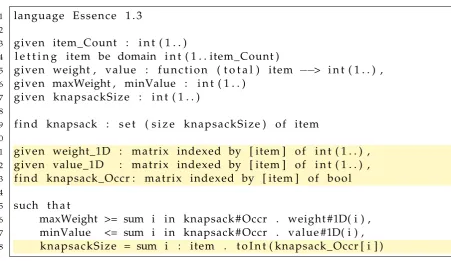
Choosing the1Drepresentation for both function domains, and theOccrrepresentation for the set domain, we reach the intermediate problem specification given inFigure 3.3.
Here, lines 11 to 13 are newly added: they are the concrete representations of original declarations with abstract domains. Line 18 is also newly added, this line is posting a new constraint to make sure the concrete representation of a set using a Boolean matrix will contain exactly as many elements as the original set variable. Such constraints are called structural constraintsand they are added to the model when needed by the representation.
Another important point to notice is representation markers attached to use sites of abstract decision variables and parameters. These markers are inserted at this phase to directexpression refinementat a later phase.
1 language Essence 1 . 3 2
3 given item_Count : i n t ( 1 . . )
4 l e t t i n g item be domain i n t ( 1 . . item_Count )
5 given weight , value : f u n c t i o n ( t o t a l ) item −−> i n t ( 1 . . ) , 6 given maxWeight , minValue : i n t ( 1 . . )
7 given knapsackSize : i n t ( 1 . . ) 8
9 f i n d knapsack : s e t ( s i z e knapsackSize ) o f item 10
11 given weight_1D : matrix indexed by [ item ] o f i n t ( 1 . . ) , 12 given value_1D : matrix indexed by [ item ] o f i n t ( 1 . . ) ,
13 f i n d knapsack_Expl : matrix indexed by [ i n t ( 1 . . knapsackSize ) ] o f item 14
15 such t h a t
16 maxWeight >= sum i i n knapsack # Expl . weight #1D( i ) , 17 minValue <= sum i i n knapsack # Expl . value #1D( i ) , 18 a l l D i f f ( knapsack_Expl ) ,
19 f o r A l l i : i n t ( 1 . . knapsackSize−1) .
[image:38.595.71.531.104.391.2]20 knapsack_Expl [ i ] < knapsack_Expl [ i +1]
Figure 3.5: After representation selection, using theExplrepresentation.
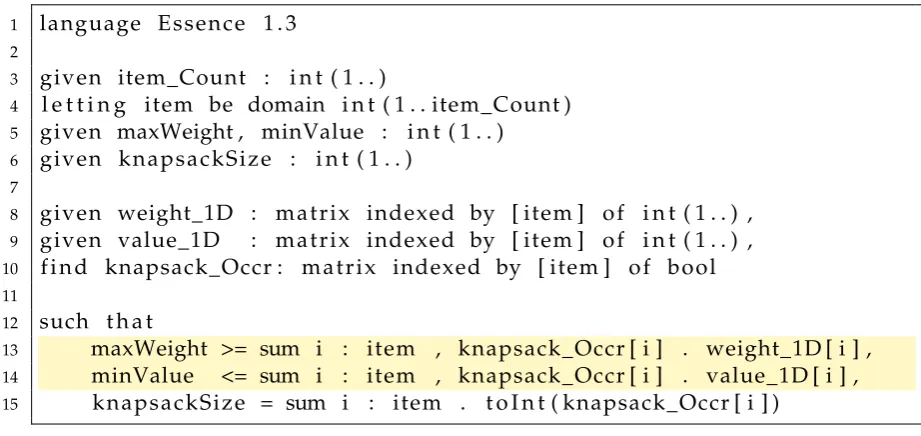
involving a reference to an abstract decision variable is rewritten, abstract decision variables are removed from the problem specification.
The complete CP model after expression refinement is given inFigure 3.4. Lines 13 and 14 are changed in comparison to the previous step. Function application for1Drepresentation of total functions is rewritten into a simple matrix dereference. The refinement of the quantified expression is slightly more involved though: it requires creating a new quantified expression over a finite integer domain. Moreover a guardis added to make sure the total sum only contains weights of those objects that are in the set.
All problem constraints are rewritten to use concrete versions of abstract decision variables and parameters. At this point the decision variable knapsack, the parameters
1 language Essence 1 . 3 2
3 given item_Count : i n t ( 1 . . )
4 l e t t i n g item be domain i n t ( 1 . . item_Count ) 5 given maxWeight , minValue : i n t ( 1 . . )
6 given knapsackSize : i n t ( 1 . . ) 7
8 given weight_1D : matrix indexed by [ item ] o f i n t ( 1 . . ) , 9 given value_1D : matrix indexed by [ item ] o f i n t ( 1 . . ) ,
10 f i n d knapsack_Expl : matrix indexed by [ i n t ( 1 . . knapsackSize ) ] o f item 11
12 such t h a t
13 maxWeight >= sum i : i n t ( 1 . . knapsackSize ) . 14 weight_1D [ knapsack_Expl [ i ] ] , 15 minValue >= sum i : i n t ( 1 . . knapsackSize ) . 16 weight_1D [ knapsack_Expl [ i ] ] , 17 f o r A l l i : i n t ( 1 . . knapsackSize−1) .
[image:39.595.56.516.106.365.2]18 knapsack_Expl [ i ] < knapsack_Expl [ i +1]
Figure 3.6: After expression refinement, using theExplrepresentation.
3.4.2 Using the Explicit representation
Again, choosing the 1D representation for both function domains, and the Expl repres-entation for the set domain, we reach the intermediate problem specification given in
Figure 3.5.
Similar to the previous section, the concrete representations of original declarations with abstract domains and structural constraints are added. Also, each use site of abstract declarations variables and parameters are marked with the name of the representation to direct expression refinement.
An important observation here is about symmetry breaking. The structural constraint on line 18 is enough to maintain the distinctness requirement of the original abstract domain. However, using anallDiffwe introduce symmetry, that is there are multiple assignments to the matrix domain which all represent the same set value. In order to break the symmetry1, we introduce another structural constraint given on lines 19 and 20. Adding this constraint
1 language Essence 1 . 3 2
3 given item_Count : i n t ( 1 . . )
4 l e t t i n g item be domain i n t ( 1 . . item_Count )
5 given weight , value : f u n c t i o n ( t o t a l ) item −−> i n t ( 1 . . ) , 6 given maxWeight , minValue : i n t ( 1 . . )
7 given knapsackSize : i n t ( 1 . . ) 8
9 f i n d knapsack : s e t ( s i z e knapsackSize ) o f item 10
11 given weight_1D : matrix indexed by [ item ] o f i n t ( 1 . . ) , 12 given value_1D : matrix indexed by [ item ] o f i n t ( 1 . . ) ,
13 f i n d knapsack_Expl : matrix indexed by [ i n t ( 1 . . knapsackSize ) ] o f item 14 f i n d knapsack_Occr : matrix indexed by [ item ] o f bool
15
16 such t h a t
17 maxWeight >= sum i i n knapsack # Expl . weight #1D( i ) , 18 minValue <= sum i i n knapsack # Occr . value #1D( i ) , 19 knapsackSize = sum i : item . t o I n t ( knapsack_Occr ) 20 f o r A l l i : i n t ( 1 . . knapsackSize−1) .
[image:40.595.71.530.102.423.2]21 knapsack_Expl [ i ] < knapsack_Expl [ i + 1 ] , 22 knapsack # Expl = knapsack # Occr
Figure 3.7: After representation selection, in a channelled model.
renders the allDiffredundant, so we do not actually add it to the model.
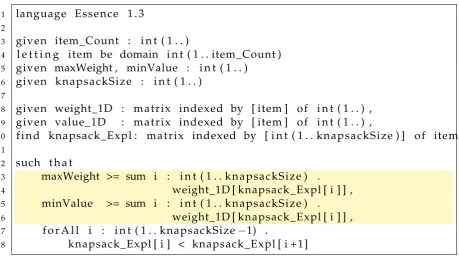
The complete CP model after expression refinement is given inFigure 3.6. Lines 13 to 16 are changed in comparison to the previous step. Similar to what happened in theOccr
representation, function application for1Drepresentation of total functions is rewritten into a simple matrix dereference. The refinement of the quantified expression is turned into a new quantified expression over a finite integer domain. This time the quantified expression does not require aguard, and it uses a simple matrix dereference to access an object in the set.
3.4.3 Channelled models
1 language Essence 1 . 3 2
3 given item_Count : i n t ( 1 . . )
4 l e t t i n g item be domain i n t ( 1 . . item_Count ) 5 given maxWeight , minValue : i n t ( 1 . . )
6 given knapsackSize : i n t ( 1 . . ) 7
8 given weight_1D : matrix indexed by [ item ] o f i n t ( 1 . . ) , 9 given value_1D : matrix indexed by [ item ] o f i n t ( 1 . . ) ,
10 f i n d knapsack_Expl : matrix indexed by [ i n t ( 1 . . knapsackSize ) ] o f item 11 f i n d knapsack_Occr : matrix indexed by [ item ] o f bool
12
13 such t h a t
14 maxWeight >= sum i : i n t ( 1 . . knapsackSize ) . 15 weight_1D [ knapsack_Expl [ i ] ] ,
16 minValue <= sum i : item , knapsack_Occr [ i ] . value_1D [ i ] , 17 knapsackSize = sum i : item . t o I n t ( knapsack_Occr )
18 f o r A l l i : i n t ( 1 . . knapsackSize−1) .
19 knapsack_Expl [ i ] < knapsack_Expl [ i + 1 ] , 20 f o r A l l i : i n t ( 1 . . knapsackSize ) .
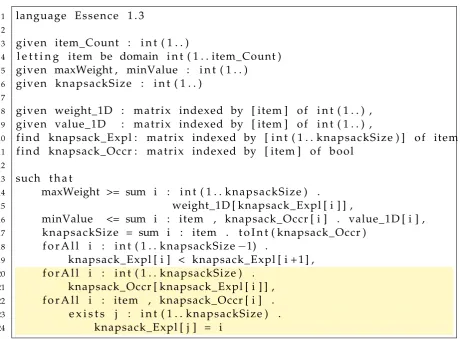
[image:41.595.56.517.104.443.2]21 knapsack_Occr [ knapsack_Expl [ i ] ] , 22 f o r A l l i : item , knapsack_Occr [ i ] . 23 e x i s t s j : i n t ( 1 . . knapsackSize ) . 24 knapsack_Expl [ j ] = i
Figure 3.8: After expression refinement, in a channelled model.
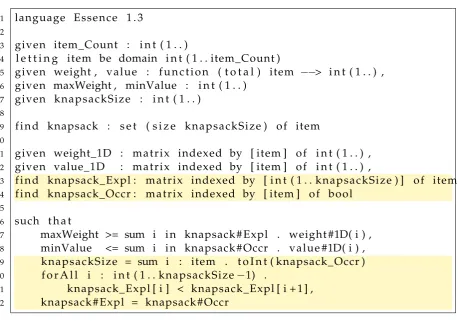
multiple representations are selected for the same decision variable,channelling constraints are required to make sure different versions of the same abstract decision variable get assigned to the same value in every solution.
In the running example, the decision variableknapsackoccurs in two different contexts. Conjurecan select different representations for it in different contexts. Figure 3.7shows the
intermediate problem specification after representation selection for a channelled model. In this alternative model, both concrete representations are added to the model at the same time. Notice the representation markers, the first constraint on line 17 is marked to use the Explicit representation forknapsack, whereas the second constraint on line 18 is marked to use the Occurrence representation.
Moreover, on line 22, a channelling constraint is added. The channelling constraint is simply an equality constraint on two set variables, which happen to refer to the same set variable but represented differently. Luckily, this is the only specific treatment Conjureneeds to do
for channelling constraints, from here on they will be refined in the same way as the other constraints in the original problem.
Highlighted inFigure 3.8is the refinement of the channelling constraint.
3.5
Summary
This chapter demonstrated Conjure’s operation on a concrete problem specification without
4
Design and Architecture
This chapter is describes the design and architecture of Conjure. It is divided into two
parts. In the first part we look from the outside-in and see the components of a constraint programming tool-chain, motivations behind having such a tool-chain, and the part Conjure
plays in enabling an effective constraint programming system. In the second part we focus on Conjure’s internals and see how it operates, the pipeline of operations, and how it uses
a rule language to describe most of its transformations.
4.1
Outside-In: The Tool-Chain
This section describes Conjurein the context of a tool-chain comprised of Conjureitself,
SavileRow the instance level constraint modelling assistant, and the constraint solver
Minion.
4.1.1 MINION and its input language
Minion[Gen+06] is a powerful constraint solver. It takes as input a problem instance model
different implementations of domains for decision variables: BOOL,DISCRETE,BOUND, and
SPARSEBOUND. Minion’s type system does not discriminate between different kinds of
domains; however, some constraints only work on decision variables with certain kinds of domains.
BOOL Boolean domains. Decision variables with Boolean domains are used very commonly for logical expressions.
DISCRETE Finite integer domains specified by a lower and an upper bound. Propagation and search can prune individual values from the domain of a decision variable with a DISCRETE domain. Namely, arbitrary holes can be created in the domains of the variables.
BOUND Finite integer domains specified by a lower and an upper bound. Only the bounds of the domain are maintained. Propagation and search can only prune from the lower or the upper bound from the domain of a decision variable with aBOUND domain. Namely, holes cannot be put in the domains of the variables.
SPARSEBOUND Finite integer domains specified by listing all the elements of the domain, but only the upper and lower bounds of the domain may be updated during search. Propagation and search can only prune from the lower or the upper bound from the domain of a decision variable with aSPARSEBOUNDdomain. Namely, any holes in the domain must be there at the time of declaration and holes cannot be created during the solving process.
The constraint language of Minion also closely follows the internals of the solver.
Constraints are mostlyflat. In this context, a constraint expression is flat if it does not take other constraints as arguments. However, Minionstill has some non-flat constraints. An
indispensable non-flat constraint is constraint reification via thereifyconstraint. Using
and use this decision variable in the rest of the model instead of the constraint itself. Constraint reification is not the only non-flat constraint, Minion also has watched-or
and watched-and which take a list of constraints as arguments and post logical-or and logical-and conditions on the arguments respectively.
Some constraints have multiple alternative implementations; such as alldiff and
gacalldiff. Generally, different versions of the same constraint enforce different levels of consistency.
Writing Minion input by hand is not practical for a few reasons. First is the lack of
parameterised models; generally a user wants to model a class of problems instead of a single instance. Second is the lack of abstraction; a user will have to be familiar with a lot of low level details about Minionbefore they can write correct models. In order to writegood
models, they will have to make a lot of low level decisions possibly without understanding all the trade-offs. Third is the verbosity of the input language. More often than not, CP modelling requires experimentation. Working with such a verbose language limits the ability to experiment. For instance, changing the viewpoint of the model or changing how a constraint is formulated requires rewriting almost the whole model.
4.1.2 SAVILEROWand ESSENCE0
SavileRow is a constraint modelling assistant. It takes as input a CP model written in
Essence0. Essence0 is a CP modelling language that allows encoding of problem-class
models, and allows constraint expressions and the objective to contain non-flat expressions. Using non-flat expressions let the modeller write mathematical equations using arithmetic and logical operators and use the results of intermediate expressions as parts of larger expressions. In this setting, constraint reification becomes implicit. In effect, the truth value of a constraint expression can be treated as a Boolean value in every context where a simple Boolean literal can be used. As an example, one feature of Essence0 which assists CP
Conjure
SavileRow
Minion
Solution
Parameters
Specification
Essence
Essence
0 [image:47.595.79.516.118.489.2]Minion
Figure 4.1: Automated Constraint Modelling Tool-Chain
Although Essence0 adds more expressivity to the expression language, it does not add
richer domains. In Essence0 the domains of decision variables are essentially finite integer
ranges, similar to domains in Minion’s input language.
Essence0 provides a level of abstraction and expressivity that is comparable to that
of other CP modelling languages. CP modellers can use Essence0 to write problem class
models, then use SavileRow to instantiate parameters and generate a Minioninstance
model, solve it using Minionand finally use SavileRowto translate solutions of Minionto
Essence0 (in comparison to Minion), most of the shortcomings of using Minion’s input
directly are solved. Some low level decisions like which kind of domain to use for a decision variable are made automatically by SavileRow. Refactoring models is relatively easier
because the language is less verbose.
SavileRowdoes not merely translate Essence0to Minion.It also employs powerful
micro-modelling optimisations. These optimisations include common subexpression elimination (CSE), constant folding, rearranging weighted sums and etc. Most of these optimisations become more effective after parameter instantiation, because more information is available at this point. SavileRowcan also target multiple solvers. Essence0 is a solver independent
CP modelling language, and SavileRow is the translator which makes multiple solver
accessible. We focus on the Minionbackend in this thesis because it is the most mature
backend, and working with multiple solvers does not add value to the key contributions of this thesis.
4.1.3 CONJURE and ESSENCE
Conjureis an automated CP modelling tool. Instead of requiring the user to produce a
concrete CP model, it takes as input an abstract problem specification written in Essence;
and generates automatically Essence0 models as output. Essenceis a high-level problem
specification language. It provides a rich set of built-in domains and domain constructors; such as sets, multi-sets and functions. Decision variables can have these domains so as to precisely encode what they mean. Without the need tomodel these complex domains via multiple decision variables with simpler domains and relating them in the rest of the problem specification via additional constraints. The full set of domains and domain constructors in Essenceare given inTable 4.1.
Another feature of Essenceis to help enable succinct problem specifications is domain
attributes. Attributes further restrict (i.e. make precise) an abstract domain, so the user of Essencedoes not need to use constraints to achieve the desired effect. For instance, a set
decision variable with this attribute can only be sets containing at least a given number of elements.
Essenceis statically typed. For a decision variable or a parameter, stripping attributes
from the domain leaves us with the type. Essencealso has a rich collection of operators
to write expressions of using smaller expressions with abstract types. For example, for functions, there is aninverseoperator, which makes sure two functions are inverses of each other. For relations, relation projection lets a use create a relation of smaller arity while fixing some of the components to a specific value. The complete set of operators in Essence
is given inTable 4.3.
In addition to those listed in the figure, Essenceprovides a rich collection of quantified
expressions. Many CP modelling languages allow quantifiers such asforAll,exists, and
sumto be used over finite integer ranges. This is a very powerful feature and Essence(as
well as Essence0) have these constructs.
Generally, quantified variables take values from the given integer range. The value of the whole quantified expression is determined by unrolling the quantified expression and aggregating each item of this unrolling depending on the quantifier keyword. Conjunction, disjunction and addition are used respectively for forAll, exists and sum quantifier keywords.
In addition to this conventional understanding of quantified expressions, Essence
allows any domain to be used instead of a simple integer range in quantified expressions. This means, a constraint expression can be written forAll values of a finite multi-set domain. Essencealso allows quantification over arbitrary set and multi-set decision variable
expressions.
For example, the following constraint posts the condition that every element in a set decision variablexhas to be even if that element is strictly greater than10.
Domain Kind Handling
bool Concrete Kept unchanged
int Concrete Kept unchanged enumerated Abstract Mapped to integers unnamed Abstract Mapped to integers
tuple ( τ1, ...,τi, ...) Abstract Separated into components
set ofτ Abstract Represented
mset of τ Abstract Represented
functionτ1->τ1 Abstract Represented relation of (τ1, ...,τi, ...) Abstract Represented
partition from τ Abstract Represented
Table 4.1: Domains in Essence
Domain Attributes
set ofτ size,minSize,maxSize
mset ofτ size,minSize,maxSize,minOccur,maxOccur
functionτ1-> τ1 total,partial,injective,surjective,bijective relation of (τ1, ...,τi, ...) size,minSize,maxSize
partition fromτ size,minSize,maxSize,regular,complete,partSize,
minPartSize,maxPartSize,numParts,minNumParts,
maxNumParts
Table 4.2: Domains in Essence
4.1.3.1 Explicit guards
Domain Attributes
set ofτ union,intersect,\(difference),subset,subseteq,supset,
supseteq,|x|(cardinality),in,max,min
mset of τ union,intersect,\(difference),subset,subseteq,supset,
supseteq,|x|(cardinality),in,freq,hist,max,min
functionτ1->τ1 union,intersect,\(difference),subset,subseteq,supset, supseteq,|x|(cardinality),defined,range,function application,inverse,preImage
relation of (τ1, ...,τi, ...) union,intersect,\(difference),subset,subseteq,supset,
supseteq,|x|(cardinality),relation application,relation projection
partition from τ |x|(cardinality),together,apart,participants,parts,
party
Table 4.3: Operators in Essence
4.1.4 The tool-chain
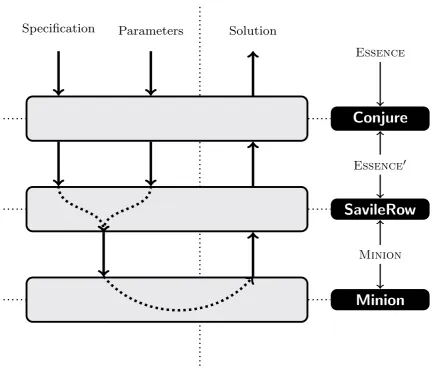
The complete tool-chain is given inFigure 4.1. An Essenceproblem specification is input
to the Conjuresystem, which employs a system of modelling transformations to refine
the specification into a concrete CP model in the Essence0 language. A CP model typically
describes a parameterised problem class. An instance of the class is obtained for input to the constraint solver by giving values for the parameters. Essenceprovides the same facility,
allowing the specification of problem classes. The refinement of problem specification and parameter values is separated in the tool-chain, as shown in the figure. This allows the user to solve multiple instances from the same problem class while only performing model refinement once.
The SavileRowsystem accepts an Essence0 model and corresponding parameter values.
It instantiates the model and transforms it into the input suitable for the Minionconstraint
solver. SavileRowis able to produce output suitable for other constraint solvers, but this
thesis will use the Minionbackend only. After Minionhas solved the problem instance,
SavileRowtranslates the solution back into Essence0. Conjurethen translates the Essence0
user.
Conjurecan generate multiple models for a given problem. Selecting a good model
from the available candidates remains a challenging task.
4.2
Inside-Out: C
ONJURE’s Inner Workings
This section describes Conjure’s inner workings by explaining each step of its pipeline in
a subsection. Examples are used when necessary to describe how a certain step operates. Essencehides CP modelling complexity very well, a concise problem specification often
produces quite large Essence0 models. It is because of this reason why small Essence
specifications or fragments of larger specifications are used as examples.
4.2.1 Abstract Syntax Tree
Conjure does not store and manipulate Essenceproblem specifications in source form.
Inputs are parsedinto an Abstract Syntax Tree (AST) representation and outputs are pretty-printedto produce the human readable textual representation.
At the top level, an Essence specification is a list of statements. Some statements
introduce new declarations of decision variables or parameters, for this reason the order of statements is important. Internally, Conjurestores a singly-linked list of statements and
each statement is stored in a data structure that is the AST of Essence. Conjure’s output –
CP models in Essence0 – are also stored using the same representation. The only difference
between the two languages in this regard is the types of AST nodes they support.
Due to the complexity of both Essenceand Essence0 and to keep the internal
repres-entation as generic as possible Conjureuses a simple rose-tree for the AST. Each node is
1 language Essence 1 . 3 2
3 f i n d x , y , z : i n t ( 1 . . 3 ) 4
5 such t h a t 6 y + 2 = z ,
[image:53.595.184.398.292.567.2]7 a l l D i f f ( [ x , y , z ] )
Figure 4.2: A simple Essencespecification
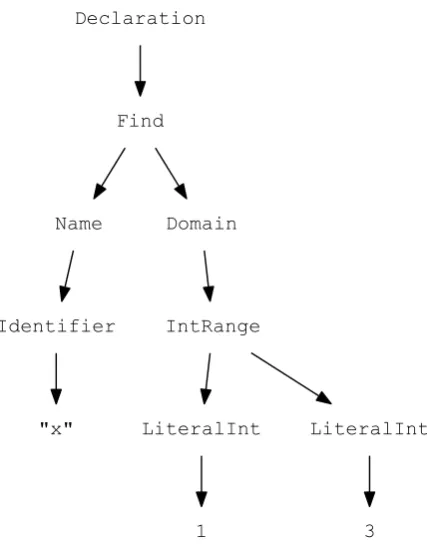
Declaration
Find
Name Domain
Identifier IntRange
"x" LiteralInt LiteralInt
1 3
Figure 4.3: AST for a declaration
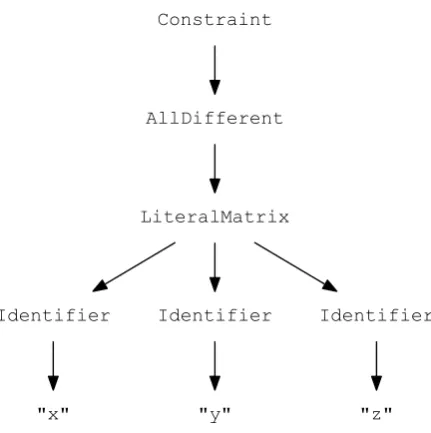
Constraint
BinaryOp{=}
BinaryOp{+} Identifier
Identifier 2
"y"
[image:54.595.199.410.148.387.2]"z"
Figure 4.4: AST for an all-different constraint
Moreover,Chapter 5describes how a rule language is implemented using a generic matching mechanism together with the parsing and pretty-printing functions to translate between Essencesyntax and the AST representation.
4.2.2 Type-checking
After parsing Essenceinput and creating an equivalent AST representation for it, Conjure
proceeds to type-checking. Essenceis statically typed and type-incorrect input need to be
rejected before further processing.
Essencespecification are a list of statements. The type-checking an Essencespecification