HOUSING POLICY
A thesis
submitted in partial ful lment of the requirements for the degree
of
Doctor of Philosophy ln the
University of Canterbury by
K.R. Henry
HP
72-'73 7-5'HS""
i'i8'2.ACKNOWLEDGEMENTS
In writing this thesis I have benefited from the
willing assistance of my supervisor, Professor Richard
Manning. Since 1977, when I was an undergraduate student
of his at the University of New South Wales, Professor
Manning's knowledge of, and enthusiasm for, the study of
economics has been my constant inspiration.
I am indebted to a number of other people: My
brother, Mr. Bruce Henry, of the School of Physics,
University of New South Wales, and Dr. Don McNickle, of
the Department of Economics, University of Canterbury, are
thanked for computing ass tance. All other members of the
Department of Economics, University of Canterbury, have
contributed something to my understanding of economics during
the past two years, and so deserve thanks also.
I should also thank my typists, Mrs. Suzanne Troup,
who typed an appendix, and especiaJly Mrs. Karilyn Smith,
who typed the remainder of the manuscript expeditiously
and with considerable skill.
Finally, I owe an immeasurable debt of gratitude
to my wife, Naomi, and to my children, Julia and Sebastien,
for their considerable sacrifice while I was working on
CONTENTS
CHAPTER PAGE
ABSTRACT 1
ONE INTRODUCTION 3
1.1 The Importance of Housing 6
1.2 Issues in Housing Policy 11
1.3 Quantitative Aspects of Housing Policy 20 1.4 Partial Equilibrium Analyses 26 1.5 General Equilibrium Considerations 36
1.6 Dynamic Considerations 42
APPENDIX A-l~l: Capital Stock Estimates 56 TWO STATIC PARTIAL EQUILIBRIUM ANALYSIS OF
HOUSING POLICY
2.1 Investment Aspects of Housing and the "User Cost" of Housing
2.2 The "User Cost" of Housing and the Owner-Occupier Subsidy in six Western Countries
86
87
105
2.3 Comparative Partial Equilibrium Statics 145 of Housing Policy and "User Costs"
THREE STATIC THREE-SECTOR MODEL OF GENERAL EQUILIBRIUM
3.1 Income and Expenditure Terms in the "User Cost" of Capital
3.2 Tax Incidence, Tax Shifting, and Tax Neutrality
3.3 Development of the Model
167
171
180
3.4 The Burden of the Non-Neutral
Taxation of Capital
3.5 The Welfare Costs of the Non-Neutral
Taxation of Capital
3.6 Second-Best Optimal Tax Policy
FOUR APPLICATIONS OF THE THREE-SECTOR MODEL
212
222
226
235
4.1 Introduction 235
4.2 Empirical Evaluation of the Distortions 241
Due to the Non-Neutral Taxation of
Housing in Five Western Countries
4.2.1 Re-examination of Laidler's Analysis
4.2.2 The Owner-Occupier Subsidy in Five Western Countries
4.2.3 The Welfare Cost of the Non-Neutral Taxation of Housing
4.2.4 The Burden of the Non-Neutral Taxation of Housing
4.2.5 Second-Best Tax policy
4.3 Sensitivity Analysis
APPENDIX B-4-2: Data Sources and Methods
FIVE IMPLICATIONS FOR INTERMED,IATE-RUN GROWTH
241
248
259
275
283
287
295
339
5.1 Resource Allocation and Intermediate- 339
Run Growth
5.2 Simulated Dynamic Adjustments to
Changes in Tax Policy
SIX HOUSING POLICY IN THE LONG-RUN
6.1 The Dynamic Incidence of the
Owner-357
363
Occupier Subsidy
6.2 The Optimal Taxation of Housing Capital 369
in the Long-Run
SEVEN CONCLUDING COMMENTS 374
1 ABSTRACT
In a number of Western countries, imputed rental
income on owner-occupied housing not taxed. In some
countries, tax treatment is even more/favourable, with
mortgage interest payments and/or local property taxes
being deductible against the owner-occupier's other
income. These policies provide a tax subsidy to
owner-occupied housing. The subsidy creates economic distortions;
in particular, i t encourages an inefficient allocation of
productive resources, producing economic waste. In
addition, i t places an excess tax burden on capital employed
in other activity, and on labour.
The distortions created by the favourable tax
treat-ment of owner-occupied housing suggest issues of theoretical
and emp ical interest. A generalized user cost of capital
methodology permits straight-forward investigation of the
subsidy to owner-occupied housing in several Western
countries. The distortions created by the subsidy are
revealed by the development of, and empirical application
of, a static three-sector general equilibrium model of tax
incidence. The three sectors are owner-occupied housing,
rented housing, and other industry. The economic distortions
are of different degrees in different countries, but are
invariably quantitatively sign cant.
Western governments are apparently persuaded by
the dubious social arguments for owner-occupied housing.
2
policy which advocates an equal tax on capital in 1 uses.
The three-sector general equilibrium model permits the
derivation of second-best tax rates, which minimize ecomomic
waste subject to the requirement that owner-occupied housing
be subsidized relative to rented housing.
The favourable tax treatment of owner-occupi
housing has important dynamic implications. Removal of
the subsidy would stimulate intermediate-run growth,
assoc with improvements in resource allocation. In
the context of long-run balanced growth i t is pos to
identify the (undiscounted) long-run utility maximizing
subsidy to housing. These dynamic issues warrant further
3
CHAPTER ONE
INTRODUCTION
Housing is a consumer durable. The housing stock
generates a flow of housing services, which are consumed
directly. The occupier is consumer of housing
services. There are two types of occupiers, tenants and
owner-occupiers. In the first case, ownership of the
housing stock is vested in a non-occupying landlord. In
second case, ownership of the housing stock is vested
in the occupier. Even in the second case is convenient,
and realistic, to conceive of the economic activities of
owners and occupiers as being quite distinct, permitting
separate analysis of each. Accordingly, the
owner-occupier may be thought of as both landlord (owner) and
tenant (occupier); being motivated by quite di
incentives according to the role he is playing. For the
most part, the economic activit s of the occupier can be
characterised in terms of a consumption motive. Likewise,
the economic activit s of the owner can be characterised
in terms of an investment motive. An owner-occupier is
both consumer and investor. Thus, the owner-occupier
might have invested his equity in non-residential assets
and paid rent to a landlord for tenanted accommodation,
but instead, has perceived that he can obtain a higher
return on his equity by investing in owner-occupied
4
investor, the owner-occupier is concerned with the
pro-vision of housing services for h own enjoyment, as
consumer.
In the housing market, the price paid by the
occupier for the consumption of housing services is the
market return on the housing stock of the owner. As in
any investment activity, the market return on the asset
must cover the "user costs" (of depreciation, repairs and
maintenance, casualty insurance premiums, interest payments
on debt, the opportunity cost of equity, and taxesl.) of
providing the housing services offered for consumption.
This must be so whether the investor is a landlord or an
owner-occupier.
The notion of the user cost of housing provides a
convenient instrument with which to analyse the
implica-tions of housing policy.2. This instrument is exploited
in this thesis.
Interest in the economics of housing, and housing
policy, is easily justified: Reference need only be made
to the quantitative significance of housing expenditures
and housing incomes (respectively, corresponding to the
consumption, and investment, aspects of the housing
market) in the national accounts. Further, in terms of
market value, the housing stock represents the most
important set of reproducible durable goods in the national
wealth of nearly all Western countries. This quantitative
5
Despite the quantitative significance of housing,
economic analyses of housing policy have a comparatively
short history; and while there has been quite a large
amount of research in the U.S.A., and to a lesser extent,
the United Kingdom, there has been very little analysis
of housing policy in other countries. The first economic
analys of housing policy seems to be contained in
Haig's (1921) seminal contribution to public finance.
Haig was concerned with the distortions created by the
failure to tax imputed rentals3. on owner-occupied housing
under United States federal tax law. The comments made
there were reinforced by the arguments of Simons (1938),
(1950), and Vickrey (1947). Goode (1960) is the first
comprehensive analysis of this issue, however. These
analyses are reviewed in Sections 1.2 and 1.4. Since 1960
there has developed an enormous literature on housing
and housing policy, particularly in the United States of
America. Even so, there are a large number of areas
deserving further research. These areas are exposed in
Sections 1.2 to 1.6 of this Chapter.
As in many areas of economics, an historical
examination of the various analyses of housing policy
reveals a "vertical" progression through analytical
tech-niques of increasing power and complexity. It is
remarkable, however, that the literature is dominated by
parti~l equilibrium analyses. It is argued in Section 1.4
that partial equilibrium techniques are not well-suited to
an analysis of housing policy. This thesis has four main
6
partial analyses of housing policy by emphasising the
investment motive in the demand for housing. The second
is to employ the investment motive in the development of
a general equilibrium model for the effective analysis of
housing policy. The third is to extend the analysis to
a consideration of the dynamic implications of housing
policy. And the fourth is to explore the importance of
housing policies in economies other than the U.S.A. and
the United Kingdomi specifically, in Australia, Canada,
and New Zealand.
This· Chapter is structured as follows: Section 1.1
explores the quantitative significance of housing. Section
1.2 examines the range of housing policies, and the issues
which arise in connection with those policies. Section
1.3 produces some data to illustrate the quantitative
significance of housing policy measures. Section 1.4
examines the partial equilibrium analyses of housing policy,
and explores their deficiencies. Section 1.5 emphasises the
need for a general equilibrium approach to the analysis
of housing policy, and suggests how this approach might
be developed. Section 1.6 examines the dynamic implications
of housing policy. Section 1.7 briefly reviews the "social"
arguments in housing policy. And Section 1.8 presents a
plan of the work in this thesis.
1.1 THE IMPORTANCE OF HOUSING
Investments in housing are a large proportion of
total capital outlays in all Western countries. Table
I
7
TABLE 1-1-1: Percentage Distribution of Gross Capital
Outlays by Form of Reproducible Tangible Capital; Various Western Countries;
Current Prices.
Country
Australia
Belgium
Canada
France
W. Germany
Japan
Luxembourg
Netherlands
New Zealand
Norway U.K. U.S.A. Source: Notes: Asset-Type
CIl~ 1 CIlZ t<:I
Year i 1-3
rt(\) rtO ~ 0
Ii Ul Ii ::l ~ rt
~ 1-'- ~ I 1-'- III
no. n ~
~
I--'rt(\) rt(\)
~ ::l ~ Ul (\)
Ii rt Ii 1-'- ::l
I
(\) 1-'- (\) 0. rt
Ul III Ul (\) I
I-' ::l ,
rt 1-'-! III
I I-'
I
I
(1) I (2 ) ( 3) (1)+(2)+(3)
I ,
I
!
1978 20.19 I
I 36.17 43.64 100.00
1978 34.51 35.00 30.49 100.00
1978 25.74 40.02 34.24 100.00
1977 30.47 28.51 41. 02 100.00
1978 27.59 31. 66 40.75 100.00
1978 28.63 44.37 27.00 100.00
1977 24.32 41.50 34.18 100.00
1978 28.00 33.04 38.96 100.00
1978 22.64 39.06 38.30 100.00
1978 16.47 48.19 35.35 100.00
1978 17.93 31.14 50.93 100.00
1978 27.59 31.88 40.53 100.00
United Nations, Yearbook of National Accounts Statistics, 1979.
1. Investment expenditure on Non-Residential
Structures includes spending on other building and construction, including
spending on land improvements, and planta-tion and orchard development.
2. All estimates are for the financial year
8
by major, asset types as a percentage of total investment
spending on tangible reproducible assets (excluding
inventories). Estimates are for Australia, Belgium,
Canada, France, West Germany, Japan, Luxembourg,
Nether-lands, New Zealand, Norway, the United Kingdom and the
United States America. Data are for 1978, except
where indicated for 1977. Investment in dwellings varies
between 16.47 and 34.51 percent of total investment
spending on tangible reproducible assets, depending upon
the country.
Housing stock figures are also of interest. Table
1-2 presents estimates of the value of national wealth
by major asset type as a percentage of total reproducible
tangible assets. The derivation of these estimates
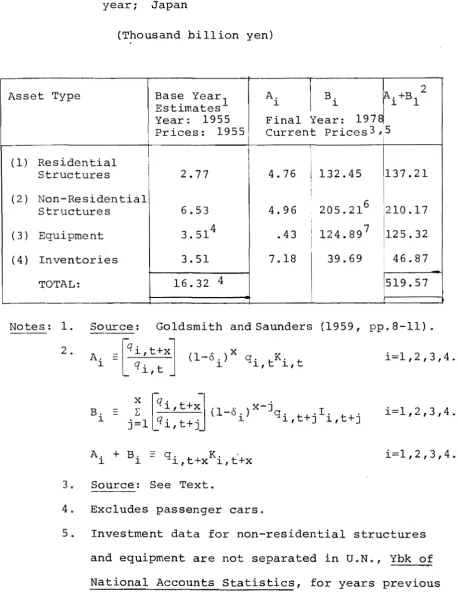
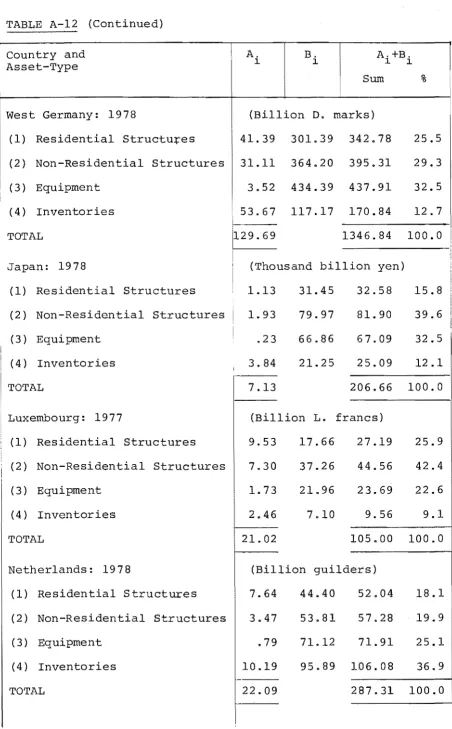
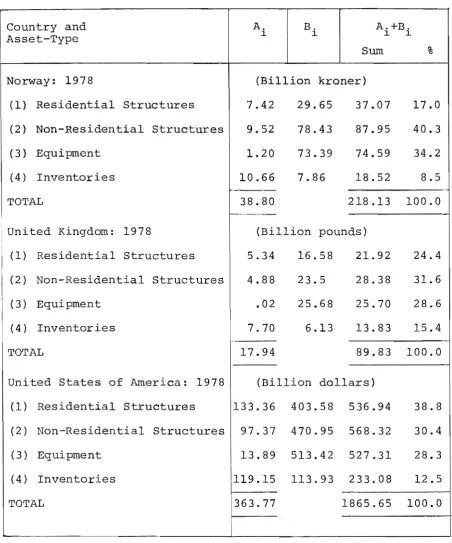
described fully in Appendix A-I-I. Data are for all the
countries listed above, except New Zealand. The necessary
data are not available for this country. The estimates
presented in Table 1-1-2 are remarkable. The percentage of
total reproducible tangible assets made up of dwellings
varies between 21.8 percent (for Norway) and 39.9 percent
(for Belgium). In Belgium, France, and West Germany, the
estimated replacement value of dwellings is larger than
for any other asset-type. The differences in asset
distri-bution among countries are largely explicable in terms of
two economic phenomena. The first is that different
count~ies exhibit different patterns of tax-subsidy policies
designed to encourage investment in some assets (at the
9
~~ ___ 1_-_1_-_2: Percentage Distribution of Net Tangible
Reproducible Capital Stocks by Asset Type; Various Western Countries; Current
Replacement Cost.
Asset-Type
Country Year 00::0
ooz:
t:r:j H 1-3rt(() rtO ;.Q ::l 0
+ i'i Ul i'i ::l C <: rt
C f-'. C I f-'. (() Sll
() OJ () i'i
~
::l I--'rt(() rt(() rt
C
::s
c
Ul (() 0i'i rt i'i f-'. ::l i'i
(() f-' .• (()OJ rt f-'.
Ul Sll Ul (() (I)
I--'
::s
Ulrt
f-'.
Sll
I--'
; I
Australia 1978 23.6 40.6 23.9 11. 9 100.0
Belgium ! 1978 39.9 35.8 17.6 6.7 100.0
Canada I 1978 29.2 41.2 20.0 9.6 100.0
I
I
France , 1977 32.4 29.8 24.4 13.4 100.0
I
West Germany i 1978 34.1 33.0 23.6 9.3 100.0
I
Japan 1978 26.4 40.5 24.1 9.0 100.0
I
Luxembourg , 1977 32.2 42.3 . 18.1 7.4 100.0
Netherlands 1978 26.6 29.5 17.8 26.1 100.0
Norway 1978 21.8 46.0 28.8 6.4 100.0
U.K. 1978 25.7 34.7 25.8 13.8 100.0
U.S.A. 1978 32.2 35.3 22.5 10.0 100.0
+
Estimates for Australia are as at 30th June, 1978.Estimates for all other countries are as at 31st
December of the ar indicated.
Source: Data in the table are derived from the capital
10
imputed rentals on owner-occupied housing from taxation,
pursued by governments in many Western countries.
Favour-able tax treatment of income earned on any asset lowers
the effective user cost of that asset, relative to the
user costs of other assets. It is well-known that the
price elasticity of demand for housing exceeds unity
(Reid (1962), Muth (1960), Laidler (1969), Lee (1964),
for instance). Tax policies which reduce the price of
housing can have quite substantial impacts on the demand
for housing. These issues are examined in more detail in
Section 1.4. The second phenomenon is that different
countries have different aggregate income levels, and
this implies differences in the demands for particular
assets. Since the income-elasticity of demand for housing
also exceeds unity,4. then, ceteris peribus, countries with
higher incomes can be expected to devote more of their
resources to the provision of housing.
The explanation of differences in asset
distribu-tions among countr is complicated by the fact that the
phenomena identified above are, to some extent, in conflict.
Much of this thesis (Chapters 3 and 4, in particular) is
concerned with this problem precisely. It might be noted
here that tax-subsidy policies which distort the
loca-tion of capital (like the subsidy on owner-occupied
housing) imply real income losses for the economy as a
whole. It is not so surprising,then, that countr like
Belgium, West Germany, Luxembourg, and the Netherlands,
11
still devote large proportions of their total capital
stocks to housing. Indeed, of the countries in Table
1-1-2, Belgium, West Germany, and Luxembourg have the
highest per capita incomes; in each of these countries,
imputed rentals on owner-occupied housing are taxed;
and yet these countries rank 1, 2, and 4, respectively,
in terms of the proportion of capital devoted to housing.
It is possible that the real income effects, due to less
distortionary tax-subsidy systems, dominate the price
effects, due to the taxation of owner-occupied housing.
To the extent that this is true, government policies
designed to encourage home ownership are actually reducing
the importance of housing in the total capital stock.
1.2 ISSUES IN HOUSING POLICY
There are an enormous number of government policies
which have implications for the housing market. The
attitude of Western Governments to the housing market,
and the way in which this attitude becomes policy, is
exemplified ln the following passage from the United
States Budget, 1981:
"Federal housing policy continues to focus on
the basic goal of providing a decent home in
a suitable living environment for every American
family. Federal housing programs carry out
this goal by:
Ensuring an adequate supply of mortgage
12
Increasing the stock of housing through
new construction and rehabilitation programs; and
Providing explicit subsidies primarily for low-and-moderate-income households. 115.
The particular policies embodied in the Federal housing programs of the United States Government have been adopted by nearly all Western Governments. While the degree of government activity differs among countries, in most
Western countries government policy involves a mixture of:
(1) The provision of State and Local Authority housing;
(2) the supply of mortgage finance, usually at subsidised interest rates;
(3) loan guarantees;
(4) a number of tax incentive schemes for owner-occupied housingi
(5) rent controls;
(6) security of tenure provisions for protected classes of tenants;
(7) urban renewal and rehabilitation programs; (8) the provision of finance for home improvement
projects at subsidised interest rates;
(9) the speci cation of building and housing codes; (10) licensing of builders and contract workers;
(12) regulation of conveyancing and land transfer;
(13) zoning regulations.
No other market can boast such a high degree of
government interference as exists in the housing market.
Clearly, housing is a very important asset.
Economic analyses of housing pol~cy are concerned
with two broad issues: The first is whether the policy
has worked. i.e., whether the policy has achieved its
stated objective(s). The second is, if the policy can
achieve (or has achieved) its objectives, whether there
is a better policy for achieving those objectives. Every
one of the thirteen housing policies listed above could
be subjected to these sorts of analyses, and every policy 13
might be deemed inappropriate on the bas of some economic
criterion. This thesis is not an attempt to do that.
Instead, this thesis confines itself to an analysis of
just one class of housing policies; specifically, those
policies which are concerned with the taxation of housing
and of housing incomes. This is the class of housing
policies commented on by Haig, Simons, and Vickrey and
analysed by Goode (1960). The issues raised by those
writers (i.e., those pertaining to the exemption of
imputed rentals on owner-occupied housing from taxation)
have subsequently been analysed by Muth (1960), Laidler
(1969), Aaron (1970), (1972), Ott and Ott (1973), White
and wqite (1977), Rosen (1979), Rosen and Rosen (1980),
and others, employing a variety of theoretical and
14
which examines the incidence and efficiency aspects of
property taxes and local government spending on the housing
market: Aaron (1975), Grierson (1974), Hamilton (1976),
Hyman and Pasour (1973), A.T. King (1973), (1977),
Netzer (1966), Simon (1943), Wales and Wiens (1974),
Rosen and Fullerton (1977), Orr (1968), Oates (1969),
(1973), Church (1974), Meadows (1976), Bickerdike (1902) I
Dusansky et al (1979), for instance. Othe~ issues in housing
policy analysed by economists include: The optimal
supply of housing capital (Reid (1958), Winnick (1956),
Dusansky and Kalman (1979»; and the economic fects of
rent controls (Lindbeck (1967), Gelting (1967».
Before identifying the issues which arise in
connection with the taxation of housing and housing
incomes, i t would seem appropriate to define the concept
of housing income. The most widely accepted economic
interpretation of income is the Haig-Simons-Hicks6•
defi-nition of this concept as being " ... the algebraic sum
of (1) the market value of rights exercised in consumption
and (2) the change in the value of the store of property
rights between the beginning and end of the period in
question"7,; or " ... the money value of the net accretion
to one's economic power between two points of time"8.; or
11
the maximum value which [the income-earner] can
con-sume during a week, and still expect to be as well off at
th d f th k h h b . . 11 9 •
e en 0 e wee as e was at t e eglnnlng.
For the landlord, housing income might be calculated
15
repairs and maintenance expenses, casualty insurance
premiums, mortgage interest payments, and taxes, and
adding to this the value of accrued capital gains on the
house during the period. For the owner-occupier i t might
be simpler to first calculate the value of his housing
consumption during the period, subtracting from this
the sum of the costs incurred as a home-owner (i.e.,
depreciation, repairs and maintenance, etc.), and then
adding accrued capital gains. The market value of
housing consumption is the gross rental payments that the
house would earn (or does earn) let in the private
rental market. Accordingly, whether the house is
tenant-occupied (i.e., owned by a landlord) or owner-tenant-occupied,
the housing income of the asset-owner is the net rental
value of his asset, plus the accretion in value of that
asset over the period in question. The only difference
between the housing income in each case is that in the case
of a house owned by a landlord the income is calculated
on the basis of actual gross rental receipts, whereas in
the case of owner-occupied housing the income must be
cal-culated on the basis of the imputed value of housing
services consumed by the owner-occupier, as occupier. It
is for this reason that the income on owner-occupied
housing is referred to as an "imputed" income.
The third component of housing income is mortgage
inter~st payments. While these payments are an expense
from the point of view of the mortgagor (landlord or
16
Net rental payments and accrued capital gains are the
return to equity capital; mortgage interest payments are
the return to debt capital.
According to tax legislation in all Western
countries, the net income of landlords is taxable; though
in most countries accrued capital gains are not. The
return to debt capital is also taxable. But in many
Western countries (including Australia, Canada, New
Zealand, the United Kingdom, and the United States of
America) the imputed return to equity invested in
oWner-. d h . . t d 10.
occup1e ous1ng 1S no taxe .
There are four important issues which arise in
connection with the failure to tax imputed rentals on
owner-occupied housing. The first relates to the concept
of vertical equity, the idea that tax liability as a
pro-portion of income should exhibit the "rightll degree of
progressivity (whereby higher income earners face higher
average tax rates). Section lA illustrates that the
failure to tax imputed rentals reduces the progressivity of
the income tax. The second issue relates to the concept
of horizontal equity, the idea that individuals of similar
economic circumstance should face similar average rates
of income tax. Here, i t is argued that the failure to tax
imputed rentals discriminates against renters relative to
owner-occupiers. The third relates to the efficiency of
the tax. The idea here is that the favourable tax
treat-ment of owner-occupied housing distorts the allocation of
17
from high-yield uses to a use with a relatively low rate
of return, reducing aggregate levels of welfare. The
fourth relates to the incidence of the tax. i.e., what
are the implications of the subsidy for private and social
rates of return on owner-occupied and rented housing,
for the net rates of return on other assets, on other
factors, and for output prices.
Central to the questions of efficiency and incidence
is the distinction between social and private rates of
return. The social rate of return pretends to measure
the market value of productive services utilized in the
period, after deductions for depreciation and depletion.l l.
The social return differs from the private return by
inclu-ding taxes as part of income. Taxes levied on housing
income can be thought as the housing income of
govern-ment. This is the fourth component of housing income. It
is clear that those sectors in the economy which face the
smallest tax rates will also have the smallest separation
of social, from private, rates of return.
Simons' arguments against the exemption of imputed
income from taxation in the United States are as pertinent
now as they were in 1938. Then, he argued that " ... [w]hen
property is employed directly in consumption uses, there
is the strongest case for recognising an addition to
taxable income. This is widely recognised in criticisms
of our federal tax for its egregious discrimination between
renters and homeowners",12. and: "Income from consumers'
18
individuals in the upper brackets. To exclude i t is to
introduce a bias inconsistent with the system of
progres-sion and to differentiate flagrantly among persons of
11 . . 1 f ' . 1 . " 13.
rea y Slml ar lnanCla clrcumstances . These
argu-ments pertain to the criteria of horizontal and vertical
equity described above.
Despite the arguments of Simons, and many who came
after him, imputed rentals have never been taxed in the
united States of America, Canada, or New
Zealand. But the same is not true for some other
coun-tries. In particular, the United Kingdom income tax base
once included imputed rentals on owner-occupied housing.
The tax was removed in 1963, after more than 100 years'
operation. The mechanics of the tax in the United Kingdom,
and its history, are of interest because of the arguments
often heard in the United States, and elsewhere, that
~he
tax would be impossible to administer.14• In theUnited Kingdom, the tax was levied on the estimated annual
value of land (including houses and other buildings) ,
whether the property was let at full rent, at less than
full rent, or was owner-occupied. The estimated annual
value was revalued periodically. It purported to reflect
the full rent the property commanded, or could command,
if let. There were "normal" deductions for repairs and
maintenance. Interestingly, the tax was charged to the
occupier, whether owner or tenant. If the occupier was a
tenant, he was entitled to deduct the tax payment from
19
the tax with the landlord. \vhere the actual rent was less
than the estimated net annual value (i.e., annual value
less "normal" deductions) the occupier bore the whole of
the tax on the difference - referred to as his "bene cial
occupation". The owner-occupier, with no actual rent to
pay, bore a tax on the whole of the net annual value of
his property.
The Radcliffe Committee in the United KingdornlS.
received a number of representations which argued that the
tax on the owner-occupier should be abolished. The
principal arguments advanced were that:
(1) i t is wrong in principle to tax notional (imputed),
as distinct from actual, income; and
(2) i t is inequitable to single out the notional income
from owner-occupied housing when the notional income
which might be imputed to other consumer durables
is not taxed.
The Committee dismissed these arguments, concluding that
the tax on the owner-occupier was right in principle and
ought to be maintained. Never-the-less, the question
abolition became a regular subject of debate On the Finance
Bill. When i t was finally abolished in 1963 all parties
in Parliament accepted that the abolition would introduce
a discrimination in tax treatment in favour of a particular
class ·of tax payer, but the Government was impressed by
the social arguments for exemption. The overriding
consi-deration was the encouragement of the owner-occupation of
20
The Irish Republ followed the United Kingdom in
abolishing the tax on owner-occupied housing in 1969.
France has since abolished the tax as well. But Germany,
the Netherlands, Belgium, Luxembourg, Italy, and Denmark,
all retain the tax. Japan, too, has a tax of this sort.
The favourable tax treatment of owner-occupied
housing in many Western countries arises primarily because
of the failure to tax imputed rentals. But in some
countries the extent of the subsidy to owner-occupied
housing is even larger than what is implied by this
exemp-tion. In the United States, for instance, owner-occupiers
are permitted to deduct mortgage interest payments and
local property taxes against other income in assessing
taxable income. Tax policies of this sort are considered
ln some det 1 in Chapter 2. Section 1.3 of this Chapter
sents some estimates of the size of the "tax
expendi-turesn16. implied by the United States tax treatment of
owner-occupied housing. The issues which arise in
connec-tion with housing policy have both static and dynamic
implications. Sections 1.4 and 1.5 are concerned with the
static implications of these issues, while Section 1.6
examines the dynamic aspects.
1.3 QUANTITATIVE ASPECTS OF HOUSING POLICY.
One of the objectives of this thes is to quantify
the various issues which arise in connection with the tax
21
estimates of the size of the "tax expenditures" on
housing in the United States, and present estimates of the
size of some the direct forms of government interference
in the housing market in other countries. The motivation
for this exercise is simply to illustrate that government
programs in the housing market are quantitatively
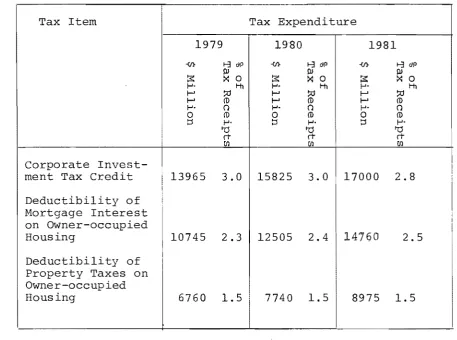
signifi-cant. In the United States, the Congressional Budget Act
requires that all "tax expenditures" be officially estimated
and presented each year in the Budget. Table 1-3-1 presents
some estimates prepared by the United States office of
Management and Budget for the years 1979, 1980, 1981.
Separate data for tax expenditures on owner-occupied
houses and the corporate investment tax credit, only, are
presented. The Table also presents these tax expenditures
as a percentage of total budget receipts in the appropriate
fiscal year. Estimates of the tax revenue losses due to
the deductibility of mortgage interest payments on
owner-occupied housing against other income are almost as large
as the revenue loss due to the corporate investment tax
credit, which has assumed such importance in the literature
on investment tax incentives (see Hall and Jorgenson (1971),
and Coen (1971), for instance). Tax expenditures due to
the deductibility of property taxes are about half the
size of the corporate investment tax credit. These gures
are quite large, even as a percentage of total tax receipts.
Becau~e owner-occupied housing has never been taxed in the
United States, this policy is not considered a tax
22
TABLE 1-3-1: Tax Expenditures Due to Federal Tax Laws,
United States, 1979, 1980, 1981.
Tax Item Tax Expenditure
1979 1980 1981
-(f} 1-3 0\0 -(f} I-3dP -(f} 1-3 o'P
III III III
~ X 0 ~ X 0 ~ X 0
1-" I-h 1-" I-h 1-" I-h
I-' ::0 t-' ::0 t-' :;0
I-' (j) t-' (j) t-' (j)
1-" Cl 1-" Cl 1-" Cl
0 (j) 0 (j) 0 (j)
tJ 1-'- tJ 1-" tJ 1-"
'0 '0 '0
rt rt rt
en en en
Corporate
Invest-I
ment Tax Cred 13965 3.0 15825 3.0 17000 2.8
Deductibi1ity of Mortgage Interest on Owner-occupied Housing
I
10745 2.3 12505 2.4 1 60 2.5
Deductibi1ity of I
I Property Taxes on Owner-occupied
Housing 6760 1.5 7740 1.5 8975 1.5
I
I
I I I
I
Source: U.S. Off of Management and Budget, United States
Budget, 1981. Special Analysis G. Estimates are
[image:27.566.57.515.122.462.2]23
revenue due to this policy is not estimated by the
united States office of Management and Budget. Of course,
if imputed rentals or owner-occupied housing were to be
~ taxed, the revenue losses presently due to the
deducti-bility of mortgage interest payments and property taxes
would no longer be considered tax expenditures, since i t
would be "normal" practice to allow these as deductions
from housing income. Estimates of the subsidy to
owner-occupied housing developed in Chapter 4 of this thesis
indicate that the revenue loss due to the exemption from
taxation of the net income earned by owner-occupied
housing is approximately twice as large as the sum of
the tax expenditures presented in Table 1-3-1.
Willis and Hardwick (1978) estimate that if the
tax on owner-occupied housing were re-introduced in the
United Kingdom, and if rateable values current in 1974-75
were adopted as the measure of imputed income, the
addi-tional tax yield in that year would have been about £930m.,
approximately 10 percent of income tax revenue actually
received.
In some cases, data on the magnitude of direct
government activity in housing are easier to find. In
Australia, a survey of housing occupancy conducted by
the Australian Bureau of Statistics in August 198017.
revealed that an estimated 4,771,100 households occupied
private dwellings (i.e., dwellings other than hotels,
motels, and the like). Of these, 1,190,700 occupied
24
percent) made rental payments to government landlords
(generally a State Housing Department, or Commission).
In addition, the average weekly rent for government
tenants was only 55 percent as large as that paid by
. t t 18.
prlva e tenan s. In Australia, much residential
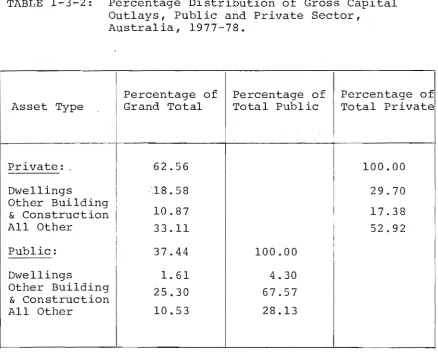
investment, too, is done by government author
Table 1-3-2 presents estimates of the percentage
distri-bution gross capital outlays by public and private
sectors in Australia in the 1977-78 financial year.
4.3 percent of all public capital outlays were
dwell-ings. 29.7 percent of all private capital outlays were
for the same asset.
Other countries exhibit similar pictures of direct
government activity in housing. Data presented in the
(U.K.) Annual Abstract of Statistics, 1975 (Central
Statis-tical Office) indicate that, on average, more than 35
percent of all dwellings in the United Kingdom were
owned by public authorities over the period 1964-74. The
Stat tical Abstract of the united States, 197719• reveals
that in 1975, 4.32 percent of total government (
state, and local) capital outlay was for housing and urban
renewal. This is much the same as for Austral It is
significantly more than U.S, government capi outlays on
health and hospitals, space research, parks and recreation
facilities, and water and air transport.
Government provision of mortgage credit is of very
large magnitudes in many Western countries. In Canada, for
25
TABLE 1-3-2: Percentage Distribution of Gross Capital
Outlays, Public and Private Sector, Australia, 1977-78.
I
Percentage of Percentage of Percentage of
Asset Type Grand Total Total Public Total Private
Private: . 62.56 100.00
Dwellings 18.58 29.70
Other Building
10.87 17.38
& Construction
All Other 33.11 52.92
Public: 37.44 100.00
Dwellings 1. 61 4.30
Other Building 25.30 67.57
& Construction
All Other 10.53 28.13
Source: Australian Bureau of Statistics, Australian
[image:30.566.69.508.73.428.2]26
between 1935 and 1968 were financed by a government body
d th H . A 20.
un er e ous1ng cts. In the united States, 7.7
percent of all outstanding mortgage debt on private
dwell-. h Id b . . 1975 2l.
1ngs was e y government agenc1es 1n .
1.4 PARTIAL EQUILIBRIUM ANALYSES:
Partial equilibrium models are employed in all
economic analyses of housing policy. The partial
equili-brium technique implies the analysis of equiliequili-brium in
one market, o:r one particular set of markets , without
reference to the pattern of equilibrium in other markets.
The application of this technique is logically valid, either
when the markets being analysed are very small (relative
to the rest of the economy), or separable, so that
dis-turbances in these markets have no perceptible impact on
the other markets. Sectionl.ldemonstrates that the
housing market does not satisfy the first of these
cri-teria: In terms of the value of productive resources
devoted to that sector, the housing market is one of the
largest markets in the economy_ The second criteria
not satisfied either: For example, the income elasticity
of demand for housing is quite large (approximately 1.5).
Goode (1960) emphasises the discriminatory implications of
the United States taxation provisions for horizontal equity
as between renters and owner-occupiers, and estimates the
revenue loss due to those provisions. Goode estimates
27
would have been approximately $3.2 billion greater than
actual level of $59.1 billion; $1.2 billion of th
being due to the taxation of imputed net rent (gross rent
minus interest on mortgage debt, property taxes, deprec
tion, repairs and maintenance, and casualty insurance
premiums), and the other $2.0 billion from eliminating the
sonal deductions for mortgage interest and property taxes
on owner-occupied dwellings. This total tax saving
sents 12.6 percent of the gross imputed rent of
owner-occupied dwellings, and 8.7 percent of the gross rent
all dwellings.
Rosen (1979a), (1979b), and Rosen and Rosen (1980)
use econometric techniques to estimate the impact of the
united States income tax provisions on the demand for
housing. Rosen and Rosen (1980) calculate that about
one-quarter of the increase in home ownership in the U.S.
since 1945 can be attributed to the distortion of tax
liability in favour of owner-occupied housing. King and
Atkinson (1980) explore the implications of U.K. tax
legislation the differential costs of housing by
tenure group; in particular, their analysis differs from
other simi analyses by comparing the costs of
owner-occupiers with rentals paid by public authority tenants
(these are the two largest tenure groups in the United
Kingdom), rather than with the situation of private
tenants. They find that while the rate of return on
28
rates of return in commercial and industrial sectors,
the average costs of owner-occupiers are even lower than
public authority rentals. King (1981) analyses the
implications of the tax treatment of housing for tenure
choice.
The impact of taxation policies on tenure-choice
relates to the extent to which those policies discriminate
between owner-occupiers and tenants. Aaron (1970)
presents an illustration of the horizontal inequity as
between owner-occupiers and tenants due to United States
tax law: We compare tax liability of two individuals.
Each individual has the same labour income ($10,000), and
receives the same amount of investment income ($1,000).
One individual is a renter, and the other, an
owner-occupier. In the case of the renter, the whole of the
$1,000 investment income is derived from non-residential
assets; in the case of the owner-occupier, however, $600
is derived from non-residential assets, while the other
$400 is derived from equity invested in owner-occupied
housing. Each individual pays the same gross rental price
for housing. The tax liabilities of the renter and
owner-occupier are illustrated in Table 1-4-1. If tax laws treated
income from all sources alike, the renter and owner-occupier
would have the same tax liability, and would have the same
disposable income. Under 1970 tax law, the differences in
tax liabilities and disposable incomes are quite large.
In addition to the issue of horizontal equity, much
of the literature, in the United Kingdom and the United
29
TABLE 1-4-1: Tax Treatment of Renters and Owner-Occupiers
under 1970 United States Tax Law; An Illustration.
Labour Earnings
Investment Income at 4%
(i) On non-residential assets
(a) $25,000 at 4%: (b) $15,000 at 4%: (ii) On equity in home
(a) $10,000 at 4%:
Money Income
Rent Payments Housing Expenses
Residual Money Income Tax Liabi1ity+
Source: Adapted from Aaron (1970)
*
2100 + 400=
2,500.Renter ($)
10,000
1,000
11,000
2,500
8,500 1,304
,
Owner ($)
10,000
600
400
10 / 600
2,100*
8 / 500
962
+ Assumptions: a) Housing costs are 25% of earnings for
both renter and owner-occupier. Mortgage interest is $900 (6% of
$15,000 mortgage); property taxes are $500.
[
!
b) Renter and owner-occupier have 4-person
households.
c) Renter claims standard deduction.
d) Owner-occupier itemizes deductions:
[image:34.566.67.510.58.435.2]30
taxation policies for vertical equity in the individual
income tax. Thus, Goode (1960), Aaron (1970), (1972),
and King and Atkinson (1980) all consider the size of the
subsidy to owner-occupied housing in different income
groups. As might be expected, the favourable tax
treat-ment of owner-occupied housing is usually found to reduce
the progressivity the income tax. There are two main
reasons for this: Firstly, since the income-elasticity
of demand for housing exceeds unit (or, put another way,
the marginal propensity to consume housing exceeds the
average propensity to consume) higher income earners derive
a larger share of their income from untaxed (imputec)
rentals on housing than lower income earners. And,
secondly, the subsidy to owner-occupied housing varies
proportionately with the individual's marginal tax rate;
so that indiv,iduals on higher incomes, facing higher
marginal tax rates, derive larger subsidies on housing
than individuals on lower incomes. These two reasons are
illustrated in Table 1-4-2.
The illustrations in Table 1-4-2 use a very simple
tax-scale: The first $10,000 of assessed income is taxed
at a rate of 20 percent; all assessed income above $10,000
is taxed at a rate of 30 percent. One individual earns
$9,000 labour income, the other $10,000. The individual
earning $9,000 receives $1,000 in imputed net rent on
owner-occupied housing. If the income-elasticity of demand
I , I I , , I , , I I
TABLE 1-4-2: Tax Treatment of Owner-occupiers of
Different Income Levels; An Illustration 31
Individual 1 ($) Individual 2 ($)
Lab'our Earnings 9,000 10,000
Net Housing Income:
.
(i)
n~
=
1,5* 1,000 1,166.6(ii) nH M
=
0 1,000Present Tax
Liability:+ 1,800
Average Tax Rate
on Labour Earnings: .20
Average Tax Rate on Total Income:
(i) n H M
=
1.5 .18( .. ) M
I I n H
=
0 .18,
Tax Liability when I
all Income is Taxed
(i) nH M
=
1.5 2,000(ii) nH M:
=
0 2,000Average Tax Rate on Total Income:
(i) nH M
=
1.5 .20(' .) M I I n
H
=
0 .20+ The tax-scale is: $(0-10,000): .20
$(10,000+) .30.
There is no mortgage interest or property tax deductibility. 1,000 2,000 .20 .179 .182 2,350 2,300 .210 .209
*
n~
is the income-elasticity of demand for housing.,
I
[image:36.566.68.504.37.677.2]32
receives $1,166.67 in imputed net rent on owner-occupied
housing. If all income (labour earnings plus imputed
net rent) were taxed, the income-elasticity of demand for
housing would have a small impact on average tax rates:
Whether the .income-elasticity is 1.5 or 0 the average tax
rate is .20 for the first individual, and varies from
.210 to .209 for the second. The interesting result is
that if rentals on owner-occupied housing are not taxed,
and if the income-elasticity of demand for housing is 1.5,
then the individual on the higher income faces the lower
average tax rate; the income tax is regressive in this
illustration. The second result of interest is that the
differences between average tax rates are smaller when
imputed rentals are not taxed; and this is independent
of the income-elasticity of demand.
The implications of housing policy for horizontal
and vertical equity are examined in some detail in Chapter
2 of this thesis.
A number of partial equilibrium analyses of housing
policy have concentrated on the efficiency aspects of the
tax subsidy to owner-occupied housing. Aaron (1972) and
Laidler (1969) assume that the supply of housing is
per-fectly elastic; put another way, that the net rate of
return on housing capital is determined outside of the
housing market, and is constant. The effect of the
subsidy on owner-occupied housing-is to cause a flow of
benefits from the government to owner-occupiers, without
33
Laid1er estimates, on the basis of 1960 United States data,
that there was over $60 billion invested in owner-occupied
housing that would not have been invested there if the
subsidy did not exist; and this was found to imply an
annual (Marsha11ian) welfare loss of over $500 million.
Laid1er uses a price-elasticity of demand of -1.5 in his
calculations. The Laid1er (1969) analysis is examined in
some detail in Chapter 4 of this thesis.
One of the nice features of the Laid1er partial
equilibrium analysis is its simplicity: There is only one
market to worry about; all substitution effects between
tenures are ignored. Using this sort of analysis i t is
possible to derive order-of-magnitude estimates of the
efficiency effects of a large number of housing policies.
One policy, of some recent interest, is the policy
pub-1icised in the 1981 New Zealand Budget Speech, which
provides for a tax rebate of 50 percent of mortgage interest
payments on owner-occupied houses, for the first five years
of home ownership. The total value of the tax saving is
not to exceed $1,000 for anyone home owner. Estimates
developed in Chapter 4 of this thesis reveal that in the
financial year 1977-78, there were 1723.5 million units of
capital employed in owner-occupied housing, where one unit
is the quantity of capital needed to generate one dollar of
net income. The effect of the new policy measure will be
to reduce the user costs of owning a first home by
.5{r ~) dollars per unit,22.
m
r
34
where: r is the mortgage interest rate.
m
<P is the proportion of the house value that
would be convered by mortgage debt.
r is the net rate of return, or opportunity
c
cost, of investing equity in housing.
According to the estimates presented in Chapter 4, the
user costs of owner-occupied housing were $0.90 per unit
in 1977-78. If we assume that r
m r c I and that 70 percent
of the finance for a first home is raised by mortgage
finance, for the average first home purchaser, we have
that the percentage change in the user cost of capital due
to the policy announced in the 1981 Budget is approximately
-38.89 percent. If the price-elasticity of demand for new
housing is .5, then the demand for (new) housing will
increase by 58.33 percent. The annual (Marshallian)
deadweight loss associated with the policy in 1977-78
would have been:
23.
*
where: P
Kl is the gross rental price on owner-occupied
housing (equals user cost).
Kl is the physical quantity of capital employed
in owner-occupied housing.
The deadweight loss evaluates at $175.6 million per annum
(approximately $.60 per capita, per annum).
The Laidler (1969) analysis has been criticised
35
been even more gnificant: M.J., and L.J. White (1977)
attack the infinite supply elasticity assumption of Aaron
(1970), (1972), and Laidler. They permit the supply
schedule for housing to have any positive elasticity. In
addition, i t is supposed that there is complete supply
substitutability of owner-occupied and rented housing.
It is shown that Laidler's estimate of the deadweight
welfare loss is biased upwards, and that the most important
implications of the owner-occupier subsidy are of a
distri-butional nature: For instance, if the ticity of
supply of housing is unitary, deadweight losses due to
the subsidy are $680m. per annum (based on 1970 data.
Compare with $1.04b. per annum, which would be Laidler's
estimate on the same data), while the transfer of benefits
from renters to landlords as a result of the subsidy is
$1.74b. per annum.
The most remarkable feature of the White and White
(1977) analysis is the implicit assumption that the demands
for owner-occupied housing and rented housing are
indepen-dent. i.e., the results of the white and White paper
depend upon an absence of substitution between tenures.
Hence, the estimates of the effects of the owner-occupier
subsidy assume that if the subsidy were eliminated there
would be no change the number of renters (although each
renter would consume more units of housing services as
the rental price 11) .24. In fact, the interdependence
of renter and owner-occupier demands for housing is one of
36
market; a feature which has been exploited analytically,
and empirically, by King (1980), and Rosen and Rosen
(1980) •
The papers by Aaron, Laidler, and vfuite and White
are concerned with some of the same issues that are
explored in this thesis, but they are all partial
equili-brium analyses: Only Aaron (1972) of s some comment on
the general equilibrium implications of the owner-occupier
subsidy. The partial equilibrium technique suffers from
the (usually implicit) restrictive assumptions which
support it. An honest application of partial equilibrium
tools precludes analysis of many of the interesting issues
arising in connection with housing policy, and taxation
policy in general. These issues are examined in the next
Section.
1.5 GENERAL EQUILIBRIUM CONSIDERATIONS.
The e iency costs of the favourable tax
treat-ment of owner-occupied housing arise because of the
dis-torted allocation of resources induced by that tax policy.
In the Laidler (1969)-type partial equilibrium analyses of
the efficiency issue, the effects of the distortions are
explained in the following terms: The marginal unit of
productive capital currently employed in owner-occupied
housing would yield more utility if employed in the
provi-sion of other commodities. The additional amount of utility
37
The total welfare cost of the subsidy is the sum of the
utility losses on each of the units of housing that would
not be employed in this sector if the subsidy were removed.
As was noted in Section 1.4, measurement of the
welfare cost of the owner-occupier subsidy by partial
equilibium techniques requires assuming an exogenous net
rate of return on housing capital. Given the quantitative
significance of housing, however, this assumption is
remarkably unrealistic: Even a very small percentage
increase in the quantity of capital employed in
owner-occupied housing implies that a large quantity of capital
is removed from other sectors in the economy, and this
must have an impact on the net rate of return on capital.
Any measure of "overinvestment,,25. in
owner-occupied housing arising from the subsidy will be associated
with a corresponding " underinvestment" in other sectors.
The assumption usually made in stud of the incidence
and efficiency effects of capital taxes is that private
net rates of return are equalized among sectors both
before and after a tax disturbance. To the extent that
this is true, social rates of return on various assets
will differ according to the tax differentials among
sectors. A marginal reallocation of resources from a
lightly taxed to a heavily taxed sector will increase
social income (gross domestic product, for instance)
because of this. Considerations of this sort can be
38
In particular, i t seems futile to attempt to measure the
incidence of the subsidy on owner-occupied housing unless
i t is admitted that the subsidy will affect rates of
return on all assets.
Despite its shortcomings, however, the importance
of the partial equilibrium technique in public finance is
indicated by the suggestion of McLure (1975) that prior
to the pUblication of Harberger's seminal paper on the
incidence of the corporation income tax (1962), the theory
of tax incidence had not advanced much beyond what is
contained in Marshall's Principles of Economics. Harberger's
general equilibrium technique (1962), (1966), represents
the most prominent contemporary approach to the analysis
of tax incidence. The power of this approach lies in its
ability to analyse the responses to a policy disturbance
in product and factor markets simultaneously, as well
as emphasising the relationships among individual markets
for factors and products. The approach is able to describe
the supply response in a particular product, or factor,
market to changes in relative product, and/or factor,
prices, incorporating the effects of interractions in
markets for other products, and factors. In contrast,
partial equilibrium analyses of tax incidence are unable
to explicitly analyse a number of important issues, like
the effects of tax disturbances on factor rewards in
untaxed industries, or on those who purchase untaxed
pro-ducts. Thus, for instance, Laidler's (1969) study assumes
a constant after-tax net rate of return on capital, so
39
The paper by Ott and Ott (1973) appears to be the
only general equilibrium analysis which relates to the
housing market. They divide the total United States
capital stock among corporate, agricultural, and housing
sectors (owner-occupied housing and rented housing are
grouped together). Their conclusion is that most of
the "underallocation" of capital to the corporate sector
has benefited the housing sector. This result, which the
authors find surprising, is in fact an implicit assumption
made in all the partial equilibrium analyses of housing
policy: Any difference between the rates of tax on housing
and other capital is interpreted as a subsidy on housing,
so encouraging "overinvestment" in housing. Given the
other assumptions embodied in the Laidler (1969) and White
and White (1977) papers, i t says nothing much more than
that the demand curve for housing is downward sloping.
Never-the-less, i t would be comforting to know that the
assumptions are correct.
The disturbing feature of the Ott and Ott (1973)
paper is its claim to be a three-sector general equilibrium
analysis of tax incidence, when i t is noti or, if i t is, i t
assumes away most of the important issues which general
equilibrium models are usually designed to analyse. In
fact, the questions of the incidence of capital taxes on
net factor prices, and on output prices, are brushed aside
by the (implicit) assumption that all taxes on capital are
not "shifted": i.e., an increase in the tax rate levied
40
rental price of capital in that sector by the full amount
of the unit tax increase, with no ef on the after-tax
unit income. Hence, suppose that a unit tax of TK is
imposed on capital in all uses, and that there were no
pre-existing distortions. Then, the gross rental price of
capital would rise by TK in all sectors. But since this
tax policy is neutral,26. and since the total capital
stock is assumed fixed, the allocation capital among
sectors must be the same after the tax as before. Under
competition (where the demand curve capital in each
sector is its value marginal product schedule) this result
can only emerge under the Ott and Ott assumptions if
output prices (equal marginal costs) for all commodities
i increase by TK/MP
Ki (where MPKi is the marginal physical
product of capital employed in sector i). In fact, as
Harberger (1962) and many others have demonstrated, if the
total capital stock is fixed, the imposition of a neutral
tax on capital causes the after-tax unit net income to fall
by the amount of the tax, with no affect on output prices.
This is prec ly the opposite set of results to those
implied by the Ott and Ott (1973) assumption.
Consequently, despite the debt of gratitude Ott
and Ott express to Harberger in the leading footnote of
their paper, the model they employ is inconsistent with
general equilibrium models of tax incidence; in particular,
i t bears no relationship to the Harberger (1962) model.27 •
Mc Lure (1975) suggests that the most significant