Received Jun 19, 2016 / Accepted Dec 10, 2016
Editorial Académica Dragón Azteca (EDITADA.ORG)
A Neighborhood Operator for Continuous Multi-Objective Optimization
Problems
Alejandro Santiago
1,2, José Carlos Soto Monterrubio
1,2, J. David Terán-Villanueva
1, Héctor
Joaquín Fraire Huacuja
1, Juan Javier González Barbosa
1, Claudia Gómez Santillán
11
Instituto Tecnológico Nacional de México, Instituto Tecnológico de Ciudad Madero
2Universidad de Cádiz
E-mail: [email protected], [email protected],
[email protected], [email protected], [email protected].
A la memoria de Jesús Vicente Flores Morfín
Abstract. Path-metaheuristics have been used successfully in combinatorial optimization. However, in continuous optimization problems, the lack of neighborhood definitions makes them difficult to design and implement. This paper proposes a neighborhood operator based on first order linear approximation of the gradient. In order to adapt the linear approximation to objective optimization, we use the multi-objective decomposition approach so the operator can be used for single and multi-multi-objective continuous optimization problems. The proposed approach is validated using a Threshold Accepting algorithm based on decomposition and a set of benchmark problems for multi-objective optimization. Results show a significant improvement over Pareto lineal sets.
1.
Introduction
13
2.
Background concepts
This section presents basic concepts of multi-objective optimization and aggregative objective functions from [1, 22].
Definition 1.A Multi-objective optimization problem (MOP).
Given a vector function 𝑓⃗(𝑥⃗) = [𝑓1(𝑥⃗), 𝑓2(𝑥⃗), … … … , 𝑓𝑘(𝑥⃗)] and its feasible solution space 𝛺, the MOP consists in finding a vector 𝑥⃗ ∈ 𝛺 that optimizes the vector function 𝑓⃗(𝑥⃗). Without loss of generality we will assume only minimization functions.
Definition 2.Pareto dominance.
A vector 𝑥⃗ dominates 𝑥⃗′ (denoted by 𝑥⃗ ≺ 𝑥⃗′) if 𝑓𝑖(𝑥⃗) ≤ 𝑓𝑖(𝑥⃗′) for all 𝑖 functions in 𝑓⃗ and there is at least one i such that 𝑓𝑖(𝑥⃗) < 𝑓𝑖(𝑥⃗′).
Definition 3.Pareto optimal.
A vector 𝑥⃗∗ is Pareto optimal if not exist 𝑥⃗′∈ 𝛺 such that 𝑥⃗′ ≺ 𝑥⃗∗.
Definition 4. Pareto optimal set.
Given a MOP, the Pareto optimal set is defined as 𝑃∗= {𝑥⃗∗∈ 𝛺}.
Definition 5.Pareto front.
Given a MOP and its Pareto optimal set 𝑃∗, the Pareto front is defined as 𝑃𝐹∗= {𝑓⃗(𝑥⃗) | 𝑥⃗ ∈ 𝑃∗}.
Definition 6.Aggregative objective function (AOF).
Given a vector function 𝑓⃗(𝑥⃗), an AOF is a function that maps 𝑓⃗(𝑥⃗) → ℝ.
Definition 7. Weighted AOF.
Given a vector of weights 𝑤⃗⃗⃗ = (𝑤1, 𝑤2, 𝑤3, … … … , 𝑤𝑘) and a vector function 𝑓⃗(𝑥⃗), a weigthed AOF is a function that
(𝑓̅(𝑥⃗), 𝑤⃗⃗⃗) → ℝ.
3.
Neighborhood operator based on linear approximations of the gradient
The gradient vector 𝛻𝑓 of a scalar valued function 𝑓 (as the weighted AOFs) on point 𝑥⃗, indicates the direction where the scalar field 𝑓 changes most quickly. There exist three different ways of compute the linear approximations of the gradient: forward (Equation 1 and 3), backward (Equation 2 and 4) and center (Equation 1, 2 and 5). To compute the approximations a perturbation value ∆ is necessary. In [15] Hughes proposed the use of forward approximation in order to guide the search. The problem using only forward gradient is that the decision variables can only be updated by positive increments as in Equation 1, leading the search to stagnation. Also the selection of ∆ is not trivial, lower values of ∆ will produce lesser exploration of the search space, while higher values will create unfeasible solutions.
𝑥
𝑖′← 𝑥
𝑖+ ∆
(1)
𝑥
𝑖′′← 𝑥
𝑖− ∆
(2)
𝛻𝑓
𝑖(𝑥⃗) ≈
𝑓(𝑥⃗)−𝑓(𝑥⃗′)
∆
(3)
𝛻𝑓
𝑖(𝑥⃗) ≈
𝑓(𝑥⃗′′)−𝑓(𝑥⃗)∆
(4)
𝛻𝑓
𝑖(𝑥⃗) ≈
𝑓(𝑥⃗′)−𝑓(𝑥⃗′′)
2∆
(5)
14
bound is set to the lower bound.
Algorithm 1. FunctionLinearApproximationGradient()
4.
Threshold accepting based on decomposition (TAD)
15
Algorithm 2. Threshold accepting algorithm based on decomposition (TAD)
As shown in Algorithm 2 the main while loop (lines 9-23) controls the stop criteria, reached when the threshold 𝑄 is equal or less than the minimum threshold value 𝑄𝑚𝑖𝑛. Every vector weight 𝑤⃗⃗⃗𝑖∈ 𝑊 has associated a best current solution 𝑥⃗𝑖, which is visited in the inner loop (lines 10-21) and is mutated maxsteps times in two steps (lines 11-20), the first step performs polynomial mutation [16] to add diversity and avoid the exclusive use of linear movements in a temporal solution 𝑥⃗′ , the second step computes their neighbor 𝑥⃗′′using the proposed operator. If 𝑥⃗′′ objective value is better than the threshold 𝑄 +(𝑓̅(𝑥⃗𝑖), 𝑤⃗⃗⃗𝑖) then 𝑥⃗𝑖 is replaced with 𝑥⃗′′ (lines 14-15). It is important to notice that when the gradient is computed backward or forward the temporal solution 𝑥′ is only one, on the other hand when central gradient is computed two temporal solutions are used (forward and backward) as in Equation 5, every temporal solutions is used later in the 𝑈𝑝𝑑𝑎𝑡𝑒𝐶𝑙𝑢𝑠𝑡𝑒𝑟𝑠 method, as the update step in MOEA/D-DE [3].
5.
Experimentation
For the experimentation, three algorithms from the state of the art were selected NSGA-II, GDE3, and MOEA/D-DE. The quality indicators computed are Generational Distance [17], Generalized Spread [18] and Spacing [19]. The TAD parameters are: the threshold start value 𝑄 = 1, threshold end value 𝑄𝑚𝑖𝑛= 1E-10, the reduction factor r=0.95, the decomposition mating/update range σ=0.9, the number of neighbor solutions to visit maxsteps=10, which is equivalent to 449 generations in classical evolutionary algorithms. The experimentation was performed with the original configuration parameters proposed by their authors. One hundred independent runs were performed over each treated problem. The experimentation benchmarks are ZDT [20], LZ09 [3] and DTLZ [21]. The algorithm and problems implementations were taken from the framework jMetal 4.5 [23] and the experimentation was carried out on an IBM x3100 M4 computer with Xeon Quad Core 3.0 Ghz with 2 GB of RAM running FreeBSD 10 as operative system.
6.
Results
16
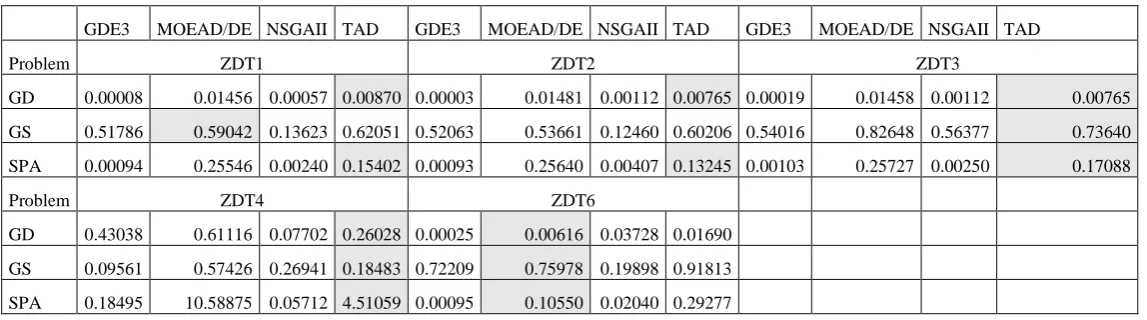
[image:5.612.22.587.276.511.2]equal to the first variable 𝑥1, except for ZDT5 which is a binary problem and ZDT6, were MOEA/D-DE outperforms our proposed TAD. The LZ09 family of problems is a set of hard optimization problems because of its complicated Pareto shapes. Our proposed TAD has a lower performance than MOEA/D-DE over these set or problems, LZ09_F8 presents a special interest to us because our proposed TAD outperforms MOEAD/-DE. The main reason of the hardness of the LZ09 problems when solved with TAD is the threshold value and reduction factor, LZ09 problems have very small objective values which needs a smoother reduction factor and a smaller final threshold value, in order to be sensitive to the changes in the objective functions values. Finally, the non-parametric statistical test of Kruskal-Wallis produces significant differences, above 95% of confidence for all the benchmark problems. The Wilcoxon rank sum test also shows a significant difference between MOEA/D-DE and TAD, above 95% for all the benchmark problems except for the GD of DTLZ6 where both algorithms were reported as equivalent. The tables in this section show in light gray the best decomposition method. The abbreviations are: Generational Distance GD, Generalized Spread GS and Spacing SPA.
Table 1. DTLZ results
GDE3 MOEAD/DE NSGAII TAD GDE3 MOEAD/DE NSGAII TAD GDE3 MOEAD/DE NSGAII TAD
Problem DTLZ1 DTLZ2 DTLZ3
GD 0.00021 0.78845 4.95647 0.85970 0.00049 0.00355 0.00065 0.00340 1.88681 2.84279 23.71066 3.09526
GS 0.41590 0.44565 0.02977 0.36167 0.37782 0.41316 0.37726 0.41626 0.03114 0.38985 0.00563 0.32703
SPA 0.00905 16.31855 8.36979 14.65828 0.02212 0.09713 0.02440 0.08509 1.71453 75.18061 24.43615 79.32565
Problem DTLZ4 DTLZ5 DTLZ6
GD 0.00190 0.00440 0.00204 0.00578 0.00010 0.00252 0.00012 0.00227 0.00022 0.01694 0.24529 0.01690
GS 0.46959 0.74281 0.45169 0.66884 0.53090 0.76705 0.41455 0.77189 0.54077 0.78889 0.01380 0.75920
SPA 0.02220 0.04189 0.02442 0.05808 0.00086 0.07222 0.00209 0.06175 0.00085 0.48096 0.20036 0.46698
Problem DTLZ7
GD 0.00119 0.03701 0.00878 0.02180
GS 0.51713 0.66791 0.48206 0.66518
SPA 0.02717 0.21473 0.03303 0.27982
Table 2. ZDT results
GDE3 MOEAD/DE NSGAII TAD GDE3 MOEAD/DE NSGAII TAD GDE3 MOEAD/DE NSGAII TAD
Problem ZDT1 ZDT2 ZDT3
GD 0.00008 0.01456 0.00057 0.00870 0.00003 0.01481 0.00112 0.00765 0.00019 0.01458 0.00112 0.00765
GS 0.51786 0.59042 0.13623 0.62051 0.52063 0.53661 0.12460 0.60206 0.54016 0.82648 0.56377 0.73640
SPA 0.00094 0.25546 0.00240 0.15402 0.00093 0.25640 0.00407 0.13245 0.00103 0.25727 0.00250 0.17088
Problem ZDT4 ZDT6
GD 0.43038 0.61116 0.07702 0.26028 0.00025 0.00616 0.03728 0.01690
GS 0.09561 0.57426 0.26941 0.18483 0.72209 0.75978 0.19898 0.91813
[image:5.612.21.595.557.717.2]17
Table 3. LZ09 results
GDE3 MOEAD/DE NSGAII TAD GDE3 MOEAD/DE NSGAII TAD GDE3 MOEAD/DE NSGAII TAD
Problem LZ09_F1 LZ09_F3 LZ09_F4
GD 0.00074 0.00356 0.00207 0.01236 0.00159 0.00040 0.00331 0.00419 0.00156 0.00343 0.00229 0.00372
GS 0.25596 0.54724 0.63339 0.36029 0.64526 0.91408 0.51263 1.04331 0.71059 1.07755 0.60250 1.18876
SPA 0.00381 0.06261 0.00662 0.21433 0.00880 0.00612 0.00817 0.06860 0.00872 0.02448 0.00608 0.06573
Problem LZ09_F5 LZ09_F6 LZ09_F7
GD 0.00112 0.00109 0.00219 0.00442 0.17813 0.03286 0.09175 0.01986 0.16661 0.03111 0.08978 0.02332
GS 0.69486 1.13480 0.53689 1.02732 0.25007 1.03308 0.42151 0.59000 0.16406 0.52020 0.26105 0.50653
SPA 0.00668 0.00648 0.00555 0.07285 0.21476 0.54351 0.15077 0.29373 0.20300 0.48539 0.10816 0.30646
Problem LZ09_F8
GD 0.01521 0.01576 0.02666 0.01483
GS 0.39725 0.42393 0.36577 0.35093
SPA 0.00271 0.00991 0.01731 0.09001
7.
Conclusions
We recommend the use of the neighborhood operator based on linear approximations of the gradient especially for linear Pareto shapes. The parameter 𝑄𝑚𝑖𝑛 has to be smaller enough in decimal precision to detect the changes in the objective functions of the treated problem. For problems with differences below 30 decimals (𝑄𝑚𝑖𝑛=1E-30) we recommend a smoother reduction factor as 999E-3. The inclusion of polynomial mutation allows the algorithm to work with not only linear Pareto shapes, as show in LZ09_F8, DTLZ5, DTLZ6. The weakness of the proposed approach is observed when very small changes in the objective values happen, then a smoother reduction factor and smaller final threshold is needed. However, those are natural deficiencies of the threshold approach, while our proposal remains independent from a particular path-search algorithm and was proved to yield good performance.
The impact of higher order linear approximations and how it affects the final Pareto front representation still need to be researched. Path-search based on decomposition for multi-objective optimization is a promising research area, with many traditional methods not which have not been researched yet. We invite researchers to test the proposed neighborhood operator as an alternative to their operators and encourage them to implement new operators to increase the knowledge on path-search algorithms for continuous optimization problems.
Acknowledgements
The authors would like to acknowledge with appreciation and gratitude to CONACYT, TECNM and PRODEP. A. Santiago, J. Carlos Soto Monterrubio J. and David Terán-Villanueva would like to thank CONACyT for the supports 360199, 414092 and 177007.
References
18
2. Q. Zhang and H. Li. Moea/d: A multiobjective evolutionary algorithm based on decomposition. Evolutionary Computation, IEEE Transactions on, 11(6):712–731, Dec 2007.
3. H. Li and Q. Zhang. Multiobjective optimization problems with complicated Pareto sets, moea/d and nsga-ii. Evolutionary Computation, IEEE Transactions on, 13(2):284–302, April 2009.
4. H. Ishibuchi and T. Murata. A multi-objective genetic local search algorithm and its application to flowshop scheduling. Systems, Man, and Cybernetics, Part C: Applications and Reviews, IEEE Transactions on, 28(3):392–403, 1998.
5. Y.-Y. Tan, Y.-C. Jiao, H. Li, and X.-K. Wang. Moea/d-sqa: a multi-objective memetic algorithm based on decomposition. Engineering Optimization, 44(9):1095–1115, 2012.
6. L. Ke, Q. Zhang, and R. Battiti. Moea/d-aco: A multiobjective evolutionary algorithm using decomposition and antcolony. Cybernetics, IEEE Transactions on, 43(6):1845–1859, Dec 2013.
7. S. Zapotecas Martínez and C. A. Coello Coello. A multi-objective particle swarm optimizer based on decomposition. In Proceedings of the 13th Annual Conference on Genetic and Evolutionary Computation, GECCO ’11, pages 69–76, New York, NY, USA, 2011. ACM.
8. N. Al Moubayed, A. Petrovski, and J. McCall. D2mopso: Multi-objective particle swarm optimizer based on decomposition and dominance. In Proceedings of the 12th European Conference on Evolutionary Computation in Combinatorial Optimization, EvoCOP’12, pages 75–86, Berlin, Heidelberg, 2012. Springer-Verlag.
9. A. Alhindi and Q. Zhang. Moea/d with tabu search for multiobjective permutation flow shop scheduling problems. In Evolutionary Computation (CEC), 2014 IEEE Congress on, pages 1155–1164, July 2014.
10. H. Li and D. Landa-Silva. An adaptive evolutionary multi-objective approach based on simulated annealing. Evol. Comput., 19(4):561– 595, Dec. 2011.
11. Pierre Hansen, Nenad Mladenović, Variable neighborhood search: Principles and applications, European Journal of Operational Research, Volume 130, Issue 3, 1 May 2001, Pages 449-467, ISSN 0377-2217.
12. D. Teran et al. Hybrid grasp with composite local search and path-relinking for the linear ordering problem with cumulative costs. International Journal of Combinatorial Optimization Problems, journal 1, volume 3, pages 21–30, 2012.
13. T. Schiavinotto and T. Stützle. The linear ordering problem: Instances, search space analysis and algorithms. Journal of Mathematical Modelling and Algorithms, 3(4):367–402, 2005.
14. J. E. Pecero, H. J. F. Huacuja, P. Bouvry, A. A. S. Pineda, M. C. L. Locés and J. J. G. Barbosa, "On the energy optimization for precedence constrained applications using local search algorithms," High Performance Computing and Simulation (HPCS), 2012 International Conference on, Madrid, 2012, pp. 133-139. doi: 10.1109/HPCSim.2012.6266902.
15. E. J. Hughes. Many-objective directed evolutionary line search. In Proceedings of the 13th Annual Conference on Genetic and Evolutionary Computation, GECCO ’11, pages 761–768, New York, NY, USA, 2011. ACM.
16. Kalyanmoy, Deb. Multi-Objective Optimization Using Evolutionary Algorithms, pages 124-124, 2001.
17. D. A. V. Veldhuizen and G. B. Lamont. Evolutionary computation and convergence to a Pareto front. In Stanford University, California, pages 221–228. Morgan Kaufmann, 1998.
18. A. Zhou, Y. Jin, Q. Zhang, B. Sendhoff, and E. Tsang. Combining model-based and genetics-based offspring generation for multi-objective optimization using a convergence criterion. In Evolutionary Computation, 2006. CEC 2006. IEEE Congress on, pages 892– 899, 2006.
19. D. A. V. Veldhuizen and G. Lamont. On measuring multiobjective evolutionary algorithm performance. In 2000 Congress on Evolutionary Computation, pages 204–211,. 2000.
20. E. Zitzler, K. Deb, and L. Thiele. Comparison of multiobjective evolutionary algorithms: Empirical results. Evol. Comput., 8(2):173– 195, June 2000.
21. K. Deb, L. Thiele, M. Laumanns, and E. Zitzler. Scalable test problems for evolutionary multiobjective optimization. In A. Abraham, L. Jain, and R. Goldberg, editors, Evolutionary Multiobjective Optimization, Advanced Information and Knowledge Processing, pages 105–145. Springer London, 2005.
22. Marler, R.T. and Arora, J.S.. Survey of multi-objective optimization methods for engineering. Structural and Multidisciplinary Optimization, volume 26 pages 369-395, April 2004.