The influence of motor sequence learning on Stroop effect
Wai Ling Lam (s1100572)
Faculty of Behavioral Sciences, University of Twente, the Netherlands
In fulfillment of the Bachelor‘s thesis requirement
Psychology
Contents
Abstract... 3
Samenvatting... 4
Introduction... 5
Method... 10
Subjects... 10
Apparatus... 10
Task and Procedure... 10
Results... 13
Training phase... 13
Test phase... 16
Discussion... 21
Abstract
The aim of this study was to find out whether motor sequence learning could contribute to less perceptual attention, which in turn caused reduced Stroop conflict. Thirty two students of the University of Twente completed a computer task that consisted of the Discrete Sequence Production (DSP) Task and the Stroop Task. Subjects had to react to the ink color of a color word, while
Samenvatting
Introduction
Human behavior consists of automatic and controlled actions and a significant proportion of human behavior appears to be automatic. Automatic processes can generally be seen as rapid, smooth, involuntary and cognitively effortless. These processes also need little or no conscious attention or explicit monitoring which makes them suitable for behavioral guidance (Langer, 1978). A controlled action on the other hand does require some degree of attention in order to reach goals. The limitation of our cognitive resources forces us to concentrate on just one object, dimension, situation, or task. The other aspects are ignored, inhibited or deferred for later processing. The exertion of selective attentionmakes this possible (Deroost, Vandenbossche, Zeischka, Coomans & Soetens, 2012).
According to Lavie, Hirst, de Fockert and Viding (2004), selective attention consists of two mechanisms. There is a passive perceptual system which can be seen as a passive mechanism, whereby possible interference caused by irrelevant distractors is avoided because the distractors are not perceived. There is also an active mechanism of cognitive control that is used for rejecting unimportant distractors even when these distractors are perceived. According to Deroost,
stimuli are processed by two routes at the same time. The processing of information via the direct processing route occurs quickly and automatically and happens irrespective of whether task instructions were given (e.g., reading Stroop words). At the same time, the task-relevant target attribute (e.g., target color in the Stroop task) is processed via the slower indirect processing route. If test subjects have to deal with congruent trials, then the same response will be activated by the indirect and the direct processing routes, which will produce responses that are fast and correct. However, if the test subjects have to deal with incongruent trials, then different responses will be activated by the direct and indirect processing route, causing slower response times and increased error rates. This is because the conflict is being resolved between the competing responses (e.g. meaning and color of the Stroop words that are incompatible).
Deroost et al. (2012) examined the influence of sequence learning on the experience of the Stroop effect. They utilized a so-called sequential Stroop task, in which the subjects learned a
perceptual sequence, expressed in terms of the color arrangements of the Stroop words (e.g., GREEN or BLUE written in green). During the sequence learning task, the order of colors was determined by sequential regularity. The experimenters observed that subjects had faster RTs over training, indicating that better anticipation of the color was achieved over sequential training. So the faster RTs in the sequenced condition were attributed to sequence learning effects (in other words, the main effect of training condition showed that RTs in the sequence condition were lower than in the random condition). Moreover, they found a decrease of the Stroop effect over training. Toward the end of the experiment, the subjects were not affected any more by the Stroop effect (i.e., the RTs derived from congruent word-color pairs did not differ significantly from the RTs derived from incongruent pairs) although the Stroop effect was fully restored when the regularity was replaced by random color sequences. The RTs of incongruent pairs became much higher than the RTs of
congruent pairs.
In a second experiment of Deroost et al. (2012), they examined whether subjects with
sequence knowledge would show smaller Stroop effects than subjects without that knowledge. What was different from the first experiment was that during the training phase, all subjects were
groups. The experimenters came to the conclusion that the same sequence learning effects were found (just like in the first experiment of Deroost et al.) and that during the testing phase, subjects with sequenced training experienced as much conflict as the subjects with random training. In other words, the difference in RTs between congruent trials and incongruent trails in the sequence training group was similar to the difference in RTs in the random training group. These results illustrated that sequence learning had no beneficial effect on Stroop effect reduction. Subjects who acquired sequence knowledge did not handle the Stroop conflict any better than subjects who did not go through sequenced training.
In both experiments of Deroost et al., a 4-stimulus-to-2-response (4S-to-2R) mapping was used in the serial reaction time (SRT) task to learn the color sequences. Two response keys were used to specify the four colors (the C-key was used for a red or green word and the N-key for a blue or yellow word. They investigated perceptual sequence learning in which probabilistic sequences were used that were not entirely fixed beforehand. Subjects were asked to react to a fixed set of stimuli over and over again in which each cue (i.e., ink color of the word) indicated that one of the two keyboard keys (i.e., C-key or N-key) had to be pressed. Probabilities governed the transition between the cues, so the appropriate key presses following one cue had a certain degree of predictability, which could result in faster RTs to the cues because the test subjects could pick up and use these probabilities of transition.
In this current study, not only perceptual sequencing (fixed color sequences were displayed on the screen) was applied but also motor sequencing, which was relevant to examine because the ability to perform motor sequences is a very important part of our life, as most actions we perform on a daily basis consist of sequences of basic movements (such as lacing a shoe, playing piano, changing clothes, etc.). Abrahamse, Ruitenberg, de Kleine and Verwey (2013) explained that motor sequence learning is about acquiring the competence to quickly generate a sequence of movements with limited effort and attentional monitoring. A task that is well-suited for studying motor sequence learning is the discrete sequence production (DSP) task (Abrahamse et al., 2013), because the
development of automated skill could be monitored in a controlled environment. Moreover, this task allowed test subjects to acquire sequencing skill very quickly (Ruitenberg et al., 2012). In this task, two sequences of two to seven stimuli were displayed to subjects in a specific order that was constructed beforehand. The intention was that they respond to the stimuli by pressing keys on a keyboard. The more the test subjects practiced with the DSP task, the better they learned and executed the sequences.
processor. These processors contribute to sequencing performance according to the degree of practice, which ultimately leads to different forms of sequence execution. In the DSP task, a motor sequence can be performed in different modes. In the reaction mode - usually displayed at the beginning of a motor sequence performance – the execution of each key press of the sequence
occurs independently of the other key presses. The conversion of each stimulus into the appropriate response is regulated by the cognitive processor. The motor processor ensures the production of the actual motor response. When subjects have practiced their discrete sequence skills thoroughly, the execution of the motor sequence can change into the chunking mode. In this mode, a motor
sequence is performed as one or more motor chunks. The selection, preparation and execution of all separate elements of the sequence are no longer necessary as the execution of the complete
sequence become automatic. The whole sequence can be completed on the basis of the first stimulus which functions as the trigger of the sequence that should be executed (Ruitenberg, Abrahamse & Verwey, 2013). In this chunking mode, “(…) the cognitive processor selects motor chunks and loads them into a temporary motor buffer, from which the motor processor then executes these motor chunks in a relatively automatic—that is, autonomous—fashion (i.e., without the need for cognitive involvement once initiated) (Ruitenberg et al. 2013, pp. 209)”.
In this study, a combination of the Stroop task and the DSP task will be used to examine the role of motor sequence learning on Stroop effect. In brief, subjects will be randomly assigned to one of two conditions: the sequenced training condition and the random training condition. During the training phase, both groups have to react to the ink color of the so-called neutral words (i.e., words that do not indicate a certain color, like the word BIKE presented in green ink) by pressing keyboard keys. One group will be exposed to various neutral words that are presented in a certain ink color sequence which is constructed beforehand. In the other group, the ink colors of the neutral words occur in random order.The four different colors were mapped into four different response keys (4S-to-4R) and it was expected that motor sequence learning would take place. In the test phase, Stroop stimuli will be presented (Color words will be used instead of neutral words, e.g., the word GREEN in blue ink) to see whether subjects who learned a color sequence in the training phase show a smaller Stroop effect compared to subjects who did not learn a sequence.
The second hypothesis is that the sequence training group will show smaller Stroop effects in the test phase when they are exposed to color sequences that they had learned during the training phase (familiar color sequences), compared to the exposure to unfamiliar color sequences. Subjects in this group can react to these fixed color sequences by performing corresponding fixed motor sequences. The moment subjects become familiar with these motor sequences, they would pay less attention to the stimuli on the screen (e.g., meaning of the color words). In other words, the
sequence training group would experience less interference (i.e., Stroop conflict), because they could use motor chunks in the test phase when Stroop stimuli are presented. When unfamiliar sequences (which are identical to familiar sequences in terms of complexity) are presented in the test phase, it is expected that the people in the sequence training group will show large Stroop effects, due to the fact that they cannot use the motor chunks they previously had developed. Moreover, people in the random training group will show large Stroop effects throughout the task, because of the same reason that they cannot develop motor chunks which they could use in the test phase.
During the training phase and in one block of the test phase, each subject of the sequence training group were presented with two different fixed color sequences (each sequence contained six colors). It should be noted that the first stimulus of the color sequence was different from the
Method
Subjects
Thirty two students from the university of Twente participated in the experiment (26 female and 6 male, M age = 21.94 years, SD = 2.56 years). In order to participate in this study, students were required to have German as their native language and had to be eighteen years or older. Moreover, they should not have motoric problems in their arms and hands and needed normal eyesight (though the use of glasses or lenses was acceptable). Last but not least, they had to report that they were not colorblind in order to be eligible for this experiment. As compensation for their participation,
subjects were rewarded with course credits. The ethics committee at the faculty of behavioral sciences of University Twente approved this experiment.
Apparatus
The task was conducted on a personal computer located in the laboratory of University Twente. The PC had an Intel Core i7-3770 CPU @ 3.40 GHz processor with 8GB RAM and was running a 64-bit version of Windows 7. In order to maximize computing resources for the E-Prime 2.0
software, which was used for the presentation of stimulus and collection of data, Windows was started in a so-called lean mode (i.e., only the basic and essential Microsoft processes were allowed to run).That way, the E-Prime 2.0 software was maximally responsive to the key presses on the (qwerty) keyboard, so in turn accurate reaction times can be measured. The stimuli were presented on a 22” LG Flatron E2210 monitor.
Task and Procedure
Before the actual experiment, the subjects were asked to give written informed consent if they agreed with the conditions of the experiments. After they gave their permission, the experiment could start. To give them a little impression of the experiment, information was given briefly about the procedure of the study.
After that, specific instructions were given about the placement of their fingers on the computer keyboard in order to perform the computer task correctly. Subjects were instructed to place their index and middle fingers above the keyboard keys C, V, B and N. Each key represented a certain color which subjects could press - one key at a time - to indicate what ink color of the word was shown on the screen. For their convenience, a piece of paper was taped on the bottom of the computer screen to help them remember what colors the keys stood for. After these instructions were clear for the subjects, the computer program could start.
screen. The subjects had to react to the color by pressing the right key on the keyboard. The words were displayed in Courier New and had a font size of 18. The sequence training group was presented with two fixed predetermined color sequences. It was intended that they would react to these color sequences by performing fixed predetermined motor sequences accordingly. The subjects learned two sequences across six training blocks and each motor sequence consisted of 6 key presses. The key sequences were counterbalanced across subjects in each group, which means that the middle fingers and index fingers of every subject were used equally across the training- and test blocks. Thus, each subject was presented with two different sequences that had to be initiated with two different kinds of fingers (so one sequence began with the index finger and one sequence with the middle finger) given that one sequence began with a finger from the left hand and the other sequence with a finger from the right hand.
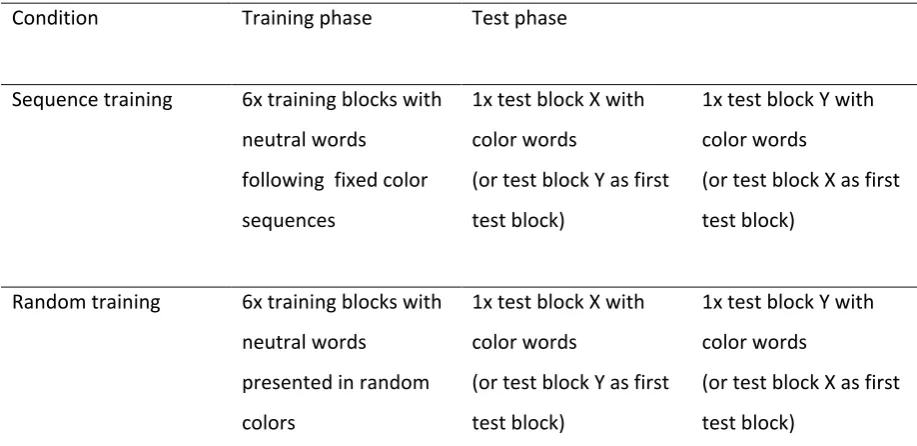
Table 1
Design of the Experiment
Condition Training phase Test phase
Sequence training 6x training blocks with neutral words
following fixed color sequences
1x test block X with color words
(or test block Y as first test block)
1x test block Y with color words
(or test block X as first test block)
Random training 6x training blocks with neutral words
presented in random colors
1x test block X with color words
(or test block Y as first test block)
1x test block Y with color words
(or test block X as first test block)
Note. When subjects in the sequence training conditon were exposed to test block X, the same color sequences were presented as in the training phase. Test block Y contained color sequences which were unfamiliar for them. Subjects in the random training condition were presented with unfamiliar sequences in both test block X and testblock Y. Subjects in the sequence training condition were exposed to the same color sequences as the subjects in the random training condition during the test phase.
In condition one, subjects were presented with the sequences “ncbvbc” and “vnbcnv” across the six training blocks and in block X of the test phase. In condition two, three and four, subjects were presented with the sequences “bnvcvn” and “cbvnbc”, “vbcncb” and “nvcbvn”, “cvnbnv” and “bcnvcb”, respectively.In block Y of the test phase, subjects got the same sequences from the other conditions. Specifically, subjects in condition one got the two sequences from condition two in the unfamiliar block. In condition two, three and four, subjects got the two sequences from condition three, four and one in the unfamiliar block, respectively.
If subjects could identify the color of the word by pressing the appropriate key, then it was considered a correct answer. Specifically, in the training phase, they had to react to the ink color of the neutral words (“Boot” = boat, “Müll” = trash, “Held” = hero and “Frau” = woman), and during the test phase, they had to react to the ink color of the color words (Rot” = red, “Grün” = green, “Gelb” = yellow, and “Blau” = blue). If the subjects pressed the wrong key, then they got a message on the screen indicating that they got the wrong answer (“Falsch”). Subjects could also react too quickly by accident (i.e., before the actual colored word was presented). If this was the case, they got the message “Zufrüh” which means “Too early” in German. In the sequence training group, each block had 48 trials and each trial consisted of 6 key presses (288 key presses in total). The order of executing sequence 1 or sequence 2 is randomly generated, given that each motor sequence was presented 24 times per block. In the random training group, 288 individual color-word combinations were presented. Halfway through each block there was a break of 30 seconds. After each block, subjects had the opportunity to take a break of a couple of minutes.
Results
Training phase
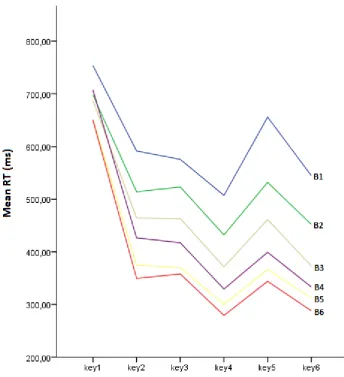
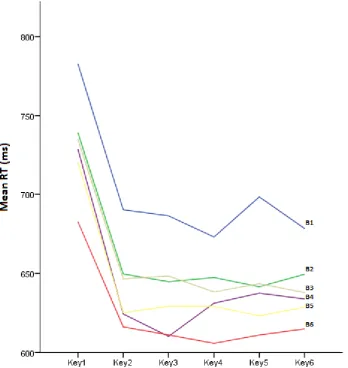
In figure 1, mean RTs of the sequence training group of each key of the fixed motor sequence are presented for each training block. It seemed that all key presses improved over the training blocks, especially for key press 2 to 6. According to figure 2, it seemed that in the random training group, RTs of all key presses did not become lower over the training blocks. To test whether these assumptions were true, a mixed factorial repeated measures ANOVA with Block (6; training blocks 1 - 6) and Key Press (6; key 1 - 6) as within-subject factors and Group (2; sequence training vs. random training) as a between-subject factor was performed.
Figure 1.
Mean RTs (in milliseconds) per key of the sequence for each training block
Figure 2.
Mean RTs (in milliseconds) per key of the sequence for each training block
(block 1 – 6 indicated as B1 – 6) of the random training group. Compared to figure 1,
different scales and a different starting point of the Y-axis were used.
A main effect of Block showed that the mean RTs differed across the training blocks, F(5, 150) = 45.74, p < .001. Furthermore, a main effect of Key Press showed that some key presses were executed faster than others, F(5, 150) = 58.23, p < .001. There was also a significant Block x Key Press interaction effect, F(25, 750) = 3.09, p < .001, which indicated that the RT differences between the training blocks varied across the key presses. Moreover, a Block x Group interaction effect, F(5, 150) = 13.55, p < .001, showed that there is more difference in RTs across the practice blocks in one of the two training groups. It was decided not to explore these main effects and two-way interaction effects mentioned above any further, because these effects varied with a third variable: there was also a significant Key Press (6) x Block (6) x Group (2) interaction effect.
assumed that the Block x Key Press interaction effect of the sequence training group would be different than the Block x Key Press interaction effect of the random training group, since the former group was not only exposed to task-specific learning, but also sequence learning (also figures 1 and 2 point in this direction). To test whether this was true, two separate repeated measures ANOVA’s (one for the sequence training group and one for the random training group) with Block (6) and Key Press (6) as within-subject factors were conducted. Results showed that there was a Block x Key Press interaction effect in the sequence training group, F(25, 375) = 3.71, p < .001, but not in the random training group, F(25, 375) = 1.12, p = .32, indicating that the RT differences between the training blocks varied across the different key presses in the sequence training group (see figure 1). However, this was not the case in the random training group (see figure 2), which showed that the improvement of key presses over the training blocks (due to task-specific learning) was not
significant. (In other words, the RT differences between key presses varied across the training blocks in the sequence training group, but not in the random training group).
It was assumed that the RT difference between block 6 and block 1 would capture the full effects of motor sequence learning and task-specific learning. Figure 1 gave the impression that the differences in RT between block 1 and 6 were significant for all keys. To examine whether this was actually true, separate independent-samples t-tests were conducted for the sequence training group to see whether RTs of block 6 were significantly higher than RTs of block 1 for each key press. Results showed that the RTs of block 1 were not significantly different from the RTs of block 6 (754 ms vs. 650 ms), for key press 1, t(30) = 1.97, p = .06. However, RTs of block 1 were significantly higher than RTs of block 6 for key press 2 (592 ms vs. 350 ms), key press 3 (576 ms vs. 358 ms), key press 4 (507 ms vs. 279 ms), key press 5 (656 ms vs. 344 ms), and key press 6 (545 ms vs. 288 ms), t(30) > 3.43, p < .01. These t-tests results together with the significant Block x Key Press interaction effect found in the sequence training group and figure 1, suggested that there was a gradual decrease in RTs for key press 2 to 6 over the training blocks. Note that these t-tests above specifically showed that the RT difference between block 1 and 6 was significant for key press 2 to 6.
Test phase
Block x Group interaction effect that showed that the difference in reaction times between the familiar and unfamiliar blocks was larger in one of the two training groups, F(1, 30) = 34.68, p < .001. A Key Press x Group interaction effect showed that the difference in reaction times between key presses was not the same in the two training groups, F(5, 150) = 9.30, p < .001. Furthermore, a Test Block x Key Press interaction effect indicated that the RT differences between key presses are not the same across the test blocks, F(5,150) = 3.02, p < .01. It was decided not to examine the main effect of Key Press and the two-way interaction effects mentioned above any further, because these effects varied with a third variable: there was also a significant Test Block (2) x Key Press (6) x Group (2) interaction effect.
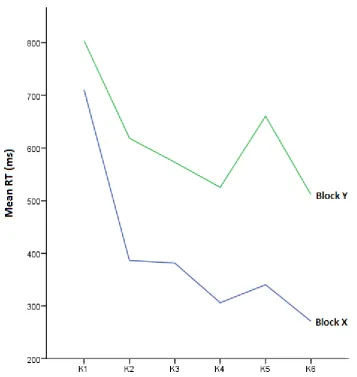
Figure 3. Mean RTs (in milliseconds) per key for the two test blocks in the sequence training group
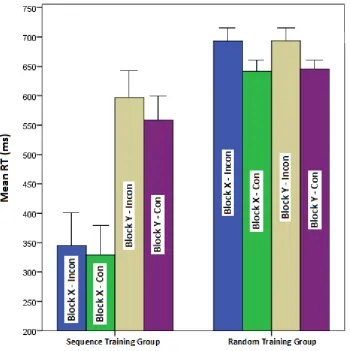
Figure 4. Mean RTs (in milliseconds) per key for the congruent and incongruent trials
The Test Block (2) x Congruency (2) x Group (2) interaction effect was not significant, F(1, 30) = 3.26, p = .08, when all key presses were considered in the analysis. It was expected that the influence of key press 1 may prevent this 3-way interaction to be significant, since key press 1 was not as sensitive to motor sequence learning as the subsequent key presses. That was the reason why another repeated measures ANOVA with Test Block (2), Congruency (2), Key Press (5) as within-subject factors and Group (2) as a between-within-subject factor was carried out (RTs of key press 1 were omitted). Results showed that Test Block x Congruency x Group interaction effect was still not significant, F(1, 30) = 3.25, p = .08.
To specifically test the hypothesis that the sequence training group would show smaller Stroop effects in test block X (with familiar sequences), than in test block Y (with unfamiliar
training group, F(1, 15) = 5.00, p < .05, indicating that the difference in Stroop effect between test block X and test block Y was significant. It showed that the Stroop effect was larger for test block Y compared to test block X in the sequence training group (see figure 5). It seemed that the Stroop effect was significant in both test block X and test block Y in the sequence training group, according to figure 5. To test whether this was true, two separate repeated measures ANOVA’s (one for test block X and one for test block Y) with Congruency (2) and Key Press (5) as within-subject factors were carried out to examine the Stroop effect in each test block in the sequence training group. The main effect of Congruency was found in both test block X, F(1, 15) = 6.06, p < .05, and test block Y, F(1, 15) = 18.43, p < .01, which means that in both test blocks, RTs of incongruent trials were significantly higher than RTs of congruent trials. This result showed that the sequence training group did not overcome the Stroop effect completely in test block X (with familiar sequences).
Discussion
The current study investigated whether motor sequence learning can help in the reduction of Stroop effect. Subjects performed a computer task in which words were presented in a certain ink color. They were instructed to only react to the ink color of the words while ignoring word meanings. The sequence training group was presented with fixed color sequences in the training phase (with neutral words), so they had to react to these sequences by performing fixed motor sequences (i.e., fixed sequences of key presses). Subjects of the random training group were presented with neutral words displayed in random ink colors, so no sequence learning took place. In the test phase, subjects had to react to Stroop stimuli (i.e., color words displayed in a certain ink color). The reaction times between congruent trials and incongruent trials would indicate the degree of Stroop effect.
Results of the study showed that the sequence training group showed a larger decline in RTs over the training blocks than the random training group. In other words, the former group learned more of the fixed motor sequences than the latter group. Furthermore, the sequence training group would show significant smaller Stroop effect when these subjects performed familiar motor
sequences compared to when they performed unfamiliar sequences, but this was only true when RTs of key press 1 were omitted. This was not surprising because it was expected that only key press 2 to 6 were responsive to motor sequence learning.
In regard to the Dual Processor Model of sequencing skill (Verwey, 2001), the subjects in the sequence training group could use motor chunks to help them perform the task. During the training phase, subjects of this group had practiced fixed motor sequences. The execution of these sequences could develop into the so-called chunking mode, which made it possible that an entire key press sequence could be executed as one (or more) motor chunks. On the basis of the first key press, the whole motor sequence could be performed as this key press functioned as the trigger of the fixed key press sequence that had to be completed. A possible reason why the subjects of the sequence training group showed decreased Stroop effects in the test phase, was because after the
presentation of the first color stimulus (and the first key press), they paid less attention to the 2nd to 6th stimuli of the fixed color sequence presented on the screen (because this was not necessary for completing the 2nd to 6th stimuli of a fixed motor sequences). So the subjects of this group paid less attention to the word meaning of the 2nd to 6th stimuli, which resulted in reduced experience of Stroop conflict for these stimuli.
Stroop effect reduction would take place. In contrast to this study in which motor sequence learning was examined, Deroost et al. (2012) investigated perceptual sequence learning in which probabilistic sequences were used that are not entirely fixed beforehand. This seemed to be the main reason why the results were not in line. Subjects were asked to react to a fixed set of stimuli over and over again in which each cue (i.e., ink color of the word) indicated that one of the two keyboard keys (i.e., C-key or N-key) had to be pressed. Probabilities governed the transition between the cues, so the
appropriate key presses following one cue have a certain degree of predictability, which could result to faster RTs to the cues because the test subjects can pick up and use these probabilities of
transition. These perceptual sequences did not have a clear starting and ending point of the
sequence, unlike the discrete motor sequences used in this study. Furthermore, subjects in the study of Deroost may not learn the sequences as well as in this study. The findings of this study had
implications for the theory: it seemed that sequences which were completely fixed beforehand and which subjects can learn and utilize relatively easy (each motor sequence only consisted of 6 keys) resulted in the above mentioned reduced Stroop effects.
Future research could focus on whether there is a reduction of Stroop effect when subjects had to perform this task for multiple times (for example, they were instructed to complete this task once every day for one month). They would get the same training blocks and test blocks as if they were in the random training condition in this study (no fixed motor sequences would be presented during the training phase). Every day, they should receive different (unfamiliar) fixed sequences in the test phase, to avoid the possibility that they would learn the fixed sequences. If significant Stroop effect reduction is found over time, this would suggest increased cognitive control, because they would have to identify each stimulus, in order to press the right keys. In this case unimportant distractors (meaning of the color word) were perceived and were successfully rejected. There were certain limitations in this study. Only a small Stroop effect reduction was observed between the two test blocks in the sequence training group. Maybe this is due to the number of blocks in the training phase. A stronger decrease of Stroop effect could be found when more training blocks were used in this task and subjects of the sequence training group may even overcome the Stroop effect in the test block in which familiar sequences were presented.
References
Deroost, N., Vandenbossche, J., Zeischka, P., Coomans, D., & Soetens, E. (2012). Cognitive Control: A Role for Implicit Learning. Journal of Experimental Psychology: Learning, Memory,
and Cognition, 38, 1243-1258. doi: 10.1037/a0027633
Ishihara, S. (1917). Tests for color-blindness. Handaya, Tokyo, Hongo Harukicho.
Jensen, A. R., Rohwer, W. D. (1966). The Stroop color-word test: a review. Acta psychologica,25(1): 36–93. doi:10.1016/0001-6918(66)90004-7
Langer, E. J. (1978). Rethinking the role of thought in social interaction. Hillsdale, NJ: Erlbaum. Lavie, N., Hirst, A., de Fockert, J., & Viding, E. (2004). Load theory of selective attention and cognitive control. Journal of Experimental Psychology: General, 133(3), 339-354. Lavie, N. (1995). Perceptual load as a necessary condition for selective attention. Journal of Experimental Psychology: Human Perception andPerformance, 21, 451–468.
MacLeod, C. M. (1991). Half a century of research on the Stroop effect: An integrative review. Psychological Bulletin, 109, 163–203. doi:10.1037/0033-2909.109.2.163
MacLeod, C. M., & MacDonald, P. A. (2000). Interdimensional interference in the Stroop effect: Uncovering the cognitive and neural anatomy of attention. Trends in Cognitive Sciences, 4, 383–391. doi:10.1016/S1364-6613(00)01530-8
McBride, J., Boy, F., Husain, M., & Sumner, P. (2012). Automatic motor activation in the executive control of action. Frontiers in human neuroscience, 6, doi: 10.3389/fnhum.2012.00082 Ruitenberg, M. F. L., Abrahamse, E. L., de Kleine, E., & Verwey, W. B. (2012). Context-dependent motor skill: perceptual processing in memory-based sequence production. Experimental Brain Research, 222, 31-40. doi: 10.1007/s00221-012-3193-6
Ruitenberg, M. F. L., Abrahamse, E. L., & Verwey, W. B. (2013). Sequential motor skill in
preadolescent children: The development of automaticity. Journal of Experimental Child Psychology, 115, 607-623. doi: http://dx.doi.org/10.1016/j.jecp.2013.04.005
Stroop, J. (1935). Studies of interference in serial verbal reaction. Journal of Experimental Psychology, 18, 643-662.