ORIGINAL RESEARCH
Optimized 3D Magnetization-Prepared Rapid
Acquisition of Gradient Echo: Identification of
Thalamus Substructures at 3T
B. Bender C. Ma¨nz A. Korn T. Na¨gele U. Klose
BACKGROUND AND PURPOSE: Because the substructures of the thalamus are not visible on standard T1- and T2-weighted MR images, planning of deep brain stimulation implantation relies on stereotactic atlas coordinates. The goal of the present work was to test whether an optimized 3D MPRAGE protocol can depict thalamus substructures.
MATERIALS AND METHODS: After optimization of the TI to maximize contrast between gray matter and white matter, 6 healthy subjects were scanned at 3T with the optimized 3D MPRAGE. The results were compared with stereotactic atlases, and 2 expert readers trained in thalamic anatomy identified the 4 large thalamic nuclei groups.
RESULTS: There was a high agreement between the different atlases and the resulting MR images. The 4 large thalamic nuclei groups (anterior, lateral, medial, posterior) could be detected reliably. The inter-reader consistency on the size and location was 75%–92%.
CONCLUSIONS:The optimized 3D MPRAGE protocol improves contrast in the thalamus, and the 4 large thalamic nuclei groups can be identified with high inter-reader agreement.
ABBREVIATIONS:AC ⫽ anterior commissure; ACPC ⫽ anterior/posterior commissure; CM ⫽ centre me´dian nucleus; LD⫽ lateral dorsal nucleus; MD⫽mediodorsal nucleus; MPRAGE ⫽ magnetization-prepared rapid acquisition of gradient echo; PC⫽posterior commissure
T
here has been increasing interest in deep brain stimulation in the treatment of several neurologic diseases since the first positive experiences in humans in the early 1980s.1 Typi-cal neurologic diseases treated with deep brain stimulation are Parkinson disease, dystonia, and essential tremor.1 Typical targets in the basal ganglia are the subthalamic nucleus, the internal globus pallidus, and the thalamic nuclei such as the nucleus ventralis intermedius.2-4More recently, the initial re-sults of larger patient groups with epilepsy treated with deep brain stimulation in the anterior thalamus complex have been published.5More substructures of the thalamus, such as the CM or the parafasicular nucleus complex, have also been re-ported to be possible targets for deep brain stimulation in a variety of diseases.6-8 Placement of electrodes is usually planned indirectly, with coordinates taken from stereotactic atlases of the thalamus, because the substructures of the thal-amus are not visible on routine MR imaging,9and is corrected by intraoperative electrophysiologic mapping. All histologic atlases face known problems: Sections in different orientationsare from different subjects and the distance between adjacent sections is relatively large and may vary. To improve targeting with coordinates from classic histologic atlases, a mean 3D atlas of the human thalamus has been published recently.10
Many authors have already addressed the problem of indi-vidualized depiction of thalamic substructures. Deoni et al11 were able to show that many substructures of the thalamus can be identified with a measurement at 1.5T, if measurement times of several hours are used. For measurements with a shorter time, a segmentation algorithm is able to identify im-portant substructures. Still, this segmentation algorithm of Deoni et al requires seed points taken from anatomic atlases, which face the known problems. Just recently, Lemaire et al12 reported that high-resolution T1-weighted measurements can be used to create images of the thalamus, which were very comparable to myelin-stained histologic sections. Such a con-trast can easily be used to identify many well-known structures in individual thalami; however, the measurement time for the protocol used was during 14 hours. Kanowski et al13showed that the CM is already identifiable in a reasonable measure-ment time of 13–26 minutes with proton-attenuation weighted images at 3T. The goal of the present work was to develop an MR imaging protocol at 3T that depicts the major substructures of the thalamus within a reasonable measure-ment time. Because T1-weighted images at high field strengths show a contrast comparable with myelin stains,12 a 3D MPRAGE protocol was optimized.
Materials and Methods
After approval by the local ethics committee, 6 healthy subjects (2 men, 4 women; 21–34 years of age; mean, 26.5 years) who gave written informed consent were included in this study. All subjects were mea-sured with standard single-slab 3D MPRAGE sequences on a 3T
scan-Received March 2, 2011; accepted after revision April 20.
From the MR Research Group, Department of Diagnostic and Interventional Neuroradiology, University Hospital Tu¨bingen, Tu¨bingen, Germany.
Benjamin Bender: Planning of study, literature research, MR imaging examination, identi-fication of thalamic substructures, statistical analysis, evaluation of results (clinical and methodologic aspects), writing of paper, approval of final version. Constantin Ma¨nz: MR imaging examination, identification of thalamic substructures, evaluation of results (clinical aspects), approval of final version. Andreas Korn: Literature research, evaluation of results (clinical aspects), approval of final version. Thomas Na¨gele: Planning of study, evaluation of results (clinical aspects), approval of final version. Uwe Klose: Planning of study, statistical analysis, evaluation of results (methodologic aspects), writing of paper, approval of final version.
Please address correspondence to Benjamin Bender, MD, Department of Diagnostic and Interventional Neuroradiology, Hoppe-Seyler-Str 3, 72076 Tu¨bingen, Germany; e-mail: [email protected]
ner (Tim Trio; Siemens, Erlangen, Germany) in a 32-channel receive-only coil. Sequence parameters were as follows: 144 sections; FOV, 256⫻256 mm2; base resolution, 256; section thickness, 1 mm; TE, 3.4
ms; TR, 2300 ms; echo spacing, 8.6 ms; bandwidth, 130 Hz/pixel; NEX, 2; flip angle, 8°; time of acquisition, 19:39 minutes. The TI was experimentally chosen to maximize suppression of cortical gray mat-ter in the first subject by using low-resolution images. TI was varied in steps of 50 ms starting at 450 ms until maximum suppression of cortical gray matter was achieved at TI 700 ms. To visualize the ad-vantages of the optimized sequence in comparison with a standard sequence, an MPRAGE that reflects the local standard for anatomic studies was acquired in 2 subjects with the following parameters: 176 sections; FOV, 256⫻256 mm2; base resolution, 256; section
thick-ness, 1 mm; TE, 2.96 ms; nonselective inversion pulse with TI, 1100 ms; TR, 2300 ms; echo spacing, 8.5 ms; bandwidth, 130 Hz/pixel; averages, 2; flip angle, 8°; time of acquisition, 19:39 minutes. In both cases, TE was not freely selectable but was dependent on the other sequence parameters. For labeling of the nuclei, we applied the no-menclature introduced by Hirai and Jones14(Table), which was also
used by Morel et al,15because the atlas of Krauth et al10is based on the
Morel atlas.
In the first step, the images were compared with histologic atlases such as the Morel atlas,15the atlas of Mai et al,16and the
Schalten-brand and Wahren atlas.17For further evaluation, the software
pack-age 3DSlicer (Version 3.4.1, www.slicer.org) was used. The outlines of the 4 large thalamic nuclei groups (lateral, medial, anterior, and pos-terior groups) first described by Morel et al (see Table 1 in Krauth et al10) were drawn on each section by an experienced neuroradiologist
(B.B., 2.5 years of experience). Afterwards, the model-maker module of the software package was used to create 3D models. For the com-plete thalamus, the sum of the volumes of all 4 thalamic nuclei groups was chosen. For comparison, the mean 3D thalamus atlas published by Krauth et al10was used. Each image was moved by rigid-body
transformation to a standard space with sections parallel to a line between the AC and the PC, with the middle of the AC being the origin. For comparison with the Schaltenbrand and Wahren atlas, the images were transformed into Reil’s plane (a tangent line above the AC below the PC). To assess the inter-reader reliability, a second neuroradiologist (C.M., 5.5 years of experience), blinded to the re-sults of the first reader, evaluated all of the datasets, and a consistency score was calculated. Each reader,n, selected a volume,Vn, for each model. The overlapVobetween volumeV1andV2(Vo⫽V1艚V2) for
each thalamic nuclei group was divided by the larger volumeV1orV2
[Vr⫽max (V1,V2)] to form the consistency score CS⫽Vo/Vr. Both
readers were trained in thalamic anatomy. Both readers first studied the myelin stains from the Mai et al atlas16and the Schaltenbrand and
Wahren atlas,17as well as the anatomic segmentation of the Morel et
al atlas.15Afterward, copies of myelin stains from the Schaltenbrand
and Wahren atlas were segmented by hand, and the results were com-pared with the transparent segmentation overlay provided by the Schaltenbrand and Wahren atlas. For reference, both readers used the anatomic atlases during segmentation.
Results
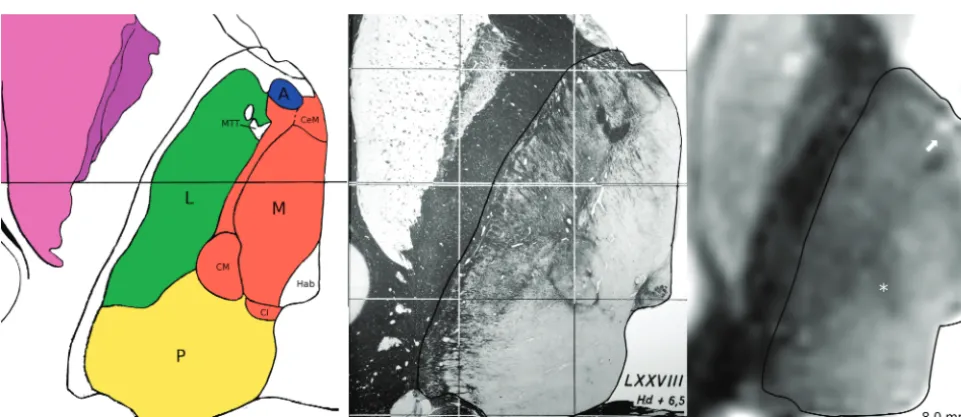
The average intercommissural distance was 26.7 mm (range, 25–29 mm). In the standard MPRAGE protocol, there was a high contrast between white matter, gray matter, and CSF, whereas in the optimized protocol, the contrast between gray matter and white matter was optimal (Fig 1). The outlines of some thalamic nuclei were visible in standard MPRAGE. In contrast, the optimized protocol depicted the borders between the nuclei groups more clearly (Figs 1 and 2). Inverted gray-scale images in comparison with myelin stains from histologic sections showed a high level of concordance (Figs 3 and 4). The section position in relation to the midline, the ACPC line, Reil’s plane, and the AC (depending on the histologic atlas and
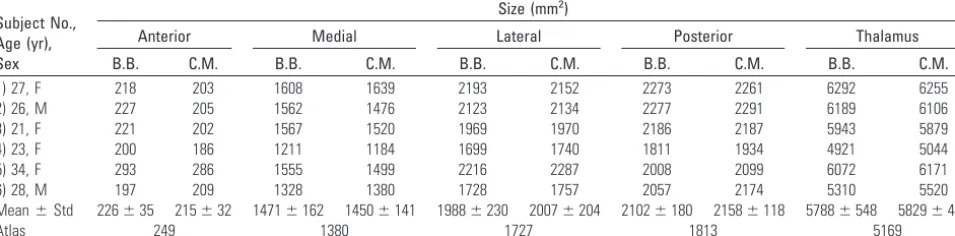
Summary of the volume size of the thalamus and substructures of the thalamus in all subjectsa
Subject No., Age (yr), Sex
Size (mm2)
Anterior Medial Lateral Posterior Thalamus
B.B. C.M. B.B. C.M. B.B. C.M. B.B. C.M. B.B. C.M.
1) 27, F 218 203 1608 1639 2193 2152 2273 2261 6292 6255
2) 26, M 227 205 1562 1476 2123 2134 2277 2291 6189 6106
3) 21, F 221 202 1567 1520 1969 1970 2186 2187 5943 5879
4) 23, F 200 186 1211 1184 1699 1740 1811 1934 4921 5044
5) 34, F 293 286 1555 1499 2216 2287 2008 2099 6072 6171
6) 28, M 197 209 1328 1380 1728 1757 2057 2174 5310 5520
Mean⫾Std 226⫾35 215⫾32 1471⫾162 1450⫾141 1988⫾230 2007⫾204 2102⫾180 2158⫾118 5788⫾548 5829⫾426
Atlas 249 1380 1727 1813 5169
a
For both readers (B.B., C.M.) and in the 3D mean thalamus atlas from Krauth et al.10
Fig 1.Comparison of the normal MPRAGE protocol (left and middle image, different windowing) with the optimized MPRAGE protocol (right).
BRAIN
ORIGINAL
[image:2.594.56.534.62.180.2]the orientation) in concordant sections in vivo and in the at-lases showed deviations by several millimeters. In Fig 4, the posterior nucleus group is already visible in the in vivo image (dashed line), whereas the histologic section showed no parts
of the posterior nucleus group. A vertical line in the axial plane, which represents a parasagittal section, through the MTT in Fig 3, also cuts the medial pulvinar. This suggests that either the plane from the Schaltenbrand and Wahren atlas17in
Fig 2.Comparison of the normal MPRAGE protocol (top row) with the optimized protocol (bottom row) in different section orientations. Contrast in both images was chosen for an optimal depiction of thalamus substructures. Adjacent anatomic structures have been labeled. cc indicates corpus callosum; fx, fornix; R, red nucleus; LV, lateral ventricles; C, caudate nucleus; Pu, putamen; IC, internal capsule; GP, globus pallidus.
Fig 3.Axial myelin stain (middle) from the Schaltenbrand and Wahren atlas,17
[image:3.594.55.533.44.362.2] [image:3.594.53.534.408.616.2]Fig 4 is slightly tilted or the MTT in the thalamus used for the sagittal sections of the Schaltenbrand and Wahren atlas had a relatively medial-positioned MTT.
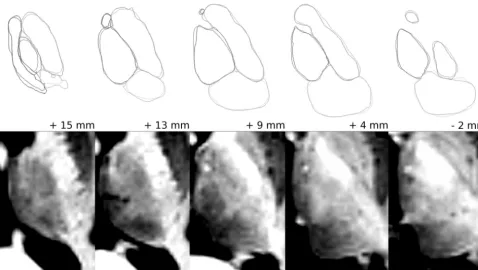
With the myelin stain-like contrast of inverted gray-scale images from the optimized MPRAGE sequence, the borders of the 4 large thalamic nuclei groups could be identified in all subjects and marked by hand. Figure 5 depicts a typical exam-ple of the demarcation of the 4 thalamic nuclei groups. The Table summarizes the size of the demarked thalamic nuclei group in comparison with the Krauth atlas. The anterior group was smaller compared with the atlas, while all the other thalamic nuclei groups were larger than those in the atlas. On average, the measured thalami were about 12% larger than the thalamus of the atlas. The accordance in size, location, and shape of the identified thalamic nuclei groups was high be-tween both raters (Table and Fig 6). For the lateral, medial, and posterior thalamic nuclei groups, the average consistency score between the volumes was 91⫾1.3% / 86⫾6.5%/92⫾
1.1%, which was considered very good. For the small anterior thalamic nuclei group, a slightly lower consistency score of 75⫾5.9% between the 2 raters was reached.
Discussion
This study showed that the main substructures of the thalamus can be identified within a reasonable measurement time of ⬍20 minutes in healthy subjects with an optimized acquisi-tion protocol. The shape and localizaacquisi-tion of the 4 thalamic nuclei groups were in good agreement with the Krauth atlas, whereas the overall size was, in general, larger (Table). An overestimation of the size of the thalamus by the neuroradi-ologists is unlikely because structures that are easy to identify, such as the MTT, the habenulae, or the pulvinar, could not be matched with the 3D atlas, and the average intercommissural distance (26.7 mm) was 1.3 mm larger than the average inter-commissural distance (25.4 mm, 23–29 mm) of the 5 brains used for the Krauth atlas.10,15The Morel atlas15was used to
Fig 4.Parasagittal myelin stain (middle) from the Schaltenbrand and Wahren atlas,17
taken from plate 44, located 5.5 mm lateral to the midline and a corresponding inverted gray-scale image from one of the subjects, located 6.2 mm lateral to the midline (right). The boundaries of the thalamus have been delineated in all images with a thin black line. The white star marks the CM, which can be clearly localized. The bright structure (black star) close to the MTT is a vessel. For anatomic reference, a schematic drawing adapted from the overlay of the Schaltenbrand and Wahren atlas is shown on the left. The anatomic structures belonging to the 4 thalamic nuclei groups used in this work have been colored (blue, anterior; red, medial; green, lateral).
[image:4.594.52.535.43.195.2] [image:4.594.53.533.260.449.2]create the Krauth atlas,10and it was not corrected for shrink-age due to the fixation process. This explains the avershrink-age dif-ference of approximately 13%, and, thus, should be kept in mind by neurosurgeons when planing stereotactic deep brain stimulation implantation. In contrast to the on-average larger size of the thalamus, the identified anterior nucleus group was, in all except 1 subject, smaller than that in the reference atlas. The anterior nucleus group consists of several small nuclei. In particular, the anterodorsal nucleus and the anteromedial nu-cleus are rather small nuclei, whereas the LD is a thin nunu-cleus. All of the 3 nuclei are, in at least 1 dimension only, approxi-mately 1–3 mm thick and, therefore, consist mainly of voxels that are part of the border of the nuclei. With an isotropic resolution of 1 mm3, partial volume effects at the borders eas-ily explain the difference in size for the anterior group and explain the larger difference in the drawn volumes between the 2 readers in the case of the anterior nucleus group. For the 3 other thalamic nuclei groups, which have a larger volume and, due to their shape, fewer voxels located at the boundaries, the inter-reader agreement was much better.
Although many small substructures of the thalamus were identifiable (Fig 3C), a clear discrimination of all thalamic substructures, possible with longer measurement times of hours or with a higher magnetic field strength,12 was not achievable. However, the measurement technique used in this study can be easily applied in presurgical examinations. For a clinical application, the long measurement time of 20 minutes requires a strict prevention of head movement during the scanning time. This can be achieved with sedation or narcosis, which is frequently performed in patients with movement dis-orders. Although the definite identification of even small sub-structures was not possible, the suggested protocol clearly
de-lineates important substructures and can be used to optimize correlation with stereotactic atlases and navigation planning. There are several possible solutions to depict even smaller substructures with certainty. Due to the small size of many thalamic nuclei, a higher resolution might be necessary to de-pict the substructures. If the resolution is increased isotropi-cally, signal intensity to noise would decrease unacceptably or measurement time would increase unacceptably. Because the shape of many nuclei varies slowly in 1 dimension (eg, sagittal or coronal for LD, axial for the CM), one might optimize the sequence, depending on the target nucleus. In this case, a low resolution in the slowly varying dimension can be combined with a high resolution in the other 2 dimensions.13Kanowski et al13suggested using at least an in-plane resolution 0.6⫻0.6 mm2with a 2- to 3-mm section thickness to depict the CM. Because the various thalamic nuclei differ not only in their transversal but also in their longitudinal relaxation time, a multimodal imaging approach as applied by Deoni et al11at 1.5T might be possible in a reasonable measurement time at higher field strengths. Until now, results from new imaging techniques to segment the thalamus, such as diffusion tensor imaging,18,19could only be compared with histologic atlases. With the new sequence, an individual comparison is possible, which might give a more detailed view inside the thalamus.
Other imaging modalities exist to depict the internal anat-omy of the thalamus. Just recently, Abosch et al20showed high contrast images of the thalamus acquired with SWI at 7T. The measurement time for an isotropic resolution of 0.67 mm3was 15 minutes. In Fig 6 of the article by Abosch et al,20an axial section of the thalamus at the level of the habenulae is de-picted. As in the optimized MPRAGE, many substructures can be identified, though the contrast differs for some
[image:5.594.54.533.48.318.2]tures, while others show a similar contrast in comparison with the optimized MPRAGE protocol. Whether SWI images at 3T provide a similar contrast and if the combination of the differ-ent contrasts of T1 and SWI further improves segmdiffer-entation need further investigation. Gringel et al21reported that with multiparameter magnetization-transfer maps, improved con-trasts can be obtained within the thalamus in a measurement time of 23–25 minutes, but postprocessing is required to cal-culate the multiparameter maps. The multiecho fast low-angle shot sequence needed is not available as a standard sequence on most scanners; this requirement is currently another drawback for clinical application. Whether the optimized MPRAGE or the multiparameter maps provide a better con-trast was not evaluated.
Conclusions
With the optimized 3D MPRAGE protocol, the main sub-structures of the thalamus can be depicted. This permits an improved individual targeting for patients undergoing deep brain stimulation electrode implantation, which, before sur-gery, does not solely rely on stereotactic atlases.
References
1. Cooper IS, Upton AR, Amin I.Reversibility of chronic neurologic deficits: some effects of electrical stimulation of the thalamus and internal capsule in man.Appl Neurophysiol1980;43:244 –58
2. Lyons KE, Pahwa R.Deep brain stimulation and essential tremor.J Clin Neu-rophysiol2004;21:2–5
3. Volkmann J.Deep brain stimulation for the treatment of Parkinson’s disease.
J Clin Neurophysiol2004;21:6 –17
4. Krauss JK, Yianni J, Loher TJ, et al.Deep brain stimulation for dystonia.J Clin Neurophysiol2004;21:18 –30
5. Fisher R, Salanova V, Witt T, et al.Electrical stimulation of the anterior nu-cleus of thalamus for treatment of refractory epilepsy.Epilepsia2010;51:899 – 908
6. Velasco F, Velasco M, Velasco AL, et al.Electrical stimulation of the
centrome-dian thalamic nucleus in control of seizures: long-term studies.Epilepsia
1995;36:63–71
7. Weigel R, Krauss JK.Center median-parafascicular complex and pain control: review from a neurosurgical perspective.Stereotact Funct Neurosurg2004;82: 115–26
8. Schiff ND, Giacino JT, Kalmar K, et al.Behavioural improvements with tha-lamic stimulation after severe traumatic brain injury.Nature 2007;448: 600 – 03
9. Bourgeois G, Magnin M, Morel A, et al.Accuracy of MRI-guided stereotactic thalamic functional neurosurgery.Neuroradiology1999;41:636 – 45 10. Krauth A, Blanc R, Poveda A, et al.A mean three-dimensional atlas of the
human thalamus: generation from multiple histological data.Neuroimage
2010;49:2053– 62
11. Deoni SCL, Josseau JC, Rutt BK, et al.Visualization of thalamic nuclei on high resolution, multi-averaged T1 and T2 maps acquired at 1.5 T.Hum Brain Mapp2005;2:353–59
12. Lemaire JJ, Sakka L, Ouchchane L, et al.Anatomy of the human thalamus based on spontaneous contrast and microscopic voxels in high-field magnetic reso-nance imaging.Neurosurgery2010;66:161–78
13. Kanowski M, Voges J, Tempelmann C.Delineation of the nucleus centre me-dian by proton density weighted magnetic resonance imaging at 3 T. Neuro-surgery2010;66(3 suppl operative):E121–23, discussion E123
14. Hirai T, Jones E.A new parcellation of the human thalamus on the basis of histochemical staining.Brain Res Brain Res Rev1989;14:1–34
15. Morel A, Magnin M, Jeanmonod D.Multiarchitectonic and stereotactic atlas of the human thalamus.J Comp Neurol1997;387:588 – 630
16. Mai JK, Paxinos G, Voss T.Atlas of the Human Brain.3rd ed. Burlington, Vermont: Academic Press; 2007
17. Schaltenbrand G, Wahren H,Atlas for Stereotaxy of the Human Brain.Stuttgart, Germany: Georg Thieme Verlag; 1991
18. Unrath A, Klose U, Grodd W, et al.Directional colour encoding of the human thalamus by diffusion tensor magnetic resonance imaging.Neurosci Lett2008; 434:322–27. Epub 2008 Feb 12
19. Mang SC, Busza A, Reiterer S, et al.Validation of a thalamus segmentation based on local diffusion information.In:Proceedings of the 18th Annual Meet-ing of International Society for Magnetic Resonance in Medicine, Stockholm, Swe-den. May 5–7, 2010:1594
20. Abosch A, Yacoub E, Ugurbil K, et al.An assessment of current brain targets for deep brain stimulation surgery with susceptibility-weighted imaging at 7 Tesla.Neurosurgery2010;67:1745–56