Knowledge sharing in schools with data teams Master Thesis
Educational Science and Technology
Graduation Committee:
First supervisor: M.D. Hubers, MSc Second supervisor: Dr. K. Schildkamp
KNOWLEDGE SHARING IN SCHOOLS WITH DATA TEAMS
Knowledge sharing in schools with data teams
Table of contents
Summary ... 3
1. Introduction ... 4
2. Conceptual framework ... 6
2.1 Data teams ... 6
2.2 Creating and sharing knowledge ... 8
2.2.1 SECI-model of Knowledge Creation ... 9
2.2.2 Theory of Knowledge Building ... 9
2.2.3 Activity Theory ... 10
2.3 Factors promoting and hindering knowledge sharing ... 10
2.3.1 Organisational factors ... 11
2.3.2 Individual factors ... 13
3. Method ... 15
3.1 Respondents... 15
3.2 Data collection ... 16
3.3 Data analysis... 16
3.4 Reliability and validity ... 17
4. Results ... 18
4.1 School A ... 18
4.1.1 What and how knowledge is shared at School A ... 18
4.1.2 Factors promoting and hindering knowledge sharing at School A ... 20
4.2 School B ... 21
4.2.1 What and how knowledge is shared at School B ... 21
4.2.2 Factors promoting and hindering knowledge sharing at School B ... 24
4.3 School C ... 24
4.3.1 What and how knowledge is shared at School C ... 24
4.3.2 Factors promoting and hindering knowledge sharing at School C ... 26
4.4 School D ... 26
4.4.1 What and how knowledge is shared at School D ... 27
4.4.2 Factors promoting and hindering knowledge sharing at School D ... 28
4.5 Cross-case analysis ... 29
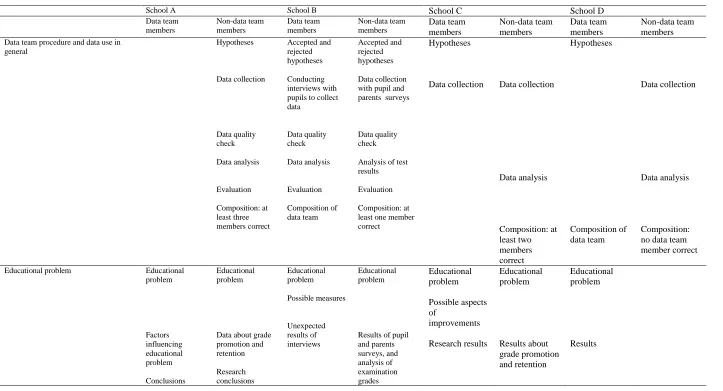
4.5.1 What and how knowledge is shared ... 29
4.5.2 Factors promoting and hindering knowledge sharing ... 33
5. Conclusion and discussion ... 36
5.1 Conclusion ... 36
5.1.1 What knowledge is shared between data team members and non-data team members? ... 36
5.1.2 How is knowledge shared between data team members and non-data team members? ... 36
5.1.3 What factors promote and hinder knowledge sharing between data team members and non-data team members? ... 37
5.2 Discussion ... 38
5.3 Implications for practice and future research ... 38
Knowledge sharing in schools with data teams
Summary
Data-based decision making has become more and more important for schools. Schools are increasingly held responsible for the education they provide and their pupils’ learning progress, and one way in which they can take this responsibility is by basing their decisions on data. This study focused on the data team procedure, which is one of the methods of data-based decision making. The data team procedure learns teachers to collect, interpret and analyse data and to develop improvement measures for the educational problems within the school (Schildkamp, Poortman, & Handelzalts, submitted). The group of teachers who use the data team procedure, the data team members, will not be able to solve the educational problem by themselves. The data team members need the cooperation of the non-data team members to implement the improvement measures in the school, because mostly these concern school wide problems. Therefore, knowledge sharing between the data team and the non-data team members is important. Data team members can share two types of knowledge: knowledge on the data team procedure and data use in general, and knowledge about the educational problem they are studying. This study focused on whether these two types are shared with the non-data team members, how this knowledge is shared, and what factors promote and hinder this knowledge sharing.
The results showed that data team members shared both knowledge about the data team procedure and about the educational problem, although more knowledge was shared about the educational problem. With regard to the way knowledge was shared, the results showed that knowledge was mostly shared verbally at the team level and during formal moments. Knowledge sharing could be promoted by a stimulating school culture and the presence of formal opportunities to share knowledge (e.g., team meetings). A factor that seemed to hinder knowledge sharing was the organisational structure of the school, when there is not much communication between the different locations and departments within the school.
Knowledge sharing in schools with data teams
1. Introduction
Over the past few years, schools are increasingly held responsible for the education they provide and the learning progress of their pupils (Ikemoto & Marsh, 2007; Schildkamp, Poortman, & Handelzalts, submitted). Schools can take this responsibility by trying to use data to gain insight in their education, and by basing their educational decisions on these data. One way in which schools can make data-based decisions is by working with the data team procedure (Schildkamp, Poortman, & Handelzalts, submitted). The data team procedure learns teachers to collect and analyse data and to develop improvement measures for educational problems the school encounters. Besides learning about data use, the teachers learn about the educational problem, how to solve this problem , and how to improve their education in general (Schildkamp, Poortman, & Handelzalts, submitted). However, making decisions based on data is not something teachers are very familiar with.
Schildkamp and Kuiper (2010) found several reasons why teachers do not use data to improve their education: they dissociate their own performance from the performances of the pupils, they think that using data is not a task for teachers but for the school leader, and they do not always have the required skills to collect and analyse data. Most teachers are not only quite unfamiliar with data use, sometimes they are also used to base their decisions on intuition. These intuitions may not always be correct and so a lot of time and money may be invested in ineffective improvement measures which are not adapted to the pupils’ needs. Therefore, it is important that teachers in a data team learn how to make decisions based on data (Schildkamp & Kuiper, 2010). Furthermore, research showed that using data can lead to improved education and higher pupil achievement (Campbell & Levin, 2009; Earl & Timperley, 2009).
Using data to improve education and increase pupil achievement will only be effective when the data team members share their knowledge about data use and the educational problem, and their data use skills with the other teachers in the school (Achterberg & Vriens, 2002; Cabrera & Cabrera, 2002; Ipe, 2003). This way, the non-data team members also learn more about data use and the educational problems, and will be stimulated to work with data themselves and to implement the developed improvement measures in their own teaching. The educational problems the data team works on are often school wide problems, so it is important that all teachers in the school exactly know what the problem is and how to deal with it.
Over the past years, a lot of research has been conducted about knowledge sharing in general and knowledge sharing between teachers. Researchers have indicated several factors that could influence knowledge sharing, for example the motivation of a teacher to share, the abilities of a teacher to share, and the school’s culture (Ipe, 2003; Riege, 2005). However, there is yet not much consensus about how knowledge is shared and what factors promote or hinder knowledge sharing between teachers. Furthermore, not much research is yet conducted about knowledge sharing in the context of data teams. Therefore, this study focused on which knowledge data team members and non-data team members share with each other, on how this knowledge is shared, and on the promoting and hindering factors of knowledge sharing. The results of this study will contribute to existing theories about knowledge sharing: it will provide more insight in what kind of knowledge is shared, how this knowledge is shared, and the factors that influence knowledge sharing. The outcomes of this study will also have a more practical relevance. It will help school leaders to gain more insight in how knowledge sharing could be promoted in order to make data use in schools more valuable. Besides that, it will help data team members and non-data team members to gain more insight in how they can share their knowledge with each other in a school context.
This study focused on three research questions:
1. What knowledge is shared between data team members and non-data team members? 2. How is knowledge shared between data team members and non-data team members?
1. Introduction
Knowledge sharing in schools with data teams
Knowledge sharing in schools with data teams
2. Conceptual framework
In the conceptual framework, an explanation will be given about data teams and the data team procedure. Thereafter, an overview will be given of existing theories about knowledge creation and sharing, and an overview of the most mentioned influential factors on knowledge sharing in the literature.
2.1 Data teams
A data team consists of four to six teachers and one or two school leaders (Schildkamp, Poortman, & Handelzalts, submitted). This team collects data, interprets them, and develops a plan of action to solve a school’s educational problem. A data team can collect quantitative and qualitative data about any school aspect. The team can collect input data (e.g., pupils’ demographics), process data (e.g., information on the quality of instruction), outcome data (e.g., pupils’ grades), and satisfaction data (e.g., opinions of teachers, pupils, and parents) (Ikemoto & Marsh, 2007; Schildkamp, Lai, & Earl, 2013).
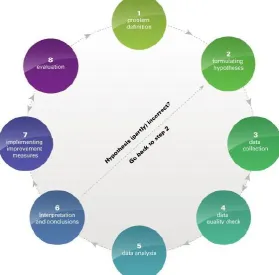
[image:6.595.84.364.312.587.2]A data team works according to a cyclic and iterative procedure consisting of eight steps, see Figure 1. In each step, the data team members have to take different actions and use different skills in order to reach their goal. In Figure 2 all steps are described.
2. Conceptual framework
Knowledge sharing in schools with data teams
Figure 2.2. The eight steps of the data team procedure (Schildkamp, Lai, & Earl, 2013, p. 57).
Knowledge sharing in schools with data teams
Working with the data team procedure gives the data team members the opportunity to acquire the skills for data use, for example formulating hypotheses and analysing data. The data team members can acquire these skills by continuously practicing the different steps and skills with problems the school encounters. The use of data will be more concrete when the skills are trained with these problems and will be more understandable for the data team members. Besides that, the developed improvement measures can immediately be applied in school’s practice, which emphasises the usefulness of the data team procedure.
2.2 Creating and sharing knowledge
Data teams are expected to create a lot of knowledge when working with the data team procedure. However, according to Davenport and Prusak (2000) it is important to understand that there is a difference between data and knowledge, and that these concepts are both connected to the concept of information. Data can be defined as objective facts, which means that data have no meaning by itself. An example of data a data team could use is the number of grade repeaters in the school. In contrast to data, information has meaning. Information can be defined as a set of data organised to a certain purpose. This organising could, for example be done by contextualising, categorising, and correcting data. An example of information the data team members could have is a categorisation of the number of grade repeaters into the different school tracks. Like data could be transformed into information, information could be transformed into knowledge. Davenport and Prusak (2000) define knowledge as “a fluid mix of framed experience, values, contextual information, and expert insight that provides a framework for evaluating and incorporating new experiences and information (p.5)”. This transforming could be done by, for example comparing or connecting information. So in case of the number of grade repeaters, data team members could compare the number of grade repeaters in their school with the national average to know if there are significant differences between them.
Data team members can create two types of knowledge: knowledge about data use in general and the data team procedure (e.g., how to formulate hypotheses, how to collect data), and knowledge about the educational problem the team is trying to solve (e.g., the improvement measures) (Schildkamp & Handelzalts, 2011). It is important to share these two types of knowledge with the non-data team members. Sharing knowledge on the educational problem will help the non-non-data team members to gain more insight in the educational problem and will help the data team members to implement the improvement measures they developed (Huffman & Kalnin, 2003). This way all teachers are involved with the data team and so the data team may become more easily a part of the school’s culture and habits. Making data use a part of the school’s culture is important, because this may contribute to the sustainability of the data team (Cijvat, Dijk, Förrer, Hortensius, & De With, 2010). Besides that, sharing knowledge on the data team procedure and data use in general will help non-data team members to develop their own skills of data use, and to contribute to their professional development as a teacher.
2. Conceptual framework
Knowledge sharing in schools with data teams
2.2.1 Theories of knowledge creation and sharing
Before discussing the influential factors on knowledge sharing, more background information will be given about the different perspectives on knowledge creation and sharing that can be found in the literature. It is hard to define exactly what knowledge is. Over the past few years, several theories have been developed to explain what knowledge is (Paavola & Hakkarainen, 2005). In this paragraph three knowledge theories will be discussed to explore what knowledge is and how it can be created and shared: the SECI-model of Knowledge Creation (Nonaka & Takeuchi, 1995), the Theory of Knowledge Building (Bereiter, 1985), and the Activity Theory (Engeström, 1987). Insight in these three theories may help to understand the process of knowledge sharing in an organisational context.
2.2.1 SECI-model of Knowledge Creation
In the SECI-model of Knowledge Creation, knowledge is defined as “justified true belief”(Nonaka & Takeuchi, 1995, p. 58), which means that it depends on personal beliefs what is seen and justified as the truth and as true knowledge. The model is based on the idea that new knowledge is created through the interaction of existing tacit and explicit knowledge (Gourlay, 2006; Nonaka, 1991). Tacit knowledge is ‘know-how’ knowledge, knowledge that is attained through individual experiences and is hard to articulate (Nonaka, 1991). An example of tacit knowledge of a data team member is knowing how to read the collected graphs and tables with data. Explicit knowledge is ‘know-what’ knowledge, knowledge that is captured in words and is therefore much easier to share (Ipe, 2003; Nonaka, 1991; Nonaka & Takeuchi, 1995; Paavola, Lipponen, & Hakkarainen, 2002; Ragab & Arisha, 2013). An example of explicit knowledge of a data team member is knowing what activities he or she should undertake to pass through the eight steps of the data team procedure. In the SECI-model tacit and explicit knowledge interact with each other in a ‘spiral of knowledge’, consisting of four modes that all contribute to the creation of knowledge (Nonaka, 1991).
The first mode is called socialization, in which the tacit knowledge of one person is acquired by another person, for example via observations. In case of a data team, a data team member could learn how to read graphs by observing another data team member who knows how to read graphs. In the second mode, externalization, the tacit knowledge of a person is translated into explicit knowledge. This translation can be done by articulating one’s own tacit knowledge in words and mind maps. A data team member could, for example presents his or her tacit knowledge to other data team members. This way, his or her tacit knowledge becomes visible and usable for others. The third mode, combination, facilitates the combining of different sources of explicit knowledge, for example by writing documents or putting the knowledge in a knowledge management system (Nonaka & Takeuchi, 1995). The data team members could summarise all knowledge they acquired while using the data team procedure and use this to develop improvement measures or to write a plan of action. The fourth mode is internalization. In this mode the external knowledge will be transferred into tacit knowledge. This happens when people who receive the explicit knowledge will reflect upon, and use the acquired knowledge (Gourlay, 2006; Nonaka, 1991). In case of a data team, data team members and non-data team members could learn how to apply the developed improvement measures in their daily practice.
2.2.2 Theory of Knowledge Building
In the Theory of Knowledge Building no clear definition of knowledge is given, although it can be said that knowledge is represented in conceptual artefacts. Conceptual artefacts are, for example theories, models, and ideas (Paavola, Lipponen, & Hakkarainen, 2002).
Knowledge sharing in schools with data teams
not be on the learning of already existing knowledge, but on the development of new knowledge (Paavola, Lipponen, & Hakkarainen, 2002). The main idea behind the Knowledge Building Theory is that this development of knowledge should occur within a community, because a community as a whole is greater than the sum of all the individuals in that community. In the community, knowledge should continuously be build by all the members of the community to improve ideas and expand the knowledge base of the community. Activities in which the community members could engage to build knowledge are, for example commenting on each others’ ideas, strengthen one’s own ideas with the help of empirical theories, and linking of each others’ ideas (Scardamalia & Bereiter, 2003).
A data team could be seen as a community in which teachers continuously build knowledge together, for example knowledge about the data team procedure and knowledge about the educational problem they are working on. This collaboration helps the data team members to develop new theories about the educational problem and to broaden the existing knowledge base by testing these theories with data analyses.
2.2.3 Activity Theory
The Activity Theory is based on the cultural historical activity theory and the theory of expansive learning (Engeström, 1987). The emphasis of the Activity Theory is on the existence of activity systems. An activity system is an entity of people, tasks, tools, and rules in a community (Engeström, 1999). Knowledge is seen as something unstable that cannot be defined easily. It is a new activity that never existed before and that people have to learn when a transformation in the activity system takes place (Engeström, 2000). Knowledge development can only take place in the long term and this is why knowledge development is only reserved for collective learning in activity systems (Engeström, 1999).
Collective learning occurs in seven steps, which do not follow one another in a fixed order (Paavola, Lipponen, & Hakkarainen, 2002). In the first step, the community notices that the required knowledge and skills for solving a specific problem are lacking within the community. In the case of data teams, the data team members could notice that they do not have enough knowledge and skills to solve the school’s problems of the high rate of grade repeaters and that they therefore have to increase their skills and knowledge. In the second step, the community members analyse which knowledge and skills they need for the problem. Data team members could, for example learn which data about grade repeaters they have to collect or how to interpret this data. The degree to which the members can increase their knowledge and skills is determined by the ‘zone of proximal development’. The zone of proximal development sets the boundaries of possible goals the members could set and the actions they could take. However, these boundaries are flexible and can be shifted continuously when intermediate goals of the members are reached (Engeström, 1999). In the third, fourth and fifth step, the community members create, examine and implement a solution for the analysed shortcomings. The data team members may implement a new policy regarding grade promotion in order to prevent grade retention. In the sixth step of the model, the members reflect upon the newly implemented solution and consolidate this in step seven (Engeström, 1999). The data team members could, for example collect and analyse data about grade retention two years after the implementation of the new policy to see if the number of grade repeaters has been reduced and the new policy has been a success.
As can be seen in the three theories, there are different perspectives on how knowledge is created and how it is shared within organisations. Regardless of the differences between the knowledge sharing theories, they also have one thing in common: every theory acknowledges that knowledge sharing in organisations is influenced by several factors. These influential factors will be discussed in the next paragraph.
2.3 Factors promoting and hindering knowledge sharing
2. Conceptual framework
Knowledge sharing in schools with data teams
literature. The discussed factors are also not mutually exclusive, which means that the factors could also influence each other and that two factors could partly measure the same phenomenon. However, these factors were the most mentioned factors in the literature study conducted.
2.3.1 Organisational factors
The first group of influential factors are organisational factors. An organisation can be described as an entity consisting of people who all have their own tasks and responsibilities serving the organisation’s goal. In the most ideal situation, the people working in an organisation all pursue the same goal, for example providing high quality education to the pupils (Plowman, 1998). Several organisational factors can be distinguished as influencing factors on knowledge sharing: school’s culture, organisational structure, use of technology, school leader support, and opportunities to share.
2.3.1.1 School’s culture
According to Ipe (2003) the school’s culture is increasingly being recognised as the most influential factor on knowledge sharing. A school can be seen as an autonomous whole with an own culture to which all other possible influencing factors are linked and dependent. These other influencing factors will not be strong enough to actually create a knowledge sharing network by themselves, because all these factors are influenced by the cultural entity of the school (Damodaran & Olphers, 2000; Gold, Malhotra, & Segars, 2001; Ipe, 2003; McDermott & O’Dell, 2001).
A school’s culture consists of beliefs, policies, norms, and traditions which could influence the behaviour of the teachers, school leaders, pupils, and other people involved in the school (Short & Greer, 1997). These beliefs, policies, norms and traditions could also influence knowledge sharing. They determine the assumptions about which knowledge is considered to be important, about which knowledge should be at which organisational level in the school, and about how knowledge should be shared between the teachers (De Long & Fahey, 2000; Gold, Malhotra, & Segars, 2001; Staples & Jarvenpaa, 2001). To support knowledge sharing in the school, it is thus important that the school’s culture consists of beliefs, policies, norms and traditions that encourage knowledge sharing between the teachers, and that these are communicated throughout the school. Data team members and teachers should feel encouraged to collaborate with each other and to learn from each other (Gold, Malhotra, & Segars, 2001). According to Chen and Huang (2007), teachers will be more motivated to share knowledge in a collaborative school culture. So, when the beliefs, policies, norms and traditions of a school’s culture emphasise the benefits of teacher collaboration, teachers are more willing to share their knowledge and skills with each other, and are more willing to establish interpersonal contacts with each other.
2.3.1.2 Organisational structure
Traditionally, most schools consist of a structure with multiple parties. In the case of data teams for example, three parties are involved: the school leader, the data team (consisting of the school leader and some teachers), and the teachers outside the data team. All these parties have their own responsibilities and procedures, and this may promote that teachers only share knowledge in their own party. Therefore, an traditional, hierarchical structure in the school makes it more difficult to share knowledge from one party to another one. An organisational structure in which the boundaries between the different parties and departments have been reduced, will make it more easy to spread knowledge within the whole school (Al-Alawi, Al-Marzooqi, & Mohammed, 2007).
Knowledge sharing in schools with data teams
2.3.1.3 Use of technology
To make knowledge sharing within the school possible, a school leader could adopt a knowledge management system. This system contains a knowledge database, to which every teacher could add knowledge, and from which every teacher could acquire knowledge (Damodaran & Olphert, 2000). The presence of a knowledge management system can promote knowledge sharing, because it provides the opportunity to store important knowledge and to make it available to all teachers in the school as required (Damodaran & Olphert, 2000).
Carroll et al. (2003) describe in their article three essential characteristics an effective knowledge management system should have. The first characteristic is that the system should be easy to use and should look attractive to use, so that teachers are not hindered by any low technological skills when they want to use the system. The second characteristic is that the system should provide tools with which the teachers can add their knowledge to the system. The third characteristic is that the knowledge should be ordered, so that it is easy to find when teachers are looking for knowledge about a certain topic.
Damodaran and Olphert (2000) warn that a knowledge management system is not a solution for the problem of sharing knowledge by itself. A management system should only be seen as a mean to make knowledge sharing easier. To make the knowledge management system really workable, the school leader should ensure that also the other stimulating organisational factors are achieved.
2.3.1.4 School leader support
According to Riege (2005), it is a challenge for the school leader to create a school culture in which sharing one’s own knowledge with other teachers and using the knowledge of other teachers is supported. To make sure that knowledge is shared within the school, the school leader first has to set clear guidelines for this and set knowledge sharing as one of the school’s organisational goals (Coburn & Turner, 2011; Ives, Torrey, & Gordon, 2000; Schildkamp & Poortman, in press). A school leader could, for example facilitate teachers with enough time to share knowledge in team meetings.
Second, most of the teachers, also the teachers in the data team, are not used to share knowledge, and therefore, sharing knowledge can be seen as a new behaviour they have to learn (Schildkamp & Kuiper, 2010). A school leader could provide all teachers with a training or ongoing support with which the teachers learn this new behaviour (Coburn & Turner, 2011; Ives, Torrey, & Gordon, 2000). The school leader could also emphasise that non-data team members could ask a data team member for help when he or she wants to acquire new data use skills.
Third, a school leader should make sure that data team members and teachers have enough opportunities and time to meet each other, to share knowledge, and to discuss this knowledge (Coburn & Turner, 2011; Riege, 2005).
2.3.1.5 Opportunities to share
Data team members should have many opportunities during the school year to meet non-data team members in order to make knowledge sharing possible. This way, the data team members will be able to present the non-data team members all aspects of their research and to involve their colleagues with the data team research. The opportunities data team members have to share their knowledge can be divided into formal and informal opportunities. Formal opportunities (e.g., a training or a teacher meeting) are an effective way of sharing explicit knowledge, because these opportunities are especially designed to share knowledge. Formal opportunities are mostly well structured and provide data team members and other teachers the tools for knowledge sharing with a large number of people. This means that the spread of knowledge could be fast and widespread (Ipe, 2003).
2. Conceptual framework
Knowledge sharing in schools with data teams
because most knowledge within a school seems to be shared via these personal and informal contacts rather than via formal contacts (Ipe, 2003; Riege, 2005).
2.3.2 Individual factors
The second group of influential factors are the individual factors. An school organisation consists of individual teachers who all have to be involved in knowledge sharing in the school to make data use successful. According to Schneider, Goldstein, and Smith (1995) those individual teachers are the most important component of an organisation. They argue in their article that people make the organisation, not the organisational culture or structure.
Three individual factors have been identified as influencing factors on knowledge sharing: motivation to share, abilities to share, and mutual trust.
2.3.2.1 Motivation to share
Data team members and non-data team members will only share their knowledge with each other when they are strongly motivated to do so (Stenmark, 2001). Both internal and external motivational factors can be distinguished (Akhavan, Rahimi, & Mehralian, 2013).
People are intrinsic motivated when they perform a task just for their own pleasure or for the satisfaction of the task itself (Akhavan, Rahimi, & Mehralian, 2013). An example of an internal motivational factor is the reciprocity for sharing knowledge. Data team members are motivated to share their knowledge when they have the feeling that they will receive something in return eventually (Ipe, 2003). In the context of data teams a possible return could be more support from the teachers when implementing improvement measures. Some researchers also indicated that once a reciprocal relation is created within the school, new reciprocal relations will be stimulated and a network of knowledge sharing will grow (Schultz, 2001).
People are extrinsic motivated when they perform a task only in order to receive rewards from factors outside the person (Akhavan, Rahimi, & Mehralian, 2013). Examples of external motivational factors are financial rewards, like bonuses, and non-financial rewards, like recognition (Bock, Zmud, Kim, & Lee, 2005; Ipe, 2003). Bock, Zmud, Kim, and Lee (2005) and Holste and Fields (2011) state in their article that the intrinsic motivation of people will contribute more to knowledge sharing than extrinsic motivation, because a motivation to share knowledge cannot be forced. Besides that, extrinsic motivation, in the form of reward systems, will mostly lead to a negative attitude towards knowledge sharing. People tend to see those systems as punishment systems and as a mean of the school leader to create a competition between the teachers, in which everyone tries to win more rewards than the other ones. Furthermore, teachers who are already intrinsic motivated to share their knowledge, can get a negative attitude towards reward systems, because they do not understand why they should be extra rewarded for one of their normal work activities and they feel too much controlled (Bock & Kim, 2002).
2.3.2.2 Abilities to share
Besides the motivation and the opportunities to share knowledge, data team members also need certain communication skills to share knowledge effectively. When someone is not able to explain his or her work to others in a clear way, it is most likely that other people will not understand his or her explanation, will not be able to use or internalise the shared knowledge and so the process of knowledge sharing will not be completed successfully. So, data team members need communication skills to promote knowledge sharing, both verbal and written (Riege, 2005).
2.3.2.3 Mutual trust
Knowledge sharing in schools with data teams
3. Method
Knowledge sharing in schools with data teams
3. Method
In the method section an explanation will be given about the conducted study. First, the respondents who participated in the study will be described. Second, an explanation will be given about the instruments used in the study. Third, the way in which the data are analysed will be explained and thereafter the reliability and validity of the study will be justified.
The study made use of a qualitative multiple case study design to answer the three research questions. This design provided the opportunity to analyse the data in depth and to explore potential factors that could influence knowledge sharing in schools (Yin, 2009). Multiple cases, each consisting of several data team members and non-data team members of one school, were studied to get a wider overview of knowledge sharing within a school and to be able to compare the different cases.
3.1 Respondents
Four schools from the data team project of the University of Twente, were selected to participate in the studyˡ. The schools were selected because of their interesting school characteristics. Interesting characteristics were the amount of trust the school had in the data team and the starting level of the data teams. It was expected that a high amount of trust and a high starting level would contribute to the amount of knowledge the data team members would share.
School A had one location with approximately 1200 pupils. The school provided a pre-vocational track (vmbo), a senior general secondary education track (havo), and a pre-university track (vwo). School B had four locations divided over three cities. Two locations participated in the study. One location had approximately 550 pupils and the other location had approximately 450 pupils. Both locations only provided a pre-vocational track (vmbo).
School C had three locations divided over two cities, of which one location participated in the study. This location provided a senior general secondary education track (havo) and a pre-university track (vwo), and had approximately 1200 pupils. School D had four locations divided over four cities. All four locations participated in the study. The first location had approximately 1400 pupils, the second location approximately 500 pupils, the third location approximately 250 pupils, and the fourth location had approximately 200 pupils. The school provided a pre-vocational track (vmbo), a senior general secondary education track (havo), and a pre-university track (vwo).
In each school all data team members were selected (n=23). The non-data team members of each school were selected based on voluntary participation (n=13). In each school, an e-mail was sent to the non-data team members who were part of the school division (e.g. school division of the lower classes or school division of the upper classes) where the educational problem of the data team was, to ask them if they were willing to participate.
These non-data team members were selected, because it was expected that they received more knowledge about the data team compared to other non-data team members in the school. Both data team members and non-data team members were selected as respondents to be able to study both the sending and receiving of the knowledge sharing process.
[image:15.595.66.528.619.701.2]
Table 3.1
Number of respondents
Data team members Non-data team members Total
School A 6 4 10
School B 6 3 9
School C 6 3 9
School D 5 3 8
Total 23 13 36
Knowledge sharing in schools with data teams
3.2 Data collection
The data were collected at the end of the second year of the data team project. The data were collected in two different ways. First, the data team members and non-data team members were interviewed. And second, artefacts of the data teams were collected. In the following paragraphs it will be explained which instruments and procedures were used to collect data.
3.2.1 Interviews
Both the data team members and the non-data team members were interviewed using a semi-structured interview scheme, consisting of open general questions. The interview scheme for the data team members was focused on knowledge the data team members acquired when working with the data team procedure, consequences of their participation in the data team for themselves and the school, what and how knowledge is shared by the data team members, and what factors promote or hinder knowledge sharing. The interviews with the data team members took approximately 45 minutes.
The interview scheme for the non-data team members was focused on their experiences with data-based decision making, what and how knowledge is shared by the data team members and what factors promote or hinder knowledge sharing. The interviews with the non-data team members took approximately 20 minutes. All interviews were recorded and during the interviews notes were made.
3.2.2 Artefacts
The data team members were asked to provide all digital artefacts (e.g., presentations, newsletters) they had created and shared with the non-data team members over the past two years. The interviewed non-data team members were asked to provide all digital artefacts they had received from the data team members.
3.3 Data analysis
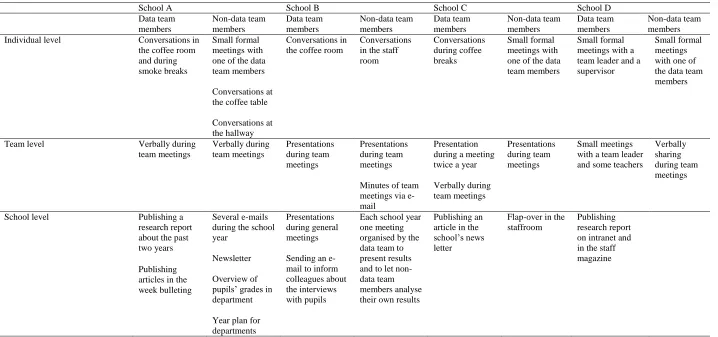
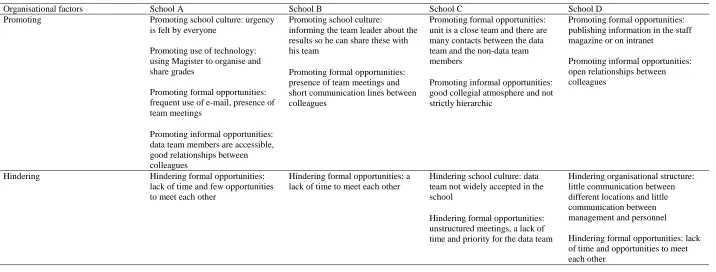
The two different data sources were coded in three categories: what type of knowledge was shared (e.g., knowledge on the data team procedure, knowledge on the educational problem), how knowledge was shared (e.g., at the individual, team, or school level, during a formal or informal moment, verbally or in writing), and the factors which influence knowledge sharing (e.g., organisational factors, individual factors). Thereafter, the data were analysed according to a fixed protocol of three steps. First, the data of each data source was written down in conceptual matrices. Per school and per data source a conceptual matrix was made to get a clear overview of the data. In these matrices the data were ordered per respondent and per code. Tables 4.1 – 4.3 are examples of these matrices. Second, a within-case analysis was conducted with the help of the conceptual matrices to get an insight in how in one particular school knowledge was shared. This was done by summarising the results per data source and by triangulating these results. Third, a cross-case analysis was conducted in which the results of all four schools were compared to each other with regard to what knowledge was shared, how this knowledge was shared and the recalled influential factors.
3.3.1 Interviews
The interview data were analysed in three steps (Miles & Huberman, 1994). First, the interview data were transcribed in verbatim. Second, the data were coded per interviewee in Atlas.ti. For the coding an a priori coding scheme was used. Examples of codes that were used in the category promoting and hindering factors are school leader support, mutual trust, and motivation to share. After all interview data were coded, a summary of all quotes of the teachers were written down in conceptual matrices and the fixed analysis protocol was followed.
3.3.2 Artefacts
3. Method
Knowledge sharing in schools with data teams
findings of each school were written down in a conceptual matrix and the fixed analysis protocol was followed.
3.4 Reliability and validity
The reliability and validity of the study was increased in several ways. First, the construct validity was increased by using multiple sources of evidence: a triangulation of instruments (interviews and artefacts) and two groups of respondents (data team members and non-data team members) (Yin, 2009). The triangulation provided the measurement of knowledge sharing in schools with two different instruments. Using two groups of respondents provided the opportunity to look from both the perspective of the sender and the receiver at knowledge sharing.
Knowledge sharing in schools with data teams
4. Results
The result section consists of two parts: a within-case analysis of all four cases, and a cross-case analysis. The description of the within-case analyses will start with an explanation of the educational problem the data team was studying. After that, it will be described what knowledge is shared, how knowledge is shared, and which promoting and hindering factors were found using interviews and artefacts.
4.1 School A
The data team in school A analysed the educational problem of grade promotion and grade retention of the upper classes at the senior general education track (havo).
4.1.1 What and how knowledge is shared at School A 4.1.1.1 Interviews data team members
The data team members of School A remembered knowledge was shared about the educational problem. The data team members Charlotte, Eva, and Anna told that they published a report last year about the quantitative research they conducted and that they wanted to publish a second report at the end of the current school year. This report would be shared with the other teachers and with the management team. In this report it would be explained what the data team members have done over the last two years, which factors played a role in the studied educational problem, and what the conclusions of the data team were. One of the conclusions the data team members came to is that the way of testing and determination within the senior general education track (havo) should be improved, because continuing learning-teaching trajectories are partly missing. Anna mentioned that she would share the content of this report also with a presentation during a team meeting: “Next Monday I will also verbally announce that the report is coming and what the content is. So they hear it at least once and can respond”. Rob mentioned that the data team members also wrote an article for the staff magazine, to explain what the data team members were doing and what the results were, and to refer to the report. Eva explained that sharing knowledge about the educational problem was important, because it would make it more easy to implement the improvement measures effectively in the school when the non-data team members were involved with the research results and measures.
Knowledge about the educational problem was also shared verbally. Emma told that she shared the results of the data team both during formal and informal moments when it was discussed by colleagues: “Where and whenever I can. I really bring it in every time, in the coffee room, during the report meetings and during the smoke break”. She believed that colleagues became more aware of the results when it was shared verbally, because people paid more attention to it when it was shared in person rather than when it was shared via reports and newsletters. Data team members Charlotte and Rob also shared their knowledge verbally during informal moments, for example during a coffee break or in the hallway when they met interested colleagues. However, it did not became clear what knowledge was shared during these moments.
4. Results
Knowledge sharing in schools with data teams
4.1.1.2 Interviews non-data team members
All non-data team members remembered knowledge was shared about the data team procedure and data use in general, specifically about the fact that the data team members collected and analysed data. Harry described the goal of a data team as: “Well at least to collect data, to collect results of pupils, departments and teachers, and to analyse those data. So to estimate and to indicate that maybe there is something not quite right”. The non-data team members gained knowledge about the data team procedure and data use in general during formal and informal moments, where knowledge was shared verbally. An example of an informal moment was given by Alice. Alice explained that she had been working with one of the data team members in Magister to do research about the grade promotion and grade retention of pupils and to look at the grades of different colleagues. Because of this collaboration she sometimes heard from the data team member what educational problem the data team was studying and how much time it took to be a data team member. Another example was given by Oliver, he recalled that the results of the data team were sometimes discussed at the coffee table. With regard to the composition of the data team, none of the non-data team members was able to recall all data team members. However, every member was able to name at least three data team members correctly.
Oliver, Jack, and Harry were able to tell which educational problem the data team was studying. They told the data team members once presented in a team meeting they were looking at the problem of grade promotion and grade retention, and how to solve this problem. Oliver and Jack remembered also some results of the data team were shared, although they both acknowledged that this did not happen frequently. Jack described it as: “Things like that are mentioned, attention is paid to it and then we proceed to the order of the day”. Oliver remembered some more details about the shared results: “Sometimes during the joint meetings it is said that the data team members are working on it and that it appears that the problem is not in the third grade for example, but already in the second”. Oliver was the only non-data team member who mentioned knowledge was also frequently shared in writing. However, he acknowledged that he did not pay much attention to this written form of knowledge sharing:
They also regularly send all kind of things, but you know how it works. You get so many of those e-mails and so many of those things and if it is not really necessary than you do not do anything with it.
All four non-data team members said the data team members should share their knowledge with them. They were curious about the results and conclusions of the data team and the factors that seemed to play a role with regard to grade promotion and grade retention. Jack said he was especially interested in those results he could use in his own daily practice. The reason why data team members should share this knowledge was, according to the non-data team members, to increase pupil’s learning results. Oliver and Alice preferred knowledge sharing during team meetings and via e-mail. Jack and Harry thought the knowledge of the data team should be shared via a think tank in the school.
4.1.1.3 Artefacts
Knowledge sharing in schools with data teams
mentor) in response to the conclusions, and how they wanted to evaluate these measures. At the end of the report the data team members explained that the data team was part of the project facilitated by the University of Twente and that it was not yet clear how the data team would continue next school year.
Non-data team members Oliver and Harry were able to provide three artefacts they received from the data team. The first artefact was a newsletter, which was sent to the whole school. In this newsletter the data team members presented a summary of the progress they had made in the first year working with the data team procedure. They explained which educational problem the data team had studied, which hypotheses they had formulated (e.g., Do pupils more often have to repeat a class when they have an insufficient grade for one of the core subjects in the third grade?), and that they had collected and analysed data.
The second artefact was an overview of the pupils’ grades and promotion over the past few years in the department of biology. The data team sent this overview to the teachers of the department to give them more insight into data the team had collected and analysed, and to help the teachers with data-based decision making in their own classroom. The artefact originally consisted of several overviews of each department which provided a central exam to the pupils. The non-data team members only received an overview of their own department.
The third artefact was a year activity plan for the departments, which was also sent to the whole school. In this plan, it was told that the data team can be seen as part of the data-based decision making in the school. Furthermore, it was told that the data team collected data to base their decisions on, and that the team eventually would evaluate the measures taken. It was suggested that the non-data team members could use this same approach of using data in their own daily practice.
4.1.2 Factors promoting and hindering knowledge sharing at School A 4.1.2.1 Interviews data team members
In the category organisational factors three promoting and two hindering factors were mentioned by the data team members. Anna called the school’s culture as a promoting factor for knowledge sharing because more and more people felt the urgency for change: “Well I think the urgency is gradually felt by everyone. Everybody knows: it is just needed, and we have been trying it for a few years and it does not work”. The use of technology in the school was also called a promoting factor by Charlotte, Emma, and Anna. They explained that the pupil monitoring system Magister was frequently used by the data team members to register and collect pupils’ grades, and to share knowledge with the non-data team members. Anna explained:
You do notice that it has more impact when you go to people with well supported information. People do not want to change because of changing so to speak. But if you say these are the facts and figures of the report in Magister, then you do see a kind of awakening like: oh yes, I do not really want that.
Opportunities to share knowledge with the non-data team members was another organisational factor that was both seen as promoting and hindering by the data team members. Emma and Rob said that it was a promoting factor, because data team members and non-data team members had a lot of formal opportunities to e-mail each other and this was done frequently, and because of the presence of team meetings. However, all six data team members also mentioned a lack of time to meet the non-data team members and the few number of team meetings during the school year. Eva and Anna explained that they, due to the lack of opportunities to meet each other, had chosen to publish a report and a newsletter so people can at least read it. “But you know that reading has less impact than real exchange and telling about it and talking about it”. Emma and Eva saw a lack of informal opportunities to share knowledge as a hindering factor. Eva explained that she was not a teacher, like the other data team members, and therefore had less contact with the teachers outside the data team. This hindered her to share her knowledge outside the formal meetings.
4. Results
Knowledge sharing in schools with data teams
Charlotte and Eva thought it would be difficult to explain the concept of a data team and the data team procedure, because they had just started to work with the procedure themselves. And data team member Rob thought it would be difficult to present the content clearly, because of the complexity and the nuance of it.
4.1.2.2 Interviews non-data team members
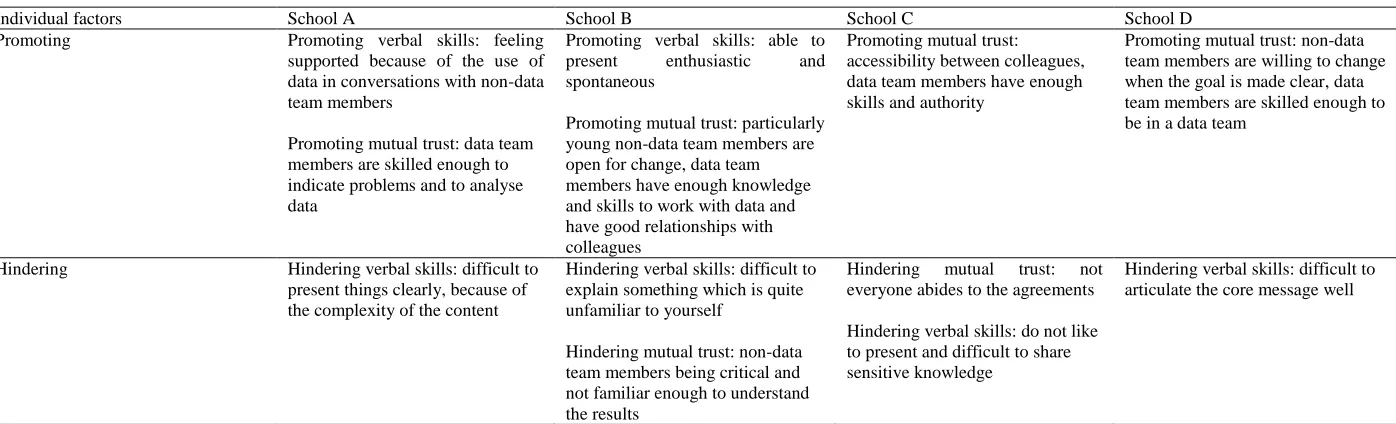
With regard to the organisational factors, the use of technology was seen as a hindering factor by one of the non-data team members. Harry explained that he wanted to get more insight into the data and wanted to be able to conduct his own analyses, for example by learning how to use the pupil monitoring system in the school. He did not know how to collect the data within the system and how to put them in an overview to analyse them. Formal opportunities to share were seen as a hindering factor by Harry and Alice, because of a lack of time and a few number of team meetings during a school year. In contrast, informal opportunities to share were seen as a promoting factor by Oliver, Harry, and Alice. The data team members were called very accessible and they all had good relationships with the data team members.
Mutual trust was seen as a promoting factor for knowledge sharing by all four non-data team members. They all thought the data team members had enough expertise to collect and analyse data correctly, and to make things clear. But all non-data team members did not think the data team would be able to solve the educational problem by itself, and therefore would need the non-data team members. Oliver explained: “Well I do not know if they can solve the problem. That is something the school board and we should do, but they can indicate the frames”.
4.2 School B
The data team in school B analysed the educational problem of grade promotion and grade retention of their lower classes.
4.2.1 What and how knowledge is shared at School B 4.2.1.1 Interviews data team members
Data team members Thomas, Jacob, Lucy and Lilly told they shared, with regard to the data team procedure and data use in general, knowledge about data collection and the hypotheses. Thomas, for example explained that he and the other data team members had presented during a team meeting which hypotheses they had rejected and which one they had accepted, and that they conducted interviews with the pupils to collect data. He told that they only presented some of the interview questions and did not go into detail, because that would be too much information and therefore too complicated for the non-data team members. Lucy mentioned that the non-data team members were also informed about the interview procedure before the actual data collection, in order to ask the non-data team members for their cooperation. In an e-mail it was explained that the non-data team members wanted to interview some of the pupils and what the reason behind the interviews was. This resulted in some questions of the non-data team members, of which the most frequently asked question was on which basis pupils were selected as respondents for the interviews.
The data team members also shared knowledge about the educational problem, for example the results of the interviews with the pupils they conducted. It turned out that the pupils indicated the atmosphere in the class as a cause for their reduced motivation, while the data team members had expected the pupils to indicate their home situation as a cause. Thomas called the presentation of these results an eye opener for the colleagues, because of these unexpected outcomes. Besides sharing the results, the data team members also shared possible measures they could take in response to the interview results. Examples of these measures are letting pupils fill out a questionnaire about the atmosphere in the class, stimulating teachers to frequently discuss grades with the pupils to motivate them, and providing the pupils with a study skills training.
Knowledge sharing in schools with data teams
staff room for an hour after their data team meeting and then answered questions from the non-data team members if they showed interest in the data team. It did not become clear what the exact content of these informal conversations was.
Knowledge sharing about the data team procedure and the educational problem was seen as important by all six data team members, in particular about the results, the measures and about what the data team had been doing. Jacob explained the educational problem they were studying was a school wide problem and it would therefore be necessary that the whole school is informed and involved with the implementation of the solutions. The need of a critical attitude in the school, and the need for professionalization of the non-data team members were also reasons for knowledge sharing, mentioned by Lucy, Sacha and Jacob. A third reason the data team members mentioned was giving the non-data team members the room and space for their input to create more support for the measures. All data team members thought that their knowledge should be shared verbally during team meetings, because it would be more easy to create interaction in small groups, and to give the non-data team members the opportunity to respond and think along with the data team members.
4.2.1.2 Interviews non-data team members
With regard to the data team procedure, Ethan remembered the data team members started their research by formulating hypotheses, which they could reject or accept. Ethan and Evie mentioned the data team members had collected and analysed data, for example by using pupil and parent surveys. Knowledge sharing about the data team procedure was always done verbally during formal team meetings. None of the three non-data team members was able to name all data team members when asked, but everyone named at least one data team member correctly.
Ethan and Grace were able to recall the educational problem the data team was working on: grade promotion and retention in the lower classes. Ethan and Evie also mentioned the data team shared the research results with them. They shared, for example the collected data about the examination grades and the results of the pupil and parent surveys. Evie remembered a formal meeting organised by the data team, where she received data from her own department:
Well things like that were all discussed and explained, and then we dispersed in groups with our section and we looked at how we do it as a section. And the intention actually was that we, consequently, started to write a plan how we are going to handle this, how we are going to improve.
Ethan could not remember exactly what the content of the meeting with the data team members was. He only remembered that it was a long story in which the data team members told they had to reject their hypothesis and that they had to start all over again with a new subject.
Grace never participated in a team meeting because of other commitments, but knew from the team meeting minutes the data team presented something about the data team:
It is briefly described who explained something about the data teams and that is it. Well I have not been present, so I miss that part. And I think that piece is currently not important enough for me to say: well what has happened, how should I deal with it?
All three non-data team members thought it was important for the data team members to share their knowledge. Although Ethan emphasised that he thought the data team procedure was unproductive and so he only wanted to hear the results of the data team when they were relevant, innovative and usable. Grace and Evie were especially interested in what the data team was doing during the school year and what the goal of the data team was. Grace said:
4. Results
Knowledge sharing in schools with data teams
money and time invested? That is for the benefit of you and the pupil. That objective should be clear and that should be communicated.
According to the non-data team members, the data team members should share their knowledge via team meetings or e-mail. Grace explained that a short presentation during a team meeting at the beginning of the school year should be enough, so everyone would know what is going on in the school. However, Evie thought that the data team members should share their knowledge several times during the school year. This way, room and space could be facilitated in which the non-data team members could learn in collaboration with the data team members and could give their input to the data team. This way it would also be more easy to implement improvement measures halfway through the school year when necessary.
4.2.1.3 Artefacts
The data team members provided two artefacts. The first artefact was a presentation about the progress the data team members made so far. This presentation was given at the start of the school year during a formal team meeting. The presentation started with the problem statement about the many grade repeaters at the third grade, and the formulated hypothesis about this problem: ‘Grade repeaters come more often from certain elementary schools’. The data team members had analysed this hypothesis with quantitative research, but wanted to collect more data with qualitative research. Therefore, several pupils would be interviewed about the reasons of their grade retention to get more insight into these reasons. The presentation ended with an explanation of the interview scheme. This scheme consisted of two parts. First, the pupils would be asked to recall several reasons for their grade retention and to categorise these into one of the three categories (e.g., school, home, yourself). Second, the pupils would be asked to describe in more details their reasons behind the retention.
The second artefact was also a presentation about the progress the data team made so far. The presentation was given in the second semester of the school year during a formal team meeting. In the presentation, it was again explained that the data team worked according to a cyclic procedure. The team presented the hypothesis they had formulated, and how and when they had collected data. They presented, among others, that they had collected qualitative data by conducting interviews, and which pupils they had interviewed. Thereafter, the presentation showed which themes and subthemes the data team had used to code the collected data (e.g., the pupil itself, school, and home situation), and how the data were analysed by using conceptual matrices. The data team also presented how they had interpreted the data analysis and what their conclusions were. They told, for example that pupils saw the teacher, their lower level of motivation, and their lack of study skills as a reason for their grade retention. At the end of the presentation, the non-data team members was told which possible measures the data team suggested to improve the problem of grade retention.
Knowledge sharing in schools with data teams
down possible causes of the problem at a flap-over in the staff room, and that all these hypotheses would be verified by the data team.
4.2.2 Factors promoting and hindering knowledge sharing at School B 4.2.2.1 Interviews data team members
The school’s culture was one of the two promoting organisational factor that was recalled by the data team members. Lucy explained it was particularly important for the data team to inform a team leader about the data team. And that this team leader could help the data team to spread their knowledge in the school by presenting this knowledge enthusiastically to his or her own team. The organisational factor formal opportunities to share was also seen as a promoting factor and as a hindering factor. Oscar, Lucy en Sacha called it promoting, because they thought of the team meetings as an effective way to share knowledge. However, Thomas mentioned a lack of time in the team meetings to let the non-data team members really experience working with the data team procedure.
Verbal abilities to share knowledge was seen as an influential factor by Lilly and Lucy. Lilly said she felt skilled enough to present the data team knowledge, because she was enthusiastic, honest and spontaneous. On the other hand, Lucy thought it would be very difficult to explain something completely new and something that was still quit unfamiliar to herself to colleagues. Mutual trust was also seen as a promoting and hindering factor by the data team members. Jacob and Lucy saw mutual trust as a promoting factor and believed the non-data team members had the skills to handle the information of the data team. Jacob explained: “What I notice on the location here is that they really are of good will and that they are also open to it”. Oscar, Thomas and Lucy thought of it as a hindering factor, because they expected that there would always be a little bit of resistance and that the non-data team members would not be familiar enough with the data team procedure.
4.2.2.2 Interviews non-data team members
The formal opportunities to share was only by Evie seen as a promoting and hindering factor. It was seen as a promoting factor because the communication lines within the school were very short. All teachers saw each other on a daily basis and had a lot of contact via e-mail. But it was seen as a hindering factor when it comes to really meet a data team member face to face. According to Evie, a lot of people worked part time, and therefore scheduling a meeting could be quite difficult sometimes.
With regard to the individual factors, all three non-data team members had trust in the skills and expertise of the data team members. Evie said: “I think there are people in it, if I look at the names, who understand it well and are able to get to work seriously”. And Ethan said that the data team members were capable of working with data and coming to conclusions according to the data team procedure.
4.3 School C
The data team in school C analysed the educational problem of the promotion in the fourth grade of the pre-university track (vwo).
4.3.1 What and how knowledge is shared at School C 4.3.1.1 Interviews data team members
4. Results
Knowledge sharing in schools with data teams
rejected. One of the rejected hypotheses was, for example: ‘Not-promoted pupils in the fourth grade have a significant lower score on their CITO test than promoted pupils in the fifth grade’. Only Noah could remember he had shared knowledge during an informal moment, a coffee break, when the subject is discussed:
If the subject comes up about the poor attitude in the fourth grade of the pre-university track, or something similar. Sometimes I tell that we have been working on it and that you have to be careful coming to conclusions.
When asked about which knowledge the data team members should share, all data team members said they should share the results and implications the data team came up with. This knowledge should be shared to create an open relationship in which non-data team members felt motivated to ask questions and to think along, and in which data team members were able to explain clearly the work of the data team. This explaining was, according to Chloe, especially important because some non-data team members felt threatened by the data team members looking at their grades. Furthermore, sharing was called important because every teacher contributed to the success of the pupils and therefore should be aware of the results of the data team. The best way in which knowledge could be shared was, according to all data team members, via a presentation during unit meetings and department meetings where non-data team members could ask questions and give their input. Leonard and Noah also thought knowledge should be shared with the non-data team members via the management team, so it would become clear that the management team supported their improvement measures.
4.3.1.2 Interviews non-data team members
The non-data team members could recall knowledge was shared both about the data team procedure and the educational problem. All three members heard during team meetings the data team members collected data about problems that occurred in the school. William and George also knew from team meetings that data were analysed to discover links between data and to come to conclusions. Joshua said he had heard from one of the data team members what to do with data during a small meeting he had as being a remedial teacher. None of the members was able to recall all data team members, but they all named at least two members correctly.
Joshua and George could remember knowledge was shared about which educational problem the data team was studying. Joshua told this was done by putting a flap-over in the staffroom to invite non-data team members to write down possible causes of the educational problem. William and George also mentioned results of the data team were shared, such as overviews about pupils’ grade promotion and grade retention.
All three non-data team members said that knowledge of the data team members should be shared to make the non-data team members more aware of the results the data team found. William and Joshua said they thought more communication was needed about the data team and their results, for example via unit meetings and e-mail. William said: “When you show more often what are we doing and what are the benefits. That is something you miss sometimes”. George emphasised that not only successes should be shared, but also non-successes when the data team members were not able to come to conclusions:
If they say we have studied something and we do not see a connection, that is often underestimated, but that is also very important information. So not saying: we have a success, and then share that. Even if they say: despite our hard work we did not come to conclusions, that is still an important result to share with the group.
4.3.1.3 Artefacts