ISSN Online: 2164-3210 ISSN Print: 2164-3202
DOI: 10.4236/wjcs.2017.712019 Dec. 21, 2017 164 World Journal of Cardiovascular Surgery
Malposition of Stent a Rare Complication in
Coarctation of Aorta Corrected with
Extraanatomic Aortic Bypass
Navnita Kisku, Subrata Pramanik, Kumar Aditya, Subodh Satyarthi
Department of CTVS, GB Pant Hospital, New Delhi, India
Abstract
Mal-position of stent in coarctation of aorta is very rare but a major complica-tion. Symptoms can worsen even more. We present here one such case where stenting done in some other institute in which we did an extra-anatomical bypass from ascending aorta to supracelial aorta successfully bypassing the coarct segment. This was an early approach without assistance of Cadio- pulmonary (CP) Bypass. We conclude that this procedure should be done in centres where experienced operator and cardiac surgery back up is present. This was a good approach without assistance of CP Bypass.
Keywords
Coarctation of Aorta, Extra-Anatomical Bypass, Cardio-Pulmonary Bypass
1. Introduction
Coarctation of aorta (CoA) is a condition where the aorta is narrow in the area of insertion of ductus arteriosus. If the narrowing is severe enough left ventricle may not be strong enough to push blood through coarctation thus resulting in lack of blood to lower half of body. It’s a common congential defect usually de-tected in childhood but can also present in adulthood. In developed countries, more adults are seen with coarctation than children and a prevalence of 5% - 8% of all congenital heart disease is seen [1]. Those presenting late in life have a higher prevalence of morbidity and late complication.
There are different methods describe for the treatment of CoA in adult in-cluding surgical or percutaneous balloon angioplasty with or without stent placement. Balloon angioplasty and stent placement is preferred mode of treat-How to cite this paper: Kisku, N.,
Prama-nik, S., Aditya, K. and Satyarthi, S. (2017) Malposition of Stent a Rare Complication in Coarctation of Aorta Corrected with Extraanatomic Aortic Bypass. World Jour-nal of Cardiovascular Surgery, 7, 164-168. https://doi.org/10.4236/wjcs.2017.712019
Received: November 16, 2017 Accepted: December 18, 2017 Published: December 21, 2017
Copyright © 2017 by authors and Scientific Research Publishing Inc. This work is licensed under the Creative Commons Attribution International License (CC BY 4.0).
DOI: 10.4236/wjcs.2017.712019 165 World Journal of Cardiovascular Surgery ment. Here we present mal-position of stent in a case of CoA for which an ex-tra-anatomical bypass from ascending aorta to supraceliac aorta was done with-out cardiopulmonary bypass (CPB) assistance.
2. Case Report
A 45-year male diagnosed having CoA (Figure 1(a)) underwent stenting of the coarct segment in another institute. Patient presented to us 1 month post-pro- cedure with worsening of symptoms of claudication. On clinical examination there were no gangrenous changes in the lower limb. Ankle brachial pressure index of left limb was 0.5 which suggested significant disease. Computer tomo-graphyangiography (CTA) showed stent below the coarcted segment (Figure 1(b)). Balloon angioplasty was unsuccessful and showed a mean gradient of 60 mm Hg.
[image:2.595.210.532.312.476.2]He was planned for surgical correction with an extra anatomical bypass from ascending thoracic aorta to supraceliac abdominal aorta as the stent was
Figure 1. (a) CTA showing CoA before stenting; (b) CTA image after stenting.
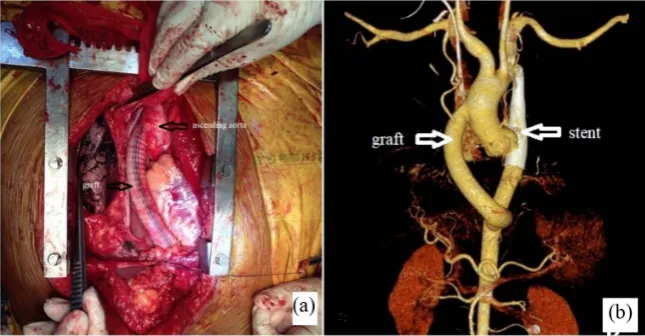
[image:2.595.209.532.510.678.2]DOI: 10.4236/wjcs.2017.712019 166 World Journal of Cardiovascular Surgery extending till the diaphragm. Median sternotomy was done. Pericardium opened. Abdomen was exposed by extending the same incision. Peritoneal cavity was entered, left triangular ligament was divided to mobilize left lobe of liver. The gastrohepatic ligament was excised to retract the caudate lobe of liver. Esopha-gus and upper part of stomach was retracted to left. Posterior peritoneum was reached where the supra-celiac position of aorta was exposed. A side biting clamp was put on ventral side of aorta. A 16 mm Dacron graft according to body surface area was taken and end to side an astomosis was done to ventral position of aorta. The graft was passed through the diaphragm. Side biting clamp was re-leased and graft was clamped. The proximal end was an astomosed to the right side of proximal ascending aorta using a side biting clamp on the aorta. Graft was placed in such a manner that it lied ventral to inferior venacave and lied lat-eral to right atrium (Figure 2(a)). Post-procedure gradient was below 15 mm Hg. Post operative CTA done at the time of follow up showed normal filling of bilateral lower limb arteries (Figure 2(b)). Patient was asymptomatic when pa-tient came 3 months after follow up.
3. Discussion
Surgical repair of CoA can be achieved by several surgical techniques. With ad-vancement of intervention cardiology balloon angioplasty either alone or along with stent is the preferred treatment modality [2]. Studies have also shown stenting to have good results with no recoil of vessel wall or re-stenosis or aneu-rysm formation. Though rare but this procedure can cause major complication such as balloon rupture mal-position of stent, vascular complication of access site and stroke [3].
Our patient was not a good candidate for stent placement. Due to lack of ex-pirence of the cardiologist he tried to stent the segment. But it was deployed dis-tal to coarct segment, which led to worsening of the symptoms and created complication. No similar case is being reported till now. We did an extra ana-tomical bypass from ascending aorta to supraceliac artery to relive his symp-toms. In 1977 Wukasch and colleagues [4] reported extra-anatomical bypass from ascending aorta to supraceliac bare portion of abdominal aorta. Advantage of this procedure is that the supraceliac bare area has less tributaries and least likely to be atherosclerotic thus less likely of bleeding, requires shortest course of graft, less bowl manipulation so less intestinal complication [5].
DOI: 10.4236/wjcs.2017.712019 167 World Journal of Cardiovascular Surgery
4. Conclusion
Mal-position of stent in treatment of CoA is a major complication and should be aggressively treated to prevent organ damage. So if possible stenting should be done in centers where experienced operators are available along with cardiac surgery facilities and a good preoperative evalution should be done. Better to do a ballondialatation before stenting so that proper size stent can be placed. The extra anatomical ascending aorta to abdominal aorta bypass graft approach is a safe procedure with no morbidity for this type of complication. Bypass to supra-celiac abdominal aorta can be done without CPB assistance (therefore excluding the complication of CPB), preventing injury to phrenic and recurrent laryngeal nerve. Dissection around Distal thoracic aorta can be prevented which can lead to devastating hemorrhage due to multiple collaterals. Risk of ischemic injury to spinal cord is decreased. The main concern is only long incision, division of di-aphragm, mobilization and manipulation of liver, esophageal injury.
Classification
Congenital heart disease in adult.
Conflict of Interest
None declared. Patient had given his consent for the Case reports to be pub-lished.
References
[1] Baumgartner, H., Bonhoeffer, P., De Groot, N.M.S., et al. (2010) ESC Guidelines for the Management of Grown-Up Congenital Heart Disease (New Version 2010): The Task Force on the Management of Grown-Up Congenital Heart Disease of the Eu-ropean Society of Cardiology (ESC). European Heart Journal, 31, 2915-2957. https://doi.org/10.1093/eurheartj/ehq249
[2] Shaddy, R.E., Boucek, M.M., Sturtevant, J.E., Ruttenberg, H.D., Jaffe, R.B., Tani, L.Y., Judd, V.E., Veasy, L.G., McGough, E.C. and Orsmond, G.S. (1993) Compari-son of Angioplasty and Surgery for Unoperated Coarctation of the Aorta. Circula-tion, 87, 793-799. https://doi.org/10.1161/01.CIR.87.3.793
[3] Mullen, M.J., et al. (2003) Coarctation of Aorta in Adults: Do We Need Surgeons? Heart, 89, 3-5. https://doi.org/10.1136/heart.89.1.3
[4] Wukasch, D.C., Cooley, D.A., Sandiford, F.M., Nappi, G. and Reul Jr., G.J. (1977) Ascending Aorta-Abdominal Aorta Bypass: Indications, Techniques and Report of 12 Patients. The Annals of Thoracic Surgery, 23, 442-448.
https://doi.org/10.1016/S0003-4975(10)64164-1
[5] Kumar, M.V., Choudhary, S.K., Talwar, S., et al. (2016) Extraanatomic Bypass to Supraceliac Abdominal Aorta for Complex Thoracic Aorta Obstruction. The Annals of Thoracic Surgery, 101, 1552-1557.
https://doi.org/10.1016/j.athoracsur.2015.10.080
DOI: 10.4236/wjcs.2017.712019 168 World Journal of Cardiovascular Surgery [7] Airan, B., Mehrotra, R., Talwar, K.K., Taneja, K. and Venugopal, P. (1997) Aor-toaortic Bypass: Indications, Techniques and Results. Indian Heart Journal, 49, 303-308.