© 2019, IRJET | Impact Factor value: 7.34 | ISO 9001:2008 Certified Journal
| Page 1003
Study on Partial Replacement of Plastic Waste Material with Coarse
Aggregate in Rigid Pavements
Sheikh Abeed Raheem Majid
#1, Dr. Rakesh Gupta
*2, Er. Neeraj Kumar
#31,2,3
SRMIET, Civil Engineering Department, Kurukshetra University
---***---
Abstract - concrete is one the most extensively used construction material all over the world. Many scientists and researchers are in quest for developing alternate construction material that are environment friendly and contribute towards sustainable development. Huge amount of plastic waste is being generated day by day which creates the disposal problem and has many environmental issues. As this plastic waste material is a plastic material having good specific gravity, energy absorbent material can be used as a replacement material for obtaining lightweight concrete. In present study an attempt is made to partially replace the plastic waste material by coarse aggregates in concrete and to study its impact on properties of concrete. A modified concrete is prepared by replacing coarse aggregates in concrete with plastic waste material aggregates by varying the replacement proportion from 0% to 20% with increment of 5%. 3 cubes for each percentage of replacement are casted and tested after 7 days and 28th days of curing. Properties like workability, compressive strength, flexural strength test and split tensile strength test of modified concrete are determined from concrete cubes experimentally.
Keywords— concrete, plastic waste, coarse aggregate, compressive strength, flexural strength, split tensile
strength.
I.INTRODUCTION
A HIGHWAY PAVEMENT IS A STRUCTURE CONSISTING OF SUPERIMPOSED LAYERS OF PROCESSED MATERIALS ABOVE THE NATURAL SOIL SUB -GRADE, WHOSE PRIMARY FUNCTION IS TO DISTRIBUTE THE APPLIED VEHICLE LOADS TO THE SUB-GRADE.THE PAVEMENT STRUCTURE SHOULD BE ABLE TO PROVIDE A SURFACE OF ACCEPTABLE RIDING QUALITY, ADEQUATE SKID RESISTANCE, FAVORABLE LIGHT REFLECTING CHARACTERISTICS, AND LOW NOISE POLLUTION.THE ULTIMATE AIM IS TO ENSURE THAT THE TRANSMITTED STRESSES DUE TO WHEEL LOAD ARE SUFFICIENTLY REDUCED, SO THAT THEY WILL NOT EXCEED BEARING CAPACITY OF THE SUB-GRADE.TWO TYPES OF PAVEMENTS ARE GENERALLY RECOGNIZED AS SERVING THIS PURPOSE, NAMELY FLEXIBLE PAVEMENTS AND RIGID PAVEMENTS.THIS CHAPTER GIVES AN OVERVIEW OF PAVEMENT TYPES, LAYERS, AND THEIR FUNCTIONS, AND PAVEMENT FAILURES. IMPROPER DESIGN OF PAVEMENTS LEADS TO EARLY FAILURE OF PAVEMENTS AFFECTING THE RIDING QUALITY.
II. PAVEMENTS REQUIREMENTS
An ideal pavement should meet the following requirements:
I Sufficient thickness to distribute the wheel load stresses to a safe value on the sub-grade soil.
II Structurally strong to withstand all types of stresses imposed upon it.
III Adequate coefficient of friction to prevent skidding of vehicles.
IV Smooth surface to provide comfort to road users even at high speed.
V Produce least noise from moving vehicles.
VI Dust proof surface so that traffic safety is not impaired by reducing visibility.
VII Impervious surface, so that sub-grade soil is well protected.
VIII Long design life with low maintenance cost.
III. PAVEMENTS TYPE
© 2019, IRJET | Impact Factor value: 7.34 | ISO 9001:2008 Certified Journal
| Page 1004
The flexible pavement, having less flexural strength, acts like a flexible sheet. On the contrary, in rigid pavements, wheel loads are transferred to sub-grade soil by flexural strength of the pavement and the pavement acts like a rigid plate. In addition to these, composite pavements are also available. A thin layer of flexible pavement over rigid pavement is an ideal pavement with most desirable characteristics. However, such pavements are rarely used in new construction because of high cost and complex analysis required.I. Rigid Pavements
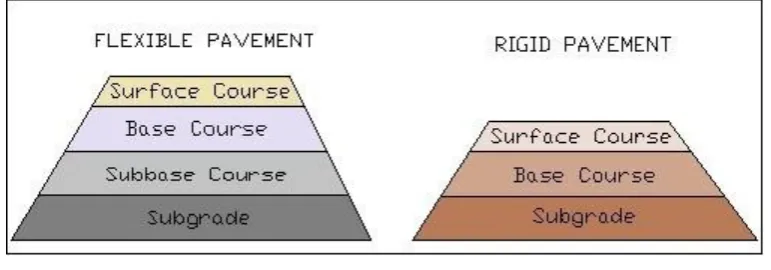
1) Rigid pavements have sufficient flexural strength to transmit the wheel load stresses to a wider area below. A typical cross section of the rigid pavement is shown in below. Compared to flexible pavement, rigid pavements are placed either directly on the prepared sub-grade or on a single layer of granular or stabilized material. Since there is only one layer of material between the concrete and the sub-grade, this layer can be called as base or sub-base coarse. A rigid pavement is constructed from cement concrete or reinforced concrete slabs. Grouted concrete roads are in the category of semi-rigid pavements. The design of rigid pavement is based on
providing a structural cement concrete slab of sufficient strength to resists the loads from traffic. In rigid
[image:2.595.105.491.300.435.2]pavement, load is distributed by the slab action, and the pavement behaves like an elastic plate resting on a viscous medium.
Fig. 1 Rigid and Flexible pavement
Rigid pavements are constructed by Portland cement concrete (PCC) and should be analyzed by plate theory instead of layer theory, assuming an elastic plate resting on viscous foundation. Plate theory is a simplified version of layer theory that assumes the concrete slab as a medium thick plate which is plane before loading and to remain plane after loading. Bending in the pavement slab due to wheel loading and temperature variation resulting in tensile and flexural stress.
II. Flexible Pavements
Flexible pavements can be defined as the one consisting of a mixture of asphaltic or bituminous material and aggregates placed on a bed of compacted granular material of appropriate quality in layers over the sub grade.
IV. PLASTIC WASTE MATERIAL
© 2019, IRJET | Impact Factor value: 7.34 | ISO 9001:2008 Certified Journal
| Page 1005
V. LITERATURE REVIEWLiterature pertaining to similar studies conducted all around the world is collected from various sources and is as under:
Ali, et al., (1998) [1] studied the effects of incorporating crumb rubber, very fine tire rubber particles, into Portland cement concrete. The objective of the study is to evaluate the effects of rubber aggregate into portlant cement concrete (PCC) properties. Initially, the rubber content replacing fine aggregates into the concrete mix was investigated by examining the concrete failure characteristics and the amount of energy absorbed during testing.
Khan A., and Nehdi M., (2001) [2] emphasizes another technically and economically attractive option, which is the use of recycled tire rubber in portland cement concrete. Preliminary studies show that workable rubberized portland cement concrete (rubcrete) mixtures can be made provided that appropriate percentages of tire rubber are used in such mixtures. Achievements in this area are examined in this paper, with special focus on engineering properties of rubcrete mixtures. These include: workability, compressive strength, split-tensile strength, flexural strength, elastic modulus, Poisson's ratio, toughness, impact resistance, sound and heat insulation, and freezing and thawing resistance.
Taha, et al., (2003) [3] added various percentages of waste plastic aggregate having the size of 5mm to 20mm. when 100% aggregate were replaced by waste material, a huge reduction of 75% in the compressive strength of resultant concrete was found which is considered to be extremely poor.
Amit Goel, and Animesh Das., (2004) [4] studied on some emerging road materials and innovative application concepts which will be promising for future developments.
Chi-Sun Poon, and Dixon Chan., (2006) [5] investigation done on the cause of the self-cementing properties by measuring X-ray diffraction patterns, pH values, compressive strength and permeability of various size fractions of the FRCA obtained from a commercially operated construction and demolition waste recycling plant. Their influence on the overall sub-base materials was determined. The results indicate that the size fractions of <0.15 and 0.3–0.6 mm (active fractions) were most likely to be the principal cause of the self-cementing properties of the FRCA.
Mehmet Gesoglu, and Erhan Guneyis., (2007) [6] carried out in order to investigate the strength development and chloride permeability characteristics of plain and rubberized concretes with and without silica fume. For this purpose, two types of tire rubber, namely crumb rubber and tire chips, were used as fine and coarse aggregate, respective ly, in the production of rubberized concrete mixtures which were obtained by partially replacing the aggregate with rubber.
Rafat Siddique, et al., (2008) [7] presented a detailed review about waste and recycled plastics, waste management options, and research published on the effect of recycled plastic on the fresh and hardened properties of concrete. The effect of recycled and waste plastic on bulk density, air content, workability, compressive strength, splitting tensile strength, modulus of elasticity, impact resistance, permeability, and abrasion resistance is discussed in this paper.
N. Oikonomou, and S. Mavridous., (2009) [8] studied on tyres used for replacement of aggregate with different %ages and where the addition of tyre rubber has proven to be effective in protecting the environment and conserving natural resources include the production of cement mixtures, road construction and geotechnical works. Recycling of tyres in the applications mentioned above represents a suitable means of disposal for both environmental and economic reasons.
Pasetto, et al., (2010) [9] verified the suitability of an industrial waste material, known as Electric Arc Furnace (EAF) steel slag, for recycling in the lithic matrix of cement bound granular material for road foundations. A preliminary study of the chemical, leaching, physical and mechanical properties of the EAF steel slag was followed by the mix design, based on Proctor compaction, compression and indirect tensile tests. Mechanical characterization of the mixtures was completed with the elastic modulus evaluation, through ultrasonic tests.
VI. MIX DESIGN
© 2019, IRJET | Impact Factor value: 7.34 | ISO 9001:2008 Certified Journal
| Page 1006
taken with (1:1.3:2.1, w/c=0.41). The natural coarse aggregate was replaced by untreated and treated plastic waste material coarse aggregate with the ratio of 5%, 10%, 15% and 20%. The properties of concrete find out with the partial replacement of plastic waste material with coarse aggregate.VII. COMPRESSIVe STRENGTH AT 14 DAYS AND 28 DAYS
The specimens were tested at the age of 14 days curing and 28 days curing. The beams were tested with universal testing machine after drying at room temperature according to IS code specifications.
27 28 29 30 31 32 33 34 35
0 5 10 15 20
Compresive Strength (MPa)
Compresive Strength (MPa)
Fig. 2 7 Days compressive strength vs. plastic waste material (untreated) replaced with coarse aggregate
43 44 45 46 47 48 49 50 51 52 53
0 5 10 15 20
Compresive Strength (MPa)
Compresive Strength (MPa)
© 2019, IRJET | Impact Factor value: 7.34 | ISO 9001:2008 Certified Journal
| Page 1007
4344 45 46 47 48 49 50 51 52 53
0 5 10 15 20
Compresive Strength (MPa)
[image:5.595.80.530.54.365.2]Compresive Strength (MPa)
Fig. 4 7 Days compressive strength vs. plastic waste material (untreated) replaced with coarse aggregate
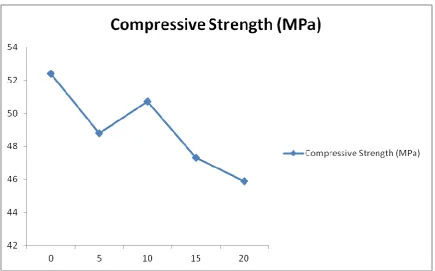
Fig. 5 28 Days compressive strength vs. plastic waste material (treated) replaced with coarse aggregate
VIII. FLEXURAL STRENGTH AT 14 DAYS AND 28 DAYS
[image:5.595.81.517.391.662.2]© 2019, IRJET | Impact Factor value: 7.34 | ISO 9001:2008 Certified Journal
| Page 1008
Fig. 6 7 Days flexural strength vs. vs. plastic waste material (untreated) replaced with coarse aggregate [image:6.595.77.518.365.619.2]© 2019, IRJET | Impact Factor value: 7.34 | ISO 9001:2008 Certified Journal
| Page 1009
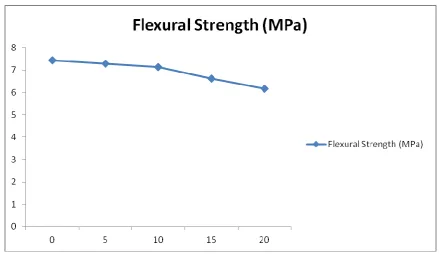
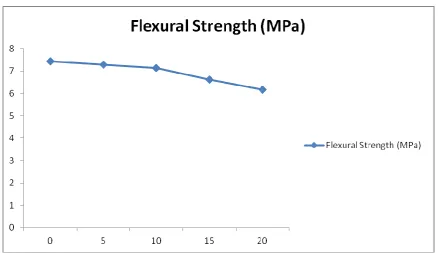
Fig. 8 7 Days flexural strength vs. vs. plastic waste material (treated) replaced with coarse aggregateFig. 9 28 Days flexural strength vs. plastic waste material (treated) replaced with coarse aggregate
X. CONCLUSIONS
During the study on the partial replacement of coarse aggregate with plastic waste material in construction mix design proportion, the following conclusions have been drawn based on the observations:
The compressive strength increase but maximum at 10.00% replacement of coarse aggregate by plastic waste
material likewise flexural strength increases but maximum at 5.00% replacement of coarse aggregate by plastic waste material and split tensile strength increases but maximum at 20.00% replacement of coarse aggregate by plastic waste material. Most important is compressive strength is found at 10.00% replacement of coarse aggregate by plastic waste material which is optimum.
[image:7.595.79.518.364.617.2]© 2019, IRJET | Impact Factor value: 7.34 | ISO 9001:2008 Certified Journal
| Page 1010
plastic waste material. Economical and environmental compulsions justify consideration of this alternative material source i.e. plastic waste
material, in places where there is lesser-availability of natural aggregate helps in waste disposal management.
XI. SCOPE FOR FURTHER STUDY
The strength characteristics of partially replacement with waste materials in concrete can be further studied by taking into account the following way:
By partially replacement of coarse aggregate with other waste material like: rubber, foundary waste etc.
XII. REFERENCES
1. Ali, A-H and Goulias, “Evaluation of Rubber-Filled Concrete and Correlation between Destructive and
Nondestructive Testing Results” Journal of ASTM International, volume 20, issue 1, pp 140-144 (1998).
2. Khan A. and Nehdi M., “Cementitious Composites Containing Recycled Tire Rubber” Journal of ASTM International,
volume 23, issue 1, pp 3-10 (2001).
3. Taha, M. M. Reda, A. S. El-Dieb and M. A. Abd El-Wahab, "Fracture toughness of concrete incorporateing rubber
tire particles" International conference on performance of construction materials, 2003.
4. Amit Goel and Animesh Das, “Emerging Road materials and Innovative Applications” National Conference on
Materials and Innovative Applications, pp 26-27 (2004).
5. Chi-Sun Poon and Dixon Chan., “The cause and influence of self-cementing properties of fine recycled concrete
aggregates on the properties of unbound sub-base” Journal of Waste Management, volume 26, issue 10, pp
1166-1172 (2006).
6. Mehmet Gesoglu Erhan Güneyis, “Strength development and chloride penetration in rubberized concretes with
and without silica fume” Journal of Material and science, volume 40, issue9, pp 953-964 (2007).
7. Rafat Siddique, Jamel Khatib and Inderpreet Kaur, “Use of recycled plastic in concrete” Journal of Waste
Management, volume 28, issue 10, pp 1835-1852 (2008).
8. N. Oikonomou S. Mavridous, “The use of waste tyre rubber in civil engineering works” Journal of Sustainability of
Construction Materials, pp 213-238 (2009).