AN EXPERIMENTIAL STUDY ON USE OF QUARRY DUST TO REPLACE SAND
IN CONCRETE FOR DRY LEAN CONCRETE
Chandan Mandal
1, Dr. S.S. Goliya
21
PG Student, Transportation Engineering, Dept. of Civil Engineering, SATI, Vidisha, M.P, India
2
Associate Professor, Dept. of Civil Engineering, SATI, Vidisha, M.P, India
---***---Abstract:-The process of quarrying stones at crushers
produces lot of quarry dust which is mostly useless to them, this by product of crushing process could very well put to use. Replacing quarry dust, can reduce the requirement of land fill area and can also solve the problem of natural scarcity of land. Sand is a very popular ingredient of concrete but day by day its availability is becoming an issue, and its availability at some places can also be an issue. Environmental concerns of sand mining too compel building industry to search for its alternative. Although Quarry dust has some striking dissimilarities with sand. If sand is replaced in some quantum it can give equivalent or better results. The fine particles of sand can be replaced by Quarry dust. 60:40 mixture of sand to Quarry dust shows the best test result in compressive strength, varies such ratio are being tested.
Key Words: -Quarry Dust, Sand, Compressive Strength, Concrete, Water Content, workability.
1 INTRODUCTION
Concrete, the single most widely used building material around the globe, is a heterogeneous composite that consists of combination of readily available basic building materials including cement, water, coarse aggregate, fine aggregate, and in some cases, admixtures, fibers or other additives, according to the need.
The fine aggregate and coarse aggregates normally fill 60 to 75 % of total concrete volume, thus responsible for most of the freshly mixed or hardened properties, mixture proportions and economy.
River sand is naturally occurring granular material formed as a result of erosion and weathering of rocks. Sand which is integral part of the riverbed system happens to be integral part of construction activity too, this creates issues of environmental deep concerns if sand is mined uncontrollably.
As the supplies of suitable natural sand near the point is exhausted due to the consumption of natural sand and the cost of this sand is increasing, which is ultimately increasing the cost of the construction. The demand of
sustainable growth of infrastructure in modern times is to find an alternative material that should not only satisfy the technical specification of fine aggregate, but it should also be abundantly available. A lot of research has been done to find substitute for fine aggregate.
Crushed sands, fine aggregate produced from stone crushing, has become very popular in areas where natural sand is not abundantly available.
1.1 Quarry Dust:-
Quarry dust can be defined as residue, tailing or waste material, left after the extraction and processing of rocks at crushing plant at a quarry. It is also known as stone dust, quarry waste or rock dust. When rock is crushed and sized in a quarry, the main aim has to produce coarse graded aggregates of different sizes and shape for road construction materials meeting the certain specifications as per standards. Quarries are set up to manufacture coarse aggregate, but as a part of production process crushed aggregate is also produced as by product.
1.2 Applications of Quarry Dust:-
1. Quarry dust has a lot of applications in construction and infrastructure sector:
2. Quarry dust is used as a fine aggregate in bituminous
mixes, i.e., Dense Bituminous Macadam (DBM), Bituminous Macadam (BM), Bituminous Concrete (BC), etc.
3. Quarry Dust is also used as a base and sub-base layer
of Granular Sub Base (GSB), Wet Mix Macadam (WMM), etc. in highway construction.
4. It is used also in the manufacturing of some building materials such as bricks, tiles, lightweight aggregates etc.
5. Few more uses of quarry dust include embankment
1.3 OBJECTIVE OF THE STUDY:
The objective of the study are as follows:-
1. To use of the Quarry dust replacement of fine
aggregate reduces the environmental pollution as well as providing an economic value for the waste material. 2. To improve durability, ductility using replacing fine
aggregate.
3. To study the mechanical and physical properties of
construction waste aggregate by conducting
experimental work.
4. To find out the % use feasible for construction.
2. METHOLOGY
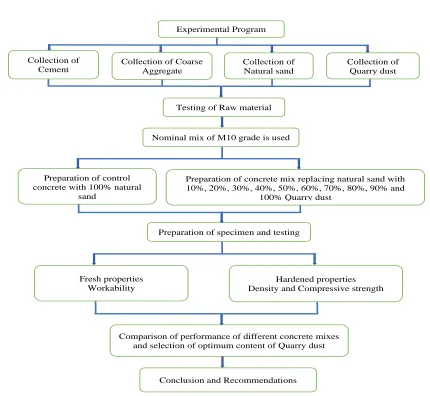
The details of experimental program and methodology for the evaluation of fresh properties (workability), hardened properties (density, compressive strength), durability properties (water absorption) and mineralogical & micro structural characteristics of concrete mixes made with varying percentages of quarry dust as partial replacement of natural sand.
Cement Testing:-
Portland Pozzolana Cement is used in all concrete mixes. Physical properties of cement, i.e., standard consistency, initial and final setting time, compressive strength, specific gravity, are evaluated by the procedures given in Bureau of Indian Standard specifications.
Coarse Aggregate:-
Aggregate of 26.5 mm is used as coarse aggregate in this experimental program. Coarse aggregate was locally procured. The aggregate should be free from dust (such that properly washed and dried for at least 72 hours before batching) and must not be alkali reactive. Physical properties of coarse aggregate, i.e., sieve analysis, specific gravity, water absorption and bulk density, are evaluated by the procedures given in Bureau of Indian Standard specifications.
Natural Sand:-
Locally procured natural sand was used as fine aggregate in concrete. Physical properties of natural sand, i.e., sieve analysis, specific gravity, water absorption and bulk density, are evaluated by the procedures given in Bureau of Indian Standard specifications.
Quarry Dust:-
Quarry dust was collected form a local crushing plant situated in district Bhopal, Madhya Pradesh.
Grade of concrete was chosen as M10 and target slump was 0 mm. According to the nominal mix design of grade M10, 1 part of cement, 3 part of sand and 6 part of coarse aggregate has been used by weight and for achieving the desire strength of the concrete for DLC layer, number of tests has been performed on different trial sample.
[image:2.612.338.561.367.561.2]Compressive strength of concrete was evaluated at age of 7 days, using standard cube specimens of 150 mm ⨯ 150 mm ⨯ 150 mm.
Fig. 1: Measurement of weight of different ingredient
Fig 2: - Flow Chart of Experimental Program
3. RESULT:
Different experimental investigations are recorded and discussed in this section. Results of physical testing of cement, coarse aggregate, natural sand and quarry dust are given below:
Coarse Aggregate:-
A 26.50 is a maximum size of aggregate is used as coarse aggregate for concrete. Coarse aggregate was locally procured and conformed to Indian Standard Specifications. Different physical properties of both types of coarse aggregate are given in Table 1.
TABLE 1: Physical Properties of Coarse Aggregate
Sr. No. Physical Property Test result
1 Specific Gravity 2.7
2 Water Absorption (%) 0.962
3 Impact value (%) 12.65
4 Abrasion value 15.60
5 Crushing value 14.85
Fine Aggregate:-
Locally procured natural sand was used in the experimental program and it was conformed to Indian Standard Specifications. Quarry dust was collected form a local crushing plant situated in district Bhopal, Madhya Pradesh. Different physical properties of natural sand and quarry dust are given in Table 2.
Comparison of performance of different concrete mixes and selection of optimum content of Quarry dust
Conclusion and Recommendations Preparation of specimen and testing
Fresh properties Workability
Hardened properties Density and Compressive strength Preparation of control
concrete with 100% natural sand
Preparation of concrete mix replacing natural sand with 10%, 20%, 30%, 40%, 50%, 60%, 70%, 80%, 90% and
100% Quarry dust Nominal mix of M10 grade is used
Testing of Raw material
Collection of Quarry dust Collection of
Natural sand Collection of Coarse
Aggregate Collection of
Cement
[image:3.612.338.558.544.632.2]TABLE 2: Physical Properties of Fine Aggregate and Quarry dust.
Sr.
No. Physical Property Test result Natural Sand Quarry Dust
1 Specific Gravity 2.61 2.57
2 Water Absorption (%) 0.8 3.09
3 Bulk (kg/L) Density 1.398 1.49
4 Void ratio 45% 40%
5 Bulking 17.64 5.04
6 Fineness Modulus 2.08 2.376
7 Grading Zone Zone II Zone II
Workability of all concrete mixes was evaluated as slump in mm, to study the effect of replacement of natural sand with quarry dust on workability of concrete.
It can be observed that at water to total weight of material ratio is 0.6, the value of slump will be minimum (or zero) for dry lean concrete work and after that the value of slump will be increasing with increase in the water to total weight of material ratio.
Density: -
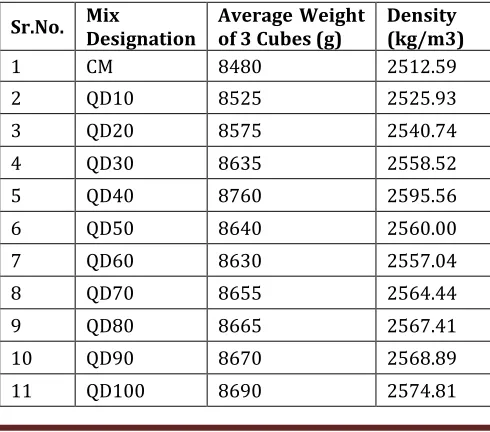
[image:4.612.39.284.526.742.2]Density of concrete, based upon the 1-day weight of the cubes of 150mm⨯150mm⨯150mm at the time of demolding after 24 hours of casting, was calculated and observations of density of concrete with increase in substitution rate of natural sand with quarry dust are given in Table 3.
TABLE 3:- 1-day Density of Concrete Mixes
Sr.No. Mix Designation Average Weight of 3 Cubes (g) Density (kg/m3)
1 CM 8480 2512.59
2 QD10 8525 2525.93
3 QD20 8575 2540.74
4 QD30 8635 2558.52
5 QD40 8760 2595.56
6 QD50 8640 2560.00
7 QD60 8630 2557.04
8 QD70 8655 2564.44
9 QD80 8665 2567.41
10 QD90 8670 2568.89
11 QD100 8690 2574.81
It observed that with the addition of some amount of quarry dust as a partial substitute of natural sand, density of the concrete is increasing. The relationship between density of concrete mixes with increase in sand substitution level is not linear, but it follows cubic variation. Concrete mix with 40% sand replacement has maximum density among all concrete mixes.
Compressive strength: -
Compressive strength of different concrete mixes was evaluated at age of 7 days for DLC work to study the effect of partial substitution of natural sand with quarry dust and different observations are given in Table 4.
TABLE 4:- Compressive Strength Test Results of a cube
Sr. No.
Proportio
n of
Sand/Qua rry dust
Load
Comp ressiv e streng th (MPa)
Average compressiv e strength (MPa)
1 100: 0
230 10.22
10.07
225 10.00
225 10.00
2 90: 10
240 10.67
10.96
260 11.56
240 10.67
3 80 : 20
260 11.56
12.15
290 12.89
270 12.00
4 70 : 30
280 12.44
12.30
270 12.00
280 12.44
5 60 : 40
310 13.78
13.04
270 12.00
300 13.33
6 50 :50
230 10.22
10.52
250 11.11
230 10.22
7 40 : 60
230 10.22
10.07
220 9.78
230 10.22
8 30 :70
220 9.78
10.07
230 10.22
9 20 : 80
220 9.78
9.63
210 9.33
220 9.78
10 10 : 90
200 8.89
9.19
210 9.33
210 9.33
11 0 : 100
190 8.44
8.74
200 8.89
200 8.89
[image:5.612.53.271.301.513.2]At age of 7 days, increase in compressive strength of concrete for QD10, QD20, QD30 and QD40 concrete mixes as compared to control concrete was 8.83%, 20.65%, 22.14%, 29.49%, respectively.
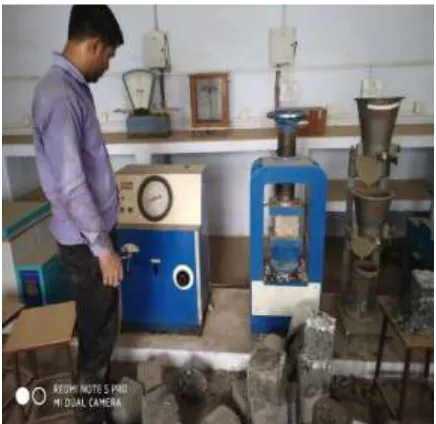
Fig 4: Compressive strength test
4. CONCLUSIONS:
1. Workability of concrete was decreased as the
percentage replacement of natural sand with quarry dust was increased. The increase in specific surface area of fine aggregate due to the micro-fines present in quarry dust and the angular shape of quarry dust particles increased the water demand of concrete and consequently resulted in decrease in workability. However, workability of all concrete mixes up to 40% sand replacement was suitable in structural uses.
2. Density of concrete was increased with increase in
replacement of natural sand with quarry dust. Density of concrete mix with 40% sand replacement level was maximum, which recorded a 3.30% increase in density as compared to control mix. Filling effect of quarry dust micro-fines to produce a dense microstructure and the higher specific gravity of quarry dust as compared to natural sand was the reason behind the increase in density of concrete.
3. Compressive strength of concrete was increased with
inclusion of quarry dust as partial replacement of natural sand. Concrete mix with 40% sand replacement level had maximum compressive strength at all ages. The increase in compressive strength of concrete was mainly attributed to increase in density of concrete with the inclusion of quarry dust and better conditions for hydration of cement in the presence of quarry dust micro-fines.
REFERENCES:
1. IS: 10262:2009, “Concrete mix proportioning ─ Guidelines”, Bureau of Indian Standards, New Delhi.
2. BIS 1199:1959, “Methods of sampling and analysis of
concrete”, Bureau of Indian Standards, New Delhi.
3. BIS 2386(Part 1):1988, “Methods for test for
aggregate: Part 1; Particle size and shape, Bureau of Indian Standards”, New Delhi.
4. BIS 2386(Part 3):1963, “Methods of Test for
Aggregates for Concrete – Specific Gravity, Density, Voids, Absorption & Bulking”, Bureau of Indian Standards, New Delhi.
5. BIS 383:1970, “Specification for coarse and fine
aggregate for natural sources”, Bureau of Indian Standards, New Delhi.
6. BIS 650:1991, “Specification for standard sand for
testing of cement”, Bureau of Indian Standards, New Delhi.
7. Gambhir M.L., “Concrete Technology”, Tata
McGraw-Hill, New Delhi.
8. SP-49:2014, “Guidelines for the use of dry lean