On the Decoding Failure Probability of Random
Network Coded Cooperation
Ioannis Chatzigeorgiou
School of Computing and Communications Lancaster University Lancaster LA1 4WA, UK Email: [email protected]
G¨unes Kurt, Semiha Tedik Bas¸aran
Department of Electronics and Communication Engineering
Istanbul Technical University 34469 Istanbul, Turkey Email:{gkurt,tedik}@itu.edu.tr
Amjad Saeed Khan
School of Mechanical, Electrical and Manufacturing Engineering
Loughborough University Loughborough LE11 3TU, UK
Email: [email protected]
Abstract—This paper considers a network of source nodes that transmit data packets to a destination node via relay nodes over erasure channels by using random linear network coding. The probability that the destination node will fail to recover the packets of all source nodes has been bounded and approximated in the literature for the case of relay nodes that randomly assign only nonzero values to the coefficients of linear combinations of data packets. The paper argues for the necessity of giving relay nodes the choice to also assign the zero value to coefficients when arithmetic operations are over finite fields of small size, e.g. GF(2). Alternative probability mass functions for the coefficients are considered, and expressions for the decoding failure probability are re-derived.
Index Terms—Cooperative communication, decoding probabil-ity, random linear network coding, random matrices.
I. INTRODUCTION
Network coding, proposed in the seminal work of Ahlswede
et al.[1], can increase data flow rates in a network. When net-work coding is employed, source nodes transmit data packets, whereas relay nodes generate and forward linear combinations of successfully received packets toward destination nodes. Wireless links between nodes can introduce packet erasures in the transmission process and affect network topology. Ho
et al. [2] proposed the use of a random linear network code
(RLNC) for networks with varying or unknown topologies, according to which the coefficients in a linear combination of packets are selected uniformly and independently from a Galois field of size q, denoted byGF(q).
Chiasserini et al. [3] studied a network that consists ofN
source nodes,M relay nodes and one destination node. Each source node transmits one data packet. Source-to-destination links are not available. An approximate expression for the
decoding probability was obtained, that is, the probability that the destination node will decode the data packets of all source nodes. Bas¸aranet al.[4] took into account the source-to-destination links, improved the counting accuracy of the combinatorial solution presented in [3] and derived an exact expression for the decoding probability. The expressions in both [3] and [4] invoke the matq(·)function, the calculation
of which is based on a numerical method by Kleinet al. [5]. As a result, the exact solution proposed in [3] and [4] is both semi-analytical and computationally intensive, and cannot be
easily integrated in optimization problems. Furthermore, both [3] and [4] assume that each relay node fails to receive at most one data packet, thus limiting the scope of the solution.
Seong [6] obtained closed-form bounds on the decoding failure probability (DFP), that is, the probability that the destination node will fail to decode the data packets of all source nodes. The key difference between [6] and [3], [4] is that the whole network in [6] has been modeled as an RLNC in which the values of code coefficients are selected with unequal probability from GF(q). When code coefficients are more likely to be assigned the zero value than any of the other
q−1 values of GF(q), the code is known assparse RLNC, otherwise it is referred to asdenseRLNC. Based on the work of Bl¨omeret al.[7] on sparse random matrices, Khanet al.[8] derived tighter bounds than those in [6]. However, both [6] and [8] study networks without direct source-to-destination links. Both [6] and [8] assume that relay nodes randomly assign onlynonzerovalues to code coefficients in linear combinations of successfully received data packets. This assumption can introduce flaws when the erasure probability of the source-to-relay links is very low and RLNC is overGF(2), resulting in a high DFP.
In this paper, the work of [6] and [8] is revisited by jointly considering the relationship between the erasure probability of the source-to-relay links and the probability mass function (PMF) of the code coefficients. The bounds on the DFP are re-derived. The work of Brownet al.[9], which proposes an approximation for the decoding failure probability, is taken into account and is extended from broadcast to relay-assisted communication. Our analysis initially focuses on transmission via the relay nodes only, referred to as Random Network Coded Relaying (RNCR), and is then extended to include the support of source-to-destination links, known as Random Network Coded Cooperation(RNCC).
II. SYSTEMMODEL
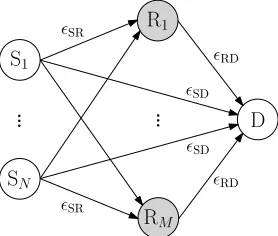
As shown in Fig. 1, we consider a network that consists of source nodesS1, . . . ,SN, relay nodesR1, . . . ,RM and one
S
1
SN
R1
RM
D ǫSR
...
...
ǫSR
ǫSD ǫRD
[image:2.612.105.244.51.169.2]ǫRD ǫSD
Figure 1. Model of a network consisting ofNsource nodes,Mrelay nodes and one destination node. The packet erasure probabilities ǫSR, ǫRD and ǫSD characterize the quality of the source-to-relay, relay-to-destination and source-to-destination links, respectively.
In the relaying phase, each relay node randomly combines successfully received data packets, generates a coded packet and forwards it to the destination. Packets are transmitted over orthogonal channels. The average channel conditions of the source-to-relay, relay-to-destination and source-to-destination links are characterized by the packet erasure probabilitiesǫSR,
ǫRDandǫSD, respectively.
The packets that are transmitted during the two-phase pro-cess can be written in matrix form as:
x=Gu⇔
x1
.. .
xN+M
=
IN×N
CM×N
u1
.. .
uN
. (1)
The column vector u contains the data packets u1, . . . , uN of the source nodes, where un is the data packet of source
node Sn, for 1 ≤ n ≤ N. The column vector x consists
of the transmitted packets x1, . . . , xN+M, where x1, . . . , xN
are the data packets transmitted by the N source nodes to the destination node, andxN+1, . . . , xN+M are the coded packets
transmitted by the M relay nodes to the destination node. G is obtained by the vertical concatenation of the N ×N identity matrixIN×N and theN×M coding matrixCM×N. Note that IN×N represents the broadcast phase and CM×N describes the encoding process of the data packets during the relaying phase. Each element of CM×N, denoted by cm,n,
is randomly drawn from GF(q), that is, cm,n ∈GF(q). The
PMF of cm,n, represented by P(cm,n), is influenced by the
erasure probability of the source-to-relay links. For example, the event of a data packet being transmitted from source node Sn to relay nodeRm and subsequently erased by the channel
is equivalent to the event of relay node Rmsettingcm,n= 0
in the encoding process. If erasures have an impact on the probability of selecting cm,n = 0, then non-erasures affect
the probability of choosing 1 ≤ cm,n ≤ q. Hence, the PMF P(cm,n)depends onǫSR.
At the end of the two-phase process, nodeDconstructs ma-trixAfrom the rows ofGthat are associated with successfully received packets. The number of rows that sub-matrixIN×N contributes to A is affected by ǫSD. Similarly, the number of rows of sub-matrix CM×N that will be appended to A
depends onǫRD. NodeD will recoveru1, . . . , uN if and only
ifAcontainsN linearly independent rows, thus, has rankN.
III. RANDOMNETWORKCODEDRELAYING
Let Em,n denote the erasure of a data packet transmitted
from source nodeSn to relay nodeRm, and letEm,nsignify
the successful delivery of the same packet, where the probabil-ity of each event isP(Em,n) =ǫSR andP(Em,n) = 1−ǫSR.
The probability that elementcm,nof the coding matrixCM×N
will be assigned a particular value fromGF(q)is given by
P(cm,n) =P(cm,n|Em,n)ǫSR+P(cm,n|Em,n)(1−ǫSR). (2)
In the event of an erasure, data packetun of source nodeSn
will not be stored on the memory of relay nodeRm and will
not participate in the encoding process. This is equivalent to settingcm,n= 0in (1) and writingP(cm,n= 0|Em,n) = 1.
Given thatǫSD= 1andG=CM×N in RNCR, the DFP can
be expressed as [6], [8], [9]
FRNCR(N, M) =
M X
m=0
M m
ǫM−m
RD (1−ǫRD)
mF(N|m)
(3)
where F(N|m) is the DFP conditioned on the number of coded packets m that have been received by the destination. If nodeDreceivesmof theM coded packets, the dimensions ofA will be m×N. The conditional probability F(N|m), which has been bounded in [6], [8] and approximated in [9], is dependent onP(cm,n)given in (2).
The analysis in [6] and [8] assumes that if data packetun
is received by relay node Rm, it will definitely contribute to
the generation of coded packetxm. This implies that the relay
node will select a value uniformly at random from theq−1
nonzeroelements ofGF(q)and assign it tocm,n. We can thus
write P(cm,n =t|Em,n) = 1/(q−1) fort ∈GF(q)\ {0}.
Substitution into (2) gives
P(cm,n=t) = (
ǫSR, ift= 0
(1−ǫSR)/(q−1), ift∈GF(q)\{0}. (4)
Based on (4), the following upper bound on the conditional DFP was obtained in [8, Theorem 3]:
Theorem 1(Khanet al.[8]). If the PMF used in the encoding process of RNCR is defined as in(4), the conditional DFP is upper bounded by
F(N|m)≤min{F1(N|m), F2(N|m)} (5)
where
F1(N|m) = 1−
N Y
n=1 "
1−
max
ǫSR,1−ǫSR q−1
m−n+1#
(6)
F2(N|m) =
N X
n=1
N n
(q−1)n−1 ρm
n, (7)
withρn in(7) given by
ρn=q−1+ 1−q−1
1−1−ǫSR 1−q−1
n
Expression (5) selects the tightest of two different loose up-per bounds, namely F1(N|m)and F2(N|m). Upper bound
F2(N|m)in (7) is a function ofρn, which is defined in (8)
and provides the probability that the sum over GF(q) of the first n elements of a row of matrix A is zero. The same PMF as in (4) was used in [9] but the Stein-Chen method was followed to approximate the DFP. In an effort to facilitate the comparison of the findings in [8] and [9], we present [9, Theorem 3.1] in the context of RNCR, as:
Theorem 2 (Brown et al. [9]). If the PMF used in the encoding process of RNCR withN source nodes andM ≥N relay nodes is defined as in (4), the conditional DFP can be approximated by
F(N|m)≈1−(1−ǫm SR)
N
exp −
N X
n=2 N
n
π
n
(1−ǫm SR)
n !
(9)
whereπn is an approximation of the probability that a subset ofncolumns of matrixAadd up to the zero vector inGF(q)
but no combination of columns from the same subset sum to the zero vector. The following recursion holds forπn:
πn =ρmn − n−1 X
s=1
n−1
s
ρm
sπn−s (10)
where ρn has been defined in(8) andπ1=ρm1.
As observed in [8] and also reported in [10], if ǫRD <1, the DFP is minimized when the values assigned to the ele-ments of the coding matrix CM×N are selected uniformly at
random from GF(q), i.e., with probability1/q. According to (4), the PMF follows the discrete uniform distribution when
ǫSR= 1/q. Forq= 2, the system design has the undesirable attribute of generating markedly more decoding failures when 0≤ǫSR<1/2than whenǫSR= 1/2. In order to alleviate this problem and reduce the DFP, we need to revise (4).
A. Relay nodes without knowledge of ǫSR
If data packet un is received by relay node Rm,
ele-ment cm,n of the coding matrix CM×N can be assigned
values from GF(q)with equal probability, including the zero value, i.e., P(cm,n|Em,n) = 1/q. This will ensure that, if
0≤ǫSR<1/q, data packets that have been received by a relay node will not necessarily be included in the RLNC process. Thus, dense RLNC will be avoided and the chances of generating linearly dependent coded packets at low values of
ǫSRwill be reduced. Based on (2), the PMF ofcm,nbecomes
P(cm,n=t) =
(ǫSR+ (1−ǫSR)/q,ift= 0
(1−ǫSR)/q, ift∈GF(q)\{0}. (11)
The following proposition is an adjustment of Theorem 1:
Proposition 1. If the PMF used in the encoding process of RNCR withNsource nodes andM ≥Nrelay nodes is defined as in(11), the conditional DFP is upper bounded by(5), where
F1(N|m) = 1−
N Y
n=1 "
1−
ǫSR+1−ǫSR
q
m−n+1# , (12)
F2(N|m)is defined as in(7) butρn is given by
ρn=q−1+ 1−q−1
ǫn
SR. (13)
Proof. According to the PMF in (11), the zero value will always be selected with a higher probability than any nonzero value from GF(q), for any value of ǫSR. Therefore, the maximum of the two branches of the PMF isǫSR+(1−ǫSR)/q. Substitution into (6) gives (12). The expression ofρn for the
revised PMF in (11) can be derived if the same reasoning as in [7, Theorem 3.3] is applied. In particular, the sum of the firstnelements of a row will be zero if (i) the sum of the first
n−1elements is zero and then-th element has the zero value, or (ii) the sum of the firstn−1 elements is greater than zero but the n-th element has the appropriate nonzero value that gives a sum of zero. In terms of probabilities, we can write:
ρn=ρn−1
ǫSR+1−ǫSR
q
+ (1−ρn−1)
1−ǫSR q
=ρn−1ǫSR+ (1−ǫSR)q −1
(14)
whereρ0= 1. If we setφn =ρn−q−1, it follows from (14)
thatφ0= 1−q−1 and
φn=φn−1ǫSR= 1−q−1
ǫnSR.
(15)
Replacingφnwith the righthand side of (15) inφn =ρn−q−1
and solving forρn leads to (13).
Corollary 1. When RNCR uses the PMF in (11), the condi-tional DFP can be approximated by(9)ifρn in(10)is defined as in(13).
We established that the PMF in (11) results in sparse RNCR because selection of the zero element is favored over the other elements of GF(q) in the encoding process. Thus, for 0≤ǫSR <1/q, the PMF in (11) is closer to the (optimal) uniform distribution than the PMF in (4) and a lower DFP can be achieved. For1/q≤ǫSR ≤1, both (11) and (4) lead to sparse implementations of RNCR; however, the PMF in (11) deviates from the uniform distribution more than the PMF in (4) and yields a higher DFP. The benefits of both (11) and (4) can be reaped for any value ofǫSR, if relay nodes knowǫSR.
B. Relay nodes with knowledge of ǫSR
The packet erasure probability ǫSR captures the average channel conditions of the source-to-relay links. If the relay nodes have knowledge ofǫSR, they can ensure that the values assigned to the elements ofCM×N are selected uniformly at
random fromGF(q), when0≤ǫSR <1/q. Otherwise, when 1/q ≤ ǫSR <1, the relay nodes can remove the zero value from the pool of candidate values for the elements ofCM×N.
For0≤ǫSR<1/q, the probability that relayRmwill select
a particular value for cm,n upon successful reception of data
packetun, so thatP(cm,n) = 1/q, can be obtained from (2):
P(cm,n=t|Em,n) =
1−q ǫSR
q(1−ǫSR)
, ift= 0
If relay nodes use (16) to assign values to those elements of CM×N that correspond to received data packets, the PMF
in (2) will follow the discrete uniform distribution and the conditional DFP will be equal to [11]
F(N|m) = 1−
N Y
n=1
1−q−m+n−1
. (17)
For1/q < ǫSR ≤1, packet erasures can still set the elements of CM×N equal to zero but relay nodes should only assign nonzero values to avoid turningCM×N into an overly sparse matrix. Thus, the PMF in (4) and the upper bound on the conditional DFP given in (5) can be used for 1/q < ǫSR≤1.
IV. RANDOMNETWORKCODEDCOOPERATION
In the case of RNCC, matrixGis the vertical concatenation of IN×N and CM×N, as in (1). Let us assume that the
destination nodeDhas collectedndata packets directly from the N source nodes andm coded packets from theM relay nodes. Elementary row and column operations can split the (n+m)×N matrixAat the destination node into four sub-matrices, with the top-left being the n×n identity matrix, the bottom-right being an m×(N −n) random matrix and the remaining entries being zero. As a result, the probability that the destination node will fail to decode the remaining
N −n data packets, given that m coded packets have been received, is equal toF(N−n|m). The DFP can be obtained by averagingF(N−n|m)over alln andm, that is
FRNCC(N, M) =
N X
n=0
N n
ǫN−n
SD (1−ǫSD) n
·
M X
m=0 M
m
ǫM−m
RD (1−ǫRD)
mF(N−n|m)
(18)
whereF(N−n|m) = 0forn=N. Note thatFRNCC(N, M) in (18) reduces to FRNCR(N, M) in (3) when ǫSD = 1. Expression (18) is an extension of the decoding probability of systematic network coding [12, eq. (8)] to the system model of RNCC. Depending on the PMF that is used by relay nodes to assign values to the elements ofCM×N, expressions (5), (9)
and (17) can be used to upper bound, approximate or compute
F(N−n|m), respectively, as explained in Section III.
V. RESULTS
The proposed modifications in the PMF used in the encod-ing process of RNCR and RNCC, their impact on the DFP and the tightness of the revised theoretical expressions are explored in this section. To refer to the different implementations of RNCR and RNCC, we have adopted a naming convention that describes the lack or excess of zeros in the coding matrix CM×N, when ǫSR ∈ [0. . .1/q] or ǫSR ∈(1/q . . .1],
respectively. Three cases can be encountered:
• C1: dense-sparse, if the PMF in (4) is used to assign values to the elements of CM×N.
• C2: sparse-very sparse, if the PMF in (11) is used to assign values to the elements ofCM×N.
0 0.2 0.4 0.6 0.8 1
0 0.2 0.4 0.6 0.8 1
Simulation Upper bound Approximation
0 0.2 0.4 0.6 0.8 1
0 0.2 0.4 0.6 0.8 1
Simulation Upper bound Approximation
0 0.2 0.4 0.6 0.8 1
0 0.2 0.4 0.6 0.8 1
Simulation Upper bound Approximation
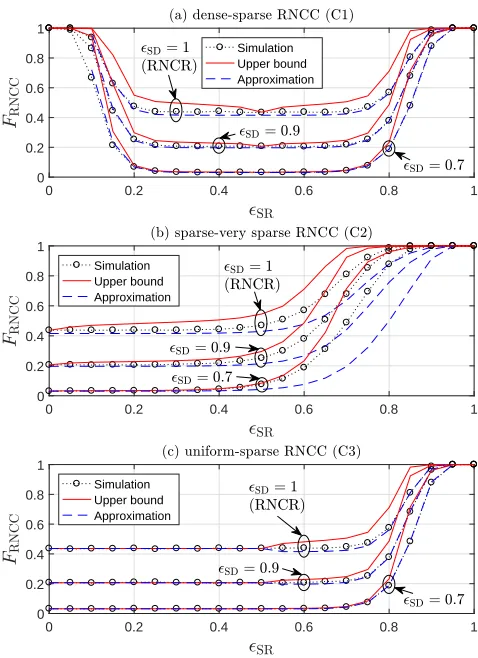
Figure 2. Decoding failure probability of RNCC as a function ofǫSR for q= 2,N= 20,M= 25,ǫRD= 0.15andǫSD∈ {0.7,0.9,1}.
• C3:uniform-sparse, if (16) is used to ensure that the PMF is uniform whenǫSR∈[0. . .1/q], and the PMF in (4) is employed whenǫSR∈(1/q . . .1].
Fig. 2 shows the impact of each PMF on the DFP of both RNCR (ǫSD= 1 by definition) and RNCC (whenǫSD∈ {0.7,0.9}) for N = 20 source nodes, M = 25 relay nodes,
q= 2, ǫRD= 0.15 and ǫSR∈[0,1]. Fig. 2(a) illustrates the poor performance of C1, analyzed in [6], [8], for low values of ǫSR. As can be observed in Fig. 2(a) for ǫSR < 0.2, the destination node will fail with a high probability to collect a sufficient number of linearly independent coded packets and recover all of the data packets. The high DFP for low values of ǫSR necessitates the adoption of a different PMF for the encoding process. In C2, relay nodes can assign0 or1 with equal probability to code coefficients of received data packets. As can be seen in Fig. 2(b) for low values of ǫSR, the DFP drops to0.44forǫSD= 1, to0.2forǫSD= 0.9and to0.03for
ǫSD = 0.7. For an increasing value ofǫSR, code coefficients are more likely to be assigned the value0 as per (11), hence fewer data packets are involved in linear combinations. In C3, the PMF of code coefficients in (16) prompts relay nodes to favor 1 over 0 with an increasing probability, as ǫSR grows from 0 to 0.5. The overall PMF is uniform and the DFP is minimized for ǫSR ∈ [0,0.5], as confirmed by Fig. 2(c). If
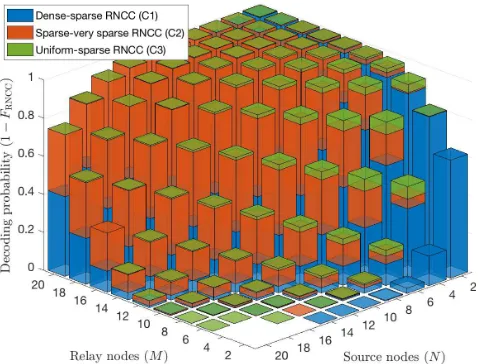
[image:4.612.315.554.47.376.2]Figure 3. Decoding probability achieved by the three RNCC implementations forq= 2,ǫSR=ǫRD= 0.15,ǫSD= 0.7andN, M∈ {2,4, . . . ,20}.
The decoding probability, given by1−FRNCC, at the desti-nation node for each of the three cases under consideration is shown in Fig. 3. In particular, the gain in decoding probability that can be achieved by the proposed schemes, C2 and C3, over C1 is depicted as a function of the number of source nodes and relay nodes in the system, where N, M ∈ {2,4, . . . ,20},
q = 2, ǫSR=ǫRD= 0.15 and ǫSD = 0.7. As expected, the decoding probability is low when the source-to-destination links are weak and the relay nodes are fewer than the source nodes (M < N); this is because the packets received by the destination node are, occasionally, fewer than the source packets or the linearly independent packets among the received packets are, often, fewer than N. As only three useful (out of four possible) linear combinations of two source packets can be generated by relay nodes when N = 2 source nodes, C2 and C3 achieve only a marginal increase in the decoding probability, as M grows. However, we observe that both C2 and C3 significantly improve the decoding probability when 2< N ≤M but the superiority of C3 is notable only for low values of M. This observation leads to the practical recommendation that C2 can be used in place of C3 as N
increases, N < M and ǫSR < 0.5, because the complexity introduced in C3 in order to equip the relay nodes with knowledge of ǫSR provides negligible performance gains.
We note that, as the field size used by RLNC grows, the number of possible linear combinations that can be generated by relay nodes increases. The use or omission of zero coeffi-cients during the encoding process has a diminishing impact on the DFP of RLNC over fields larger thanGF(2), and C1, C2 and C3 perform similarly, especially at low values ofǫSR.
VI. CONCLUSIONS
Expressions to bound and approximate the decoding failure probability of random network coded relaying are readily available. This paper has extended these expressions to random network coded cooperation in order to capture the contribution
that links between the source nodes and the destination node can make to the reduction of the decoding failure probabil-ity. More crucially, the paper established that inclusion or exclusion of the zero element from GF(2) in the selection process of code coefficients at the relay nodes should take into consideration the packet erasure probability of the source-to-relay links, i.e. ǫSR. ForǫSR≤0.5, relay nodes should be able to choose the zero element with a probability equal to 0.5 or a variable probability that decreases from 0.5 to 0 for an increasing value of ǫSR. For ǫSR>0.5, the zero element should be excluded from the encoding process at the relay nodes to avoid the generation of overly sparse linear combinations of data packets.
VII. ACKNOWLEDGEMENTS
This work was partially supported by the Engineering and Physical Sciences Research Council (EPSRC) under Grant No. EP/R006385/1. Collaboration of the authors was facilitated by the Erasmus+ programme of the European Union.
REFERENCES
[1] R. Ahlswede, N. Cai, S. R. Li, and R. W. Weung, “Network information flow,”IEEE Trans. on Inform. Theory, vol. 46, no. 4, pp. 1204–1216, Jul. 2000.
[2] T. Ho, M. Medard, R. Koetter, D. R. Karger, M. Effros, J. Shi, and B. Leong, “A random linear network coding approach to multicast,” IEEE Trans. Info. Theory, vol. 52, no. 10, pp. 4413–4430, Oct 2006. [3] C.-F. Chiasserini, E. Viterbo, and C. Casetti, “Decoding probability in
random linear network coding with packet losses,”IEEE Commun. Lett., vol. 17, no. 11, pp. 2128–2131, Nov. 2013.
[4] S. T. Basaran, S. Gokceli, G. K. Kurt, E. Ozdemir, and E. Yaraneri, “Error performance analysis of random network coded cooperation systems,” IEEE Trans. Wireless Commun., vol. 16, no. 8, pp. 5325– 5337, Aug. 2017.
[5] A. J. Klein, J. B. Lewis, and A. H. Morales, “Counting matrices over finite fields with support on skew Young diagrams and complements of Rothe diagrams,”J. Algebr. Comb., vol. 39, no. 2, pp. 429–456, Mar. 2014.
[6] J.-T. Seong, “Bounds on decoding failure probability in linear network coding schemes with erasure channels,” IEEE Commun. Lett., vol. 18, no. 4, pp. 648–651, Apr. 2014.
[7] J. Bl¨omer, R. Karp, and E. Welzl, “The rank of sparse random matrices over finite fields,”Rand. Struct. Alg., vol. 10, no. 4, pp. 407–420, Jul. 1997.
[8] A. S. Khan and I. Chatzigeorgiou, “Improved bounds on the decoding failure probability of network coding over multi-source multi-relay networks,”IEEE Commun. Lett., vol. 20, no. 10, pp. 2035–2038, Oct. 2016.
[9] S. Brown, O. Johnson, and A. Tassi, “Reliability of broadcast communi-cations under sparse random linear network coding,”IEEE Trans. Veh. Technol., vol. PP, no. 99, pp. 1–1, Jan. 2018.
[10] A. Tassi, I. Chatzigeorgiou, and D. E. Lucani, “Analysis and optimization of sparse random linear network coding for reliable multicast services,” IEEE Trans. Commun., vol. 64, no. 1, pp. 285–299, Apr. 2016. [11] O. Trullols-Cruces, J. Barcelo-Ordinas, and M. Fiore, “Exact decoding
probability under random linear network coding,”IEEE Commun. Lett., vol. 15, no. 1, pp. 67–69, Jan. 2011.