ISSN Online: 2160-889X ISSN Print: 2160-8881
DOI: 10.4236/opj.2018.87022 Jul. 27, 2018 264 Optics and Photonics Journal
Self-Referencing Method for Relative Color
Intensity Analysis Using Mobile-Phone
Wellington S. Souza
1,2, Marcos A. S. de Oliveira
1, Gabrielli M. F. de Oliveira
1,
Dalton P. de Santana
1, Renato E. de Araujo
1*1Laboratory of Biomedical Optics and Imaging, Federal University of Pernambuco, Recife, Brazil 2Federal Institute of Education, Science and Technology of Sertão Pernambucano, Salgueiro, Brazil
Abstract
Mobile-phones have been widely explored on colorimetric evaluations. How-ever, their use with different built-in image systems and acquisition configu-ration, in an environment with non-controlled illumination, limits the estab-lishment of an accurate color analysis. To overcome this restriction, the de-termination of the absolute color of an object can be overlooked and a relative color value determined. In this work, we establish a new approach for spec-troscopic evaluation based on cell-phone imaging, with no previous calibra-tion, determining relative color values. The standalone relative color intensity method is evaluated under the use of four distinct mobile-phones and differ-ent illumination conditions. The capability to distinguish differdiffer-ent color shades exploring the proposed self-referenced relative color intensity tech-nique is appraised. Moreover, the potential use of the method is demonstrated by evaluating the chemical-adsorption process of Cysteamine molecules on gold nanoparticle surfaces. The proposed self-referenced technique can im-prove and expand the use of mobile-phones in spectroscopic applications.
Keywords
Spectrometry, Colorimetry, Mobile-Phone
1. Introduction
Colorimetric test have been widely used on several application such as industrial control [1], immunoassays [2], food industry [3], water quality evaluation [4]. Color evaluations are mainly performed by exploring optical absorption or ref-lection spectroscopy techniques, which may require expensive devices, con-trolled illumination and the use of color calibrators. However, in a real world How to cite this paper: Souza, W.S., de
Oliveira, M.A.S., de Oliveira, G.M.F., de Santana, D.P. and de Araujo, R.E. (2018) Self-Referencing Method for Relative Color Intensity Analysis Using Mobile-Phone. Optics and Photonics Journal, 8, 264-275. https://doi.org/10.4236/opj.2018.87022
Received: May 25, 2018 Accepted: July 24, 2018 Published: July 27, 2018
Copyright © 2018 by authors and Scientific Research Publishing Inc. This work is licensed under the Creative Commons Attribution International License (CC BY 4.0).
DOI: 10.4236/opj.2018.87022 265 Optics and Photonics Journal scenario there are several applications demanding color’s evaluation in an im-perfect illumination environment, with no available calibrated reference color object. On that context, mobile-phones could be explored as an important tool for colorimetric analysis [5][6]. Several mobile-phones applications (Apps) are available to perform a roughly color evaluation of objects, as Catch Color Free (developed by CeSnow), Color Grab (by Loomatix), LifeDropper (by Bitjutsu Software). However, the color analysis of an object using distinct cell-phones and Apps leads to disparate results [6]. The popularization of mobile-phones and the improvement of their components allowed the implementation of dif-ferent colorimetric analysis techniques in several areas such as forensic science
DOI: 10.4236/opj.2018.87022 266 Optics and Photonics Journal method is demonstrated evaluating chemical-adsorption process of Cysteamine molecules on gold nanoparticle surfaces.
2. Materials and Methods
2.1. Relative Color
Images, obtained by cell-phones, usually provide color information on RGB space. Even under same illumination, different image capture devices can lead to distinct color output information (RGB values) [6]. Therefore, an accurate color analysis requires a calibration procedure, that is performed exploring a reference object with know RGB values [21]. Moreover, even the evaluation of color dif-ferences of two regions in a single image can be device dependent. In many cas-es, the relation between the input and output signal strength of a given device is characterized by a non-linear equation. The output color information of an im-age capture devices maybe described as
C′ =Cγ, (1)
where C is the real object color, C′ is the colorimage output and γ is known as the correction gamma factor [22] [23]. Therefore, if two or more cell phones have approximately the same value of γ, the color perception at the output of these devices will be similar. However, if γ values are different, the output values of the measured color will be distinct. In a first approximation, γ also carries the information of the illumination source. Moreover, as color is described on a RGB space, Equation (1) can be express as
, ,
R R G G B B′= γ ′= γ ′= γ (2)
where (R, G, B) and (R', G', B') are respectively the real object color and the cell-phone color output. On the color evaluation of two different regions in a single image, we define the relative color parameters (r, g, b) as:
( )
( )
( )
( )
ln ln ln ln i i r r R R r R R ′ = =′ (3)
( )
( )
ln( )
( )
ln ln ln i r r G G g G G ′ = =
′ (4)
( )
( )
( )
( )
ln ln ln ln i i r r B B b B B ′ = =′ (5)
where the index i and r denotes the two different regions of an image, the region of interest and the reference region, respectively. Notices that the relative colors are independent of γ, and therefore they are only dependent of the real colors of the object.
2.2. Spectroscopic Measurements
DOI: 10.4236/opj.2018.87022 267 Optics and Photonics Journal
Figure 1. Patterns (a) with different colors and (b) with different shades of red.
with different shades of red color. All color patterns areas were determined using a CR-400 colorimeter from Konica Minolta. However, the CR-400 colorimeter-provides color information in the XYZ-CIE space and is required to convert these values to the RGB color space. For this, a code in Mathlab was used consi-dering the CIE standard illuminant D65. Images of the patterns were obtained using 4 different cell-phones (CP1: LG Optmus L3; CP2: iPhone 4s; CP3: Sam-sung Galaxy J3; CP4: Microsoft Lumia 640). The CP1 device has Android oper-ating system, 3.1 MP camera and 2048 × 1533 pixels image resolution. CP2 has iOS 9 operating system, 8 MP camera and 3264 × 2448 pixels image resolution.
The CP3 phone features Android operating system, 8MP camera and 3264 ×
2448 pixels image resolution. Finally, CP4 runs Windows Phone 8.1 platform, 8 MP camera and 1280 × 721 pixels image resolution. Despite these technical dif-ferences, the color images recorded by these devices are True Color type, mean-ing that each pixel of the RGB image has 24 bits color information. Therefore each of the three-color components (red, green, blue) has a value ranging from 0 to 255 (8 bits).
Pictures were taken without flash and at approximately 30 cm away from the target. Automatic focus was also explored on the image capture procedure. An Android application (App), developed on the Android Studio platform, was de-veloped to evaluate the relative color intensity (Equation (3), (4) and (5)) of two different regions of the same picture. Images captured using the App were saved in PNG format. The developed smartphone application features an intuitive in-terface, ability to zoom the images and allows the evaluation of images taken by other devices (stored in the mobile-phone).
The color evaluation procedure was also explored on the analysis of molecule adsorption on metallic nanoparticles. A 0.01 g of Cysteamine, from Sig-ma-Aldrich, was added to 1.3 ml of a gold colloidal solution, with 50 nm nanos-pheres, from Sigma-Aldrich. Photographs of the colloid were taken before and after the addition of Cysteamine. Absorption spectra were also obtained by using a spectrometer (USB2000 Ocean Optics).
3. Results and Discursion
mo-DOI: 10.4236/opj.2018.87022 268 Optics and Photonics Journal bile-phones, significant difference on the output color image were identified. The images were taken under the same illumination condition (under fluores-cent light, with 200 Lux) and the color evaluations were performed on an 80 × 80 pixels area. In addition, all color areas on Figure 1(a) were also examined using the colorimeter. Table 1 shows the RGB color vales for three-color areas of this color pattern. The mobile-phones RGB mean values and the standard devia-tions were obtained by analyzing 16 images (4 pictures from 4 cell-phones). Huge differences were observed on the RGB colors values obtained by the colo-rimeter and by the mobile-phones. Those discrepancies are expected since the colorimeter explores an internal light source with optical characteristics distinct from the illumination used on the cell-phone analysis. As shown in Table 1, variations on RGB value, obtained from the mobile-phones images, have reached over 28%. Furthermore, one can notice that the evaluation of the R color com-ponent of the red color area, and the G comcom-ponent of the green area, and the B color component of the blue area have presented the smaller standard deviations (11.38%, 12.41% and 5.70% respectively).
It is well known in the literature that color evaluation by distinct mo-bile-phones leads to significant difference of color values [7]. The obtained color values of an acquired picture are influenced by the ambient illumination, the camera color filters, and the white balance algorithms explored [24]. To reduce this limitation, the determination of the absolute color value of an object can be overlooked and a relative color value determined. Ahuja and coauthors have es-tablished a method to evaluate relative color, based on RGB components differ-ences in the RGB color space [25]. On the analysis of colors with mobile-phones, Yestisen et al. have explored color distances on the 2D (x, y) CIE 1931 chroma-ticity space, [15]. Sumriddetchkajorn et al. have analyzed colors by defining a specific color ratio [17]. Moreover, the described measures presented in refer-ences [7]-[12][17][19][20] were performed using a single mobile-phone.
Here we evaluate and compared the performance of several methods, explor-ing 4 different mobile-phones. Based on the references [15] [17] [25] and on Equation (3) the values of |Ri − Rr|, Ri/Rr, |xi − xr| and r were determined. The x chromaticity values of the relative color distance |xi − xr| was define as
(
)
x R R G B= + + . The index i and r designates the region of interest and the
DOI: 10.4236/opj.2018.87022 269 Optics and Photonics Journal
Table 1. RGB values of color regions (red, green and blue) using colorimeter and mo-bile-phones.
Region Red Region Green Region Blue
Colorimeter R G B R G B R G B
Mean 27.38 19.93 14.47 19.47 27.43 17.92 16.38 14.96 14.51 S. Deviation (%) 0.11 0.16 0.32 0.35 0.23 0.59 0.22 0.23 0.15
Smartphone R G B R G B R G B
Mean 147.72 69.15 74.17 73.52 125.08 77.43 45.57 64.21 139.44 S. Deviation (%) 11.38 16.40 12.30 19.34 12.41 14.83 28.34 13.35 5.70
Table 2. The relative color values of the Figure 1(a) red region using different mo-bile-phones. White area was used as the reference region.
Relative color Mobile-phone (mean value) Standard Deviation (%)
|Ri − Rr| 48.90 37.9
Ri/R 0.75 9.72
|xi − xr| 0.18 10.06
r 1.06 1.93
|Gi − Gr| 127.32 16.53
Gi/Gr 0.35 14.86
|yi − yr| 0.09 11.11
g 1.25 3.2
|Bi −Br| 134.35 23.08
Bi/Br 0.36 15.83
|zi − zr| 0.091 13.19
b 1.25 3.46
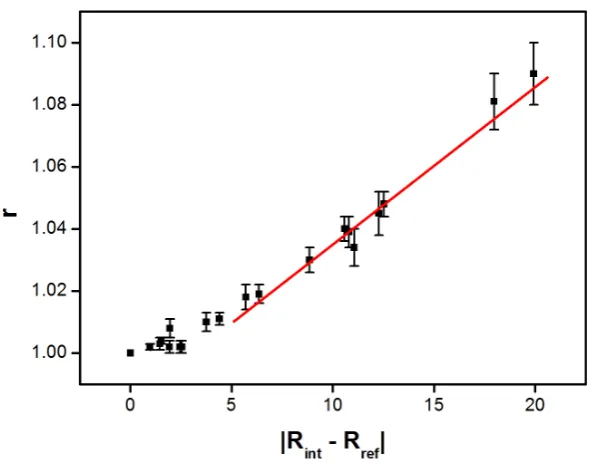
To evaluate the performance of proposed method to distinguish different col-or shades, the colcol-or pattern of Figure 1(b) was imaged and analyzed, using Equ-ation (3). Figure 2 shows the values of the relative color intensity r of different areas of Figure 1(b). In Figure 2, the |Ri − Rr| values of abscissa axis were ob-tained by measuring the R-color component of the red shades areas with the co-lorimeter. Figure 2 indicates that the proposed self-referenced colorimetric me-thod can distinguish two different color shades areas with |Ri − Rr| > 5, estab-lishing a relative red color threshold, rt, of ~1.02. Similar analyses were per-formed to identify the limitation of the proposed method in the evaluation of re-gions with green and blue tonalities. The measured relative green and blue color thresholds were gt ~ 1.00 and bt ~ 1.03.
DOI: 10.4236/opj.2018.87022 270 Optics and Photonics Journal
Figure 2. Relative rcolor intensity values of the Figure 1(b) red shades areas as function of the color differences (|Ri − Rr|), measured with the colorimeter. The
solid line is a guide to the eye.
intensity analysis can also reduce the illumination dependence of the spectros-copic evaluation. Figure 3 shows the normalized average relative color intensity values of the red shades areas (using regions 1 and 2 from Figure 1(b)) under different illuminations. Here a fluorescent lamp (175 Lux), an incandescent lamp (33 Lux) and a white LED (5 Lux) were used as light source. Sunlight (355 Lux) was also explored on the illumination of the color pattern. The relative color av-erage value obtained under sun illumination was used to normalize all the measured values. The smallest deviation (0.53%) of the measured average rela-tive color values was observed using the proposed method (Equation (3)), under different illumination conditions. The proposed self-referenced relative color intensity method reduces the mobile-phone spectroscopic evaluation depen-dence on the illumination source.
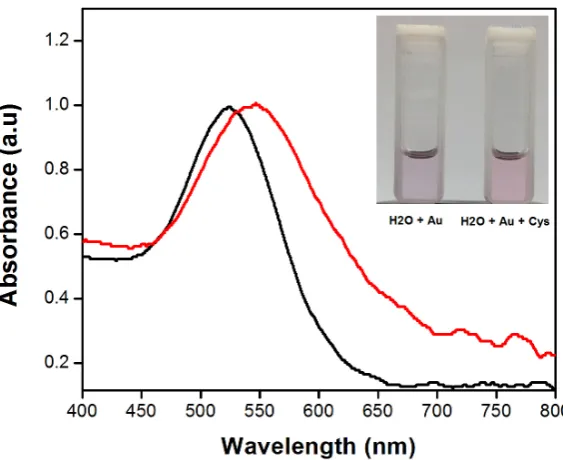
To demonstrate the potential use of the method, the chemical-adsorption of a molecule on nanoparticle surface was evaluated, using a mobile-phone (CP3). Optical properties (scattering and absorption) of metallic nanoparticle maybe changed by the adsorption of molecules on the metal surface [26]. In particular, 50 nm gold sphere colloid presents a faint pink color, with an extinction spec-trum characterized by a peak (Plasmon peak) at 523.94 nm, and FWHM of 69.13 nm. The addition of Cystemaine to colloid volume and it adsorption on nano-structures induces a read shift of the Plasmon peak to 544.91 nm. Figure 4
DOI: 10.4236/opj.2018.87022 271 Optics and Photonics Journal
Figure 3. Dependence of the relative color parameters as a function of the light source.
Figure 4. Extinction spectra of the 50 nmAu sphere colloid with (red) and without (black) Cysteamine. Inset: Mobile-phone image of the colloid with and without Cysteamine (Cys).
[29][30][31]. The inset of Figure 4 shows a picture of the two solutions (colloid with and without Cysteamine) in 1 cm optical length glass cuvettes. The color difference of the samples is hardly noticed.
[image:8.595.232.514.342.572.2]DOI: 10.4236/opj.2018.87022 272 Optics and Photonics Journal the gold-Cysteamine solution image was selected as the interested region. The App interface with the processing result for a given image is shown in Figure 5. After taking a photo with the mobile-phone application, the image is shown on the display of the device with two regions markers (black and red). The black marker was positioned over the region of the image used as a color reference, while the red marker was placed on the region of interest. The color analysis was performed by selecting the render button (process) of the App.
The time behavior of the Cysteamine adsorption on the gold surface was eva-luated with the self-referenced relative color assay. Figure 6 shows the time evolution of the sample’s red component of the relative color value with the ad-dition of Cysteamine in the gold colloid and the peak shift in the spectrum due to the presence of the Cysteamine. Although the method cannot precisely iden-tify color changes smaller than rt, we were able to verify that the adsorption process takes approximately 40 min to be complete established. A good correla-tion (a2 = 0.9824) between the red component of the relative color and the cor-responding extinction peak wavelength were identified, as shown in the inset of
Figure 6. The measured r value change (r = 1.013), associated to the colloid col-or modification, was close to the relative colcol-or threshold value, rt, determined on
Figure 2, indicating the capability of the method to distinguish slight colors changes. Moreover we were able, with a mobile-phone, to identify a 20.99 nm spectrum shift of a 69.13 nm FWHM spectrum band.
4. Conclusion
[image:9.595.229.525.528.675.2]The color analysis of an object using distinct mobile-phones can lead to dispa-rate results. To overcome this obstacle a mobile-phone based standalone spec-troscopic method, without calibration procedures, to determine relative color values of an image was proposed and evaluated. On the analysis of a color pat-tern, no more than 3.5% of deviation was observed on the relative color values obtained by four different mobile-phones, indicating that the proposed color
DOI: 10.4236/opj.2018.87022 273 Optics and Photonics Journal
Figure 6. Time evolution of the goldcolloid extinction spectrum peak (red) and red component of the relative color intensity value (blue), with the addition of Cysteamine. The inset shows a linear correlation (a2 = 0.9824) of the r and the colloid extinction peak.
evaluation procedure is weakly dependent of the image device used. The pro-posed self-referenced spectroscopic method can distinguish 2% (|Ri − Rr| > 5) difference on the R-color component of red shades areas. We also demonstrated that relative color analysis could also reduce the illumination dependence on the spectroscopic evaluation. Under different illumination conditions we observed a 0.53% deviation of the measured relative color values of a color pattern. Moreo-ver, the method allowed identifying a 20.99 nm spectrum shift of a 69.13 nm FWHM spectrum band of colloidal gold, due to the Cysteamine adsorption on the metal surface. The proposed self-referenced technique leads to relative color intensity values that are weakly dependent of the illumination condition and mobile-phone used. Therefore the color analysis method can improve and ex-pand the use of cell-phones in standalone spectroscopic applications. Moreover, mobile-phones spectroscopic platforms can contribute to the democratization of diagnostics technologies globally, by offering high sensitivity cost-effective sensors [32].
Acknowledgements
The authors acknowledge the financial support from the Brazilian agency CAPES/PNPD, FACEPE, CNPq and the National Institute of Photonics.
References
DOI: 10.4236/opj.2018.87022 274 Optics and Photonics Journal [2] Yin, Y., Cao, Y., Xu, Y. and Li, G. (2010) Colorimetric Immunoassay for Detection
of Tumor Markers. International Journal Molecular Sciences, 11, 5077-5094.
https://doi.org/10.3390/ijms11125077
[3] Xing, J., Ngadi, M., Gunenc, A., Prasher, S. and Gariepy, C. (2007) Use of Visible Spectroscopy for Quality Classification of Intact Pork Meat. Journal of Food Engi-neering, 82, 135-141.https://doi.org/10.1016/j.jfoodeng.2007.01.020
[4] Zhang, C. and Suslick, K.S. (2005) A Colorimetric Sensor Array for Organics in Water. Journal of the American Chemical Society, 127, 11548-11549.
https://doi.org/10.1021/ja052606z
[5] Kim, H., Awofeso, O., Choi, S., Juang, Y. and Bal, E. (2017) Colorimetric Analysis of Saliva-Alcohol Test Strips by Smartphone-Based Instruments Using Machine- Learning Algorithms. Applied Optics, 56, 84-92.
https://doi.org/10.1364/AO.56.000084
[6] Ilja, Z. (2013) Colour Management Using Mobile Phone Camera. Bachelor’s Thesis. Helsinkimetropolia University of Applied Sciences, Filand.
[7] Shin, J., Choi, S., Yang, J., Song, J., Chui, J. and Juang, H. (2017) Smart Forensic Phone: Colorimetric Analysis of a Bloodstain for Age Estimation Using a Smart-phone. Sensors and Actuators B, 243, 221-225.
https://doi.org/10.1016/j.snb.2016.11.142
[8] Xu, W., Lu, S., Chen, Y., Zhao, T., Jiang, Y., Wang, Y. and Chen X. (2015) Simulta-neous Color Sensing of O2 and pH Using a Smartphone. Sensors and Actuators B,
220, 326-330.https://doi.org/10.1016/j.snb.2015.05.088
[9] Zachary, J.S., Kaiqin, C., Alyssa, R.E., Mehdi, R., Amy, G., Marco, M., Denis, M.D., Stephen, L., Dennis, M. and Sebastian, W.H. (2011) Cell-Phone-Based Platform for Biomedical Device Development and Education Applications. PLoS ONE, 6, 1-11. [10] Sewoong, K., Dongrae, C., Jihun, K., Manjae, K., Sangyeon, Y., Jae, E.J., Minkyu, J.,
Dong, H.L., Boreom, L., Daniel, L.F. and Jae, Y.H. (2016) Smartphone-Based Mul-tispectral Imaging: System Development and Potential for Mobile Skin Diagnosis. Biomedical Optics Express, 7, 5294-53071. https://doi.org/10.1364/BOE.7.005294 [11] Karthik, R.K., Surya, C. and Michael, G. (2017) mHealth Dipstick Analyzer for
Monitoring of Pregnancy Complications. IEEE Sensors Journal, 17, 7311-7316. https://doi.org/10.1109/JSEN.2017.2752722
[12] Sandeep, K.V., Thomas, V.O., Marion, S., Roland, Z., Felix, V.S. and John, L. (2015) A Smartphone-Based Colorimetric Reader for Bioanalytical Applications Using the Screen-Based Bottom Illumination Provided by Gadgets. Biosensors and Bioelec-tronics, 67, 248-255. https://doi.org/10.1016/j.bios.2014.08.027
[13] Brandon, B., Bingen, C., Derek, T., Haydar, O., Steve, F., Qingshan, W., et al. (2015)Cellphone-Based Hand-Held Microplate Reader for Point-of-Care Testing of Enzyme-Linked Immunosorbent Assays. ASC Nano, 9, 7857-7866.
https://doi.org/10.1021/acsnano.5b03203
[14] Wang, Y., Liu, X., Chen, P., Tran, N.T., Zhang, J., Chia, W.S., et al. (2016) Smart-phone Spectrometer for Colorimetric Biosensing. Analyst, 141, 3233-3238. https://doi.org/10.1039/C5AN02508G
[15] Yetisen, A.K., Martinez-Hurtado, J.L., Garcia-Melendrez, A., Vasconcelos, F.C. and Lowe, C.R. (2014) A Smartphone Algorithm with Inter-Phone Repeatability for the Analysis of Colorimetric Tests. Sensors and Actuators B, 196, 156-160.
https://doi.org/10.1016/j.snb.2014.01.077
DOI: 10.4236/opj.2018.87022 275 Optics and Photonics Journal Self-Calibration Approach. Sensors and Actuators B, 24, 476-483.
https://doi.org/10.1016/j.snb.2016.11.057
[17] Sumriddetchkajorn, S., Chaitavon, K. and Intaravanne, Y. (2013) Mobile De-vice-Based Self-Referencing Colorimeter for Monitoring Chlorine Concentration in Water. Sensors and Actuators B, 182, 592-597.
https://doi.org/10.1016/j.snb.2013.03.080
[18] Samuel, S. (2014) Colorimetric Water Quality Sensing with Mobile Smart Phones. PhD Thesis, University of British Columbia, Vancouver.
[19] Erika, A.T., Scott, E.G., William, A.S., Robert, G.M., Alexander, J.W., Alexa, F.S., et al. (2014) Disposable Platform Provides Visual and Color-Based Point-of-Care Anemia Self-Testing. Journal of Clinical Investigation, 124, 4387-4394.
https://doi.org/10.1172/JCI76666
[20] Yuttana, I., Sarun, S. and Jiti, N. (2012) Cell Phone-Based Two-Dimensional Spec-tral Analysis for Banana Ripeness Estimation. Sensors and Actuators B, 168, 390-394.https://doi.org/10.1016/j.snb.2012.04.042
[21] Reza, S. and Milivoje, A. (2010) An Efficient Spectral-Based Calibration Method for RGB White-Balancing Gains under Various Illumination Conditions for Cell- Phone Cameras.
[22] Stephen, W. and Catarina, R. (2004) Computational Colour Science Using Matlab. John Wiley & Sons Ltd., Hoboken.
[23] Charles, A.P. (1993) Gamma and Its Disguises: The Nonlinear Mappings of Inten-sity in Perception, CRTs, Film, and Video. SMPTE Journal, 102, 1099-1108.
[24] Felix, K., Peter, B., Sangam, C. and Tran, Q.K. (2013) Optimized Flash Light- Emitting Diode Spectra for Mobile Phone Cameras. Applied Optics, 36, 8779-8788. [25] Punkaj, A., Maria, A.P., Brian, D.H. and Miklós, G. (2014) Minimizing Color
Inter-ference from Biological Samples in Optode-Based Measurements. Sensors and Ac-tuators B, 204, 319-325. https://doi.org/10.1016/j.snb.2014.07.113
[26] Willets, K.A. and Van Duyne, R.P. (2007) Localized Surface Plasmon Resonance Spectroscopy and Sensing. Annual Review of Physical Chemistry, 58, 267-297. https://doi.org/10.1146/annurev.physchem.58.032806.104607
[27] Yurui, X., Xun, L., Hongbin, L. and Wenke, Z. (2014) Quantifying Thiol-Gold Inte-ractions towards the Efficient Strength Control. Nature Communications, 5, Article No. 4348.https://doi.org/10.1038/ncomms5348
[28] Michel, G., Martin, B., Matthias, R. and Hermann, E. (1999) How Strong Is a Cova-lent Bond? Science, 283, 1727-1730.
[29] Anker, J.N., Hall, W.P., Lyandres, O., Shah, N.C, Zhao, J. and Van Duyne, R.P. (2008) Biosensing with Plasmonicnanosensors. Nature Materials, 7, 442-453. https://doi.org/10.1038/nmat2162
[30] Jie, C., Tong, S. and Kenneth, G. (2014) Gold Nanorod-Based Localized Surface Plasmonresonance Biosensors: A Review. Sensors and Actuator B, 195, 332-351. https://doi.org/10.1016/j.snb.2014.01.056
[31] Alexandre, C., Paula, G., Ana, C., Arthur, M., Rosa, D., Renato, E.A., et al. (2013) Dengue Immunoassay with an LSPR Fiber Optic Sensor. Optics Express, 21, 27023-27031.https://doi.org/10.1364/OE.21.027023