PROGRESS AND CHALLENGES OF ICDS IN MADURAI DISTRICT OF SELECTED BLOCKS
*P. Mary Elizabeth and ** Dr.
*Center for Women’s Studies, Arul Anandar
**Department of Rural Development, Gandhigram Rural University,
ARTICLE INFO ABSTRACT
Integrated Child Development Services (ICDS) is the most comprehensive scheme of the Government of India for early childhood care and development. It aims at enhancing survival and development of children from the vulnerable sections of society, ICDS is a
encompasses the main components of human resources development namely, health nutrition and education. The programme today covers over 4.8 million expectant and nursing mothers and over 23 million children under the age of six. Of thes
activities. The purpose of ICDS is to improve the health, nutrition and development of children. The programme offers health, nutrition and hygiene education to mothers, non
education to children aged three to six, supplementary feeding for all children and pregnant and nursing mothers, growth monitoring and promotion, and links to primary healthcare services such as immunization and vitamin A supplements. These services are delivered
the anganwadi
undergo three months of institutional training and four months of community cost of the ICDS programme average
function of AWW intervention by ICDS and improved the outreach of maternal and child health (MCH).
INTRODUCTION
Integrated Child Development Scheme was started in the year on 2nd October 1975, today; ICDS Scheme represents one of the world’s largest and most unique programmes for early childhood development. ICDS is the foremost symbol of India’s commitment to her children – India’s response to the challenge of providing pre-school education on one hand and breaking the vicious cycle of malnutrition, morbidity, reduced learning capacity and mortality, on the other. Integrated Child Development Services (ICDS) in India is the world’s largest integrated early childhood programme, with over 40,000 centers nationwide. Since its inception in 1975, the programme has matured and expanded, despite difficulties in adapting to the vastly different local circumstances found on the Indian subcontinent. UNICEF helped launch the ICDS programme and continues to provide financial and technical assistance along with the World Bank. A review of these research studies indicate that ICDS has had a positive impact on beneficiaries and has the potential of enhancing the child survival rate. Definite improvement has been reported on major indicators of health and nutrition like Infant Mortality Rate (IMR), Nutritional status, Immunization coverage and utilization of health services. The objectives of (ICDS) programme are follows:
ISSN: 0975-833X
International Journal of Current Research Vol.
Article History:
Received 14th
March, 2012 Received in revised form 25th
April, 2012 Accepted 19th
May, 2012 Published online 30th
June, 2012
Key words:
Integrated Child Development Services, Health nutrition,
Education, Anganwadi worker.
*Corresponding author: [email protected]
RESEARCH ARTICLE
PROGRESS AND CHALLENGES OF ICDS IN MADURAI DISTRICT OF SELECTED BLOCKS
Mary Elizabeth and ** Dr. Neema Gnanadve
*Center for Women’s Studies, Arul Anandar College, Karumathur, Madurai (DT) Department of Rural Development, Gandhigram Rural University,Gandhigram
ABSTRACT
Integrated Child Development Services (ICDS) is the most comprehensive scheme of the Government of India for early childhood care and development. It aims at enhancing survival and development of children from the vulnerable sections of society, ICDS is a
encompasses the main components of human resources development namely, health nutrition and education. The programme today covers over 4.8 million expectant and nursing mothers and over 23 million children under the age of six. Of these children, more than half participate in early learning activities. The purpose of ICDS is to improve the health, nutrition and development of children. The programme offers health, nutrition and hygiene education to mothers, non
n to children aged three to six, supplementary feeding for all children and pregnant and nursing mothers, growth monitoring and promotion, and links to primary healthcare services such as immunization and vitamin A supplements. These services are delivered
anganwadi, or childcare centre. Each centre is run by an anganwadi worker and one helper, who undergo three months of institutional training and four months of community
cost of the ICDS programme averages $10-$22 per child a year. Thus, the study to analyze the function of AWW intervention by ICDS and improved the outreach of maternal and child health
Copy Right, IJCR, 2012, Academic Journals
Integrated Child Development Scheme was started in the year October 1975, today; ICDS Scheme represents one of the world’s largest and most unique programmes for early childhood development. ICDS is the foremost symbol of India’s response to the l education on one hand and breaking the vicious cycle of malnutrition, morbidity, reduced learning capacity and mortality, on the other. Integrated Child Development Services (ICDS) in India is the world’s largest h over 40,000 centers nationwide. Since its inception in 1975, the programme has matured and expanded, despite difficulties in adapting to the vastly different local circumstances found on the Indian subcontinent. UNICEF helped launch the ICDS d continues to provide financial and technical A review of these research studies indicate that ICDS has had a positive impact on beneficiaries and has the potential of enhancing the child vement has been reported on major indicators of health and nutrition like Infant Mortality Rate (IMR), Nutritional status, Immunization coverage and utilization of health services. The objectives of (ICDS)
i. To improve the nutritional and health status of children in the age-group 0-6 years;
ii. To lay the foundation for proper psychological, physical and social development of the child; iii. To reduce the incidence of mortality, morbid
malnutrition and school dropout;
iv. To achieve effective co-ordination of policy and implementation amongst the various departments to promote child development; and
v. To enhance the capability of the mother to look after the normal health and nutritiona
through proper nutrition and health education.
With these specific objectives ICDS programme aims at providing a package of services to the mothers and children. It is a unique programme in which all health and nutrition activities essential for promotion of child health and development are included.
i. Supplementary nutrition, ii. Immunization,
iii. Health check-up, iv. Referral services,
v. Pre-school non-formal education and vi. Nutrition & health education.
The concept of providing a package of services is based primarily on the consideration that the overall impact will be
ternational Journal of Current Research Vol. 4, Issue, 06, pp.127-131, June,2012
INTERNATIONAL
OF CURRENT RESEARCH
PROGRESS AND CHALLENGES OF ICDS IN MADURAI DISTRICT OF SELECTED BLOCKS
College, Karumathur, Madurai (DT)-625514 Gandhigram-624 302
Integrated Child Development Services (ICDS) is the most comprehensive scheme of the Government of India for early childhood care and development. It aims at enhancing survival and development of children from the vulnerable sections of society, ICDS is a unique programme, it encompasses the main components of human resources development namely, health nutrition and education. The programme today covers over 4.8 million expectant and nursing mothers and over 23 e children, more than half participate in early learning activities. The purpose of ICDS is to improve the health, nutrition and development of children. The programme offers health, nutrition and hygiene education to mothers, non-formal preschool n to children aged three to six, supplementary feeding for all children and pregnant and nursing mothers, growth monitoring and promotion, and links to primary healthcare services such as immunization and vitamin A supplements. These services are delivered in an integrated manner at , or childcare centre. Each centre is run by an anganwadi worker and one helper, who undergo three months of institutional training and four months of community-based training. The $22 per child a year. Thus, the study to analyze the function of AWW intervention by ICDS and improved the outreach of maternal and child health
, Academic Journals. All rights reserved.
To improve the nutritional and health status of 6 years;
To lay the foundation for proper psychological, physical and social development of the child; To reduce the incidence of mortality, morbidity, malnutrition and school dropout;
ordination of policy and implementation amongst the various departments to promote child development; and
To enhance the capability of the mother to look after the normal health and nutritional needs of the child through proper nutrition and health education.
With these specific objectives ICDS programme aims at providing a package of services to the mothers and children. It is a unique programme in which all health and nutrition sential for promotion of child health and
formal education and Nutrition & health education.
The concept of providing a package of services is based primarily on the consideration that the overall impact will be INTERNATIONAL JOURNAL
much larger if the different services develop in an integrated manner as the efficacy of a particular service depends upon the support it receives from related services.
Services Target Group Service Provided by
Supplementary Nutrition
Children below 6 years: Pregnant & Lactating Mother (P&LM)
Anganwadi Worker and Anganwadi Helper Immunization* Children below 6 years:
Pregnant & Lactating Mother (P&LM)
ANM/MO
Health Check-up*
Children below 6 years: Pregnant & Lactating Mother (P&LM)
ANM/MO/AWW
Referral Services Children below 6 years: Pregnant & Lactating Mother (P&LM)
AWW/ANM/MO
Pre-School Education
Children 3-6 years AWW
Nutrition & Health Education
Women (15-45 years) AWW/ANM/MO
*AWW assists ANM in identifying the target group.
Three of the six services namely Immunisation, Health Check-up and Referral Services delivered through Public Health Infrastructure under the Ministry of Health & Family Welfare.
1. Nutrition including Supplementary Nutrition: This
includes supplementary feeding and growth monitoring; and prophylaxis against vitamin A deficiency and control of nutritional anaemia. All families in the community are surveyed, to identify children below the age of six and pregnant & nursing mothers. They avail of supplementary feeding support for 300 days in a year. By providing supplementary feeding, the Anganwadi attempts to bridge the caloric gap between the national recommended and average intake of children and women in low income and disadvantaged communities.
2. Immunization: Immunization of pregnant women and
infants protects children from six vaccine preventable diseases-poliomyelitis, diphtheria, pertussis, tetanus, tuberculosis and measles. These are major preventable causes of child mortality, disability, morbidity and related malnutrition. Immunization of pregnant women against tetanus also reduces maternal and neonatal mortality.
3. Health Check-ups: This includes health care of children
less than six years of age, antenatal care of expectant mothers and postnatal care of nursing mothers. The various health services provided for children by anganwadi workers and Primary Health Centre (PHC) staff, include regular health check-ups, recording of weight, immunization, management of malnutrition, treatment of diarrhoea, de-worming and distribution of simple medicines etc.
4. Referral Services: During health check-ups and growth
monitoring, sick or malnourished children, in need of prompt medical attention, are referred to the Primary Health Centre or its sub-centre. The anganwadi worker has also been oriented to detect disabilities in young children. She enlists all such cases in a special register and refers them to the medical officer of the Primary Health Centre/ Sub-centre.
5. Non-formal Pre-School Education (PSE)
The Non-formal Pre-school Education (PSE) component of the ICDS may well be considered the backbone of the ICDS programme, since all its services essentially converge at the anganwadi – a village courtyard. Anganwadi Centre (AWC) – a village courtyard – is the main platform for delivering of these services. These AWCs have been set up in every village in the country. In pursuance of its commitment to the cause of India’s Children, present government has decided to set up an AWC in every human habitation/ settlement. As a result, total number of AWC would go up to almost 1.4 million. This is also the most joyful play-way daily activity, visibly sustained for three hours a day. It brings and keeps young children at the anganwadi centre - an activity that motivates parents and communities. PSE, as envisaged in the ICDS, focuses on total development of the child, in the age up to six years, mainly from the underprivileged groups.
6. Nutrition and Health Education: Nutrition, Health and
Education (NHED) is a key element of the work of the anganwadi worker. This forms part of BCC (Behaviour Change Communication) strategy. This has the long term goal of capacity-building of women – especially in the age group of 15-45 years – so that they can look after their own health, nutrition and development needs as well as that of their children and families.
Objectives
To study the function of AWW intervention by ICDS
To examine the awareness of antenatal practices among women.
Area of the Study
Madurai district comprises 13 ICDS blocks. These Blocks become the best part of administration due to the number of villages in the district where rural administration is done by the Block hq. The area chosen for the study were Thirumangalam and Usilampatti taluck comes under Madurai district. The researcher has taken 10 Anganwadi Workers and 25 beneficiaries in each taluck at random sampling method.
Analysis and Interpretation
The important part in a research is the analysis part. The researcher has explained due weightage to various aspects such as ICDS intervention by of AWWs and to examine the awareness of antenatal practices among rural women.
Anganwadi Workers
Supplementary feeding of 0-6 years of children, pregnant and nursing mothers.
Assisting health staff in immunization and health check-up.
Referral services for severely under-nourished, mal-nourished, sick and cases of communicable diseases and children with impairments.
Maintaining records, registers of the Anganwadi centre.
Training Programme Attended
[image:3.612.59.298.251.499.2]The data regarding the training programmme attended by AWW revealed that all the AWWs had undergone orientation or job course training and also the in service training which is also called as refresher course.
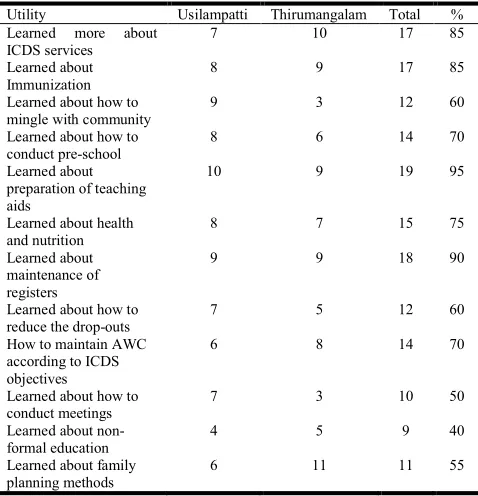
Table 1. Utility of the Training Programme
Utility Usilampatti Thirumangalam Total %
Learned more about ICDS services
7 10 17 85
Learned about Immunization
8 9 17 85
Learned about how to mingle with community
9 3 12 60
Learned about how to conduct pre-school
8 6 14 70
Learned about preparation of teaching aids
10 9 19 95
Learned about health and nutrition
8 7 15 75
Learned about maintenance of registers
9 9 18 90
Learned about how to reduce the drop-outs
7 5 12 60
How to maintain AWC according to ICDS objectives
6 8 14 70
Learned about how to conduct meetings
7 3 10 50
Learned about non-formal education
4 5 9 40
Learned about family planning methods
6 11 11 55
Regarding the orientation training, all the respondents attended for 3 months, except 14% of the respondents of Thirumangalam block, who told that they have attended 4 months training programme. When the respondents had been asked about the utility of the training programmes, majority (85%) of the respondents told that they have learned a lot about Immunization and ICDS programmes, 60 % of the respondents told that they learned about how to mingle or how to motivate the parents to send their children for pre-school. But all the respondents told that the meetings were very helpful for them in the day-to-day activities of their work. Table-2 validates the data regarding job responsibilities of the respondents. Though all the activities have been conducted at the Anganwadi, few of by them could not tell some of the responsibilities carried by them. According to the data, majority of the 90% of the respondents felt that conducting pre-school programme and distribution Supplementary Nutrition Food (SNF) and providing immunization to children and pregnant women as their major responsibilities. 55% of the respondents could tell that making home visits as their main responsibilities which is very important to identify
pre-school children, pregnant women and lactating mothers. A very negligible percent of respondents even felt that distribution of folic acid tablets, health check-up of children, organizing thrift programme, referral services etc as their responsibilities.
Table 2. Responsibilities of the AWW
Responsibilities Usilampatti Thirumangalam Total %
Giving Immunization to pregnant and children 0-6 years
10 8 18 90
Conducting pre-school programme
9 11 18 90
Giving health and nutrition education
8 6 14 70
SNF distribution 9 9 18 90
Mahila Mandal formation
2 3 5 25
Referral services 4 2 6 30
Making home visits 8 5 11 55
Conducting survey - 2 2 10
Motivating women to undergo tubectomy
1 2 3 15
Maintenance of registers 2 1 3 15
Organizing thrift programme
1 3 4 20
Distribution of folic acid tablets
1 1 2 10
Health check-up to children
1 1 2 10
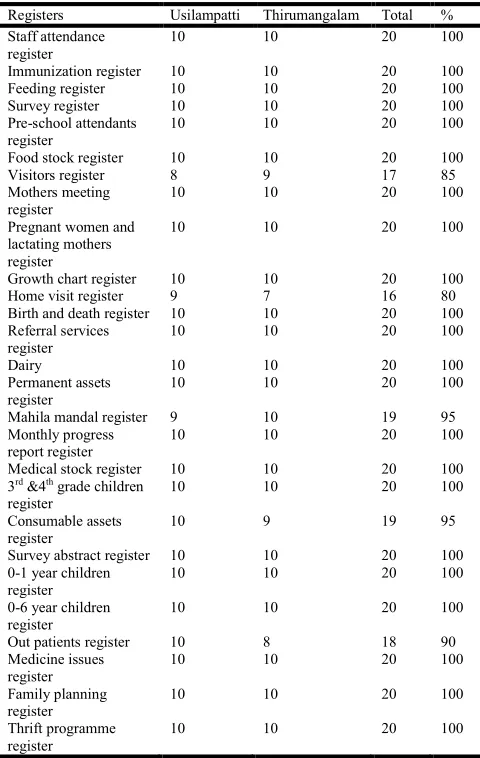
Table-2 validates the data regarding job responsibilities of the respondents. Though all the activities have been conducted at the Anganwadi, few of by them could not tell some of the responsibilities carried by them. According to the data, majority of the 90% of the respondents felt that conducting pre-school programme and distribution Supplementary Nutrition Food (SNF) and providing immunization to children and pregnant women as their major responsibilities. 55% of the respondents could tell that making home visits as their main responsibilities which is very important to identify pre-school children, pregnant women and lactating mothers. A very negligible percent of respondents even felt that distribution of folic acid tablets, health check-up of children, organizing thrift programme, referral services etc as their responsibilities. Maintenance of registers is also one of the primary duties of the AWWs. They told that all the AWWs of each project have to maintain the same registers. According to the instruction given by CDPO, AWWs were maintaining the register. It has been noted that staff attendance register, immunization register and feeding register etc were the registers, which had been maintained by all the AWWs in all the projects.
Antenatal Care
Table 3. Registers Maintaining by AWWs
Registers Usilampatti Thirumangalam Total %
Staff attendance register
10 10 20 100
Immunization register 10 10 20 100
Feeding register 10 10 20 100
Survey register 10 10 20 100
Pre-school attendants register
10 10 20 100
Food stock register 10 10 20 100
Visitors register 8 9 17 85
Mothers meeting register
10 10 20 100
Pregnant women and lactating mothers register
10 10 20 100
Growth chart register 10 10 20 100
Home visit register 9 7 16 80
Birth and death register 10 10 20 100
Referral services register
10 10 20 100
Dairy 10 10 20 100
Permanent assets register
10 10 20 100
Mahila mandal register 9 10 19 95
Monthly progress report register
10 10 20 100
Medical stock register 10 10 20 100
3rd
&4th
grade children register
10 10 20 100
Consumable assets register
10 9 19 95
Survey abstract register 10 10 20 100
0-1 year children register
10 10 20 100
0-6 year children register
10 10 20 100
Out patients register 10 8 18 90
Medicine issues register
10 10 20 100
Family planning register
10 10 20 100
Thrift programme register
10 10 20 100
Table 4. Source of Antenatal Care During Pregnancy
Place Usilampatti Thirumangalam Total %
Doctor 12 8 20 40
Health professional 7 11 18 37
ANC at Home 4 3 7 14
Not received 2 3 5 9
Total 25 25 50 100
Table- 4 shows that the percentage distribution of antenatal care recived by the respondents during the period of pregnancy. Allopathic doctors provided antenatal care for 40% of birth and other health professionals (such as nurse, midwives, ayurvedic doctors and homoeopathic doctors) provide care for 37% of births. Mothers received antenatal care only at home from a health worker for 14% of births, Those who received antenatal care outside the home whether or not they also receive care at home from a health worker. 9% of births were to mothers who did not receive any antenatal care.
Immunization
Immunization Means production of immunity either by introducing vaccine where body system has to take active part ot develop antibody. A body needs immunization to be free from attack of several diseases in future. Hence the provision
[image:4.612.317.544.125.184.2]of immunization services is the other important in built component of ICDS, safegurding the health of beneficiaries against preventable diseases like Tetanus, Tunerculosis, Poliomyelitis, Diphtheria, Whooping Cough and Measles.
Table 5. Tetanus Toxide Vaccination
Tetanus Toxoid Vaccine
Usilampatti Thirumangalam Total %
One dose 2 3 5 10
Two Dose 21 22 43 86
Not Received 2 - 2 4
Total 25 25 50 100
[image:4.612.319.540.345.394.2]Neonatal tetanus is caused by infection of the newborn with tetanus organism. Neonatal tetanus is most common when the delivery takes place in an unhygienic environment and nonsterilized instruments are used for cutting the umbilical cord. The distribution of birth by the number of tetanus toxide injuctions given to the mother according to selected background characteristics is shown in Table -5 Eighty six percent (86%)of births were given by mothers who had recived two or more doses of tetanus toxide vaccine,10% were to those who had recived one dose, and 4% were to those who did not receive even a single dose.
Table 6. Iron and Folic Acid Tablets
Iron and Folic Acid Tablets
Usilampatti Thirumangalam Total %
Yes 24 18 42 84
No 1 7 8 16
Total 25 25 50 100
[image:4.612.62.294.478.534.2]The size of a baby mother preparation for lactation and the iron and folate status of both the mother and the infant depend upon the mother’s nutritionl status at the time of conception as well as her diet during pregnancy. Proper maternal care is important for the healthy intrautrine growth of the baby and may affect the baby’s birth weight. The mother recived iron and folic acid tablets during each pregnancy resulting in a live birth. This information is presented in Table-6, 84% of birth were given by mothers who had received iron and folic acid tablets remining 16% of the respondents did not receive Iron and Folic Acid tablets.
Table 7. Health Problems during Pregnancy
Health problems Usilampatti Thirumangalam Total %
Anaemia 7 5 12 25
Swelling legs 3 4 7 3
Fever 1 2 3 6
Cough 2 1 3 6
Stomach pain - 1 1 2
BP - 1 1 2
Asthma - - - 1
Body pains 1 1 2 1
Pain during urination 2 2 4 2
Nothing 9 8 17 52
Total 25 25 50 100
[image:4.612.317.548.555.664.2]the respondents were suffering with anaemia, fever, cough, swelling of legs, stomach pain, high blood pressure, asthma, body pains and pain during urination etc, were the health problems for the remaining beneficiaries.
FINDINGS
Majority of the respondents told that they have learned a lot about Immunization and ICDS programmes, 60 % of the respondents told that they learned about how to mingle or how to motivate the parents to send their children for pre-school.
90% of the respondents felt that conducting pre-school programme and distribution Supplementary Nutrition Food (SNF) and providing immunization to children and pregnant women as their major responsibilities
All the AWWs of each project have to maintain the same registers. According to the instruction given by CDPO, AWWs were maintaining the register.
Eighty six percent (86%)of births were given by mothers who had recived two or more doses of tetanus toxide vaccine,10% were to those who had recived one dose, and 4% were to those who did not receive even a single dose.
25% of the respondents were suffering with anaemia, fever, cough, swelling of legs, stomach pain, high blood pressure, asthma, body pains, pain during urination etc, were the health problems for the remaining beneficiaries.
Conclusion
The root cause of under development and decreased productivity is poor nutritious and health status for any individual. Therefore it is imperative that he ICDS which was initiated with prime purpose of improving the nutritional health status of children and women should be continued. However the feedback indicates that there are several areas in the functioning of ICDS which needs to be strengthened.
REFERENCES
Bharat, S., Patkar, A. and Thomas, D. 2003. Mainstreaming Equity and Access into the Reproductive and Child
Health Program. London: Department for International
Development (DFID) Health Systems Resource Centre Claeson Mariam, Bos Eduard R., Mawji Tazim, Pathmanathan
Indra. 2000. “Reducing child mortality in India in the new millennium,” Bulletin of the World Health
Organization, 78(10): 1192-1199.
Defo, Barthélémy Kuate. 1997. “Effects of socioeconomic disadvantage and women's status on women's health in Cameroon.” Social Science & Medicine, 44(7):
1023-1042 21
Goswami, R. 2003. “A revolution in infant survival.” India
Together, October 2003. Accessed in August 2009 from
http://www.indiatogether.org/2003/oct/hlt-nodoctors.htm Heaton, T. B. and A. Y. Amoateng. 2007. “The family context for racial differences in child mortality in South Africa” in Amoateng, A.Y. & Heaton, T.B. (eds). Families and households in post-apartheid South Africa:
socio-demographic perspectives. Cape Town: HSRC Press
Kapoor, A.K. and Kshatriya, G.K. 2000. ‘Fertility and mortality differentials among selected tribal population groups of north-western and eastern India.’ Journal of
Biosocial Sciences, 32 (2): 253–264.
Sobha ,I.2003.”Welfare Services for Women and Children,
Discovery publishing house, New Delhi.
http://lalitreports.blogspot.co m/2004/12/korku-adivasis-in-melghat-region-of.html