© 2019, IRJET | Impact Factor value: 7.34 | ISO 9001:2008 Certified Journal
| Page 1365
Solar Tracer
Jesús Méndez Melo
1, Jonny Carmona Reyes
2, José Luis Hernández Corona
3,
Ernesto Mendoza Vázquez
41,2,3,4
Industrial Maintenance Engineering, Technological University of Tlaxcala, Highway to El Carmen
Xalpatlahuaya Huamantla, Tlaxcala, Mexico.
---***---Abstract - The purpose of this project is to design and build ofa solar tracer, which aims to verify its efficiency, capacity and performance.
Currently, it is found that most photovoltaic panels are placed in a single position, this is determined in an empirical way, because, the panels are positioned pointing to the place where the sun at a certain time of day emanates a greater amount of energy, these disadvantages in most of the designs of the panels' structures, led to the design and construction of a solar tracer that allows the photovoltaic panels to be maintained perpendicular to the position of the sun.
The structure of the tracer was made, for better use of solar energy, based on the measurements of the photovoltaic panel. A structure was built with the following dimensions: 1.20x.60 m. for greater stability, having a height of 60cm in the center of the base with a tilt of 60 µg per side, a bearing box was designed, the two bearings that have the system are joined by an arrow, performing rotation on the azimuthal axis, for rotation on the horizontal axis two soleras of 10cm were welded, each one in the center of the arrow and thus be able to place another one vertically, for the placement of the second arrow and the base of the photovoltaic panel.
Four sensors were placed, two on each axis, each LDR sensor is centered to obtain a better reception of the stimuli of sunlight.
The design of the electrical control was carried out with Arduino, it works with a system called by luminous point, because, programming is easier. The electric assembly of the solar tracker consists of two servo motors, making the movement on the indicated axes, and relays that function as a switch.
Key Words: 1- ARDUINO, (Hardware and software
platform).
1. INTRODUCTION
Solar energy in the form of electrons is so large that it can be harnessed for electric power generation, when hydrogen atoms combine to form heavier helium atoms. At the end of this transformation, one part becomes helium and another part disappears into luminous radiation. This luminous radiation is radiated by the Sun in all directions. Approximately 1000 Watts per square meter reach the Earth, enough to provide energy for all our needs.
Photovoltaic solar energy produces electricity through the visible light spectrum of the sun, through photovoltaic cells. When the solar rays hit the cell, an electron movement occurs which, by channeling them, produces electric current.
Photovoltaic cells are mostly made of silicon, cells are put together to form modules and panels that produce more electricity. These modules and panels are connected to form photovoltaic systems to achieve different electric power yields.
Solar energy is the cleanest, since it can be you used it does not cause pollution or adverse effects on the environment, such as noise and toxic emissions that generate other energy sources. Photovoltaic solar energy can be stored in batteries for using during the night and cloudy days. In systems without batteries connected to the grid, can provide excess energy produced in the day to the distribution lines.
Solar tracker
1. What is it?
A solar tracker is a mechanical device capable of orienting the solar panels so that they remain approximately perpendicular to the sun's rays, following the sun from east at dawn to west at dusk. Solar trackers are used in all solar tracking technologies: conventional photovoltaic solar energy, concentrating photovoltaic solar energy and concentrating solar thermal energy.
In other words, a solar tracker is a device that is inserted into a set of photovoltaic panels that are oriented towards the Sun to take advantage of its light and generate energy.
The idea is to be able to tilt the solar panels in the direction in which the sun moves throughout the day and therefore throughout the year as the seasons and climate change.
The use of solar trackers can increase electricity production by about 30% to 40% in some regions, compared to fixed solar panels. In any solar energy application, conversion efficiency is improved when modules are continuously adjusted to the angle of the sun as it moves in the sky.
2. Uses
© 2019, IRJET | Impact Factor value: 7.34 | ISO 9001:2008 Certified Journal
| Page 1366
supply electricity to places without connection to the generalelectricity grid.
3. Types of solar trackers
In two axes (2x): the surface is always perpendicular to the sun. There are two types:
Monopole: a single central support.
Carrousel: several supports distributed along a circular surface.
In a polar axis (1xp): the surface rotates on an axis oriented to the south and inclined an angle equal to the latitude. The rotation is adjusted so that the normal to the surface coincides at all times with the terrestrial meridian containing the sun. The rotational speed is 15° per hour, just like the clock.
In an azimuthal axis (1xa): the surface rotates on a vertical axis, the angle of the surface is constant and equal to the latitude. The rotation is adjusted so that the normal to the surface coincides at all times with the local meridian containing the sun. The speed of rotation is variable throughout the day.
On a horizontal axis (1xh): the surface rotates on a horizontal axis and oriented in a north-south direction. The rotation is adjusted so that the normal to the surface coincides at all times with the earth meridian containing the sun.
4. Solar tracker
The solar tracker works by using two photoreceptors on each axis of motion. These sensors capture solar radiation, so a difference between them on the same straight line will indicate that the sun is not located perpendicularly.
The intensity of the solar radiation captured by the sensors is not the same, since the sun is perpendicular to them.
By means of an electrical control system, this difference is translated into movement of the motors that regulate the position of the solar tracker.
When the solar intensity captured by the sensors is practically the same, the motors will stop and the solar tracker will be positioned in such a way that the sun will strike them perpendicularly.
2. DEVELOPMENT
Characteristics of the solar tracker
Mechanical design.
Previously it was explained the differences between the different types of solar trackers and based on that it was
decided that out of two axes because it is the one that offers better results, before being built the structure was designed in a 3D program (SolidWorks) which allows you to have the ability to integrate the design of your mechanical models of your project, you will allow to anticipate possible interference or errors in the assembly. You will no longer need to resort to a prototype to check the validity of your design.
Gauges
The sensors direct the panels or modules towards where the sun is. These devices change their orientation during the day to follow the path of the sun and maximize the energy that is captured.
In photovoltaic systems, sensors help minimize the angle of incidence, the angle a beam of light creates with a line perpendicular to the surface between the incoming light and the panel, which increases the amount of energy the system produces.
Solar photovoltaic concentrators and heat collectors are optically designed to directly accept sunlight, so solar sensors must be properly adjusted to collect energy. All solar concentrator systems have trackers to capture more solar energy.
The sensors used in this project are LDR
Because an LDR photoresistor is sensitive to the light it receives and offers greater or lesser resistance depending on the amount of light it receives. They are ideal sensors for lighting projects or any project that needs to control ambient light.
Characteristics:
Resistance (with light) : ~1k Ohm
Resistance (darkness): ~10k Ohm
Vmax : 150V
Dissipation: 100mW max
Dimensions:
Sensor dimensions: 2 x 4 x 5mm
Pin spacing: 4mm
Length of sideburns: 31mm
Platform occupies to carry out the programming.
© 2019, IRJET | Impact Factor value: 7.34 | ISO 9001:2008 Certified Journal
| Page 1367
The solar tracker designed is two-axis, azimuthal and [image:3.595.33.292.191.350.2]horizontal this to improve the process of the solar tracker, as this changes depending on the seasons of the year and that in each of them the sun changes position, once the number of axes has been decided, was determined the material with which to manufacture the solar tracker.
Table -1: Materials
Material Quantity Description Angle 6 M. 3/8
Servos motors 2 Pz Servomotor corona y sinfín.
Photovoltaic
panel 1 Pz Model: Dimension: LA361J48, 985x445x36mm
Gears 2 Pz 58 teeth, 5.6 in diameter Gears 2 Pz 27 teeth, 2 in diameter Bearings 2 Pz Bearing 6904 marca Koyo Solera 1 M 3/16”, 4.8mm
3. RESULTS
The structure of the tracer was made, for better use of solar energy, based on the measurements of the photovoltaic panel. A structure was built with the following dimensions: 1.20x.60 m. for greater stability, having a height of 60cm in the center of the base with a tilt of 60 µg per side, a bearing box was designed, the two bearings that have the system are joined by an arrow, performing rotation on the azimuthal axis, for rotation on the horizontal axis two soleras of 10cm were welded, each one in the center of the arrow and thus be able to place another one vertically, for the placement of the second arrow and the base of the photovoltaic panel, as shown in Figure 1.
Four sensors were placed, two on each axis, each LDR sensor is centered to obtain a better reception of the stimuli of sunlight.
Figure 1: solar tracer
To verify the efficiency of the solar tracker, tests were made with the photovoltaic panel, the positions in which the readings were taken are in 30°, and mounted on the tracker, the positions are to compare the different voltages obtained by the panel and check the production of electricity.
Data at 30° angle
Conermex one of the most important manufacturers and distributors of voltaic panels in Mexico recognizes that it is important to take into account the following concepts:
"The solar panels are oriented to the south" and "The panels must be inclined according to the latitude of the site". This with the aim of obtaining the maximum voltage of the photovoltaic panels.
The surface where the tests were carried out is flat, the direction is towards the south and the latitude of the place where the tests were carried out is 19,416.
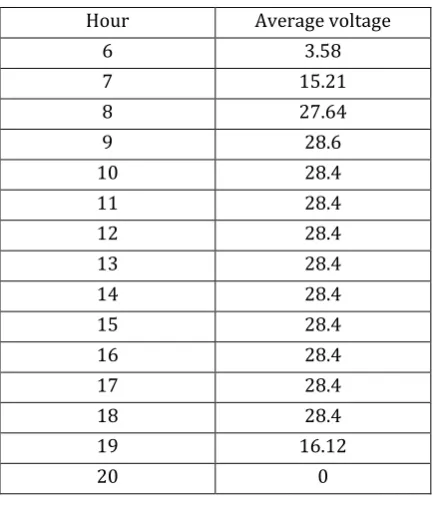
[image:3.595.324.545.387.645.2]For this test it was decided that the inclination out of 30° orients to the south since it is the one that reflects less loss of tension. The results obtained are shown in table 2:
Table -2: Inclination of 30°
Hour Average voltage
6 3.58
7 15.21
8 27.64
9 28.6
10 28.4
11 28.4
12 28.4
13 28.4
14 28.4
15 28.4
16 28.4
17 28.4
18 28.4
19 16.12
20 0
Data of the photovoltaic panel in the solar tracer.
This test verifies the efficiency of the solar tracker for electricity production, fixes the photovoltaic panel to the solar tracker.
[image:3.595.326.543.390.643.2]© 2019, IRJET | Impact Factor value: 7.34 | ISO 9001:2008 Certified Journal
| Page 1368
Table -3: Solar tracerHour Average voltage
6 2.54
7 41.4
8 41.4
9 41.4
10 41.4
11 41.4
12 41.4
13 41.4
14 41.4
15 41.4
16 41.4
17 41.4
18 41.4
19 32.7
20 0.9
3. CONCLUSIONS
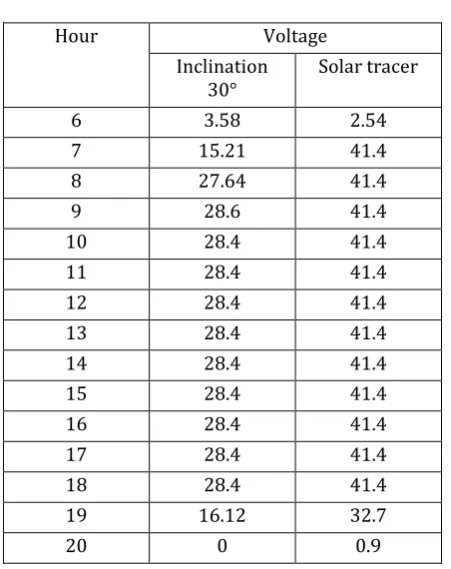
Obtained the results of all the positions, it is observed that the solar tracker in truth if it improves the production of electricity, table 4.
Table -4: Results
Hour Voltage
Inclination
30° Solar tracer
6 3.58 2.54
7 15.21 41.4
8 27.64 41.4
9 28.6 41.4
10 28.4 41.4
11 28.4 41.4
12 28.4 41.4
13 28.4 41.4
14 28.4 41.4
15 28.4 41.4
16 28.4 41.4
17 28.4 41.4
18 28.4 41.4
19 16.12 32.7
20 0 0.9
The production of electricity from the photovoltaic panel is better in a solar tracker because it improves by 33% over the inclination of 30°, we have to take into account that there are
technological alternatives available for the use of solar energy such as photovoltaic panels and solar tracers that can allow the diversification of energy sources.
4. REFERENCES
[1] A. Colmenar and O. Perpiñan, Design of photovoltaic systems. Version 1.2, April 2002
[2] Group new professional activities. photovoltaic solar energy, official college of telecommunications engineers, Ibergraphi 2002.
[3] PROGENSA. solar energy practical applications, sevilla (Spain), fifth edition 2009,
[4] Energías renovables: centro de investigación en energía. Universidad Autónoma de México, 2010.
5. BIOGRAPHIES
José Luis Hernández Corona Candidate for a PhD from the Autonomous University of Tlaxcala, Research Professor in the area of Industrial Maintenance, Desirable Profile before the PROMEP, responsible for the CA of Industrial Maintenance at the Technological University of Tlaxcala.
Ernesto Mendoza Vazquez teacher researcher of time complete in the Technological University of Tlaxcala as well as academic corps in industry maintenance.
[image:4.595.50.276.444.729.2]