Towards a Multilingual Financial Narrative Processing System
Mahmoud El-Haj
1, Paul Rayson
1, Paulo Alves
2, and Steven Young
31School of Computing and Communications, Lancaster University, UK 2Management School, Lancaster University, UK
3Universidade Católica Portuguesa, Portugal
{1m.el-haj, p.rayson}@lancaster.ac.uk,[email protected],[email protected]
Abstract
Large scale financial narrative processing for UK annual reports has only become possible in the last few years with our prior work on automatically understanding and extracting the structure of unstructured PDF glossy reports. This has levelled the playing field somewhat relative to US research where annual reports (10-K Forms) have a rigid structure imposed on them by legislation and are submitted in plain text format. The structure extraction is just the first step in a pipeline of analyses to examine disclosure quality and change over time relative to financial results. In this paper, we describe and evaluate the use of similar Information Extraction and Natural Language Processing methods for extraction and analysis of annual financial reports in a second language (Portuguese) in order to evaluate the applicability of our techniques in another national context (Portugal). Extraction accuracy varies between languages with English exceeding 95%. To further examine the robustness of our techniques, we apply the extraction methods on a comprehensive sample of annual reports published by UK and Portuguese non-financial firms between 2003 and 2015.
Keywords:Financial Narrative Processing, NLP, annual reports, Information Extraction, Multilingual
1.
Introduction
There are a number of different financial reporting require-ments and legislative frameworks for national and interna-tional companies in terms of how they must report to their shareholders, potential investors and the financial markets. Companies produce a variety of reports containing both textual and numerical information at various times dur-ing their financial year, includdur-ing annual financial reports, quarterly reports, preliminary earnings announcements and press releases. Additionally, conference calls with ana-lysts are transcribed and made available publicly, and other sources of information such as media articles and online social media are employed by companies, analysts and the general public. This creates a vast financial information en-vironment which can be impossible to keep track of. Previ-ous academic research in accounting and finance areas has tended to focus on numerical information, or small scale manual studies of textual information. Over the last few years, we have been able to contribute to the scaling up of the textual analysis component by applying Information Extraction (IE), Natural Language Processing (NLP) and Corpus Linguistics (CL) methods to the data. 1 have
fo-cussed on the UK context where annual financial reports are released in glossy PDF format with a variety of differ-ent looser structures, and these have made it harder to apply normal research methods on a large scale. In contrast, much of the previous research has been targetted at the US con-text where annual 10-K forms are required to follow a rigid structure with a standard set of headings, and are written in plain text. A standard format enables more straightfor-ward selection of relevant sections for further analysis. In this paper, we describe not only the structure detection and extraction process that we have designed and implemented for English annual reports, but also our initial work to ex-tend this research to another national context, in this case
1For more details, see the CFIE projects described at http://ucrel.lancs.ac.uk/cfie/
to Portugal. We report on our experiments to port the sys-tem from English annual reports to those published in Por-tuguese, and describe the adaptations made to the system to enable this. Our methods extract information on docu-ment structure which is needed to enable a clear distinc-tion between narrative and financial statement components of annual reports and between individual sections within the narratives component. The resulting software is made freely available for academic research.
2.
Related Work
In the natural language processing research area, previous research has been carried out to extract document structure mainly from scientific articles and books (Doucet et al., 2009; Teufel, 2010; McConnaughey et al., 2017). Other than this, there has been much recent work in using text mining and sentiment analysis, in particular to Twitter, with the goal of predicting stock market performance (Devitt and Ahmad, 2007; Schumaker, 2010; Im et al., 2013; Ferreira et al., 2014; Neuenschwander et al., 2014) although presum-ably any really successful methods would not be published. From the other end of the language analysis spectrum, in linguistics, there has been a large amount of research on the language of business communication. Merkl-Davies and Koller (2012) introduced the Critical Discourse Analysis (CDA) approach to the accounting community and showed how it can be used to systematically analyse corporate nar-rative documents to explore how grammatical devices can be used to obfuscate and guide interpretations. Brennan and Merkl-Davies (2013) considered communication choices and devices which contribute to the phenomena of impres-sion management, where individuals or companies use lan-guage to present themselves favourably to others.
3.
Dataset
In our work we focus on UK and Portuguese annual re-ports for large firms listed on the stock exchange market in each country. The number of UK annual reports exceeds 10,000 of mostly UK non-financial firms listed on the Lon-don Stock Exchange. The annual reports cover a period of years in the range 2003 and 2014. The extraction methods have been tested and evaluated on English annual reports and were later adapted to work with other languages. We collected 627 Portuguese annual for 77 firms for the period for the period 2006-2015. All firms are listed on the Por-tuguese Stock Exchange. The annual reports were collected automatically from Perfect Information2.
3.1.
Description of Dataset
We first start with explaining an annual report is. An an-nual report is an analysis and assessment of the financial trend of the business over the past year. An annual report consists of a description of the accounting activities seen within the report. For example, a description of the princi-ples used for determining the accounting items in both the income statement and the balance sheet. An annual report could also include information on the events that have in-fluenced the company’s accounting throughout the year, a statement from management showing an accurate picture of the company’s economic standing and development, and an auditor’s report.
It was not until legislation was enacted after the stock mar-ket crash in 1929 that the annual report became a regular component of corporate financial reporting. Typically, an annual report will contain the following sections:
• Financial Highlights
• Letter to the Shareholders
2
http://www.perfectinfo.com
• Narrative Text, Graphics and Photos
• Management’s Discussion and Analysis
• Financial Statements
• Notes to Financial Statements
• Auditor’s Report
• Summary Financial Data
• Corporate Information
Most of the published annual reports are in PDF file for-mat. The different variation of annual reports’ formatting makes it difficult to automatically extract relevant informa-tion or even detect the report’s structure. The annual reports vary in respect to their style and number of pages. In the US firms are required to disclose their annual reports by follow-ing and fillfollow-ing a preset template by the US Securities and Exchange Commission (SEC). This allows a standard struc-ture to be followed by each company making it easy to ex-tract information and easily detect structure. In contrast to the US, stock exchange-listed firms in UK and Portugal do not present their financial information and accompanying narratives in a standardised format when creating annual reports. Firms in the aforementioned countries have much more discretion regarding the structure and content of the annual report. Added to this is the problem of nomencla-ture: no standardised naming convention exists for different sections in UK annual reports so that even firms adopting the same underlying structure and content may use different terminology to describe the same section(s).
Table 3.1. shows the dataset size in words in addition to the number of reports for each language.
Language Reports Words English (UK) 11,009 300M Portuguese 396 7.50M
Table 1: Dataset Size
4.
Extraction Methods
4.1.
Structure Extraction Process
This section explains in details the steps and process needed to be able to detect the structure of the PDF annual reports of both UK and Portuguese datasets. The process was first applied to the 10,000 UK annual reports (Section 4.1.), we then applied the same process to the smaller Portuguese dataset.
As mentioned in Section none of the UK or Portuguese an-nual reports follow a standard reporting template as in the US Stock Exchange. Firms and management in the UK have more discretion when it comes to the the format, struc-ture and the contents of the annual reports. On the other hand the US Securities and Exchange Commission forces firms to follow a standard format and a pre–labeled annual reports template which they publish in HTML file format. This has helped in creating a reporting standard making it easy for investors, firms and analysts to access and ac-quire information automatically from a bulk of annual re-ports. This is different in the UK where firms tend to pub-lish their annual reports in PDF file format. Despite being cross-platform and a portable file format it is deemed a dif-ficult task to automatically extract information from PDF annual reports since companies’ reports vary significantly especially when it comes to the contents and the section headers. In order to automatically analyse a large dataset of UK annual reports we first needed to automatically detect the structure of the PDF annual reports so we can extract the information needed.
To detect and extract the structure of the annual reports each PDF file goes through the following five steps: 1) detect-ing the contents-page, 2) parsdetect-ing the detected contents-page and extracting the sections, 3) detecting page numbering, 4) adding the extracted sections to the annual report PDFs as bookmarks, and 5) using the added bookmarks to extract the narrative sections under each heading.
4.1.1. Detecting the Contents Page
An annual report contents page includes information about the main sections of the report and its associated page num-bers. Information in the contents page helped us detect the structure of the annual reports. However, detecting the con-tents page was not a straightforward task. We created a list of gold–standard section names extracted manually from the contents page of a random sample of 50 annual reports. We filtered the gold–standard keywords by removing dupli-cates and preserving the structure of how they appeared in the annual reports. We matched each page in the annual re-port against the list of section names in gold–standard, then we selected the page with the highest matching score as the
potentialcontents page. The score was calculated by an in-crement of 1 for each match. To improve the matching pro-cess and avoid false positives, we match the gold–standard keywords against lines of text that follow a contents–page– like style (e.g. a section name followed by a page number, such as “Governance Report 22”).
4.1.2. Parsing the Contents Page
In order to get the structure of the annual report we auto-matically parse the selected contents page by extracting the name of each section and its associated page number. To
do this we matched each line of text in the selected con-tents page against a regular expression commands that will extract any line starting or ending with a number between 1 and the number of pages of the annual report.
We built a simple filtering tool that filters out any block of text that matches our regular expression commands. This is done by removing text containing addresses, dates, and postal codes. The filtering tool can also detect email ad-dresses, websites, references to branches and locations us-ing regular expression commands and a gazetteer.
We differentiate between dates and actual page numbers to avoid extracting incorrect section headers. However, lines containing text such as an address (e.g., 23 Robert Avenue) might still be confusing for the tool. We tackled this prob-lem by matching the list of extracted sections against a list of gold–standard section synonyms which we explain in more details in Section 4.1.5..
The structure of the PDF files makes it difficult to extract text in its actual format. Extracting plain text from PDFs results in many line breaks being added in between the text. This makes extracting a section name that is split into two lines a difficult task. To tackle the problem of broken sections (i.e., appearing on two lines or more), we implemented an algorithm to detect broken section head-ers and fix them by concatenating lines that end or begin with prepositions such as ‘of’, ‘in’ ...etc. The algorithm also concatenates sentences ending with singular or plural possessives, symbolic and textual connectors (e.g. ‘and’, ‘or’, ‘&’...etc), and sentences ending with hyphenations. This method was also adapted to Portuguese prepositions and other stop-words needed to concatenate lines of text by forming a list of most common stop-words for each lan-guage.
4.1.3. Detecting Page Numbering
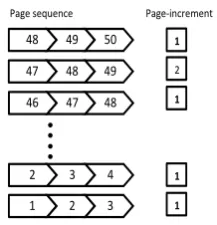
The page numbers appearing on the contents page do not usually match with the actual page numbers in the PDF files. For example, page 4 in the annual report could refer to page 6 in the PDF file, which may lead to incorrect extrac-tion3. We address this problem by creating a page detection tool that crawls through annual report pages taking three consecutive pages in each iteration. The tool aims to ex-tract a pattern of sequential numbers with an increment of 1 (e.g. 16, 17, 18) but with the complex structure of the PDF files this has been proven to be a difficult task. The tool starts by reading the contents three pages at a time starting from the report’s number of pages minus one. For example, assume we are trying to detect the page numbering pattern for a report of 51 pages. The tool starts by extracting text from pages 48, 49 and 50. A regular expression command is then used to extract all the numbers in each page contents that is made up of maximum three digits creating a vector of numbers for each page. Figure 1 shows a sample of 3 vectors for the pages 48, 49 and 50. As shown in Figure 1 the algorithm will only keep numbers that are within a range of 10 pages those linked with small double arrows. The algorithm will then try to form a pattern of sequential
3
numbers with an increment of 1. Figure 1 shows that the pattern 49, 50 and 51 (dark circles) has been found which is equivalent to a one page difference (page–increment) be-tween the reports page numbering and those found in the PDF file. The tool will repeat the same process for all the pages in the annual report until it reaches pages 1, 2 and 3 where it stops.
50 37
12
44
66
210
ϱϭ
14 21
41 48
ϰϵ
60
55
48
101 5 11 25
33
49 42
80
55
ϱϬ
14 7 107 26
[image:4.595.80.259.185.340.2]29
Figure 1: Detecting Page Numbering
47 48 49 48 49 50
1 2 3
46 47 48
2 3 4
Page‐increment
1
2
1
1
1 Page sequence
Figure 2: Popular Page Increment
As shown in Figure 2 for each 3 vectors the tool will store the page–increment in an array of numbers and at the end of the process the most popular (most frequent) page– increment will be selected as the difference between the an-nual report and the PDF numbering.
This process on the sample yielded an accuracy rate of more than 95%. Manual examination of the remaining less than 5% revealed the following reasons for non-detection:
• Encoding Error, unrecognised text
• Images or empty pages interrupting the sequence of pages
• Page numbers appeared on even or odd pages only
• Unusual numbering format (e.g. “001001001029” refers to page 29).
• Page numbers appeared in a written format (e.g. Twenty One)
• Page numbers restarted on each section
• Some pages had no page numbers available
• Every other page has two numbers (e.g. 26/27) with no numbers available on the next page
• Two pages on each PDF page
• Some other errors due to formatting
4.1.4. Adding Section Headers as Bookmarks
Using the sections and their correct page numbers from Sections 4.1.1. and 4.1.3. we implemented a tool to insert the extracted contents page sections as bookmarks (hyper-links) to sample PDFs. This process helped in extracting narratives associated with each section for further process-ing (see Section 4.1.5. below).
4.1.5. Extracting Sections’ Narratives
We implemented an automatic extraction algorithm to crawl through the data collection and, for each PDF file, extract all inserted bookmarks and their associated pages. Since UK firms do not follow a standard format when cre-ating annual reports, a long list of synonyms are possible for a single section header. For example the section header “Chairman’s Statement” may also appear as “Chairman’s Introduction”, “Chairman’s Report” or “Letter to Share-holders”. The same case applies to Portuguese as well. To solve this problem, we semi-automatically and by the help of experts in accounting and finance, created a list of syn-onyms for each of the generic annual report sections (see the list below). This was done by extracting all sections containing “Chairman”, “Introduction”, “Statement”, “Let-ter to”...etc from a sample of 250 annual reports of 50 UK firms (the quoted unigrams were selected by the same ex-perts). We refined the list by removing redundancies. The accounting experts then manually examined the list and deleted irrelevant or incorrect sections. We used the refined list as gold–standard synonyms to extract all the sections re-lated to each of our generic sections (e.g. all sections about the “Chairman’s Statement”). To overcome the problem of different word–order or additional words included in the headline (e.g. “The Statement of the Chairman”), we used
Levenshtein Distancestring metric algorithm (Levenshtein, 1966) to measure the difference between two sections. The Levenshtein distance between two words is the minimum number of single-character edits (insertion, deletion, sub-stitution) required to change one word into the other. To work on a sentence level we modified the algorithm to deal with words instead of characters. All the sections with a Levenshtein distance of up to five were presented to the ac-counting expert.
We used the above process to create gold–standard syn-onym lists for the following 8 generic section headers that we wished to extract for further analysis:
1. Chairman Statement
2. CEO Review
3. Corporate Government Report
[image:4.595.115.224.410.523.2]5. Business Review
6. Financial Review
7. Operating Review
8. Highlights
Having detected and extracted section headers (or their gold–standard synonyms) and their sections, we then ex-tract the sections’ narratives using iText4, an open source
library to manipulate and create PDF documents (Lowagie, 2010), to apply our text analysis metrics, which include readability measurement and counting word frequencies us-ing financial domain hand–crafted word lists.
5.
Extraction Tools
We used the extraction methods described in Section 4. to create publicly available web and desktop tools for users to automatically and freely analyse annual reports in different languages. The tools deal with multilingual annual reports of firms within the UK and Portugal written in either En-glish or Portuguese and distributed in PDF file format5. The tool is called CFIE-FRSE standing for Corporate Fi-nancial Information Environment (CFIE) -Final Report Structure Extractor (FRSE). The tool is available as a web application6or as desktop application, which is freely
avail-able on GitHub7. The tools detect the structure of annual
reports by detecting the key sections, their start and end pages in addition to the narrative contents. This works for both languages. The tools provide further analysis for re-ports written in English such as readability metrics, section classification and tone scores. This is because the tool was built to analyse UK annual reports where we have a large dataset to train the system to provide an extra level of anal-ysis.
The extra level of analysis will be made available for Por-tuguese at a later stage. For now we do not have enough reports for Portuguese to be able to train the system. As explained earlier the aim of this paper is to show that our extraction methods can be applied to a second language, a vital step towards fully analysing reports in other languages in the future.
6.
Multilingual Extraction
In this section we explain the process we followed to ex-tracting sections from annual reports in both English and Portuguese.
6.1.
English
As mentioned earlier the work was first designed to analyse UK English annual reports (El-Haj et al., 2014). We au-tomatically harvested more than 10,000 annual reports for firms listed on the London Stock Exchange (LSE). Prior to analysing the annual reports we first worked on sorting
4http://itextpdf.com/api
5
For now only the Desktop version of the tool can work with multilingual annual reports
6
https://cfie.lancaster.ac.uk:8443
7https://github.com/drelhaj/CFIE-FRSE
them by firm and we created our own unique report identi-fier which we called “LANCS_ID”. Sorting annual reports was done semi-automatically were we used a Java tool to match firm names and extract the reports’ years. This was followed by manual post editing to make sure the match-ing was correct. Firms without a match could be firms that do not exist anymore or firms with a new name due to merging with another firm, those had to be manually matched. PDF filenames do not contain a unique firm iden-tifier. For example, reports collected from Perfect Infor-mation use a standard naming convention comprising firm name and publication year. We use filenames as the basis for a fuzzy matching algorithm that pairs firm names ex-tracted from the PDF filename with firm names provided by Thomson Datastream. Matching on name is problem-atic because firms can change their name over the sample period. The matching procedure must therefore track name changes. To address this problem, we combine firm regis-tration numbers and archived names from the London Share Price Database with Datastream’s firm name archive in our fuzzy matching algorithm. For those cases where our algo-rithm fails to find a sufficiently reliable match, we perform a second round of matching by hand. Further details of the matching procedure, including a copy of the algorithm and a step-by-guide to implementing the matching procedure in SAS are available athttp//cfie.lancaster.ac. uk.8443/. Licensing restrictions prevent direct publica-tion of proprietary identifiers.
Annual report structures vary significantly across reporting regimes and therefore to make the initial development task feasible we focus on reports for a single reporting regime. We select the UK due to the LSE’s position as largest eq-uity market by capitalisation outside the US. The extraction process is nevertheless generic insofar as reports published in other reporting regimes and languages can be analysed by modifying the language- and regime-dependent aspects of our tool without editing the underlying Java source code. Further guidance will be provided in an online appendix, together with full technical details of our method, in due course.
Table 6.1. shows the structure detection and extraction ac-curacy for UK annual reports.
Number of downloaded annual reports 11,009 Number of reports analysed 10,820 % of correctly retrieved table of contents 98.28 % of correctly retrieved pages 95.00 % of correctly retrieved text from sections 95.00
Table 2: UK Annual Reports Analysis
of the following reasons:
1. The file does not allow the text to be extracted (image-based documents). This problem is more common in the early years of our sample (i.e. 2000-2005), as some of the annual reports were poor quality scanned files. Reports from the more recent years tend not to be of this type.
2. Reports with a table of contents that could not be read due to the limitation imposed by how the table was designed. For example where a table of contents is designed with numbers and text in two different columns, or where the table of contents is split into two pages which causes problems for the PDF library.
3. Absence of page numbers.
6.2.
Portuguese
The adaptation of our software to other languages must deal with problems that are both specific to the financial report-ing environment and to the language itself. As in most countries, Portuguese market regulations allow a certain degree of flexibility in relation to the content and struc-ture of the annual report8 and concerning a firm’s
gover-nance structure. For instance, the board of directors (or its equivalent) and the Fiscal Committee can adopt differ-ent structures and names. As an example, we detected 7 alternative titles for the CEO’s message, 12 different titles for the chairman’s letter and 35 alternatives for the audi-tor and related governance mechanisms. We believe that this will be a common problem across the different lan-guage implementations. The approach we adopted was to list all the alternatives, create a list of synonymous and as-sign a unique classification to each alternative. On the other hand, the language related issues are specific to each lan-guage. During the implementation of the Portuguese ver-sion, we identified several different problems. Firstly, the English language is one of the few western languages that does not use phonetic modifications of common characters, such as “À”, “Á”, “Ô, “” and “Ç”. These phonetic modi-fications are common in other languages and can also vary across countries. Secondly, Portuguese is a gender-based language, which increases the complexity in developing a list of stop-words to deal with the line breaking. One such example is the proposition “of”, which can be translated as “de”, “do”, “da”, “dos” and “das”, depending on the gen-der of the following word. Thirdly, Portugal signed the
8
The Companies Act (Código das Sociedades Comerciais) and Portuguese market regulations require a firm’s Annual Report to include, amongst other items a review of the firm’s activities, per-formance and financial position, a description of the main risks and uncertainties, financial risk management goals and policies, including details of hedging operations and risk exposures, a de-scription of subsequent events, the expected evolution of the firm and a proposed net income allocation and dividends. In addi-tion, firms are required to submit a Corporate Governance Report. Firms can opt to include this report in the Annual Report or to submit a separate document. Disclosure requirements are sum-marised in Circular sobre Contas Anuais – 9th February 2017.
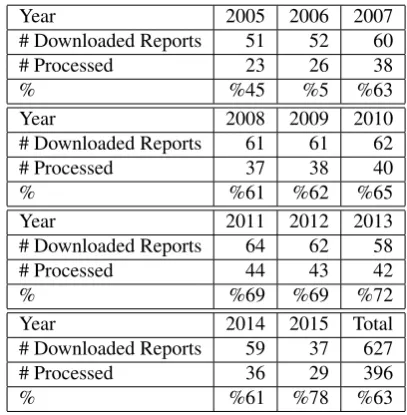
Portuguese Language Orthographic Agreement of 19909. This agreement changed the spelling of some words (e.g. the word “Accionistas”, is now spelt “Acionistas”,). It also allowed an alternative spelling for some words (e.g. the word “Sector” can also be spelt as “Setor”,). During the transition period, which ended in 2015, the adoption of the new spelling was voluntary and different firms used differ-ent spelling variations for some words. As a result, the al-gorithm must recognise all spelling variations. To test the adaption of the software to Portuguese Annual Reports, we retrieved from Perfect Information all annual reports pub-lished in Portuguese by firms listed on Euronext Lisbon for the period 2006 to 2015, totaling 627 reports for 77 firms (Table 6.2.).
Year 2005 2006 2007
# Downloaded Reports 51 52 60
# Processed 23 26 38
% %45 %5 %63
Year 2008 2009 2010
# Downloaded Reports 61 61 62
# Processed 37 38 40
% %61 %62 %65
Year 2011 2012 2013
# Downloaded Reports 64 62 58
# Processed 44 43 42
% %69 %69 %72
Year 2014 2015 Total
# Downloaded Reports 59 37 627
# Processed 36 29 396
[image:6.595.319.523.246.454.2]% %61 %78 %63
Table 3: Number of Reports Per Year
The software was able to process 396 reports (63%) of the annual reports. We then focused on understanding the rea-son for the non-processed reports and the accuracy of the processed reports. The software failed to process 231 re-ports:
• Table of contents does not exist: 62 reports
• Table of contents could not be detected: 52 reports
• Table of contents presented in an unconventional for-mat: 45 reports
• Table of contents without page numbers: 39 reports
• Table of contents with more than one page: 12 reports
• Image based file: 21 reports
The adaptation to Portuguese was based on 2 steps. We started by listing all table of contents entries for 67 ran-domly selected annual reports. This procedure produced a list of 2,053 entries that, after cleaning for errors and minor differences, included 694 different table of contents entries.
9
This variety reflects the lack of standardisation of the struc-ture of the annual report that is common to most countries. To deal with this problem, for the second step, we assigned each entry to a pre-defined section (Chairman, CEO, Per-formance, Auditor, Financial Statements and Other), which reflects the common structure of a Portuguese annual re-port at a very basic level. We also tested the accuracy of the adaptation to Portuguese by manually checking 100 an-nual reports processed and we concluded that the software performs with an accuracy comparable to the English im-plementation (Tables 6.1. and 6.2.).
7.
Conclusion
The methods reported in this paper demonstrate the adapt-ability of our extraction and classification procedures to non-English annual reports published in regulatory settings other than the UK, and we examine Portuguese reports in this paper. This adaptation was achieved by developing methods that are language independent where the extrac-tion process relies on the structure of the annual reports rather than the deep language characteristics. The meth-ods will still require dictionaries and word-lists to be in the same language as the annual reports but the extraction pro-cess remains the same across languages. The reported work paves the way for investors, firms and analysts to access and acquire information automatically from a large volume of annual reports in languages other than English.
8.
Acknowledgements
We acknowledge support for this research in three projects. The first Corporate Financial Information Environment (CFIE) project was funded (2012-14) by the Economic and Social Research Council (ESRC) (reference ES/J012394/1) and The Institute of Chartered Accountants in England and Wales (ICAEW). This work also continued in the Under-standing Corporate Communications sub-project funded as part of the ESRC Centre for Corpus Approaches to So-cial Science (CASS) (reference ES/K002155/1). Most re-cently, the research is funded under the new project which started in January 2018 Analysing Narrative Aspects of UK Preliminary Earnings Announcements and Annual Reports (reference ES/R003904/1).
9.
Bibliographical References
Brennan, N. M. and Merkl-Davies, D. M. (2013). Ac-counting narratives and impression management. InThe Routledge Companion to Communication in Accounting. Devitt, A. and Ahmad, K. (2007). Sentiment polarity iden-tification in financial news: A cohesion-based approach. InProceedings of the 45th Annual Meeting of the Asso-ciation of Computational Linguistics, pages 984–991. Doucet, A., Kazai, G., Dresevic, B., Uzelac, A., Radakovic,
B., and Todic, N. (2009). Icdar 2009 book structure ex-traction competition. InProceedings of the Tenth Inter-national Conference on Document Analysis and Recog-nition (ICDAR’2009), pages 1408–1412, Barcelona, Spain, July.
El-Haj, M., Rayson, P., Young, S., and Walker, M. (2014). Detecting document structure in a very large corpus of
UK financial reports. InProceedings of the Ninth Inter-national Conference on Language Resources and Eval-uation, LREC 2014, Reykjavik, Iceland, May 26-31, 2014., pages 1335–1338.
Ferreira, J. Z., Rodrigues, J., Cristo, M., and de Oliveira, D. F. (2014). Multi-entity polarity analysis in financial documents. InProceedings of the 20th Brazilian Sympo-sium on Multimedia and the Web, WebMedia ’14, pages 115–122, New York, NY, USA. ACM.
Im, T. L., San, P. W., On, C. K., Alfred, R., and Anthony, P. (2013). Analysing market sentiment in financial news using lexical approach. InOpen Systems (ICOS), 2013 IEEE Conference on, pages 145–149, Dec.
Levenshtein, V. I. (1966). Binary codes capable of correct-ing deletions, insertions, and reversals. Soviet Physics Doklady, 10(8):707–710.
Li, F. (2010). The information content of forward-looking statements in corporate filings—a naïve bayesian ma-chine learning approach. Journal of Accounting Re-search, 48(5):1049–1102.
Loughran, T. and McDonald, B. (2011). When Is a Liabil-ity Not a LiabilLiabil-ity? Textual Analysis, Dictionaries, and 10-Ks. The Journal of Finance, 66(1):35–65.
Loughran, T. and McDonald, B. (2016). Textual analy-sis in accounting and finance: A survey. Journal of Ac-counting Research, 54(4):1187–1230.
Lowagie, B. (2010). iText in Action. Covers iText 5. Man-ning Publications Company.
McConnaughey, L., Dai, J., and Bamman, D. (2017). The labeled segmentation of printed books. In Proceedings of the EMNLP 2017 conference.
Merkl-Davies, D. and Koller, V. (2012). ‘Metaphoring’ people out of this world: a critical discourse analysis of a chairman’s statement of a UK defence firm. Accounting Forum, 36(3):178–193, 9.
Neuenschwander, B., Pereira, A. C., Meira, W., and Bar-bosa, D. (2014). Sentiment analysis for streams of web data: A case study of Brazilian financial markets. In Pro-ceedings of the 20th Brazilian Symposium on Multimedia and the Web, WebMedia ’14, pages 167–170, New York, NY, USA. ACM.
Schleicher, T. and Walker, M. (2010). Bias in the tone of forward-looking narratives. Accounting and Business Research, 40(4):371–390.
Schumaker, R. P. (2010). An analysis of verbs in financial news articles and their impact on stock price. In Pro-ceedings of the NAACL HLT 2010 Workshop on Com-putational Linguistics in a World of Social Media, WSA ’10, pages 3–4, Stroudsburg, PA, USA. ACL.