© 2019, IRJET | Impact Factor value: 7.211 | ISO 9001:2008 Certified Journal
| Page 2656
EVALUATING THE PERFORMANCE OF PLANT BY OVERALL EQUIPMENT
EFFECTIVENESS & OVERALL RESOURCE EFFECTIVENESS: A CASE STUDY
Rahul Pandey, Dr. K Sridhar
M.Tech Scholar, Department of Mechanical Engineering, C.S.I.T. Durg
Professor, Department of Mechanical Engineering, C.S.I.T. Durg
---***---Abstract — In the highly competitive business environment, well run organizations continually strive to enhance
their capabilities to create excellent value for the customers by improving the cost effectiveness of the operations. Significant improvement has taken place in the management of resources associated with manufacturing systems, to reduce the wastage of resources. The Total Productive Maintenance (TPM) concept provides a quantitative metric-Overall Equipment Effectiveness (OEE), for measuring the effectiveness of equipment or a production line. In this project, a method is developed to evaluate Overall Resource Effectiveness (ORE) by including the factors known as readiness, changeover efficiency, availability of material and availability of manpower. ORE addresses various kinds of losses associated with manufacturing system, which can be targeted for initiating improvements. Further, a case study is presented for the evaluation of ORE in a manufacturing line. Also an attempt is made implement the concept of TPM, which resulted in the improvement of machine life & reduced the failure & breakdown due to various measures taken for maintenance. The study is conducted by collecting data from Hariom Industry, Bhilai.
Keywords— Overall Resource Effectiveness, Overall Equipment Effectiveness. Total Productive Maintanence.
I. INTRODUCTION
In the present highly competitive business environment, well run organizations continually strive to enhance their capabilities to create excellent value for the customers by improving the cost effectiveness of the operations. Significant improvement has taken place in the management of resources associated with manufacturing systems, to reduce the wastage of resources. The Total Productive Maintenance (TPM) concept provides a quantitative metric-Overall Equipment Effectiveness (OEE), for measuring the effectiveness of equipment or a production line. In this study, a method is developed to evaluate Overall Resource Effectiveness (ORE) by including the factors known as readiness, changeover efficiency, availability of material and availability of manpower. ORE addresses various kinds of losses associated with manufacturing system, which can be targeted for initiating improvements. Further, a case study is presented for the evaluation of ORE in a manufacturing line.
In today’s global and highly competitive environment, it is essential for the survival of any firm to be adaptive, price competitive, responsive and proactive and has the capability to deliver world class products according to diverse customer requirements. These challenges force companies to implement various Lean tools to meet the needs of the ever-changing market demand. To be a world class organization and to be stable in the global market, the firm does not have to operate worldwide or even nationwide. It may be a small local organization, which leads in its area/fields embraces and actively demonstrates to the characteristics of world-class performance. World class performance maintains, continued success through the development of an organizational environment that is distinctly different from peer and competitor firms in its philosophy and wealth-creating formula. A great number of companies find that in spite of huge improvements in productivity, there is still a bigger and better potential to utilize machine tools and reach better productivity goals. One of the main methods to meet these challenges is Total Productive Maintenance (TPM). After TPM implementation, it is necessary to monitor the overall effectiveness of the manufacturing system and benchmark it with the World class standard which will enable to continuously improve and become a World class organization.
© 2019, IRJET | Impact Factor value: 7.211 | ISO 9001:2008 Certified Journal
| Page 2657
“ORE” is an enhancement to the time honored “Overall Equipment Effectiveness” (OEE) developed back. After numerous implementations of the “OEE” philosophy in various manufacturing environments it became clear that it is not equipment alone that contributes to operational losses, but other resources and systems are at play. To transform the philosophy into a truly all-inclusive tool we must measure the human resource and planing and support systems as part of the equation. Understanding ORE is a learning experience and its use as a metric is achieved through actual time study measurements. To truly understand ORE an organization must go through the process of performing an ORE Study, analyzing the results and implementing improvements. Going through the process of sampling, analyzing, and creating an improvement roadmap will pay for the effort with knowledge gained.
II. LITERATURE REVIEW
Jamal Fattah et. al (2017) contributed to improve and evaluate the performance of a production line, by using the Overall Equipment Effectiveness (OEE) indicator. They proposed and implement an OEE improvement approach based on Best Manufacturing Practices (BMPs) and applied to a case study of a production line at a food company. Nofri Eka Candra et. al (2017) presented research to evaluate TPM implementation, as a case study at sheeter machine cut size line 5 finishing department, PT RAPP, Indonesia. In their research methodology data were collected for Overall Equipment Effectiveness (OEE) of sheeter machine and computed its scores.
Normariah Che Maideen et. al (2017) found Overall Equipment Effectiveness (OEE) is an important and reliable method that could be adopted in manufacturing environment. This method is significant to evaluate machines performance and later setting up goals for the industry to keep improving their performance. Nikunj A Patel et. Al (2016) focused on efficiency and effectiveness are buzzwords words in today’s competitive market. Greater the efficiency and effectiveness more productive is the organization. Number of management techniques has been developed over the years to manage the manufacturing. Waste of time, energy, money and overworked staff are common issues faced by manufacturing company.
Pradeep Kumar et. al (2014) found total productive maintenance is practical technique aimed at maximizing the effectiveness of facility that we use within our organization. Total productive maintenance establishes a system of productive maintenance, covering the entire life cycle of equipment, covers all departments, involves participation of all employees from top to bottom and promotes small group autonomous activities. A.P. Puvanasvaran (2013) highlighted on improvement of the Overall Equipment Efficiency (OEE) of the autoclave process through the implementation of time studies. Two types of time study are employed where the initial time study conducted was the direct stopwatch time study used to validate the current OEE standard. Maynard’s Operation Sequencing Technique (MOST) is then adopted to conduct the secondary time study. MOST study revealed the significant value added and non-value added activities at each sub process. MOST is used to evaluate the percentage of improvement contributed to the OEE.
V. Palanisamy et. al (2013) conducted a study and found that Overall equipment effectiveness (OEE) is a concept where the bottleneck operations of a particular process are reduced to certain extent. A pilot scale study is under taken in the product manufacturing industry and OEE concepts are implemented in the job floor. The three parameters such as availability, performance and quality of the process are taken up for this purpose. The OEE concepts were implemented in a periodic manner and continuous improvement in the job floor was monitored which proved some positive output.Rosario Domingo et. al (2013) presented a new metric for describing the sustainability improvements achieved, relative to the company’s initial situation, after implementing a lean and green. Manufacturing system. The final value of this metric is identified as the Overall Environmental Equipment Effectiveness (OEEE), which is used to analyze the evolution between two identified states of the Overall Equipment Effectiveness (OEE) and the sustainability together, and references, globally and individually, the production steps.
Soniya Parihar et. al (2012) studied and found that OEE measurement is also commonly used as a Key Performance Indicator (KPI) in conjunction with lean manufacturing efforts to provide an indicator of success. It quantifies how well a manufacturing unit performs relative to its designed capacity, during the periods when it is scheduled to run. It is a well known concept in maintenance and is a way of measuring the effectiveness of a machine which evaluates and indicates how effectively a manufacturing operation is utilized. Dal et al. (2000) describe that OEE appears so differently in various OEE literatures as to reveal what levels of Availability, Performance efficiency and Quality rate constitute acceptable levels of OEE. They illustrate that OEE achievement or the level setting is different across different business sectors and industries. All these studies reveal that OEE is used as an index for performance evaluation of a manufacturing system
III. METHODOLOGY
© 2019, IRJET | Impact Factor value: 7.211 | ISO 9001:2008 Certified Journal
| Page 2658
layout of the machines (processing equipments) as per the product routing. First, the raw material enters process-1, then process-2 and then proceeds till to the final process, through ‘n’ processes. Each process/manufacturing line utilizes the resources such as Man, Machine (includes Jigs and Fixtures and Gauges and Instruments), Material whose performance needs to be improved rather than concentrating only on machines.
Availability, Performance and Quality rate are the factors for calculation of Overall Equipment Effectiveness (OEE). This classification of losses includes all the down time events (equipment and process related) into one category and leads to the factor of availability, hampering the identification of losses in stratified manner. In addition to that, if planned down time is not taken into account in calculation of effectiveness which leads to excessively long planned activities. The next problem in OEE calculation is there is no separate metric or method to monitor the losses due to non-availability of manpower and material (components, sub-assemblies and WIP) which are also extremely important for effectiveness of a manufacturing system. The existing OEE factors are not sufficient for assessment of losses individually in a manufacturing system. Hence, an attempt has been made in this study to address the losses associated with manufacturing resources with separate metrics which enable the engineers and managers to initiate the improvement action on the specific metrics/losses.
Generally to evaluate a production unit, it is not an easy task to do so. Plant can be evaluated on the basis of various parameters. One of the best parameter to evaluate the plant is OEE & ORE. This two performance parameter will guide the higher authority to understand the issues related to production. The Problem can be described as:
1. To evaluate the performance of the plant considered under case study.
2. To identify the various types of losses in plant.
3. To suggest different remedies to overcome the losses in plant.
4. Also suggest maintenance to implement TPM
Following are the common gaps identified:
1. Plant evaluation is performed only by considering the input & output parameters of production process.
2. Analysis related to breakdown in machinery & maintenance is not yet performed by previous author.
3. Kind of maintenance to be opted is not yet suggested by the previous researcher.
4. Overall resource effectiveness (ORE) is one of the good parameter to evaluate the plant.ORE has not yet been
utilized by previous researcher to evaluate the plant.
5. Various type of loss occur in plant is not highlighted by previous authors.
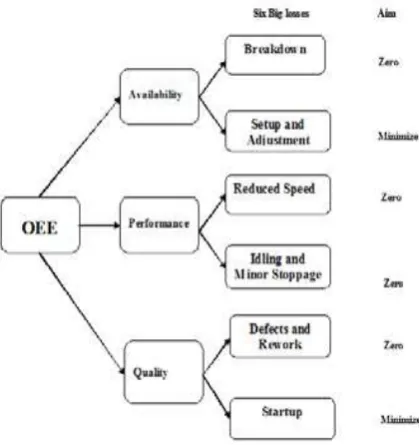
OEE breaks the performance of a manufacturing unit into three separate but measurable components: Availability, Performance, and Quality. Each component points to an aspect of the process that can be targeted for improvement. OEE may be applied to any individual Work Center, or rolled up to Department or Plant levels. This tool also allows for drilling down for very specific analysis, such as a particular Part Number, Shift, or any of several other parameters. It is unlikely that any manufacturing process can run at 100% OEE. Many manufacturers benchmark their industry to set a challenging target; 85% is not uncommon.
OEE is calculated with the formula (Availability)*(Performance)*(Quality)
1) Availability
The Availability portion of the OEE Metric represents the percentage of scheduled time that the operation is available to operate. The Availability Metric is a pure measurement of Uptime that is designed to exclude the effects of Quality,
Performance, and Scheduled Downtime Events. The losses due to wasted availability are called availability losses.[4]
2) Quality
The Quality portion of the OEE Metric represents the Good Units produced as a percentage of the Total Units Started. The Quality Metric is a pure measurement of Process Yield that is designed to exclude the effects of Availability and Performance. The losses due to defects and rework are called quality losses.
3) Performance and productivity
© 2019, IRJET | Impact Factor value: 7.211 | ISO 9001:2008 Certified Journal
| Page 2659
practice it is often difficult to determine speed losses, and a common approach is to merely assign the remaining unknown losses as speed losses.
[image:4.595.196.406.130.353.2]
Figure 1. Overall Equipment Effectiveness Model
Table 1: Calculation for OEE
Week Availability Performance Quality Rate (Q) OEE= Ax Px Q
1 0.69 0.76 0.88 45.91
2 0.69 0.79 0.90 49.41
3 0.67 0.76 0.88 44.78
4 0.66 0.79 0.82 42.66
5 0.74 0.76 0.82 46.28
6 0.72 0.81 0.87 50.82
7 0.71 0.77 0.90 49.22
8 0.67 0.79 0.83 44.34
9 0.64 0.81 0.89 46.12
10 0.62 0.74 0.87 40.20
11 0.67 0.74 0.86 42.53
12 0.66 0.79 0.85 44.16
Evaluation of Overall Resource Effectiveness (ORE)
The factors including new factors (Readiness, Availability of Facility, Changeover Efficiency, Availability of Material, Availability of Man power) and the inputs required for evaluation of ORE are presented below.
i. Readiness (R)
The “Readiness (R)” measure is concerned with the total time that the system is not ready for operation because of planned down time due to preparatory/ planned activities. Readiness indicates the ratio of planned production time to the total time available:
Planned production time
)
© 2019, IRJET | Impact Factor value: 7.211 | ISO 9001:2008 Certified Journal
| Page 2660
i. Preparatory work like cleaning, inspection of machine, initial part inspection, lubrication, tightening, Data
collection and updation
ii. Meeting, Audit, operator training
iii. Proto sample processing for R and D requirements, Process engineering study
ii. Availability of Facility (Af): The “Availability of Facility (Af)” measure is concerned with the total time that the system is not operating due to down time of facilities. It indicates the ratio of loading time to the planned production time:
)
Loading time = Planned production time-Facilities down time. Facilities down time include:
i. Down time of machine and its accessories.
ii. Non-availability of tools, jigs and fixtures.
iii. Non-availability of gauges and instruments, test rigs related to facility.
iii. Changeover Efficiency (C)
The Changeover Efficiency (C) measure is concerned with the total time that the system is not operating because of Set-up and adjustments. It indicates the ratio of operation time to the Loading time:
)
Operation time = Loading time-Set-up and adjustments. Set-up and adjustments include:
i. Changeover time of tools, dies, jigs and fixtures
ii. Minor adjustments after the changeover
iv. Availability of Material (Am)
In manufacturing scenario, sometimes, the raw materials, components, sub-assemblies are not available due to shortages and various other reasons. The “Availability of Material (Am)” measure is concerned with the total time that the system is not operating because of material shortages. It is the ratio of running time to the operation time.
)
Running time = Operation time-Material shortages. Material shortage includes:
• Non-availability of raw materials, consumables, parts and sub-assemblies
• Non-availability of WIP
v. Availability of Manpower (Amp)
In manufacturing system, sometimes, the operator/s may not be available at work station due to absenteeism, discussions. The “Availability of Manpower (Amp)” measure is concerned with the total time that the system is not operating because of absence of manpower. It is the ratio of Actual running time to the Running time:
)
Actual Running time = Running time - Manpower absence time. Man power absence includes:
• Permission, Leave and absenteeism • Discussion with supervisor, team leader
• Medical related
vi. Performance Efficiency (P)
The “Performance efficiency (P)” measures the total time that the operator how efficiently utilizes. It is the time earned in producing the product as against the actual running time. Performance efficiency is the ratio of Earned time to the Actual
running time. )
© 2019, IRJET | Impact Factor value: 7.211 | ISO 9001:2008 Certified Journal
| Page 2661
vii. Quality Rate (Q)
The “Quality rate” is the rate of quality products produced by the system. It is the ratio of Quantity of parts accepted to the Quantity of parts produced:
)
Quantity of parts accepted = Quantity produced-Quantity rejected. Overall Resource Effectiveness (ORE)
The “Overall Resource Effectiveness (ORE)” is the measureof overall effective time of the manufacturing system (resources). It is the product of Readiness (R), Availability of Facility (Af), Changeover Efficiency (C), Availability of Material (Am), Availability of Man power (Amp), Performance Efficiency (P) and Quality rate (Q).
Overall Resource Effectiveness (ORE) = Readiness (R) X Availability of Facility (Af) X Changeover Efficiency (C) X Availability of Material (Am) X Availability of Man power (Amp) X Performance Efficiency (P) X Quality rate (Q) X 100:
ORE = R × Af × C × Am × Amp × P × Q × 100
ORE will be much helpful to the decision maker for further analysis and continually improve the performance of the resources. This is used to identify the current status of manufacturing system and also for benchmarking the manufacturing effectiveness with the World class standard to become a World class organization.
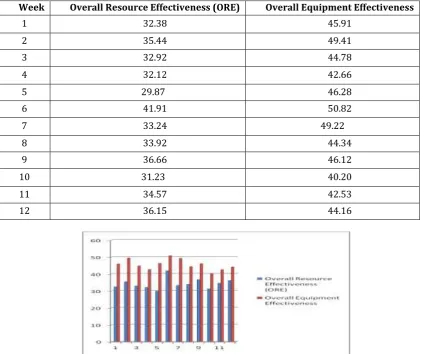
[image:6.595.88.513.391.752.2]A case-based approach is used to illustrate the proposed method of Overall Resource Effectiveness (ORE) calculation. A major product of a manufacturing company is considered for the study. The application of ORE and its factors within this environment is presented. In order to start the ORE measurement process, operational performance data collection for seven ORE variables viz., Readiness, Availability of Facility, Changeover Efficiency, Availability of Material, Availability of Man power, Performance Efficiency and Quality rate was carried out and presented in Table.
Table 2: Comparison of Overall Resource Effectiveness (ORE) & Overall Equipment Effectiveness
Week Overall Resource Effectiveness (ORE) Overall Equipment Effectiveness
1 32.38 45.91
2 35.44 49.41
3 32.92 44.78
4 32.12 42.66
5 29.87 46.28
6 41.91 50.82
7 33.24 49.22
8 33.92 44.34
9 36.66 46.12
10 31.23 40.20
11 34.57 42.53
12 36.15 44.16
[image:6.595.88.510.395.749.2]© 2019, IRJET | Impact Factor value: 7.211 | ISO 9001:2008 Certified Journal
| Page 2662
The Overall Equipment Effectiveness (OEE), Overall Resource Effectiveness (ORE) and their factors are calculated and tabulated in Table 4. The proposed method provides the complete information on various losses additionally in a stratified way to initiate appropriate action for improvement. The trend of various factors of ORE is very much useful for monitoring the losses on a continuous basis and base for further improvement.
OEE factors do not provide the planned production time losses with separate metric where there is scope for improvement. Readiness in ORE provides the losses on account of planned production time. OEE shows the mainly the uptime of machine, but ORE considers the whole facility like Machines, Tools, Jigs and Fixtures and Gauges and instruments.ORE shows the stratified lost time of Set-up and adjustments which can be improved by using SMED (Single Minute Exchange of Dies) concept. Many companies are facing the materials and component shortages. The factor Availability of Materials addresses the material shortage separately to initiate action on the external and internal suppliers. Operator leave and absenteeism is also addressed including small portion of absence due to discussion with supervisors and team leaders. Operators can be motivated to reduce leave and absenteeism. In addition to the above, action can be initiated for improvement of Performance Efficiency and Quality rate to enhance the ORE continually.
IV. CONCLUSION&FUTUREWORK
This study presents the developed Overall Resources Effectiveness methodology for performance measurement. The measurement of ORE leads to the focused improvement required to enhance the effectiveness of manufacturing system. ORE provides a useful guide to aspects of the production process where losses can be targeted which are created by the resources. In order to utilize the ORE measure effectively, it must be made convincing and possible to manufacturing environment. For this, the real effectiveness of the manufacturing system is calculated fully using the method developed and presented in this study. The effectiveness measurement using ORE is good enough to improve the effectiveness of resources. The results of the study show that the proposed method of ORE will be helpful for today’s organizations to initiate improvement activities towards enhancing the overall performance of resources by identifying the problem exactly (based on the proposed factors) and thus achieve business excellence by effective utilization of the available resources. Further, the metric ORE can be used as a benchmark at various levels to achieve world-class standard.
The study can be further improved by including some more parameter for evaluating the plant. Also type of maintenance requirement & preventive measures in different situation can be also analysed in further study.
REFERENCES
1. A.P. Puvanasvaran, C.Z. Mei, V.A. Alagendran “Overall Equipment Efficiency Improvement Using Time Study in an
Aerospace Industry” The Malaysian International Tribology Conference 2013, MITC2013. Procedia Engineering 68 ( 2013 ) 271 – 277.
2. Nikunj A Patel, Dilbag c Mondloe, DR G D Acharya “Study optimization of productivity through overall equipment
effectiveness (OEE) method - A REVIEW” International Journal of Advance Engineering and Research Development Volume 3, Issue 3, March -2016 @IJAERD-2016.
3. Jamal Fattah, Latifa Ezzine, Zineb Aman, Abdeslam Lachhab “Evaluating the performance of a production line by
the Overall Equipment Effectiveness: An approach based on Best Manufacturing Practices” Proceedings of the International Conference on Industrial Engineering and Operations Management Rabat, Morocco, April 11-13, 2017.
4. Nofri Eka Candra , Anita Susilawati, Herisiswanto, and Wahyu Setiady “Implementation of Total Productive
Maintenance (TPM) to Improve Sheeter Machine Performance” MATEC Web of Conferences 135, 00028 (2017) , ICME’17, DOI: 10.1051/matecconf/201713500028.
5. Pradeep Kumar, Raviraj Shetty, Lewlyn L.R. Rodrigues “Overall Equipment Efficiency and Productivity of a News
Paper Printing Machine of a Daily News Paper Company - A Case Study” International Journal of Engineering Practical Research (IJEPR) Volume 3 Issue 1, February 2014. doi: 10.14355/ijepr.2014.0301.04 20 .
6. Lenka Landryova and Iveta Zolotova “OEE Monitoring for Production Processes Based on SCADA/HMI Platform”
Landryova, L., Zolotova, I., 2007, in IFIP International Federation for Information Processing, Volume 246, Advances in Production Management Systems, eds. Olhager, J., Persson, F., (Boston: Springer), pp. 189-196.
7. Yunos bin Ngadiman, Dr. Burairah bin Hussin, Dr. Izaidin bin Abdul Majid “Exploring The Overall Equipment
Effectiveness (OEE) In An Industrial Manufacturing Plant” Proceedings The 2nd International Conference On Global Optimization and Its Applications 2013 (ICoGOIA2013) Avillion Legacy Melaka Hotel, Malaysia 28-29 August 2013.
8. V. Palanisamy and Jose Ananth Vino “Implementing Overall Equipment Effectiveness in a Process Industry” Indian
© 2019, IRJET | Impact Factor value: 7.211 | ISO 9001:2008 Certified Journal
| Page 2663
9. Normariah Che Maideen, Salina Budin , Shuib Sahudin, Hasnida Ab. Samat “Synthesizing the Machine’s Availability
in Overall Equipment Effectiveness (OEE)” Journal of Mechanical Engineering Vol SI 4(3), 89-99, 2017.
10. Rosario Domingo and Sergio Aguado “Overall Environmental Equipment Effectiveness as a Metric of a Lean and
Green Manufacturing System” sustainability, ISSN 2071-1050, www.mdpi.com/journal/sustainability.
11. Soniya Parihar, Sanjay Jain, Dr. Lokesh Bajpai “Calculation of OEE for an Assembly Process” International Journal
of Research in Mechanical Engineering & Technology, IJRMET Vol. 2, Issue 2, July - Dec 2012.
12. Sermin Elevli and Birol Elevli “Performance Measurement of Mining Equipments by Utilizing OEE” Acta
Montanistica Slovaca Rocník 15 (2010), císlo 2, 95-101.
13. Yunos bin Ngadiman, Dr. Burairah bin Hussin, Dr. Izaidin bin Abdul Majid “Exploring Overall Equipment Efficiency
Model of Laboratory Capital Equipments in Malaysian Public Universities” Proceedings of the 2011 International Conference on Industrial Engineering and Operations Management Kuala Lumpur, Malaysia, January 22 – 24, 2011.
14. Tomlingston, P.D.: Maintenance: An oppurtinity for improvement, Mining Engineering, February 2001,
page:13-20.
15. Nakajima S.: Introduction to TPM, Productivity Press, Cambridge, MA., 1988.
16. Jeong K. and Phillips D.T. “Operational Efficiency and Effectiveness Measurement”, International Journal of
Operations & Production Management, vol.21 no.11, p.g.1404, 2001.
17. Jonsson P. and Lesshammar M. “Evaluation and Improvement of Manufacturing Performance Measurement
Systems - The Role of OEE”, International Journal of Operations & Production Management, vol.19 iss.1, p.g. 55, 1999.
18. Prickett P. W. “An Integrated Approach to Autonomous Maintenance Management”, Integrated Manufacturing
Systems, vol.18 iss.5, p.g. 495, 1998.
19. Ljungberg O. “Measurement of Overall Equipment Effectiveness as a Basis for TPM Activities”, International
Journal of Operations & Production Management, vol.21 no.11, p.g. 1404, 2001.
20. Dal B., Tugwell P. and Greatbanks R. “Overall Equipment Effectiveness as a Measure of Operational Improvement-
A Practical Analysis”, International Journal of Operations & Production Management, vol.2 iss.12, p.g. 1488, 2000.
21. Bamber C.J., Castka P., Sharp J.M. and Motara Y. “Cross-functional Team Working for Overall Equipment
Effectiveness”, Journal of Quality in Maintenance Engineering, vol. 9 no.3, pg.223, 2003.
22. Nikunj S Patel and Chetan U Patel. Study and implementation of lean manufacturing tool5S. Journal of Technical