Function-as-a-Service Benchmarking Framework
Roland Pellegrini
1, Igor Ivkic
2,3and Markus Tauber
31Plan-B IT, Vienna, Austria 2Lancaster University, Lancaster, U.K.
3University of Applied Sciences Burgenland, Eisenstadt, Austria
[email protected], [email protected], [email protected]
Keywords: Cloud Computing, Function-as-a-Service, Benchmarking.
Abstract: Cloud Service Providers deliver their products in form of ”as-a-Service”, which are typically categorized by the level of abstraction. This approach hides the implementation details and shows only functionality to the user. However, the problem is that it is hard to measure the performance of Cloud services, because they behave like black boxes. Especially with Function-as-a-Service it is even more difficult because it completely hides server and infrastructure management from users by design. Cloud Service Prodivers usually restrict the maximum size of code, memory and runtime of Cloud Functions. Nevertheless, users need clarification if more ressources are needed to deliver services in high quality. In this regard, we present the architectural design of a new Function-as-a-Service benchmarking tool, which allows users to evaluate the performance of Cloud Functions. Furthermore, the capabilities of the framework are tested on an isolated platform with a specific workload. The results show that users are able to get insights into Function-as-a-Service environments. This, in turn, allows users to identify factors which may slow down or speed up the performance of Cloud Functions.
1
INTRODUCTION
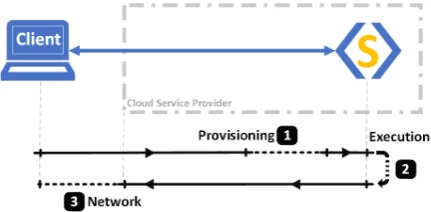
In the past, many benchmark tools have been devel-oped and characterized to evaluate the performance of hard- and software components (Berry et al., 1991). The standardization of those benchmark tools by or-ganizations such as Standard Performance Evaluation Corporation (SPEC, 2019) made it possible to ob-jectively assess single components or an entire sys-tem. Traditionally, computer benchmarks are mainly focused on performance qualities of computer sys-tems, which are under the direct control of the bench-marking program. Cloud service benchbench-marking, in contrast, is about IT benchmarking of software ser-vices where the underlying infrastructure is abstracted away (Bermbach et al., 2017). Nevertheless, it can not be avoided that Cloud services may become un-available, slow to respond, or limited with regards to resources such as memory, computing time, or max-imum number of requests. Therefore, Cloud Service Consumers (CSC) need a clear statement if a Cloud service fulfills its purpose with the existing resources or if additional Cloud resources are needed. Conse-quently, new methods for benchmarking and perfor-mance metrics for Cloud services must be taken into account. As shown in Figure 1, an external client calls
[image:1.595.309.525.592.698.2]a Cloud service (S), which is provided by a Cloud Ser-vice Provider (CSP). Since the client and Cloud ser-vice are geographically dispersed, a variety of perfor-mance issues can occur, which may be a compound result of many various causes. In this scenario, the re-quest may be delayed by service provisioning mech-anism (1) inside the CSP infrastructure, while code execution (2) of the Cloud Service itself, or by net-work delays (3) between CSP and the client. Since the Cloud infrastructure is hidden by design, the CSC is not able to identify the exact location of the root cause. As a result, the CSC can not get to the bottom of the issue in order to solve the problem as well as to prevent it in the future.
Function-as-a-Service (FaaS) is a relatively young technology in the field of Cloud Computing, which provides a platform for CSC to develop and run appli-cations without managing servers and providing low-level infrastructure resources. In a FaaS environment, applications are broken down into granular function units of scale, which are invoked through network protocols with explicitly specifed or externally trig-gered messages (Spillner, 2017). All functions are ex-ecuted in a fully-managed environment where a CSP handles the underlying infrastructure resources dy-namically and manages the runtime environment for code execution. The software development and ap-plication management remains with the CSC whereas the responsibility for running and maintaining the en-vironment shifts from the CSC to the CSP.
In recent years, a large number of commercial and Open-source FaaS platforms have been developed and deployed. Under the hood, all platform are hetero-geneous in nature, because they use different hard-ware and softhard-ware components, different runtime sys-tems and programming languages, routing gateways, resource management tools and monitoring systems. As an example, Malawski et al. (2017) points out that most platforms use Linux, but Azure functions run on Windows. With the rising popularity of FaaS, an in-creasing need to benchmark different aspects of FaaS platforms has been recognized by research and indus-try (Kuhlenkamp and Werner, 2018). However, the authors add that it remains challenging to efficiently identify a suitable benchmarking approach. They fur-thermore point out that there is a need for efficiently identifying the current state of the art of experiments, which validates FaaS platforms.
In this paper, we present a prototype of a frame-work for benchmarking FaaS, which takes Cloud Functions and the underlying environment into ac-count. We describe the architectual design, the com-ponents, and how they interact with each other. Typ-ically, benchmark tools are used to evaluate the per-formance of hard- or software components in terms of speed or bandwidth. However, we show how this benchmarking framework can also be used to iden-tify limitations and restrictions on top of the FaaS in-frastructure. This, in turn, helps CSC to identify if the overall performance of Cloud Functions and FaaS platform meets their business requirement.
The remainder of this paper is as follows: we pro-vide a summary of the related work in Section II, followed by a detailed description of the benchmark framework archictechture in Section III. Afterwards, we present our test scenario and the results in Section IV. Finally, we conclude our work with a short sum-mary and future work in Section V.
2
RELATED WORK
An initial introduction and guideline have been done by Bermbach et al. (2017) who are mainly interested in client-observable characteristics of Cloud Services. The authors cover all aspects of Cloud service bench-marking including motivation, benchbench-marking design and execution, and the use of the results. The au-thors point out that Cloud benchmarking is important as applications depends more and more on Cloud ser-vices. However, this work describes a general picture of Cloud benchmarking but does not focus on FaaS, in particular, and specific characteristics of this new Cloud Service.
Kuhlenkamp and Werner (2018) identify the need to benchmark different qualities and features of FaaS platforms and present a set of benchmarking ap-proaches. They present a preliminary results for a sys-tematic literature review in support of benchmarking FaaS platforms. The results show that no standardized and industry-wide Benchmark suite exists for measur-ing the performance and capabilities of FaaS imple-mentations. Their results indicate a lack of bench-marks that observe functions not in an isolated but in a shared environment of a Cloud Service.
Spillner et al. (2017) analyze several resource-intensive tasks in terms of comparing FaaS models with conventional monolithic algorithms. The au-thors conduct several experiments and compare the performance and other resource-related characteris-tics. The results demonstrate that solutions for sci-entific and high-performance computing can be re-alized by Cloud Functions. The authors mainly fo-cus on computing intensive tasks (e.g. face detec-tion, calculation ofπ, etc.) in the domain of scientific and high-performance computing but they do not take other FaaS qualities of interest into account. For ex-ample, FaaS environments offer a timeout parameter, which specifies the maximum time for code execu-tion. After this time, any code execution stops and the FaaS platform returns an error status. A timeout might become crucial when it comes to Cloud Func-tion pricing since CSC is charged for the entire time that the Cloud Function executes. Therefore, a lack of precision can lead to early and misleading time-outs during code execution, which, in turn, can end in uncompleted tasks and high costs.
and container discovery in detail. Furthermore, they propose useful metric to evalute the performance of serverless platform. The presented prototype and its internal architecture, in particular, helped us to design and implement the FaaS Benchmarking Framework.
Malawski et al. (2017) present an approach for performance evaluation of Cloud functions and take the heterogeneity aspects into account. For this pur-pose, the authors developed a framework with two suites of computing-intensive benchmarks for perfor-mance evaluation of Cloud functions. Their results show the heterogeneity of Cloud Function Providers, the relation between function size and performance and how providers interpret the resource allocation policies differently. The authors conclude that there is need of research that should analyse the impact of parallelism, delays, and warm-up on performance.
Lloyd et al. (2018) study the factors that influ-ence the performance of microservices provided by serverless platforms. In detail, the authors focus on infrastructure elasticity, load balancing, provisioning, infrastructure retention, and memory reservation. For this purpose, Lloyd et al. (2018) implement two ded-icated functions, which are executed on the platforms Azure Functions (Microsoft, 2019) and AWS Lambda (Amazon, 2019). This approach is useful when com-paring the performance of different FaaS platforms but it does not take the performance of business-related Cloud Functions into account. Therefore, the FaaS Benchmark Framework presented in this pa-per is able to benchmark Cloud Functions which are not specifically adapted for benchmarking. Instead, it is also applicable for performance evaluation of production-related Cloud Functions including the un-derlying FaaS platforms.
Hwang et al. (2016) present a generic Cloud Per-formance Model and provide a summary of useful Cloud Performance Metrics (CPM) on three levels: Basic performance metrics, Cloud capabilities, and Cloud productivity. The Basic performance metrics include traditional metrics such as execution time or speed. The Cloud capabilities describe through-put, bandwidth, and network latency. Finally, Cloud productivity deals with productivity metrics such as Quality of Service (QoS), Service Level Agreement (SLA) and security. The authors encourage the Cloud community to test Cloud capability in big-data ana-lytics and machine learning intelligence. In particu-lar, they argue that the Cloud community is short of benchmarking tests. In this regard, the authors moti-vated us to develop the FaaS Benchmarking Frame-work and to adapt existing tests for FaaS platforms. This includes also the analysis and feasibility of ap-propriate FaaS performance metrics.
Back and Andrikopoulos (2018) discuss the use of a microbenchmark in order to evaluate how dif-ferent FaaS solutions behave in terms of performance and cost. For this purpose, the authors develop a mi-crobenchmark in order to investigate the observable behavior with respect to the computer/memory rela-tion of different FaaS platforms, and the pricing mod-els currently being in use.
Mohanty et al. (2018) analyse the status of Open-source serverless computing frameworks Fis-sion (2019), Kubeless (2019) and OpenFaaS (2019). For this purpose, the authors evaluate the performance of the response time and ratio of successfully re-sponses under different loads. The results show that Kubeless has the most consistent performance across different scenarios. In constrast, the authors notice that OpenFaaS has the most flexible architecture with support for multiple container orchestrators.
Finally, the FaaS Benchmark Framework pre-sented in this paper is built upon a previous work of Pellegrini et al. (2018), who present an initial inves-tigation of benchmarking FaaS and outline the archi-tectural design. Pellegrini et al. (2018) present a two-tier architecture of a benchmarking framework where requests are invoked by a sender and processed by a Cloud Function on the CSP platform. This paper takes up the idea of previous research and introduces an additional third component that enables testers to evaluate the performance of the FaaS platform more precisely. Details about this third component and its improvements for benchmarking FaaS are discussed in Section III.
3
FaaS Benchmarking
FRAMEWORK
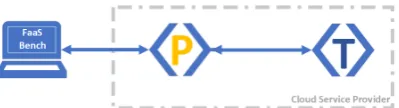
[image:3.595.317.517.643.697.2]The components of the FaaS Benchmarking Frame-work are shown in Figure 2. Basically, it consists of two software components, a Java-based application (FaaSBench) and a JavaScript-based Proxy Cloud Function (PCF). The FaaSBench is responsible to cre-ate and invoke workloads on the Target Cloud Func-tion (TCF) while the PCF collects benchmark relevant metrics of the TCF and the FaaS platform.
The following subsections provide a detail de-scription about the architecture of the FaaS Bench-mark Framework, the components involved and how they communicate and exchange data with each other.
3.1
Framework Architecture
As illustrated in Figure 2, the proposed architecture divides the intial request into two separate calls. The first call between FaaSBench and the PCF allows the measurement of transmission relevant metrics such as bandwith, byte size, or transfer rate. Since Cloud Functions are invoked over network protocols, laten-cies and delays during the data transmission can be easily identified. In contrast, the second call between PCF and TCF is used to measure benchmark relevant metrics on top of the FaaS platform. This includes not only the time measurement of compute-intensive tasks on top of the CSP’s infrastructure but also to measure the routing time for invocation calls the time needed for launching a new function instance, and the time a function instance stays active.
In addition, the proposed architecture supports a variety of implementation and application options. Since the PCF is under the control of the CSC, it can be easily adapted, modified, and extended with addi-tional benchmark-relevant profiling methods or log-ging functionalities without adapting the source code of the TCF. Furthermore, the PCF can decode and an-alyze the communication between any client and the TCF in both, production and test environments. For this purpose, the PCF can split, enrich and invoke new requests on-demand, if necessary. In summary, the in-troduction of the PCF allows the measurement of time and resource critical factors of Cloud Functions on top of FaaS platforms.
3.2
FaaSBench Application
The first component of the FaaS Benchmark Frame-work is a Java-based application named FaaSBench. This tool is responsible for generating workloads, in-voking requests, collecting metrics, and providing statistical reports. Since the FaaSBench application is written in Java, it can be installed on any client ma-chine which provides a Java runtime environment.
Technically, the FaaSBench application consists of a set of Java classes, which are grouped in three main packages. The first package, the Generator, con-sists of Java classes, which are responsible for execut-ing a set of benchmark tests by extractexecut-ing workloads from the properties. For this purpose, the Genera-tor supports different operations, which take techni-cal aspects and specific characteristics of FaaS
plat-forms into account. In the context of this paper, the following three types of operations have been im-plemented: first, if the workload focuses on peak performance evaluation, the Generator executes re-quests or in groups of batches, synchronously or asyn-cronously. Second, in order to test the responsive-ness of the FaaS environment, the Generator uses an operation with an automatic retry logic, which pro-gressively longer waits between the retries. This op-eration evaluates the time when functions need to be provisioned in as a short time span due to incomming requests. Finally, if the maximum time for Function code execution is crucial, the Generator executes an operation, which provokes a timeout error, either on the FaaS Gateway or on Cloud Function level. Typi-cal uses are therefore situations when it comes to re-source planing in terms of timing and accuracy.
The purpose of the second package, the Metrics, is three-fold: first, it records the status of each invoca-tion call. This logic helps to identify and distinguish successful invocation calls from unsuccessful or un-completed calls. Second, it records the responses of the TCF for the purpose of transparency and provid-ing proof of the correctness. Finally, the package also records all benchmark relevant performance metrics during each benchmark run. At the time of writing, the FaaS Benchmark Framework records only a set of well-established metrics. A detailed overview of all supported metrics are listed in Table 1, including a brief description and the measured units, expressed in milliseconds (ms), seconds (sec), or in bytes.
Table 1: Metrics provided by the FaaS Benchmarking Framework.
Finally, the Java-classes of the Reporting package provide different forms of presentation of the mea-sured values (e.g. total runtime, total byte size, etc.). The package generates a set of logfiles and comma-separated values (CSV) files, which can be processed by a various spreadsheet applications or command-line programs for data visualization.
3.3
Proxy Cloud Function (PCF)
Cloud Function, which is installed on a FaaS plat-form. From the viewpoint of a workflow, the PCF is placed between the FaaSBench application and the TCF. The PCF receives requests from the FaaSBench application and forwards them to the TCF. After-wards, it sends all responses of the TCF back to the FaaSBench application.
Since the PCF acts as an intermediary, it gains new opportunities and solutions by solving following problems efficiently:
1. The PCF is useful when any kind of modification of the testbed for benchmark-relevant profiling in-tegration is not allowed or possible. In addition, the PCF can be easily adapted and modified to meet very special requirements of the TCF. For example, a request can be split up and its data can be enriched with additional workflow-relevant in-formation at runtime. As a result, the PCF can be used not only in test environments but also in production-related environments.
2. The PCF is able to collect useful performance metrics of the FaaS environment itself. As an intermediary, the PCF is able to measure and evaluate the routing time of invocation calls, the throughput and the data transfer capabilities of the Cloud network inside the FaaS environment.
3. The PCF is useful when problems with clock syn-chronization between the FaaSBench and the TCF occur. Since the CSP dictates the system time for the FaaS platform, PCF and TCF can rely on this unifom time basis.
4. Multiple PCF instances can be installed in dif-ferent regions of the CSP. In terms of Google (2019), a region is defined as a geographical loca-tion where resources and services are hosted and executed. Running multiple PCF instances in dif-ferent regions can be helpful in choosing a loca-tion that is close to the service and has minimal network and transmission latency.
3.4
Target Cloud Function (TCF)
TCFs usually represent a set of Cloud Function, which are optimized for production environments. They are characterized by the fact that code modifi-cations for a benchmark-relevant profiling integration are not permitted or possible. Typical use-cases for productive TCF are data and event processing, server-side back-ends for mobile apps, or the orchestration of microservice workloads. The FaaS Benchmark Framework uses representative real-world workloads for performance evaluation of productive TCFs.
However, the FaaS Benchmark Framework also includes a set of non-productive TCFs. These func-tions include benchmark-relevant profiling methods and execute synthetical workloads, which take the unique characteristic of FaaS platforms into account. For example, a TCF may provoke a timeout errors when executing a long-running operation for deter-mining the behavior of the FaaS platform. Another non-productive TCF supports workloads for evaluat-ing the responsivness of FaaS platform by executevaluat-ing requests periodically with progressively longer waits between two requests.
By using productive and non-productive TCFs, the FaaS Benchmark Framework can be used in test and production-related environments without the need of implementing a complex testbed. Due to performance reasons, however, all non-productive TCFs do not log information to external logging tools. Instead, all benchmark-relevant data are kept in memory-based messages and distributed between the components of the FaaS Benchmarking Framework.
3.5
Communication Flow
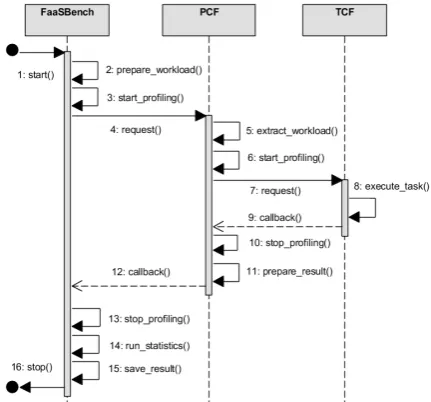
[image:5.595.308.524.416.617.2]The interaction between the FaaSBench, the PCF, and the TCF in sequential order as well as their corre-sponding method calls are shown in Figure 3.
Figure 3: Interaction between the components FaaSBench, PCF, and TCF.
internal profiling method (6), and invokes a separate request (7) to the TCF. After executing the requested task (8) and receiving (9) the result from the TCF, the PCF stops its internal profiling method (10), prepares the result message (11) and returns it back (12) to the FaaSBench application. Finally, the FaaSBench stops its internal profiling (13) as well, runs the statistical analysis (14) and saves the results locally (15). This also marks the end of the benchmark run (16).
3.6
Data exchange
FaaSBench, PCF, and TCF (if non-productive) use a common way to exchange workloads, data and log-ging information. Both components communicate with each other by using JSON-based (JavaScript Object Notation) messages, which contain self-describing data fields. Each field name starts with a prefix, which indicates the location of its origin. For example, the field ”proxy start time” refers to the in-ternal timer of the PCF, and only the PCF is able to create this field.
In order to evaluate the performance of a TCF for counting letters, the following example illustrates a JSON message used for the communication between FaasBench and the PCF.
{ "faasbench_workload_uuid": "112c338d", "target_uri": "https://faas:8080/func/word", "faasbench_workload_data":"F a a S" }
The request message is structured as follows: the field ”faasbench workload uuid” specifies the uni-versally unique identifier (UUID) for this request. This ensures uniqueness over the entire lifetime of the benchmark run. The field ”target uri” refers to the location of the TCF and instructs the PCF to forward this request to it. Finally, the key ”faas-bench workload data” contains the workload which has to be processed by the TCF. In the example above, the workload consists of a text with four (4) letters, which has to be counted by the TCF.
After the TCF has executed its task, the follow-ing sample response shows an extract of the JSON message created by the PCF and reported back to the FaaSBench application.
{ "proxy_workload_uuid": "112c338d", "target_start_time":1533675892375, "target_stop_time":1533675892401, "target_run_time_hr_seconds":0,
"target_run_time_hr_nanoseconds":26250589, "target_workload_result": "4" }
Each response message is structured as follows: The field ”proxy workload uuid” specifies the UUID of this response which must be identical to the
original UUID of ”faasbench workload uuid”, other-wise the workload will be marked as invalid. The fields ”target start time” and ”target stop time” refer to the start and stop time of the TCF. All time val-ues are representatives of the Long data type, and refer to the Unix Epoch Time (The Open Group, 2019). The fields ”target run time hr seconds” and ”target run time hr nanoseconds” refer to the time of TCF execution in high-resolution realtime of a [sec-ond, nanosecond] tuple array. Finally, the result of the function execution can be found in the field ”tar-get workload result”.
4
EVALUATION SCENARIO
The last section described the architecture of the FaaS Bechmark Framework. This section demonstrates how the framework is used on basis of a concrete ex-ample and discusses the results of the benchmark run.
4.1
Setup & Procedure
[image:6.595.312.520.623.708.2]The testbed is based upon the Open-source FaaS implementation OpenFaaS (2019), a framework for building serverless functions on top of containers. The testbed consists of a virtual machine (VM) run-ning Debian 9.1 with 4 GigaByte (GB) of memory al-located, which is deployed on a physical QNAP server with a quad-core Intel i5-4590S CPU @ 3.00 Giga-Hertz (GHz) and 16 GB of memory in total. This isolated testbed eliminates any effects of interference and perturberation that could affect the experiment. A PCF and a non-productive TCF, as discussed in Section 3.3 and 3.4, are deployed on the same VM. The experiment does not focus on performing high-performance computating tasks, which are preferably used in most researches. Instead, the proposed testbed allows the study of request and response messages on top of the FaaS platform. For this purpose, the TCF expects a text and answers immediately with the num-ber of words and letters in this text. In the context of the work, a word represents a character separated by at least one space from another character.
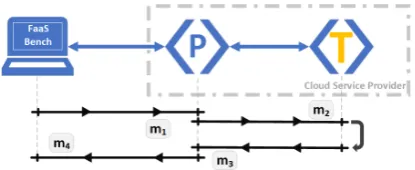
A schematic overview of the workflow is shown in Figure 4, illustrating four measurement points (m1, m2, m3, and m4) where HTTP traffic is decoded, stored, and prepared for further analysis.
The aim of the benchmark run is to evaluate the size of the Hyptertext Transfer Protocol (HTTP) quests/responses inside the FaaS environment in re-lation to the size of the workload. For this purpose, the benchmark run uses different workloads (10, 102, 103, 104, 105, and 106words). The first measurement point (m1) evaluates the size of the initial request, sent by FaaSBench. Measurement point m2 exam-ines the request size of the HTTP invocation for the TCF, while measurement point m3 evaluates the size of the reply message. Finally, measurement point m4 collects the size of the response message, returned by the PCF. In addition, more data such as runtimes or latencies are measured by FaaSBench, PCF, and TCF in order to identify variances and trends.
4.2
Results & Findings
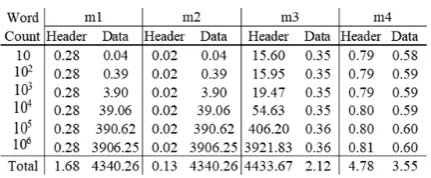
[image:7.595.74.290.461.550.2]Table 2 illustrates the collected measurement values for progressively increasing word count per row. Each column of the table refers to a measurement point (m1, m2, m3, m4) that evaluates the size of the HTTP message header (Header) and the message body data (Data) in Kilobyte (KB). Finally, the last row of the table summarizes the total size in KB.
Table 2: Size of HTTP messages per measurement point, all values in KB.
Measurement points m1, m2 and m3 report an in-crease of the size of message body data in sync with the payload, while the size of the message headers re-mains stable. However, measurement point m3 shows a completely different picture. While the size of the HTTP message body data increases slowly in sync with the result of the word count, the HTTP message header increases rapidly. Analyses of the logging data (see 3.6 for more details) demonstrate that the reason for the growth of the header is caused by the under-lying JavaScript runtime environment. In detail, the engine creates an internal message object, which con-tains the result of the function call but also the original workload data of the benchmark run. As a result, the
size of the HTTP message header increases in sync with the workload. This, in turn, may have impact to total runtime caused by the amount of time it takes for the HTTP response to travel from TCF to PCF.
In order to get a clear picture, Table 3 summarizes the effect to the transmission time in response to the HTTP requests and responses. The column ”Request (m2)” refers to the route PCF to TCF and represents the total byte size (in KB) of the HTTP requests and the transmission time (in ms) per HTTP request and word count. In contrast, the column ”Response (m3)” refers to the route TCF to PCF and represents the to-tal byte size (in KB) of the HTTP responses and the transmission time (in ms). The last row summarizes the total byte size of the HTTP requests/responses sent and their total runtimes.
Table 3: Time for transmission (in ms) of HTTP requests and responses (in KB) per measurement point m2 and m3.
As expected, the transmission times for HTTP re-sponses increases in sync with the word count but not in the same way as the transmission times for HTTP requests. The time values for HTTP requests range from 80 up to 107 ms, with a total runtime of 526 ms. However, the time values for HTTP responses range from 7 up to 9 ms, resulting in a total runtime of 46 ms. The results are even more surprising because the total byte size of HTTP requests are only slightly different from the total byte size of the correspond-ing HTTP responses. A possible explanation for this is the use of caching mechanism inside the Node.js (2019) runtime. However, a detailed examination of the reasons for this divergence is not in focus of this paper but offers opportunities for further research in this area.
4.3
Discussion
TCF and waits for the response. As an intermediary, it monitors the HTTP traffic and measures the byte size of outbound requests and inbound responses. This ap-proach allows CSC to compare the size of all inbound and outbound HTTP messages, which are handled by the FaaS environment. As demonstrated in the ex-periment, the FaaS Benchmarking Framework uncov-ers HTTP overhead while transmitting data inside the FaaS platform.
In this experiment, we have evaluated and ana-lyzed the size of the HTTP requests/responses in-side the FaaS environmnent in relation to the size of the workload. We have shown that the cascading of Cloud Functions generates an overhead in the HTTP message header with the potential of negative perfor-mance impacts for the runtime environment. How-ever, we have not evaluated critically the performance of the testbed. The reason for this is that most re-search, as discussed in Section 2, have evaluated and compared the performance of commercial and Open-source FaaS platform. Instead, we believe that the performance evaluation of a business-related Cloud Function with its underlying FaaS platform is a more reliable indicator for the CSC.
We encountered three issues while preparing and executing the experiment. First, we noticed that time synchronization becomes crucial when it comes to benchmarking, monitoring and realtime control of Cloud Functions as timestamps must by synchronized across multiple geographical regions, between differ-ent Cloud infrastructures, and clidiffer-ents. Second, we observed performance degradation caused by logging services of the FaaS platform. This is because logging requires additional resources that must be handled by the FaaS platform during the function’s execution. Fi-nally, we observed issues with performance isolation between the coresident PCF and TCF instances. The phenomenon with ”noisy neighbors” may be fixed by isolation through dedicated FaaS platforms or by moving workloads across physical servers. We there-fore encourage researchers to work jointly in devel-oping methods for dealing with these issues.
The proposed architecture has room for improve-ments. First, the FaaS Benchmark Framework has been tested with different sizes of workloads. How-ever, the limiting factor are not the number of re-quests or the size of workloads but computer mem-ory and network bandwidth. The FaaS Benchmark Framework code is not optimized for benchmark runs that exceed these limits. Second, the PCF does not provide any functionality to store a specific workload temporary on the FaaS Platform when re-using it for multiple runs. Finally, CSPs usually provide logging functionality which records detailed activities of the
FaaS Platform. Currently, FaaSBench and PCF are not able to retrieve logging data from FaaS platforms.
5
CONCLUSION
In this paper, we introduced a benchmarking frame-work for measuring the performance of Cloud Func-tions and FaaS environments. First, we explained the idea behind FaaS, its benefits for CSC and CSP, but also the challenges for benchmarking FaaS. Next, we explained the architecture of the framework, its com-ponents, and how they are linked together. Finally, in Section IV we prepared and executed a benchmark run executed on an isolated FaaS platform. The re-sults showed a growth of message sizes generated by the underlying runtime environment and identified the root cause. In summary, the main contribution of this paper is a FaaS Benchmarking Framework framework which allows performance evaluation of FaaS envi-ronments by a using proxy-based implementation.
The current version of the FaaS Benchmark Framework provides interesting insights of a FaaS en-vironment. Nevertheless, many experiments, adap-tations, and scientific intensification of knowledge in FaaS have been left for the future. First of all, we plan to migrate our project to OpenJDK (Ora-cle, 2019). Afterwards, we will make the soure code of the FaaS Benchmark Framework publicly avail-able. Furthermore, we plan to implement additional PCF and non-productive TCFs written in different programming languages and supporting more runtime environments. In addition, we plan to define new workloads, which are specially tailored to the fea-tures of FaaS enviromnents. For example, we want to examine how precisely a FaaS environment works in case of time controlling for code execution ver-sus billing. For this purpose, we plan to examine the timeout parameter of Cloud Functions, which speci-fies the maximum time for code execution. Inaccu-racies in the timing may lead to uncompleted tasks and high costs for CSCs. More workloads for high-performance computing will complete the portfolio.
ACKNOWLEDGEMENTS
The research has been carried out in the context of the project MIT 4.0 (FE02), funded by IWB-EFRE 2014-2020. The technical infrastructure needed for the research has been provided by Plan-B IT.
REFERENCES
Amazon (2019). AWS Lambda - Serverless Compute. https://aws.amazon.com/lambda/.
Back, T. and Andrikopoulos, V. (2018). Using a mi-crobenchmark to compare function as a service solu-tions. In European Conference on Service-Oriented and Cloud Computing, pages 146–160. Springer. Bermbach, D., Wittern, E., and Tai, S. (2017). Cloud
vice Benchmarking - Measuring Quality of Cloud Ser-vices from a Client Perspective. Springer, Berlin. Berry, M., Cybenko, G., and Larson, J. (1991).
Scien-tific benchmark characterizations. Parallel Comput-ing, 17(10-11):1173–1194.
Fission (2019). Serverless Functions for Kubernetes. https://fission.io/.
Google (2019). Regions and Zones. https://cloud. google.com/compute/docs/regions-zones/.
Hwang, K., Bai, X., Shi, Y., Li, M., Chen, W. G., and Wu, Y. (2016). Cloud Performance Modeling with Benchmark Evaluation of Elastic Scaling Strategies.
IEEE Transactions on Parallel and Distributed Sys-tems, 27(1):pages 130–143.
Kubeless (2019). The kibernetes native serverless frame-work. https://kubeless.io/.
Kuhlenkamp, J. and Werner, S. (2018). Benchmarking FaaS Platforms: Call for Community Participation. In2018 IEEE/ACM International Conference on Util-ity and Cloud Computing Companion (UCC Compan-ion), pages 189–194. IEEE.
Lloyd, W., Ramesh, S., Chinthalapati, S., Ly, L., and Pal-lickara, S. (2018). Serverless computing: An in-vestigation of factors influencing microservice perfor-mance. In2018 IEEE International Conference on Cloud Engineering (IC2E), pages 159–169. IEEE. Malawski, M., Figiela, K., Gajek, A., and Zima, A. (2017).
Benchmarking Heterogeneous Cloud Functions. In
Euro-Par 2017: Parallel Processing Workshops, Lec-ture Notes in Computer Science, pages 415–426. Springer.
McGrath, G. and Brenner, P. R. (2017). Serverless com-puting: Design, implementation, and performance. InDistributed Computing Systems Workshops (ICD-CSW), 2017 IEEE 37th International Conference on, pages 405–410. IEEE.
Microsoft (2019). Azure Functions – Serverless Architecture. https:// azure.microsoft.com/en-us/services/functions/.
Mohanty, S. K., Premsankar, G., and Di Francesco, M. (2018). An evaluation of open source serverless com-puting frameworks. In2018 IEEE International
Con-ference on Cloud Computing Technology and Science (CloudCom), pages 115–120. IEEE.
Node.js (2019). Node.js. https://nodejs.org/.
OpenFaaS (2019). OpenFaaS - Serverless Func-tions Made Simple for Docker & Kubernetes. https://github.com/openfaas/faas/.
Oracle (2019). Openjdk. http://openjdk.java.net/.
Pellegrini, R., Ivkic, I., and Tauber, M. (2018). To-wards a Security-Aware Benchmarking Framework for Function-as-a-Service. InCLOSER, pages 666– 669.
SPEC (2019). SPEC - Standard Performance Evaluation Corporation. https://www.spec.org/.
Spillner, J. (2017). Snafu: Function-as-a-Service (FaaS) Runtime Design and Implementation. arXiv preprint arXiv:1703.07562.
Spillner, J., Mateos, C., and Monge, D. A. (2017). FaaSter, Better, Cheaper: The Prospect of Serverless Scientific Computing and HPC. InHigh Performance Comput-ing, Communications in Computer and Information Science, pages 154–168. Springer, Cham.