A STUDY ON URBANIZATION IN NORTH EASTERN STATES OF INDIA
Department of Population Studies
ARTICLE INFO ABSTRACT
Background:
aspect. The concept of urbanization is the transformation process of the rural agricultural population who moved to lived cities and towns
(NE) States of India comprises of seven states namely Assam, Arunachal PradeshNagaland and Tripura., Manipur, Meghalaya, Mizoram,
Objective :
understand the state wise comparison of percentage of urban population and growth rate .
Methodology:
publications of Directorate of Census Operations Registrar General serial, India New Delhi. The data were collected for the period 1951
Findings:
which increased to 82,16,089 (18.26 percent of total population) in 2011.During the early period i.e 1951-1961 the decadal growth rate of urban population of NE region was incr
percent and after that the decadal growth rate of urban population declined abruptly to 67.44 percent in 1961-71 and finally it touched at 37.58 percent in 2011 census year. In regard to both decadal growth rate and average annual exponenti
decades were as high as compared to all India figures. The percentage of urban population to the population in NE region is increasing over the census years, but still low than the national’s figures
Conclusion:
very slow basically due to its location and infrastructural problems. Development of secondary sectors also not up to the mark in this region resulted i
INTRODUCTION
Urbanization is an index of transformation from traditional rural economic to modern industrial one. It is progressive concentration (Davis, 1965) of population in rural unit. Quantification of urbanization is very difficult. It is a long terms process. Kingsley Davis has explained urbanization as process (Davis, 1962) of switch from spread out pattern of human settlement to one of concentration in urban centers. It is a finite process --- a cycle through which a nation pass they evolve from agrarian to industrial society (Davis and Golden, 1954). He has mentioned three stages in the process of urbanization. Stage one is the initial stage characterized by rural traditional society with predominance in agriculture and dispersed pattern of settlement. Stage tw
acceleration stage where basic restructuring of the economy and investments in social overhead capitals including transportation, communication take place. Proportion of urban population gradually increases from 25 % to 40 %, 50 %, 60 % and so on. Dependence on primary sector gradually dwindles. Third stage is known as terminal stage where urban population exceeds 70 % or more. At these stage
*Corresponding author: [email protected]
ISSN: 0975-833X
Available online at http://www.journalcra.com
International Journal of Current Research
Vol.
Article History:
Received 10th
July, 2012 Received in revised form 21thAugust, 2012 Accepted 19th
September, 2012 Published online 30th October, 2012
Key words: Urbanization, Exponential Growth, Decadal Growth, Census Operation
RESEARCH ARTICLE
A STUDY ON URBANIZATION IN NORTH EASTERN STATES OF INDIA
*Dr. Kh. Bimolata Devi
of Population Studies, Annamalai University, Annamalai Nagar, Tamilnadu, 608002
ABSTRACT
Background: In the process of development of any nation or state, urbanization is an important aspect. The concept of urbanization is the transformation process of the rural agricultural population who moved to lived cities and towns and became an urban non-agricultural population. North East (NE) States of India comprises of seven states namely Assam, Arunachal PradeshNagaland and Tripura., Manipur, Meghalaya, Mizoram,
Objective :To study the levels and trends of urbanization in North Eastern Region of India and to understand the state wise comparison of percentage of urban population and growth rate .
Methodology: The present study is based on secondary data collected from various census publications of Directorate of Census Operations Registrar General serial, India New Delhi. The data were collected for the period 1951-2011 taking into account the various census years
Findings: In 1951 the urban population of NE region was 4,59,874 (4.48 percent of total population) which increased to 82,16,089 (18.26 percent of total population) in 2011.During the early period i.e
1961 the decadal growth rate of urban population of NE region was incr
percent and after that the decadal growth rate of urban population declined abruptly to 67.44 percent 71 and finally it touched at 37.58 percent in 2011 census year. In regard to both decadal growth rate and average annual exponential growth rate of urban population NE region for all the decades were as high as compared to all India figures. The percentage of urban population to the population in NE region is increasing over the census years, but still low than the national’s figures
Conclusion:Itcan be concluded that the overall process of urbanization in agro
very slow basically due to its location and infrastructural problems. Development of secondary sectors also not up to the mark in this region resulted in heavy dependence on agriculture sector.
Copy Right, IJCR, 2012, Academic Journals
Urbanization is an index of transformation from traditional rural economic to modern industrial one. It is progressive concentration (Davis, 1965) of population in rural unit. Quantification of urbanization is very difficult. It is a long ngsley Davis has explained urbanization as process (Davis, 1962) of switch from spread out pattern of human settlement to one of concentration in urban centers. It a cycle through which a nation pass they ustrial society (Davis and Golden, 1954). He has mentioned three stages in the process of urbanization. Stage one is the initial stage characterized by rural traditional society with predominance in agriculture and dispersed pattern of settlement. Stage two refers to acceleration stage where basic restructuring of the economy and investments in social overhead capitals including transportation, communication take place. Proportion of urban population gradually increases from 25 % to 40 %, 50 on. Dependence on primary sector gradually dwindles. Third stage is known as terminal stage where urban stage levels of
urbanization ( Davis, 1965) remain
constant. Rate of growth of urban population and total population becomes same at this terminal stage.
growth rate of population growth, a major problems facing most of the developing countries like India, it’s the rapid growth rate of urban population. Even though, the level of urbanization is low especially in North East (NE) region of India. North East region is a geographical unity lying north eastern corner of India surrounded by
linked a narrow corridor with the rest of the country. It comprises of seven states namely Assam, Arunachal Pradesh, Manipur, Meghalaya, Mizoram, Nagaland and Tripura. The total geographical area of NE region is 2, 53,089 Sq km. (7.76 percent of country's geographical area). Although NE has vast natural resources and is a rich source of flora and fauna, backward economic and infrastructural facilities and other location, physical, socio economic, political barriers considerably limited the development of this small area since Independent. As per the latest 2011 census the population of NE region recorded at 4,49,80,795 (3.7 percent to the population of the country) and the density of this region is very low i,e 176 per Sq Km of area
figure of 382 persons.
Available online at http://www.journalcra.com
ternational Journal of Current Research
Vol. 4, Issue, 10, pp.272-276, October, 2012
INTERNATIONAL
OF CURRENT RESEARCH
A STUDY ON URBANIZATION IN NORTH EASTERN STATES OF INDIA
Tamilnadu, 608002
the process of development of any nation or state, urbanization is an important aspect. The concept of urbanization is the transformation process of the rural agricultural population agricultural population. North East (NE) States of India comprises of seven states namely Assam, Arunachal PradeshNagaland and
To study the levels and trends of urbanization in North Eastern Region of India and to understand the state wise comparison of percentage of urban population and growth rate . on secondary data collected from various census publications of Directorate of Census Operations Registrar General serial, India New Delhi. The data
2011 taking into account the various census years.
e urban population of NE region was 4,59,874 (4.48 percent of total population) which increased to 82,16,089 (18.26 percent of total population) in 2011.During the early period i.e 1961 the decadal growth rate of urban population of NE region was increased by 139.83 percent and after that the decadal growth rate of urban population declined abruptly to 67.44 percent 71 and finally it touched at 37.58 percent in 2011 census year. In regard to both decadal al growth rate of urban population NE region for all the decades were as high as compared to all India figures. The percentage of urban population to the population in NE region is increasing over the census years, but still low than the national’s figures. can be concluded that the overall process of urbanization in agro -based North East is very slow basically due to its location and infrastructural problems. Development of secondary
n heavy dependence on agriculture sector.
, Academic Journals. All rights reserved.
more or less same or constant. Rate of growth of urban population and total population becomes same at this terminal stage. The high growth rate of population growth, a major problems facing countries like India, it’s the rapid growth rate of urban population. Even though, the level of urbanization is low especially in North East (NE) region of India. North East region is a geographical unity lying north eastern corner of India surrounded by four foreign countries linked a narrow corridor with the rest of the country. It comprises of seven states namely Assam, Arunachal Pradesh, Manipur, Meghalaya, Mizoram, Nagaland and Tripura. The total geographical area of NE region is 2, 53,089 Sq km. 6 percent of country's geographical area). Although NE has vast natural resources and is a rich source of flora and fauna, backward economic and infrastructural facilities and other location, physical, socio economic, political barriers d the development of this small area since Independent. As per the latest 2011 census the population of NE region recorded at 4,49,80,795 (3.7 percent to the population of the country) and the density of this region is very low i,e 176 per Sq Km of area as compared to India’s INTERNATIONAL JOURNAL
Objectives
The prime objective of present study:
• To study the levels and trends of urbanization in North Eastern Region of India.
• To understand the state wise comparison of percentage of urban population and growth rate.
METHODOLOGY
The present study covers the entire North Eastern Region comprising of seven states namely Assam, Meghalaya, Manipur, Mizoram, Nagaland, Tripura and Arunachal Pradesh. The data for the present study is based on secondary data collected from various census publications of Directorate of Census Operations, Registrar General serial, India New Delhi. The data were collected for the period 1951-2011 taking into account the various census years. But data relating to some aspects were not available as such, hence analysis of these aspects were made on the basis of available information. Moreover, on some aspects data relating to 2011 census, years were not available due to non completion of reports. As and when necessary comparative tables were made with all India level figures for understanding of the problem. Whereas in case of Arunachal Pradesh data could be available from 1961, onwards as up 1951, census could not held in the state.
RESULTS AND DISCUSSION
Although a vast majority of people in India live in rural areas, the urban population increasing day by day. It is useful
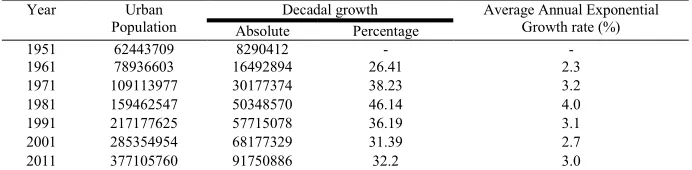
to make a distinction between rural and urban population as the village and urban life differs significantly. Table No. 1and 2 shows the trend of growth of urban population, decadal growth and exponential growth rate of urban population in North East region and India, separately over the various census years. In 1951 the urban population NE region was 4,59,874 (4.48) percent of total population which increased to 82, 16, 089 (18.26 percent of total population) in 2011 census year. This indicates that as per the latest figures of 2011, census, only 18.26 percent of the total population of NE region resided in urban areas against India’s figure of 31.17 percent in 2011 census year. During the early period that is 1951-61, the decadal growth rate of urban population of NE region was increased by 139.83 percent and after that the decadal growth rate of urban population declined abruptly to 67.44 percent in 1961-71 and finally touched at 37.58 percent in 2011 census. At the early part of the study period (1951-61) the NE region recorded a heavy growth of population which ultimately resulted the rapid growth of urban population and this was mainly because of influx of migrant population immediately after the partition of the country. But by the time due to extreme remoteness and emergence of various other communication problems growth rate of urbanization declined severely in successive periods of the study period. Primary sector still dominates the region’s economy as a result rate of formation of urban centers was also quite low. A comparative picture with all India figures in regard to decadal and average annual
[image:2.612.143.474.375.584.2]exponential growth rates of urban population could be highlighted from tables 1 and 2. It was seen that decadal growth rate of urban population in NE region for all the decades were as high as compared to all India’s figures. It
Table No: 1. Growth of Urban Population in North East - (1951- 2011)
Year Urban Population
Decadal growth Average Annual Exponential Growth rate (%) Absolute Percentage
1951 459874 - - -
1961 1102899 643025 139.83 8.7
1971 1846685 743786 67.44 5.2
1981 2908213 1061528 57.48 4.5
1991 4382005 1473792 50.68 4.1
2001 5972078 1590073 36.29 3.1
[image:2.612.145.470.376.474.2]2011 8216089 2244011 37.58 3.2
Table No: 2. Growth of urban population in India - (1951-2011)
Year Urban Population
Decadal growth Average Annual Exponential Growth rate (%) Absolute Percentage
1951 62443709 8290412 - -
1961 78936603 16492894 26.41 2.3
1971 109113977 30177374 38.23 3.2
1981 159462547 50348570 46.14 4.0
1991 217177625 57715078 36.19 3.1
2001 285354954 68177329 31.39 2.7
2011 377105760 91750886 32.2 3.0
Table No. 3. Percentage of Urban Population of NE Region and India - (1951-2011)
Year NE India
1951 4.48 17.92
1961 7.61 17.97
1971 9.43 19.91
1981 11.75 23.34
1991 13.89 25.72
2001 15.51 27.78
[image:2.612.133.479.497.582.2]can be concluded that urban population is increasing faster in NE region as compared to the country as whole. Similar type of inferences could be drawn from the average annual exponential growth rates of urban population also In regard to both decadal growth rate and average annual exponential growth rate of urban population, NE region for all the decades were as high as compared to all India figures.
In order to get a clear comparative look of urbanization, the percent of urban population to the total population of NE region vis-a –vis India for various census years were shown in table No 3. Urbanization in NE region has been relatively slow as compared to India’s figure. In the beginning of the study period, the percentage of urban population to the total population in NE region is quite low i.e 4.48 percent in 1951 which has increased 11.75 present to the total population in
1981 and finally reached 18.26 percent in 2011 census. While in India, 17.79 percent of the total population lived in urban areas in 1951 which has increased to 31.17 percent in 2011 census. The percentage of urban population to the population in NE region is increasing over the census years, but still low than the national’s figures.
[image:3.612.103.514.71.232.2]Table no.4 and 5 shows the state wise percentage of urban population of North Eastern states during the period 1951-2001. As per the latest figures 2011 available data, Assam ranked the lowest (14.1 percent of the total population) so far urban population is concerned, followed by Maghalaya (20.1 percent) and Arunachal Pradesh (22.6 percent) respectively. However, all throughout the study period there was a continuous increase of percentage urban population over the years in all the states except the Manipur in the census year
Table No: 4. State Wise Distribution of Urban Population in North East Region– (1951-2011)
States/ NE/India
Year
1951 1961 1971 1981 1991 2001 2011
Assam 344831
(4.29) 781288 (7.21) 1289222 (8.8) 1788376 (9.88) 2447795 (11.10) 3389413 (12.72) 4388756 (14.1) Meghalaya 58512
(9.66) 117483 (15.27) 147170 (14.55) 241333 (18.07) 330047 (18.60) 452612 (19.63) 595036 (20.1) Mizoram 6950
(3.54) 14257 (5.36) 37759 (11.36) 121814 (24.67) 317946 (46.10) 441041 (49.50) 561997 (51.02) Manipur 2861
(0.50) 67717 (8.68) 141492 (13.19) 375460 (26.42) 505545 (27.52) 576410 (23.88) 822132 (30.2) Tripura 42595
(6.67) 102997 (9.02) 162360 (10.43) 225568 (10.99) 421721 (15.30) 543094 (17.02) 960981 (26.2) Arunachal Pradesh
- - 17288
(3.70) 41428 (6.56) 110628 (12.80) 222688 (20.41) 313446 (22.67) Nagaland 4125
(1.94) 19157 (5.19) 51394 (9.95) 120234 (15.52) 208223 (17.21) 352821 (17.74) 573.741 (28.9)
NE 459874
[image:3.612.86.530.258.346.2](4.48) 1102899 (7.61) 1846685 (9.41) 2908213 (11.75) 4382005 (13.89) 5972078 (15.51) 8216089 (18.26)
Table No. 5. State Wise Percentage of Urban Population of North East- (1951-2011)
States Year 1951 (%) 1961 (%) 1971 (%) 1981 (%) 1991 (%) 2001 (%) 2011 (%)
Assam 4.29 7.21 8.8 9.88 11.10 12.72 14.1
Meghalaya 9.66 15.27 14.55 18.0 18.60 19.63 20.1
Mizoram 3.54 5.36 11.36 24.67 46.10 49.50 51.02
Manipur 0.50 8.68 13.19 26.42 27.52 23.88 30.2
Tripura 6.67 9.02 10.43 10.9 15.30 17.02 26.2
Arunachal Pradesh - - 3.70 6.56 12.8 20.41 22.67
Nagaland 1.94) 5.19 9.95 15.52 17.21 7.74) 28.9)
Table No.6. State Wise Decadal Growth Rate of North East Region - (1951-2011)
States 1951-61 1961-71 1971-81 1981-91 1991-2001 2001-20011
Assam 126.6 65.0 38.7 37.0 38.5 29.5
Meghalaya 101.0 25.3 64.0 37.0 37.1 31.5
Mizoram 105.1 165.0 223.0 161.0 38.0 27.4
Manipur 2.3 109.0 165.4 35.0 14.0 43.0
Tripura 142 58.0 39.0 87.0 29.0 77.0
Arunachal Pradesh
- - 140.0 143.0 101.2 41.0
[image:3.612.84.526.478.557.2]Nagaland 364.5 168.3 134.0 73.2 69.4 62.6
Table No: 7. State wise Annual Average Exponential Growth Rate of North East (1951-2011)
States 1951-61 1961-71 1971-81 1981-91 1991-2001 2001-20011
Assam 8.2 5.0 3.3 3.3 3.1 2.3
Meghalaya 7.0 2.3 5.0 3.1 3.2 2.7
Mizoram 7.2 9.7 3.0 7.3 3.3 2.4
Manipur 31.6 7.4 9.8 3.0 1.3 3.6
Tripura 8.8 4.6 3.3 6.3 2.5 3.7
Arunachal Pradesh - - 8.7 9.8 6.9 3.4
Fig. 1: Percentage of Decadal Growth Rate of Urban Population in North East – (1951-2011)
Fig. 2. Decadal growth of urban population in NE region and India
[image:4.612.61.294.214.638.2]Fig. 3: Percentage of Urban Population of NE - (1951-2011)
Fig. 4: Percentage of Urban Population of India - (1951-2011)
2001. Whereas in Manipur the percent of urban population increase 30.2 percent against 23.88 percent of urban population in the 2001-2011. In the early period of the study (1951-71), Meghalaya ranked the top having highest percentage of urban population among North Eastern states, but after 1971 Mizoram overtook the Meghalaya and still Mizoram is occupying as first position having urban population as high as 51.02 percent to the total population as
compared to the other states. In order to know the state wise trend of urban decadal growth rates of urban population and the annual exponential growth rates of population (%) were calculated and presented in table no. 6 and 7. In Assam, decadal urban growth rate was 126.0 percent in 1951-61 and after that it was recorded a gradual decline over the census years with minor fluctuation and in 2001-2011 it reached at 29.5 percent. And in case of Mahalaya, it can be seen suddenly decline with some fluctuation during the 1971-81. Whereas in Mizoram, there was a heavy fluctuation a decadal growth of population during the entire study period. The decadal growth rate of urban population was 105.0 percent in Mizoram during 1951-61, that increased to 223.0 percent 1971-81 after that suddenly declined to 161.0 percent and finally reached at 27.4 percent in 2001-2011 census years.
Summary and Conclusion
From the present study it is found that although North Eastern Region is a small part of the country a great variation of urban growth and percent of urban population is seen during the study period. It contributed only 3.7 percent to the total population of the country. In regard to both decadal growth rate and average annual exponential growth rate of urban population recorded all time high in NE region of the study period as compared to the country. The percentage of urban population to the total population is found increasing in NE region over the census year, but still low than the country figures. Among the state wise comparisons of NE states during the period 1951-2011, Assam ranked the lowest (14.1 percent of the total population) so far urban population is concerned, followed by Maghalaya (20.1 percent) and Arunachal Pradesh (22.6 percent).
However, all throughout the study period there was a continuous increase of percentage urban population over the years in all the states except Manipur in the census year 2001. In the early period (1951-71), Meghalaya ranked the top having highest percentage of urban population among North Eastern states, but after 1971 Mizoram overtook the Meghalaya and still Misoram is occupying as first position having urban population as high as 51.02 percent to the total population as compared to the other states. It can be concluded that the overall process of urbanization in agro-based NE is very slow basically due to its location and infrastructural problems. Development of secondary sectors also not upto the mark in this region resulted a very dependence on agriculture sector. From the above findings of the present study, the following points can be suggested. Policy should relate to proper urban planning where city planning will consist of operation, developmental of restorative planning. Operational planning should take care of improvement of urban infrastructure, e.g roads, traffic, transport etc. developmental planning especially urban housing and environmental sanitation should emphasize on development of newly annexed urban areas. Various urban renewal processes can be used.
REFERENCE
Bhattacharjee, R.P., 992 Demographic Profile of North East, In: Sanu Mukherjee (ed).
Bhende A,Asha and Tara Kanitkar (2003), Principle of population Studies, Bombay; Himalaya Publishing House. Census of India 1991, State Profile 1991 India.
139.83
67.44
57.48 50.68
36.29 37.58
0 50 100 150
1 2 3 4 5 6
1951-61 61-71 71-81 81-91 91-01 01-11
Percentage of Decadal Growth Rate of Urban Population in North Eastern Region
26.41 38.23
46.14
36.19
31.39 32.2
0 10 20 30 40 50
1 2 3 4 5 6
1951-61 61-71 71-81 81-91 91-01 01-11
Percentage of Decadal Growth Rate of Urban population in India
Pe rce ntage of Urban Population to the Total Population of North East
4.48 7.61
9.43 11.75
13.89 15.51
18.26
0 5 10 15 20
1951 1961 1971 1981 1991 2001 2011
NE
Percentage of Urban Population to the Total Population of India
17.92 17.97 19.91 23.34
25.72 27.78 31.17
0 10 20 30 40
1951 1961 1971 1981 1991 2001 2011
Census of India 2001, Series India, Paper 1 of 2001,
Provisional Population Trends, 2001 p 117.
Daves Kingsly (1962) “Urbanization in India – Post and Feature”. In Turner, R. (e.d) India’s Urban feature, university of California Press, Berkley.
Daves Kingsly (1965). The urbanization of female population. Scientific American, 213(3), 41-53.
Daves Kingsly and Golden H.H (1954); “Urbanization and
development in Pre-Industrial areas”, Economic development and cultural change, Vol.3 No.1
Natarajan .D, Extract from All India Census Reports on
Literacy, Census of India, 1971 Census Centenary
Monographic No.9 New Delhi, the Register General of India , 1972 .
Pandy, M.C and Gel, N. P., 1992, Population Trend in North East Region. In: Sanu Mukherjee (ed).