© 2019, IRJET | Impact Factor value: 7.211 | ISO 9001:2008 Certified Journal
| Page 375
STUDY ON PROCESS PARAMETERS OF DIFFUSION BONDING OF TITANIUM
WITH OTHER METALS
K. Chandrappa
1, Kirthan L J
2, Siddhaprabhu Tambake
31
Associate Professor, Department of Mechanical Engineering, SIT, Tumkur, India
2
Associate Professor, Department of Mechanical Engineering, RV College of Engineering ®, Bengaluru
3
PG Student, Department of Mechanical Engineering, RV College of Engineering ®, Bengaluru
---***---Abstract: Diffusion bonding is a process of joining similar and dissimilar materials by atomic transfer at the interface of both the materials. The parameters that influence the diffusion bonding are bonding temperature, bonding time and bonding pressure. This process is carried out at elevated temperatures approximately 50-70% of the melting temperature of the parent material, for easy transfer of atoms from one surface to another surface by gaining the required activation energy. To prevent the oxidation of metals that occur during the process, high vacuum is created with the help of diffusion and vacuum pumps. This process gives more bonding strength compared to the conventional joining processes like welding, brazing and soldering. In this paper process parameters for diffusion bonding of Titanium with Stainless steel 304 and Aluminium 6061 are studied. The microstructure and micro hardness of the interface of diffusion bonded specimens are studied and analyzed, for evaluation of bonding strength using Micro-Hardness Tester. The optimized results obtained for Diffusion bonding of Ti/SS were 900 ˚C (bonding temperature), 90 min (bonding time) and 5 MPa (load) and for diffusion bonding of Ti/Al were 450 ˚C (bonding temperature), 90 min (bonding time) and 10 MPa (load). Key words: Diffusion Bonding, Hot-Press,Activation Energy, Micro-Hardness
1. INTRODUCTION
The aerospace industry is a very large market for titanium products primarily due to exceptional specific strength, and high resistance to elevated temperature corrosion [1-2]. Titanium is widely used in aviation, navigation and automobile industries because of its good elasticity, high strength and good abrasive resistance [3-4]. In some locations, the performance requirements for titanium and aluminum and copper components are special. So the joining of titanium and aluminium and copper alloy to form compound structure is necessary, and can reduce the mass of structure. Therefore, study on the technology for joining of titanium to aluminium and copper is of great importance. However, the properties of Ti and Al, Cu have great differences in crystal structure, melting point, heat conductivity, and linear expansion coefficient.
Thus, the traditional fusion method is hard to realize the joining process [5]. Brazing is an effective method for dissimilar materials joining, but the brazing joint of Ti to Cu is difficult to guarantee access to the entire surface of the joint continuity [6]. Diffusion bonding (DB) is a solid state joining process where coalescence of contacting surfaces occurs with minimum macroscopic deformation by diffusion controlled process, which is induced by applied definite heat and pressure for a finite interval [7-8]. Diffusion bonding is suitable for joining Ti to SS because of its high joining quality. In recent years, DB has been applied widely in brittle materials and dissimilar metals [8]. Furthermore, it has been used in connecting between titanium alloy and other metals [2-7]. If the joining of titanium alloy and Stainless steel is realized by diffusion bonding to fabricate composite structure, it will open up a new way to broaden the application of titanium and stainless steel. So, it is significant to study the diffusion bonding of titanium alloy to copper alloy in a vacuum. The objective of this study is to realize the vacuum diffusion bonding of Ti-Al and Ti-SS and analysed the microstructure characteristics in the interfacial zone of specimens.
2. EXPERIMENTAL PROCEDURE
2.1. Materials and fabrication
The materials used in the present research were Titanium alloy (OT4-1), Aluminum, Copper were procured from reliable suppliers. The specimen size of titanium alloy (OT4-1) bonded with Stainless steel 304 and Aluminum 6061 was 10 x 10 mm and 1 mm thickness separately bonded by diffusion bonding process with different temperature, time and pressure.
2.2. Diffusion bonding procedure
© 2019, IRJET | Impact Factor value: 7.211 | ISO 9001:2008 Certified Journal
| Page 376
Vacancy is referred to an unoccupied site in a lattice structure. Diffusion of atoms is a thermodynamic process where temperature and infusibility ofThe material are considerable parameters. In general, the diffusion rate [9], in term of diffusion coefficient D, is defined as
(Eq. 1)
[image:2.595.207.383.391.498.2]Where Do is the frequency factor depending on the type of lattice and the oscillation frequency of the diffusing atom. Q is the activation energy, R is the gas constant and T is the temperature in Kelvin. The activation energy for atomic diffusion at the surface, interface and grain boundaries is relatively low compared to the bulk diffusion due to a looser bond of the atoms and higher oscillation frequency of the diffusing atom. This enhances the atomic diffusion, and thus eases the diffusion bonding of two metal pieces assuming that a perfect interface contact exists The interface contact can be optimized by a treatment of the surface to be bonded through a number of processes, such as mechanical machining and polishing, etching, cleaning, coating, and material creeping under high temperature and loading. Creep mechanism allows a material flow to produce full intimate contact at the joint interface as required for diffusion bonding. Therefore, surface treatment and selection of bonding temperature and loading are basically important factors of the diffusion bonding process. Other factors such as thermal conductivity, thermal expansion, and bonding environment also affect the bonding process, particularly at high bonding temperature. Experimental Setup. DB was conducted with a Vacuum thermal-imitation machine, and the working chamber was evacuated to 1.1*10-3 Pa at room temperature. The mating surfaces of the specimens were ground with Sic-paper down to grit 80 and finally cleaned in a reagent acetone for 10 s. The mating specimens were put inside a stainless steel rectangle box to create vacuum and bond at a specified temperature. The microstructures of the base alloys and the interfaces resulting from joining were characterized by scanning electron microscopy (SEM). .
Fig. 1: Diffusion Bonding Processes diagram
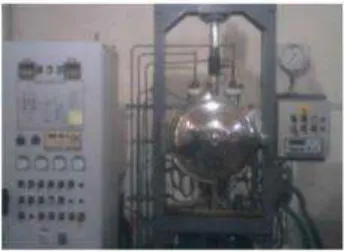
Fig. 2: Diffusion bonding unit
Non Steady State Diffusion Bonding (Flick's Equation). The quantitative treatment of no steady state diffusion processes is formulated as a partial differential equation [9]. It is beyond the scope of energy to treat the equations in detail but we can consider the second law qualitatively and examine some relevant solutions quantitatively. Since the oxidation rate constant follows an Arrhenius relationship,
[image:2.595.207.379.539.665.2]© 2019, IRJET | Impact Factor value: 7.211 | ISO 9001:2008 Certified Journal
| Page 377
(Eq.2)Where Q is the effective activation energy for oxidation, R the gas constant, T the absolute temperature and K0 is the constant for given material. The effective activation energy for oxidation was obtained from an Arrhenius plot of K in logarithm scale versus T. The activation energy for the titanium material is improved by heating the specimen almost near the recrystallization temperature which is 1123 K .At higher temperature, creep problems can be eliminated by creating the inert atmosphere through the use of rotary and diffusion pump. Cooling can be provided with the help of a chiller through the recirculation pipe lines
The Diffusion bonding set up shown in Fig 2 is utilized for the diffusion bonding on the Titanium alloys and Copper alloy. This set up includes the Vacuum chamber to minimize the chemical reaction during the bonding process by creating the necessary Vacuum on application of Rotary
Pump & Diffusion pump. Furnace (heating System), diffusion Pump and Vacuum Chambers are continuously cooled through water circulation system with Pump and a chillers. The required force on the specimens during bonding can be applied using Hydraulic loading .
RESULTS AND DISCUSSION
The Microhardness of interfacial regions of Ti/SS and Ti/Al respectively and are represented by the graphs.0In this application we will consider the indentation0hardness which is defined as0a measure of a material’s resistance0to plastic deformation0when a hard indenter penetrates into0a softer material.
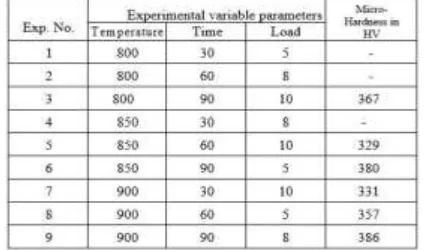
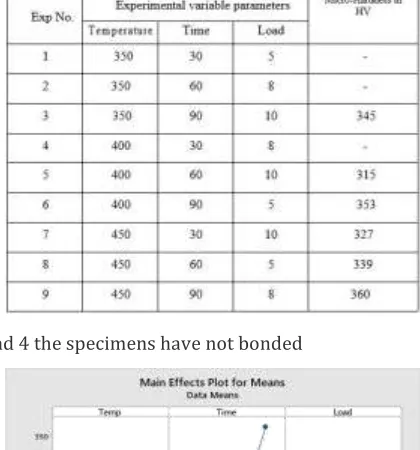
[image:3.595.188.400.500.576.2]Microhardness obtained from the tests for interfacial regions of Ti/SS and Ti/Al and for different combinations of bonding temperature, load and time are compared in the Table 3 and Table 4 .
Table 1: Factors and their corresponding variability levels for Diffusion bonding of Titanium and Stainless Steel
Table 2: Factors and their corresponding variability levels for Diffusion bonding of Titanium and Aluminium
Table 3: Microhardness of Ti/SS interfacial region for different temperature, time and load
[image:3.595.182.394.607.732.2]© 2019, IRJET | Impact Factor value: 7.211 | ISO 9001:2008 Certified Journal
| Page 378
Fig 3: Main effect plot for microhardness of Ti/Al
Interfacial region
[image:4.595.173.383.419.644.2]It was observed from the Fig 3 that microhardness of Ti/SS interfacial region increased with increase in bonding temperature of 800 to 900 ˚C. It also tells us that increase in bonding temperature increases the bonding strength. It was inferred that with increase in bonding time from 30 to 60 minutes the microhardness considerably increased. When we increase bonding time more atomic transfer takes place as a result more voids are filled and therefore microhardness of the interfacial region increases. From the graph we observed that load affected inversely on microhardness from 5 to 8 MPa, and it slightly increased from 8 to 10 MPa. Hence the optimized result obtained from the Minitab software and main effect plot for microhardness of Ti/SS is 900 ˚C (bonding temperature), 90 min (bonding time) and 5 MPa (load).
Table 3: Microhardness of Ti/SS interfacial region for different temperature, time and load
Note: For experiment No. 1, 2 and 4 the specimens have not bonded
[image:4.595.176.384.607.738.2]© 2019, IRJET | Impact Factor value: 7.211 | ISO 9001:2008 Certified Journal
| Page 379
It was observed in Fig 4 that microhardness of Ti/Al interfacial region increased with increase in bonding temperature of 350 to 450 ˚C. It also tells us that increase in bonding temperature increases the bonding strength. It was inferred that with increase in bonding time from 30 to 60 minutes the microhardness considerably increased. When we increase bonding time more atomic transfer takes place as a result more voids are filled and therefore microhardness of the interfacial region increases. From the graph we observed that load affected inversely on microhardness from 5 to 8 MPa, and it gradually increased from 8 to 10 MPa. Hence the optimized result obtained from the Minitab software and main effect plot for microhardness of Ti/Al is 450 ˚C (bonding temperature), 90 min (bonding time) and 10 MPa(load).Conclusions
Diffusion bonding is a very promising method in solid state joining processes for joining of different metals. In this project different metals like Stainless steel, aluminum and copper were diffusion bonded to Titanium. Diffusion bonding of the metals was carried out at different bonding parameters for all the three combinations and optimum parameters were found. Taguchi L9 array was used to design the experiments and to observe the effect of all the parameters on microhardness of the interfacial region.The following points are concluded after the investigation of the bonding process of Titanium with different materials:
1. The strength of the bonding depends on the nature of the surface to be bonded, pair of materials to be bonded and the operating process parameters like bonding temperature, bonding time and bonding load.
2. The microhardness value purely depends on the surface in contact, microvoids and surface irregularities at the interfacial region. If there are minimum microvoids and minimum surface irregularities microhardness will be maximum and good quality of the bond can be achieved.
3. The optimum bonding parameters for diffusion bonding of Titanium with Stainless steel are bonding temperature of 900 ˚C, bonding time of 90 minutes and bonding load of 5 MPa.
4. The optimum bonding parameters for diffusion bonding of Titanium with Aluminium are bonding temperature of 450 ˚C, bonding time of 90 minutes and bonding load of 10 MPa.
Future work
The future scope of this project is
1] Diffusion bonding can be done by introducing interlayer material between the bonding surfaces with lower melting point and the process can be made more efficient.
2] The effect of surface roughness of the bonding surfaces before bonding on the microhardness and the bond strength can be studied for different combinations of metals.
3] The effect of thickness of the interfacial layer on the bonding strength must be studied and optimized. So that bonds with better strength can be obtained.
REFERENCES
[1]Safarzadeh, Ahmad, Moslem Paidar, Hossein Youzbashi-Zade. "A Study on the Effects Bonding Temperature and Holding Time on Mechanical and Metallurgical Properties of Al–Cu Dissimilar Joining by DFW." Transactions of the Indian Institute of Metals 70, Vol 1, 2016, pp 125-131.
[2]Akca, Enes, Ali Gursel. "The Effect of Diffusion Welding Parameters on the Mechanical Properties of Titanium Alloy and Aluminum Couples." Metals 7, Vol 1, 2017, pp 22.
[3]Kurgan, Naci. "Investigation of the Effect of Diffusion Bonding Parameters on Microstructure and Mechanical Properties of 7075 Aluminium Alloy." The International Journal of Advanced Manufacturing Technology 71, Vol 9-12, 2014, pp, 2115-124.
[4]Yan, Huang, Cui Jianzhong, and Ma Longxiang. "Diffusion Bonding of Superplastic 7075 Aluminum Alloy." MRS Proceedings Vol 196, 1990, pp 196-149.
© 2019, IRJET | Impact Factor value: 7.211 | ISO 9001:2008 Certified Journal
| Page 380
Alloy." International Journal of Science and Research, Vol 12, 2017, pp 1015-020.[6]Kundu, Sukumar, Mainak Ghosh, and Subrata Chatterjee. "Reactive Diffusion Bonding Between Commercially Pure Titanium and 304 Stainless Steel Using Nickel Interlayer." ISIJ International 44, Vol 11, 2004, pp 1882-887.
[7] Samavatian, M., S. Zakipour, and M. Paidar. "Effect of Bonding Pressure on Microstructure and Mechanical Properties of Ti-6Al-4V Diffusion-bonded Joint." Welding in the World 61, Vol 1, 2016, pp 69-74.
[8] Aydın, Kemal, Yakup Kaya, and Nizamettin Kahraman. "Experimental Study of Diffusion Welding/bonding of Titanium to Copper." Materials & Design Vol 37, 2012, pp 356-68.
[9] Lee, Ho-Sung, Jong-Hoon Yoon, Chan Hee Park, Young Gun Ko, Dong Hyuk Shin, Chong Soo Lee. "A Study on Diffusion Bonding of Superplastic Ti–6Al–4V ELI Grade." Journal of Materials Processing Technology Vol 87-188, 2007, pp 526-29.
[10]Li, Yajiang, Peng Liu, Juan Wang, and Haijun Ma. "XRD and SEM Analysis near the Diffusion Bonding Interface of Mg/Al Dissimilar Materials." Vacuum 82, Vol 1, 2007, pp 15-19.
[11]Sheng, G. M., J. W. Huang, B. Qin, B. Zhou, S. Y. Qiu, and C. Li. "An Experimental Investigation of Phase Transformation Superplastic Diffusion Bonding of Titanium Alloy to Stainless Steel." Journal of Materials Science 40, Vol 24, 2005, pp 6385-390.
[12] Kurt, Bulent, Nuri Orhan, Ertan Evin, and Adnan Çalik. "Diffusion Bonding between Ti– 6Al–4V Alloy and Ferritic Stainless Steel." Materials Letters 61, Vol 8-9, 2007, pp 1747-750.
[13] Kundu, S., M. Ghosh, and S. Chatterjee. "Diffusion Bonding of Commercially Pure Titanium and 17-4 Precipitation Hardening Stainless Steel." Materials Science and Engineering: A 428, Vol 1-2, 2006, pp 18-23.
[14]He, P, J.-H. Zhang, X.-Q. Li "Diffusion Bonding of Titanium Alloy to Stainless Steel Wire Mesh." Materials Science and Technology 17, Vol 9, 2001, pp 1158-162.
[15] Kato, H., M. Shibata, and K. Yoshikawa. "Diffusion Welding of Ti/Ti and Ti/stainless Steel Rods under Phase Transformation in Air." Materials Science and Technology 2, Vol 4, 1986, pp 405-09.