Mitigation of Current and Voltage Harmonics Using MAF Based UPQC
A.RAJA
1, K.N.S.K.SANTHOSH
21
PG Student, Dept of EEE, Kakinada Institute of Engineering & Technology - II, Korangi, India
2Assistant Professor, Dept of EEE, Kakinada Institute of Engineering & Technology - II, Korangi, India
---***---Abstract - Today power system demand is increasing. Inrecent Year power degraded at distribution side. Power loss is increasing at consumer side due to more uses of non-linear load. Power Quality issues created by sensitive load. In this paper moving average filter (MAF) based UPQC device used for reduce voltage and current distortion. The pv cell is connected in between shunt and series connected voltage compensators in UPQC which consists of a series compensator and a shunt compensator. The compensator in series to a source is used to mitigate the voltage harmonics between the sources and loads. Whereas the shunt active filter is connected in parallel with the load is used to reduce and the harmonic currents produced by the load and reduces the total harmonic distortion (THD) and extracting power from PV array, Reactive power compensation. The Synchronous reference frame based control is used in shunt and series compensators in UPQC. In this project the power Quality can be improved by reduction of losses leads to increase in efficiency of power. The performance of MAF based-UPQC is verified by simulating the system in Matlab-Simulink under a nonlinear load.
Key Words: power quality, shunt compensation, series compensation UPQC ,THD, MAF
1. INTRODUCTION
With the advancement in semiconductor technology, there is an increased penetration of power electronic loads. These loads such as computer power supplies, adjustable speed drives, switched mode power supplies etc. have very good efficiency, and however, they draw nonlinear currents. These nonlinear currents cause voltage distortion at point of common coupling particularly in distribution systems. There is also increasing emphasis on clean energy generation through installation of rooftop PV systems in small apartments as well as in commercial buildings [1], [2]. However, due to the intermittent nature of the PV energy sources, an increased penetration of such systems, particularly in weak distribution systems leads to voltage quality problems like voltage sags and swells, which eventually instability in the grid . These voltage quality problems also lead to frequent false tripping of power electronic systems, malfunctioning and false triggering of electronic systems and increased heating of capacitor banks etc. Power quality issues at both load side and grid side are major problems faced by modern distribution systems. Due to the demand for clean energy as well as stringent power quality requirement of sophisticated electronic loads,
performance of DC-link controllers as well as for Grid synchronization using phase locked loop (PLL).
2. PROPOSED SYSTEM CONFIGURATION
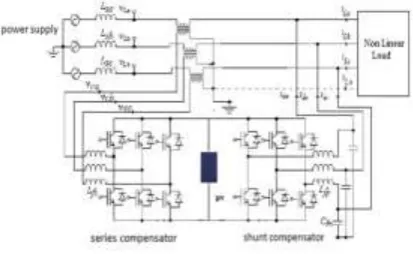
[image:2.595.62.269.288.415.2]The proposed topology consists of a series and shunt active power filter. The active filter connected in series to a source acts as a harmonic isolator between the sources and loads whereas the shunt active filter is connected in parallel with a load and suppresses the harmonic current produced by the load as shown in Figure.1 The series active filter compensates the harmonic voltage by synchronous reference frame (SRF)-based controllers. The shunt active filter compensates the harmonic current by using synchronous reference frame (SRF) -based controllers.
Fig .1 Series and Shunt compensators (UPQC)
The performance of an active power filter depends mainly on the technique selected to generate reference compensating current. The template to generate the reference current must include amplitude and phase information to produce the desired compensating current while keeping the voltage across the DC bus capacitor constant. The chosen technique must operate satisfactorily under both steady state and transient conditions. In the proposed model, the technique chosen for extracting reference currents and with the synchronous reference frame (SRF) method.
3. MOVING AVERAGE
As the name implies, the moving average filter operates by averaging a number of points from the input signal to produce each point in the output signal.
In equation form, this is written
………(1)
Where x [ ] is the input signal, y [ ] is the output signal, and M
is the number of points in the average. For example, in a 5 point moving average filter, point 80 in the output signal is given by:
………(2)
As an alternative, the group of points from the input signal can be chosen symmetrically around the output point: Symmetrical averaging requires that Mbe an oddnumber. Programming is slightly easier with the points on only one side; however, this produces a relative shift between the input and output signals. You should recognize that the moving average filter is a convolution using a very simple filter kernel. That is, the moving average filter is a convolution of the input signal with a rectangular pulse having an area of one.
4. SYNCHRONOUS REFERENCE FRAME
SRF-based controller was employed in a hybrid APF solution for improving passive filter performance in high power applications, whereas in the SRF-based controller was used to generate the sinusoidal compensating current references applied to a three-phase line-interactive UPS system. In this work, for this purpose, an algorithm based on SRF is also used. In the SRF-based algorithm the fundamental terms of voltage and/or current of the abc-phase stationary reference frame are transformed into continuous quantities into the dq synchronous axes, in which they rotate at a synchronous speed in relation to the spatial vectors of voltage and/or current. In the dq-axes, the harmonic contents of voltage and/or current can be represented by alternate quantities, which are superposed on the continuous components. Therefore the fundamental component can be easily obtained by means of HPFs. The estimation of the utility grid phase-angle (θ) can be performed by using PLL algorithms, allowing the generation of the unit vector coordinates (sin θ and cos θ) used in the SRF-based algorithm.
5. PROPOSED METHOD
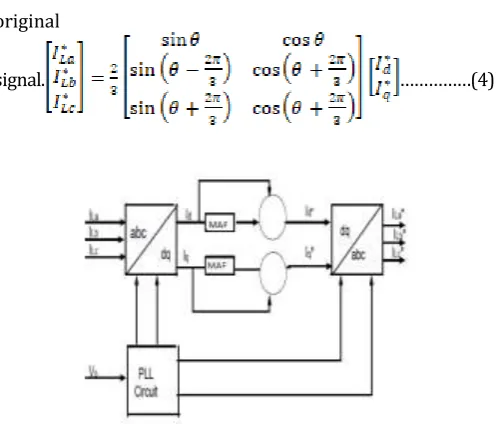
In SRF theory the distorted three phase harmonic load current ( ILa, Ilb, Ilc)are achieved in a-b-c coordinates by the three phase measurement block and these quantities are transformed into d-q coordinates (Rotating reference frame) by using equation (3) and cosine and sine functions from phase locked loop. The extraction of harmonic component present in the load current is done with the use of SRF theory
.(3)
original
[image:3.595.39.289.89.301.2]signal. ………(4)
Fig.2 Block diagram of SRF current control technique with MAF
The output of MAF extract only dc quantities and attenuates the ac components corresponding to harmonic frequency .Since the output of LPF are D.C. so it will not suffer any magnitude or phase error. One of the advantage of using low cut-off frequency of LPF is that it improves closed loop system stability margin. The output of MAF is and this output Id*,Iq* is transformed into ICA,ICB ,ICC by using inverse SRF transformation in and it is used as reference current of hysteresis controller.
Fig.3 Block diagram of SRF voltage control technique with MAF
6 HYSTERESIS CURRENT CONTROL METHOD
[image:3.595.341.550.109.215.2]Hysteresis current control method of generating the switching signal for the inverter switches in order to control the inverter output current. It is adopted in shunt active filter due to easy implementation and quick current controllability.
Fig 4 Block diagram of hysteresis current controller
It is a fed back current control method shown in figure 4, where the actual current continuously tracks the reference current in the hysteresis band .The reference and actual current is compared with respect to hysteresis band which decides switching pulse of voltage source inverter. As the current crosses a set hysteresis band, the upper switch in the half-bridge is turned off and the lower switch is turned on. As the current exceeds the lower band limit, the upper switch is turned on and the lower switch is turned off.
Fig 5 Hysteresis tolerance band
[image:3.595.324.547.363.501.2] [image:3.595.54.267.467.635.2]7. SIMULATION AND RESULTS
7.1 PV MODULE WITH BOOST CONVERTER
Fig 6 PV Module with Boost Converter
7.2 MODEL FOR CONTROL OF HARMONICS
Fig 7 SRF Control for Series Converter
Fig 8 SRF Control for Shunt Converte
[image:4.595.317.554.126.399.2]7.3 SHUNT AND SERIES CONVERTERS INTEGRATED WITH PV
Fig 9 Unified Power Quality Condition
[image:4.595.322.545.441.579.2]7.4 MODEL FOR MAF BASED UPQC
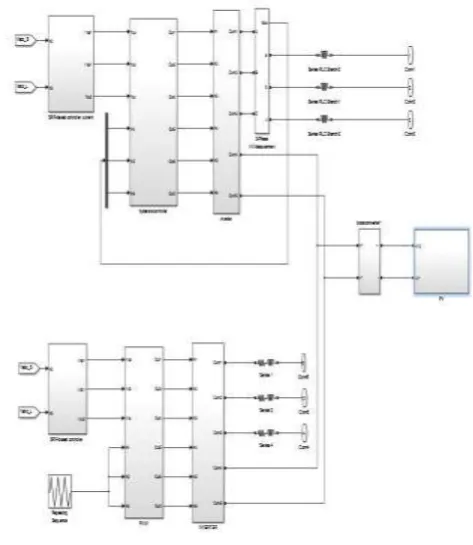
Fig 10 Simulink model for MAF BASED-UPQC
7.5 Mitigation of Voltage Harmonics under a Non-linear load
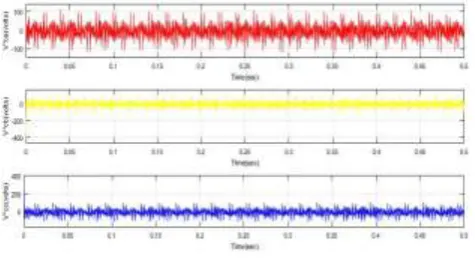
Mitigation of Voltage Harmonics Using UPQC is shown in fig 11, 12 and 13. The signs indicated are Source Voltage of phase-a (Vsa), Source Voltage of phase-b (Vsb), Source Voltage of phase-c (Vsc), and Load Voltage of phase-a (Vla), Load Voltage of phase-b (Vlb), Load Voltage of phase-c (Vlc), and Compensating voltages of phase-a, b, c are V*ca, V*cb, V*cc respectively.
Fig 11 Load voltage waveforms
[image:5.595.43.281.272.402.2]The fig 11 shows Compensating Voltage signals which are injected into source voltage signal by Series Converter in order to mitigate the harmonics.
Fig 12 Compensating Voltage waveforms
[image:5.595.316.547.426.532.2]The fig 10 shows Source Voltage signals which are in sinusoidal waveforms due to mitigation of Harmonics by UPQC.
Fig 13 Source Voltage waveforms
7.6 Mitigation of Current Harmonics under a Non-linear load
Mitigation of Current Harmonics Using UPQC is shown in fig 11, 12, and 13. The signs indicated are Source Current of phase-a (Isa), Source Current of phase-b (Isb), Source Current of phase-c (Isc), and Load Current of phase-a (Ila), Load Current of phase-b (Ilb), Load Current of phase-c (Ilc), and Compensating Current signals of phase-a, b, c are I*ca, I*cb, I*cc respectively.
The fig 11 shows Load Current signals which are distorted due to Harmonics produced by Non-linear load. The produced harmonics distorted the source signals.
Fig 14 Load current waveforms
The fig 14 shows Compensating Current signals which are injected into source current signals by Shunt converter in order to mitigate the harmonics.
Fig 15 Compensating current waveforms
The fig 15 shows the Source Current waveforms which are in sinusoidal due to mitigation of harmonics by UPQC.
Fig 16 Source Current waveforms
7.7 Comparison of %THD
A. Control strategy
B. Load side C. Source side
D. Voltage (%THD)
E. 9.2% F. 0.5%
G. Current (%THD)
[image:5.595.49.274.476.581.2]H. 20.6% I. 2.8%
Table 1 Comparison of %THD
8. CONCLUSION AND FUTURE SCOPE
8.1 Conclusion
[image:5.595.304.565.576.662.2]improved through the use of MAF. Introduction of SRF based controlling for MAF based UPQC reduces the harmonics, increases the power factor of the system and also maintains the percentage of THD under the limits of IEEE-519 standards.
9. REFERENCES
[1]. Sachin Devassy & Bhim Singh “Dynamic Performance of Solar PV Integrated UPQC for Critical Loads”, IEEE INDICON 2015 1570197603.
[2]. “IEEE recommended practice for evaluating electric power system compatibility with electronic process equipment,” IEEE Std 1346-1998, pp. 1–43, 1998.
[3]. Ismael Molina-Moreno, Aurelio Medina and Rafeael, Olimpo Anaya-Lara “Noise Mitigation in Voltage and Current Waveforms in Harmonic Distortion Estimation” IEEE std ROPEC 2017.
[4]. Nenceey Jain, Amit Guptha “Comparison between Two Compensation Current Control Methods of Shunt Active Power filter” International Journal of Research and General Science vol-2, 2014
[5]. Vivek Tamrakar, S.C Guptha and Yashwant Sawle “Single-diode PV cell Modeling and Study of Characteristics of Single and Two-diode Equivalent circuit” ELELIJ vol-4, 2015
[6]. S.srinivasa rao, P.Siva Rama Krishna, Dr. sai babu “Mitigation of voltage sag, swell and THD using Dynamic voltage restorer with Photovoltaic system”
[7]. Muneer V, Avik Bhattacharya “Investigation on Reduced DC link voltage Based UPQC for Harmonic compensation under Unbalanced load” IEEE std , 2017 [8]. Sudeer Vinnakoti “SRF-based control of unified power quality conditioner for power quality enhancement”