© 2019, IRJET | Impact Factor value: 7.211 | ISO 9001:2008 Certified Journal
| Page 2908
“PARAMETRIC STUDY ON MULTISTORIED DIAGRID STRUCTURE”
Kedar A. Kore
1, Prof. Vijay S. Shingade
2, Prof. Swapnil B. Walzade
31
Post Graduate Student, Department of Civil Engineering, Trinity College of Engineering and Research, Pune, India.
2Professor, Department of Civil Engineering, Trinity College of Engineering and Research, Pune.411048, India.
---***---Abstract -
Tall buildings are more vulnerable to collapse due to high wind and earthquake load. It’s a very big task that structure to be standup against lateral forces such as earthquake and wind load. The risk of failure in such buildings can be minimized by adopting lateral load resisting systems. In this study, diagrid system is provided in building to resist lateral load due to earthquake load and wind load. Modelling and analysis is done with equivalent static method on STAAD Pro software for assessment of effectiveness of diagrid system. In this thesis, five models are analysed, two for bare frame & three models each for diagrid system . Each model consists ten storey frame structure having total height 30 and storeyheight is kept 3 m for each floors.Comparison has been done
for different types of model for earthquake and wind load case by considering various parameters like storey drift, absolute displacement, base shear, moment and axial forces. The result of work showed that steel diagrid system resist lateral load more efficiently than concrete diagrid as it yields the least value for absolute displacement, storey drift, moment and axial force. Absolute displacement, axial force, Storey drift, and moment in wind load case are lesser than earthquake load case. So it is considered that in comparison wind load case is less predominant than earthquake load case. The value of Base shear in diagrid structure is greater than the bare frames.
Key Words: Diagrid, Earthquake, Wind, Lateral load, Equivalent static, STAAD Pro.
1. INTRODUCTION
The rapid growth of urban population and limitation of available land, scarcity and high cost of available land, the taller structures are preferable now days. As the height of structure increases then the consideration of lateral load is very much important. That’s why to resists the gravitational loads the lateral load resisting system becomes more important than the structural system. The lateral load resisting systems that are widely used are rigid frame, shear wall, diagrid structural system, wall frame, braced tube system, outrigger system and tubular system. Recently shear wall systems and diagrid structural system are the most commonly used lateral load resisting systems. Diagrid structural system is mostly used in high rise buildings because of its structural efficiency and flexibility in architectural planning. Diagrid structural systems are mostly used for high rise buildings due to its aesthetic potential and structural efficiency provided by the unique geometric configuration of the system. Hence the diagrid, for structural effectiveness and aesthetics has generated renewed interest
from architectural and structural designers of tall buildings.
The earthquakes are the most unpredictable and devastating among the natural disasters and in recent years, The quick increase of town in habitant’s results in high pressure on available town area has a large influence in the expansion of that town. Buildings are subjected to two types of loads viz. vertical load because of gravity and Lateral load because of earthquake and wind. The structural system of building may also be visualised as consisting of two components systems such as Horizontal framing system consisting of slab and beams which is primarily responsible for transfer of vertical load to the vertical framing system and Vertical framing system consisting of beams and columns, which is primarily responsible for transfer of lateral load to foundation. However, the two components work in conjunction with each other.
1.1 Diagrid system
The diagrid is a framework of diagonally intersecting metal, concrete or wooden beams that is used in construction of buildings. Diagrid is a particular form of space truss. It consists of perimeter grid made up of a series of triangulated truss system. Diagrid is formed by intersecting the diagonal and horizontal components it has good appearance and it is easily recognized. The configuration and efficiency of a diagrid system reduce the number of structural element required on the façade of the buildings, therefore less obstruction to the outside view. The structural efficiency of diagrid system also helps in ignoring interior and corner columns, hence allowing great flexibility with the floor plan. Diagrid structures are more effective in minimizing shear deformation because they carry lateral shear by axial action of diagonal members. The famous examples of diagrid structure all around the world are the Swiss Re in London, Hearst Tower in New York.
© 2019, IRJET | Impact Factor value: 7.211 | ISO 9001:2008 Certified Journal
| Page 2909
seismic zones as per geological features and seismic historyas per provision of IS 1893(Part 1):2002
1.2 Aims and objectives:
a. To determination the best and the appropriate of structural systems for the different high-rise buildings in the number of storey’s
b. To understand bare frame and diagrid system action in high rise building.
c. To study the variation of displacement, story drift, base shear, story drift, moment and axial force is evaluated for all these models in earthquake and wind load case.
d. To compare analytical data for a suitable framing system and to get efficient lateral load resisting system for seismic and wind areas.
2. METHODOLOGY:
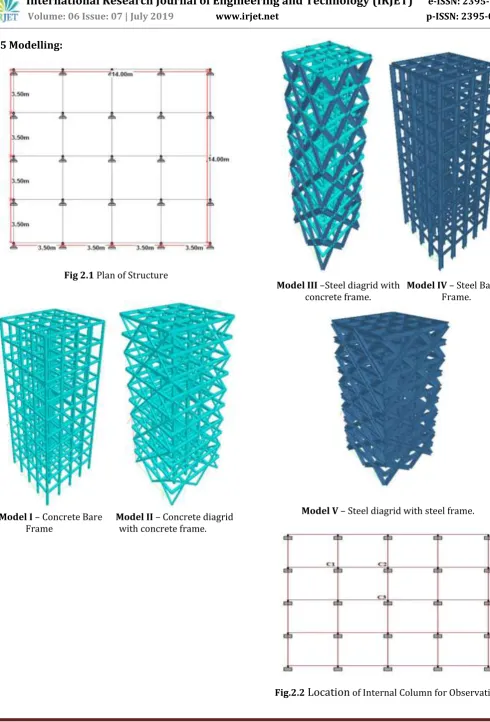
In this thesis, five models are analysed, First model for concrete bare frame, second model concrete frame with concrete diagrid , third model for concrete frame with steel diagrid , fourth model for steel bare frame and the fifth model for steel frame with steel. The structures are modelled by using computer software STAAD-PRO. The basic assumptions and the building geometries considered for this study. All the selected buildings were designed as per Indian Standards.
2.1 Material properties:
M-25 grade of concrete and Fe-415 grade of reinforced steel are used for all the concrete frame models and for the steel frame models I section with grade FYLD250 is used in this study. Elastic material properties of these materials are taken as per Indian Standard IS 456 (2000) and IS 800:2007
The modulus of elasticity of steel is taken as Ec = 2 × 10⁵ N/mm2
Poisons ratio of steel = 0.3
Density of steel = 7833.41 kg/m3
2.2 Structural elements:
The beam-column joints are assumed to be rigid in concrete frame models. The column end at foundation was considered as fixed for all the models in this study and the steel frame models have a bolded joints are assumed.
2.3 Building description:
The STAAD-PRO software is used to develop 3D model and to carry out the analysis. The lateral loads and wind load to be applied on the buildings are based on the Indian standards. The study is performed for seismic zone –IV as per IS 1893:2002 (Earthquake load), IS875: 1984(Wind
Load). The building consists of reinforced concrete ad Steel frames. G+9 storied bare frames and diagrid system frames are analysed for seismic and wind forces.
2.4 Model data:
Types of Structure
Concrete frame SMRF
Steel frame SMRF as per SP6 No. Of stories G+9
Storey Height 3 m Material property Concrete Frame:
Grade of concrete M25 Grade of Steel Fe 415
Steel Frame FYLD 250
Member Properties
Thickness of slab 0.120 m
Size of members Column Beam
Model 1 350×350mm 300×300mm
Model 2 350×350mm 300×300mm
Model 3 350×350mm 300×300mm
Model 4 I100012B50012 I80016B50012
Model 5 I100012B50012 I80016B50012
Diagrid Size
Model 2 230×230mm
Model 3 I80012B50012
Model 5 I80012B55016
Load Intensities
Seismic Zone IV
Location Delhi
Height of building 30 m Dead load for Concrete
Frame 4.375 kN/m2
Live load for Concrete
Frame 3 kN/m2
Dead load for Steel
Frame 3.75 kN/m2
Live load for Steel
© 2019, IRJET | Impact Factor value: 7.211 | ISO 9001:2008 Certified Journal
| Page 2910
[image:3.595.45.536.55.778.2]2.5 Modelling:
Fig 2.1 Plan of Structure
Model I – Concrete Bare Model II – Concrete diagrid Frame with concrete frame.
Model III –Steel diagrid with Model IV – Steel Bare concrete frame. Frame.
[image:3.595.324.543.587.732.2]Model V – Steel diagrid with steel frame.
© 2019, IRJET | Impact Factor value: 7.211 | ISO 9001:2008 Certified Journal
| Page 2911
Fig 2.3: Application of earthquake and wind forces usingSTAAD- pro.
3 RESULTS AND ANALYSIS:
For earthquake resistant design of structures IS 1893 (PART-1): 2002 code is used for calculating seismic design force. Wind forces are calculated using code IS-875 (PART-3):1987.For calculation of forces, moments and displacement consider two important load cases for the analysis.
[image:4.595.33.293.472.621.2]a) 1.2(DL+LL+WL) – for wind analysis b) 1.5(DL+EQ) – for earthquake analysis.
Table 3.1: Maximum values in different types of model for earthquake and wind case for Beams.
Model
Bending moment Shear force For wind load case For earthquake load case For wind load case For earthquake load case
Model 1 55.044 80.255 31.917 46.829
Model 2 37.627 59.322 50.824 61.95
Model 3 25.9 50.017 46.426 50.22
Model 4 27.475 55.991 29.795 43.55
Model 5 20.018 31.097 76.346 95.01
Table 3.2: Maximum values in different types of model for earthquake and wind case for Beams.
Model Displacement Storey drift For wind load case For earthquake load case For wind load case For earthquake load case
Model 1 41.562 128.154 6.705 16.661 Model 2 23.95 56.761 2.952 6.323
Model 3 11.435 23.014 1.692 2.944 Model 4 21.352 60.463 2.647 7.294 Model 5 3.52 27.706 0.457 3.466
Bending Moment: 55.044 37.627 25.9 27.475 20.018 80.255 59.322 50.01755.991 31.097 0 20 40 60 80 100 model 1 model 2 model 3 model 4 model 5
Wind load case
Earthquake load case
Fig. 3.1: Variations of Maximum Bending Moment in kN with different types of Model.
1. In earthquake and wind load case, Bending Moment is maximum in model –I and less in model –III
2. For Model – IV &V, Bending Moment is maximum in Model -IV.
3. Bending Moment in wind load case is lesser than earthquake load case.
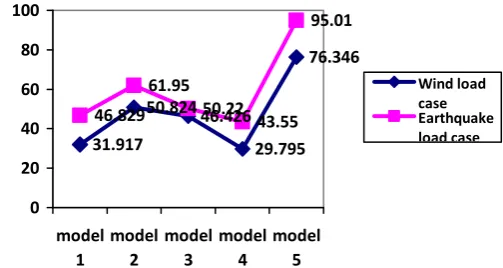
Shear Force: 31.917 50.824 46.426 29.795 76.346 46.829 61.95 50.22 43.55 95.01 0 20 40 60 80 100 model 1 model 2 model 3 model 4 model 5 Wind load case Earthquake load case
Fig. 3.2: Variations of maximum Shear Force in kN with different types of Model.
1. In earthquake and wind load cases value of Shear force is less in Model-I as compared to model-II and Model- III.
2. In Model IV &V, Shear Force is maximum in Model IV as compared to Model IV.
[image:4.595.315.567.485.619.2]© 2019, IRJET | Impact Factor value: 7.211 | ISO 9001:2008 Certified Journal
| Page 2912
Displacement: 41.562 23.95 11.43521.352 3.52 128.154 56.761 23.014 60.463 27.706 0 20 40 60 80 100 120 140 model 1 model 2 model 3 model 4 model 5 Wind load case Earthquake load caseFig.3.3: Variations of maximum Absolute Displacement in mm with different types of Model.
1. The Absolute displacement in bare frames is the greater among all lateral load resisting systems investigated.
2. In earthquake and wind load case, Absolute Displacement is maximum in model –I and less in model –III.
3. For Model – IV &V, Absolute Displacement is maximum in Model -IV.
4. Maximum Absolute displacement in wind load case is lesser than earthquake load case.
5. In earthquake and wind load cases value of Displacement is maximum at upper floor and it is go on decreasing for ground level.
Storey Drift: 6.705 2.952 1.692 2.647 0.457 16.661 6.323 2.944 7.294 3.466 0 2 4 6 8 10 12 14 16 18 model 1 model 2 model 3 model 4 model 5
Wind load case
Earthquake load case
Fig. 3.4: Variations of maximum Storey Drift in mm with different types of Model.
1. Model-I (bare frame) shows maximum storey drift as compared to other model in wind and earthquake load case.
2. Fig.4.22 indicates that the maximum Storey drift in wind load case is lesser than earthquake load case.
3. In earthquake and wind load case, Storey Drift is maximum in model –I and less in model –III.
4. For Model – IV & V, Storey Drift is maximum in Model -IV.
4 CONCLUSIONS:
From the study of Diagrid system in G+ 9 storey building subjected to earthquake and wind load following conclusions can be made –
a. Fluctuation in results is observed where the diagrid are connected to the floor i.e. Storey Drift and Bending Moment a value decreases considerably where diagrid is provided.
b. The Absolute displacement is much less in model-III i.e. In Steel diagrid with Concrete frame as compare to model-II i.e. Concrete diagrid with Concrete frame.
c. Storey drift is less in model-III i.e. In Steel diagrid with Concrete frame as compare to model-II i.e. Concrete diagrid with Concrete frame.
d. Absolute displacement, axial force, storey drift, and moment in wind load case are lesser than earthquake load case. Hence wind load is less predominant than earthquake load case.
e. There is much fluctuation for earthquake load in displacement value at diagrid location as compare to wind load case.
f. Absolute displacement, storey drift are very less for steel diagrid in steel frame i.e. for Model-V as compare to bare steel frame i.e. for model-III. g. The value of Base shear in diagrid structure is
greater than the bare frames.
5 SCOPES FOR FUTURE WORK:
a. Comparative study on different position of diagrid System for concrete and steel diagrid.
b. Comparative study by using pushover analysis method and response spectrum method.
c. Critical study between earthquake and wind load case in Diagrid system in various types of zones and wind speed.
d. Comparative study on increasing the height of buildings.
REFERENCES:
1. Arvindreddy, R.J.Fernandes 2015, “Seismic analysis of RC regular and irregular frame structures”, International Research Journal of Engineering and Technology (IRJET) ,Volume: 02 , 44-47.
© 2019, IRJET | Impact Factor value: 7.211 | ISO 9001:2008 Certified Journal
| Page 2913
irregularity using staad.pro”, International ResearchJournal of Engineering and Technology (IRJET) , Volume: 04 ,1863-1866.
3. Giulia Milana, Pierluigi Olmati, Konstantinos Gkoumas, Franco Bontempi, “Ultimate Capacity of Diagrid Systems for Tall Buildings in Nominal Configuration and Damaged State”. Periodica Polytechnica Civil Engineering2015. pp. 381–391.
4. Irfan Saleem 2018, “Parametric study on asymmetric diagrid structure”: International Journal of Applied Engineering Research ISSN 0973-4562 , Volume:13 , 61-66.
5. Jerome J. Connor, John E. Fernandez, “Diagrid Structural Systems for Tall Buildings: Characteristics and Methodology for Preliminary Design”. Strut.Design Tall Spec.Build.2007.Pg.205-230.
6. J. Kim, Y. Jun and Y.-Ho Lee, “Seismic Performance Evaluation of Diagrid System Buildings”. 2nd Specialty Conference on Disaster Mitigation.2010.
7. Khushbu Jania , Paresh V. Patel, “Analysis and Design of Diagrid Structural System for High Rise Steel Buildings” Elsevier Procedia Engineering.2013.pp92 – 100. 8. Kyoung Sun Moon, “Practical Design Guidelines for
Steel Diagrid Structures” Buildng Integration Solutions . ASCE.2008.
9. Nishith B. Panchal, Vinubhai R. Patel, “Diagrid Structural System: Strategies To Reduce Lateral Forces On High-Rise Buildings” IJRET2014. Volume: 03 Issue: 04.pp.374-378.
10. IS 1893 (part 1):2002, “Criterion for Earthquake Resistant Design of Structures, Bureau of Indian Standard, New Delhi”
11. IS 875 (part 3):1987, “Code of Practice for Design Loads (Other than Earthquake) for Buildings and Structure, Bureau of Indian Standard, New Delhi”