Munich Personal RePEc Archive
A note on the social responsibility in a
bilateral monopoly
Fanti, Luciano and Buccella, Domenico
University of Pisa, Italy, Kozminski University in Warsaw, Poland
3 March 2018
Online at https://mpra.ub.uni-muenchen.de/88162/
1 A note on the social responsibility in a bilateral monopoly
Luciano Fanti and Domenico Buccella* Abstract
In a linear bilateral monopoly with the up-stream manufacturer and the
down-stream retailer “consumers’ friendly” socially concerned (i.e. caring about a
share of consumer surplus), Brand and Grothe (2015, in this Journal) shows
that, although (as expected) both firms’ owners do not have an incentive to
deviate from pure profit maximization when they choose their level of
corporate social responsibility (CSR) simultaneously (or the retailer commits
itself on social concern before the manufacturerer does), if the manufacturer
commits itself on social concern before the retailer does, then both profits are
enhanced. This paper shows that Brand and Grothe’s result may be strongly
modified if there are decreasing returns to the input: only the retailer firm’s
owners are incentived to adopt CSR and, at the equilibrium, this leads to a
Pareto-superior outcome. This offers straightforward policy and empirical
implications, arguing that the presence of CSR-type firms – which leads to
higher profits and Pareto-superior outcomes, confirming the neoclassical
economics point of view with respect to the adoption of CSR behaviors by
firms’ owners – depends crucially on the technology.
Keywords: Bilateral Monopoly; Corporate Social Responsibility
JEL Classification D21, L12, L22, M14.
*
Luciano Fanti, Department of Economics and Management, University of Pisa, Via Cosimo Ridolfi, 10, I –56124 Pisa (PI), Italy. E-mail address: [email protected]; tel.: +39 050 22 16 369; fax: +39 050 22 16 384.
2
1. Introduction
In the last decades, the adoption of Corporate Social Responsibility (CSR)
activities has become a global business practice. In 2002, KPMG surveyed the
top 100 companies in 45 countries, disclosing that 23 percent of them declared
the accomplishment of CSR activities in their financial reports; those figures
grew to 73 percent in 2015. Moreover, in the same time period, the Global
Fortune Index (which includes the world’s 250 largest companies) has more
than doubled those figures, from 45 to 92 percent (KPMG 2005, 2015).
The booming expansion of CSR has raised questions among scholars and
policy-makers, exciting the debate on the motives pushing companies to engage in
socially concerned activities, and this subject has been approached from
different perspectives.1
The rationale for firms owned and (directly or indirectly, through opportunely
hired and instructed managers) managed by shareholders to embark in
unprofitable social activities has so far remained an unanswered puzzle, unless
one discards the first principle of the rationality of “homo oeconomicus”.
In fact, focusing exclusively on the realm of economics, the first principles of
economics states that corporations are only responsible to their shareholders2, and Milton Friedman (1970), in an article appeared in The New York Times with
the evocative title “The social responsibility of business is to increase its
profits”, openly declares that the only objective of corporations is to maximize
1
For instance, Garriga and Mele` (2004) categorize the most significant CSR theories (and
related approaches) with respect to the following aspects of social reality: economics,
politics, social integration and ethics.
2
With regard to the standpoint of economics, see also the discussion in Benabou and Tirole
3 their shareholders’ returns, provided that the legal framework and the ethical custom of the country in which the corporations operate are respected.
Therefore, several empirical works have started investigating the correlation
between CSR activities and profitability performances. On the whole, the
results have been mixed or opposing, even within the same study. It follows
that, at the current stage, there is a lack of an unambiguous, general
consensus. A large majority of the scholars has identified either an exclusive
negative (see, e.g. Bromiley and Marcus, 1989; Davidson et al. 1987; Davidson
and Worrel, 1988) or a doubtful empirical evidence (e.g. Aupperle et al., 1985;
Ingram and Frazier, 1983). However, a growing number of empirical works has
revealed a positive link between the CSR and their financial performance (e.g.
Griffin and Mahon, 1997; Roman et al., 1999; Waddock and Graves, 1997).
Focusing on the relationship between performance and CSR in retailer firms,
empirical evidence is provided by Schramm-Klein et al. (2015) who, through
a survey among retailers and applying partial least squares structural
equation modeling, argue that CSR generally has positive effects on retailer
performance – despite the cost associated with CSR implementation.
However, theoretical explanations of the widespread presence of CSR-type
firms have been provided resorting to several standpoints, but substantially
abstracting from the above mentioned puzzle. Though no general agreement
exists about the precise definition of the term “corporate social responsibility”, two different viewpoints describe it: 1) a specific social activity firms conduct in
voluntary way (i.e. beyond legal requirements), without inquiring neither the
rationale for the occurring of this choice, nor the purely economic effects it
4 to the profits precisely defines the true CSR).3 It seems to be rather unexpected that, in the domain of economics, the firms’ extensive engagement in CSR activities either is not explained and it does not matter to explain it, or is clearly
profit-damaging and the main interpretation is that precisely this damage truly
identifies CSR. Therefore, taking seriously into consideration the point of view
of economics, it is natural to inquire whether the introduction of CSR may contribute to improve the firms’ profitability, so also contributing to the solution of the puzzle. In this paper, we start from the basic model of
duopolistic Cournot competition, in which it is easy to show that firms – which
maximize short-run profits - always reduce their profits by introducing social
concerns in their objectives, for instance, under the form of an “interest” for
the welfare of consumers.
Indeed, a typical feature shared by several articles is the assumption of CSR
activities in terms of a maximization of an objective function which is a
weighted sum of profit and consumer surplus, i.e. social responsibility takes the
form of “consumers’ friendly” activities. However, among those contributions, a typical difference concerns whether and how such CSR activities are chosen:
3
Doni and Ricchiuti (2013, 382) describes in an enlightening way these definitions and their
different implications: “There are two polar definitions that can appear in sharp contrast.
According to a first point of view, a firm is socially responsible when it takes
environment-friendly actions not required by law. In this light, CSR can be defined without any regard
neither to the motivation of the firm’s choices nor to the impact of such choices on the firm’s profit. From a different point of view, other authors believe that a firm is truly responsible only when it sacrifices its profit, at least in part, in order to carry out some social
objective. Baron (2001) names the first behaviour as strategic CSR and the second one as
altruistic CSR. This second concept of CSR is quite disputed: according to some authors an
altruistic CSR is neither sustainable in a competitive market nor desirable from a social point
5 on the one hand, the levels of CSR may be exogenously given for both firms or
only one firm chooses the level of CSR while other firms remain profit-seeking
(e.g. Kopel, 2009; Kopel and Brand, 2012; Goering 2007, 2009, 2012, 2014;
Brand and Grothe, 2013; Lambertini and Tampieri 2012, 2015; Fanti and
Buccella, 2017a,b; which focus on the effects of firms’ CSR on competition
under various aspects such as the environmental outcomes4, entry game5 and managerial delegation6), and on the other hand, the CSR levels are endogenously chosen by profit-maximizing firms’ owners for strategic reasons
in oligopolistic contexts (i.e., in a standard Cournot duopoly market), although
few authors study the endogenous strategic choice of the CSR parameter (e.g.
Hino and Zennyo, 2017; Planer-Friedrich and Sahm, 2016; Fanti and Buccella,
4
For instance, Lambertini and Tampieri (2015) assume, in addition to the care for the
consumer surplus, an environmental externality and show that, with a sufficiently large
market size, the CSR firm obtains higher profits than its profit-seeking competitors.
Lambertini, Palestini, and Tampieri (2016) further show – although in a dynamic context with
a linear state differential game and capacity accumulation – that, in the presence of
environmental externalities, if the market is sufficiently large, the CSR firm sells more,
accumulates more capital, and earns higher profits than its profit-seeking rival.
5
Fanti and Buccella (2017a) show that when the market is adequately large, the adoption of
CSR rules acts as an entry barrier in the industry because the incumbent may “penalize” the
potential entrant’s profits when the former has social concern, and the larger the
incumbent’s social concern is, the larger the “penalization” is. 6
More precisely, Goering (2007) and Kopel and Brand (2012) analyze the strategic use of
managerial incentives in a non-profit firm mixed duopoly, in which one of the firms is not
profit maximizer while the rival is. On the other hand, Goering (2008) studies the same
asymmetric structure without managers, in the presence of three firms in which the care of
the overall social welfare represents the CSR feature of the non-profit firms. Kopel and
Brand (2013), in line with their previous work, investigate the reason why a CSR-type firm
6 2017b Supplement, c).7 Hino and Zennyo (2017) analyze the endogenous
decision-making as regards the level of CSR in a delegation game with Cournot–
Stackelberg competition. They show that the follower can derive a greater
profit than the leader and achieve maximum profit when firms sequentially
choose their CSR level. Planer-Friedrich and Sahm (2016) show that firms prefer
to care for all consumers rather than for own customers only, choosing positive
levels of CSR, but at the equilibrium choosing CSR reduce firms’ profits.
However, independently of the strategic motivations for adopting CSR
behaviors (while, however, as highlighted above, lead to lower profits at the
market equilibrium), some recent papers have shown that the aim of
maximizing profits can be a motive for the firm’s engagement in CSR, as the
neoclassical economics point of view requires because the adoption of CSR may
increase profits of all firms at the market equilibrium. Fanti and Buccella
(2017b, Supplement) study the situation in which firms’ owners non
-cooperatively select their endogenous level of social concerns. Those authors
find that, when goods are substitute,8 a unique sub-game perfect Nash equilibrium exists in which both firms engage in CSR, but this equilibrium is
Pareto inefficient: a standard prisoner’s dilemma arises. Indeed, Fanti and
Buccella (2017c), also introducing managerial delegation (i.e. owners delegate
output decisions to a manager), show that in the subgame perfect Nash
equilibrium both firms are CSR-type and, in addition, the presence of CSR
7
Siegel and Vitaliano (2007) and Fernández-Kranz and Santaló (2010) provide some
empirical confirmations that firms’ social responsibility can be strategically chosen.
8
On the other hand, when goods are complement, two pure-strategy asymmetric Nash
equilibria emerge, that is, one firm engages in CSR activities while the rival remains
7 activities improves the firms’ profitability while harms the welfare of consumers and society, a result in contrast to the conventional wisdom under
non-managerial firms. Moreover, Fanti and Buccella (2017d) show that, when
firms non-cooperatively compete on CSR in network industries, the classical
conventional prisoner’s dilemma result in standard industries – i.e. to have social concerns is the Nash equilibrium but it is harmful for firms’ profits – vanishes and, for adequately strong network effects, the equilibrium in which
both firms are engaged in CSR is more profitable than simple profit-seeking.
When firms cooperatively choose the maximising level of CSR - a
profit-maximising CSR level does exist provided that network effects are sufficiently
strong.
While all the aforementioned contributions deal with the standard Cournot
duopoly, another branch of this literature studying the strategic content of the
CSR choices focuses on a vertical structure of the industry and studies the
impact of firms’ social concern on that. In particular, in a bilateral monopoly
model, Goering (2012) and Brand and Grothe (2013) focus on a perfectly
coordinated 9 supply chain channel: while the former assumes that either the
manufacturer or the retailer can be socially concerned and finds that CSR
reduces a firm's profit, the latter authors extend the analysis to the case where
both firms are socially concerned and show that the retailer does not have any
incentive to be socially concerned, because all the actions are neutralized by
the manufacturer through the two-part tariff. Goering (2014) assumes that the
manufacturer – which is strictly profit-seeking - will select a two-part contract,
9
In such a case, the double marginalization - early investigated by Spengler (1950) - is
eliminated by construction through the assumption that the manufacturer absorbs the
8 consisting of a wholesale price for the goods and level of CSR (which its retailer
has to include in its business activity) that maximizes its profits, showing that a
CSR contract can be used in place of the two-part tariff scheme to coordinate
optimally the marketing channel. Brand and Grothe (2015), unlike Goering
(2012) and Brand and Grothe (2013), relax the assumption of perfect channel
coordination and unlike Goering (2014), assume that both the manufacturer
and the retailer maximize the socially responsible objectives. Those authors
show that, when both firms simultaneously choose their level of social
responsibility or the retailer first commits on the social responsibility, both
firms do not have an incentive to deviate from pure profit maximization, while
if the choice of the manufacturer on social concerns is prior to that of the
retailer then, at the equilibrium, both firms endogenously decide to follow CSR
rules, and are better off. Finally, following Wirl (2015)10, a recent paper by Chen et al. (2016), still examining the influence of CSR strategy in vertically related
markets, pays attention to the retailer's effort and different pricing rule under
successive duopoly, assuming that downstream retailers do not directly
concern over CSR, however they need to choose the optimal efforts to keep or
even improve the sales quantity or quality of intermediate goods purchased
from the upstream firms, while the upstream firms have CSR concerns, showing
that such a concerns may reduce the total surplus of the four firms and the
social welfare.
In particular, the latter Brand and Grothe (2015)’s result is important because it
shows that, in a vertical industry, the owners of both firms may choose to be
10
Wirl (2015) investigates whether is more profitable a wholesale or a retail pricing
9 socially responsible simply because their profits increase (that is, without
owners’ altruism or stakeholders’ pressures). However, Brand and Grothe (2015), as all the above-mentioned received literature, assume constant
returns to input (i.e. a one-to-one relationship between input and output).
Given the interest of the Brand and Grothe (2015)’s results for the issue of the firms’ motivation to engage in CSR as well as the specificity of its predictions (that is, CSR may emerge only if the manufacturer is Stackelberg-leader in the
choice of the CSR levels and the weight given to the consumer surplus by the
retailer is precisely one third and half of that given by the manufacturer), we
question if the alteration of the assumption with regard to the technology in
place in the supply chain may modify such results. Therefore, in our
framework, the constant return to input assumption is relaxed and substituted
by a decreasing return to input, while the rest of the Brand and Grothe’s (2015)
model is kept unaltered. In detail, we assume increasing marginal costs in line
with the short-run context of any Cournot model: indeed, according to the first
principles of economics, in the short-run some factors are fixed with remaining
factors subject to diminishing returns, so that the short-run marginal cost is
increasing in output. With regard to the labor costs, typical arguments for the
existence of rising marginal costs are, for instance, the additional costs of
overtime work and the higher cost of bringing into use older vintages of
equipment to meet the additional demand.11
The main findings of the paper are as follows. First, in a vertical industry (with
decreasing returns to input), both firms’ owners may earn higher profits at the
11
Making use of U.S. manufacturing data for 1957-1983, Bils (1987) shows that a short-run
increase in production- worker employment of 10 percent was associated with a marginal
cost rise of about 2.4 percent, mostly due to overtime payments because employment is not
10 equilibrium adopting CSR behavios. Second, only the downstream firm finds
optimal to be of CSR-type and strongly engaged towards the welfare of
consumers, reversing the Brand and Grothe’s (2015) result; nonetheless, the
profit-seeking manufacturer firm’s benefits from the consumers’ friendly CSR of
its retailer, leading to a Pareto-superior outcome.
In the next Section, we introduce the basic ingredients of the model with
unions and the cooperative choice of CSR activities. Then, for comparative
purposes, Section 3 presents the equilibrium outcomes of the model without
CSR. Section 4 compares the outcomes of the models without and with firms
endogenously socially concerned and derives the main results. The last Section
sums up our findings, offering some policy and empirical insights.
2. The model
We develop a standard linear bilateral monopoly framework, where p is the
market price for the final product and q is the final product’s quantity. The
manufacturer (M) sells its quantity m at the wholesale price c to the retailer (R)
before the retailer sells the products to the consumer. We assume a decreasing
returns to scale production function in the input:
m
q (1)
where m is the input retailer employs. We denote v the constant marginal cost
of production in the manufacturer firm. In addition to the manufactured input
cost, the retailer has to face a constant marginal (e.g. labour) cost, w.
11 2
) ( )
(c v m c v q
M
. (2)
The monopolist retailer firm faces the following linear inverse demand
function:
q a
p . (3)
The monopolist retailer’s profit function is:
q cq w q a cm q w p R
) (
)
(
. (4)
In line with the recent established literature (e.g. Goering 2007, 2008, 2012;
Lambertini and Tampieri, 2015, Brand and Grothe, 2015), the model considers
that social concerns can be interpreted as taking care of the welfare of
consumers (consumers’ friendliness). Therefore, the characteristic of a CSR firm
is to be responsive to the consumer surplus, which is, as known,
2
2 q
CS . (5)
As a consequence, each “consumers’ friendly” firm is supposed, in its objective,
to maximize its profits plus a fraction of the consumer surplus, which
represents the firm’s ‘‘social concern’’ or care for consumers. Thus, the
CSR-type firm’s objective function can be translated into a parameterised combination of profits and consumer’s surplus.
12
2 )
(
2 2 q
k q v c kCS
WM M , (6)
where k 0 is the weight the manufacturer firm assigns to consumer surplus.
On the other hand, the objective function of the retailer firm (WR) is
2 )
(
2 q r q cq w q a rCS
WR R , (7)
where r 0 is the weight the retailer firm assigns to consumer surplus.12
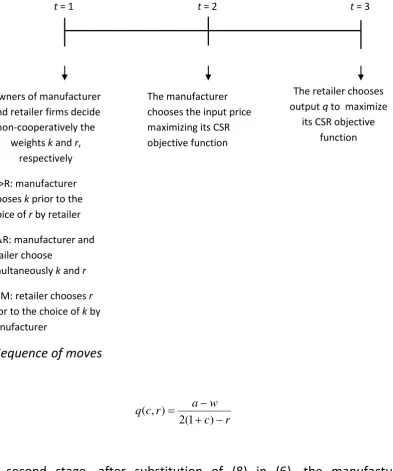
The game is structured as a three-stage game. At stage three, as usual, the
retailer chooses output having a CSR objective. At stage two, the manufacturer
fixes the input price. Then, at stage one, owners of manufacturer and retailer
firms decide non-cooperatively the weight of consumer surplus for the
objective function, maximizing their own profits, according to three different
sequence of moves: i) M->R: the manufacturer chooses k prior to the choice of
r by retailer; ii) M&R: the manufacturer and the retailer simultaneously choose
k and r; iii) R->M: the retailer chooses r prior to the manufacturer’s choice of k.
As usual, the game is solved by backward induction. The sequence of moves for
this game is illustrated in Figure 1.
At the third stage, the maximization of the retailer firm objective function in (7)
leads to the following output function
12
It is easy to see that, for k =r= 0, each firm operates as a profit-maximizing firm while, for
13
Fig. 1. Sequence of moves
r c
w a r
c q
) 1 ( 2 ) ,
( (8)
At the second stage, after substitution of (8) in (6), the manufacturer
maximizes its objective function (6) with respect to c, which straightforwardly
leads to the input as a function of the CSR parameters:
2 2 ) 1 2 ( 2 ) ,
(k r v k r
c . (9)
Substituting (9) in (8), we obtain the final quantity as function of the CSR
parameters:
Owners of manufacturer and retailer firms decide non-cooperatively the
weights k and r, respectively
M->R: manufacturer chooses k prior to the choice of r by retailer
M&R: manufacturer and retailer choose
simultaneously k and r
R->M: retailer chooses r
prior to the choice of k by manufacturer
The manufacturer chooses the input price maximizing its CSR objective function
The retailer chooses output q to maximize
its CSR objective function
14
v k r
w a r k q ) 1 ( 2 2 ) ,
( . (10)
Substituting backwards (9) and (10) we obtain both firms’ profits as function of only CSR parameters:
22 ) 1 ( 2 8 ) ( 2 ) 1 ( 2 ) , ( r k v w a r k v r k M
(11)
22 ) 1 ( 2 8 ) ( 3 2 ) 1 ( 4 ) , ( r k v w a r k v r k R
(12)
We now address the stage of the decision on the CSR parameters. Let us begin
with the case MR. Under this sequence, the manufacturer decides whether
and how introduce the CSR parameter prior to the corresponding retailer’s decision. The solutions of this stage are given by the following Lemmas.
Lemma 1. The retailer sets a CSR parameter at the level r=r°, whose values depend on the future choice of the k level by manufacturer .
Proof: it is easy to see that
3) 1 ( 2 0 ) 1 ( 2 8 ) ( ) 1 ( 2 3 3 2 k v r r r k v w a v k r r M R
R
.
Lemma 2. The manufacturer, taking into account the decision of the retailer on r=r°, chooses to remain a profit-seeking firm (i.e., k=0).
Proof: it is easy to see that
2
3
3(5 2(1 ) ( )
0, 0
32 2(1 )
M
M R
k v a w
k
k k v
15 Under the sequence M&R, both firms’ owners decide independently and simultaneously on their CSR parameters, leading to the following Lemmas.
Lemma 3. Only the retailer decides a positive engagement in CSR activities setting r=r*.
Proof: this straightforwardly derives by observing each derivative of profits
with respect to the own CSR parameter:
2 3 & ( ) 0, 04 2(1 )
M
M R
k a w
k
k v k r
, and
3) 1 ( 2 0 ) 1 ( 2 8 ) ( ) 1 ( 2 3 3 2 & k v r r r k v w a v k r r M R
R
.
Therefore, the retailer, given the manufacturer’s choice of remaining
profit-seeking (k=0), selects the optimal (profit-maximizing) CSR parameter at the
level 3 ) 1 ( 2 * v r
r
. (13)
Remark: By inspection of (13), we observe that the retailer always chooses to
take into account in its objective at least two-third of the consumer surplus;
because this weight increases with the marginal cost of input production, it
follows that, when the latter is sufficiently high, even a weight of the consumer
surplus larger than the unity (and then, than own profits) may be optimal for
16 Finally, under the sequence RM, the retailer decides whether and how
introduce the CSR parameter prior to the corresponding manufacturer’s decision. Under this sequence, the following holds.
Lemma 4. The manufacturer does never engage in CSR activities.
Proof: it is easy to see that
2
3
( )
0, 0
4 2(1 )
M
R M
k a w
k
k v k r
.
Lemma 5. The retailer, embodying the decision of the manufacturer of not being of CSR-type (i.e., k=0), decides a positive engagement in CSR activities
setting r=r*.
Proof: it is easy to see that
2(1 )
0 *8 ) ( ) 1 ( 2 3 3 2 r r r k v w a v r
r R M R .
From Lemma 1-5, the following Corollary holds.
Corollary 1. Regardless of the timing of moves as regards the choice of the CSR parameter, the retailer always chooses the some level of CSR, while the
manufacturer always choses to remain profit-seeking.
17 while in Brand and Grothe (2015) is adopted by both firms but only if the timing
of moves is MR.
Substituting the retailer’s CSR parameter positive value r* in (9), and taking into account for the choice of being only profit-seeking by the manufacturer, that is
k=0, we obtain the equilibrium wholesale price c*:
2 5 *
3
v
c (14)
Substitution of r*, k=0, and the equilibrium wholesale price c* into the
expressions (10), (11) and (12) yields the equilibrium quantity, each firm’s
profits and total channel profits ():
) 1 ( 8 ) ( 3 * v w a q
(15)
) 1 ( 32 ) ( 3 * 2 v w a M
(16)
) 1 ( 64 ) ( 9 * 2 v w a R
(17)
) 1 ( 64 ) ( 15 * 2 v w a
(18)
Moreover, it is also straightforward to provide the expressions for the
consumer surplus and total welfare:
2 2 ) 1 ( 128 ) ( 9 * v w a CS
(19)
2 2 ) 1 ( 128 ) )( 13 10 ( 3 * v w a v SW
18 To compare the classical bilateral monopoly in which both firms are purely
profit-maximizing and a bilateral monopoly in which a socially concerned
retailer endogenously emerges (while the manufacturer remains
profit-maximizing), we report the equilibrium outcomes of the former case13:
v
c12 (21)
) 1 ( 4 ) ( v w a q
(22)
) 1 ( 16 ) ( 2 v w a M
(23)
) 1 ( 8 ) ( 2 v w a R
(24)
) 1 ( 16 ) ( 3 2 v w a
(25)
2 2 ) 1 ( 32 ) ( v w a CS
(26)
2 2 ) 1 ( 32 ) )( 7 6 ( v w a v SW
(27)
Lemma 6. The manufacturer always charges a lower input price when the retailer is social concerned.
Proof: by simple comparison of (14) and (21).
The choice of the manufacturer of not being engaged in CSR activities is
intuitive. Given the decreasing returns technology, every additional unit of
output produced is increasingly costly. Therefore, the manufacturer has not
13
Those outcomes are straightforwardly obtained considering that, if both firms are purely
19 any incentive in further expanding production taking into account the
consumers’ welfare into its objective. On the other hand, the retailer strategically adopts CSR behaviors to obtain a lower input price from the
manufacturer (see also eq. (9)). The selection of a positive level of “consumers’
friendly” CSR activities leads to an output expansion which has several effects both on the revenues and costs side of the retailer. In fact, on the one hand, an
increase in output has a positive effect on revenues; however, it decreases the
price for final consumers, with a negative impact on revenues. On the other
hand, more products for the final consumers directly increase the retailer’s
total cost; however, the strategic choice of engaging in CSR reduces the
manufacturer’s wholesale price of the intermediate input (which has the highest incidence on the retailer’s total costs). As a consequence, for the retailer the combined effect of the output expansion and the input price
reduction overweighs the effect of the output price reduction, and for the
manufacturer the output expansion effect overweighs the price reduction
effect, leading to the following results.
Result 1. When the endogenous choice whether to be of CSR-type is allowed in the supply chain, the emergence of downstream firms' concern over CSR
realizes an enhancement of profits of each firm, industry profit, consumer
surplus and social welfare as a whole.
Proof: by simple comparison of Eqs. (16- 20) and (23-27).
Corollary 2. i) Although the downstream firm's CSR concern brings upon a profits increase in both firms, the profits’ enhancement of the CSR retailer firm
20 standard profit-seeking context the manufacturer’s profits are twice those of
the retailer, under the retailer’s endogenous choice of CSR the profitability
ranking is exactly reversed.
Therefore, we note that, in a vertical industry with a convex technology, the
choice of being CSR-engaged results in a device in the hand of the retailer to
redistribute profits inside the channel with respect to the supplier, however
not at the expenses of the latter, which also benefits from the retailer’s social
responsibility, as does the total value of the channel as well as the welfare of
consumers and society.
Corollary 3. The downstream firm's social responsibility not only brings upon a higher profit for its owners but also leads to a Pareto-superior outcome.
6. Conclusions
This paper investigates a standard bilateral monopoly in which a manufacturer
sells an intermediate product to the retailer, which in turn offers the final
product to end-consumers, allowing for an endogenous strategic choice of the
level of care about the consumer surplus (consumers’ friendly CSR) by the
firms’ owners, assuming decreasing return to the input provided by the
manufacturer to the retailer. In other words, we revisit the results of Brand and
Grothe (2015) who assume a linear bilateral monopoly, and we reveal different
findings which can be resumed as follows: 1) the achievement of a higher profit
for owners of all firms at the equilibrium, as the motivation behind the
presence of social concerns in the firms’ behaviors, is also extended to a
21 downstream firm - but not for the upstream firm - to be of CSR-type and
strongly engaged towards the welfare of consumers (even being sensitive to it
more than to own profits), and this holds for whatever timing of moves with
respect to the choice of CSR, reversing the Brand and Grothe’s (2015) finding;
3) not only the retailer’s profits but also the profit-seeking manufacturer firm’s profits benefit from the consumers’ friendly CSR activities of its retailer and
thus this situation constitutes a Pareto-superior outcome; 4) this result may
explain real world cases in which in a supply chain only the retailer is engaged
in CSR activities; 5) this offers a policy warning about whether either retailers
or manufacturers should be more stimulated for engaging in CSR, depending
on the prevailing technology (i.e. returns to scale) in the industry; 6) since we
have shown that the choice of being CSR-engaged becomes a device in the
hand of the retailer to redistribute profits inside the marketing channel then, in
a vertical industry with a convex technology, the empirical implication is that it
should more often detected a presence of CSR in the downstream rather than
in the upstream firm as well as a higher profitability of the retailer than that of
the manufacturer when the former engages in CSR activities; 7) the purely
selfish owners’ behavior of the downstream component of a bilateral monopoly leads to the achievement of a Pareto-improvement. This is another
novel example showing the reconciliation between the achievement of social
objectives and the sole firm’s behaviour admitted by the traditional approach
of economics – according to the Friedman (1970)’s opinion - that is, the
maximization of profits to the shareholders. In conclusion, our paper sheds new
light on whether and how firms in a marketing channel may endogenously
choose to be socially concerned under a realistic technology.
As future research agenda, those findings call for an extra robustness check
22 First, it would be interesting to introduce network externalities to verify the
survival of the current results. Moreover, other hypotheses such as the
presence of managerial delegation and endogenous costs (such as the
presence of unionised labor) within the marketing channel, either only in the
upstream/downstream company or in all the channel, are extremely intriguing
to be studied.
References
Aupperle, K.E., Carroll, A.B., Hatfield, J.D., 1985. An empirical examination of
the relationship between corporate social responsibility and
profitability. Academy of Management Journal 28(2), 446-463.
Baron, D.P., 2001. Private politics, corporate social responsibility, and
integrated strategy. Journal of Economics and Management Strategy 10,
7–45.
Benabou, R., Tirole, J., 2010. Individual and Corporate Social Responsibility.
Economica 77, 1-19.
Bils, M., 1987. The Cyclical Behavior of Marginal Cost and Price. The American
Economic Review 77(5), 838-855.
Brand B., Grothe M., 2013. A note on ‘Corporate Social Responsibility and
Marketing Channel Coordination’. Research in Economics 67, 324–327.
Brand, B., Grothe, M., 2015. Social Responsibility in a Bilateral Monopoly.
Journal of Economics 115, 275–289.
Bromiley, P., Marcus, A., 1989. The deterrent to dubious corporate behavior:
Profitability, probability and safety recalls. Strategic Management
23 Chen, C.L., Liu, Q., Li, J., Wang, L.F.S., 2016. Corporate social responsibility and
downstream price competition with retailer's effort. International
Review of Economics and Finance 46, 36–54.
Davidson, W.N., Chandy, P.R., Cross, M., 1987. Large losses, risk management
and stock returns in the airline industry. The Journal of Risk and
Insurance 54(1), 162-172.
Davidson, W.N., Worrel, D.L., 1988. The impact of announcements of corporate
illegalities on shareholder returns. Academy of Management
Journal 31(1), 195-200.
Doni, N., Ricchiuti G., 2013. Market equilibrium in the presence of green
consumers and responsible firms: A comparative statics analysis.
Resource and Energy Economics 35, 380–395.
Fanti, L., Buccella, D., 2017a. The effects of Corporate Social Responsibility on
entry. Economia e Politica Industriale - Journal of Industrial and Business
Economics 44(2), 259-267.
Fanti, L., Buccella, D., 2017b. Corporate Social Responsibility in a game
theoretic context. Economia e Politica Industriale - Journal of Industrial
and Business Economics 34(3), 471–489.
Fanti, L., Buccella, D., 2017c. Corporate social responsibility, profits and welfare
with managerial firms. International Review of Economics 64(4), 341-356.
Fanti, L., Buccella, D., 2017d. Profitability of Corporate Social Responsibility in
network industries. Department of Economics and Management,
University of Pisa, Discussion Paper 2017/216.
Fernández‐Kranz, D., Santaló, J., 2010. When necessity becomes a virtue: The effect of product market competition on corporate social
responsibility. Journal of Economics & Management Strategy19(2),
24 Friedman, M., 1970. The Social Responsibility of Business is to Increase its
Profits, New York Times Magazine, September.
Garriga, E., Melè, D., 2004. Corporate Social Responsibility Theories: Mapping the Territory. Journal of Business Ethics 53, 51–71, 2004.
Goering, G.E., 2007. The strategic use of managerial incentives in a non-profit
firm mixed duopoly. Managerial and Decision Economics 28, 83–91.
Goering, G. E., 2008. Welfare impacts of a non-profit firm in mixed commercial
markets. Economic Systems 32, 326–334.
Goering, G.E., 2012. Corporate social responsibility and marketing channel
coordination. Research in Economics 66(2), 142–148.
Goering, G.E., 2014. The profit-maximizing case for corporate social
responsibility in a bilateral monopoly. Managerial and Decision
Economics 35, 493–499
Griffin, J.J., Mahon, J.F., 1997. The corporate social performance and corporate
financial performance debate twenty-five years of incomparable
research. Business & Society36(1), 5-31
Ingram, R.W., Frazier, K.B., 1983. Narrative disclosures in annual
reports. Journal of Business Research 11(1), 49-60.
Kopel, M (2009) Strategic CSR, spillovers, and first-mover advantage. SSRN.
doi:10.2139/ssrn.1408632
Kopel, M., Brand, B., 2012. Socially responsible firms and endogenous choice of
strategic incentives. Economic Modelling 29(3), 982–989.
Kopel, M., Brand, B., 2013. Why Do Socially Concerned Firms Provide
Low-Powered Incentives to their Managers? SSRN Working Paper. Available at
SSRN: https://ssrn.com/abstract=2269192 or http://dx.doi.org/10.2139/s
25 KPMG, 2005. KPMG International Survey of Corporate Social Responsibility
Reporting 2005. Available online at
https://commdev.org/userfiles/files/1274_file_D2.pdf
KPMG, 2015. Currents of Change: KPMG Survey of Corporate responsibility
reporting 2015. Available online at
http://www.kpmg.com/cn/en/issuesandinsights/articlespublications/pag
es/kpmg-survey-of-corporate-responsibility-reporting-2015-o-201511.aspx
Hino, Y., Zennyo Y., 2017, Corporate social responsibility and strategic
relationships. International Review of Economics 64(3), 231-244.
Heywood, J. S., McGinty, M., 2007. Convex costs and the merger paradox
revisited. Economic Inquiry 45, 342_349.
Lambertini, L., Tampieri, A., 2012. Corporate social responsibility and firms
ability to collude. In: Boubaker, S., Nguyen, D.K. (Eds.), Board Directors
and Corporate Social Responsibility. Houndmills, Palgrave Macmillan UK.
Lambertini L., Tampieri A., 2015. Incentives, performance and desirability of
socially responsible firms in a Cournot oligopoly. Economic Modelling 50,
40–48.
Lambertini, L., Palestini, A., Tampieri, A., 2016. CSR in an asymmetric duopoly
with environmental externality. Southern Economic Journal 83, 236–252.
Planer-Friedrich, L., Sahm M., 2016. Why firms should care for all consumers,
BERG Working Paper Series, No. 116, ISBN 978-3-943153-35-4.
Reinhardt, F.L., Stavins, R.N., Vietor, R.H.K., 2008. Corporate social
responsibility through an economic lens. Review of Environmental
26 Roman, R.M., Hayibor, S. Agle, B.R., 1999. The relationship between social and
financial performance repainting a portrait. Business & Society 38(1),
109-125.
Schramm-Klein H., Dirk Morschett, D., Swoboda, B., 2015. Retailer corporate
social responsibility: Shedding light on CSR’s impact on profit of intermediaries in marketing channels. International Journal of Retail &
Distribution Management 43(4-5), 403-431.
Siegel, D.S., Vitaliano, D.F., 2007. An empirical analysis of the strategic use of
corporate social responsibility. Journal of Economics and Management
Strategy 16(3), 773–792.
Spengler, J.J., 1950. Vertical integration and antitrust policy. Journal of Political
Economy 58(4), 347–352.
Waddock, S.A., Graves, S.B., 1997. The corporate social performance-financial
performance link. Strategic Management Journal 18(4), 303-319.
Wirl, F., 2015. Downstream and upstream oligopolies when retailer's effort