3098
Multi-Source Cross-Lingual Model Transfer: Learning What to Share
Xilun Chen†∗ Ahmed Hassan Awadallah‡ Hany Hassan‡
Wei Wang‡ Claire Cardie†
†Cornell University
Ithaca, NY
{xlchen,cardie}@cs.cornell.edu
‡Microsoft Research
Redmond, WA
{hassanam,hanyh,Wei.Wang}@microsoft.com
Abstract
Modern NLP applications have enjoyed a great boost utilizing neural networks models. Such deep neural models, however, are not applica-ble to most human languages due to the lack of annotated training data for various NLP tasks. Cross-lingual transfer learning (CLTL) is a viable method for building NLP models for a low-resource target language by lever-aging labeled data from other (source) lan-guages. In this work, we focus on the multi-lingual transfer setting where training data in multiple source languages is leveraged to fur-ther boost target language performance.
Unlike most existing methods that rely only on language-invariant features for CLTL, our approach coherently utilizes both language-invariant and language-specific featuresat in-stance level. Our model leverages adversarial networks to learn language-invariant features, and mixture-of-experts models to dynamically exploit the similarity between the target lan-guage and each individual source lanlan-guage1.
This enables our model to learn effectively what to share between various languages in the multilingual setup. Moreover, when coupled with unsupervised multilingual embeddings, our model can operate in azero-resource set-ting where neither target language training datanorcross-lingual resourcesare available. Our model achieves significant performance gains over prior art, as shown in an extensive set of experiments over multiple text classifi-cation and sequence tagging tasks including a large-scale industry dataset.
1 Introduction
Recent advances in deep learning enabled a wide variety of NLP models to achieve impressive per-formance, thanks in part to the availability of
∗
Most work was done while the first author was an intern at Microsoft Research.
1The code is available at https://github.com/
microsoft/Multilingual-Model-Transfer.
large-scale annotated datasets. However, such an advantage is not available to most of the world lan-guages since many of them lack the the labeled data necessary for training deep neural nets for a variety of NLP tasks. As it is prohibitive to obtain
training data for all languages of interest,
cross-lingual transfer learning (CLTL) offers the
pos-sibility of learning models for a target language
using annotated data from other languages (source
languages) (Yarowsky et al.,2001). In this paper,
we concentrate on the more challenging
unsuper-visedCLTL setting, whereno target language la-beled data is used for training.2
Traditionally, most research on CLTL has been
devoted to the standardbilingual transfer(BLTL)
case where training data comes from a single source language. In practice, however, it is of-ten the case that we have labeled data in a few languages, and would like to be able to utilize all of the data when transferring to other languages.
Previous work (McDonald et al., 2011) indeed
showed that transferring from multiple source lan-guages could result in significant performance im-provement. Therefore, in this work, we focus on the multi-source CLTL scenario, also known as
multilingual transfer learning (MLTL), to
fur-ther boost the target language performance. One straightforward method employed in CLTL is weight sharing, namely directly applying the model trained on the source language to the target after mapping both languages to a common
em-bedding space. As shown in previous work (Chen
et al.,2016), however, the distributions of the hid-den feature vectors of samples from different lan-guages extracted by the same neural net remain di-vergent, and hence weight sharing is not sufficient for learning a language-invariant feature space that generalizes well across languages. As such,
ous work has explored usinglanguage-adversarial training(Chen et al.,2016;Kim et al.,2017) to ex-tract features that are invariant with respect to the shift in language, using only (non-parallel) unla-beled texts from each language.
On the other hand, in the MLTL setting, where multiple source languages exist, language-adversarial training will only use, for model trans-fer, the features that are common among all source languages and the target, which may be too re-strictive in many cases. For example, when
trans-ferring from English, Spanish and Chinese to
German, language-adversarial training will retain only features that are invariant across all four lan-guages, which can be too sparse to be informative. Furthermore, the fact that German is more similar to English than to Chinese is neglected because the transferred model is unable to utilize features that are shared only between English and German.
To address these shortcomings, we propose a new MLTL model that not only exploits language-invariant features, but also allows the target lan-guage to dynamically and selectively leverage language-specific features through a probabilistic attention-style mixture of experts mechanism (see
§3). This allows our model to learn effectively
what to share between various languages.
An-other contribution of this paper is that, when com-bined with the recent unsupervised cross-lingual
word embeddings (Lample et al.,2018;Chen and
Cardie,2018b), our model is able to operate in a
zero-resourcesetting where neither task-specific
target language annotationsnor general-purpose cross-lingual resources (e.g. parallel corpora or machine translation (MT) systems) are available. This is an advantage over many existing CLTL works, making our model more widely applicable to many lower-resource languages.
We evaluate our model on multiple MLTL tasks ranging from text classification to named entity recognition and semantic slot filling, including a real-world industry dataset. Our model beats all baseline models trained, like ours, without cross-lingual resources. More strikingly, in many cases, it can match or outperform state-of-the-art models that have access to strong cross-lingual supervi-sion (e.g. commercial MT systems).
2 Related Work
The diversity of human languages is a critical chal-lenge for natural language processing. In order to
alleviate the need for obtaining annotated data for each task in each language, cross-lingual transfer
learning (CLTL) has long been studied (Yarowsky
et al.,2001;Bel et al.,2003,inter alia).
Forunsupervised CLTL in particular, where no target language training data is available, most
prior research investigates the bilingual
trans-fer setting. Traditionally, research focuses on
resource-based methods, where general-purpose cross-lingual resources such as MT systems or parallel corpora are utilized to replace
task-specific annotated data (Wan, 2009;Prettenhofer
and Stein, 2010). With the advent of deep
learn-ing, especially adversarial neural networks (
Good-fellow et al., 2014; Ganin et al., 2016), progress
has been made towardsmodel-basedCLTL
meth-ods. Chen et al. (2016) propose language-adversarial training that does not directly depend on parallel corpora, but instead only requires a set of bilingual word embeddings (BWEs).
On the other hand, the multilingual transfer
setting, although less explored, has also been stud-ied (McDonald et al., 2011;Naseem et al.,2012;
T¨ackstr¨om et al., 2013; Hajmohammadi et al.,
2014;Zhang and Barzilay,2015;Guo et al.,2016), showing improved performance compared to us-ing labeled data from one source language as in bilingual transfer.
Another important direction for CLTL is to
learn cross-lingual word representations (
Klemen-tiev et al.,2012;Zou et al.,2013;Mikolov et al.,
2013). Recently, there have been several notable
work for learning fully unsupervised cross-lingual
word embeddings, both for the bilingual (Zhang
et al., 2017; Lample et al., 2018; Artetxe et al.,
2018) and multilingual case (Chen and Cardie,
2018b). These efforts pave the road for perform-ing CLTL without cross-lperform-ingual resources.
Finally, a related field to MLTL is multi-source
domain adaptation (Mansour et al.,2009), where
most prior work relies on the learning of
domain-invariant features (Zhao et al., 2018; Chen and
Cardie, 2018a). Ruder et al. (2019) propose a general framework for selective sharing between domains, but their method learns static weights
at the task level, while our model can
dynami-cally select what to share at the instance level.
A very recent work (Guo et al., 2018) attempts
simul-Shared Feature Extractor
Fs
MoE Private Feature Extractor
Fp
MoE Task-Specific Predictor
C
Task Label
Multilingual Word Representation
Input Text JC
Language Discriminator
D
Language Label
JD 1JD
Gate Label
2Jg
Forward and backward passes when updating the parameters of Fs, Fp and C Forward and backward passes when updating the parameters of D
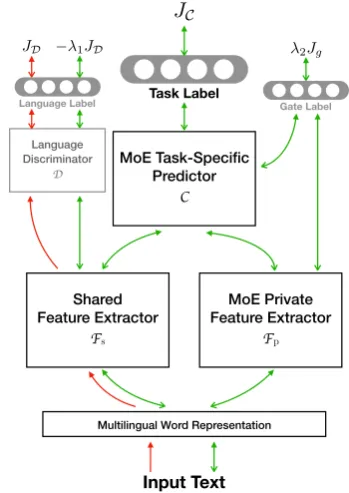
Figure 1: An overview of theMAN-MoEmodel.
taneously utilize both the domain-invariant and domain-specific features in a coherent way.
3 Model
One commonly adopted paradigm for
neu-ral cross-lingual transfer is the shared-private
model (Bousmalis et al., 2016), where the
fea-tures are divided into two parts:shared
(language-invariant) features andprivate(language-specific)
features. As mentioned before, the shared fea-tures are enforced to be language-invariant via language-adversarial training, by attempting to
fool a language discriminator. Furthermore,Chen
and Cardie(2018a) propose a generalized shared-private model for the multi-source setting, where a
multinomial adversarial network(MAN) is adopted to extract common features shared by all source languages as well as the target. On the other hand, the private features are learned by separate feature extractors, one for each source language, captur-ing the remaincaptur-ing features outside the shared ones. During training, the labeled samples from a certain source language go through the corresponding pri-vate feature extractor for that particular language. At test time, there is no private feature extractor for the target language; only the shared features are used for cross-lingual transfer.
As mentioned in§1, using only the shared
fea-tures for MLTL imposes an overly strong
con-straint and many useful features may be wiped out by adversarial training if they are shared only between the target language and a subset of source languages. Therefore, we propose to use a mixture-of-experts (MoE) model (Shazeer et al.,
2017;Gu et al.,2018) to learn the private features. The idea is to have a set of language expert net-works, one per source language, each responsi-ble for learning language-specific features for that source language during training. However, instead of hard-switching between the experts, each sam-ple uses a convex combination of all experts,
dic-tated by an expert gate. Thus, at test time, the
trained expert gate can decide the optimal expert weights for the unseen target language based on its similarity to the source languages.
Figure 1 shows an overview of our MAN-MoE
model for multilingual model transfer. The boxes
illustrate various components of the MAN-MoE
model (§3.1), while the arrows depict the training flow (§3.2).
3.1 Model Architecture
Figure 1 portrays an abstract view of the
MAN-MoEmodel with four components: the
Mul-tilingual Word Representation, the MAN Shared
Feature ExtractorFs(together with the Language
DiscriminatorD), theMoEPrivate Feature
Extrac-torFp, and finally theMoEPredictorC. Based on
the actual task (e.g. sequence tagging, text classi-fication, sequence to sequence, etc.), different ar-chitectures may be adopted, as explained below.
Multilingual Word Representation embeds
words from all languages into a single semantic space so that words with similar meanings are
close to each other regardless of language. In
this work, we mainly rely on the MUSE embed-dings (Lample et al., 2018), which are trained in a fully unsupervised manner. We map all other languages into English to obtain a multilingual
embedding space. However, in certain
experi-ments, MUSE yields 0 accuracy on one or more
language pairs (Søgaard et al., 2018), in which
case the VecMap embeddings (Artetxe et al.,
2017) are used. It uses identical strings as
su-pervision, which does not require parallel corpus
or human annotations. We further experiment
with the recent unsupervised multilingual word
embeddings (Chen and Cardie, 2018b), which
gives improved performance (§4.2).
[image:3.595.89.264.64.311.2]fea-BiLSTM … …
… … BiLSTM BiLSTM
Multilingual Word Representation
Driving directions to
… … … …
EN Expert MLP Expert
Gate ESMLP Expert
ZH Expert MLP
⍺1 ⍺
2 ⍺3
Private Features
Gate Label
[image:4.595.74.287.62.251.2]2Jg
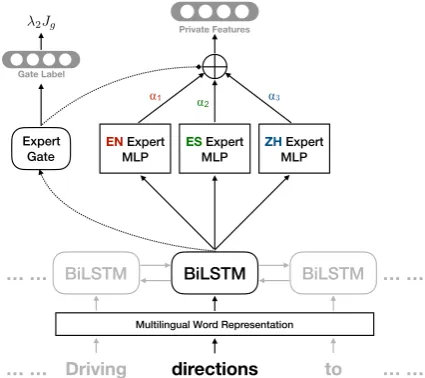
Figure 2: TheMoEPrivate Feature ExtractorFp with three source languages: English (EN), Spanish (ES), and Chinese (ZH).
tures are important, one can add character-level
word embeddings (Dos Santos and Zadrozny,
2014) that captures sub-word information. When
character embeddings are used, we add a single CharCNN that is shared across all languages, and the final word representation is the concatenation of the word embedding and the char-level embed-ding. The CharCNN can then be trained end to end with the rest of the model.
MAN Shared Feature Extractor Fs is a
multi-nomial adversarial network (Chen and Cardie,
2018a), which is an adversarial pair of a feature
extractor (e.g. LSTM or CNN) and alanguage
dis-criminator D. D is a text classifier (Kim, 2014) that takes the shared features (extracted byFs) of
an input sequence and predicts which language it
comes from. On the other hand,Fsstrives to fool
Dso that it cannot identify the language of a
sam-ple. The hypothesis is that ifDcannot recognize
the language of the input, the shared features then do not contain language information and are hence
language-invariant. Note thatDis trained only
us-ing unlabeled texts, and can therefore be trained on all languages including the target language.
MoE Private Feature ExtractorFp is a key
dif-ference from previous work, shown in Figure 2.
The figure shows the Mixture-of-Experts (Shazeer
et al., 2017) model with three source languages,
English, Spanish, and Chinese. Fp has a shared
BiLSTM at the bottom that extracts contextualized
word representations for each tokenwin the input
sentence. The LSTM hidden representationhwis
then fed into theMoEmodule, where each source
language has a separate expert network (a MLP). In addition, theexpert gateG is a linear
transfor-mation that takeshw as input and outputs a
soft-max score αi for each expert. The final private
feature vector is a mixture of all expert outputs, dictated by the expert gate weightsα.
During training, the expert gate is trained to pre-dict the language of a sample using the gate loss
Jg, where the expert gate outputαis treated as the
softmax probability of the predicted languages. In other words, the more accurate the language pre-diction is, the more the correct expert gets used.
Therefore,Jg is used to encourage samples from
a certain source language to use the correct ex-pert, and each expert is hence learning language-specific features for that language. As the BiL-STM is exposed to all source languages during training, the trained expert gate will be able to examine the hidden representation of a token to
predict the optimal expert weightsα, even for
un-seen target languages at test time. For instance,
if a German test sample is similar to the English training samples, the trained expert gate will
pre-dict a higher α for the English expert, resulting
in a heavier use of it in the final feature vector. Therefore, even for the unforeseen target language
(e.g. German), Fp is able to dynamically
deter-mine what knowledge to use from each individual source language at a token level.
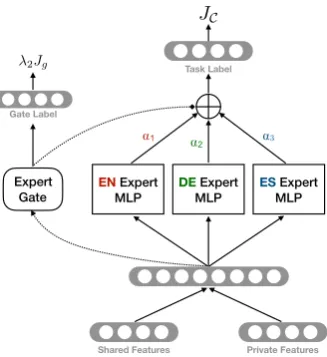
MoETask-Specific Predictor Cis the final
mod-ule that make predictions for the end task, and may take different forms depending on the task. For in-stance, for sequence tagging tasks, the shared and private features are first concatenated for each
to-ken, and then past through aMoE module similar
toFp(as shown in Figure6in the Appendix). It is
straightforward to adaptCto work for other tasks.
For example, for text classification, a pooling layer such as dot-product attention (Luong et al.,2015) is added at the bottom to fuse token-level features into a single sentence feature vector.
C first concatenates the shared and private
fea-tures to form a single feature vector for each
to-ken. It then has anotherMoEmodule that outputs
lan-Algorithm 1MAN-MoETraining
Require: labeled corpusX; unlabeled corpusU;
Hyperpa-mameterλ1, λ2>0,k∈N
1: repeat
2: .Diterations
3: forditer= 1tokdo
4: lD= 0
5: for alll∈∆do .For all languages 6: Sample a mini-batchx∼Ul
7: fs=Fs(x) .Shared features
8: lD+=LD(D(fs);l) .Dloss
9: UpdateDparameters using∇lD
10: .Main iteration 11: loss= 0
12: for alll∈ Sdo .For all source languages 13: Sample a mini-batch(x,y)∼Xl
14: fs=Fs(x) .Shared features
15: fp,g1=Fp(x) .Private feat. & gate outputs
16: yˆ,g2=C(fs,fp)
17: loss+=LC( ˆy;y) +λ2(Lg(g1;l) +Lg(g2;l))
18: for alll∈∆do .For all languages 19: Sample a mini-batchx∼Ul
20: fs=Fs(x) .Shared features
21: loss+=−λ1·LD(D(fs);l) .ConfuseD
22: UpdateFs,Fp,Cparameters using∇loss
23: untilconvergence
guages are similar to each other while all being rather distant from Chinese. Therefore, the adver-sarially learned shared features might be more im-portant in this case. On the other hand, when trans-ferring to German, which is much more similar to English than to Chinese, we might want to pay
more attention to theMoEprivate features.
There-fore, we adopt aMoEmodule inC, which provides
more flexibility than using a single MLP3.
3.2 Model Training
Denote the set of all N source languages as S,
where |S| = N. Denote the target language as
T, and let∆ =S ∪ T be the set of all languages.
Denote the annotated corpus for a source language
l∈ SasXl, where(x, y)∼Xlis a sample drawn
from Xl. In addition, unlabeled data is required
for all languages to facilitate theMANtraining. We hence denote asUl0the unlabeled texts from a
lan-guagel0 ∈∆.
The overall training flow of variant components
is illustrated in Figure 1, while the training
al-gorithm is depicted in Alal-gorithm 1. Similar to
MAN, there are two separate optimizers to train
MAN-MoE, one updating the parameters ofD(red arrows), while the other updating the parameters
of all other modules (green arrows). In
Algo-3We also experimented with an attention mechanism be-tween the shared and private features, or a gating mechanism to modulate each feature channel, but got sub-optimal results.
rithm1,LC,LD andLg are the loss functions for
the predictorC, the language discriminatorD, and the expert gates inFpandC, respectively.
In practice, we adopt the NLL loss for LC for
text classification, and token-level NLL loss for sequence tagging:
LN LL(ˆy;y) =−logP(ˆy=y) (1)
LT-N LL( ˆy;y) =−logP( ˆy=y)
=−X
i
logP( ˆyi =yi) (2)
whereyis a scalar class label, andyis a vector of
token labels. LC is hence interpreted as the
neg-ative log-likelihoodof predicting the correct task
label. Similarly, D adopts the NLL loss in (1)
for predicting the correct language of a sample.
Finally, the expert gates G use token-level NLL
loss in (2), which translates to the negative log-likelihood of using the correct language expert for each token in a sample.
Therefore, the objectives thatC,DandG
mini-mize are, respectively:
JC=
X
l∈S
E (x,y)∈Xl
[LC(C(Fs(x),Fp(x));y)] (3)
JD=
X
l∈∆ E x∈Ul
[LD(D(Fs(x));l)] (4)
JG=
X
l∈S
E x∈Xl
" X
w∈x
LG(G(hw);l)
#
(5)
wherehwin (5) is the BiLSTM hidden
representa-tion inFp as shown in Figure2. In addition, note
thatDis trained using unlabeled corpora over all
languages (∆), while the training ofFpandC(and
henceG) only take place on source languages (S). Finally, the overall objective function is:
J =JC−λ1JD+λ2(JG(1)+J
(2)
G ) (6)
whereJG(1)andJG(2)are the two expert gates inFp
andC, respectively. More implementation details
can be found in AppendixB.
4 Experiments
English German Spanish Chinese
Domain #Train #Dev #Test #Train #Dev #Test #Train #Dev #Test #Train #Dev #Test #Slot
Navigation 311045 23480 36625 13356 1599 2014 13862 1497 1986 7472 1114 1173 8
Calendar 64010 5946 8260 8261 1084 1366 6706 926 1081 2056 309 390 4
Files 30339 2058 5355 3005 451 480 6082 843 970 1289 256 215 5
Domain Examples
Navigation [Driving]transportation typedirections to[Walmart]place namein[New York]location.
Calendar Add[school meeting]titleto my calendar on[Monday]start dateat[noon]start time.
Files Search for[notes]data typewith[grocery list]keyword.
Table 1: Statistics for the Multilingual Semantic Slot Filling dataset with examples from each domain.
academic datasets, namely the CoNLL multilin-gual named entity recognition (sequence tagging)
dataset (Sang, 2002; Sang and Meulder, 2003),
and the multilingual Amazon reviews (text clas-sification) dataset (Prettenhofer and Stein,2010).
4.1 Cross-Lingual Semantic Slot Filling
As shown in Table1, we collect data for four
lan-guages: English, German, Spanish, and Chinese, over three domains: Navigation, Calendar, and Files. Each domain has a set of pre-determined slots (the slots are the same across languages), and the user utterances in each language and domain are annotated by crowd workers with the correct
slots (see the examples in Table 1). We employ
the standard BIO tagging scheme to formulate the slot filling problem as a sequence tagging task.
For each domain and language, the data is di-vided into a training, a validation, and a test set, with the number of samples in each split shown
in Table1. In our experiments, we treat each
do-main as a separate experiment, and consider each of German, Spanish and Chinese as the target guage while the remaining three being source lan-guages, which results in a total of 9 experiments.
4.1.1 Results
In Table 2, we report the performance of
MAN-MoEcompared to a number of baseline sys-tems. All systems adopt the same base architec-ture, which is a multi-layer BiLSTM sequence
tag-ger (˙Irsoy and Cardie, 2014) with a token-level
MLP on top (no CRFs were used).
MT baselines employ machine translation (MT)
for cross-lingual transfer. In particular, the train-on-trans(lation) method translates the entire En-glish training set into each target language which are in turn used to train a supervised system on the
target language. On the other hand, the
test-on-trans(lation) method trains an English sequence tagger, and utilizes MT to translate the test set
of each target language into English in order to make predictions. In this work, we adopt the
Mi-crosoft Translator4, a strong commercial MT
sys-tem. Note that for a MT system to work for
se-quence tagging tasks, word alignment
informa-tion must be available, in order to project word-level annotations across languages. This rules out many MT systems such as Google Translate since they do not provide word alignment information through their APIs.
BWE baselines rely on Bilingual Word
Embed-dings (BWEs) and weight sharing for CLTL. Namely, the sequence tagger trained on the source language(s) are directly applied to the target lan-guage, in hopes that the BWEs could bridge the language gap. This simple method has been shown
to yield strong results in recent work (Upadhyay
et al., 2018). The MUSE (Lample et al., 2018) BWEs are used by all systems in this experiment.
1-to-1indicates that we are only transferring from
English, while3-to-1means the training data from
all other three languages are leveraged.5
The final baseline is theMANmodel (Chen and
Cardie, 2018a), presented before our MAN-MoE
approach. As shown in Table2, MAN-MoE
sub-stantially outperforms all baseline systems that do not employ cross-lingual supervision on almost all domains and languages. Another interesting
ob-servation is that MAN performs strongly on
Chi-nese while being much worse on German and
Spanish compared to the BWE baseline. This
corroborates our hypothesis thatMAN only
lever-ages features that are invariant across all
lan-guages for CLTL, and it learns such features bet-ter than weight sharing. Therefore, when trans-ferring to German or Spanish, which is similar to a subset of source languages, the performance of
4
https://azure.microsoft.com/en-us/services/ cognitive-services/translator-text-api/
German Spanish Chinese
Domain Navi. Cal. Files avg. Navi. Cal. Files avg. Navi. Cal. Files avg.
Methods with cross-lingual resources
MT (train-on-trans.) 59.95 63.53 38.68 54.05 64.37 59.93 67.55 63.95 60.56 66.49 61.01 62.69
MT (test-on-trans.) 54.49 51.74 55.87 54.03 52.13 58.10 55.00 55.08 54.23 22.71 64.01 46.98
Methods without cross-lingual resources
BWE (1-to-1) 57.53 58.28 35.73 50.51 62.54 44.44 57.56 54.85 17.62 22.48 21.32 20.47 BWE (3-to-1) 61.03 67.66 51.30 60.00 63.74 45.10 64.47 57.77 20.91 13.70 28.47 21.03
MAN 59.07 60.24 39.35 52.89 58.86 37.90 46.75 47.84 34.45 13.53 40.63 29.54
[image:7.595.75.520.231.318.2]MAN-MoE 62.73 75.13 59.19 65.68 66.57 50.21 70.91 62.56 34.18 29.36 41.70 35.08
Table 2: F1 scores on the Multilingual Semantic Slot Filling dataset. The highest performance is in bold; the highest performance within method group (with vs. without cross-lingual resources) is underlined (sic passim).
German Spanish Chinese
Domain Navi. Cal. Files avg Navi. Cal. Files avg Navi. Cal. Files avg
MAN-MoE 62.73 75.13 59.19 65.68 66.57 50.21 70.91 62.56 34.18 29.36 41.70 35.08
-CMoE 63.42 76.68 55.68 65.26 65.50 47.51 69.67 60.89 27.71 21.75 41.77 30.41 -FpMoE 58.33 48.85 37.35 48.18 58.99 36.67 48.39 48.02 39.61 14.64 38.08 30.78
- bothMoE 59.07 60.24 39.35 52.89 58.86 37.90 46.75 47.84 34.45 13.53 40.63 29.54 -MAN 60.64 67.69 55.10 61.14 65.38 46.71 68.25 60.11 18.43 10.82 28.90 19.38
Table 3: Ablation (w.r.t.MAN-MoE) results on the Multilingual Semantic Slot Filling dataset.
MAN degrades significantly. On the other hand,
when Chinese serves as the target language, where all source languages are rather distant from it,
MANhas its merit in extracting language-invariant
features that could generalize to Chinese. With
MAN-MoE, however, this trade-off between close and distant language pairs is well addressed by
the combination of MAN and MoE. By utilizing
both language-invariant and language-specific
fea-tures for transfer,MAN-MoEoutperforms all
cross-lingually unsupervised baselines on all languages. Furthermore, even when compared with the MT baseline, which has access to hundreds of millions
of parallel sentences,MAN-MoEperforms
compet-itively on German and Spanish. It even signifi-cantly beats both MT systems on German as MT sometimes fails to provide accurate word align-ment for German. On Chinese, where the unsuper-vised BWEs are much less accurate (BWE
base-lines only achieve 20% F1),MAN-MoEis able to
greatly improve over the BWE andMANbaselines
and shows promising results for zero-resource CLTL even between distant language pairs.
4.1.2 Feature Ablation
In this section, we take a closer look at the various
modules ofMAN-MoEand their impacts on
perfor-mance (Table3). When theMoEinCis removed,
moderate decrease is observed on all languages. The performance degrades the most on Chinese,
suggesting that using a single MLP in C is not
ideal when the target language is not similar to the
sources. When removing the privateMoE, theMoE
in C no longer makes much sense as C only has
access to the shared features, and the performance
is even slightly worse than removing bothMoEs.
With bothMoEmodules removed, it reduces to the
MANmodel, and we see a significant drop on
Ger-man and Spanish. Finally, when removing MAN
while keepingMoE, where the shared features are
simply learned via weight-sharing, we see a slight drop on German and Spanish, but a rather great one on Chinese. The ablation results support our
hypotheses and validate the merit ofMAN-MoE.
4.2 Cross-Lingual Named Entity Recognition
In this section, we present experiments on the CoNLL 2002 & 2003 multilingual named entity
recognition (NER) dataset (Sang,2002;Sang and
Meulder, 2003), with four languages: English, German, Spanish and Dutch. The task is also for-mulated as a sequence tagging problem, with four types of tags: PER, LOC, ORG, and MISC.
The results are summarized in Table 4. We
fea-Target Language de es nl avg
Methods with cross-lingual resources
T¨ackstr¨om et al.(2012) 40.4 59.3 58.4 52.7
Nothman et al.(2013) 55.8 61.0 64.0 60.3
Tsai et al.(2016) 48.1 60.6 61.6 56.8
Ni et al.(2017) 58.5 65.1 65.4 63.0
Mayhew et al.(2017) 57.5 66.0 64.5 62.3
Methods without cross-lingual resources
MAN-MoE 55.1 59.5 61.8 58.8
BWE+CharCNN (1-to-1) 51.5 61.0 67.3 60.0 BWE+CharCNN (3-to-1) 55.8 70.4 69.8 65.3
Xie et al.(2018)* 56.9 71.0 71.3 66.4 MAN-MoE+CharCNN 56.7 71.0 70.9 66.2 MAN-MoE+CharCNN+UMWE 56.0 73.5 72.4 67.3
*
[image:8.595.307.529.62.151.2]Contemporaneous work
Table 4: F1 scores for the CoNLL NER dataset on German (de), Spanish (es) and Dutch (nl).
tures and alleviate the OOV problem. For Ger-man, however, all nouns are capitalized, and the capitalization features learned on the other three languages would lead to poor results. Therefore, for German only, we lowercase all characters in systems that adopt CharCNN.
Table 4also shows the performance of several
state-of-the-art models in the literature6. Note
that most of these systems are specifically de-signed for the NER task, and exploit many task-specific resources, such as multilingual gazetteers, or metadata in Freebase or Wikipedia (such as
en-tity categories). Among these, T¨ackstr¨om et al.
(2012) rely on parallel corpora to learn
cross-lingual word clusters that serve as features.
Noth-man et al. (2013); Tsai et al. (2016) both lever-age information in external knowledge bases such as Wikipedia to learn useful features for
cross-lingual NER. Ni et al. (2017) employ noisy
par-allel corpora (aligned sentence pairs, but not al-ways translations) and bilingual dictionaries (5k words for each language pair) for model trans-fer. They further add external features such as entity types learned from Wikipedia for improved
performance. Finally, Mayhew et al.(2017)
pro-pose a multi-source framework that utilizes large cross-lingual lexica. Despite using none of these
resources, general or task-specific, MAN-MoE
nonetheless outperforms all these methods. The only exception is German, where task-specific re-sources remain helpful due to its unique capital-ization rules and high OOV rate.
6We also experimented with the MT baselines, but it often failed to produce word alignment, resulting in many empty predictions. The MT baselines attain only a F1 score of
∼30%, and were thus excluded for comparison.
en fr ja Target Lang: de 0.25
0.30 0.35 0.40
Average Gate Weights
en de ja
Target Lang: fr enTarget Lang: jade fr
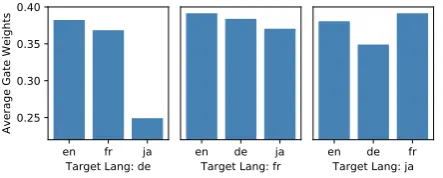
Figure 3: Average expert gate weights aggregated on a language level for theAmazon Reviewsdataset.
In a contemporaneous work by (Xie et al.,
2018), they propose a cross-lingual NER model
using Bi-LSTM-CRF that achieves similar
perfor-mance compared to MAN-MoE+CharCNN.
How-ever, our architecture is not specialized to the NER task, and we did not add task-specific modules such as a CRF decoding layer, etc.
Last but not least, we replace the MUSE em-beddings with the recently proposed unsupervised
multilingual word embeddings (Chen and Cardie,
2018b), which further boosts the performance, achieving a new state-of-the-art performance as
shown in Table4(last row).
4.3 Cross-Lingual Text Classification on
Amazon Reviews
Finally, we report results on a multilingual text classification dataset (Prettenhofer and Stein,
2010). The dataset is a binary classification
dataset where each review is classified into posi-tive or negaposi-tive sentiment. It has four languages: English, German, French and Japanese.
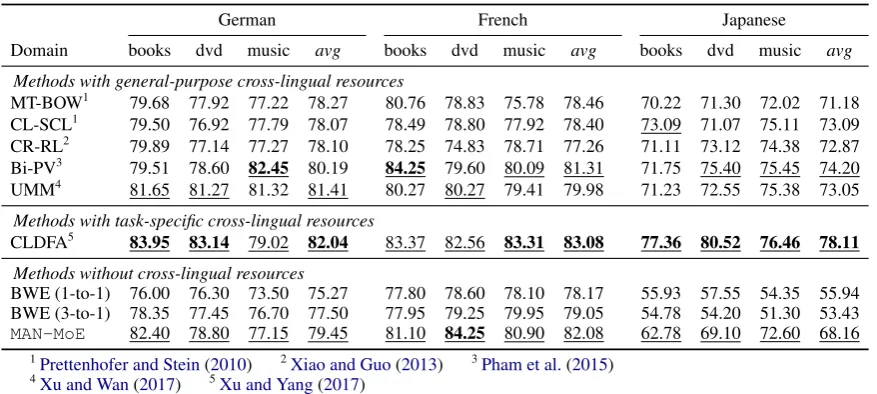
As shown in Table 5, MT-BOW uses machine
translation to translate the bag of words of a target sentence into the source language, while CL-SCL learns a cross-lingual feature space via structural
correspondence learning (Prettenhofer and Stein,
2010). CR-RL (Xiao and Guo,2013) learns
bilin-gual word representations where part of the word
vector is shared among languages. Bi-PV (Pham
et al.,2015) extracts bilingual paragraph vector by sharing the representation between parallel
doc-uments. UMM (Xu and Wan, 2017) is a
multi-lingual framework that could utilize parallel cor-pora between multiple language pairs, and pivot as needed when direct bitexts are not available for
a specific source-target pair. Finally CLDFA (Xu
[image:8.595.74.285.62.219.2]num-German French Japanese
Domain books dvd music avg books dvd music avg books dvd music avg
Methods with general-purpose cross-lingual resources
MT-BOW1 79.68 77.92 77.22 78.27 80.76 78.83 75.78 78.46 70.22 71.30 72.02 71.18 CL-SCL1 79.50 76.92 77.79 78.07 78.49 78.80 77.92 78.40 73.09 71.07 75.11 73.09 CR-RL2 79.89 77.14 77.27 78.10 78.25 74.83 78.71 77.26 71.11 73.12 74.38 72.87 Bi-PV3 79.51 78.60 82.45 80.19 84.25 79.60 80.09 81.31 71.75 75.40 75.45 74.20 UMM4 81.65 81.27 81.32 81.41 80.27 80.27 79.41 79.98 71.23 72.55 75.38 73.05
Methods with task-specific cross-lingual resources
CLDFA5 83.95 83.14 79.02 82.04 83.37 82.56 83.31 83.08 77.36 80.52 76.46 78.11
Methods without cross-lingual resources
BWE (1-to-1) 76.00 76.30 73.50 75.27 77.80 78.60 78.10 78.17 55.93 57.55 54.35 55.94 BWE (3-to-1) 78.35 77.45 76.70 77.50 77.95 79.25 79.95 79.05 54.78 54.20 51.30 53.43 MAN-MoE 82.40 78.80 77.15 79.45 81.10 84.25 80.90 82.08 62.78 69.10 72.60 68.16
1
Prettenhofer and Stein(2010) 2Xiao and Guo(2013) 3Pham et al.(2015) 4
[image:9.595.81.520.61.258.2]Xu and Wan(2017) 5Xu and Yang(2017)
Table 5: Results for the Multilingual Amazon Reviews dataset. Numbers indicate binary classification accuracy. VecMap embeddings (Artetxe et al.,2017) are used for this experiment as MUSE training fails on Japanese (§3.1).
bers not directly comparable to others.
Among these methods, UMM is the only one that does not require direct parallel corpus be-tween all source-target pairs. It can instead utilize pivot languages (e.g. English) to connect multiple
languages. MAN-MoE, however, takes another
gi-ant leap forward to completely remove the neces-sity of parallel corpora while achieving similar re-sults on German and French compared to UMM.
On Japanese, the performance of MAN-MoE is
again limited by the quality of BWEs. (BWE base-lines are merely better than randomness.)
Nev-ertheless,MAN-MoEremains highly effective and
the performance is only a few points below most SoTA methods with cross-lingual supervision.
For a better understanding of the model
behav-ior, Figure 3 visualizes the expert weights when
transferring to different languages, which corrob-orates our model hypothesis and the findings in §4.1.2(see AppendixAfor more details).
5 Conclusion
In this paper, we propose MAN-MoE, a
mul-tilingual model transfer approach that exploits both language-invariant (shared) features and language-specific (private) features, which de-parts from most previous models that can only make use of shared features. Following earlier work, the shared features are learned via
language-adversarial training (Chen et al., 2016). On the
other hand, the private features are extracted by a
mixture-of-experts (MoE) module, which is able to
dynamically capture the relation between the
tar-get language and each source language on a token level. This is extremely helpful when the target language is similar to a subset of source languages, in which case traditional models that solely rely on shared features would perform poorly.
Further-more, MAN-MoE is a purely model-based
trans-fer method, which does not require parallel data for training, enabling fully zero-resource MLTL when combined with unsupervised cross-lingual
word embeddings. This makes MAN-MoE more
widely applicable to lower-resourced languages. Our claim is supported by a wide range of ex-periments over multiple text classification and se-quence tagging tasks, including a large-scale
in-dustry dataset. MAN-MoE significantly
outper-forms all cross-lingually unsupervised baselines regardless of task or language. Furthermore, even considering methods with strong cross-lingual
su-pervision, MAN-MoE is able to match or
outper-form these models on closer language pairs. When transferring to distant languages such as Chinese or Japanese (from European languages), where the quality of cross-lingual word embeddings are
un-satisfactory, MAN-MoE remains highly effective
and substantially mitigates the performance gap introduced by cross-lingual supervision.
For future work, we plan to apply MAN-MoE
to more challenging languages for tasks such as syntactic parsing, where multilingual data
exists (Nivre et al., 2017). Furthermore, we
References
Mikel Artetxe, Gorka Labaka, and Eneko Agirre. 2017.
Learning bilingual word embeddings with (almost) no bilingual data. InProceedings of the 55th Annual Meeting of the Association for Computational Lin-guistics (Volume 1: Long Papers), pages 451–462. Association for Computational Linguistics.
Mikel Artetxe, Gorka Labaka, and Eneko Agirre. 2018.
A robust self-learning method for fully unsupervised cross-lingual mappings of word embeddings. In Proceedings of the 56th Annual Meeting of the As-sociation for Computational Linguistics (Volume 1: Long Papers), pages 789–798. Association for Com-putational Linguistics.
Nuria Bel, Cornelis H. A. Koster, and Marta Vil-legas. 2003. Cross-lingual text categorization. In Research and Advanced Technology for Digi-tal Libraries, pages 126–139, Berlin, Heidelberg. Springer Berlin Heidelberg.
Piotr Bojanowski, Edouard Grave, Armand Joulin, and Tomas Mikolov. 2017. Enriching word vectors with subword information. Transactions of the Associa-tion for ComputaAssocia-tional Linguistics, 5:135–146.
Konstantinos Bousmalis, George Trigeorgis, Nathan Silberman, Dilip Krishnan, and Dumitru Erhan. 2016. Domain separation networks. InAdvances in Neural Information Processing Systems 29, pages 343–351. Curran Associates, Inc.
Xilun Chen and Claire Cardie. 2018a. Multinomial adversarial networks for multi-domain text classi-fication. In Proceedings of the 2018 Conference of the North American Chapter of the Association for Computational Linguistics: Human Language Technologies, Volume 1 (Long Papers), pages 1226– 1240. Association for Computational Linguistics.
Xilun Chen and Claire Cardie. 2018b. Unsupervised multilingual word embeddings. In Proceedings of the 2018 Conference on Empirical Methods in Nat-ural Language Processing, pages 261–270, Brus-sels, Belgium. Association for Computational Lin-guistics.
Xilun Chen, Yu Sun, Ben Athiwaratkun, Claire Cardie, and Kilian Weinberger. 2016. Adversarial deep av-eraging networks for cross-lingual sentiment classi-fication.ArXiv e-prints.
Jacob Devlin, Ming-Wei Chang, Kenton Lee, and Kristina Toutanova. 2018. Bert: Pre-training of deep bidirectional transformers for language understand-ing. arXiv preprint arXiv:1810.04805.
C´ıcero Nogueira Dos Santos and Bianca Zadrozny. 2014. Learning character-level representations for part-of-speech tagging. InProceedings of the 31st International Conference on International Confer-ence on Machine Learning - Volume 32, ICML’14, pages II–1818–II–1826. JMLR.org.
Yaroslav Ganin, Evgeniya Ustinova, Hana Ajakan, Pascal Germain, Hugo Larochelle, Franc¸ois Lavi-olette, Mario Marchand, and Victor Lempitsky. 2016. Domain-adversarial training of neural net-works. Journal of Machine Learning Research, 17(1):2096–2030.
Ian Goodfellow, Jean Pouget-Abadie, Mehdi Mirza, Bing Xu, David Warde-Farley, Sherjil Ozair, Aaron Courville, and Yoshua Bengio. 2014. Generative ad-versarial nets. InAdvances in Neural Information Processing Systems 27, pages 2672–2680. Curran Associates, Inc.
Jiatao Gu, Hany Hassan, Jacob Devlin, and Victor O.K. Li. 2018. Universal neural machine translation for extremely low resource languages. In Proceed-ings of the 2018 Conference of the North Ameri-can Chapter of the Association for Computational Linguistics: Human Language Technologies, Vol-ume 1 (Long Papers), pages 344–354. Association for Computational Linguistics.
Jiang Guo, Wanxiang Che, David Yarowsky, Haifeng Wang, and Ting Liu. 2016. A representation learn-ing framework for multi-source transfer parslearn-ing. In AAAI Conference on Artificial Intelligence.
Jiang Guo, Darsh Shah, and Regina Barzilay. 2018.
Multi-source domain adaptation with mixture of ex-perts. In Proceedings of the 2018 Conference on Empirical Methods in Natural Language Process-ing, pages 4694–4703, Brussels, Belgium. Associ-ation for ComputAssoci-ational Linguistics.
Mohammad Sadegh Hajmohammadi, Roliana Ibrahim, Ali Selamat, and Alireza Yousefpour. 2014. Com-bination of multi-view multi-source language classi-fiers for cross-lingual sentiment classification. In In-telligent Information and Database Systems, pages 21–30. Springer International Publishing.
Ozan ˙Irsoy and Claire Cardie. 2014. Opinion mining with deep recurrent neural networks. InProceedings of the Conference on Empirical Methods in Natural Language Processing, pages 720–728.
Joo-Kyung Kim, Young-Bum Kim, Ruhi Sarikaya, and Eric Fosler-Lussier. 2017. Cross-lingual transfer learning for POS tagging without cross-lingual re-sources. InProceedings of the 2017 Conference on Empirical Methods in Natural Language Process-ing, pages 2832–2838. Association for Computa-tional Linguistics.
Yoon Kim. 2014. Convolutional neural networks for sentence classification. In Proceedings of the 2014 Conference on Empirical Methods in Natural Lan-guage Processing (EMNLP), pages 1746–1751. As-sociation for Computational Linguistics.
Alexandre Klementiev, Ivan Titov, and Binod Bhat-tarai. 2012. Inducing crosslingual distributed rep-resentations of words. InProceedings of COLING 2012, pages 1459–1474, Mumbai, India. The COL-ING 2012 Organizing Committee.
Guillaume Lample, Alexis Conneau, Marc’Aurelio Ranzato, Ludovic Denoyer, and Herv Jgou. 2018.
Word translation without parallel data. In Interna-tional Conference on Learning Representations.
Thang Luong, Hieu Pham, and Christopher D. Man-ning. 2015. Effective approaches to attention-based neural machine translation. InProceedings of the 2015 Conference on Empirical Methods in Natural Language Processing, pages 1412–1421. Associa-tion for ComputaAssocia-tional Linguistics.
Yishay Mansour, Mehryar Mohri, and Afshin Ros-tamizadeh. 2009. Domain adaptation with multiple sources. In Advances in Neural Information Pro-cessing Systems 21, pages 1041–1048. Curran As-sociates, Inc.
Stephen Mayhew, Chen-Tse Tsai, and Dan Roth. 2017.
Cheap translation for cross-lingual named entity recognition. InProceedings of the 2017 Conference on Empirical Methods in Natural Language Pro-cessing, pages 2536–2545. Association for Compu-tational Linguistics.
Ryan McDonald, Slav Petrov, and Keith Hall. 2011.
Multi-source transfer of delexicalized dependency parsers. InProceedings of the Conference on Em-pirical Methods in Natural Language Processing, pages 62–72, Stroudsburg, PA, USA. Association for Computational Linguistics.
Tomas Mikolov, Quoc V. Le, and Ilya Sutskever. 2013.
Exploiting similarities among languages for ma-chine translation.CoRR, abs/1309.4168.
Tahira Naseem, Regina Barzilay, and Amir Globerson. 2012.Selective sharing for multilingual dependency parsing. InProceedings of the 50th Annual Meet-ing of the Association for Computational LMeet-inguis- Linguis-tics (Volume 1: Long Papers), pages 629–637, Jeju Island, Korea. Association for Computational Lin-guistics.
Jian Ni, Georgiana Dinu, and Radu Florian. 2017.
Weakly supervised cross-lingual named entity recognition via effective annotation and represen-tation projection. In Proceedings of the 55th An-nual Meeting of the Association for Computational Linguistics (Volume 1: Long Papers), pages 1470– 1480. Association for Computational Linguistics.
Joakim Nivre, ˇZeljko Agi´c, Lars Ahrenberg, Lene Antonsen, Maria Jesus Aranzabe, Masayuki Asa-hara, Luma Ateyah, Mohammed Attia, Aitziber Atutxa, Elena Badmaeva, Miguel Ballesteros, Esha Banerjee, Sebastian Bank, John Bauer, Kepa Ben-goetxea, Riyaz Ahmad Bhat, Eckhard Bick, Cristina Bosco, Gosse Bouma, Sam Bowman, Aljoscha Bur-chardt, Marie Candito, Gauthier Caron, G¨uls¸en
Cebiro˘glu Eryi˘git, Giuseppe G. A. Celano, Savas Cetin, Fabricio Chalub, Jinho Choi, Yongseok Cho, Silvie Cinkov´a, C¸ a˘grı C¸ ¨oltekin, Miriam Connor, Marie-Catherine de Marneffe, Valeria de Paiva, Arantza Diaz de Ilarraza, Kaja Dobrovoljc, Tim-othy Dozat, Kira Droganova, Marhaba Eli, Ali Elkahky, Tomaˇz Erjavec, Rich´ard Farkas, Hector Fernandez Alcalde, Jennifer Foster, Cl´audia Fre-itas, Katar´ına Gajdoˇsov´a, Daniel Galbraith, Mar-cos Garcia, Filip Ginter, Iakes Goenaga, Koldo Go-jenola, Memduh G¨okırmak, Yoav Goldberg, Xavier G´omez Guinovart, Berta Gonz´ales Saavedra, Ma-tias Grioni, Normunds Gr¯uz¯ıtis, Bruno Guillaume, Nizar Habash, Jan Hajiˇc, Jan Hajiˇc jr., Linh H`a M˜y, Kim Harris, Dag Haug, Barbora Hladk´a, Jaroslava Hlav´aˇcov´a, Petter Hohle, Radu Ion, Elena Irimia, Anders Johannsen, Fredrik Jørgensen, H¨uner Kas¸ıkara, Hiroshi Kanayama, Jenna Kan-erva, Tolga Kayadelen, V´aclava Kettnerov´a, Jesse Kirchner, Natalia Kotsyba, Simon Krek, Sooky-oung Kwak, Veronika Laippala, Lorenzo Lam-bertino, Tatiana Lando, Phng Lˆe H`ˆong, Alessan-dro Lenci, Saran Lertpradit, Herman Leung, Cheuk Ying Li, Josie Li, Nikola Ljubeˇsi´c, Olga Loginova, Olga Lyashevskaya, Teresa Lynn, Vivien Macketanz, Aibek Makazhanov, Michael Mandl, Christopher Manning, Ruli Manurung, C˘at˘alina M˘ar˘anduc, David Mareˇcek, Katrin Marheinecke, H´ector Mart´ınez Alonso, Andr´e Martins, Jan Maˇsek, Yuji Matsumoto, Ryan McDonald, Gus-tavo Mendonc¸a, Anna Missil¨a, Verginica Mi-titelu, Yusuke Miyao, Simonetta Montemagni, Amir More, Laura Moreno Romero, Shunsuke Mori, Bohdan Moskalevskyi, Kadri Muischnek, Nina Mustafina, Kaili M¨u¨urisep, Pinkey Nainwani, Anna Nedoluzhko, Lng Nguy˜ˆen Thi., Huy`ˆen Nguy˜ˆen Thi. Minh, Vitaly Nikolaev, Rattima Nitisaroj, Hanna Nurmi, Stina Ojala, Petya Osenova, Lilja Øvrelid, Elena Pascual, Marco Passarotti, Cenel-Augusto Perez, Guy Perrier, Slav Petrov, Jussi Piitulainen, Emily Pitler, Barbara Plank, Martin Popel, Lauma Pretkalnin¸a, Prokopis Prokopidis, Ti-ina Puolakainen, Sampo Pyysalo, Alexandre Rade-maker, Livy Real, Siva Reddy, Georg Rehm, Larissa Rinaldi, Laura Rituma, Rudolf Rosa, Davide Rovati, Shadi Saleh, Manuela Sanguinetti, Baiba Saul¯ıte, Yanin Sawanakunanon, Sebastian Schus-ter, Djam´e Seddah, Wolfgang Seeker, Mojgan Ser-aji, Lena Shakurova, Mo Shen, Atsuko Shimada, Muh Shohibussirri, Natalia Silveira, Maria Simi, Radu Simionescu, Katalin Simk´o, M´aria ˇSimkov´a, Kiril Simov, Aaron Smith, Antonio Stella, Jana Str-nadov´a, Alane Suhr, Umut Sulubacak, Zsolt Sz´ant´o, Dima Taji, Takaaki Tanaka, Trond Trosterud, Anna Trukhina, Reut Tsarfaty, Francis Tyers, Sumire Ue-matsu, Zdeˇnka Ureˇsov´a, Larraitz Uria, Hans Uszko-reit, Gertjan van Noord, Viktor Varga, Veronika Vincze, Jonathan North Washington, Zhuoran Yu, Zdenˇek ˇZabokrtsk´y, Daniel Zeman, and Hanzhi Zhu. 2017. Universal dependencies 2.0 CoNLL 2017 shared task development and test data.
mul-tilingual named entity recognition from wikipedia. Artificial Intelligence, 194:151–175.
Hieu Pham, Minh-Thang Luong, and Christopher Man-ning. 2015. Learning distributed representations for multilingual text sequences. InProceedings of the 1st Workshop on Vector Space Modeling for Natural Language Processing, pages 88–94, Denver, Col-orado. Association for Computational Linguistics.
Peter Prettenhofer and Benno Stein. 2010. Cross-language text classification using structural corre-spondence learning. InProceedings of the 48th An-nual Meeting of the Association for Computational Linguistics, pages 1118–1127. Association for Com-putational Linguistics.
Sebastian Ruder, Joachim Bingel, Isabelle Augenstein, and Anders Søgaard. 2019. Latent multi-task archi-tecture learning. In AAAI Conference on Artificial Intelligence.
Erik F. Tjong Kim Sang. 2002. Introduction to the conll-2002 shared task: Language-independent named entity recognition. In COLING-02: The 6th Conference on Natural Language Learning 2002 (CoNLL-2002).
Erik F. Tjong Kim Sang and Fien De Meulder. 2003. Introduction to the conll-2003 shared task: Language-independent named entity recognition. In Proceedings of the Seventh Conference on Natural Language Learning at HLT-NAACL 2003.
Noam Shazeer, Azalia Mirhoseini, Krzysztof Maziarz, Andy Davis, Quoc Le, Geoffrey Hinton, and Jeff Dean. 2017. Outrageously large neural networks: The sparsely-gated mixture-of-experts layer. In International Conference on Learning Representa-tions.
Anders Søgaard, Sebastian Ruder, and Ivan Vuli´c. 2018. On the limitations of unsupervised bilingual dictionary induction. InProceedings of the 56th An-nual Meeting of the Association for Computational Linguistics (Volume 1: Long Papers), pages 778– 788. Association for Computational Linguistics.
Nitish Srivastava, Geoffrey Hinton, Alex Krizhevsky, Ilya Sutskever, and Ruslan Salakhutdinov. 2014.
Dropout: A simple way to prevent neural networks from overfitting. Journal of Machine Learning Re-search, 15:1929–1958.
Oscar T¨ackstr¨om, Ryan McDonald, and Joakim Nivre. 2013. Target language adaptation of discrimina-tive transfer parsers. In Proceedings of the 2013 Conference of the North American Chapter of the Association for Computational Linguistics: Human Language Technologies, pages 1061–1071, Atlanta, Georgia. Association for Computational Linguistics.
Oscar T¨ackstr¨om, Ryan McDonald, and Jakob Uszko-reit. 2012. Cross-lingual word clusters for direct transfer of linguistic structure. InProceedings of the 2012 Conference of the North American Chapter of
the Association for Computational Linguistics: Hu-man Language Technologies, pages 477–487. Asso-ciation for Computational Linguistics.
Chen-Tse Tsai, Stephen Mayhew, and Dan Roth. 2016.
Cross-lingual named entity recognition via wikifica-tion. InProceedings of The 20th SIGNLL Confer-ence on Computational Natural Language Learning, pages 219–228. Association for Computational Lin-guistics.
Shyam Upadhyay, Manaal Faruqui, Gokhan Tur, Dilek Hakkani-Tur, and Larry Heck. 2018. (almost) zero-shot cross-lingual spoken language understanding. In 2018 IEEE International Conference on Acous-tics, Speech and Signal Processing (ICASSP), pages 6034–6038.
Xiaojun Wan. 2009. Co-training for cross-lingual sen-timent classification. In Proceedings of the Joint Conference of the 47th Annual Meeting of the ACL and the 4th International Joint Conference on Natu-ral Language Processing of the AFNLP, pages 235– 243. Association for Computational Linguistics.
Min Xiao and Yuhong Guo. 2013. Semi-supervised representation learning for cross-lingual text clas-sification. InProceedings of the 2013 Conference on Empirical Methods in Natural Language Pro-cessing, pages 1465–1475. Association for Compu-tational Linguistics.
Jiateng Xie, Zhilin Yang, Graham Neubig, Noah A. Smith, and Jaime Carbonell. 2018. Neural cross-lingual named entity recognition with minimal re-sources. InProceedings of the 2018 Conference on Empirical Methods in Natural Language Process-ing, pages 369–379. Association for Computational Linguistics.
Kui Xu and Xiaojun Wan. 2017. Towards a universal sentiment classifier in multiple languages. In Pro-ceedings of the 2017 Conference on Empirical Meth-ods in Natural Language Processing, pages 511– 520, Copenhagen, Denmark. Association for Com-putational Linguistics.
Ruochen Xu and Yiming Yang. 2017. Cross-lingual distillation for text classification. In Proceedings of the 55th Annual Meeting of the Association for Computational Linguistics (Volume 1: Long Pa-pers), pages 1415–1425. Association for Computa-tional Linguistics.
D. Yarowsky, G. Ngai, and R. Wicentowski. 2001. In-ducing multilingual text analysis tools via robust projection across aligned corpora. InProceedings of the First International Conference on Human Lan-guage Technology Research.
pages 1959–1970, Vancouver, Canada. Association for Computational Linguistics.
Yuan Zhang and Regina Barzilay. 2015. Hierarchical low-rank tensors for multilingual transfer parsing. In Proceedings of the 2015 Conference on Empiri-cal Methods in Natural Language Processing, pages 1857–1867, Lisbon, Portugal. Association for Com-putational Linguistics.
Han Zhao, Shanghang Zhang, Guanhang Wu, Jos´e M. F. Moura, Joao P Costeira, and Geoffrey J Gor-don. 2018. Adversarial multiple source domain adaptation. In S. Bengio, H. Wallach, H. Larochelle, K. Grauman, N. Cesa-Bianchi, and R. Garnett, ed-itors, Advances in Neural Information Processing Systems 31, pages 8568–8579. Curran Associates, Inc.
Appendix A Visualization of Expert Gate Weights
In Figure4and5, we visualize the average expert
gate weights for each of the three target languages in the Amazon and CoNLL datasets, respectively. For each sample, we first compute a sentence-level aggregation by averaging over the expert gate weights of all its tokens. These sentence-level ex-pert gate weights are then further averaged across all samples in the validation set, which forms a fi-nal language-level average expert gate weight for each target language. For the Amazon dataset, we take the combination of all three domains (books, dvd, music).
The visualization further collaborates with our hypothesis that our model makes informed de-cisions when selecting what features to share to the target language. On the Amazon dataset, it can be seen that when transferring to German or French (from the remaining three), the Japanese expert is less utilized compared to the European languages. On the other hand, it is interesting that when transferring to Japanese, the French and En-glish experts are used more than the German one, and the exact reason remains to be investigated. However, this phenomenon might be of less sig-nificance since the private features may not play a very important role when transferring to Japanese as the model is probably focusing more on the shared features, according to the ablation study in Section4.1.2.
In addition, on the CoNLL dataset, we ob-serve that when transferring to German, the ex-perts from the two more similar lanaguages, En-glish and Dutch, are favored over the Spanish one. Similarly, when transferring to Dutch, the highly relevant German expert is heavily used, and the
Spanish expert is barely used at all.
Interest-ingly, when transferring to Spanish, the model also shows a skewed pattern in terms of expert usage, and prefers the German expert over the other two.
Appendix B Implementation Details
In all experiments, Adam (Kingma and Ba,2015)
is used for both optimizers (main optimizer and
Doptimizer), with learning rate0.001and weight
decay 10−8. Batch size is 64 for the slot
fill-ing experiment and 16 for the NER and Amazon Reviews experiments, which is selected mainly due to memory concerns. CharCNN increases the GPU memory usage and NER hence could only
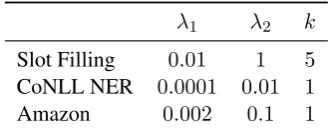
λ1 λ2 k
Slot Filling 0.01 1 5
CoNLL NER 0.0001 0.01 1
[image:14.595.333.500.62.128.2]Amazon 0.002 0.1 1
Table 6: The hyperparameter choices for different ex-periments.
use a batch size of 16 to fit in 12GB of GPU memory. The Amazon experiment does not em-ploy character embeddings but the documents are much longer, and thus also using a smaller batch size. All embeddings are fixed during training. Dropout (Srivastava et al.,2014) withp = 0.5is applied in all components. Unless otherwise men-tioned, ReLU is used as non-linear activation.
Bidirectional LSTM is used in the feature
ex-tractors for all experiments. In particular, Fs is
a two-layer BiLSTM of hidden size 128 (64 for
each direction), andFpis a two-layer BiLSTM of
hidden size 128 stacked with a MoE module (see
Figure2). Each expert network in theMoE
mod-ule ofFpis a two-layer MLP again of hidden size
of 128. The final layer in the MLP has a tanh
activation instead of ReLU to match the
LSTM-extracted shared features (withtanhactivations).
The expert gate is a linear transformation (matrix)
of size128×N, whereN is the number of source
languages.
On the other hand, the architecture of the task
specific predictor C depends on the task. For
se-quence tagging experiments, the structure of C
is shown in Figure 6, where each expert in the
MoEmodule is a token-level two-layer MLP with
a softmax layer on top for making token label predictions. For text classification tasks, a
dot-product attention mechanism (Luong et al.,2015)
is added after the shared and private features are concatenated. It has a length 256 weight vector that attends to the feature vectors of each token and computes a softmax mixture that pools the token-level feature vectors into a single
sentence-level feature vector. The rest of C remains the
same for text classification.
For the language discriminator D, a CNN text
classifier (Kim, 2014) is adopted in all
clas-en fr ja Target Lang: de 0.25
0.30 0.35 0.40
Average Gate Weights
en de ja
Target Lang: fr 0.25
0.30 0.35 0.40
en de fr
Target Lang: ja 0.25
[image:15.595.102.507.67.195.2]0.30 0.35 0.40
Figure 4: Average expert gate weights aggregated on a language level for the Amazon dataset.
en es nl
Target Lang: de 0.0
0.1 0.2 0.3 0.4
Average Gate Weights
en de nl
Target Lang: es 0.0
0.1 0.2 0.3 0.4 0.5 0.6
en de es
Target Lang: nl 0.0
[image:15.595.104.503.238.363.2]0.2 0.4 0.6
Figure 5: Average expert gate weights aggregated on a language level for the CoNLL dataset.
EN Expert MLP Expert
Gate DEMLP Expert ESMLP Expert
⍺1 ⍺
2 ⍺3
Task Label
Gate Label 2Jg
Private Features Shared Features
JC
Figure 6: TheMoEPredictorCfor Sequence Tagging.
sifying the language of the input sequence. The number of kernels is 200 in the CNN, while the kernel sizes are 3, 4, and 5. The MLP has one hidden layer of size 128.
The MUSE, VecMap, and UMWE embeddings
are trained with the monolingual 300d fastText
Wikipedia embeddings (Bojanowski et al.,2017).
When character-level word embeddings are used, a CharCNN is added that takes randomly initial-ized character embeddings of each character in a word, and passes them through a CNN with ker-nel number 200 and kerker-nel sizes 3, 4, and 5. Fi-nally, the character embeddings are max-pooled and fed into a single fully-connected layer to form a 128 dimensional character-level word embed-ding, which is concatenated with the pre-trained cross-lingual word embedding to form the final word representation of that word.
The remaining hyperparameters such asλ1,λ2
andk (see Algorithm1) are tuned for each
[image:15.595.99.263.485.664.2]