3204
JW300: A Wide-Coverage Parallel Corpus for Low-Resource Languages
ˇ
Zeljko Agi´c
Department of Computer Science IT University of Copenhagen, Denmark
Ivan Vuli´c PolyAI Ltd. London, United Kingdom
Abstract
Viable cross-lingual transfer critically depends on the availability of parallel texts. Shortage of such resources imposes a development and evaluation bottleneck in multilingual process-ing. We introduce JW300, a parallel corpus of over 300 languages with around 100 thousand parallel sentences per language pair on aver-age. In this paper, we present the resource and showcase its utility in experiments with cross-lingual word embedding induction and multi-source part-of-speech projection.
1 Introduction
In natural language processing (NLP) the rule of thumb is that if we possess some parallel data for a low-resource target language, then we can yield feasible basic tools such as part-of-speech taggers for that language. Without such distant supervi-sion, this task and many others remain unattain-able, leaving the majority of languages in the world without basic language technology. Parallel data features a prominent role in building multilingual word representations (Ruder et al.,2017), annota-tion projecannota-tion for parts-of-speech and syntactic dependencies (Das and Petrov,2011;Tiedemann,
2014) and naturally machine translation.
The shortage of parallel data in turn creates a bottleneck in cross-lingual processing: without par-allel sentences, we cannot yield usable models, nor can we robustly evaluate them, if even just approx-imately (cf.Agi´c et al. 2017). This absence has over the recent years materialized theproxy fallacy, whereby intended low-resource methods are tested by proxy, exclusively on resource-rich languages, because of the absence of test data or the lack of effort to produce it for approximate evaluation.
[image:1.595.309.521.227.341.2]We seek to alleviate these issues by a significant new addition to the limited pool of parallel texts for low-resource languages.
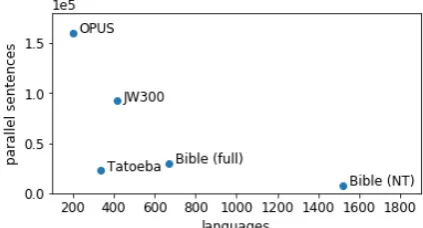
Figure 1: Our dataset JW300 in comparison to other massive parallel text collections with respect to multi-lingual breadth and volume of parallel sentences. The y-axis depicts the mean number of parallel sentences per language pair.
Contributions. A massive collection of parallel texts for over 300 diverse languages is our main contribution to facilitate multilingual NLP. The dataset is freely available for all non-commercial use.1 We also show how simple techniques over our data yield competitive results in building cross-lingual word embeddings and annotation projection for part-of-speech tagger induction.
2 Dataset
JW300 spans across 343 languages, and comprises a total of 1,335,376 articles, with a bit over 109 million sentences, and 1.48 billion tokens.
Sources and structure. The data is a complete crawl of all the publications from the website
jw.org. A vast majority of texts come from the magazines Awake! and Watchtower. While the texts do stem from a religious society, they cover an immense range of topics. The multilingual ar-ticles are mainly translations from a source in En-glish. The dataset is organized by language and by article. Articles carry unique identifiers which
span across the languages: all translations of the same article carry the same identifier number. This way we denote “parallel articles” as the base of all further processing.
Curation. All articles are converted from their HTML source into plain text format, one sentence per line, and tokenized. We also preserve the origi-nal formatting. We apply Polyglot (Al-Rfou,2015) for sentence splitting and tokenization. For lan-guages uncovered by Polyglot, we use its built-in language identifier to select the closest fit. Roughly 40% of all articles were split using a “neighbor lan-guage” tokenizer. Such broad strokes are necessary when dealing with massively multilingual datasets with low-resource languages where not even the basic processing is available, cf.Agi´c et al.(2016) who used only whitespace tokenization.
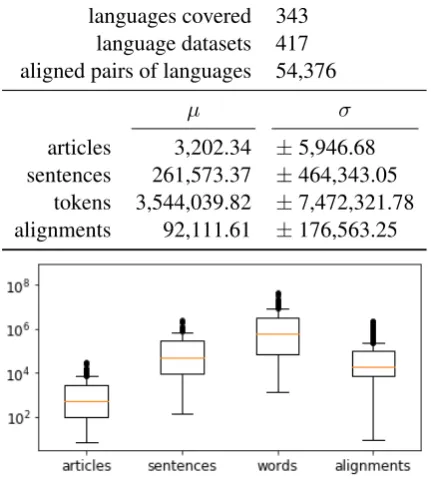
For all language pairs, and for all article pairs car-rying the same identifier number, we perform sen-tence alignment using the aligner Yasa (Lamraoui and Langlais,2013) with default settings. This way we align more than 50 thousand language pairs with over 90 thousand parallel sentences per language pair on average (see Table1).
The basic statistics of JW300 in Table1reveal a small number of outliers with up to 2.5 million sen-tences like English, French, and Italian which are all rich in resources. However, the long tail of low-resource languages typically still offers between 50-100 thousand sentences.
Comparison. With its balance between multilin-gual breadth and monolinmultilin-gual depth, JW300 fills an important gap in cross-lingual resources: it com-prises a multitude of low-resource languages while still offering ample sentences for each individual language, and parallel sentences for language pairs. To illustrate, for JW300 the breadth×depth ratio is 1.2x larger than for OPUS (Tiedemann,2012), 2x larger than for the full Bible, and even 3x that of New Testament (see Figure1).
JW300 still does come with its own caveats. The crucial one is surely bias: For example, could we indiscriminately use JW300 to train complex ma-chine learning systems that further propagate the attitude of jw.orgtowards gender differences? From another viewpoint, however, should we rather train part-of-speech taggers through multi-source annotation projection fromWatchtowerarticles on one side, or OPUS Ubuntu menu localizations or Bible psalms on the other side?
languages covered 343 language datasets 417 aligned pairs of languages 54,376
µ σ
articles 3,202.34 ±5,946.68
sentences 261,573.37 ±464,343.05 tokens 3,544,039.82 ±7,472,321.78
[image:2.595.309.525.65.305.2]alignments 92,111.61 ±176,563.25
Table 1: Basic statistics for the JW300 corpus: counts of articles, sentences, words, and alignments, as well as an illustration of their distributions. Counts are re-ported for languages with at least one non-empty align-ment to another language. Some languages have multi-ple datasets, e.g. different scripts, sign language.
Moreover, the ideological bias of JW300 is fairly well-defined. In that sense, while bias may invali-date the use of our corpus in some application areas, we argue that a wide-coverage collection of parallel data withknownbias may in fact be valuable for researchon biasin NLP (Bolukbasi et al., 2016;
Caliskan et al.,2017;Dev and Phillips,2019; Go-nen and Goldberg,2019), especially in multilingual settings (Lauscher and Glavaˇs,2019).2
JW300 excels in low-resource language cover-age. For example, OPUS offers over 100 million English-German parallel sentences, and JW300 only 2.1 million. However, in another example, for Afrikaans-Croatian the counts are 300 thousand in OPUS and 990 thousand in JW300, and more-over, the OPUS data for this language pair contains only Linux localizations.
Availability. Our dataset is freely available for all non-commercial use. The exact terms of use are provided by the copyright holder; seehttps:// www.jw.org/en/terms-of-use/. For all practical purposes their custom terms of use are very closely aligned with the more well-known
CC-2We acknowledge the anonymous area chair who
EN ET HR MR MT
EN – 0.280 0.254 0.0 0.001
ET 0.314 – 0.302 0.001 0.0
HR 0.269 0.334 – 0.002 0.0
MR 0.094 0.144 0.112 – 0.001
[image:3.595.76.290.64.130.2]MT 0.131 0.206 0.164 0.141 –
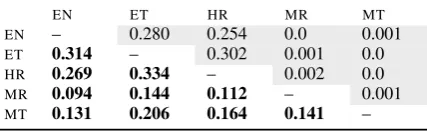
Table 2: BLI results (MRR scores) on a small sub-set of JW300 language pairs. The scores with the best-performing unsupervised cross-lingual word em-bedding model (Artetxe et al.,2018) are in gray cells over the main diagonal; the scores with a simple super-vised method (Smith et al.,2017) are below the main diagonal. Better performance for each pair in bold.
BY-NC-SA license.3
3 Experiments
3.1 Cross-lingual word embedding induction
A recent trend in cross-lingual word embedding induction are fully unsupervised projection-based methods that learn on the basis of monolingual data only (Conneau et al., 2018; Alvarez-Melis and Jaakkola,2018;Chen and Cardie,2018,inter alia). The main idea is to construct a seed bilingual dictionary in an unsupervised fashion relying on adversarial training (Conneau et al.,2018), mono-lingual similarity distributions (Artetxe et al.,2018) or PCA projection similarities (Hoshen and Wolf,
2018), and then learn (gradually refined) projec-tions of two monolingual embedding spaces into a shared cross-lingual space (by also iteratively refining the seed dictionary).
Such models hold promise to support cross-lingual representation learning for resource-poor language pairs. However, besides their problems with training divergence (Søgaard et al.,2018), a recent empirical study (Glavaˇs et al., 2019) has demonstrated that even most robust projection-based unsupervised models cannot match the per-formance of projection-based methods which re-quire only 1K-5K seed translation pairs. The large-scale JW300 corpus offers such supervision (i.e., seed translation pairs) for a large number of lan-guage pairs. In other words, instead of resorting to fully unsupervised models for the language pairs included in JW300, we can use seed bilingual dic-tionaries from the parallel data to learn the pro-jections. Based on the findings fromGlavaˇs et al.
(2019), we compare the most effective and the most robust unsupervised method ofArtetxe et al.(2018)
3https://creativecommons.org/licenses/
by-nc-sa/4.0/
to a simple supervised method (Smith et al.,2017) in the bilingual lexicon induction task (BLI).4
For the demonstration purposes, we work with all pairs from the following language set: English (EN), Estonian (ET), Croatian (HR), Marathi (MR), and Maltese (MT). Our seed bilingual dictionaries are extracted from the JW300 corpora by taking the most probable target translation for each source word from IBM1-based word translation tables. Following prior work, we use the 5K most frequent translation pairs from training, while the next 2K pairs are used for testing. We use 300-dim monolin-gual fastText embeddings pretrained on Wikipedia for all languages (Bojanowski et al.,2017),5but the same trends are observed with other monolingual embeddings. The results in terms of Mean Recip-rocal Rank (MRR) are summarized in Table2. The BLI results are straightforward to interpret: for all experimental runs a simple supervised model with its supervision extracted from the JW300 corpus outperforms its unsupervised competition, further confirming the findings ofGlavaˇs et al.(2019). The unsupervised model is even unable to converge for most language pairs, yielding extremely low MRR scores. The scores on another test set (Conneau et al.,2018) forEN-ETandEN-HRalso favour the supervised model: 0.342 vs. 0.313 onEN-ET, and 0.289 vs. 0.261 onEN-HR. In sum, these prelimi-nary experiments indicate the potential of JW300 in guiding cross-lingual representation learning.
3.2 Part-of-speech projection
Massively parallel data has proven most useful in inducing basic NLP models such as part-of-speech taggers. The formative work by Yarowsky et al.
(2001) has inspired many influential works in pro-jecting sequential labels from multiple source lan-guages (Das and Petrov,2011;T¨ackstr¨om et al.,
2013), as well as projecting more complex anno-tations such as syntactic and semantic dependen-cies (Hwa et al., 2005; Pad´o and Lapata, 2009;
Agi´c et al.,2016). Here we implement an experi-ment with projecting parts of speech from multiple sources to multiple targets following the line of work byAgi´c et al.(2015) and subsequentlyPlank et al.(2018), to showcase our corpus.
4We expect even better performance with recently
devel-oped more sophisticated supervised methods such as RCSLS proposed byJoulin et al.(2018), seeGlavaˇs et al.(2019).
5https://fasttext.cc/docs/en/
Setup. We work with a large collection of multi-lingual sentences, where each sentence is a graph G = (V, A). Its verticesV are sentence words for all involved languages, while its edgesAare alignments between these words. One sentencet is declared as target sentence and indexed asi= 0, while the remainingnsentences are sources: Tar-get words are then vertices vt ∈ V0, while the
verticesvs∈ Vi,1 ≤i≤nare the source words. The word alignmentsa(vs, vt)∈Aare also word aligner confidences:a(vs, vt)∈(0,1). The graph is thus bipartite between the target wordsV0and all
the source wordsVi, i >0. The source sentences are tagged for parts of speech and thus each source wordvspacks a label distributionp(l|vs)of tagger confidences across parts of speechl∈L.
On top of this parallel dataset, we implement the best practices in annotation projection of sequen-tial labels from multiple sources with low-resource target languages in mind:
– Word alignments are obtained from an IBM1 model Efmaral (Ostling and Tiedemann¨ ,2016) asAgi´c et al.(2016) show that simpler alignment models favor low-resource languages. Thus we acquire alla(vs, vt)∈A.
– Source sentences are tagged for parts of speech by a state-of-the-art neural tagger with default settings (Plank et al.,2016). That way all source words attain a tag distributionp(l|vs).
– Source tags are projected through the word align-ments and accumulated at the target ends:
BALLOT(l|vt) = X
vs∈Vs
p(l|vs)a(vs, vt).
The part-of-speech tag for each target wordvtis finally decoded through simple weighted major-ity voting:
LABEL(vt) = arg max
l BALLOT(l|vt).
– The sentences are further filtered so as to remove noisy instances. The model byPlank et al.(2018) is used, whereby for training we select only the top 10 thousand target sentences ranked by mean word alignment coveragect:
ct= 1
n n X
i=1
ci,t.
Mean coveragectis defined through individual source-target coverages, for alli >0:
ci,t =
|{vt:∃vs, vs∈Vi, a(vs, vt)∈A}|
|Vt| .
BIBLE DSDS JW300PROJ
Bulgarian (BG) 77.7 83.9 82.7 Croatian (HR) 67.1 78.0 77.7 Czech (CS) 73.3 86.8 82.5 Danish (DA) 79.0 84.5 84.8 English (EN) 73.0 85.7 80.3 French (FR) 76.6 88.7 84.9 German (DE) 80.2 84.1 83.3 Greek (EL) 52.3 81.1 76.1 Hindi (HI) 67.6 63.1 73.4 Hungarian (HU) 72.0 77.3 76.3 Italian (IT) 76.9 92.1 85.2 Norwegian (NO) 76.7 86.2 83.1 Persian (FA) 59.6 43.6 66.6 Polish (PL) 75.1 84.4 83.2 Portuguese (PT) 83.8 89.4 86.9 Spanish (ES) 81.4 91.7 87.0 Swedish (SV) 75.2 83.1 79.7
[image:4.595.316.519.66.301.2]µ 73.4 81.4 80.8
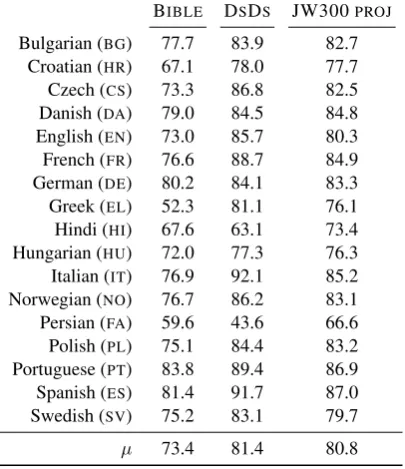
Table 3: Accuracy of part-of-speech taggers induced by projection from multiple sources of JW300, in compar-ison to projections from the Bible byAgi´c et al.(2015) and the DSDS system by Plank et al. (2018) which learns from multiple sources of weak supervision in-cluding annotation projection.
We also remove all sentences under 3 and over 100 tokens. Finally, the target language taggers are trained on these 10 thousand filtered projec-tions and evaluated on held-out test data. We use the same part-of-speech tagger byPlank et al.
(2016) for the target languages as we did for the source languages.
Baselines and data. In this experiment we com-pare three distantly supervised systems:
– the bare-bones BIBLE annotation projection byAgi´c et al.(2015),
– a state-of-the-art system DSDS byPlank et al.
(2018) which combines annotation projection, type supervision with Wiktionary and Uni-Morph (Kirov et al.,2018), word embeddings, and subword representations, and finally – JW300PROJwhich is our own multi-source
pro-jection with JW300 data as defined above.
The training data is Universal Dependencies ver-sion 2.3 (Nivre et al.,2018). The test data amounts to 17 languages at the intersection of the three systems and comes fromPlank and Agi´c(2018). All tags are converted to the tagset ofPetrov et al.
Results. Table 3 lists the tagging accuracy by language and system. Projections from our system JW300PROJare expectedly superior to those by BIBLEby +7.4 increase in mean accuracy across all 17 languages. On a more interesting note, our bare-bones approach to annotation projection falls only -0.6 points short of DSDSon average, which is an admirable feat since DSDSis an intricate multi-task learning system which learns from several disparate signals of distant supervision, only one of which is annotation projection.
Beyond the confines of the 17-language compari-son from Table3, we also conduct one larger exper-iment with 42 languages in the overlap of JW300 and Universal Dependencies v2.3. The mean ac-curacy for the 17 languages in Table3increases with this additional multi-source support by +0.8 points absolute, to 81.6 which now just surpasses the score of DSDS. Since these systems are com-plementary, future work could further explore the benefits of injecting the improved JW300 projec-tions to more complex learners such as DSDS. In particular, DSDSwould likely benefit from better projections, since the ones that its current instance uses are inferior to JW300.
4 Related work
Our work is a contribution to the pool of massively multilingual resources. In that pool we already sin-gled out OPUS (Tiedemann,2012) as the largest collection of freely available parallel sentences to date. OPUS is a collection that covers large datasets such as Europarl (Koehn,2005), OpenSubtitles ( Li-son and Tiedemann,2016), along with many others. OPUS also contains a smaller snapshot of Tatoeba, whose original collection hosts 337 languages and 22,427 (±106,815) sentences on average.6
Moving from OPUS and Tatoeba towards greater linguistic breadth, there are several publicly avail-able Bible datasets, most notably those byMayer and Cysouw(2014) andChristodouloupoulos and Steedman(2015). The Bible datasets are typically aligned by verse and not by sentence, because verse identifiers are assigned by humans, with absolute accuracy. However, a verse sometimes comprises several sentences, or alternatively just parts of one sentence, thus in effect replacing one type of align-ment noise with another. Our results strongly favor JW300 for part-of-speech projection.
6https://tatoeba.org/eng/stats/
sentences_by_language
Prior to our work, Agi´c et al. (2016) have also collected a smaller dataset fromjw.orgto pro-duce cross-lingual dependency parsers with multi-source projection. Their dataset covers 135 guages with a mean of 115,856 sentences per lan-guage (±34,898), but with sentence alignments only within a group of 27 languages.
Our contribution JW300 strikes a balance be-tween multilingual and intra-language coverage that will greatly facilitate future research in large-scale cross-lingual processing. Our work is entirely complementary to related efforts in bringing forth massively multilingual resources.
5 Conclusion
We introduced JW300, a large collection of parallel texts that spans over more than 300 languages, and offers 54 thousand pairs of alignments, each with roughly 100 thousand parallel sentences on average. We posit that the dataset would prove immensely useful for a wide variety of research in cross-lingual processing. JW300 is freely available for all non-commercial use as per terms of the data owner.
Our two experiments show that even with simple models JW300 offers top performance in cross-lingual word embedding induction and multicross-lingual projection for part-of-speech tagging, where we reach or even surpass more advanced models.
Acknowledgements
The authors acknowledge the NVIDIA Corporation for supporting their work. We are also thankful to the anonymous reviewers and area chairs for their incisive reviews.
References
ˇ
Zeljko Agi´c, Dirk Hovy, and Anders Søgaard. 2015. If all you have is a bit of the Bible: Learning POS tag-gers for truly low-resource languages. In Proceed-ings of ACL, pages 268–272.
ˇ
Zeljko Agi´c, Anders Johannsen, Barbara Plank, H´ector Mart´ınez Alonso, Natalie Schluter, and An-ders Søgaard. 2016. Multilingual projection for parsing truly low-resource languages. Transactions of the Association for Computational Linguistics, 4:301–312.
ˇ
Zeljko Agi´c, Barbara Plank, and Anders Søgaard. 2017. Cross-lingual tagger evaluation without test data. In
Rami Al-Rfou. 2015. Polyglot: A Massive Multilin-gual Natural Language Processing Pipeline. Ph.D. thesis, Stony Brook University.
David Alvarez-Melis and Tommi Jaakkola. 2018. Gromov-Wasserstein alignment of word embedding spaces. In Proceedings of EMNLP, pages 1881– 1890.
Mikel Artetxe, Gorka Labaka, and Eneko Agirre. 2018. A robust self-learning method for fully unsupervised cross-lingual mappings of word embeddings. In Pro-ceedings of ACL, pages 789–798.
Piotr Bojanowski, Edouard Grave, Armand Joulin, and Tomas Mikolov. 2017. Enriching word vectors with subword information. Transactions of the Associa-tion for ComputaAssocia-tional Linguistics, 5:135–146.
Tolga Bolukbasi, Kai-Wei Chang, James Zou, Venkatesh Saligrama, and Adam Kalai. 2016. Man is to computer programmer as woman is to homemaker? Debiasing word embeddings. In
Proceedings of NIPS, pages 4356–4364.
Aylin Caliskan, Joanna J. Bryson, and Arvind Narayanan. 2017. Semantics derived automatically from language corpora contain human-like biases.
Science, 356(6334):183–186.
Xilun Chen and Claire Cardie. 2018. Unsupervised multilingual word embeddings. In Proceedings of EMNLP, pages 261–270.
Christos Christodouloupoulos and Mark Steedman. 2015. A massively parallel corpus: The bible in 100 languages. Language Resources and Evalua-tion, 49(2):375–395.
Alexis Conneau, Guillaume Lample, Marc’Aurelio Ranzato, Ludovic Denoyer, and Herv´e J´egou. 2018. Word translation without parallel data. In Proceed-ings of ICLR.
Dipanjan Das and Slav Petrov. 2011. Unsupervised part-of-speech tagging with bilingual graph-based projections. InProceedings of ACL, pages 600–609.
Sunipa Dev and Jeff Phillips. 2019. Attenuating bias in word vectors. InProceedings of AISTATS.
Goran Glavaˇs, Robert Litschko, Sebastian Ruder, and Ivan Vuli´c. 2019. How to (properly) evaluate cross-lingual word embeddings: On strong baselines, com-parative analyses, and some misconceptions. CoRR, abs/1902.00508.
Hila Gonen and Yoav Goldberg. 2019. Lipstick on a pig: Debiasing methods cover up systematic gender biases in word embeddings but do not remove them. InProceedings of NAACL-HLT, pages 609–614.
Yedid Hoshen and Lior Wolf. 2018. Non-adversarial unsupervised word translation. In Proceedings of EMNLP, pages 469–478.
Rebecca Hwa, Philip Resnik, Amy Weinberg, Clara Cabezas, and Okan Kolak. 2005. Bootstrapping parsers via syntactic projection across parallel texts.
Natural Language Engineering, 11(3):311–325.
Armand Joulin, Piotr Bojanowski, Tomas Mikolov, Herv´e J´egou, and Edouard Grave. 2018. Loss in translation: Learning bilingual word mapping with a retrieval criterion. InProceedings of EMNLP, pages 2979–2984.
Christo Kirov, Ryan Cotterell, John Sylak-Glassman, G´eraldine Walther, Ekaterina Vylomova, Patrick Xia, Manaal Faruqui, Sebastian Mielke, Arya D McCarthy, Sandra K¨ubler, et al. 2018. Uni-morph 2.0: Universal Uni-morphology. arXiv preprint arXiv:1810.11101.
Philipp Koehn. 2005. Europarl: A parallel corpus for statistical machine translation. In Proceedings of MT Summit, volume 5, pages 79–86.
Fethi Lamraoui and Philippe Langlais. 2013. Yet an-other fast, robust and open source sentence aligner: Time to reconsider sentence alignment? In Proceed-ings of the XIV Machine Translation Summit.
Anne Lauscher and Goran Glavaˇs. 2019. Are we con-sistently biased? multidimensional analysis of bi-ases in distributional word vectors. InProceedings of *SEM, pages 85–91.
Pierre Lison and J¨org Tiedemann. 2016. OpenSub-titles2016: extracting large parallel corpora from movie and tv subtitles. InProceedings of LREC.
Thomas Mayer and Michael Cysouw. 2014. Creating a massively parallel bible corpus. InProceedings of LREC.
Joakim Nivre et al. 2018. Universal Dependencies 2.3. LINDAT/CLARIN digital library at the Institute of Formal and Applied Linguistics ( ´UFAL), Faculty of Mathematics and Physics, Charles University.
Robert ¨Ostling and J¨org Tiedemann. 2016. Effi-cient word alignment with Markov Chain Monte Carlo. Prague Bulletin of Mathematical Linguistics, 106:125–146.
Sebastian Pad´o and Mirella Lapata. 2009. Cross-lingual annotation projection for semantic roles.
Journal of Artificial Intelligence Research, 36:307– 340.
Slav Petrov, Dipanjan Das, and Ryan McDonald. 2011. A universal part-of-speech tagset. arXiv preprint arXiv:1104.2086.
Barbara Plank, Sigrid Klerke, and ˇZeljko Agi´c. 2018. The best of both worlds: Lexical resources to im-prove low-resource part-of-speech tagging. arXiv preprint arXiv:1811.08757.
Barbara Plank, Anders Søgaard, and Yoav Goldberg. 2016. Multilingual part-of-speech tagging with bidi-rectional long short-term memory models and auxil-iary loss. InProceedings of ACL, pages 412–418.
Sebastian Ruder, Ivan Vuli´c, and Anders Søgaard. 2017. A survey of cross-lingual word embedding models. arXiv preprint arXiv:1706.04902.
Samuel L. Smith, David H.P. Turban, Steven Hamblin, and Nils Y. Hammerla. 2017. Offline bilingual word vectors, orthogonal transformations and the inverted softmax. InProceedings of ICLR.
Anders Søgaard, Sebastian Ruder, and Ivan Vuli´c. 2018. On the limitations of unsupervised bilingual dictionary induction. InProceedings of ACL, pages 778–788.
Oscar T¨ackstr¨om, Dipanjan Das, Slav Petrov, Ryan Mc-Donald, and Joakim Nivre. 2013. Token and type constraints for cross-lingual part-of-speech tagging.
Transactions of the Association for Computational Linguistics, 1:1–12.
J¨org Tiedemann. 2012. Parallel data, tools and inter-faces in OPUS. In Proceedings of LREC, pages 2214–2218.
J¨org Tiedemann. 2014. Rediscovering annotation pro-jection for cross-lingual parser induction. In Pro-ceedings of COLING, pages 1854–1864.
David Yarowsky, Grace Ngai, and Richard Wicen-towski. 2001. Inducing multilingual text analysis tools via robust projection across aligned corpora. In