Proceedings of the 56th Annual Meeting of the Association for Computational Linguistics (Long Papers), pages 2171–2181 2171
Recursive Neural Structural Correspondence Network for
Cross-domain Aspect and Opinion Co-Extraction
Wenya Wang†‡ and Sinno Jialin Pan†
†Nanyang Technological University, Singapore
‡SAP Innovation Center Singapore
{wa0001ya, sinnopan}@ntu.edu.sg
Abstract
Fine-grained opinion analysis aims to ex-tract aspect and opinion terms from each sentence for opinion summarization. Su-pervised learning methods have proven to be effective for this task. However, in many domains, the lack of labeled data hinders the learning of a precise extraction model. In this case, unsupervised domain adapta-tion methods are desired to transfer knowl-edge from the source domain to any un-labeled target domain. In this paper, we develop a novel recursive neural network that could reduce domain shift effectively in word level through syntactic relations. We treat these relations as invariant “pivot information” across domains to build struc-tural correspondences and generate an aux-iliary task to predict the relation between any two adjacent words in the dependency tree. In the end, we demonstrate state-of-the-art results on three benchmark datasets.
1 Introduction
The problem of fine-grained opinion analysis in-volves extraction of opinion targets (or aspect terms) and opinion expressions (or opinion terms) from each review sentence. For example, in the
sen-tence: “They offer good appetizers”, the aspect and
opinion terms areappetizersandgood
correspond-ingly. Many supervised deep models have been
pro-posed for this problem (Liu et al.,2015;Yin et al.,
2016;Wang et al.,2017), and obtained promising results. However, these methods fail to adapt well across domains, because the aspect terms from two
different domains are usually disjoint, e.g.,
lap-topv.s. restaurant, leading to large domain shift in the feature vector space. Though unsupervised
methods (Hu and Liu,2004;Qiu et al.,2011) can
deal with data with few labels, their performance is unsatisfactory compared with supervised ones.
There have been a number of domain adaptation methods for coarse-grained sentiment classification problems across domains, where an overall senti-ment polarity of a sentence or docusenti-ment is being predicted. Nevertheless, very few approaches exist for cross-domain fine-grained opinion analysis due to the difficulties in fine-grained adaptation, which is more challenging than coarse-grained problems.
Li et al.(2012) proposed a bootstrap method based
on the TrAdaBoost algorithm (Dai et al., 2007)
to iteratively expand opinion and aspect lexicons in the target domain by exploiting source-domain labeled data and cross-domain common relations between aspect terms and opinion terms. However, their model requires a seed opinion lexicon in the target domain and pre-mined syntactic patterns as a
bridge.Ding et al.(2017) proposed to use rules to
generate auxiliary supervision on top of a recurrent neural network to learn domain-invariant hidden representation for each word. The performance highly depends on the quality of the manually de-fined rules and the prior knowledge of a sentiment lexicon. In addition, the recurrent structure fails to capture the syntactic interactions among words in-trinsically for opinion extraction. The requirement for rules makes the above methods non-flexible.
In this paper, we propose a novel cross-domain
Recursive Neural Network (RNN)1for aspect and
opinion terms co-extraction across domains. Our motivations are twofold: 1) The dependency re-lations capture the interactions among different words. These relations are especially important
for identifying aspect terms and opinion terms (Qiu
et al., 2011;Wang et al., 2016), which are also domain-invariant within the same language. There-fore, they can be used as “pivot” information to
bridge the gap between different domains. 2)
In-spired by the idea ofstructural learning(Ando and
Zhang,2005), the success of target task depends on the ability of finding good predictive structures learned from other related tasks, e.g., structural
cor-respondence learning (SCL) (Blitzer et al.,2006)
for coarse-grained cross-domain sentiment classifi-cation. Here, we aim to generate an auxiliary task on dependency relation classification. Different from previous approaches, our auxiliary task and the target extraction task are of heterogeneous label spaces. We aim to integrate this auxiliary task with distributed relation representation learning into a recursive neural network.
Specifically, we generate a dependency tree for each sentence from the dependency parser and con-struct a unified RNN that integrates an auxiliary task into the computation of each node. The aux-iliary task is to classify the dependency relation for each direct edge in the dependency tree by learning a relation feature vector. To reduce la-bel noise brought by inaccurate parsing trees, we further propose to incorporate an autoencoder into the auxiliary task to group the relations into dif-ferent clusters. Finally, to model the sequential context interaction, we develop a joint architec-ture that combines RNN with a sequential labeling model for aspect and opinion terms extraction. Ex-tensive experiments are conducted to demonstrate the advantage of our proposed model.
2 Related Work
Existing works for single-domain aspect/opinion terms extraction include unsupervised methods
based on association rule mining (Hu and Liu,
2004), syntactic rule propagation (Qiu et al.,2011)
or topic modeling (Titov and McDonald,2008;Lu
et al., 2009; Zhang et al., 2010), as well as su-pervised methods based on extensive feature
engi-neering with graphical models (Jin and Ho,2009;
Li et al.,2010) or deep learning (Liu et al.,2015;
Zhang et al.,2015;Wang et al., 2017;Yin et al.,
2016). Among exiting deep models, improved
re-sults are obtained using dependency relations (Yin
et al.,2016;Wang et al.,2016), which indicates the significance of syntactic word interactions for tar-get term extraction. In cross-domain setting, there are very few works for aspect/opinion terms
extrac-tion including a pipelined approach (Li et al.,2012)
and a recurrent neural network (Ding et al.,2017).
Both of the methods require manual construction
of common and pivot syntactic patterns or rules, which are indicative of aspect or opinion words.
There have been a number of domain adaptation approaches proposed for coarse-grained sentiment classification. Among existing methods, one active line focuses on projecting original feature spaces of two domains into the same low-dimensional space to reduce domain shift using pivot features
as a bridge (Blitzer et al.,2007;Pan et al.,2010;
Bollegala et al., 2015;Yu and Jiang, 2016). An-other line learns domain-invariant features via
auto-encoders (Glorot et al., 2011;Chen et al., 2012;
Zhou et al.,2016). Our work is more related to the first line by utilizing pivot information to transfer knowledge across domains, but we integrate the idea into a unified deep structure that can fully uti-lize syntactic structure for domain adaptation in fine-grained sentiment analysis.
3 Problem Definition & Motivation
Our task is to extract opinion and aspect terms within each review sentence. We denote a
sen-tence by a sequence of tokensx= (w1, w2, ..., wn).
The output is a sequence of token-level labels
y= (y1, y2, ..., yn), withyi∈ {BA,IA,BO,IO,N}
that represents beginning of an aspect (BA), inside of an aspect (IA), beginning of an opinion (BO), inside of an opinion (IO) or none of the above (N). A subsequence of labels started with “BA” and fol-lowed by “IA” indicates a multi-word aspect term. In unsupervised domain adaptation, we are given a set of labeled review sentences from a source
do-mainDS={(xSi,ySi)}
nS
i=1, and a set of unlabeled
sentences from a target domain DT ={xTj}nT
j=1.
Our goal is to predict token-level labels onDT.
Existing works for cross-domain aspect and/or opinion terms extraction require hand-coded rules and a sentiment lexicon in order to transfer
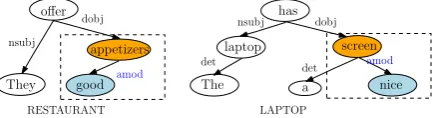
knowl-edge across domains. For example in Figure 1,
given a review sentence “They offer good
appe-tizers” in the source domain and “The laptop has a nice screen” in the target domain. If nicehas been extracted as a common sentiment word, and “OPINION-amod-ASPECT” has been identified as a common syntactic pattern from the source
do-main,screencould be deduced as an aspect term
us-ing the identified syntactic pattern (Li et al.,2012).
Similarly, Ding et al. (2017) used a set of
They oer
good appetizers
nsubj
dobj
amod
The laptop
has
a
screen
nice
det det
nsubj dobj
amod
[image:3.595.74.292.64.123.2]RESTAURANT LAPTOP
Figure 1: An example of two reviews with similar syntactic patterns.
recurrent neural network.
On one hand, these previous attempts have ver-ified that syntactic information between words, which can be used as a bridge between domains, is crucial for domain adaptation. On the other hand,
dependency-tree-based RNN (Socher et al.,2010)
has proven to be effective to learn high-level fea-ture representation of each word by encoding syn-tactic relations between aspect terms and opinion
terms (Wang et al.,2016). With the above findings,
we propose a novel RNN namedRecursiveNeural
StructuralCorrespondenceNetwork (RNSCN) to
learn high-level representation for each word across different domains. Our model is built upon depen-dency trees generated from a dependepen-dency parser. Different from previous approaches, we do not re-quire any hand-coded rules or pre-selected pivot features to construct correspondences, but rather focus on the automatically generated dependency relations as the pivots. The model associates each direct edge in the tree with a relation feature vector, which is used to predict the corresponding depen-dency relation as an auxiliary task.
Note that the relation vector is the key in the model: it associates with the two interacting words and is used to construct structural correspondences between two different domains. Hence, the aux-iliary task guides the learning of relation vectors, which in turn affects their correspondingly
interac-tive words. Specifically in Figure1, the relation
vector for “amod” is computed from the features of its child and parent words, and also used to pro-duce the hidden representation of its parent. For this relation path in both sentences, the auxiliary task enforces close proximity for these two relation vectors. This pushes the hidden representations for
their parent nodesappetizersandscreencloser to
each other, provided thatgoodandnicehave
sim-ilar representations. In a word, the auxiliary task bridges the gap between two different domains by drawing the words with similar syntactic properties closer to each other.
However, the relation vectors may be sensitive to the accuracy of the dependency parser. It might
harm the learning process when some noise ex-ists for certain relations, especially for informal texts. This problem of noisy labels has been
ad-dressed using perceptual consistency (Reed et al.,
2015). Inspired by the taxonomy of dependency
re-lations (de Marneffe and Manning,2008), relations
with similar functionalities could be grouped
to-gether, e.g.,dobj,iobjandpobjall indicate objects.
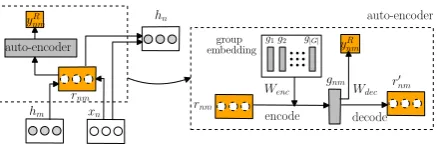
We propose to use an auto-encoder to automatically group these relations in an unsupervised manner. The reconstruction loss serves as the consistency objective that reduces label noise by aligning rela-tion features with their intrinsic relarela-tion group.
4 Proposed Methodology
Our model consists of two components. The first component is a Recursive Neural Structural Cor-respondence Network (RNSCN), and the second component is a sequence labeling classifier. In this paper, we focus on Gated Recurrent Unit (GRU) as an implementation for the sequence labeling classi-fier. We choose GRU because it is able to deal with long-term dependencies compared to a simple Re-current neural network and requires less parameters making it easier to train than LSTM. The resultant deep learning model is denoted by RNSCN-GRU. We also implement Conditional Random Field as the sequence labeling classifier, and denote the model by RNSCN-CRF accordingly.
The overall architecture of RNSCN-GRU with-out auto-encoder on relation denoising is shown
in Figure2. The left and right are two example
sentences from the source and the target domain, respectively. In the first component, RNSCN, an auxiliary task to predict the dependency relation for each direct edge is integrated into a dependency-tree-based RNN. We generate a relation vector for each direct edge from its child node to parent node, and use it to predict the relation and produce the hidden representation for the parent node in the de-pendency tree. To address the issues of noisy rela-tion labels, we further incorporate an auto-encoder
into RNSCN, as will be shown in Figure3.
appetizers good
oer they
root dobj
amod
nsubj
h4
h3 h
h2
r2 r43
r24
x x2 x3 x4
y 43 y
2
y 24
nice a
has laptop
det
amod
nsubj
h6
h5 h
h3
r2
r65 r36
x2 x3 x4 x5
y 2
y 65 y 36
x6 x
The screen
dobj h2
r32 y
32
det
h4 r64 y 64 h
h2 h3 h4 h h2 h3 h4 h5 h6
RNSCN GRU
[image:4.595.104.491.65.301.2]Source Target
Figure 2: The architecture of RNSCN-GRU.
4.1 Recursive Neural Structural Correspondence Network
RNSCN is built on the dependency tree of each sen-tence, which is pre-generated from a dependency parser. Specifically, each node in the tree is
asso-ciated with a wordwn, an input word embedding
xn∈Rdand a transformed hidden representation
hn∈Rd. Each direct edge in the dependency tree
associates with a relation feature vectorrnm∈Rd
and a true relation label vectoryR
nm∈RK, where
Kis the total number of dependency relations,n
andmdenote the indices of the parent and child
word of the dependency edge, respectively. Based on the dependency tree, the hidden representations are generated in a recursive manner from leaf nodes until reaching the root node. Consider the
source-domain sentence shown in Figure2as an
illustra-tive example, we first compute hidden
representa-tions for leaf nodestheyandgood:
h1=tanh(Wxx1+b), h3=tanh(Wxx3+b),
whereWx∈Rd×dtransforms word embeddings
to hidden space. For non-leaf nodeappetizer, we
first generate the relation vectorr43for the
depen-dency edge x4 (appetizers) −−−−→amod x3 (good) by
r43= tanh(Whh3+Wxx4),
whereWh ∈ Rd×dtransforms the hidden
repre-sentation to the relation vector space. We then
compute the hidden representation forappetizer:
h4 = tanh(Wamodr43+Wxx4+b).
Moreover, the relation vectorr43 is used for the
auxiliary task on relation prediction:
ˆ
yR43=softmax(WRr43+bR),
where WR ∈ RK×d is the relation
classifica-tion matrix. The supervised relaclassifica-tion classifier
en-forces close proximity of similar{rnm}’s in the
dis-tributed relation vector space. The relation features bridge the gap of word representations in different domains by incorporating them into the forward computations. In general, the hidden representation
hnfor a non-leaf node is produced through
hn= tanh(
X
m∈Mn
WRnmrnm+Wxxn+b), (1)
wherernm= tanh(Wh·hm+Wx·xn),Mnis the
set of child nodes ofwn, andWRnmis the relation
transformation matrix tied with each relationRnm.
The predicted label vectoryˆnmR forrnmis
ˆ
yRnm=softmax(WR·rnm+bR). (2)
Here we adopt the the cross-entropy loss for re-lation classification between the predicted label
vectoryˆnmR and the ground-truth yRnm to encode
relation side information into feature learning:
`R= K
X
k=1
−ynmR [k]log ˆyRnm[k]. (3)
that words with similar syntactic functionalities are clustered across domains. On the other hand, the pre-trained word embeddings group semantically-similar words. By taking them as input to RNN, together with the auxiliary task, our model encodes both semantic and syntactic information.
4.2 Reduce Label Noise with Auto-encoders
As discussed in Section3, it might be hard to learn
an accurate relation classifier when each class is a unique relation, because the dependency parser may generate incorrect relations as noisy labels. To address it, we propose to integrate an autoencoder into RNSCN. Suppose there is a set of latent groups
of relations: G={1,2, ...,|G|}, where each
rela-tion belongs to only one group. For each relarela-tion
vector,rnm, an autoencoder is performed before
feeding it into the auxiliary classifier (2). The goal
is to encode the relation vector to a probability dis-tribution of assigning this relation to any group. As
can be seen Figure3, each relation vectorrnmis
first passed through the autoencoder as follows,
p(Gnm =i|rnm) =
exp(r>nmWencgi)
P
j∈G
exp(r>nmWencgj)
, (4)
whereGnmdenotes the inherent relation group for
rnm,gi∈Rdrepresents the feature embedding for
groupi, andWenc∈Rd×dis the encoding matrix
that computes bilinear interactions between relation
vectorrnmand relation group embeddinggi. Thus,
p(Gnm =i|rnm)represents the probability ofrnm
being mapped to groupi. An accumulated relation
group embedding is computed as:
gnm =
|G|
X
i=1
p(Gnm=i|rnm)gi. (5)
For decoding, the decoder takesgnmas input and
tries to reconstruct the relation feature inputrnm.
Moreover,gnmis also used as the higher-level
fea-ture vector forrnmfor predicting the relation label.
Therefore, the objective for the auxiliary task in (3)
becomes:
`R=`R1 +α`R2+β`R3, (6)
where
`R1 = krnm−Wdecgnmk
2
2, (7)
`R2 =
K
X
k=1
−yRnm[k]log ˆyRnm[k], (8)
`R3 = I−G¯
>G¯
2
F. (9)
y nm
autoencoder
rnm
gg2 gjj
Wenc gnm
encode
r
nm
decode Wdec
autoencoder
group emedding
rnm
hm xn
hn
[image:5.595.308.527.60.133.2]y nm
Figure 3: An autoencoder for relation grouping.
Here `R1 is the reconstruction loss with Wdec
being the decoding matrix, `R2 follows (3) with
ˆ
yRnm =softmax(WRgnm +bR) and `R3 is the
regularization term on the correlations among
la-tent groups withIbeing the identity matrix andG¯
being a normalized group embedding matrix that
consists of normalizedgi’s as column vectors. This
regularization term enforces orthogonality between
gi and gj for i 6= j. α and β are used to
con-trol the trade-off among different losses. With the auto-encoder, the auxiliary task of relation classi-fication is conditioned on group assignment. The reconstruction loss further ensures the consistency between relation features and groupings, which is supposed to dominate classification loss when the observed labels are inaccurate. We denote RNSCN
with auto-encoder by RNSCN+.
4.3 Joint Models for Sequence Labeling
RNSCN or RNSCN+focuses on capturing and
rep-resenting syntactic relations to build a bridge be-tween domains and learn more powerful represen-tations for tokens. However, it ignores the linear-chain correlations among tokens within a sentence, which is important for aspect and opinion terms ex-traction. Therefore, we propose a joint model,
de-noted by RNSCN-GRU (RNSCN+-GRU), which
integrates a GRU-based recurrent neural network
on top of RNSCN (RNSCN+), i.e., the input for
GRU is the hidden representationshnlearned by
RNSCN or RNSCN+for then-th token in the
sen-tence. For simplicity in presentation, we denote the
computation of GRU by using the notationfGRU.
To be specific, by takinghnas input, the final
fea-ture representationh0nfor each word is obtained
through
h0n=fGRU(h0n−1,hn;Θ), (10)
whereΘis the collection of the GRU parameters.
The final token-level prediction is made through
ˆ
yn=softmax(Wl·h0n+bl), (11)
whereWl ∈ R5×d
0
transforms ad0-dimensional
have 5 different classes as defined in Section3). The second joint model, namely RNSCN-CRF, combines a linear-chain CRF with RNSCN to learn the discriminative mapping from high-level fea-tures to labels. The advantage of CRF is to learn sequential interactions between each pair of adja-cent words as well as labels and provide structural outputs. Formally, the joint model aims to output a sequence of labels with maximum conditional
probability given its input. Denote byya sequence
of labels for a sentence and byHthe embedding
matrix for each sentence (each column denotes a hidden feature vector of a word in the sentence learned by RNSCN), the inference is computed as:
ˆ
y= arg max
y p(y|H)
= arg max y
1
Z(H)
Y
c∈C
exphWc, g(H,yc)i(12)
whereCindicates the set of different cliques (unary
and pairwise cliques in the context of linear-chain).
Wc is tied for each differentyc, which indicates
the labels for clique c. The operator h·,·iis the
element-wise multiplication, andg(·)produces the
concatenation of{hn}’s in a context window of
each word. The above two models both consider the sequential interaction of the words within each sentence, but the formalization and training are totally different. We will report the results for both joint models in the experiment section.
4.4 Training
Recall that in our cross-domain setting, the labels for terms extraction are only available in the source domain, but the auxiliary relation labels can be automatically produced for both domains via the dependency parser. Besides the source domain
la-beled data DS ={(xSi,ySi)}
nS
i=1, we denote by
DR={(rj,yjR)} nR
j=1 the combined source and
tar-get domain data with auxiliary relation labels. For training, the total loss consists of token-prediction
loss`S and relation-prediction loss`R:
L=X
DS
`S(ySi,ˆySi) +γ X
DR
`R(rj,yRj), (13)
whereγis the trade-off parameter,`Sis the
cross-entropy loss between the predicted extraction label
in (11) and the ground-truth, and`Ris defined in
(6) for RNSCN+or (3) for RNSCN. For
RNSCN-CRF, the loss becomes the negative log probability of the true label given the corresponding input:
`S(ySi,ˆySi) =−log(ySi|hSi). (14)
[image:6.595.308.525.64.113.2]Dataset Description # Sentences Training Testing R Restaurant 5,841 4,381 1,460 L Laptop 3,845 2,884 961 D Device 3,836 2,877 959
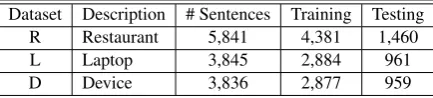
Table 1: Data statistics with number of sentences.
The parameters for token-level predictions and relation-level predictions are updated jointly such that the information from the auxiliary task could be propagated to the target task to obtain better performance. This idea is in accordance with
struc-tural learning proposed byAndo and Zhang(2005),
which shows that multiple related tasks are use-ful for finding the optimal hypothesis space. In our case, the set of multiple tasks includes the tar-get terms extraction task and the auxiliary relation prediction task, which are closely related. The pa-rameters are all shared across domains. The joint model is trained using back-propagation from the top layer of GRU or CRF to RNSCN until reaching to the input word embeddings in the bottom.
5 Experiments
5.1 Data & Experimental Setup
The data is taken from the benchmark customer re-views in three different domains, namely restaurant, laptop and digital devices. The restaurant domain contains a combination of restaurant reviews from
SemEval 2014 task 4 subtask 1 (Pontiki et al.,2014)
and SemEval 2015 task 12 subtask 1 (Pontiki et al.,
2015). The laptop domain consists of laptop
re-views from SemEval 2014 task 4 subtask 1. For
digital device, we take reviews from (Hu and Liu,
2004) containing sentences from 5 digital devices.
The statistics for each domain are shown in Table1.
In our experiments, we randomly split the data in each domain into training set and testing set with the proportion being 3:1. To obtain more rigorous result, we make three random splits for each do-main and test the learned model on each split. The number of sentences for training and testing after
each split is also shown in Table1. Each sentence
The evaluation metric we used is F1 score. Fol-lowing the setting from existing work, only exact match could be counted as correct.
For experimental setup, we use Stanford
Depen-dency Parser (Klein and Manning,2003) to
gen-erate dependency trees. There are in total 43 dif-ferent dependency relations, i.e. 43 classes for the auxiliary task. We set the number of latent rela-tion groups as 20. The input word features for RNSCN are pre-trained word embeddings using
word2vec (Mikolov et al.,2013) which is trained
on 3M reviews from the Yelp dataset2and
electron-ics dataset in Amazon reviews3 (McAuley et al.,
2015). The dimension of word embeddings is 100.
Because of the relatively small size of the training data compared with the number of parameters, we firstly pre-train RNSCN for 5 epochs with mini-batch size 30 and rmsprop initialized at 0.01. The
joint model of RNSCN+-GRU is then trained with
rmsprop initialized at 0.001 and mini-batch size 30.
The trade-off parameterα, β andγ are set to be
1, 0.001 and 0.1, respectively. The hidden-layer dimension for GRU is 50, and the context win-dow size is 3 for input feature vectors of GRU. For the joint model of RNSCN-CRF, we implement SGD with a decaying learning rate initialized at 0.02. The context window size is also 3 in this case. Both joint models are trained for 10 epochs.
5.2 Comparison & Results
We compared our proposed model with several baselines and variants of the proposed model:
• RNCRF: A joint model of recursive neural
network and CRF proposed by (Wang et al.,
2016) for single-domain aspect and opinion
terms extraction. We make all the parameters shared across domains for target prediction.
• RNGRU: A joint model of RNN and GRU. The hidden layer of RNN is taken as input for GRU. We share all the parameters across domains, similar to RNCRF.
• CrossCRF: A linear-chain CRF with hand-engineered features that are useful for
cross-domain settings (Jakob and Gurevych,2010),
e.g., POS tags, dependency relations.
• RAP: The Relational Adaptive bootstraPping
method proposed by (Li et al.,2012) that uses
TrAdaBoost to expand lexicons.
2
http://www.yelp.com/dataset challenge 3http://jmcauley.ucsd.edu/data/amazon/links.html
• Hier-Joint: A recent deep model proposed byDing et al.(2017) that achieves state-of-the-art performance on aspect terms extraction across domains.
• RNSCN-GRU: Our proposed joint model in-tegrating auxiliary relation prediction task into RNN that is further combined with GRU.
• RNSCN-CRF: The second proposed model similar to RNSCN-GRU, which replace GRU with CRF.
• RNSCN+-GRU: Our final joint model with auto-encoders to reduce auxiliary label noise.
Note that we do not implement other recent deep
adaptation models for comparison (Chen et al.,
2012;Yang and Hospedales,2015), because
Hier-Joint (Ding et al.,2017) has already demonstrated
better performances than these models. The overall comparison results with the baselines are shown
in Table 2 with average F1 scores and standard
deviations over three random splits. Clearly, the re-sults for aspect terms (AS) transfer are much lower than opinion terms (OP) transfer, which indicate that the aspect terms are usually quite different across domains, whereas the opinion terms could be more common and similar. Hence the ability to adapt the aspect extraction from the source do-main to the target dodo-main becomes more crucial. On this behalf, our proposed model shows clear advantage over other baselines for this more dif-ficult transfer problem. Specifically, we achieve 6.77%, 5.88%, 10.55% improvement over the
best-performing baselines for aspect extraction in R→L,
L→D and D→L, respectively. By comparing with
RNCRF and RNGRU, we show that the structural correspondence network is indeed effective when integrated into RNN.
To show the effect of the integration of the au-toencoder, we conduct experiments over different
variants of the proposed model in Table3.
RNSCN-GRU represents the model without autoencoder, which achieves much better F1 scores on most
ex-periments compared with the baselines in Table2.
RNSCN+-GRU outperforms RNSCN-GRU in
Models R→L R→D L→R L→D D→R D→L
AS OP AS OP AS OP AS OP AS OP AS OP
CrossCRF 19.72 59.20 21.07 52.05 28.19 65.52 29.96 56.17 6.59 39.38 24.22 46.67
(1.82) (1.34) (0.44) (1.67) (0.58) (0.89) (1.69) (1.49) (0.49) (3.06) (2.54) (2.43)
RAP 25.92 62.72 22.63 54.44 46.90 67.98 34.54 54.25 45.44 60.67 28.22 59.79
(2.75) (0.49) (0.52) (2.20) (1.64) (1.05) (0.64) (1.65) (1.61) (2.15) (2.42) (4.18)
Hier-Joint 33.66 - 33.20 - 48.10 - 31.25 - 47.97 - 34.74
-(1.47) - (0.52) - (1.45) - (0.49) - (0.46) - (2.27)
RNCRF 24.26 60.86 24.31 51.28 40.88 66.50 31.52 55.85 34.59 63.89 40.59 60.17
(3.97) (3.35) (2.57) (1.78) (2.09) (1.48) (1.40) (1.09) (1.34) (1.59) (0.80) (1.20)
RNGRU 24.23 60.65 20.49 52.28 39.78 62.99 32.51 52.24 38.15 64.21 39.44 60.85
(2.41) (1.04) (2.68) (2.69) (0.61) (0.95) (1.12) (2.37) (2.82) (1.11) (2.79) (1.25)
RNSCN-CRF 35.26 61.67 32.00 52.81 53.38 67.60 34.63 56.22 48.13 65.06 46.71 61.88
(1.31) (1.35) (1.48) (1.29) (1.49) (0.99) (1.38) (1.10) (0.71) (0.66) (1.16) (1.52)
RNSCN-GRU 37.77 62.35 33.02 57.54 53.18 71.44 35.65 60.02 49.62 69.42 45.92 63.85
(0.45) (1.85) (0.58) (1.27) (0.75) (0.97) (0.77) (0.80) (0.34) (2.27) (1.14) (1.97)
RNSCN+-GRU 40.43 65.85 35.10 60.17 52.91 72.51 40.42 61.15 48.36 73.75 51.14 71.18
[image:8.595.92.506.61.214.2](0.96) (1.50) (0.62) (0.75) (1.82) (1.03) (0.70) (0.60) (1.14) (1.76) (1.68) (1.58)
Table 2: Comparisons with different baselines.
Models R→L R→D L→R L→D D→R D→L
AS OP AS OP AS OP AS OP AS OP AS OP
RNSCN-GRU 37.77 62.35 33.02 57.54 53.18 71.44 35.65 60.02 49.62 69.42 45.92 63.85
RNSCN-GRU (r) 32.97 50.18 26.21 53.58 35.88 65.73 32.87 57.57 40.03 67.34 40.06 59.18
RNSCN+-GRU 40.43 65.85 35.10 60.17 52.91 72.51 40.42 61.15 48.36 73.75 51.14 71.18
[image:8.595.94.505.252.309.2]RNSCN+-GRU (r) 39.27 59.41 33.42 57.24 45.79 69.96 38.21 59.12 45.36 72.84 50.45 68.05
Table 3: Comparisons with different variants of the proposed model.
R→L R→D L→R L→D D→R D→L
AS OP AS OP AS OP AS OP AS OP AS OP
OUT
Hier-Joint 33.66 - 33.20 - 48.10 - 31.25 - 47.97 - 34.74
-RNSCN+-GRU* 39.06 - 34.07 - 47.98 - 38.51 - 47.49 - 48.49
-RNSCN+ 31.60 65.89 24.37 60.01 39.58 71.03 34.40 60.47 41.02 71.23 45.54 69.00
RNSCN+-GRU 40.43 65.85 35.10 60.17 52.91 72.51 40.42 61.15 48.36 73.75 51.14 71.18
IN
Hier-Joint 32.41 - 29.79 - 47.04 - 31.26 - 47.41 - 33.80
-RNSCN+-GRU* 40.34 - 30.75 - 48.69 - 37.40 - 46.49 - 48.50
-RNSCN+ 30.76 63.65 22.48 59.24 39.54 70.25 35.32 60.00 37.75 70.64 43.72 68.27
RNSCN+-GRU 41.27 65.44 33.58 60.28 52.48 72.10 39.73 60.18 47.10 72.19 50.23 70.21
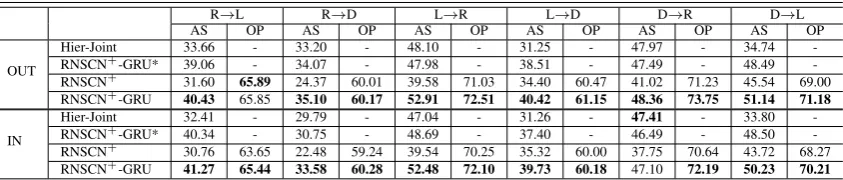
Table 4: Comparisons with different transfer setting.
relation. Specifically, in each source domain, for each relation that connects to any aspect or opin-ion word, it has 0.5 probability of being replaced
by any other relation. In Table3, We denote the
model with noisy relations with (r). Obviously, the performance of RNSCN-GRU without an autoen-coder significantly deteriorates when the auxiliary
labels are very noisy. On the contrary, RNSCN+
-GRU (r) achieves acceptable results compared to
RNSCN+-GRU. This proves that the autoencoder
makes the model more robust to label noise and helps to adapt the information more accurately to
the target data. Note that a large drop forL→R
in aspect extraction might be caused by a large por-tion of noisy replacements for this particular data which makes it too hard to train a good classifier. This may not greatly influence opinion extraction, as shown, because the two domains usually share many common opinion terms. However, the signif-icant difference in aspect terms makes the learning
more dependent on common relations.
The above comparisons are made using the test data from target domains which are not available during training (i.e., the inductive setting). For more complete comparison, we also conduct exper-iments in the transductive setting. We pick our best
model RNSCN+-GRU, and show the effect of
dif-ferent components. To do that, we first remove the
sequential structure on top, resulting in RNSCN+.
Moreover, we create another variant by removing opinion term labels to show the effect of the dou-ble propogation between aspect terms and opinion
terms. The resulting model is named RNSCN+
-GRU*. As shown in Table4, we denote by OUT
and IN the inductive and transductive setting, re-spectively. The results shown are the average F1
scores among three splits4. In general, RNSCN+
-GRU shows similar performances for both induc-tive and transducinduc-tive settings. This indicates the
[image:8.595.89.511.347.437.2]G Word
1 this, the, their, my, here, it, I, our, not
2 quality, jukebox, maitre-d, sauces, portions, volume, friend, noodles, calamari
3 in, slightly, often, overall, regularly, since, back, much, ago
4 handy, tastier, white, salty, right, vibrant, first, ok
5 get, went, impressed, had, try, said, recommended, call, love
[image:9.595.77.287.62.169.2]6 is, are, feels, believes, seems, like, will, would
Table 5: Case studies on word clustering
robustness and the ability to learn well when test data is not presented during training. Without
opin-ion labels, RNSCN+-GRU* still achieves better
results than Hier-Joint most of the time. Its lower
performance compared to RNSCN+-GRU also
in-dicates that in the cross-domain setting, the dual information between aspects and opinions is bene-ficial to find appropriate and discriminative relation
feature space. Finally, the results for RNSCN+
by removing GRU are lower than the joint model, which proves the importance of combining syntac-tic tree structure with sequential modeling.
To qualitatively show the effect of the auxiliary task with auto-encoders for clustering syntactically similar words across domains, we provide some case studies on the predicted groups of some words
in Table 5. Specifically, for each relation in the
dependency tree, we use (4) to obtain the most
probable group to assign the word in the child node. The left column shows the predicted group index with the right column showing the corresponding words. Clearly, the words in the same group have similar syntactic functionalities, whereas the word types vary across groups.
In the end, we verify the robustness and capa-bility of the model by conducting sensitivity stud-ies and experiments with varying number of
unla-beled target data for training, respectively. Figure4
shows the sensitivity test for L→D, which
indi-cates that changing of the trade-off parameter γ
or the number of groups |G| does not affect the
model’s performance greatly, i.e., less than 1% for aspect extraction and 2% for opinion extraction. This proves that our model is robust and stable
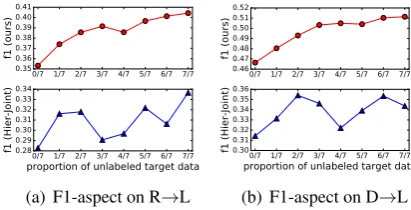
against small variations. Figure5 compares the
results of RNSCN+-GRU with Hier-Joint when
increasing the proportion of unlabeled target train-ing data from 0 to 1. Obviously, our model shows steady improvement with the increasing number of unlabeled target data. This pattern proves our
0.1 0.2 0.3 0.4 0.5 0.6 0.7 0.8 0.9 1.0 0.58 0.59 0.60 0.61 0.62 0.63 0.64 f1-op ini on
0.1 0.2 0.3 0.4 0.5 0.6 0.7 0.8 0.9 1.0
trade-off parameter (γ) 0.36 0.37 0.38 0.39 0.40 0.41 0.42 f1-asp ec t
(a) On trade-off parameter.
5 10 15 20 25 30 35 40 0.58 0.59 0.60 0.61 0.62 0.63 0.64 f1-op ini on
5 10 15 20 25 30 35 40
number of groups (|G|) 0.36 0.37 0.38 0.39 0.40 0.41 0.42 f1-asp ec t
[image:9.595.307.515.68.172.2](b) On number of groups.
Figure 4: Sensitivity studies for L→D.
0/7 1/7 2/7 3/7 4/7 5/7 6/7 7/7 proportion of unlabeled target data 0.28 0.29 0.30 0.31 0.32 0.33 0.34 f1 ( H ie r-Jo in t)
0/7 1/7 2/7 3/7 4/7 5/7 6/7 7/7 0.35 0.36 0.37 0.38 0.39 0.40 0.41 f1 ( ou rs)
(a) F1-aspect on R→L
0/7 1/7 2/7 3/7 4/7 5/7 6/7 7/7 proportion of unlabeled target data 0.30 0.31 0.32 0.33 0.34 0.35 0.36 f1 ( H ie r-Jo in t)
0/7 1/7 2/7 3/7 4/7 5/7 6/7 7/7 0.46 0.47 0.48 0.49 0.50 0.51 0.52 f1 ( ou rs)
(b) F1-aspect on D→L
Figure 5: F1 vs proportion of unlabeled target data.
model’s capability of learning from target domain for adaptation.
6 Conclusion
We propose a novel dependency-tree-based RNN,
namely RNSCN (or RNSCN+), for domain
adap-tation. The model integrates an auxiliary task into representation learning of nodes in the dependency tree. The adaptation takes place in a common re-lation feature space, which builds the structural correspondences using syntactic relations among the words in each sentence. We further develop a
joint model to combine RNSCN/RNSCN+with a
sequential labeling model for terms extraction.
Acknowledgements
This work is supported by NTU Singapore Nanyang Assistant Professorship (NAP) grant M4081532.020, MOE AcRF Tier-1 grant 2016-T1-001-159, and Fuji Xerox Corporation through joint research on Multilingual Semantic Analysis.
References
Rie Kubota Ando and Tong Zhang. 2005. A framework for learning predictive structures from multiple tasks and unlabeled data.JMLR6:1817–1853.
[image:9.595.308.514.217.322.2]Domain adaptation for sentiment classification. In
ACL. pages 187–205.
John Blitzer, Ryan McDonald, and Fernando Pereira. 2006. Domain adaptation with structural correspon-dence learning. InEMNLP. pages 120–128.
Danushka Bollegala, Takanori Maehara, and Ken ichi Kawarabayashi. 2015. Unsupervised cross-domain word representation learning. InACL. pages 730– 740.
Minmin Chen, Zhixiang Xu, Kilian Q. Weinberger, and Fei Sha. 2012. Marginalized denoising autoen-coders for domain adaptation. InICML. pages 1627– 1634.
Wenyuan Dai, Qiang Yang, Gui-Rong Xue, and Yong Yu. 2007. Boosting for transfer learning. In ICML. pages 193–200.
Marie C. de Marneffe and Christopher D. Manning. 2008. The stanford typed dependencies representa-tion. InCrossParser. pages 1–8.
Ying Ding, Jianfei Yu, and Jing Jiang. 2017. Recur-rent neural networks with auxiliary labels for cross-domain opinion target extraction. In AAAI. pages 3436–3442.
Xavier Glorot, Antoine Bordes, and Yoshua Bengio. 2011. Domain adaptation for large-scale sentiment classification: A deep learning approach. InICML. pages 97–110.
Minqing Hu and Bing Liu. 2004. Mining and summa-rizing customer reviews. InKDD. pages 168–177.
Niklas Jakob and Iryna Gurevych. 2010. Extracting opinion targets in a single- and cross-domain setting with conditional random fields. InEMNLP. pages 1035–1045.
Wei Jin and Hung Hay Ho. 2009. A novel lexical-ized hmm-based learning framework for web opin-ion mining. InICML. pages 465–472.
Dan Klein and Christopher D. Manning. 2003. Accu-rate unlexicalized parsing. InACL. pages 423–430.
Fangtao Li, Chao Han, Minlie Huang, Xiaoyan Zhu, Ying-Ju Xia, Shu Zhang, and Hao Yu. 2010. Structure-aware review mining and summarization. InCOLING. pages 653–661.
Fangtao Li, Sinno Jialin Pan, Ou Jin, Qiang Yang, and Xiaoyan Zhu. 2012. Cross-domain co-extraction of sentiment and topic lexicons. In ACL. pages 410– 419.
Pengfei Liu, Shafiq Joty, and Helen Meng. 2015. Fine-grained opinion mining with recurrent neural net-works and word embeddings. In EMNLP. pages 1433–1443.
Yue Lu, ChengXiang Zhai, and Neel Sundaresan. 2009. Rated aspect summarization of short comments. In
WWW. pages 131–140.
Julian McAuley, Christopher Targett, Qinfeng Shi, and Anton van den Hengel. 2015. Image-based rec-ommendations on styles and substitutes. InSIGIR. pages 43–52.
Tomas Mikolov, Kai Chen, Greg Corrado, and Jeffrey Dean. 2013. Efficient estimation of word represen-tations in vector space.CoRRabs/1301.3781.
Sinno Jialin Pan, Xiaochuan Ni, Jian-Tao Sun, Qiang Yang, and Zheng Chen. 2010. Cross-domain senti-ment classification via spectral feature alignsenti-ment. In
WWW. pages 751–760.
Maria Pontiki, Dimitris Galanis, Haris Papageorgiou, Suresh Manandhar, and Ion Androutsopoulos. 2015. SemEval-2015 task 12: Aspect based sentiment analysis. InSemEval 2015. pages 486–495.
Maria Pontiki, Dimitris Galanis, John Pavlopoulos, Harris Papageorgiou, Ion Androutsopoulos, and Suresh Manandhar. 2014. Semeval-2014 task 4: As-pect based sentiment analysis. In SemEval. pages 27–35.
Guang Qiu, Bing Liu, Jiajun Bu, and Chun Chen. 2011. Opinion word expansion and target extrac-tion through double propagaextrac-tion. Comput. Linguist.
37(1):9–27.
Scott E. Reed, Honglak Lee, Dragomir Anguelov, Christian Szegedy, Dumitru Erhan, and Andrew Ra-binovich. 2015. Training deep neural networks on noisy labels with bootstrapping. InICLR 2015.
Richard Socher, Christopher D. Manning, and An-drew Y. Ng. 2010. Learning Continuous Phrase Rep-resentations and Syntactic Parsing with Recursive Neural Networks. InNIPS Workshop. pages 1–9.
Ivan Titov and Ryan McDonald. 2008. Modeling online reviews with multi-grain topic models. In
WWW. pages 111–120.
Wenya Wang, Sinno Jialin Pan, Daniel Dahlmeier, and Xiaokui Xiao. 2016. Recursive neural conditional random fields for aspect-based sentiment analysis. InEMNLP. pages 616–626.
Wenya Wang, Sinno Jialin Pan, Daniel Dahlmeier, and Xiaokui Xiao. 2017. Coupled multi-layer tensor net-work for co-extraction of aspect and opinion terms. InAAAI. pages 3316–3322.
Yongxin Yang and Timothy M. Hospedales. 2015. A unified perspective on multi-domain and multi-task learning. InICLR.
Jianfei Yu and Jing Jiang. 2016. Learning sentence em-beddings with auxiliary tasks for cross-domain sen-timent classification. InEMNLP. pages 236–246.
Lei Zhang, Bing Liu, Suk Hwan Lim, and Eamonn O’Brien-Strain. 2010. Extracting and ranking prod-uct features in opinion documents. In COLING. pages 1462–1470.
Meishan Zhang, Yue Zhang, and Duy Tin Vo. 2015. Neural networks for open domain targeted sentiment. InEMNLP.