2556
Conceptual Captions: A Cleaned, Hypernymed, Image Alt-text Dataset
For Automatic Image Captioning
Piyush Sharma, Nan Ding, Sebastian Goodman, Radu Soricut Google AI
Venice, CA 90291
{piyushsharma,dingnan,seabass,rsoricut}@google.com
Abstract
We present a new dataset of image caption annotations, Conceptual Captions, which contains an order of magnitude more im-ages than the MS-COCO dataset (Lin et al.,
2014) and represents a wider variety of
both images and image caption styles. We achieve this by extracting and filtering im-age caption annotations from billions of webpages. We also present quantitative evaluations of a number of image cap-tioning models and show that a model architecture based on Inception-ResNet-v2 (Szegedy et al.,2016) for image-feature extraction and Transformer (Vaswani et al., 2017) for sequence modeling achieves the best performance when trained on the Con-ceptual Captions dataset.
1 Introduction
Automatic image description is the task of pro-ducing a natural-language utterance (usually a sen-tence) which correctly reflects the visual content of an image. This task has seen an explosion in proposed solutions based on deep learning architec-tures (Bengio,2009), starting with the winners of the 2015 COCO challenge (Vinyals et al.,2015a; Fang et al.,2015), and continuing with a variety of improvements (see e.g.Bernardi et al.(2016) for a review). Practical applications of automatic image description systems include leveraging descriptions for image indexing or retrieval, and helping those with visual impairments by transforming visual sig-nals into information that can be communicated via text-to-speech technology. The scientific challenge is seen as aligning, exploiting, and pushing further the latest improvements at the intersection of Com-puter Vision and Natural Language Processing.
Alt-text: A Pakistani worker helps to clear the debris from the Taj Ma-hal Hotel November 7, 2005 in Bal-akot, Pakistan.
Conceptual Captions: a worker helps to clear the debris.
Alt-text: Musician Justin Timber-lake performs at the 2017 Pilgrim-age Music & Cultural Festival on September 23, 2017 in Franklin, Tennessee.
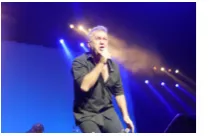
Conceptual Captions: pop artist performs at the festival in a city.
Figure 1: Examples of images and image descrip-tions from the Conceptual Capdescrip-tions dataset; we start from existing alt-text descriptions, and auto-matically process them into Conceptual Captions with a balance of cleanliness, informativeness, flu-ency, and learnability.
There are two main categories of advances re-sponsible for increased interest in this task. The first is the availability of large amounts of anno-tated data. Relevant datasets include the ImageNet dataset (Deng et al.,2009), with over 14 million images and 1 million bounding-box annotations, and the MS-COCO dataset (Lin et al.,2014), with 120,000 images and 5-way image-caption anno-tations. The second is the availability of power-ful modeling mechanisms such as modern Con-volutional Neural Networks (e.g.Krizhevsky et al. (2012)), which are capable of converting image pix-els into high-level features with no manual feature-engineering.
In this paper, we make contributions to both
the data and modeling categories. First, we
present a new dataset of caption annotations∗,
Conceptual Captions (Fig. 1), which has an
or-der of magnitude more images than the COCO
∗
dataset. Conceptual Captions consists of about 3.3Mhimage,descriptionipairs. In contrast with the curated style of the COCO images, Concep-tual Captions images and their raw descriptions are harvested from the web, and therefore repre-sent a wider variety of styles. The raw descriptions
are harvested from the Alt-text HTML attribute†
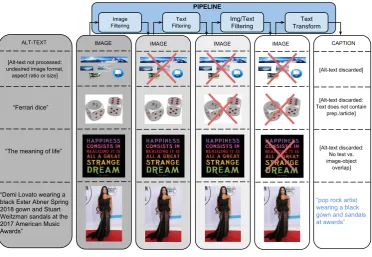
associated with web images. We developed an au-tomatic pipeline (Fig.2) that extracts, filters, and transforms candidate image/caption pairs, with the goal of achieving a balance of cleanliness, informa-tiveness, fluency, and learnability of the resulting captions.
As a contribution to the modeling category, we evaluate several image-captioning models. Based
on the findings of Huang et al. (2016), we use
Inception-ResNet-v2 (Szegedy et al., 2016) for
image-feature extraction, which confers optimiza-tion benefits via residual connecoptimiza-tions and
com-putationally efficient Inception units. For
cap-tion generacap-tion, we use both RNN-based (
Hochre-iter and Schmidhuber, 1997) and Transformer-based (Vaswani et al.,2017) models. Our results indicate that Transformer-based models achieve higher output accuracy; combined with the reports ofVaswani et al.(2017) regarding the reduced num-ber of parameters and FLOPs required for training & serving (compared with RNNs), models such as
T2T8x8(Section4) push forward the performance
on image-captioning and deserve further attention.
2 Related Work
Automatic image captioning has a long history ( Ho-dosh et al., 2013; Donahue et al., 2014; Karpa-thy and Fei-Fei, 2015; Kiros et al., 2015). It has accelerated with the success of Deep Neu-ral Networks (Bengio,2009) and the availability of annotated data as offered by datasets such as Flickr30K (Young et al.,2014) and MS-COCO (Lin et al.,2014).
The COCO dataset is not large (order of106 im-ages), given the training needs of DNNs. In spite of that, it has been very popular, in part because it offers annotations for images with non-iconic views, or non-canonical perspectives of objects, and therefore reflects the composition of everyday
scenes (the same is true about Flickr30K (Young
et al.,2014)). COCO annotations–category label-ing, instance spottlabel-ing, and instance segmentation– are done for all objects in an image, including those
†
https://en.wikipedia.org/wiki/Alt attribute
in the background, in a cluttered environment, or partially occluded. Its images are also annotated with captions, i.e. sentences produced by human an-notators to reflect the visual content of the images in terms of objects and their actions or relations.
A large number of DNN models for image cap-tion generacap-tion have been trained and evaluated using COCO captions (Vinyals et al.,2015a;Fang et al.,2015;Xu et al.,2015;Ranzato et al.,2015; Yang et al.,2016;Liu et al.,2017;Ding and Soricut,
2017). These models are inspired by
sequence-to-sequence models (Sutskever et al.,2014;Bahdanau et al., 2015) but use CNN-based encodings in-stead of RNNs (Hochreiter and Schmidhuber,1997; Chung et al.,2014). Recently, the Transformer ar-chitecture (Vaswani et al.,2017) has been shown to be a viable alternative to RNNs (and CNNs) for sequence modeling. In this work, we evaluate the impact of the Conceptual Captions dataset on the image captioning task using models that combine CNN, RNN, and Transformer layers.
Also related to this work is the Pinterest image and sentence-description dataset (Mao et al.,2016). It is a large dataset (order of108examples), but its text descriptions do not strictly reflect the visual content of the associated image, and therefore can-not be used directly for training image-captioning models.
3 Conceptual Captions Dataset Creation
The Conceptual Captions dataset is
programmat-ically created using a Flume (Chambers et al.,
2010) pipeline. This pipeline processes billions
of Internet webpages in parallel. From these web-pages, it extracts, filters, and processes candidate
himage,captionipairs. The filtering and process-ing steps are described in detail in the followprocess-ing sections.
Image-based Filtering The first filtering stage, image-based filtering, discards images based on encoding format, size, aspect ratio, and offensive content. It only keeps JPEG images where both dimensions are greater than 400 pixels, and the ratio of larger to smaller dimension is no more than 2. It excludes images that trigger pornography or profanity detectors. These filters discard more than 65% of the candidates.
[Alt-text not processed: undesired image format,
aspect ratio or size] ALT-TEXT
“Ferrari dice”
“The meaning of life”
“Demi Lovato wearing a black Ester Abner Spring 2018 gown and Stuart Weitzman sandals at the 2017 American Music Awards”
IMAGE
[Alt-text discarded] CAPTION
“pop rock artist wearing a black gown and sandals at awards”
[Alt-text discarded: Text does not contain
prep./article]
[Alt-text discarded: No text vs. image-object
overlap] Image
Filtering
Text Filtering
Img/Text Filtering
Text Transform
PIPELINE
IMAGE IMAGE
[image:3.595.117.490.83.340.2]IMAGE
Figure 2: Conceptual Captions pipeline steps with examples and final output.
and intends to describe the nature or the content of the image. Because these Alt-text values are not in any way restricted or enforced to be good image descriptions, many of them have to be discarded, e.g., search engine optimization (SEO) terms, or Twitter hash-tag terms.
We analyze candidate Alt-text using the Google Cloud Natural Language APIs, specifically part-of-speech (POS), sentiment/polarity, and pornogra-phy/profanity annotations. On top of these annota-tions, we have the following heuristics:
• a well-formed caption should have a high
unique word ratio covering various POS tags; candidates with no determiner, no noun, or no preposition are discarded; candidates with a high noun ratio are also discarded;
• candidates with a high rate of token repetition are discarded;
• capitalization is a good indicator of
well-composed sentences; candidates where the first word is not capitalized, or with too high capitalized-word ratio are discarded;
• highly unlikely tokens are a good indicator of not desirable text; we use a vocabularyVW of 1B token types, appearing at least 5 times in
the English Wikipedia, and discard candidates that contain tokens that are not found in this vocabulary.
• candidates that score too high or too low on
the polarity annotations, or trigger the pornog-raphy/profanity detectors, are discarded;
• predefined boiler-plate prefix/suffix sequences matching the text are cropped, e.g. “click to enlarge picture”, “stock photo”; we also drop text which begins/ends in certain patterns, e.g. “embedded image permalink”, “profile photo”.
These filters only allow around 3% of the incoming candidates to pass to the later stages.
Image&Text-based Filtering In addition to the separate filtering based on image and text content, we filter out candidates for which none of the text tokens can be mapped to the content of the image. To this end, we use classifiers available via the Google Cloud Vision APIs to assign class labels to images, using an image classifier with a large num-ber of labels (order of magnitude of105). Notably, these labels are also 100% covered by theVwtoken types.
Original Alt-text Harrison Ford and Calista Flockhart attend the premiere of ‘Hollywood Homicide’ at the 29th American Film Festival September 5, 2003 in Deauville, France.
Conceptual Captions actors attend the premiere at festival.
what-happened “Harrison Ford and Calista Flockhart” mapped to “actors”; name, location, and date dropped.
Original Alt-text Side view of a British Airways Airbus A319 aircraft on approach to land with landing gear down - Stock Image
Conceptual Captions side view of an aircraft on approach to land with landing gear down
what-happened phrase “British Airways Airbus A319 aircraft” mapped to “aircraft”; boilerplate removed.
Original Alt-text Two sculptures by artist Duncan McKellar adorn trees outside the derelict Norwich Union offices in Bristol, UK - Stock Image
Conceptual Captions sculptures by person adorn trees outside the derelict offices
[image:4.595.85.519.64.233.2]what-happened object count (e.g. “Two”) dropped; proper noun-phrase hypernymized to “person”; proper-noun modifiers dropped; location dropped; boilerplate removed.
Table 1: Examples of Conceptual Captions as derived from their original Alt-text versions.
image. We match these labels against the candi-date text, taking into account morphology-based stemming as provided by the text annotation. Can-didatehimage,captionipairs with no overlap are discarded. This filter discards around 60% of the incoming candidates.
Text Transformation with Hypernymization
In the current version of the dataset, we consid-ered over 5 billion images from about 1 billion English webpages. The filtering criteria above are designed to be high-precision (which comes with potentially low recall). From the original input can-didates, only 0.2%himage,captionipairs pass the filtering criteria described above.
While the remaining candidate captions tend to be appropriate Alt-text image descriptions (see Alt-text in Fig.1), a majority of these candidate captions contain proper names (people, venues, locations, etc.), which would be extremely diffi-cult to learn as part of the image captioning task. To give an idea of what would happen in such cases, we train an RNN-based captioning model (see Section4) on non-hypernymized Alt-text data and present an output example in Fig.3. If auto-matic determination of person identity, location, etc. is needed, it should be attempted as a sepa-rate task and would need to leverage image meta-information about the image (e.g. location).
Using the Google Cloud Natural Language APIs, we obtain named-entity and syntactic-dependency
annotations. We then use the Google
Knowl-edge Graph (KG) Search API to match the named-entities to KG entries and exploit the associated hy-pernym terms. For instance, both “Harrison Ford” and “Calista Flockhart” identify as named-entities,
Alt-text (groundtruth): Jimmy Barnes performs at the Sydney Entertainment Centre
Model output: Singer Justin Bieber performs onstage during the Billboard Music Awards at the MGM
Figure 3: Example of model output trained on clean, non-hypernymized Alt-text data.
so we match them to their corresponding KG en-tries. These KG entries have “actor” as their hyper-nym, so we replace the original surface tokens with that hypernym.
The following steps are applied to achieve text transformations:
• noun modifiers of certain types (proper nouns, numbers, units) are removed;
• dates, durations, and preposition-based loca-tions (e.g., “in Los Angeles”) are removed;
• named-entities are identified, matched against the KG entries, and substitute with their hy-pernym;
• resulting coordination noun-phrases with the
same head (e.g., “actor and actor”) are re-solved into a single-head, pluralized form (e.g., “actors”);
Around 20% of samples are discarded during this transformation because it can leave sentences too short or inconsistent.
[image:4.595.313.418.280.348.2]“actor”, “dog”, “neighborhood”, etc.) and keep only the candidates for which all detected types have a count of over 100 (around 55% of the can-didates). These remaininghimage,captionipairs contain around 16,000 entity types, guaranteed to be well represented in terms of number of examples.
Table1contains several examples of
before/after-transformation pairs.
Conceptual Captions Quality To evaluate the precision of our pipeline, we consider a random sample of 4K examples extracted from the test split of the Conceptual Captions dataset. We perform a human evaluation on this sample, using the same methodology described in Section5.4.
GOOD (out of 3)
1+ 2+ 3
Conceptual Captions 96.9% 90.3% 78.5%
Table 2: Human evaluation results on a sample from Conceptual Captions.
The results are presented in Table 2and show
that, out of 3 annotations, over 90% of the captions receive a majority (2+) of GOOD judgments. This indicates that the Conceptual Captions pipeline, though involving extensive algorithmic processing, produces high-quality image captions.
Examples Unique Tokens/Caption Tokens Mean StdDev Median Train 3,318,333 51,201 10.3 4.5 9.0
Valid. 28,355 13,063 10.3 4.6 9.0
[image:5.595.306.526.174.306.2]Test 22,530 11,731 10.1 4.5 9.0
Table 3: Statistics over Train/Validation/Test splits for Conceptual Captions.
We present in Table 3 statistics over the
Train/Validation/Test splits for the Conceptual Cap-tions dataset. The training set consists of slightly over 3.3M examples, while there are slightly over 28K examples in the validation set and 22.5K ex-amples in the test set. The size of the training set vocabulary (unique tokens) is 51,201. Note that the test set has been cleaned using human judgements (2+ GOOD), while both the training and valida-tion splits contain all the data, as produced by our automatic pipeline. The mean/stddev/median statis-tics for tokens-per-caption over the data splits are consistent with each other, at around 10.3/4.5/9.0, respectively.
4 Image Captioning Models
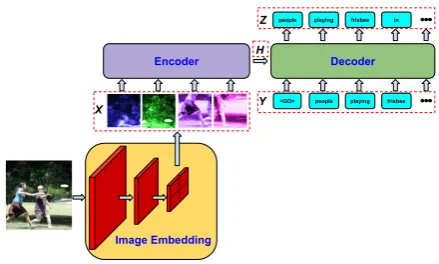
In order to assess the impact of the Conceptual Cap-tions dataset, we consider several image captioning models previously proposed in the literature. These models can be understood using the illustration in Fig.4, as they mainly differ in the way in which they instantiate some of these components.
Encoder
<GO> people playing frisbee
Decoder
people playing frisbee in
Image Embedding X
H
Y Z
Figure 4: The main model components.
There are three main components to this archi-tecture:
• A deep CNN that takes a (preprocessed)
im-age and outputs a vector of imim-age embeddings X= (x1,x2, ...,xL).
• An Encoder module that takes the image
embeddings and encodes them into a tensor H=fenc(X).
• A Decoder model that generates outputszt=
fdec(Y1:t,H)at each step t, conditioned on Has well as the decoder inputsY1:t.
We explore two main instantiations of this
architec-ture. One uses RNNs with LSTM cells (Hochreiter
and Schmidhuber,1997) to implement thefencand
fdec functions, corresponding to the
Show-And-Tell (Vinyals et al.,2015b) model. The other uses Transformer self-attention networks (Vaswani et al., 2017) to implementfencand fdec. All models in this paper use Inception-ResNet-v2 as the CNN component (Szegedy et al.,2016).
4.1 RNN-based Models
Our instantiation of the RNN-based model is close to the Show-And-Tell (Vinyals et al.,2015b) model.
hl,RNNenc(xl,hl−1), and H=hL,
[image:5.595.78.286.474.524.2]In the original Show-And-Tell model, a single im-age embedding of the entire imim-age is fed to the first cell of an RNN, which is also used for text gener-ation. In our model, a single image embedding is fed to an RNNencwith only one cell, and then a dif-ferent RNNdecis used for text generation. We tried both single image (1x1) embeddings and 8x8 parti-tions of the image, where each partition has its own embedding. In the 8x8 case, image embeddings are fed in a sequence to the RNNenc. In both cases, we apply plain RNNs without cross attention, same as the Show-And-Tell model. RNNs with cross
atten-tion were used in the Show-Attend-Tell model (Xu
et al., 2015), but we find its performance to be inferior to the Show-And-Tell model.
4.2 Transformer Model
In the Transformer-based models, both the encoder
and the decoder contain a stack ofN layers. We
denote the n-th layer in the encoder by Xn =
{xn,1, . . . ,xn,L}, andX0 = X,H= XN. Each of these layers contains two sub-layers: a multi-head self-attention layerATTN, and a position-wise
feedforward networkFFN:
x0n,j =ATTN(xn,j,Xn;Weq,Wek,Wev)
,softmax(hxn,jWeq,XnWeki)XnWev
x(n+1),j =FFN(x0n,j;W e f)
whereWeq,Wek, andWevare the encoder weight matrices for query, key, and value transformation in the self-attention sub-layer; andWef denotes the encoder weight matrix of the feedforward sub-layer. Similar to the RNN-based model, we consider us-ing a sus-ingle image embeddus-ing (1x1) and a vector of 8x8 image embeddings.
In the decoder, we denote the n-th layer by
Zn = {zn,1, . . . ,zn,T} andZ0 = Y. There are
two main differences between the decoder and en-coder layers. First, the self-attention sub-layer in the decoder is masked to the right, in order to pre-vent attending to “future” positions (i.e.zn,j does not attend tozn,(j+1), . . . ,zn,T). Second, in be-tween the self-attention layer and the feedforward layer, the decoder adds a third cross-attention layer that connectszn,j to the top-layer encoder
repre-sentationH=XN.
z0n,j =ATTN(zn,j,Zn,1:j;Wdq,Wdk,W d v)
z00n,j =ATTN(z0
n,j,H;Wcq,Wck,Wcv)
z(n+1),j=FFN(z00n,j;W d f)
whereWdq,Wdk, andWdv are the weight matrices for query, key, and value transformation in the de-coder self-attention sub-layer;Wcq,Wck,Wcv are the corresponding decoder weight matrices in the cross-attention sub-layer; andWdf is the decoder weight matrix of the feedforward sub-layer.
The Transformer-based models utilize position information at the embedding layer. In the 8x8 case, the 64 embedding vectors are serialized to a 1D sequence with positions from[0, . . . ,63]. The po-sition information is modeled by applying sine and cosine functions at each position and with differ-ent frequencies for each embedding dimension, as in (Vaswani et al.,2017), and subsequently added to the embedding representations.
5 Experimental Results
In this section, we evaluate the impact of using the Conceptual Captions dataset (referred to as ’Conceptual’ in what follows) for training image
captioning models. To this end, we train the
models described in Section 4 under two
exper-imental conditions: using the training &
devel-opment sets provided by the COCO dataset (Lin
et al.,2014), versus training & development sets using the Conceptual dataset. We quantitatively evaluate the resulting models using three differ-ent test sets: the blind COCO-C40 test set (in-domain for COCO-trained models, out-of-(in-domain for Conceptual-trained models); the Conceptual test set (out-of-domain for COCO-trained mod-els, in-domain for Conceptual-trained models); and the Flickr (Young et al., 2014) 1K test set (out-of-domain for both COCO-trained models and Conceptual-trained models).
5.1 Dataset Details
COCO Image Captions The COCO image cap-tioning dataset is normally divided into 82K images for training, and 40K images for validation. Each of these images comes with at least 5 groundtruth captions. Following standard practice, we combine the training set with most of the validation dataset for training our model, and only hold out a subset of 4K images for validation.
COCO-trained
RNN8x8 a group of men standing in front of a building
a couple of people walk-ing down a walkway
a child sitting at a table with a cake on it
a close up of a stuffed animal on a table
T2T8x8 a group of men in uni-form and ties are talking
a narrow hallway with a clock and two doors
a woman cutting a birth-day cake at a party
a picture of a fish on the side of a car
Conceptual-trained
RNN8x8
graduates line up for the commencement cer-emony
a view of the nave a child ’s drawing at a birthday party
a cartoon business-man thinking about something
T2T8x8 graduates line up to re-ceive their diplomas
the cloister of the cathe-dral
learning about the arts and crafts
[image:7.595.85.511.64.239.2]a cartoon businessman asking for help
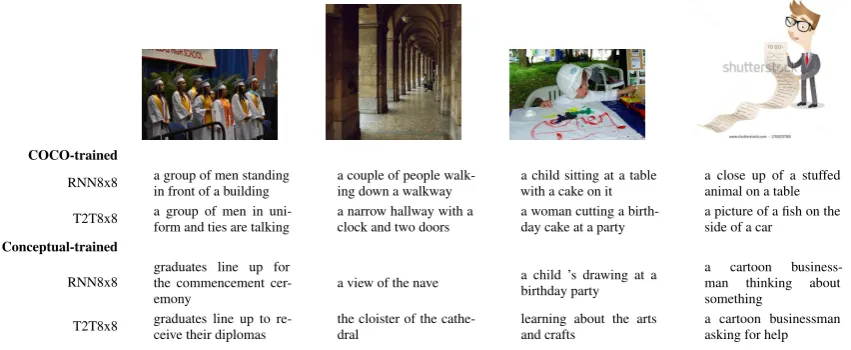
Figure 5: Side by side comparison of model outputs under two training conditions. Conceptual-based models (lower half) tend to hallucinate less, are more expressive, and handle well a larger variety of images. The two images in the middle are from Flickr; the other two are from Conceptual Captions.
5.2 Experimental Setup
Image Preprocessing Each input image is first preprocessed by random distortion and cropping
(using a random ratio from 50%∼100%). This
prevents models from overfitting individual pixels of the training images.
Encoder-Decoder For RNN-based models, we use a 1-layer, 512-dim LSTM as the RNN cell. For the Transformer-based models, we use the default
setup from (Vaswani et al., 2017), withN = 6
encoder and decoder layers, a hidden-layer size of 512, and 8 attention heads.
Text Handling Training captions are truncated to maximum 15 tokens. We use a token type min-count of 4, which results in around 9,000 token types for the COCO dataset, and around 25,000 token types for the Conceptual Captions dataset. All other tokens are replaced with special token
hUNKi. The word embedding matrix has size 512
and is tied to the output projection matrix.
Optimization All models are trained using MLE
loss and optimized using Adagrad (Duchi et al.,
2011) with learning rate 0.01. Mini-batch size is 25. All model parameters are trained for a total number of 5M steps, with batch updates asynchronously distributed across 40 workers. The final model is selected based on the best CIDEr score on the development set for the given training condition.
Inference During inference, the decoder predic-tion of the previous posipredic-tion is fed to the input of the next position. We use a beam search of beam
size 4 to compute the most likely output sequence.
5.3 Qualitative Results
Before we present the numerical results for our experiments, we discuss briefly the patterns that we have observed.
One difference between COCO-trained models and Conceptual-trained models is their ability to use the appropriate natural language terms for the entities in an image. For the left-most image in
Fig.5, COCO-trained models use “group of men”
to refer to the people in the image; Conceptual-based models use the more appropriate and infor-mative term “graduates”. The second image, from the Flickr test set, makes this even more clear. The
Conceptual-trainedT2T8x8model is perfectly
ren-dering the image content as “the cloister of the cathedral”. None of the other models come close to producing such an accurate description.
A second difference is that COCO-trained mod-els often seem to hallucinate objects. For instance, they hallucinate “front of building” for the first im-age, “clock and two doors” for the second, and “birthday cake” for the third image. In contrast,
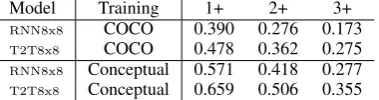
Model Training 1+ 2+ 3+
RNN8x8 COCO 0.390 0.276 0.173 T2T8x8 COCO 0.478 0.362 0.275 RNN8x8 Conceptual 0.571 0.418 0.277
[image:8.595.309.528.62.154.2]T2T8x8 Conceptual 0.659 0.506 0.355
Table 4: Human eval results on Flickr 1K Test.
A third difference is the resilience to a large spectrum of image types. COCO only contains nat-ural images, and therefore a cartoon image like the fourth one results in massive hallucination effects for COCO-trained models (“stuffed animal”, “fish”, “side of car”). In contrast, Conceptual-trained
mod-els handle such images with ease.
5.4 Quantitative Results
In this section, we present quantitative results on the quality of the outputs produced by several im-age captioning models. We present both automatic evaluation results and human evaluation results.
5.4.1 Human Evaluation Results
For human evaluations, we use a pool of profes-sional raters (tens of raters), with a double-blind evaluation condition. Raters are asked to assign a
GOOD or BAD label to a givenhimage,captioni
input, using just common-sense judgment. This approximates the reaction of a typical user, who normally would not accept predefined notions of GOOD vs. BAD. We ask 3 separate raters to rate each input pair and report the percentage of pairs that receivekor more (k+) GOOD annotations.
In Table 4, we report the results on the Flickr 1K test set. This evaluation is out-of-domain for both training conditions, so all models are on rel-atively equal footing. The results indicate that the Conceptual-based models are superior. In 50.6% (for theT2T8x8model) of cases, a majority of
an-notators (2+) assigned a GOOD label. The results also indicate that the Transformer-based models are superior to the RNN-based models by a good mar-gin, by over 8-points (for 2+) under both COCO and Conceptual training conditions.
Model Training CIDEr ROUGE-L METEOR
[image:8.595.88.278.63.113.2]RNN1x1 COCO 1.021 0.694 0.348 RNN8x8 COCO 1.044 0.698 0.354 T2T1x1 COCO 1.032 0.700 0.358 T2T8x8 COCO 1.032 0.700 0.356 RNN1x1 Conceptual 0.403 0.445 0.191 RNN8x8 Conceptual 0.410 0.437 0.189 T2T1x1 Conceptual 0.348 0.403 0.171 T2T8x8 Conceptual 0.345 0.400 0.170
Table 5: Auto metrics on the COCO C40 Test.
Model Training CIDEr ROUGE-L SPICE
[image:8.595.309.528.195.288.2]RNN1x1 COCO 0.183 0.149 0.062 RNN8x8 COCO 0.191 0.152 0.065 T2T1x1 COCO 0.184 0.148 0.062 T2T8x8 COCO 0.190 0.151 0.064 RNN1x1 Conceptual 1.351 0.326 0.235 RNN8x8 Conceptual 1.401 0.330 0.240 T2T1x1 Conceptual 1.588 0.331 0.254 T2T8x8 Conceptual 1.676 0.336 0.257
Table 6: Auto metrics on the 22.5K Conceptual Captions Test set.
Model Training CIDEr ROUGE-L SPICE
RNN1x1 COCO 0.340 0.414 0.101
RNN8x8 COCO 0.356 0.413 0.103 T2T1x1 COCO 0.341 0.404 0.101 T2T8x8 COCO 0.359 0.416 0.103 RNN1x1 Conceptual 0.269 0.310 0.076 RNN8x8 Conceptual 0.275 0.309 0.076 T2T1x1 Conceptual 0.226 0.280 0.068 T2T8x8 Conceptual 0.227 0.277 0.066
Table 7: Auto metrics on the Flickr 1K Test.
5.4.2 Automatic Evaluation Results
In this section, we report automatic evaluation re-sults, using established image captioning metrics.
For the COCO C40 test set (Fig.5), we report
the numerical values returned by the COCO on-line evaluation server‡, using the CIDEr (Vedantam et al.,2015), ROUGE-L (Lin and Och,2004), and
METEOR (Banerjee and Lavie,2005) metrics. For
Conceptual Captions (Fig.6) and Flickr (Fig.7) test sets, we report numerical values for the CIDEr,
ROUGE-L, and SPICE (Anderson et al., 2016)§.
For all metrics, higher number means closer dis-tance between the candidates and the groundtruth captions.
The automatic metrics are good at detecting in-vs out-of-domain situations. For COCO-models
tested on COCO, the results in Fig.5show CIDEr
scores in the 1.02-1.04 range, for both RNN- and Transformer-based models; the scores drop in the 0.35-0.41 range (CIDEr) for the Conceptual-based models tested against COCO groundtruth. For Conceptual-models tested on the Conceptual
Cap-tions test set, the results in Fig. 6 show scores
as high as 1.468 CIDEr for the T2T8x8 model,
which corroborates the human-eval results for the Transformer-based models being superior to the RNN-based models; the scores for the COCO-based models tested against Conceptual Captions groundtruth are all below 0.2 CIDEr.
The automatic metrics fail to corroborate the
‡
http://mscoco.org/dataset/#captions-eval. §
human evaluation results. According to the auto-matic metrics, the COCO-trained models are su-perior to the Conceptual-trained models (CIDEr scores in the mid-0.3 for the COCO-trained con-dition, versus mid-0.2 for the Conceptual-trained condition), and the RNN-based models are supe-rior to Transformer-based models. Notably, these are the same metrics which score humans lower than the methods that won the COCO 2015 chal-lenge (Vinyals et al., 2015a; Fang et al., 2015), despite the fact that humans are still much better at this task. The failure of these metrics to align with the human evaluation results casts again grave doubts on their ability to drive progress in this field. A significant weakness of these metrics is that hal-lucination effects are under-penalized (a small pre-cision penalty for tokens with no correspondent in the reference), compared to human judgments that tend to dive dramatically in the presence of hallucinations.
6 Conclusions
We present a new image captioning dataset, Con-ceptual Captions, which has several key character-istics: it has around 3.3M examples, an order of magnitude larger than the COCO image-captioning dataset; it consists of a wide variety of images, including natural images, product images, profes-sional photos, cartoons, drawings, etc.; and, its captions are based on descriptions taken from orig-inal Alt-text attributes, automatically transformed to achieve a balance between cleanliness, informa-tiveness, and learnability.
We evaluate both the quality of the resulting image/caption pairs, as well as the performance of several image-captioning models when trained on the Conceptual Captions data. The results indicate that such models achieve better performance, and avoid some of the pitfalls seen with COCO-trained models, such as object hallucination. We hope that the availability of the Conceptual Captions dataset will foster considerable progress on the automatic image-captioning task.
References
Peter Anderson, Basura Fernando, Mark Johnson, and Stephen Gould. 2016. SPICE: semantic proposi-tional image caption evaluation. InECCV.
D. Bahdanau, K. Cho, and Y. Bengio. 2015. Neural machine translation by jointly learning to align and translate. InProceedings of ICLR.
Satanjeev Banerjee and Alon Lavie. 2005. METEOR: An automatic metric for MT evaluation with im-proved correlation with human judgments. In Pro-ceedings of the ACL Workshop on intrinsic and ex-trinsic evaluation measures for machine translation and/or summarization.
Yoshua Bengio. 2009. Learning deep architectures for ai.Found. Trends Mach. Learn.2(1):1–127.
Raffaella Bernardi, Ruket Cakici, Desmond Elliott, Aykut Erdem, Erkut Erdem, Nazli Ikizler-Cinbis, Frank Keller, Adrian Muscat, and Barbara Plank. 2016. Automatic description generation from im-ages: A survey of models, datasets, and evaluation measures. JAIR55.
Craig Chambers, Ashish Raniwala, Frances Perry, Stephen Adams, Robert Henry, Robert Bradshaw,
and Nathan. 2010. Flumejava: Easy,
effi-cient data-parallel pipelines. In ACM SIGPLAN Conference on Programming Language Design and Implementation (PLDI). 2 Penn Plaza, Suite 701 New York, NY 10121-0701, pages 363–375.
http://dl.acm.org/citation.cfm?id=1806638.
Junyoung Chung, Caglar Gulcehre, KyungHyun Cho, and Yoshua Bengio. 2014. Empirical evaluation of gated recurrent neural networks on sequence model-ing.arXiv preprint arXiv:1412.3555.
J. Deng, W. Dong, R. Socher, L.-J. Li, K. Li, and L. Fei-Fei. 2009. ImageNet: A large-scale hierarchical im-age database. InCVPR.
Nan Ding and Radu Soricut. 2017. Cold-start reinforce-ment learning with softmax policy gradients. In NIPS.
Jeff Donahue, Lisa Anne Hendricks, Sergio Guadar-rama, Marcus Rohrbach, Subhashini Venugopalan, Kate Saenko, and Trevor Darrell. 2014. Long-term recurrent convolutional networks for visual recog-nition and description. In Proc. of IEEE Confer-ence on Computer Vision and Pattern Recognition (CVPR).
John Duchi, Elad Hazan, and Yoram Singer. 2011. Adaptive subgradient methods for online learning and stochastic optimization. Journal of Machine Learning Research12(Jul):2121–2159.
Hao Fang, Saurabh Gupta, Forrest Iandola, Rupesh Sri-vastava, Li Deng, Piotr Doll´ar, Jianfeng Gao, Xi-aodong He, Margaret Mitchell, John Platt, et al. 2015. From captions to visual concepts and back. In Proc. of IEEE Conference on Computer Vision and Pattern Recognition (CVPR).
Sepp Hochreiter and J¨urgen Schmidhuber. 1997. Long short-term memory. Neural computation9(8):1735– 1780.
Jonathan Huang, Vivek Rathod, Chen Sun, Menglong Zhu, Anoop Korattikara, Alireza Fathi, Ian Fischer, Zbigniew Wojna, Yang Song, Sergio Guadarrama, and Kevin Murphy. 2016. Speed/accuracy trade-offs for modern convolutional object detectors. CoRR abs/1611.10012.
Andrej Karpathy and Li Fei-Fei. 2015. Deep visual-semantic alignments for generating image descrip-tions. In Proc. of IEEE Conference on Computer Vision and Pattern Recognition (CVPR).
Ryan Kiros, Ruslan Salakhutdinov, and Richard S Zemel. 2015. Unifying visual-semantic embeddings with multimodal neural language models. Transac-tions of the Association for Computational Linguis-tics.
A. Krizhevsky, I. Sutskever, and G. Hinton. 2012. Im-agenet classification with deep convolutional neural networks. InNIPS.
Chin-Yew Lin and Franz Josef Och. 2004. Auto-matic evaluation of machine translation quality us-ing longest common subsequence and skip-bigram statistics. InProceedings of ACL.
Tsung-Yi Lin, Michael Maire, Serge J. Belongie, Lubomir D. Bourdev, Ross B. Girshick, James Hays, Pietro Perona, Deva Ramanan, Piotr Doll´ar, and C. Lawrence Zitnick. 2014. Microsoft COCO: com-mon objects in context. CoRRabs/1405.0312.
Siqi Liu, Zhenhai Zhu, Ning Ye, Sergio Guadarrama, and Kevin Murphy. 2017. Optimization of image description metrics using policy gradient methods. In International Conference on Computer Vision (ICCV).
Junhua Mao, Jiajing Xu, Yushi Jing, and Alan Yuille. 2016. Training and evaluating multimodal word em-beddings with large-scale web annotated images. In NIPS.
Marc’Aurelio Ranzato, Sumit Chopra, Michael Auli, and Wojciech Zaremba. 2015. Sequence level training with recurrent neural networks. CoRR abs/1511.06732.
Ilya Sutskever, Oriol Vinyals, and Quoc V Le. 2014. Sequence to sequence learning with neural networks. In Advances in neural information processing sys-tems. pages 3104–3112.
Christian Szegedy, Sergey Ioffe, and Vincent Van-houcke. 2016. Inception-v4, inception-resnet and the impact of residual connections on learning. CoRRabs/1602.07261.
Ashish Vaswani, Noam Shazeer, Niki Parmar, Jakob Uszkoreit, Llion Jones, Aidan N Gomez, Lukasz Kaiser, and Illia Polosukhin. 2017. Attention is all you need. InAdvances in Neural Information Pro-cessing Systems.
Ramakrishna Vedantam, C. Lawrence Zitnick, and Devi Parikh. 2015. Cider: Consensus-based image description evaluation. InThe IEEE Conference on Computer Vision and Pattern Recognition (CVPR).
Oriol Vinyals, Alexander Toshev, Samy Bengio, and Dumitru Erhan. 2015a. Show and tell: A neural im-age caption generator. InProceedings of the IEEE conference on computer vision and pattern recogni-tion. pages 3156–3164.
Oriol Vinyals, Alexander Toshev, Samy Bengio, and Dumitru Erhan. 2015b. Show and tell: A neural image caption generator. In Proc. of IEEE Confer-ence on Computer Vision and Pattern Recognition (CVPR).
Kelvin Xu, Jimmy Ba, Ryan Kiros, Aaron Courville, Ruslan Salakhutdinov, Richard Zemel, and Yoshua Bengio. 2015. Show, attend and tell: Neural image caption generation with visual attention. In Proc. of the 32nd International Conference on Machine Learning (ICML).
Z. Yang, Y. Yuan, Y. Wu, R. Salakhutdinov, and W. W. Cohen. 2016. Review networks for caption genera-tion. InNIPS.