371
Towards Unsupervised Text Classification
Leveraging Experts and Word Embeddings
Zied Haj-Yahia Capgemini Invent
Adrien Sieg Capgemini Invent
L´ea A. Deleris BNP Paribas
Abstract
Text classification aims at mapping documents into a set of predefined categories. Super-vised machine learning models have shown great success in this area but they require a large number of labeled documents to reach adequate accuracy. This is particularly true when the number of target categories is in the tens or the hundreds. In this work, we explore an unsupervised approach to classify documents into categories simply described by a label. The proposed method is inspired by the way a human proceeds in this situation: It draws on textual similarity between the most relevant words in each document and a dic-tionary of keywords for each category reflect-ing its semantics and lexical field. The nov-elty of our method hinges on the enrichment of the category labels through a combination of human expertise and language models, both generic and domain specific. Our experiments on 5 standard corpora show that the proposed method increases F1-score over relying solely on human expertise and can also be on par with simple supervised approaches. It thus provides a practical alternative to situations where low-cost text categorization is needed, as we illus-trate with our application to operational risk incidents classification.
1 Introduction
Document classification is a standard task in ma-chine learning (Joachims,1999;Sebastiani,2002). Its applications span a variety of ”use cases and contexts, e.g., email filtering, news article clus-tering, clinical document classification, expert-question matching”. The standard process for text categorization relies on supervised and semi-supervised approaches.
The motivation for the present effort comes from the banking sector, in particular the manage-ment of operational risks. This category of risks
corresponds to the broad set of incidents that are neither credit nor market risk and includes issues related to internal and external fraud, cybersecu-rity, damages on physical assets, natural disasters, etc. The practical management of operational risk is partially based on the management of a dataset of historical operational risk incidents where each incident is described in details and that is shared on a regular basis with regulators.
Historically, all incident reports have been mapped to about twenty categories of risk issued from the regulator. However, from an operational perspective, a higher number of risk categories is relevant to better capture the nuances around the incidents and enable relevant comparisons. This led to the creation of a new internal risk taxon-omy of risk composed of 264 categories, each de-scribed by a label (a few words). To make it op-erational, the stock of all internal and external in-cident reports had to be classified into categories from the new internal taxonomy. However, since it had never been used before, we had no labeled samples readily available. As hundreds of thou-sands of incidents had to be processed, text classi-fication seemed a promising approach to assist in that mapping task. Indeed, given the specificity of the domain and the lack of availability of experts, it was not conceivable to obtain many labeled ex-amples for each category as would be required for supervised approaches.
This is the issue addressed in this paper where describe our work towards an unsupervised ap-proach to classify documents into a set of cate-gories described by a short sentence (label). While the inspiration of this paper is the classification of incident reports in operational risk, our approach aims to be readily transferable to other domains. For that purpose, we tested it on standard text clas-sification corpora.
emulate the approach that a domain expert would follow to manually assign an input document (in-cident report, client review, news article, etc.) to a given category. Specifically this entails devel-oping an understanding of the categories seman-tic fields and then, for each document, to clas-sify it into the closest category. The novelty of our method hinges on the diversity of enrichment techniques of the categories label, including expert input that assists the semantic expansion and the use of word embeddings, both generic and domain specific.
The remainder of this paper is organized as fol-lows. In Section2, we provide an overview of the relevant literature. Section 3 contains a detailed description of our approach. Sections4and5 de-scribe the results of its application to standard cor-pora and operational risks incidents respectively. We conclude in Section6.
2 Related Work
In this review of relevant work, we focus predom-inantly on techniques that have been proposed to overcome the requirement of having a large num-ber of annotated data for standard text classifi-cation techniques. Overall, the majority of ap-proaches focus on generating labeled examples without full manual annotation.
Those include semi-supervised techniques that seek to leverage a small set of labeled documents to derive labels for the remainder of the cor-pus. For instance,Nigam et al.(2000) propose to follow the Expectation-Maximization (EM) algo-rithm by iteratively using the set of labeled data to obtain probabilistically-weighted class labels for each unlabeled document and then training a clas-sifier on the complete corpus based on those anno-tations. This process is repeated until convergence of the log likelihood of the parameters given ob-served data. Other approaches attempt to automat-ically derive labels without any starting set of an-notations. For instance, Turney (2002) classifies a review as recommended or not recommended by computing the pointwise mutual information of the words in the review with a positive ence word (excellent) and with a negative refer-ence word (poor) using search engine results as a proxy for a reference corpus. Another exam-ple is Ko and Seo (2000) who leverage an initial set of manually provided keywords for each tar-get category to derive labels. Based on those
key-words, they look for representative sentences in the corpus to support label assignment. Finally,
Yang et al.(2013) make use of wikipedia as back-ground knowledge to assemble representative set of words for each category label via topic model-ing and use them to annotate the unlabeled doc-uments. In a similar way, Miller et al. (2016) represent each target category as a TF-IDF (term-frequency/inverse document frequency) vector ob-tained from Wikipedia and then use this cate-gory representation as an informed prior to Latent Dirichlet Allocation (LDA), an unsupervised algo-rithm that finds the topics that best satisfy the data given the priors. The occurrence of these topics in a document can be used as a noisy label for that document.
Our approach differs in spirit in the sense that our objective is not to construct surrogate labels so that we can apply a machine learning classifier to our unlabeled data. By contrast, we opted for a fully unsupervised method which hinges on com-puting a similarity metric between documents and target categories. To that end, a richer represen-tation of category labels is derived. The method that were proposed by Yang et al.(2013);Miller et al. (2016) could be adapted to align with our perspective (by removing the classification step). Other examples of unsupervised approach include
Rao et al.(2006) which defined the label of docu-ments based on a k-means word clustering. They select a set of representative words from each clus-ter as a label and derive a set of candidate labels. An input document vector is then assigned to the label vector that maximizes the norm of the dot-product. While this approach performs well when there are no categories specified as input, e.g., so-cial listening, trend monitoring, topic modeling, it is less likely to do so with a set of predefined target categories where it is difficult to steer word clusters to categories of interest and, critically, to ensure the full coverage of target categories (new internal taxonomy of risk in our practical case).
Finally, our method makes use of word embed-dings as a mean to enrich category label via se-mantic expansion. As far as we know, word em-beddings have been used to improve text classifi-cation performance through their appliclassifi-cation as a document representation technique. InLiu et al.
representative words of another category, outper-form general domain embeddings. As we do not have any labeled data, this approach is not directly relevant to our problem setting.
3 Method
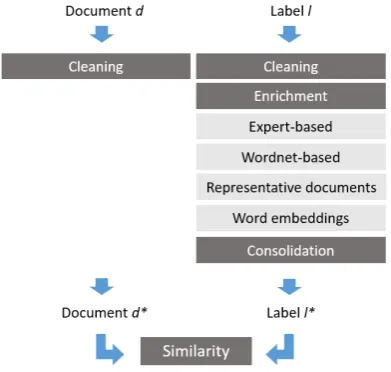
[image:3.595.84.280.284.470.2]Our approach for unsupervised text classification is based on the choice to model the task as a text similarity problem between two sets of words: One containing the most relevant words in the doc-ument and another containing keywords derived from the label of the target category. While the key advantage of this approach is its simplicity, its success hinges on the good definition of a dictio-nary of wordsfor each category.
Figure 1: Overview of our Method
Figure1provides an overview of the main steps included in our method. On the document side, we simply perform standard cleaning steps. On the category labels side, besides the same initial processing, we implement a series ofenrichment
steps so as to iteratively expand label dictionar-ies. Before proceeding to the comparison of doc-uments and labels via a similarity metric, we have added aconsolidationstep which considers all ex-panded label dictionaries and makes adjustments so that they are as discriminating as possible. We compare documents and labels by computing a
similarity metricbetween cleaned documents and dictionaries. We provide further details into each of these main steps in the following subsections. In terms of notation, we refer to the unlabeled cor-pus as C, its vocabulary as V and and assume that we have M text categories to which documents in C need to be mapped.
3.1 Cleaning Steps
Cleaning of either documents or category labels is done as follows: After tokenization, we start by re-placing a list of common abbreviations, e.g.,Mgt, Mngt, IT, ATMprovided by business with their as-sociated expansions. Similarly we spell out nega-tive contractions. We then remove uninformanega-tive tokens including (i) isolated and special characters such asi, a, o, op, @, *, (ii) punctuation (iii) stop-words (based on stopword lists from NLTK’s list of english stopwords, scikit-learn version 0.18.2,
spaCy version 1.8.2) (iv) common words across documents such asrisky, dangerous, based on the highest Term Frequency (top 3 %) (v) uncommon words, i.e., top 3 % in terms of Inverse Term Fre-quency (vi) specific tokens such as dates, nation-alities, countries, regions, bank names. For in-stance, to extract dates, we use both regular ex-pression and fuzzy matching to identify all sorts of date-like strings (e.g., February can also be written as Feb or Febr). Regarding nationalities and bank names, we combined different lists com-ing from Wikipedia, business experts and fuzzy matching (e.g., BNP Paribas could be found as BNP, BNPParibas, BNP Securities, BNP Trading, BNP Group, etc.). As the taxonomy is designed to be universal, such tokens are not relevant to the text classification task and are thus removed.
To give a concrete example, the following snip-pet of operational incident “On 18 June 2013 the US Commodity Futures Trading Commission (CFTC) fined ABN AMRO Clearing Chicago USD 1 million (EUR 748,000) for failing to segregate or secure sufficient customer funds, failing to meet the minimum net capital requirements, failing to maintain accurate books and records, and fail-ing to supervise its employees...” would have been transformed into“fine fail segreg secur suf-fici custom fund fail meet minimum net capit re-quir fail maintain accur book record fail supervis employe..”
3.2 Enrichment
As mentioned previously, once we have clean la-bels, we make a series of enrichment steps.
the web with the category name and performing token counts over retrieved entries. Before pro-ceeding to the next enrichment step, we also add to the label dictionaries all the spelling variants of the expert-provided words that can be found in the document corpus. We also remove any word whose stem is not in the document corpus.
Second, we leverage WordNet (Fellbaum,
1998) to obtain knowledge-based synonyms. For every word obtained in the previous step, we add to the label dictionary all the associated synonym sets (English nouns, verbs, and adjectives). Again, once this step is completed, we remove all words where the stem is not in the vocabulary V.
Third, we bootstrap the label dictionary ob-tained upon this point by making use of represen-tative documents. A representative sentence for a given category is defined byKo and Seo(2000) as a sentence in the document corpus that contains manually pre-defined keywords of the category in its content words. In this work, we extend this def-inition to apply to documents instead of sentences and to include all categories’ keywords obtained at this stage. Therefore we calculate a similarity score between each pair of input document - cate-gory label keywords using cosine distance and La-tent Semantic Analysis. The text similarity met-ric will be details in section 3.4. For this step, we use an empirically identified similarity thresh-old (70%). Then, for each identified representative document, we add all its words to the label dictio-nary.
Finally, we make use of word embeddings
(Bengio et al., 2003;Mikolov et al., 2013a,b) to further capture semantically similar words to the ones belonging to each label dictionary. We first proceed with pre-trained models which enable to identify semantically similar words used in the general domain. In our case, we used Glove1( Pen-nington et al.,2014), The model is pre-trained on a corpus using Wikipedia2014 and Gigaword5, with a 330 vocabulary of the top 400,000 most frequent words and a context window size of 10.
Furthermore, we also seek to obtain similar words as used in the specific domain of the corpus. Since the neighbors of each keyword are semanti-cally related in embedding space (Mikolov et al.,
2013b), we train a Word2Vec model, trained on all input documents cleaned then joined together. In this work, we tested its two main architectures:
1https://nlp.stanford.edu/projects/glove/
Continous Bag of words (CBOW) that predicts a word based on its context defined by a sliding win-dow of words and Skip-Gram (SG) which predicts the context given the target word. Experimental settings will be detailed in section4.3.
3.3 Consolidation
Once all labels have been associated with dictio-naries, we perform a final step in order to re-duce keyword overlap among all dictionaries. In essence, we favor words that are representative (salient) for the category in the sense that they have the ability to distinguish the category label from the other categories.
We adapt the Function-aware Component (FAC) originally used in supervised document classification (Liu et al.,2018).
F AC(w,c) =
T F(w, c)−M1 P
1≤k≤MT F(w, k)
var(T F−c(w))
(1)
where T F−c(w) is the collection of term
fre-quencies except the c-th category andvar()is the variance.
3.4 Text Similarity Metric
Once documents and labels have been processed as described previously, we assign a label to a doc-ument by identifying the label to which it is most similar. Our evaluation of similarity is based on Latent Semantic Analysis (to avoid the pitfalls of literal term matching) and cosine similarity on the output LSA vectors. Before applying LSA, we start by stemming all the words using Porter stem-mer.
We feel that similarities between documents and labels can be more reliably estimated in the re-duced latent space representation than in the origi-nal representation. The ratioorigi-nale is that documents which share frequently co-occurring terms will have a similar representation in the latent space, even if they have no terms in common. LSA thus performs some sort of noise reduction and has the potential benefit to detect synonyms as well as words that refer to the same topic.
4 Experiments
4.1 Datasets
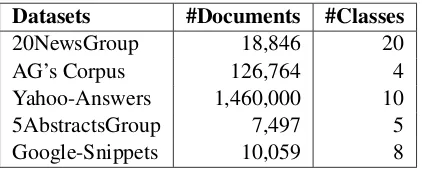
In order to evaluate our approach, we conduct ex-periments on five standard text classification cor-pora, described listed in Table 1. As we use an unsupervised approach for text classification, we make use of the whole corpus of each dataset by aggregating training and test sets.
Datasets #Documents #Classes
20NewsGroup 18,846 20
AG’s Corpus 126,764 4
[image:5.595.77.288.484.569.2]Yahoo-Answers 1,460,000 10 5AbstractsGroup 7,497 5 Google-Snippets 10,059 8
Table 1: Statistics of the five mainstream datasets for text classification.
We describe each corpus briefly: (1) The
20NewsGroup2 dataset consists of 18,846 news articles divided almost evenly among 20 different UseNet discussion groups. Some of the newsgroups are closely re-lated (e.g., comp.sys.ibm.pc.hardware and comp.sys.mac.hardware). While each document may discuss multiple topics, it needs to be as-signed to a single category. (2) TheAG’s Corpus
2http://qwone.com/ jason/20Newsgroups/
of news articles3 is a collection of more than
1 million news articles. We used the version created by Zhang et al. (2015) who selected 4 largest classes from AG news corpus on the web with each instance containing class index, title and description fields. (3) TheYahoo-Answers4
corpus contains 4,483,032 questions and their cor-responding answers from Yahoo! Answers service as of 10/25/2007. We used the version constructed by Zhang et al. (2015) using 10 largest main categories and the best answer content from all the answers. (4) The 5AbstractsGroup5 dataset is a collection of academic papers from five different domains collected from Web of Science namely, business, artificial intelligence, sociology, transport and law. We extracted the abstract and title fields of each paper as a document. (5) The Google-Snippets6 dataset contains the web search results related to 8 different domains such as business, computers and engineering.
4.2 Configurations and Baseline Methods
We apply multiple variants of our method to each of the above corpora. Note first that using repre-sentative documents (Section3.2) to enrich label dictionaries is suitable for categories whose labels take the form of a structured sentence containing more than 10 words before cleaning. In the appli-cation to operational risk incidents (Section5), it allowed to enrich 13% of dictionaries. In the stan-dard text classification datasets used in our exper-iments, category labels contain less than 5 words so representative documents were not relevant in the enrichment process. Thus none of the configu-rations discussed in this section include this step.
Overall, in addition to the full pipeline, which we refer to as all keywords, we also investigated whether semantic expansion solely through word embeddings could improve performance. We thus tested with either generic embeddings (pre-trained Glove) or corpus-based embeddings (Word2Vec). Finally, for each configuration, we tested with and without the function aware component (FAC) for consolidation of the label dictionaries.
We also implemented simple baselines for com-parison. On the unsupervised side, (1) we calcu-lated a text similarity score between each
docu-3www.di.unipi.it/ gulli/AG corpus of news articles.html 4
https://github.com/LC-John/Yahoo-Answers- Topic-Classification-Dataset /tree/master/dataset
5
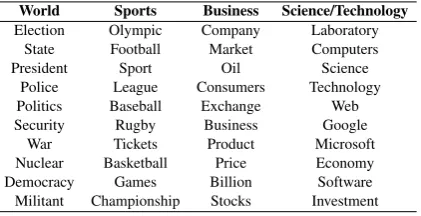
World Sports Business Science/Technology Election Olympic Company Laboratory
State Football Market Computers President Sport Oil Science
Police League Consumers Technology Politics Baseball Exchange Web Security Rugby Business Google
[image:6.595.74.285.62.170.2]War Tickets Product Microsoft Nuclear Basketball Price Economy Democracy Games Billion Software Militant Championship Stocks Investment
Table 2: Example of ten salient words for each category in the AGs Corpus dataset.
ment and the set of expert provided keywords (2) we enriched this list of initial keywords with their synonyms from WordNet. On the supervised side, we use Multinomial Na¨ıve Bayes as a basic base-line where we represented each document as TF-IDF vector (bag of words), cleaned the input cor-pus in the same way as in our proposed approach and split each dataset into a training set (2/3) and a test set (1/3).
4.3 Experimental Settings
In our method, an offline process is used to extract initial keywords from category labels. For the pur-pose of testing our approach, we had to emulate human experts ourselves. For each category, one team member added a few keywords based only on label description. Then, we randomly selected 2 or 3 documents for each label that were read by two team members who used them to identify 5 to 10 salient words to be added to each dictio-nary. In average, we manually added 9 words per label for 20NewsGroup, 17 words for AGs Cor-pus and Google-Snippets, 11 words for Yahoo-Answers and 14 words for 5AbstractsGroup. We present in Table 2, the output of that process for the AGs Corpus dataset.
Once we identify initial keywords, we make the series of enrichment steps described in section3.2. For every word in the set of initial keywords, we add all its synonym sets from WordNet as well as the 10 most similar words from Glove, CBOW and Skip-Gram. The average length of label dictio-naries obtained from the full enrichment pipeline (which we refer to as all keywords) is 428 words.
We use the word2vec python implementation provided by gensim (Rehurek and Sojka, 2010). For Skip-gram and CBOW, a 10-word window size is used to provide the same amount of raw in-formation. Also words appearing 3 times or fewer are filtered out, 10 workers were used and
train-ing was performed in 100 epochs. We chose 300 for the size of all word embeddings, it has been reported to perform well in classification tasks (Mikolov et al.,2013a).
Filtering word dictionaries with the Function-aware Component (FAC) allowed to keep in aver-age 37% of all keywords per label. As described previously, once different versions of label dictio-naries have been obtained, we calculate their simi-larity with input documents using LSA and Cosine distance. The optimal dimension (k) of the latent space depends on the dataset. Optimal k values are typically in the range of 100-300 dimensions (Harman,1993;Letsche and Berry,1997). In this work, for each dataset, we set a range of 100-300 values, and we determine the optimal k by max-imizing the topic coherence score (R¨oder et al.,
2015).
The multi-class classification performance was evaluated in terms of precision (Prec.), recall (Rec.) and F1-score (F1). All measures are com-puted based on a weighted average of each class using the number of true instances to determine the weights.
4.4 Results and Discussion
Table 3 summarizes the performance of each of the methods tested on the five corpora that we considered. Overall, the various configurations of our method, all leveraging embeddings for seman-tic expansion, outperform the simple unsupervised baselines, leading to a doubling of the F1-score for all corpora, the least affected being the 5Abstracts-Group where F1 goes from 38.1 to 68.3 percent, comparing with the all keywords variant of our method.
improves performance except for 20NewsGroup where precision increases from 64.7 to 71.1 but recall decreases from 57.8 to 35.6.
Comparing now our best unsupervised perfor-mance with the supervised baseline, we observe that the ratio of the best F1-score performance over the supervised baseline performance varies from 0.71 to 1.11 with two datasets yielding ratios above 1. Such results demonstrate the validity of the unsupervised approach as a practical alterna-tive to investing to a cognialterna-tively and timely costly annotation effort.
5 Application to Operational Risk Incident Classification
As we described previously, the proposed method stemmed from a specific need in the banking in-dustry where a large number of incidents had to be mapped to a newly defined taxonomy of opera-tional risks. Specifically, it was designed to avoid the tedious and time consuming effort of asking experts to manually review thousands of incidents. An automated - or more precisely assisted - ap-proach also presented the additional benefit of en-suring a higher degree of consistency in the map-ping than would have been achieved a team of annotators. In this section, we provide some ad-ditional context into this specific task, report the observed performance of our method and discuss some of the specificities of the context.
5.1 Operational Risk Incidents Corpus & Taxonomy
In our application, we were asked to map both in-ternal incidents and exin-ternal incidents to the new taxonomy. In this paper, we focus on the external incidents for confidentiality reasons. More pre-cisely, our task was to assign a unique category to each one of the 25,000 incidents that was obtained from ORX news. The Operational Risk Exchange (ORX) is a consortium of financial institutions fo-cused on operational risk information sharing. The ORX news service provides publicly reported op-erational risk loss data to its institutional members. An incident record is mostly composed of an incident description along with associated meta-information such as geographical indicators, time information and institution affected. We only make use of the incident descriptions. Their av-erage length is 2150 words, with a standard devia-tion of 1181 words and ranging from 10 words to
more than 14000 words.
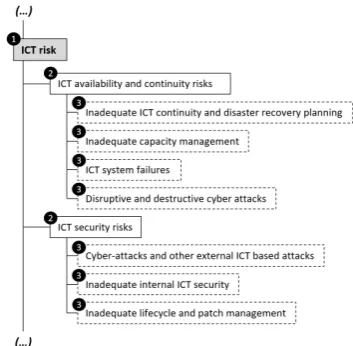
[image:7.595.332.509.276.449.2]The target taxonomy is composed of three lev-els. The first one contains 16 labels and indi-cates at a very high level the domain of the in-cidents such as IT, legal, regulatory. The second and third levels contain respectively 69 and 264 levels to add increasing granularity to the inci-dent classification. Figure 2 presents an extract of the taxonomy focused on ICT risk, which is public as it draws upon Article 107(3) of Direc-tive 2013/36/EU2 which aim to ensure the conver-gence of supervisory practices in the assessment of the information and communication technology (ICT) risk.
Figure 2: Example of Taxonomy regarding three levels for an ICT incident
Methods 20NewsGroup AG’s Corpus Yahoo-Answers 5AbstractsGroup Google-Snippets Prec. Rec. F1 Prec. Rec. F1 Prec. Rec. F1 Prec. Rec. F1 Prec. Rec. F1 Expert keywords 38.0 21.4 27.0 32.9 29.8 31.4 20.4 17.9 19.1 41.7 34.5 37.1 39.4 29.3 33.6 Expert keywords + WordNet 39.2 24.2 27.0 33.7 31.4 32.5 21.8 19.2 20.4 42.5 35.7 38.1 41.6 32.5 36.5 Generic embeddings (Glove) 57.8 48.2 52.6 72.2 72.3 72.2 54.6 50.5 52.5 67.5 66.0 66.7 69.2 66.3 67.7 Corpus based embeddings 64.7 57.8 61.0 75.1 75.2 75.1 50.4 47.9 49.1 69.0 66.2 67.6 72.4 70.0 71.2 All keywords 62.2 54.2 57.9 75.0 74.9 74.9 54.9 51.9 53.3 69.4 66.9 68.3 71.9 70.1 71.0 FAC-Generic embeddings (Glove) 65.8 34.2 39.6 72.6 72.8 72.5 54.0 52.2 52.1 67.9 61.5 63.2 70.3 65.9 67.5 FAC-Corpus based embeddings 71.1 35.6 42.8 76.8 76.6 76.6 59.2 52.7 52.5 70.2 66.8 68.2 72.5 71.3 71.1 FAC-All keywords 66.2 37.8 41.3 74.0 73.8 73.9 59.3 53.9 55.7 71.5 67.3 69.7 72.9 72.8 72.8 Supervised Na¨ıve Bayes 87.1 85.4 85.0 89.8 89.9 89.8 57.2 53.0 49.9 77.5 68.8 65.5 81.8 77.4 77.0
Table 3: Performance of our methods and baseline methods on five standard text classification corpora. Bold numbers indicate the best configurations among the unsupervised approaches. Configurations of our approach do not contain the representative document enrichment step.
Taxonomy level Prec. Recall F1-Score
Level 1 91.80 89.37 90.45 Level 2 86.08 74.80 78.10 Level 3 34.98 19.88 22.95
Table 4: Performance of our Method on the Opera-tional Risk Text Classification Task
5.2 Result
For the purpose of experiment, operational teams (not experts) were asked to provide manual tags for a sample of 989 operational incidents. Table4
provide the classification results of our approach when compared to those manual annotations, con-sidering all three levels of the taxonomy.
In a second step in the evaluation, an expert was given the difficult task to challenge each time they disagreed the computer and human annota-tion and determine which was ultimately correct. This exercise indicated that in 32 cases out of 989 operational incidents under consideration for the Level 1 classification, the machine generated cate-gory were more relevant (hence correct) than those identified by the operational team.
5.3 Discussion
Given the number of categories, we were satisfied with the level of performance that we observed, especially for Level 1 and Level 2 of the taxon-omy. More importantly, as we progress with the follow up exercise of mapping internal incident descriptions, we have evolved from a point where users always mistrust the outcome of the auto-mated classification to a point where users see the suggested mapping from our algorithm as a
rele-vant recommendation.
Our perspective on the success of this method in this particular context is that operational risk is a textbook case where domain specific labels and vocabulary prevail. For instance, technical words such asforge,fictitious,bogus,ersatz, or counter-feit indicate almost surely that a Fraudulent Ac-count Opening operation happened. Most of op-erational incidents must contain a combination of technical keywords due to their highly operational nature. What the method brings is the ability to combine human expertise through seed words with the strength of the machine which can process and memorize large corpus and derive distributional semantics from it. In this way, the cognitive bur-den of being exhaustive is lifted from the experts shoulders.
6 Conclusion
In this paper, we present a method for unsuper-vised text classification based on computing the similarity between the documents to be classi-fied and a rich description of the categories label. The category label enrichment starts with human-expert provided keywords but is then expanded through the use of word embeddings. We also investigated whether a consolidation step that re-moves non discriminant words from the label dic-tionaries could have an effect on performance.
References
Yoshua Bengio, R´ejean Ducharme, Pascal Vincent, and Christian Jauvin. 2003. A neural probabilistic lan-guage model. Journal of machine learning research, 3(Feb):1137–1155.
Jacob Devlin, Ming-Wei Chang, Kenton Lee, and Kristina Toutanova. 2018. Bert: Pre-training of deep bidirectional transformers for language understand-ing. arXiv preprint arXiv:1810.04805.
C Fellbaum. 1998. Wordnet: An on-line lexical database.
Donna K Harman. 1993. The first text retrieval con-ference (TREC-1), volume 500. US Department of Commerce, National Institute of Standards and Technology.
Thorsten Joachims. 1999. Transductive inference for text classification using support vector machines. In Icml, volume 99, pages 200–209.
Youngjoong Ko and Jungyun Seo. 2000. Automatic text categorization by unsupervised learning. In Proceedings of the 18th conference on Computa-tional linguistics-Volume 1, pages 453–459. Asso-ciation for Computational Linguistics.
Todd A Letsche and Michael W Berry. 1997. Large-scale information retrieval with latent semantic in-dexing. Information sciences, 100(1-4):105–137.
Qian Liu, Heyan Huang, Yang Gao, Xiaochi Wei, Yuxin Tian, and Luyang Liu. 2018. Task-oriented word embedding for text classification. In Proceed-ings of the 27th International Conference on Com-putational Linguistics, pages 2023–2032.
Tomas Mikolov, Kai Chen, Greg Corrado, and Jef-frey Dean. 2013a. Efficient estimation of word representations in vector space. arXiv preprint arXiv:1301.3781.
Tomas Mikolov, Ilya Sutskever, Kai Chen, Greg S Cor-rado, and Jeff Dean. 2013b. Distributed representa-tions of words and phrases and their compositional-ity. InAdvances in neural information processing systems, pages 3111–3119.
Timothy Miller, Dmitriy Dligach, and Guergana Savova. 2016. Unsupervised document classifica-tion with informed topic models. InProceedings of the 15th Workshop on Biomedical Natural Language Processing, pages 83–91.
Kamal Nigam, Andrew Kachites McCallum, Sebastian Thrun, and Tom Mitchell. 2000. Text classification from labeled and unlabeled documents using em. Machine learning, 39(2-3):103–134.
Jeffrey Pennington, Richard Socher, and Christopher Manning. 2014. Glove: Global vectors for word representation. InProceedings of the 2014 confer-ence on empirical methods in natural language pro-cessing (EMNLP), pages 1532–1543.
Matthew E Peters, Mark Neumann, Mohit Iyyer, Matt Gardner, Christopher Clark, Kenton Lee, and Luke Zettlemoyer. 2018. Deep contextualized word rep-resentations. arXiv preprint arXiv:1802.05365.
Delip Rao, P Deepak, and Deepak Khemani. 2006. Corpus based unsupervised labeling of documents. InFLAIRS Conference, pages 321–326.
Radim Rehurek and Petr Sojka. 2010. Software frame-work for topic modelling with large corpora. InIn Proceedings of the LREC 2010 Workshop on New Challenges for NLP Frameworks. Citeseer.
Michael R¨oder, Andreas Both, and Alexander Hinneb-urg. 2015. Exploring the space of topic coherence measures. InProceedings of the eighth ACM inter-national conference on Web search and data mining, pages 399–408. ACM.
Fabrizio Sebastiani. 2002. Machine learning in auto-mated text categorization. ACM computing surveys (CSUR), 34(1):1–47.
Peter D Turney. 2002. Thumbs up or thumbs down?: semantic orientation applied to unsupervised classi-fication of reviews. InProceedings of the 40th an-nual meeting on association for computational lin-guistics, pages 417–424. Association for Computa-tional Linguistics.
Lili Yang, Chunping Li, Qiang Ding, and Li Li. 2013. Combining lexical and semantic features for short text classification. Procedia Computer Science, 22:78–86.