Discovering Latent Structure in Task-Oriented Dialogues
Ke Zhai∗
Computer Science, University of Maryland College Park, MD 20740
Jason D. Williams
Microsoft Research Redmond, WA 98052
Abstract
A key challenge for computational conver-sation models is to discover latent struc-ture in task-oriented dialogue, since it pro-vides a basis for analysing, evaluating, and building conversational systems. We pro-pose three new unsupervised models to discover latent structures in task-oriented dialogues. Our methods synthesize hidden Markov models (for underlying state) and topic models (to connect words to states). We apply them to two real, non-trivial datasets: human-computer spoken dia-logues in bus query service, and human-human text-based chats from a live tech-nical support service. We show that our models extract meaningful state represen-tations and dialogue structures consistent with human annotations. Quantitatively, we show our models achieve superior per-formance on held-out log likelihood eval-uation and an ordering task.
1 Introduction
Modeling human conversation is a fundamental scientific pursuit. In addition to yielding ba-sic insights into human communication, compu-tational models of conversation underpin a host of real-world applications, including interactive dialogue systems (Young, 2006), dialogue sum-marization (Murray et al., 2005; Daum´e III and Marcu, 2006; Liu et al., 2010), and even medi-cal applications such as diagnosis of psychologimedi-cal conditions (DeVault et al., 2013).
Computational models of conversation can be
broadly divided into two genres: modeling and
control. Control is concerned with choosing ac-tions in interactive settings—for example to maxi-mize task completion—using reinforcement
learn-∗Work done at Microsoft Research.
ing (Levin et al., 2000), supervised learning (Hur-tado et al., 2010), hand-crafted rules (Larsson and Traum, 2000), or mixtures of these (Henderson
and Lemon, 2008). By contrast, modeling—the
genre of this paper—is concerned with inferring a phenomena in an existing corpus, such as di-alogue acts in two-party conversations (Stolcke et al., 2000) or topic shifts in multi-party dia-logues (Galley et al., 2003; Purver et al., 2006; Hsueh et al., 2006; Banerjee and Rudnicky, 2006). Many past works rely on supervised learning or human annotations, which usually requires man-ual labels and annotation guidelines (Jurafsky et al., 1997). It constrains scaling the size of training examples, and application domains. By contrast, unsupervised methods operate only on the observ-able signal (e.g. words) and are estimated with-out labels or their attendant limitations (Crook et al., 2009). They are particularly relevant because conversation is atemporal process where models are trained to infer a latentstatewhich evolves as the dialogue progresses (Bangalore et al., 2006; Traum and Larsson, 2003).
Our basic approach is to assume that each ut-terance in the conversation is in a latent state, which has a causal effect on the words the conver-sants produce. Inferring this model yields basic insights into the structure of conversation and also has broad practical benefits, for example, speech recognition (Williams and Balakrishnan, 2009), natural language generation (Rieser and Lemon, 2010), and new features for dialogue policy opti-mization (Singh et al., 2002; Young, 2006).
There has been limited past work on unsuper-vised methods for conversation modeling. Choti-mongkol (2008) studies task-oriented
conversa-tion and proposed a model based on a hidden
Markov model (HMM). Ritter et al. (2010) ex-tends it by introducing additional word sources, and applies tonon-task-oriented conversations— social interactions on Twitter, where the subjects
discussed are very diffuse. The additional word sources capture the subjects, leaving the state-specific models to express common dialogue flows such as question/answer pairs.
In this paper, we retain the underlying HMM, but assume words are emitted usingtopic models
(TM), exemplified by latent Dirichlet allocation
(Blei et al., 2003, LDA). LDA assumes each word in an utterance is drawn from one of a set of latent topics, where each topic is a multinomial distri-bution over the vocabulary. The key idea is that the set of topics is shared across all states, and each state corresponds to a mixture of topics. We propose three model variants that link topics and states in different ways.
Sharing topics across states is an attractive property in task-oriented dialogue, where a sin-gle concept can be discussed at many points in a dialogue, yet different topics often appear in pre-dictable sequences. Compared to past works, the
decoupling of states and topics gives our mod-els more expressive power and the potential to be more data efficient. Empirically, we find that our models outperform past approaches on two real-world corpora of task-oriented dialogues.
This paper is organized as follows: Section 2 in-troduces two task-oriented domains and corpora; Section 3 details three new unsupervised genera-tive models which combine HMMs and LDA and efficient inference schemes; Section 4 evaluates our models qualitatively and quantitatively, and fi-nally conclude in Section 5.
2 Data
To test the generality of our models, we study two very different datasets: a set of human-computer spoken dialogues in quering bus timetable ( Bus-Time), and a set of human-human text-based dia-logues in the technical support domain ( TechSup-port). InBusTime, the conversational structure is known because the computer followed a determin-istic program (Williams, 2012), making it possible to directly compare an inferred model to ground truth on this corpus.1 InTechSupport, there is no known flowchart,2making this a realistic applica-tion of unsupervised methods.
1Available for download athttp://research.microsoft.
com/en-us/events/dstc/
2Technical support human agents use many types of
documentation—mainly checklists and guidelines, but in general, there are no flowcharts.
BusTime This corpus consists of logs of
tele-phone calls between a spoken dialogue system and real bus users in Pittsburgh, USA (Black et al., 2010). For the user side, the words logged are the words recognized by the automatic speech recog-nizer. The vocabulary of the recognizer was con-strained to the bus timetable task, so only words known to the recognizer in advance are output. Even so, the word error rate is approximately30
-40%, due to the challenging audio conditions of usage—with traffic noise and extraneous speech. The system asked users sequentially for a bus route, origin and destination, and optionally date and time. The system confirmed low-confidence speech recognition results. Due to the speech recognition channel, system and user turns always alternate. An example dialogue is given below:
System:Say a route likehbus-routei, or say I’m not sure. User:hbus-routei.
System:I thought you saidhbus-routei, is that right? User:Yes.
System:Say where’re you leaving from, likehlocationi. User:hlocationi.
System:Okay,hlocationi, where are you going to? ...
We discard dialogues with fewer than 20
ut-terances. We also map all named entities (e.g., “downtown” and “28X”) to their semantic types (resp. hlocationi and hbus-routei) to reduce vo-cabulary size. The corpus we use consists of ap-proximately 850dialogue sessions or30,000 ut-terances. It contains370,000tokens (words or se-mantic types) with vocabulary size250.
TechSupport This corpus consists of logs of
real web-based human-human text “chat” con-versations between clients and technical support agents at a large corporation. Usually, clients and agents first exchange names and contact informa-tion; after that, dialogues are quite free-form, as agents ask questions and suggest fixes. Most dia-logues ultimately end when the client’s issue has been resolved; some clients are provided with a reference number for future follow-up. An exam-ple dialogue is given below:
Agent:Welcome to the answer desk! My name ish agent-namei. How can I help you today?
Agent:May I have your name, email and phone no.? Client: Hi,hagent-namei. I recently installed new soft-ware but I kept getting error, can you help me?
Agent:Sorry to hear that. Let me help you with that. Agent:May I have your name, email and phone no.? Client:The error code isherror-codei.
Client:It appears every time when I launch it. Client:Sure. My name ishclient-namei.
Client:My email and phone arehemaili,hphonei. Agent:Thanks,hclient-namei, please give me a minute.
s0
w0,i
N0
M
s0 M
s0
w0,i
N0
s1 M
s0
w0,i
N0
s1
w1,i
N1
M
s0
w0,i
N0
s1
w1,i
N1 ... sn
wn,i
Nn M M
(a)LM-HMM
s0
w0,i
N0
s1 ... sn
M
w1,i
N1
wn,i
Nn
r1,i
r0,i rn,i
πm
ψE
φm
s0
w0,i
N0
s1 ... sn
M
w1,i
N1
wn,i
Nn
r1,i
r0,i rn,i
tm
gE
um
s0
w0,i
N0
s1
M
w1,i
N1
r1,i r0,i
tm
gE
um
s0
w0,i
N0
s1
M
r0,i
tm
gE
um s0
w0,i
N0
s1
M
N1
r1,i r0,i
tm
gE
um
s0
N0 M
r0,i
tm
gE
um s0
w0,i
N0 M
r0,i
tm
gE
um
M
tm
gE
um s0
N0 M
tm
gE
[image:3.595.80.286.54.150.2]um (b)LM-HMMS
Figure 1: Plate diagrams of baseline models, from existing work (Chotimongkol, 2008; Ritter et al., 2010). Variable definitions are given in the text.
...
This data is less structured than BusTime;
clients’ issues span software, hardware, network-ing, and other topics. In addition, clients use com-mon internet short-hand (e.g., “thx”, “gtg”, “ppl”, “hv”, etc), with mis-spellings (e.g., “ofice”, “off-fice”, “erorr”, etc). In addition, chats from the web interface are segmented into turns when a user hits “Enter” on a keyboard. Therefore, clients’ input and agents’ responses donotnecessarily alternate consecutively, e.g., an agent’s response may take multiple turns as in the above example. Also, it is unreasonable to group consecutive chats from the same party to form a “alternating” structure like BusTime dataset due to the asynchronism of different states. For instance, the second block of client inputs clearly comes from two different states which shouldnotbe merged together.
We discard dialogues with fewer than30 utter-ances. We map named entities to their semantic types, apply stemming, and remove stop words.3 The corpus we use contains approximately2,000
dialogue sessions or 80,000 conversation utter-ances. It consists of770,000tokens, with a a vo-cabulary size of6,600.
3 Latent Structure in Dialogues
In this work, our goal is to infer latent structure presented in task-oriented conversation. We as-sume that the structure can be encoded in a prob-abilistic state transition diagram, where the dia-logue is in one state at each utterance, and states have a causal effect on the words observed. We as-sume the boundaries between utterances are given, which is trivial in many corpora.
The simplest formulation we consider is an
HMM where each state contains a unigram
lan-guage model (LM), proposed by Chotimongkol (2008) for task-oriented dialogue and originally
3We used regular expression to map named entities, and Porter stemmer in NLTK to stem all tokens.
developed for discourse analysis by Barzilay and Lee (2004). We call itLM-HMMas in Figure 1(a). For a corpus of M dialogues, the m-th dialogue containsnutterances, each of which containsNn
words (we omit index m from terms because it
will be clear from context). At n-th utterance, we assume the dialogue is in some latent statesn. Words inn-th utterancewn,1, . . . , wn,Nn are gen-erated (independently) according to theLM. When an utterance is complete, the next state is drawn according toHMM, i.e.,P(s0|s).
WhileLM-HMMcaptures the basic intuition of
conversation structure, it assumes words are con-ditioned only on state. Ritter et al. (2010) extends
LM-HMM to allow words to be emitted from two
additional sources: the topic of current dialogue
φ, or a backgroundLM ψ shared across all
dia-logues. A multinomialπ indicates the expected
fraction of words from these three sources. For every word in an utterance, first draw a source in-dicatorrfromπ, and then generate the word from
the corresponding source. We call it LM-HMMS
(Figure 1(b)). Ritter et al. (2010) finds these al-ternate sources are important in non-task-oriented domains, where events are diffuse and fleeting. For example, Twitter exchanges often focus on a particular event (labeledX), and follow patterns like “sawXlast night?”, “Xwas amazing”. Here
X appears throughout the dialogue but does not
help to distinguish conversational states in social media. We also explore similar variants.
In this paper, these two models form our base-lines. For all models, we useMarkov chain Monte Carlo(MCMC) inference (Neal, 2000) to find la-tent variables that best fit observed data. We also assume symmetric Dirichlet priors on all multino-mial distributions and apply collapsed Gibbs sam-pling. In the rest of this section, we present our models and their inference algorithms in turn.
3.1 TM-HMM
“lo-s0
w0,i
N0
s1 ... sn M z0,i w1,i N1 z1,i wn,i Nn zn,i T K θt φk s0 w0,i N0
s1 ... sn M z0,i w1,i N1 z1,i wn,i Nn zn,i T K ht gk s0 w0,i N0 s1 M z0,i w1,i N1 z1,i T K ht gk s0 w0,i N0 s1 M z0,i N1 z1,i T K ht gk s0 w0,i N0 s1 M z0,i T K ht gk s0 w0,i N0 M z0,i T K ht gk s0 N0 M z0,i T K ht gk s0 M T K ht gk M T K ht gk (a)TM-HMM s0 w0,i N0
s1 ... sn
M z0,i w1,i N1 z1,i wn,i Nn zn,i K r1,i
r0,i rn,i
θm τm φk s0 w0,i N0
s1 ... sn
M z0,i w1,i N1 z1,i wn,i Nn zn,i K r1,i
r0,i rn,i
hm um gk s0 w0,i N0 s1 M z0,i N1 z1,i K r1,i r0,i hm um gk s0 w0,i N0 s1 M z0,i w1,i N1 z1,i K r1,i r0,i hm um gk s0 w0,i N0 s1 M z0,i N1 z1,i K r0,i hm um gk s0 w0,i N0 s1 M z0,i K r0,i hm um gk s0 w0,i N0 M z0,i K r0,i hm um gk s0 N0 M z0,i K r0,i hm um gk s0 N0 M z0,i K hm um gk s0 M K hm um gk M K hm um gk M K gk (b)TM-HMMS s0 w0,i N0
s1 ... sn
M z0,i w1,i N1 z1,i wn,i Nn zn,i K r1,i
r0,i rn,i
T θm φk τt s0 w0,i N0
s1 ... sn
M z0,i w1,i N1 z1,i wn,i Nn zn,i K r1,i
r0,i rn,i
[image:4.595.106.499.50.178.2]T hm gk ut s0 w0,i N0 s1 M z0,i w1,i N1 z1,i K r1,i r0,i T hm gk ut s0 w0,i N0 s1 M z0,i N1 z1,i K r1,i r0,i T hm gk ut s0 w0,i N0 s1 M z0,i N1 z1,i K r0,i T hm gk ut s0 w0,i N0 s1 M z0,i K r0,i T hm gk ut s0 w0,i N0 M z0,i K r0,i T hm gk ut s0 N0 M z0,i K r0,i T hm gk ut s0 N0 M z0,i K T hm gk ut s0 M K T hm gk ut M K T hm gk ut M K T gk ut (c) TM-HMMSS
Figure 2: Plate diagrams of proposed models.TM-HMMis an HMM with state-wise topic distributions.
TM-HMMSadds session-wise topic distribution and a source generator. TM-HMMSSadds a state-wise source generator. Variable definitions are given in the text.
cations”; and other topics for dialogue acts, like to “ask” or “confirm” information. States could then becombinationsof these, e.g., a state might express “ask bus route” or “confirm location”. This approach also decouples the number of top-ics from the number of states. Throughout this pa-per, we denote the number of topics asKand the number of states asT. We index words, turns and dialogues in the same ways as baseline models.
We develop three generative models. In the first variant (TM-HMM, Figure 2(a)), we assume every state sin HMM is associated with a distribution over topicsθ, and topics generate wordswat each utterance. The other two models allow words to be generated from different sources (in addition to
states), akin to theLM-HMMSmodel.
TM-HMMgenerates a dialogue as following:
1: For each utterancenin that dialogue, sample a statesnbased on the previous statesn−1.
2: For each word in utterance n, first draw a
topic z from the state-specified distribution over topicsθsnconditioned onsn, then gener-ate wordwfrom the topic-specified distribu-tion over vocabularyφzbased onz.
We assume θ’s and φ’s are drawn from
corre-sponding Dirichlet priors, as inLDA.
The posterior distributions of state assignment
snand topic assignmentzn,iare
p(sn|s−n,z,α,γ)∝p(sn|s−n,γ)
·p(zn|s,z−n,α), (1)
p(zn,i|s,w,z−(n,i),α,β)∝p(zn,i|s,z−(n,i),α) ·p(wn,i|sn,w−(n,i),z,β),
whereα,β,γ are symmetric Dirichlet priors on state-wise topic distributionθt’s, topic-wise word distributionφt’s and state transition multinomials, respectively. All probabilities can be computed using collapsed Gibbs sampler forLDA(Griffiths
and Steyvers, 2004) and HMM (Goldwater and
Griffiths, 2007). We iteratively sample all param-eters until convergence.
3.2 TM-HMMS
TM-HMMS(Figure 2(b)) extendsTM-HMMto
al-low words to be generated either from state LM
(as in LM-HMM), or a set of dialogue topics
(akin to LM-HMMS). Because task-oriented
dia-logues usually focus on a specific domain, a set of words appears repeatedly throughout a given dialogue. Therefore, the topic distribution is of-ten stable throughout the entire dialogue, and does not vary from turn to turn. For example, in the troubleshooting domain, dialogues about network connections, desktop productivity, and anti-virus software could each map to different session-wide topics. To express this, words in the TM-HMMS model are generated either from a dialogue-specific topic distribution, or from a state-specific language model.4 A distribution over sources is sampled once at the beginning of each dialogue and selects the expected fraction of words generated from different sources.
The generative story for a dialogue session is:
1: At the beginning of each session, draw a
dis-tribution over topicsθand a distribution over word sourcesτ.
2: For each utterancenin the conversation, draw
a statesnbased on previous statesn−1.
3: For each word in utterance n, first choose a
word source r according toτ, and then de-pending onr, generate a wordweither from the session-wide topic distribution θ or the language model specified by the statesn.
4Note that aTM-HMMSmodel with state-specific topic
models (instead of state-specific language models) would be
subsumed byTM-HMM, since one topic could be used as the
background topic inTM-HMMS.
Again, we impose Dirichlet priors on distributions over topics θ’s and distributions over words φ’s as in LDA. We also assume the distributions over sourcesτ’s are governed by a Beta distribution.
The session-wide topics is slightly different
from that used inLM-HMMS:LM-HMMSwas
de-veloped for social chats on Twitter where topics are very diffuse and unlikely to repeat; hence of-ten unique to each dialogue. By contrast, our mod-els are designed for task-oriented dialogues which pertain to a given domain where topics are more tightly clustered; thus, inTM-HMMSsession-wide topics are shared across the corpus.
The posterior distributions of state assignment
sn, word sourcern,iand topic assignmentzn,iare
p(sn|r,s−n,w,γ,π)∝p(sn|s−n,γ)
·p(wn|r,s,π),
p(rn,i|r−(n,i),s,w,π)∝p(rn,i|r−(n,i),π) ·p(wn,i|r,s,w−(n,i),z,β), (2)
p(zn,i|r,w,z−(n,i),α,β)∝p(zn,i|r,z−(n,i),α) ·p(wn,i|r,w−(n,i),z,β),
whereπis a symmetric Dirichlet prior on session-wise word source distribution τm’s, and other symbols are defined above. All these probabilities are Dirichlet-multinomial distributions and there-fore can be computed efficiently.
3.3 TM-HMMSS
The TM-HMMSS (Figure 2(c)) model modifies
TM-HMMS to re-sample the distribution over word sourcesτat every utterance, instead of once at the beginning of each session. This modifica-tion allows the fracmodifica-tion of words drawn from the session-wide topics to vary over the course of the dialogue. This is attractive in task-oriented di-alogue, where some sections of the dialogue al-ways follow a similar script, regardless of session topic—for example, the opening, closing, or ask-ing the user if they will take a survey. To support
these patterns,TM-HMMSSconditions the source
generator distribution on the current state.
The generative story of TM-HMMSS is very
similar toTM-HMMS, except the distribution over word sources τ’s are sampled at every state. A dialogue is generated as following:
1: For each session, draw a topic distributionθ. 2: For each utterancenin the conversation, draw
a state sn based on previous statesn−1, and
subsequently retrieve the state-specific distri-bution over word sourcesτsn.
3: For each word in utterance n, first sample a
word sourceraccording toτsn, and then de-pending onr, generate a wordweither from the session-wide topic distribution θ or the language model specified by the statesn.
As inTM-HMMS, we assume multinomial
distri-butionsθ’s andφ’s are drawn from Dirichlet pri-ors; andτ’s are governed by Beta distributions.
The inference forTM-HMMSSis exactly same
as the inference forTM-HMMS, except the poste-rior distributions over word sourcern,iis now
p(rn,i|r−(n,i),s,w,π)∝p(rn,i|r−(n,i), sn,π)
·p(wn,i|r,s,w−(n,i),z,β), (3)
where the first term is integrated over all sessions and conditioned on the state assignment.
3.4 Supporting Multiple Parties
Since our primary focus is task-oriented dia-logues between two parties, we assume every word source is associated withtwosets ofLMs— one for system/agent and another for user/client. This configuration is similar toPolyLDA(Mimno et al., 2009) orLinkLDA(Yano et al., 2009), such that utterances from different parties are treated as different languages or blog-post and comments pairs. In this work, we implement all models un-der this setting, but omit details in plate diagrams for the sake of simplicity.
In settings where the agent and client always al-ternate, each state emits both text before transi-tioning to the next state. This is the case in the
BusTime dataset, where the spoken dialogue sys-tem enforces strict turn-taking. In settings where agents or client may produce more than one utter-ance in a row, each state emits either agent textor
client text, then transitions to the next state. This is the case in theTechSupportcorpus, where either conversant may send a message at any time.
3.5 Likelihood Estimation
likeli-hoods intractable. Hence, we use a Chib-style estimator (Wallach et al., 2009). Although it is computationally more expensive, it gives less bi-ased approximation of marginal likelihood, even for finite samples. This ensures likelihood mea-surements are comparable across models.
4 Experiments
In this section, we examine the effectiveness of our models. We first evaluate our models qualitatively by exploring the inferred state diagram. We then perform quantitative analysis with log likelihood measurements and an ordering task on a held-out test set. We train all models with80%of the en-tire dataset and use the rest for testing. We run the Gibbs samplers for1000iterations and update all hyper-parameters using slice sampling (Neal,
2003; Wallach, 2008) every 10 iterations. The
training likelihood suggest all models converge within500−800iterations. For all Chib-style esti-mators, we collect100samples along the Markov chain to approximate the marginal likelihood.
4.1 Qualitative Evaluation
Figure 3 shows the state diagram forBusTime
cor-pus inferred by TM-HMM without any
supervi-sion.5 Every dialogue is opened by asking the user to say a bus route, or to say “I’m not sure.” It then transits to a state about location, e.g., origin and destination. Both these two states may continue to a confirmation step immediately after. After verifying all the necessary information, the system asks if the user wants “the next few buses”.6 Oth-erwise, the system follows up with the user on the particular date and time information. After system reads out bus times, the user has options to “re-peat” or ask for subsequent schedules.
In addition, we also include the human-annotated dialogue flow in Figure 4 for refer-ence (Williams, 2012). It only illustrates the most common design of system actions, without show-ing edge cases. Comparshow-ing these two figures, the dialogue flow inferred by our model along the most probable path (highlighted in bold red in Fig-ure 3) is consistent with underlying design. Fur-thermore, our models are able to capture edge cases—omitted for space—through a more gen-eral and probabilistic fashion. In summary, our
5Recall inBusTime, state transitions occur after eachpair of system/user utterances, so we display them synchronously.
6The system was designed this way because most users
say “yes” to this question, obviating the date and time.
models yield a very similar flowchart to the under-lying design in a completely unsupervised way.7
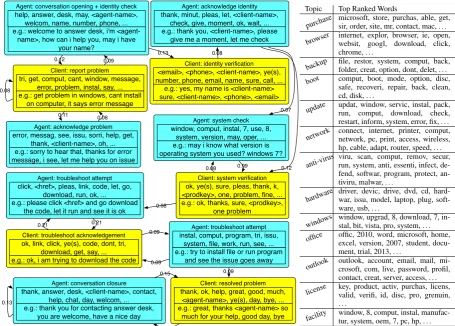
Figure 5 shows part of the flowchart for the TechSupport corpus, generated by the TM-HMMSS model.8 A conversation usually starts with a welcome message from a customer support agent. Next, clients sometimes report a problem; otherwise, the agent gathers the client’s identity. After these preliminaries, the agent usually checks the system version or platform settings. Then, in-formation about the problem is exchanged, and a cycle ensues where agents propose solutions, and clients attempt them, reporting results. Usually, a conversation loops among these states until ei-ther the problem is resolved (as the case shown in the figure) or the client is left with a reference number for future follow-up (not shown due to space limit). Although technical support is task-oriented, the scope of possible issues is vast and not prescribed. The table in Figure 5 lists the top ranked words of selected topics—the categories clients often report problems in. It illustrates that,
qualitatively,TM-HMMSSdiscovers both problem
categories and conversation structures on our data. As one of the baseline model, we also include a
part of flowchart generated by LM-HMM model
with similar settings of T = 20 states.
Illus-trated by the highlighted states in 6, LM-HMM
model conflates interactions that commonly occur at the beginning and end of a dialogue—i.e., “ac-knowledge agent” and “resolve problem”, since their underlying language models are likely to pro-duce similar probability distributions over words. By incorporating topic information, our proposed models (e.g.,TM-HMMSSin Figure 5) are able to enforce the state transitions towards more frequent flow patterns, which further helps to overcome the weakness of language model.
4.2 Quantitative Evaluation
In this section, we evaluate our models using log likelihood and an ordering task on a held-out test set. Both evaluation metrics measure the predic-tive power of a conversation model.
7We considered various ways of making a quantitative
evaluation of the inferred state diagram, and proved difficult. Rather than attempt to justify a particular sub-division of each “design states”, we instead give several straightforward quan-titative evaluations in the next section.
8Recall in this corpus, state transitions occur after emit-ting each agentorclient utterances, which doesnot necessar-ily alternate in a dialogue, so we display client request and agent response separately.
state: ask for bus route (route:0.14), (say:0.13), (<bus-route>:0.12), (not:0.10), (sure:0.10), (im:0.09), (a:0.08), (bus:0.07), (like:0.06), ... e.g.: say a bus route like <bus-route> or say i am not sure
(<bus-route>:0.7), (the:0.07), (im:0.06), (not: 0.05), (sure:0.04), (route:0.02), (any:0.01), ...
e.g.: <bus-route>/im not sure
0.53
state: confirm low-confidence speech recognition results (right:0.19), (is:0.19), (that:0.19), (<location>:0.12), (<bus-route>:
0.05), (i:0.04), (you:0.03), (said:0.03), (thought:0.03), (over:0.03), ... e.g.: i thought you said (<bus-route>/<location>) is that right
(yes:0.45), (no:0.3), (yeah:0.12), (wrong:0.04), (correct:0.03), (back:0.02), (go:0.02), (nope:0.01), ...
e.g.: yes/no/yeah/wrong/correct/go back/nope
0.12
0.32
0.53 0.15
state: ask for locations (you:0.1), (are:0.09), (where:0.08), (to:0.07), (say:0.06), (from:0.05),
(leaving:0.05), (going:0.05),(<location>:0.05), (okay:0.04), ...
e.g.: (okay <location>) say where are you (going to/leaving from)
(<location>:0.84), (back: 0.05), (go:0.05), ...
e.g.: <location>
0.21 0.23
0.85 0.44 0.28
state: ask if user is traveling now (say:0.8), (the:0.07), (you:0.07), (no:0.06), (yes:0.06), (do:
0.06), (want:0.06), (buses:0.05), (few:0.05), (next:0.04), ... e.g.: do you want the next few buses say yes or no
(yes:0.5), (no:0.17), (yeah:0.16), (<bus-route>: 0.07), (back:0.04), (go:0.04), (nope:0.01), ...
e.g.: yes/no/yeah
0.31
state: read out bus timetables (<location>:0.08), (at:0.05), (<time>:0.05), (next:0.05), (say:0.05), (from:0.04), (there:
0.04), (<bus-route>:0.04), (to:0.04), ...
e.g.: there is a <bus-route> from <location> to <location> at <time> say next or repeat
(next:0.4), (repeat:0.16), (over:0.11), (start:0.11), (previous:0.07), (go:0.06), (back:0.06), (goodbye:0.05), ...
e.g.: next/repeat/start over/previous
0.12
0.42
state: ask for date and time (optional) (<time>:0.14), (<date>:0.1), (the:0.06), (or:0.05), (like:0.05),
(say:0.05), (you:0.05), (want:0.05), (at:0.04), (depart:0.04), ... e.g.: say the time you want to depart like <time>
(<time>:0.26), (<date>:0.14), (m:0.11), (depart:0.07), (a:0.07), (at:0.07), (by:0.03), ...
e.g.: depart (at/by) <time> a m <date>
0.55
Start
I heard 61C, is that right?
Downtown, is that correct?
Did you just say Norwood?
Say just the day you want.
Say just the <me you want. I'm sorry, I can't find any bus at all that run from Milton to Norwell. I checked route 61C and I also checked all the other bus routes I know too. Repeat, next, previous At 11:45 PM today,
there is a 61 C from 5th Ave and Main St Canton, arriving 2nd St and Grant Ave in Norwood at 12:34 AM. Say a bus route, or say I’m not sure. Where are you leaving from? (query database)
Where are you going to? (query database)
[image:7.595.92.504.50.248.2]Do you want <mes for the next few buses? (query database)
Figure 3: (Upper)Part of the flowchart inferred on Bus-Time, by TM-HMM model with K = 10 topics and
T = 10 states. The most probable path is highlighted,
[image:7.595.78.509.51.446.2]which is consistent with the underlying design (Figure 4). Cyan blocks are system actions and yellow blocks are user responses. In every block, the upper cell shows the top ranked words marginalized over all topics and the lower cell shows some examples of that state. Transition probability cut-off is0.1. States are labelled manually.
Figure 4: (Left) Hand-crafted reference flowchart for
BusTime (Williams, 2012). Only the most common di-alogue flows are displayed. System prompts shown are example paraphrases. Edge cases are not included.
Log Likelihood The likelihood metric measures
the probability of generating the test set under a specified model. As shown in Figure 7, our models
yield as good or better likelihood thanLM-HMM
andLM-HMMSmodels on both datasets under all
settings. For our proposed models, TM-HMMS
and TM-HMMSS perform better than TM-HMM
on TechSupport, but not necessarily on BusTime. In addition, we notice that the marginal benefit of
TM-HMMSS over TM-HMM is greater on Tech-Support dataset, where each dialogue focuses on one of many possible tasks. This coincides with our belief that topics are more conversation de-pendent and shared across the entire corpus in cus-tomer support data—i.e., different clients in differ-ent sessions might ask about similar issues.
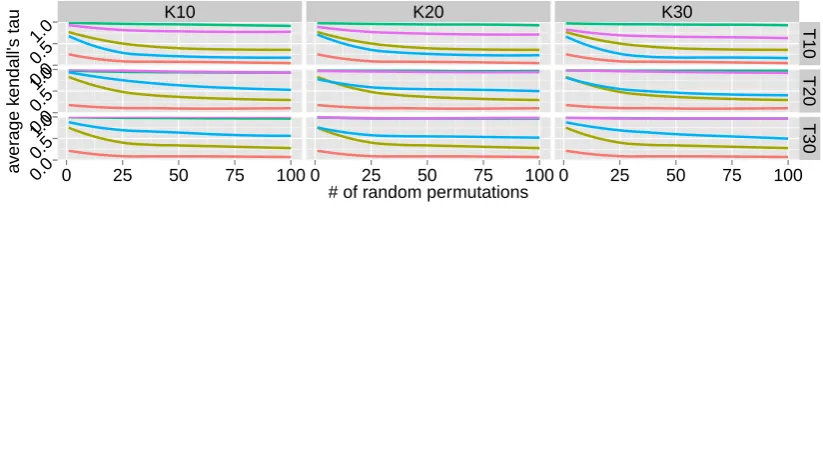
Ordering Test Ritter et al. (2010) proposes an
evaluation based on rank correlation coefficient, which measures the degree of similarity between any two orderings over sequential data. They use Kendall’s τ as evaluation metric, which is based on the agreement between pairwise orderings of two sequences (Kendall, 1938). It ranges from−1
to +1, where +1 indicates an identical ordering and−1indicates a reverse ordering. The idea is to generate all permutations of the utterances in a dialogue (including true ordering), and compute the log likelihood for each under the model. Then, Kendall’sτ is computed between the most proba-ble permutation and true ordering. The result is the average ofτvalues for all dialogues in test corpus. Ritter et al. (2010) limits their dataset by choos-ing Twitter dialogues containchoos-ing3 to6posts (ut-terances), making it tractable to enumerate all per-mutations. However, our datasets are much larger, and enumerating all possible permutations of dia-logues with more than20or30utterances is infea-sible. Instead, we incrementally build up the per-mutation set by adding one random perper-mutation at a time, and taking the most probable permutation after each addition. If this process were continued (intractably!) until all permutations are enumer-ated, the true value of Kendall’sτ test would be reached. In practice, the value appears to plateau after a few dozen measurements.
Agent: conversation opening + identity check help, answer, desk, microsoft, may, <agent>, welcom, name, number, phone, ... e.g.: welcome to microsoft answer desk, i'm
<agent>, how can i help you, may i have your name?
Client: report problem tri, get, comput, cant, window, message,
error, problem, instal, say, ... e.g.: get problem in windows, cant install
on computer, it says error message
Agent: conversation closure thank, answer, microsoft, desk, <client>,
contact, help, chat, day, welcom, ... e.g.: thank you for contacting microsoft answer
desk, you are welcome, have a nice day
Agent: acknowledge identity thank, minut, pleas, let, <client>, check,
give, moment, ok, wait, ... e.g.: thank you, <client>, please give me a moment, wait for a minute, let me check
Agent: system check window, comput, instal, 7, use, 8,
system, version, may, oper, ... e.g.: may i know what version is operating system you used? windows 7?
Client: system verification ok, ye(s), sure, pleas, thank, k, <prodkey>, one, problem, fine, ... e.g.: ok, thanks, sure, <prodkey>,
one problem Agent: acknowledge problem
error, messag, see, issu, sorri, help, get, thank, <client>, oh, ... e.g.: sorry to hear that, thanks for error message, i see, let me help you on issue
Agent: troubleshoot attempt click, <href>, pleas, link, code, let, go,
download, run, ok, ...
e.g.: please click <href> and go download the code, let it run and see it is ok
Client: troubleshoot acknowledgement ok, link, click, ye(s), code, dont, tri,
download, get, say, ... e.g.: ok, i am trying to download the code
Client: identity verification <email>, <phoneno>, <client>, ye(s), number, phone, email, name, sure, call, ...
e.g.: yes, my name is <client> sure, <client>, <phoneno>, <email>
Agent: troubleshoot attempt instal, comput, program, tri, issu,
system, file, work, run, see, ... e.g.: try to install file or run program
and see the issue goes away
Client: resolved problem thank, ok, help, great, good, much,
<agent>, ye(s), day, bye, ... e.g.: yes, thank you <agent> so much
for your great help, good day, bye
0.240581 0.20916 0.207256 0.145682 0.131558 0.122512 0.117276 0.108547 0.1291865 0.0798235 0.0764909 0.0893519 0.0801476 0.085454 0.077694 0.088172 0.0728498 0.083912 0.0917323 0.0888547 Agent: conversation opening + identity check
help, answer, desk, microsoft, may, #agent#, welcom, name, number, phone, ...
e.g.: welcome to microsoft answer desk, i'm #agent#, how can i help you, may i have your name?
Client: report problem
tri, get, comput, cant, window, message, error, problem, instal, say, ... e.g.: i get this problem in windows, cant install
on my computer, it says this error message
Agent: conversation closure thank, answer, microsoft, desk, #client#,
contact, help, chat, day, welcom, ... e.g.: thank you for contacting microsoft answer
desk, you are welcome, have a nice day
Agent: acknowledge identity thank, minut, pleas, let, #client#, check,
give, moment, ok, wait, ... e.g.: thank you, #client#, please give me a
moment, wait for a minute, let me check
Agent: system check window, comput, instal, 7, use, 8,
system, version, may, oper, ... e.g.: may i know what version is operating system you used? windows 7?
Client: system verification ok, ye(s), sure, pleas, thank, k, #prodkey#,
one, problem, fine, ...
e.g.: ok, thanks, sure, #prodkey#, one problem Agent: acknowledge problem
error, messag, see, issu, sorri, help, get, thank, #client#, oh, ... e.g.: sorry to hear that, thanks for error message, i see, let me help you on issue
Agent: troubleshoot attempt click, #href#, pleas, link, code, let, go,
download, run, ok, ... e.g.: please click #href# and go download
the code, let it run and see it is ok
Client: troubleshoot acknowledgement ok, link, click, ye(s), code, dont, tri, download, get, say, ...
e.g.: ok, i am trying to download the code, yes
Client: identity verification #email#, #phoneno#, #client#, ye(s), number, phone, email, name, sure, call, ...
e.g.: yes, my name is #client# sure, #client#, #phoneno#, #email#
Agent: troubleshoot attempt instal, comput, program, tri, issu,
system, file, work, run, see, ... e.g.: try to install file or run program
and see the issue goes away
Client: resolved problem thank, ok, help, great, good, much,
#agent#, ye(s), day, bye, ... e.g.: yes, thank you #agent# so much
for your great help, good day, bye
0.0240581 0.020916 0.0207256 0.0145682 0.0131558 0.0122512 0.0117276 0.0108547 0.00891865 0.00798235 0.00764909 0.00593519 0.00801476 0.00455454 0.00377694 0.00568172 0.00328498 0.0053912 0.00617323 0.00588547
Agent: conversation opening + identity check help, answer, desk, may, <agent-name>,
welcom, name, number, phone, ... e.g.: welcome to answer desk, i'm
<agent-name>, how can i help you, may i have your name?
Client: report problem
tri, get, comput, cant, window, message, error, problem, instal, say, ... e.g.: get problem in windows, cant install
on computer, it says error message
Agent: conversation closure thank, answer, desk, <client-name>, contact,
help, chat, day, welcom, ... e.g.: thank you for contacting answer desk,
you are welcome, have a nice day
Agent: acknowledge identity thank, minut, pleas, let, <client-name>,
check, give, moment, ok, wait, ... e.g.: thank you, <client-name>, please
give me a moment, let me check
Agent: system check window, comput, instal, 7, use, 8,
system, version, may, oper, ... e.g.: may i know what version is operating system you used? windows 7?
Client: system verification ok, ye(s), sure, pleas, thank, k, <prodkey>, one, problem, fine, ... e.g.: ok, thanks, sure, <prodkey>,
one problem Agent: acknowledge problem
error, messag, see, issu, sorri, help, get, thank, <client-name>, oh, ... e.g.: sorry to hear that, thanks for error message, i see, let me help you on issue
Agent: troubleshoot attempt click, <href>, pleas, link, code, let, go,
download, run, ok, ... e.g.: please click <href> and go download
the code, let it run and see it is ok
Client: troubleshoot acknowledgement ok, link, click, ye(s), code, dont, tri,
download, get, say, ... e.g.: ok, i am trying to download the code
Client: identity verification <email>, <phone>, <client-name>, ye(s), number, phone, email, name, sure, call, ...
e.g.: yes, my name is <client-name> sure, <client-name>, <phone>, <email>
Agent: troubleshoot attempt instal, comput, program, tri, issu,
system, file, work, run, see, ... e.g.: try to install file or run program
and see the issue goes away
Client: resolved problem thank, ok, help, great, good, much,
<agent-name>, ye(s), day, bye, ... e.g.: great, thanks <agent-name> so
much for your help, good day, bye
0.24 0.21 0.21 0.15 0.13 0.12 0.12 0.11 0.13 0.08 0.08 0.09 0.08 0.09 0.08 0.09 0.07 0.08 0.09 0.09 Agent: conversation opening + identity check
help, answer, desk, microsoft, may, <agent-name>, welcom, name, number, phone, ... e.g.: welcome to microsoft answer desk, i'm
<agent-name>, how can i help you, may i have your name?
Client: report problem
tri, get, comput, cant, window, message, error, problem, instal, say, ... e.g.: get problem in windows, cant install
on computer, it says error message
Agent: conversation closure
thank, answer, microsoft, desk, <client-name>, contact, help, chat, day, welcom, ... e.g.: thank you for contacting microsoft answer
desk, you are welcome, have a nice day
Agent: acknowledge identity thank, minut, pleas, let, <client-name>,
check, give, moment, ok, wait, ... e.g.: thank you, <client-name>, please
give me a moment, let me check
Agent: system check window, comput, instal, 7, use, 8,
system, version, may, oper, ... e.g.: may i know what version is operating system you used? windows 7?
Client: system verification ok, ye(s), sure, pleas, thank, k, <prodkey>, one, problem, fine, ... e.g.: ok, thanks, sure, <prodkey>,
one problem Agent: acknowledge problem
error, messag, see, issu, sorri, help, get, thank, <client-name>, oh, ... e.g.: sorry to hear that, thanks for error message, i see, let me help you on issue
Agent: troubleshoot attempt click, <href>, pleas, link, code, let, go,
download, run, ok, ...
e.g.: please click <href> and go download the code, let it run and see it is ok
Client: troubleshoot acknowledgement ok, link, click, ye(s), code, dont, tri,
download, get, say, ... e.g.: ok, i am trying to download the code
Client: identity verification <email>, <phone>, <client-name>, ye(s), number, phone, email, name, sure, call, ...
e.g.: yes, my name is <client-name> sure, <client-name>, <phone>, <email>
Agent: troubleshoot attempt instal, comput, program, tri, issu,
system, file, work, run, see, ... e.g.: try to install file or run program
and see the issue goes away
Client: resolved problem thank, ok, help, great, good, much,
<agent-name>, ye(s), day, bye, ... e.g.: great, thanks <agent-name> so
much for your help, good day, bye
0.24 0.21 0.21 0.15 0.13 0.12 0.12 0.11 0.13 0.08 0.08 0.09 0.08 0.09 0.08 0.09 0.07 0.08 0.09 0.09
Topic Top Ranked Words
purchase microsoft, store, purchas, able, get,sir, order, site, mr, contact, mac, . . . browser internet, explor, browser, ie, open,websit, googl, download, click,
chrome, . . .
backup file, restor, system, comput, back,folder, creat, option, dont, delet, . . . boot comput, boot, mode, option, disc,safe, recoveri, repair, back, clean,
cd, disk, . . .
update updat, window, servic, instal, pack,run, comput, download, check, restart, inform, system, error, fix, . . . network connect, internet, printer, comput,network, pc, print, access, wireless, hp, cable, adapt, router, speed, . . . anti-virus viru, scan, comput, remov, secur,run, system, anti, essenti, infect,
de-fend, softwar, program, protect, an-tiviru, malwar, . . .
hardware driver, devic, drive, dvd, cd, hard-war, issu, model, laptop, plug, soft-ware, usb, . . .
windows window, upgrad, 8, download, 7, in-stal, bit, vista, pro, system, . . . office offic, 2010, word, microsoft, home,excel, version, 2007, student,
docu-ment, trial, 2013, . . .
outlook outlook, account, email, mail, mi-crosoft, com, live, password, profil, contact, creat, server, access, . . . license key, product, activ, purchas, licens,valid, verifi, id, disc, pro, grenuin,
. . .
[image:8.595.70.526.51.377.2]facility window, 8, comput, instal, manufac-tur, system, oem, 7, pc, hp, . . . Figure 5: Part of flowchart (left) and topic table (right) onTechSupportdataset, generated byTM-HMMSS
model under settings ofK = 20topics andT = 20states. The topic table lists top ranked words in issues discussed in the chats. Cyan blocks are system actions and yellow blocks are user responses. In every block, the upper cell shows top ranked words, and the lower cell shows example string patterns of that state. Transition probability cut-off is0.05. States and topics are labelled manually.
Agent: conversation opening + identity check
answer, desk, help, <agent-name>, welcom, today, may, name, number, ... e.g.: welcome to answer desk, i'm
<agent-name>, how can i help you, may i have your name, case/phone number, account?
Client: acknowledge agent / resolved problem
thank, ok, help, much, good, great, <agent-name>, day, appreci, bye, ... e.g.: ok, thanks, great, <agent-name>
appreciate your help, good day, bye
Agent: conversation closure
answer, desk, thank, contact, day, chat, great, session, com, help, ... e.g.: thank you for contacting answer desk,
you are welcome, have a nice day
Agent: acknowledge problem
issu, sorri, call, help, number, suport, concern, <client-name>, <phone>, best, ...
e.g.: sorry to hear that, let me help with your concern, <client-name>
Client: confirm identity
call, number, phone, case, <time>, would, <agent-name>, pleas, <phone>, time, ... e.g.: <agent-time>, my phone number is <phone>. would you pleas call number...
Agent: conversation closure
anyth, els, welcom, help, <client-name>, today, assist, question, would, answer, ... e.g.: you are welcome, anything else today
i would help/assist you, <client-name>?
Agent: acknowledge identity
give, minut, pleas, check, let, thank, moment, 3, one, 5, ... e.g.: thanks, one moment please,
give me 3 minutes, let me check
Client: report problem
updat, window, install, <agent-name>, hello, error, get, problem, download, message, ... e.g.: hello, <agent-name>, i get problem/error
when install/update/download in windows
0.08 0.1 0.08 0.07 0.14 0.05 0.07 0.06 0.05 0.05 0.08 0.06
state 0 0 (0, answer) 0.14307
(0, desk) 0.140908 (0, help) 0.139542 (0, #agentname#) 0.122925
(0, microsoft) 0.121104 (0, welcom) 0.119283 (0, today) 0.0638546 (0, may) 0.0453027 (0, name) 0.0382462
(0, hello) 0.023564
state 0 1 (0, offic) 0.129144 (0, instal) 0.0691015 (0, 2013) 0.0479101 (0, purchas) 0.0395219
(0, 365) 0.0366522 (0, home) 0.0362107 (0, product) 0.0322373 (0, download) 0.0280432
(0, key) 0.0260565 (0, 2010) 0.024732
state 1 0 (1, offic) 0.211557 (1, instal) 0.0920019
(1, 2013) 0.057979 (1, 365) 0.0517066 (1, version) 0.0410626 (1, purchas) 0.028898 (1, home) 0.026237
(1, use) 0.0245264 (1, 2010) 0.0222455 (1, product) 0.0188242 state 1 1
(1, updat) 0.117013 (1, window) 0.0831741
(1, instal) 0.0484751 (1, #agentname#) 0.0456075
(1, hello) 0.0335632 (1, error) 0.0304088 (1, get) 0.0246734 (1, problem) 0.0212322 (1, download) 0.0209454
(1, messag) 0.0195116
state 3 0 (3, give) 0.0975515 (3, minut) 0.0942818 (3, pleas) 0.0906489 (3, check) 0.0884691 (3, let) 0.0703043 (3, thank) 0.0675796 (3, moment) 0.0523213
(3, 3) 0.0485067 (3, one) 0.0308869
(3, 5) 0.0305236 state 3 1
(3, window) 0.129853 (3, 7) 0.0926994 (3, home) 0.074722
(3, bit) 0.0595411 (3, premium) 0.0479556
(3, 64) 0.0463576 (3, vista) 0.0419631 (3, instal) 0.0351717 (3, servic) 0.0323752 (3, pack) 0.0303777 state 4 0
(4, support) 0.0786022 (4, premium) 0.0519191
(4, servic) 0.0504038 (4, #dollaramt#) 0.0501403
(4, issu) 0.0425636 (4, softwar) 0.0376882 (4, warranti) 0.035514 (4, day) 0.0312315
(4, 30) 0.0210854 (4, fix) 0.0206901 state 4 1
(4, pay) 0.0413008 (4, #dollaramt#) 0.0393345
(4, dont) 0.0325617 (4, fix) 0.0310324 (4, support) 0.0275368
(4, much) 0.0231672 (4, ok) 0.0216379 (4, cost) 0.0214194 (4, issu) 0.0192346 (4, money) 0.0192346
state 5 0 (5, thank) 0.313335 (5, #clientname#) 0.149405
(5, inform) 0.0777987 (5, wait) 0.0738004 (5, much) 0.0363618 (5, correct) 0.0243669 (5, patienc) 0.021459 (5, patient) 0.0200051 (5, #email#) 0.0156433 (5, card) 0.0138259
state 6 0 (6, comput) 0.0520198
(6, instal) 0.0475635 (6, system) 0.038489 (6, file) 0.0370306 (6, viru) 0.035248 (6, updat) 0.0345188 (6, program) 0.0290093
(6, run) 0.0215552 (6, tri) 0.0201778 (6, caus) 0.0179091
state 6 1 (6, window) 0.146467
(6, 8) 0.0713756 (6, instal) 0.0647403
(6, 7) 0.0538974 (6, comput) 0.0349627 (6, upgrad) 0.0216923 (6, laptop) 0.0199121 (6, new) 0.0189411
(6, ye) 0.0179701 (6, use) 0.0178082
state 7 0 (7, answer) 0.0739787 (7, microsoft) 0.0701565
(7, desk) 0.0603621 (7, thank) 0.0573362 (7, contact) 0.042764 (7, day) 0.0422066 (7, chat) 0.0359159 (7, great) 0.0321733 (7, session) 0.0280325
(7, com) 0.0226177 state 7 1
(7, call) 0.0779531 (7, number) 0.0643551
(7, phone) 0.0394806 (7, case) 0.0305258 (7, #time#) 0.0232293
(7, would) 0.0222343 (7, #agentname#) 0.0219027
(7, pleas) 0.021571 (7, #phoneno#) 0.0199127
(7, time) 0.0169278 state 8 0
(8, click) 0.105887 (8, right) 0.0329512 (8, pleas) 0.0285344 (8, start) 0.0279375 (8, type) 0.0272213 (8, open) 0.0236401 (8, press) 0.0205365 (8, window) 0.020059 (8, see) 0.0197009 (8, option) 0.0193427
state 8 1 (8, ok) 0.0348863 (8, click) 0.0326788 (8, internet) 0.0309129 (8, screen) 0.0262772 (8, open) 0.0238491 (8, see) 0.0236283 (8, dont) 0.0203172 (8, right) 0.0200964 (8, say) 0.0200964 (8, window) 0.0194342
state 9 1 (9, #email#) 0.244926 (9, #phoneno#) 0.240782 (9, #clientname#) 0.144641
(9, phone) 0.0414562 (9, number) 0.0298531
(9, ye) 0.0277811 (9, email) 0.0273667 (9, name) 0.0219795 (9, 4) 0.0136915 (9, cell) 0.0124484
state 10 0 (10, window) 0.155062
(10, instal) 0.0641206 (10, comput) 0.0618775
(10, 8) 0.0571107 (10, 7) 0.0501943 (10, system) 0.0422498
(10, use) 0.0337444 (10, oper) 0.0298189 (10, version) 0.0250522 (10, manufactur) 0.0186031
state 10 1 (10, updat) 0.0326156 (10, instal) 0.0297734 (10, comput) 0.0230421 (10, problem) 0.0224438 (10, ago) 0.0221446 (10, program) 0.0218454
(10, system) 0.0210975 (10, dont) 0.0209479 (10, restor) 0.0190033 (10, fix) 0.0185545
state 11 0 (11, number) 0.13071 (11, phone) 0.0902297 (11, email) 0.0720301 (11, may) 0.0627649 (11, case) 0.0584632 (11, address) 0.0581323
(11, pleas) 0.0576911 (11, name) 0.05361 (11, chat) 0.030447 (11, disconnect) 0.0212921
state 12 0 (12, issu) 0.0431294 (12, sorri) 0.0419008 (12, call) 0.0310888 (12, help) 0.0286316 (12, number) 0.0264201 (12, support) 0.0243314 (12, concern) 0.0229799 (12, #clientname#) 0.0218741
(12, #phoneno#) 0.0202769 (12, best) 0.0194169
state 12 1 (12, thank) 0.282447
(12, ok) 0.0864091 (12, help) 0.069528 (12, much) 0.0459309 (12, good) 0.0419375 (12, great) 0.0410299 (12, #agentname#) 0.0401223
(12, day) 0.0217892 (12, appreci) 0.0192479
(12, bye) 0.0179773
state 14 0 (14, comput) 0.0877508
(14, access) 0.061482 (14, remot) 0.0601575 (14, ok) 0.0432704 (14, let) 0.0359858 (14, connect) 0.0334472
(14, tri) 0.0309086 (14, issu) 0.0302464 (14, restart) 0.0281493 (14, check) 0.0224099 state 14 1
(14, ok) 0.436864 (14, ye) 0.106903 (14, thank) 0.101863 (14, pleas) 0.0313091 (14, sure) 0.0262695 (14, great) 0.0199037 (14, wait) 0.0191079 (14, oh) 0.0164555
(14, k) 0.015925 (14, let) 0.0148641
state 15 0 (15, #href#) 0.129779
(15, click) 0.118174 (15, link) 0.0862138 (15, pleas) 0.0784769
(15, code) 0.055727 (15, download) 0.0259771
(15, run) 0.0230297 (15, accept) 0.019806 (15, open) 0.0179639 (15, remot) 0.0166745
state 15 1 (15, ok) 0.100091 (15, link) 0.0744436 (15, click) 0.0557658 (15, download) 0.0376455
(15, code) 0.0292823 (15, dont) 0.0281672 (15, copi) 0.0245431 (15, #href#) 0.0242643
(15, page) 0.0237068 (15, past) 0.0237068
state 16 0 (16, anyth) 0.1478 (16, els) 0.146359 (16, welcom) 0.0844204
(16, help) 0.0792348 (16, #clientname#) 0.0754896
(16, today) 0.066847 (16, assist) 0.0518665 (16, question) 0.0233458
(16, would) 0.0193126 (16, answer) 0.0161437 state 19 0
(19, issu) 0.0736645 (19, troubleshoot) 0.0553393
(19, support) 0.0440807 (19, step) 0.0358164
(19, link) 0.0340198 (19, fix) 0.0339001 (19, help) 0.0325826 (19, resolv) 0.0285103 (19, advanc) 0.0240787
(19, option) 0.0230008
0.018599 0.0175358 0.0162186 0.015441 0.0149967 0.0147745 0.0147745 0.0143936 0.0138858 0.0127432 0.0122989 0.0113943 0.0107436 0.0106643 0.00910909 0.00833148 0.00761735 0.0072841 0.00674453 0.0063954 0.00631606 0.00625258 0.00609388 0.00590345 0.00579236 0.00576062 0.00569715 0.00568128 0.00518932 0.00509411 0.0050465 0.0048878 0.00453867 0.00439585 0.00412607 0.00407846 0.00403085 0.00403085 0.00382455 0.00377694 0.00366585 0.0035389 0.0035389 0.0035389 0.00349129 0.00342781 0.00326911 0.00326911 0.00325325 0.00318977 0.0031739 0.00307868 0.00299933 0.00296759 0.00284064 0.00277716 0.00276129 0.00266607 0.00266607 0.0026502 0.00261847 0.00255499 0.00255499 0.00250738
Figure 6: Part of flowchart on
Tech-Support dataset, generated by LM-HMM
model withT = 20states. Cyan blocks
are system actions and yellow blocks are user responses. In every block, the upper cell shows the top ranked words, and the lower cell shows example word sequences or string patterns of that state. Transition probability cut-off is0.05. States are la-belled manually. A poorly-inferred state is highlighted, which seems to conflate the “acknowledge agent” and “resolve
problem” states, andTM-HMMSSmodel
has properly disentangled (Figure 5).
the baseline models. For BusTime data, all
models perform relatively well except LM-HMM
which only indicates weak correlations.
TM-HMMout-performs all other models under all set-tings. This is also true for TechSupport dataset.
LM-HMMS, TM-HMMS and TM-HMMSS
mod-els perform considerably well on BusTime, but
not onTechSupportdata. These three models
al-low words to be generated from additional sources other than states. Although this improves log like-lihood, it is possible these models encode less in-formation about the state sequences, at least in
the more diffuseTechSupport data. In summary,
under both quantitative evaluation measures, our models advance state-of-the-art, howeverwhichof our models is best depends on the application.
[image:8.595.74.340.452.637.2]K10 K20 K30
150000 200000 250000
150000 200000 250000
150000 200000 250000
T10
T20
T30
LM−
HMM
LM−
HMMS
TM−
HMM
TM−
HMMS
TM−
HMMSS
LM−
HMM
LM−
HMMS
TM−
HMM
TM−
HMMS
TM−
HMMSS
LM−
HMM
LM−
HMMS
TM−
HMM
TM−
HMMS
TM−
HMMSS
model
negativ
e log lik
elihood
K10 K20 K30
6e+05 7e+05 8e+05
6e+05 7e+05 8e+05
6e+05 7e+05 8e+05
T10
T20
T30
LM− HMM
LM− HMMS
TM− HMM
TM− HMMS
TM− HMMSS
LM− HMM
LM− HMMS
TM− HMM
TM− HMMS
TM− HMMSS
LM− HMM
LM− HMMS
TM− HMM
TM− HMMS
TM− HMMSS
model
negativ
e log lik
[image:9.595.95.505.51.275.2]elihood
Figure 7: Negative log likelihood onBusTime(upper) andTechSupport(lower) datasets (smaller is better) under different settings of topicsK and statesT.
K10 K20 K30
0.0 0.5 1.0
0.0 0.5 1.0
0.0 0.5 1.0
T10
T20
T30
0 25 50 75 100 0 25 50 75 100 0 25 50 75 100
# of random permutations
a
v
er
age k
endall's tau
model LM−HMM LM−HMMS TM−HMM TM−HMMS TM−HMMSS
K10 K20 K30
0.0 0.5 1.0
0.0 0.5 1.0
0.0 0.5 1.0
T10
T20
T30
0 25 50 75 100 0 25 50 75 100 0 25 50 75 100
# of random permutations
a
v
er
age k
endall's tau
model LM−HMM LM−HMMS TM−HMM TM−HMMS TM−HMMSS
Figure 8: Average Kendall’sτ measure onBusTime(upper) andTechSupport(lower) datasets (larger is better) against number of random permutations, under various settings of topicsKand statesT.
5 Conclusion and Future Work
We have presented three new unsupervised mod-els to discover latent structures in task-oriented dialogues. We evaluated on two very different corpora—logs from spoken, human-computer dia-logues about bus time, and logs of textual, human-human dialogues about technical support. We have shown our models yield superior perfor-mance both qualitatively and quantitatively.
One possible avenue for future work is scala-bility. Parallelization (Asuncion et al., 2012) or online learning (Doucet et al., 2001) could
signif-icantly speed up inference. In addition to MCMC, another class of inference method is variational Bayesian analysis (Blei et al., 2003; Beal, 2003), which is inherently easier to distribute (Zhai et al., 2012) and online update (Hoffman et al., 2010).
Acknowledgments
[image:9.595.92.504.316.545.2]References
Arthur Asuncion, Padhraic Smyth, Max Welling, David Newman, Ian Porteous, and Scott Triglia, 2012. Distributed Gibbs sampling for latent vari-able models.
Satanjeev Banerjee and Alexander I Rudnicky. 2006. A texttiling based approach to topic boundary detec-tion in meetings. InINTERSPEECH.
Srinivas Bangalore, Giuseppe Di Fabbrizio, and Amanda Stent. 2006. Learning the structure of task-driven human-human dialogs. InACL, Stroudsburg, PA, USA.
Regina Barzilay and Lillian Lee. 2004. Catching the drift: Probabilistic content models, with applications to generation and summarization. InNAACL, pages 113–120.
Matthew J. Beal. 2003. Variational Algorithms for Ap-proximate Bayesian Inference. Ph.D. thesis.
Alan W Black, Susanne Burger, Alistair Conkie, Helen Hastie, Simon Keizer, Nicolas Merigaud, Gabriel Parent, Gabriel Schubiner, Blaise Thomson, D. Williams, Kai Yu, Steve Young, and Maxine Es-kenazi. 2010. Spoken dialog challenge 2010: Com-parison of live and control test results. InSIGDIAL.
David M. Blei, Andrew Ng, and Michael Jordan. 2003. Latent Dirichlet allocation. JMLR.
Ananlada Chotimongkol. 2008. Learning the Struc-ture of Task-oriented Conversations from the Corpus of In-domain Dialogs. Ph.D. thesis.
Nigel Crook, Ramn Granell, and Stephen G. Pulman. 2009. Unsupervised classification of dialogue acts using a dirichlet process mixture model. In SIG-DIAL.
Hal Daum´e III and Daniel Marcu. 2006. Bayesian query-focused summarization. In ACL-44: Pro-ceedings of the 21st International Conference on Computational Linguistics and the 44th annual meeting of the Association for Computational Lin-guistics, pages 305–312, Morristown, NJ, USA. As-sociation for Computational Linguistics.
David DeVault, Kallirroi Georgila, Ron Artstein, Fab-rizio Morbini, David Traum, Stefan Scherer, Albert Rizzo, and Louis-Philippe Morency. 2013. Verbal indicators of psychological distress in interactive di-alogue with a virtual human. InSIGDIAL.
Arnaud Doucet, Nando De Freitas, and Neil Gordon, editors. 2001. Sequential Monte Carlo methods in practice. Springer Texts in Statistics.
Michel Galley, Kathleen McKeown, Eric Fosler-Lussier, and Hongyan Jing. 2003. Discourse seg-mentation of multi-party conversation. InACL.
Sharon Goldwater and Thomas L. Griffiths. 2007. A fully Bayesian approach to unsupervised part-of-speech tagging. InACL.
Thomas L. Griffiths and Mark Steyvers. 2004. Finding scientific topics. PNAS, 101(Suppl 1):5228–5235.
James Henderson and Oliver Lemon. 2008. Mixture model POMDPs for efficient handling of uncertainty in dialogue management. InACL.
Matthew Hoffman, David M. Blei, and Francis Bach. 2010. Online learning for latent Dirichlet allocation. InNIPS.
Pei-yun Hsueh, Johanna D. Moore, and Steve Renals. 2006. Automatic segmentation of multiparty dia-logue. InEACL.
Llu´ıs F. Hurtado, Joaquin Planells, Encarna Segarra, Emilio Sanchis, and David Griol. 2010. A stochas-tic finite-state transducer approach to spoken dialog management. InINTERSPEECH.
Dan Jurafsky, Elizabeth Shriberg, and Debra Bi-asca. 1997. Switchboard SWBD-DAMSL shallow-discourse-function annotation coders manual. Insti-tute of Cognitive Science Technical Report, pages 97–02.
Maurice G. Kendall. 1938. A new measure of rank correlation. Biometrika Trust.
Staffan Larsson and David R. Traum. 2000. Informa-tion state and dialogue management in the TRINDI dialogue move engine toolkit. Natural Language Engineering, 5(3/4):323–340.
Esther Levin, Roberto Pieraccini, and Wieland Eckert. 2000. A stochastic model of human-machine inter-action for learning dialogue strategies. IEEE Trans on Speech and Audio Processing, 8(1):11–23.
Jingjing Liu, Stephanie Seneff, and Victor Zue. 2010. Dialogue-oriented review summary generation for spoken dialogue recommendation systems. In NAACL.
David Mimno, Hanna Wallach, Jason Naradowsky, David Smith, and Andrew McCallum. 2009. Polylingual topic models. InEMNLP.
Gabriel Murray, Steve Renals, and Jean Carletta. 2005. Extractive summarization of meeting recordings. In European Conference on Speech Communication and Technology.
Radford M. Neal. 2000. Markov chain sampling meth-ods for Dirichlet process mixture models. Journal of Computational and Graphical Statistics, 9(2):249– 265.
Radford M. Neal. 2003. Slice sampling. Annals of Statistics, 31:705–767.
Matthew Purver, Konrad K¨ording, Thomas L. Griffiths, and Joshua Tenenbaum. 2006. Unsupervised topic modelling for multi-party spoken discourse. InACL. Verena Rieser and Oliver Lemon. 2010. Natural lan-guage generation as planning under uncertainty for spoken dialogue systems. InEMNLP.
Alan Ritter, Colin Cherry, and Bill Dolan. 2010. Un-supervised modeling of twitter conversations. In NAACL.
Satinder Singh, Diane Litman, Michael Kearns, and Marilyn Walker. 2002. Optimizing dialogue man-agement with reinforcement learning: Experiments with the NJFun system. Journal of Artificial Intelli-gence Research.
Andreas Stolcke, Noah Coccaro, Rebecca Bates, Paul Taylor, Carol Van Ess-Dykema, Klaus Ries, Eliza-beth Shriberg, Daniel Jurafsky, Rachel Martin, and Marie Meteer. 2000. Dialogue act modeling for automatic tagging and recognition of conversational speech. Computational Linguistics, September. David R Traum and Staffan Larsson. 2003. The
in-formation state approach to dialogue management. InCurrent and new directions in discourse and dia-logue, pages 325–353.
Hanna M. Wallach, Iain Murray, Ruslan Salakhutdinov, and David Mimno. 2009. Evaluation methods for topic models. InICML.
Hanna M. Wallach. 2008.Structured Topic Models for Language. Ph.D. thesis, University of Cambridge. Jason D. Williams and Suhrid Balakrishnan. 2009.
Es-timating probability of correctness for ASR N-best lists. InSIGDIAL.
Jason D. Williams. 2012. Challenges and opportuni-ties for state tracking in statistical spoken dialog sys-tems: Results from two public deployments. Jour-nal of Selected Topics in SigJour-nal Processing.
Tae Yano, William W. Cohen, and Noah A. Smith. 2009. Predicting response to political blog posts with topic models. In NAACL, pages 477–485, Stroudsburg, PA, USA. ACL.
Steve Young. 2006. Using POMDPs for dialog man-agement. InProceedings of the 1st IEEE/ACL Work-shop on Spoken Language Technologies (SLT06). Ke Zhai, Jordan Boyd-Graber, Nima Asadi, and