207
Level-Up: Learning to Improve Proficiency Level of Essays
Wen-Bin Han, Jhih-Jie Chen, Ching-Yu Yang, Jason S. Chang Department of Computer Science
National Tsing Hua University
{vincent.han, jjc, chingyu, jason}@nlplab.cc
Abstract
We introduce a method for generating sug-gestions on a given sentence for improving the proficiency level. In our approach, the sentence is transformed into a sequence of grammatical elements aimed at providing sug-gestions of more advanced grammar elements based on originals. The method involves pars-ing the sentence, identifypars-ing grammatical el-ements, and ranking related elements to rec-ommend a higher level of grammatical ele-ment. We present a prototype coaching sys-tem,Level-Up, that applies the method to En-glish learners’ essays in order to assist them in writing and reading. Evaluation on a set of es-says shows that our method does assist user in writing.
1 Introduction
Many essays (e.g., “Amazingly, the child is so fashionable and creative that he makes the ugly house modern.”) are submitted to tutor-ing services by English learners on the Web every day, and an increasing number of ser-vices on the Web specifically target learn-ers’ essays. For example, LanguageToolPlus
(languagetoolplus.com) uses rule-based model with n-grams extracted from the nu-merous data to inspect essays for grammat-ical errors, while Grammarly (grammarly. com), 1checker (1checker.com) and Ginger
(gingersoftware.com) use proprietary neu-ral network approaches to proofread texts, check grammar, review style, and enrich vocabulary.
Tutoring services such as Write&Improve
(writeandimprove.com) and WhiteSmoke
(whitesmoke.com) typically correct and grade essays as a whole. However, very few systems provide focused suggestions on how to raise the level of proficiency. Learners could raise their level of grammatical proficiency, if a system can
identify grammatical elements and suggest the learner to use related elements with a higher level. Consider the essay “Amazingly, the child is so fashionable and creative that he makes the ugly house modern.”. The useful suggestion for this sentence is definitely not just a level for the whole essay, which is pointless for learners, but the lev-els of grammatical elements with explanation and level-up grammatical elements. A helpful sugges-tion for an essay should not only contain the pairs of level and explanation such as: “B1 - make the ugly house modern - Can use adjectives as ob-ject complement after ‘make’.” but also suggest improvement: “B2 - Can use a limited range of degree adjectives (‘real’, ‘absolute’, ‘complete’) before a noun to express intensity.”. These gram-matical elements can be retrieved from English Grammar Profile (EGP) with more than a thou-sand grammatical elements with levels stipulated by Common European Framework of Reference (CEFR). Intuitively, by categorizing grammatical elements, we can provide more informative in-struction for learners to improve their essays.
We present a new system,Level-Up, that parses essays into trees expected to recommend related advanced grammatical elements. An example
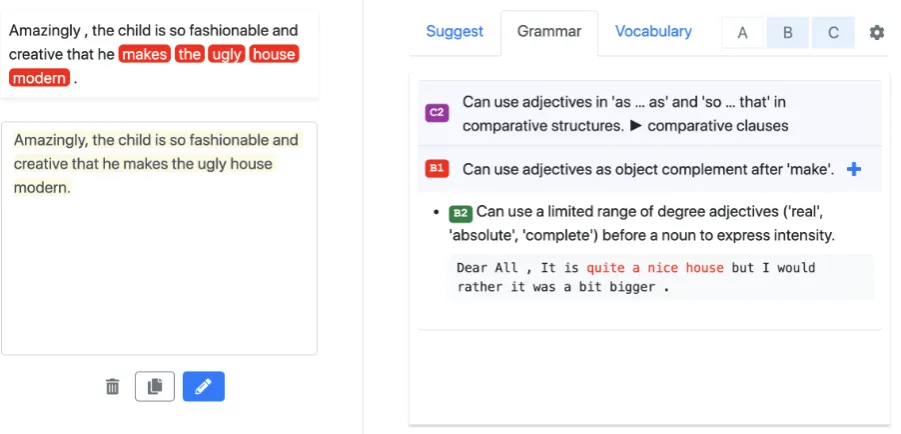
Level-Up recommending for the essay “Amaz-ingly, the child is so fashionable and creative that he made the ugly house modern.”is shown in Fig-ure 1. Level-Uphas identified several grammat-ical elements (e.g., {make NOUN ADJ}) for the given essay. Level-Updetects these grammatical elements by matching patterns against the parse trees. We describe the Level-Up model in more detail in Section 3.
Figure 1: The screenshot ofLevel-Up
Level-Upranks categorized elements and retrieves the related elements with a higher level as sugges-tions. In our prototype,Level-Upreturns detected grammatical elements and recommendations of higher level elements to English learners directly (see Figure1); alternatively, the elements and lev-els returned by Level-Upcan be used as input to an essay scoring system.
The rest of the paper is organized as follows. We review the related work in the next section. Then we present our method for detecting gram-matical elements in learners’ essays expected to suggest more advanced elements. In our eval-uation, Level-Up can provide useful collocations with levels for learners during writing.
2 Related work
English Language Teaching (ELT) has been an area of active research in Applied Linguistics and Computational Linguistics. Recently, the state-of-the-art research in ELT has been represented in the 13th Workshop on Innovative Use of NLP for Building Educational Applications (Tetreault et al.,2018) in the Association for Computational Linguistics (ACL) community. The workshop in-volves developing applications based on NLP ap-proaches for teachers and learners of English as a Second Language (ESL) in educational settings. For example, Bryant and Briscoe (2018) build a competitive system only requiring minimal anno-tated data by using a simple Language Model
ap-proach. In our work, we address an aspect of En-glish Language Teaching which is not the focus of correcting errors. Instead, we concentrate on how to analyze grammatical elements and suggest more advanced elements for learners to level up their essays.
More specifically, we focus on grammatical analysis for assisting learners in writing En-glish, namely, suggesting grammatical elements at higher proficiency level based on identified gram-matical elements in learner’s writing. Grammat-icality improvement for learners has been the fo-cus of ELT research with much works concentrat-ing on Grammar Error Correction (GEC). In gen-eral, GEC systems are aimed at correcting errors in learners’ essays without considering the levels of grammatical elements used in the essays. In contrast, we will analyze the levels of grammat-ical elements in a given essay and provide more grammatically and lexically advanced elements to inform learners of how to refine and level up their essays.
Regex Level Statement
JJR and JJR B1 Can use ’and’ to join a limited range of comparative adjectives.
too JJ TO VB B1 Can use ’too’ before adjectives followed by ’to’-infinitive.
very JJ A1 Can use ’very’ to modify common gradable adjectives.
Table 1: Example regular expressions
commas and “and” to join more than two adjec-tives, after “be”.) Moreover, Cambridge Univer-sity Press organizes a wealth of information re-lated to CEFR, including English Grammar Pro-file (EGP) and English Vocabulary ProPro-file (EVP). EGP grades learners’ ability in terms of grammat-ical form and CEFR levels, while EVP defines words and phrases of different CEFR levels.
Previous works targeting CEFR level detection of learners’ essays include Hancke and Meurers
(2013) for German andVajjala(2014) for Estonian based on annotated learner data. To cope with high cost of collecting learners’ data,Pil´an et al.(2016) investigated the benefits of using texts from lan-guage learning coursebooks to train classifiers for predicting proficiency levels of learners’ texts. Va-jjala(2017) andTack et al.(2017) present methods for identifying the linguistic variables that are in-dicative of writing quality to evaluate a learner’s proficiency. Their researches and Bartning et al.
(2019) all use CEFR to assess proficiency levels. We also utilize CEFR criteria in our research to evaluate essays, but focusing more on grammati-cal elements laid out in Cambridge EGP.
In a study more closely related to our work,
Write&Improve1 (Andersen et al., 2013; Yan-nakoudakis et al., 2018) supports self-assessment and learning by correcting common errors and re-turning an overall score for an essay. Furthermore, it also indicates potentially worst sentences. In contrast, we focus on providing specific informa-tion on raising the proficiency level as the learner writes.
Researches have pointed out that supplying gestions while writing is more helpful than sug-gesting after the fact (Hearst,2015). Grammarly
tries to correct grammatical errors and provides the explanation while the user is writing. WriteA-head2 (Yen et al., 2015) provides real-time writ-ing suggestions on what to write next in the form of grammar patterns and example sentences. Sim-ilarly,ColloCaid3(Lew et al.,2018) checks if the
1
www.writeandimprove.com 2
www.writeahead.nlpweb.org 3www.collocaid.uk
collocation is used correctly and provides frequent collocates so that writers can choose words that go well together.
In contrast to the previous research in En-glish Language Teaching and Grammatical Error Correction, we present a tutoring system, Level-Up, that provides writing assistance, focusing on analyzing grammatical elements and suggesting higher level elements during writing.
3 TheLevel-UpSystem
To improve learners’ essays, grammatical error correction (GEC) is not sufficient. Unfortunately, very few Language tools go beyond GEC and provide suggestions on proficiency level improve-ment for learners. In this section, we address such a problem. Level-Updisplays a set of suggestions based on leveled grammatical elements for im-proving an unfinished sentence or complete sen-tences in essays. We transform criteria (e.g., EGP) into a pattern-matching program to identify gram-matical elements and example n-grams from the corpus. We describe the process of our solution to this problem in the subsections that follow.
3.1 Extracting Grammatical Elements
Due to the lack of annotated data on grammati-cal elements, we attempt to extract grammatigrammati-cal elements using rules representing grammatical el-ements. The method involves using regular ex-pressions, a lexical dictionary, and a parser, since regular expression is straightforward for matching patterns. Table 1 shows the examples of regular expression corresponding to EGP elements.
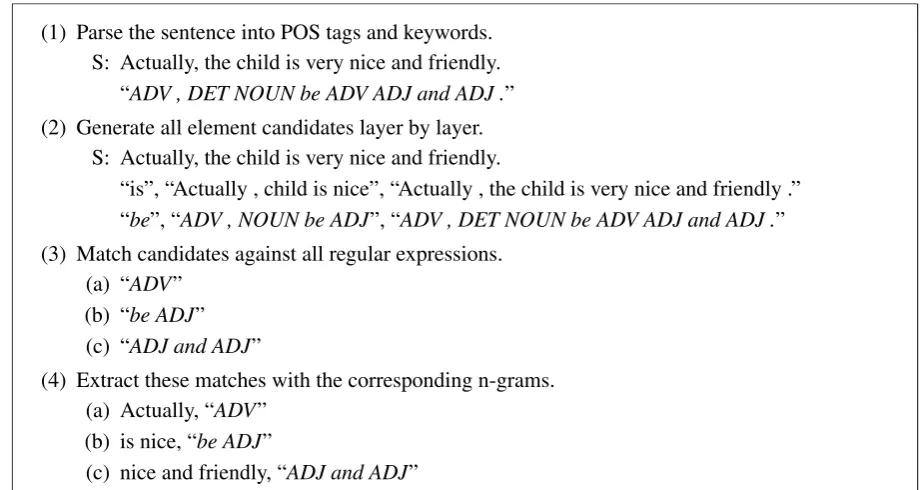
(1) Parse the sentence into POS tags and keywords. S: Actually, the child is very nice and friendly.
“ADV , DET NOUN be ADV ADJ and ADJ .”
(2) Generate all element candidates layer by layer. S: Actually, the child is very nice and friendly.
“is”, “Actually , child is nice”, “Actually , the child is very nice and friendly .” “be”, “ADV , NOUN be ADJ”, “ADV , DET NOUN be ADV ADJ and ADJ .”
(3) Match candidates against all regular expressions. (a) “ADV”
(b) “be ADJ” (c) “ADJ and ADJ”
(4) Extract these matches with the corresponding n-grams. (a) Actually, “ADV”
(b) is nice, “be ADJ”
[image:4.595.66.527.61.306.2](c) nice and friendly, “ADJ and ADJ”
Figure 2: Outline of the process used to identify elements in an example sentence
(1) Obtain n-grams belonging to the given element. (2) Remove the n-grams not containing the last word
in the unfinished sentence.
(3) Calculate Language Model of the unfinished sen-tence with each n-gram.
(4) Retain top 10 highest n-grams of Language Model.
(5) Calculate the n-grams of the average word level. (6) Select the highest n-gram and its corresponding
grammatical elements.
Figure 3: Outline of the process used to select top 1 n-gram to exemplify a given suggested grammatical el-ement.
then record every matching phrase and sentence for generating suggestions at run-time. Figure 2
shows the process of identifying grammatical ele-ments in an example sentence.
3.2 Automated Writing Suggestion for Leveling up
Once the grammatical elements and n-grams are automatically extracted and counted from the given corpus, they are stored as suggestion can-didates. Level-Up constantly returns suggestions based on the last word the user types in the writ-ing area. With the last word as a query, Level-Upretrieves and displays n-grams, ranked by Lan-guage Model and the level of words. Furthermore, each n-gram exemplifies different grammatical el-ements and is accompanied with three example
(1) Obtain grammatical elements in the same subcat-egory.
(2) Retain elements with higher level than the identi-fied element.
(3) Select the first one element for recommendation
Figure 4: Outline of the process of recommending level-up elements for identified grammatical elements.
sentences. The process of selecting n-grams is shown in Figure3.
3.3 Analyzing Elements and Ranking Suggestions
Level-Up also analyzes essays after users finish writing. The process of analyzing is the same as described in Subsection3.1. However, we do not display all the matches to the user. Instead, if the grammatical element is completely overlapped by the other element, we only retain the one with higher level.
4 Experiments and Results
In this section, we describe the details of our ex-periments and the results. First, we introduce how we preprocess the corpus and extracted grammati-cal elements. Then, we explain the analysis of vo-cabularies in Level-Up. Finally, we describe the program architecture and the toolkits used, and show the evaluation results of our system.
4.1 English Grammar Profile
CEFR lists total 1,222 grammatical elements in EGP. In our prototype, we experimented with two categories, adjectives and adverbs, as a pilot study to prove that our approach is effective. Some specific types of words, such as degree adverbs, are enumerated fromSinclair(2005). For prepro-cessing, we used British National Corpus (BNC) (Corpus,2001), containing over four million sen-tences, to collect example n-grams for grammati-cal elements. To be more specific, we parsed all the sentences and generated grammatical element candidates by using SpaCy parser (Honnibal and Montani,2017). Then, we matched all the candi-dates against all the rules. Every detected match of grammar pattern is stored with its n-gram and sentence.
4.2 English Vocabulary Profile
In addition to EGP, we also utilize EVP in our sys-tem. Level-Upnot only analyzes the levels of vo-cabularies defined by EVP in learner’s essays but also provides similar vocabularies at higher level. For example, Level-Up can suggest “strive” (C2 level) for the verb “try” (A2 level). However, an-alyzing vocabulary in our study is not described in Section3due to our focus of EGP. First of all, we obtained the full six-level vocabularies from EVP4, which covers levels A1-C2 of CEFR. How-ever, disambiguating the meanings of polysemy is still an open problem. Therefore, we use the low-est level of a word directly. In other words, after tokenizing sentences with SpaCy, we match these tokens against the lookup table, EVP, to obtain the lower level.
For word suggestions, we use the pre-trained 300 dimension Word2Vec (Mikolov et al., 2013) trained on Google News to generate top 100 sim-ilar words as candidates using Gensim (Reh˚uˇrekˇ and Sojka, 2010). Then, we filter out those can-didates that are not in EVP, at a lower level, or
4vocabulary.englishprofile.org/staticfiles/about.html
Suggestion Count Percent Precision
1st suggestions 22 0.53 0.44
2nd suggestions 13 0.32 0.26
3rd suggestions 6 0.15 0.12
Top 3 suggestions 41 - 0.82
[image:5.595.312.523.62.139.2]Not in Top 3 9 - 0.18
Table 2: Human evaluation ofLevel-Up
different POS tags. Finally, we choose the top 10 candidates to show to learners.
4.3 Technical Architecture
Leve-Up was implemented in Python with the Flask Web framework. We stored the suggestions in JSON format and read the content into mem-ory for fast access. Level-Upserver obtains client input from a popular browser (Safari, Chrome, or Firefox) dynamically with AJAX techniques.
4.4 EvaluatingLevel-Up
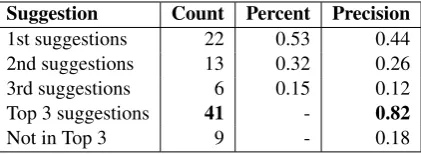
To evaluate the performance of Level-Up, we randomly sampled sentences from learner’s cor-pus. For simplicity, we tested if learners can ac-quire suitable n-grams with advanced grammat-ical structures from using Level-Up and evalu-ate the performance. We randomly selected 50 sentences with adjectives or adverbs from EF-Cambridge Open Language Database (EFCAM-DAT) as test data and segmented each sentence from start to adjective or adverb word for recom-mended n-grams. After typing it inLevel-Up, we considered n-grams from first one to third one, and counted the position of good suggestions. We as-sumed that learners can fit the n-grams to the in-put with less tolerance of edit. Finally, we manu-ally determined the appropriateness of suggestions based on the precision of the Top-3 suggestions. Table2shows the performance ofLevel-Up.
5 Future Work and Conclusion
we could suggest “the better part of a week” to level up “almost a week”. Similarly, we could suggest “in the making” for “happening.” Yet an-other direction of research is evaluating an essay as a whole based on the detected grammatical el-ements. In other words, teachers can assess stu-dents’ essays more efficiently usingLevel-Up.
In summary, we have proposed a method for analyzing grammatical elements and suggesting level-up elements while a user is writing. The ap-proach involves extracting, retrieving, and ranking grammatical elements and examples. We have im-plemented and evaluated the proposed approach as applied to a large corpus with promising results.
References
Øistein E. Andersen, Helen Yannakoudakis, Fiona Barker, and Tim Parish. 2013. Developing and testing a self-assessment and tutoring system. In BEA@NAACL-HLT.
Inge Bartning, M Martin, and Ineke Vedder. 2019. Communicative proficiency and linguistic develop-ment: intersections between sla and language testing research.
Christopher Bryant and Ted Briscoe. 2018. Language model based grammatical error correction without annotated training data. InBEA@NAACL-HLT.
British National Corpus. 2001.
Council of Europe. 2001. Common European Frame-work of Reference for Languages: Learning, Teach-ing, Assessment. Common European Framework of Reference for Languages: Learning, Teaching, As-sessment. Cambridge University Press.
Julia Hancke and Detmar Meurers. 2013. Exploring cefr classification for german based on rich linguis-tic modeling. pages 54–56.
Marti A. Hearst. 2015. Can natural language process-ing become natural language coachprocess-ing? InACL.
Matthew Honnibal and Ines Montani. 2017. spacy 2: Natural language understanding with bloom embed-dings, convolutional neural networks and incremen-tal parsing. To appear.
Robert Lew, Ana Frankenberg-Garcia, Geraint Paul Rees, Jonathan C Roberts, and Nirwan Sharma. 2018. Collocaid: A real-time tool to help academic writers with english collocations. InThe XVIII EU-RALEX International Congress, page 165.
Tomas Mikolov, Ilya Sutskever, Kai Chen, Greg Cor-rado, and Jeffrey Dean. 2013. Distributed represen-tations of words and phrases and their composition-ality. InProceedings of the 26th International Conference on Neural Information Processing Systems
-Volume 2, NIPS’13, pages 3111–3119, USA. Curran Associates Inc.
Ildik´o Pil´an, Elena Volodina, and Torsten Zesch. 2016. Predicting proficiency levels in learner writings by transferring a linguistic complexity model from expert-written coursebooks. InCOLING.
Radim ˇReh˚uˇrek and Petr Sojka. 2010. Software Frame-work for Topic Modelling with Large Corpora. In Proceedings of the LREC 2010 Workshop on New Challenges for NLP Frameworks, pages 45–50, Val-letta, Malta. ELRA. http://is.muni.cz/
publication/884893/en.
J. Sinclair. 2005. Collins Cobuild English grammar. Collins Cobuild. HarperCollins.
Ana¨ıs Tack, Thomas Franois, Sophie Roekhaut, and C´edrick Fairon. 2017. Human and automated cefr-based grading of short answers. InBEA@EMNLP.
Joel Tetreault, Jill Burstein, Ekaterina Kochmar, Clau-dia Leacock, and Helen Yannakoudakis. 2018. Pro-ceedings of the thirteenth workshop on innovative use of nlp for building educational applications. In Proceedings of the Thirteenth Workshop on Innova-tive Use of NLP for Building Educational Applica-tions. Association for Computational Linguistics.
Sowmya Vajjala. 2014. Automatic cefr level prediction for estonian learner text.
Sowmya Vajjala. 2017. Automated assessment of non-native learner essays: Investigating the role of lin-guistic features. International Journal of Artificial Intelligence in Education, 28:79–105.
Helen Yannakoudakis, Øistein E. Andersen, Ardeshir Geranpayeh, Ted Briscoe, and Diane Nicholls. 2018. Developing an automated writing placement system for esl learners.