Munich Personal RePEc Archive
A novel Optimization Plan for
Multiple-Area Economic Dispatch : An
Electro Search Optimization Approach
Kapoor, Advik and Kaur, Vijay
Bennett University
12 September 2018
Online at
https://mpra.ub.uni-muenchen.de/88979/
Abstract—Economic dispatch is an approach that can indirectly improve the power system resonance. A novel
algorithm called JAYA is introduces in this manuscript to have an answer for the non-convex multiple-area economic dispatch (MAED). MAED comprises some zone which satisfy the load-generation balance in each area. The aggregated cost is minimized through transferring the energy from the area that has the lower cost to the zone owns the higher-cost. In above of the transmission line rating, our proposed approach provides the scientists with the multiple petroleum cost function for the generators as well as the prohibited zones for generating the power in the large-scale power generations. Moreover, a new procedure according to the electro search optimization algorithm (ESOA) is projected to obtain the global solution for the MAED problem, when all the limitations are simultaneously considered. The proposed approach is tested to validate its performance through a case system consist of seven generators located in two areas. The results show that the proposed ESOA procedure is more efficient in compare with the other approaches.
Index Terms—Economic Dispatch, Prohibited Operating Zone, Transmission line rating, Optimization approach.
I. INTRODUCTION
Power economic dispatch (DE), known as the economic dispatch (ED), is among the important techniques that
extremely considered when the mathematical approaches used in power system is the focus of study. Distributing the
needed power between the committed generators and optimizing the objective function is the basic purpose of the
economic dispatch. In addition, it is required to fulfill all the realistic constraints simultaneously [1]. The unique ED
problem is a quadric polynomial problem [2]. Based on the woks have been done many different techniques like the
Gradient Method [3], Lambda Iteration [4], and linear programming [5] are used so far to solve the ED problem.
A novel Optimization Plan for
Multiple-Area Economic Dispatch : An Electro
Search Optimization Approach
Advik Kapoor, Vijay Kaur
The ED with the prohibited generation zone (PZ) is extensively studied in [6]. In most cases, some sort of high-level
optimization technique is required to deal with the problem. While the model is usually formulated as the non-linear
mixed integer programming, the exact linearization techniques [7], [8] can be employed to reduce the problem
complexity. Although this linearization approaches relax the non-linearity in the system, using mathematical and
heuristic approaches are always recommended, since the model suffers from discontinuity and nonlinearity caused by
the VP effect [9].
Going beyond the classic mathematical approach, the efficient heuristic methods can solve the problem more
efficiently. A new heuristic approach for determining coherent groups of generator proposed in [10], where an algorithm
developed to deal with the generator coherency detection. The same authors substitute their heuristic approach with
the modularity clustering in [11], and proposed the clusters with higher violability. While the authors worked on the
model maturity in the [10]-[11], the efficient model applied for the real-time decision making in [12]. This review shown
how developing the models can lead toward the realistic approach like the real-time decision-making methods.
While the well-known dynamic programming has been used for ED [13], the componential burden of this model made
it impractical for solving the ED problem [14]. Furthermore, many meta-heuristics approaches such as genetic
algorithm [15], particle swarm optimization [16], tabu-search [17], simulated annealing [18], the common
quasi-oppositional group optimization based on the search [19], chaotic global best artificial bee colony [20], Firefly algorithm
[21], continuous quick group search optimizer [22], fuzzy adaptive chaotic ant swarm optimization [23], augmented
Lagrange hop-field network were used. It should be mentioned that, some of these approaches are not considered as the
optimal solution for the problem.
The renewable energy resources (RE) are considered as the most important source of the energy in this new era. The
wind turbine is among the most important Res. The power generation of a wind turbine has a strong relationship with
the turbine structure. [24] proposed a novel approach to model an offshore wind turbine. The same authors used energy
harvesters to generate electrical power from sea waives [25]- [26].
Multi area ED (MAED) is an extension of ED problem [27] - [28]. The ED problem requirements has to be answered
in every zone and the interchange of the power between the zones requires to be calculated while every constraint is
met, and the objective function is minimized. Additionally, the transmission line rating needs to be emphasized as one
of the most substantial constraint in MAED. some mathematical methods such as linear programming [29] are used to
solve MAED. Other kinds of methods such as, Dantzig–Wolfe decomposition principle [30] and decomposition approach
using expert systems [31] are used to solve MAEDs. Increasing the problem’s decision variables makes the mathematical
modeling more challenging due to the VP effect, the discontinuity because of the PZ [6] and so on. Thus, some
meta-heuristics approaches for example particle swarm optimization (PSO) with Reserve-constrained multi-area
environmental/ED [31-34], a new nonlinear optimization NN approach [32], ABC optimization, teaching-learning based
optimization in [1] and chaotic global best artificial bee colony [15] are suggested.
In this paper, a novel modified electro search optimization algorithm is used to solve the proposed MAED. ESOA is
be a good solution. This algorithm is modest. However, by increasing the problem dimension, the algorithm performance
decreased and finding the optimal solution is not assured. Consequently, considering every probable condition (for
instance each motion that goes towards the worst solution or the part that gets far from the best solution or other
conditions). Moreover, a change operator mode is studied to improve the convergence speed. Lastly, the suggested
method is used to solve for the multi-area ED problem under diverse circumstances. Meta-heuristics approaches are
among the best tools to solve the problem that is utilized in numerous fields.
II. Multiple Area ED
A. The ED Problem
ED is treated as one of the significant optimization techniques in the power network. The main purpose of this
approach is to describe the generation and optimize the cost when all the limits are met. To model the ED, a quadratic
function is usually employed that shows the fuel cost for a generator. However, in some large generators the valve point
(VP) and PZ can cause the non-linearity and non-convexity in the cost function. Accordingly, a sinusoidal term needs
to be augmented to the objective function to effectively modeling the VP effect and the PZs:
1 2
g N
i gi
i
i gi i gi i gi i
i i gi min gi
Min H ( X ) F ( p )
F ( p ) a p b p c
e sin( f ( p - p ))
(1)
Where,
1 2 3 g
g g g gN
Z [ p , p , p , ... , p ] (2)
B. Multi-area ED
Multi area ED (MAED) is a developed ED problem. The main goal of MAED is to govern the power generation and
the power transmission between all areas so that the objective function will be minimized, and the constraints and the
load demand are fulfilled [30]-[32]. The mathematical modeling of multi area ED, objective function, variables and
constraints are expressed as follows:
1 1
Ngi M
ij gij
i j
Min H ( X ) F ( P )
(3)where F ( pij gij) a pij gij2 b p ij gij c ij | e sin( f ( pij ij gij min - pgij)) |. Also, i j, denotes
generating unit indices, H X( ) denotes the objective function, F pg
denotes generating unit cost function, Pgiis powersolution index, i qj
B is loss coefficient relating the productions of qth and jth generators in area i, i0 j
B is loss coefficient
related with the production of jth generator in area i, Bi00is loss coefficient parameter (MW) in area i, Liis number of POZs for ith generator, Ngdenotes the number of generating units, Pgiminis lowest output power of ith generator (MW),
max gi
P is highest output power of ith generator (MW), Pgi l,Low, Pgi l,Upare minimum and maximum boundary of the lth
POZ for ith generator, respectively, and rand(1, )n is a vector including of random numbers in [0,1].
Also,
1 2 3
g g g gM 1 2 M
Z [ p , p , p , ... , p , T , T , ... , T ] (4)
1 1 1 2 1
1 2 M , , ,M 2,3 2,4 2,M
M-1,M
[T , T , ... , T ] = [T ,T ,...,T ], [T ,T ,...,T ], ..., [T ]
(5)- (6)
Where Pgimaxis highest output power of ith generator (MW), and Ti j, is transmission power between area i and j areas
Usually, in some power plants, multi types of fuels are used as sources, instead of only one fuel for power generation.
Therefore, the factors of the objective function in every time snap is diverse [15]. Thus, by applying the VP effect, PZs
and line rating constraint, the multi-area ED leads to a compound problem. So, an effective optimization technique is
needed to solve the problem [1].
C. Constraints
1. Power Generation
The generate power for the generators is limited with the minimum and the maximum as follow:
gi min gi gi max
P
P
P
(7)2. Conservation of flow
The generate power must satisfy the total load demand in addition to the the transmission network losses.
Accordingly, for the multi-area structure the following constraint must be met:
1
N
Gi Di Li ij
j , j i
P P P T i=1,2,...,M
(8)Li
P
stands for the transmission network losses in the ith zone as follows [15]:0
1 1 1
gi gi gi
N N N
i i i
Li gij q j giq j gij 00
q j j
P = P B P + B P + B
3. PZs Constraint
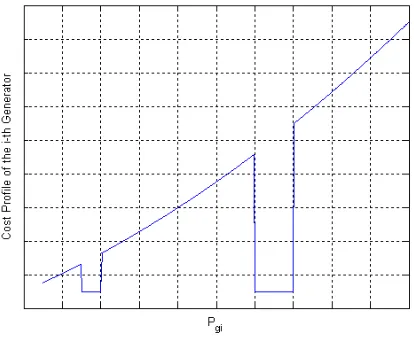
Considering the realistic limitations that prevents the damages to the plant, the generators cannot generate power
in a continues mode. Therefore, power generation in these intervals is forbidden. Fig (1), illustrates the power generation
[image:6.612.202.409.141.310.2]plot of the power generators with two different PZs.
Fig. 1, The fuel plot of the power plant with two forbidden operating zones
Furthermore, equation (6) demonstrates the PZ constraint as following:
1
1
gi ,l
i ,Li
Low gi min gi gi ,l
Up Low
gi gi ,l
gi i
Up
gi gimax g
g
P P P
P P P
.
P = l=2,3,...,L
. .
P P P
i = 1,2,...,N
(10)
4. Tie Transmission Line Rating Constraint
The transmission line rating is very constraint in MAED. Power exchange between areas should be among the
bounded capacity for each transmission line as the following equation:
i , j max i , j i , j max
T
T
T
(11)III. THE PROPOSES ESOA
In this study, the (ESOA) is to overwhelm the non-convexity of the problem. ESOA is a novel meta-heuristic method
some important benefits such as lower mathematical demand and no requirement to control variables in comparison
with the other approaches like GA, PSO, SA, PGHA. ESOA is as follow:
1)Atom spreading phase
In the phase, the applicant solutions are banquet all around the search space arbitrarily.
2)Orbital transition
According to the quantized energy concept, electrons around each nucleus tend to move to the bigger orbit to obtain
higher energy level.
2
1
i i
e = N +(2 rand-1)(1- ) r, n [2,5] n
(12)
The new electrons in the higher level of energy are considered as the best solution (ebest) and used atom moving in the
next step.
3)Nucleus relocation
In this phase, the location of the new nucleus (Nnew) is related to the phases of energy of the atoms. In conclusion,
the nucleus transfer is determined as the following equation:
2 2
1 1
k best best k
best k
D = (e -N ) +Re ( )
N N
(13)
new ,k k k k
N =N +Ac D (14)
This step is sustained for all nucleus and relocates of all atoms to determine the global optimum point. Based on the
equations mentioned above, the algorithm’s convergence speed is associated to the Rydberg’s energy constant and
accelerator coefficient. These numbers are picked arbitrarily for the first iteration and are updated in the next iteration
using the following step.
4)Orbital-Tuner method
Orbital-Tuner method is used to update the accelerator coefficients and Rydberg’s energy. This method is suggested
according to the cumulative normal density function. Thus, as an alternative to the center of gravity between two
candidates, the center of mass is computed.
1 1 1 2 i i i i n
i N | Re
k best
N | Re i
k
Re / f
Re (Re )
/ f
Re
(15)1 1 1 2 i i i i n
i N | Ac
k best
N | Ac i
k
Ac / f
Ac ( Ac )
/ f
Ac
(16)IV. CASE STUDY AND RESULTS
Seven generators in two areas:
This case study system comprises seven generations units in two dissimilar areas. The first area has four units while
the second area contains three units. The total required is 1963 (MW), where the load request of the first area is 1177.8
MW which is equal to 60% and the second area is 785.2 MW which is equal to 40%. The line rating between the two
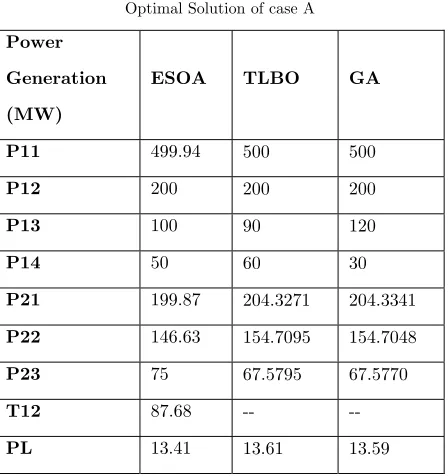
areas is 120 MW. The advantage of the introduced algorithm in comparison with other types of optimization algorithms
[image:8.612.196.420.185.423.2]for example GA, and (TLBO) is summarized in Table. 1.
Table I
Optimal Solution of case A
GA TLBO
ESOA Power
Generation (MW)
500 500
499.94
P11
200 200
200
P12
120 90
100
P13
30 60
50
P14
204.3341 204.3271
199.87
P21
154.7048 154.7095
146.63
P22
67.5770 67.5795
75
P23
-- --
87.68
T12
13.59 13.61
13.41
PL
Figure 2, presents the total operation cost by different techniques. Based on this figure, the proposed EASO technique
[image:8.612.187.436.486.633.2]has a less operation cost in comparison with others.
Fig. 2. Total operation cost by different techniques.
CONCLUSION
MAED is a complex form of ED. In MAED, the transmission line capacity constrains should be satisfied in above of
is introduced. To assess the aptitude and workability of the method, two different systems are employed. The results
show that the proposed method is a high efficient, accurate and robust.
REFERENCES
[1] Dabbaghjamanesh, M., A. Moeini, M. Ashkaboosi, P. Khazaei, and K. Mirzapalangi. "High performance control
of grid connected cascaded H-Bridge active rectifier based on type II-fuzzy logic controller with low frequency
modulation technique." International Journal of Electrical and Computer Engineering (IJECE) 6, no. 2 (2016):
484-494.
[2] Dabbaghjamanesh, Morteza, Abdollah Kavousi-Fard, and Shahab Mehraeen. "Effective Scheduling of
Reconfigurable Microgrids with Dynamic Thermal Line Rating." IEEE Transactions on Industrial Electronics
(2018).
[3] Tashakori, Sajad, Amir Tavakoli, and Farzad Mirzaei. "Effective Micro Grid Stability Under Excitation Limiters
in Islanded and Connected Modes." American Journal of Electrical and Electronic Engineering 5, no. 1 (2017):
28-33.
[4] Ferdowsi, Farzad, Ahmad Sadeghi Yazdankhah, and Homayoon Rohani. "A combinative method to control output
power fluctuations of large grid-connected photovoltaic systems." In Environment and Electrical Engineering
(EEEIC), 2014 14th International Conference on, pp. 260-264. IEEE, 2014.
[5] Ferdowsi, Farzad, Ahmad Sadeghi Yazdankhah, and Bahareh Abbasi. "Declining power fluctuation velocity in
large PV systems by optimal battery selection." In Environment and Electrical Engineering (EEEIC), 2012 11th
International Conference on, pp. 983-988. IEEE, 2012.
[6] Liu, Xian, and Hamzeh Davarikia. "Optimal Power Flow with Disjoint Prohibited Zones: New Formulation and
Solutions." arXiv preprint arXiv:1805.03769 (2018).
[7] DAVARIKIA, Hamzeh, and Masoud BARATI. "A tri-level programming model for attack-resilient control of
power grids." Journal of Modern Power Systems and Clean Energy (2018): 1-12.
[8] Davarikia, Hamzeh. "Investment plan against malicious attacks on power networks: multilevel game-theoretic
[9] Ashkaboosi, Maryam, Seyed Mehdi Nourani, Peyman Khazaei, Morteza Dabbaghjamanesh, and Amirhossein
Moeini. "An optimization technique based on profit of investment and market clearing in wind power systems."
American Journal of Electrical and Electronic Engineering 4, no. 3 (2016): 85-91.
[10] Davarikia, Hamzeh, Faycal Znidi, Mohammad Reza Aghamohammadi, and Kamran Iqbal. "Identification of
coherent groups of generators based on synchronization coefficient." In Power and Energy Society General Meeting
(PESGM), 2016, pp. 1-5. IEEE, 2016.
[11] Znidi, Faycal, Hamzeh Davarikia, and Kamran Iqbal. "Modularity clustering based detection of coherent groups
of generators with generator integrity indices." In Power & Energy Society General Meeting, 2017 IEEE, pp. 1-5.
IEEE, 2017.
[12] Davarikia, Hamzeh, Masoud Barati, Faycal Znidi, and Kamran Iqbal. "Real-Time Integrity Indices in Power Grid:
A Synchronization Coefficient Based Clustering Approach." arXiv preprint arXiv:1804.02793 (2018).
[13] Rakhshan, Mohsen, Navid Vafamand, Mokhtar Shasadeghi, Morteza Dabbaghjamanesh, and Amirhossein Moeini.
"Design of networked polynomial control systems with random delays: sum of squares approach." International
Journal of Automation and Control 10, no. 1 (2016): 73-86.
[14] Khazaei, P., S. M. Modares, M. Dabbaghjamanesh, M. Almousa, and A. Moeini. "A high efficiency DC/DC boost
converter for photovoltaic applications." International Journal of Soft Computing and Engineering (IJSCE) 6, no.
2 (2016): 2231-2307.
[15] Khazaei, Peyman, Morteza Dabbaghjamanesh, Ali Kalantarzadeh, and Hasan Mousavi. "Applying the modified
TLBO algorithm to solve the unit commitment problem." In World Automation Congress (WAC), 2016, pp. 1-6.
IEEE, 2016.
[16] Dabbaghjamanesh, Morteza, Shahab Mehraeen, Abdollah Kavousifard, and Mosayeb Afshari Igder. "Effective
scheduling operation of coordinated and uncoordinated wind-hydro and pumped-storage in generation units with
[17] Dabbaghjamanesh, Morteza, Shahab Mehraeen, Abdollah Kavousi Fard, and Farzad Ferdowsi. "A New Efficient
Stochastic Energy Management Technique for Interconnected AC Microgrids." arXiv preprint arXiv:1803.03320
(2018).
[18] Azizi, S. (2017). Altruism: primary motivation of remittances. Applied Economics Letters, 24(17), 1218-1221.
http://dx.doi.org/10.1080/13504851.2016.1267840
[19] Azizi S. Why do migrants remit?. World Econ. 2018;00:1–24. https://doi.org/10.1111/twec.12681.
[20] S. Jafarishiadeh, M. Ardebili, A. Nazari Marashi, “Investigation of pole and slot numbers in axial-flux pm bldc
motors with single-layer windings for electric vehicles,” 24th Iranian Conference on Electrical Engineering (ICEE),
pp. 1444-1448, 2016.
[21] Azizi, S., The impacts of workers’ remittances on human capital and labor supply in developing countries,
Economic Modelling (2018), https://doi.org/10.1016/j.econmod.2018.07.011.
[22] E. Rabiei, P. Ahmadian, and A. Jalilzade, “Top down strategy for renewable energy investment: sizing
methodologies and Integrated Renewable Energy System models,” 1st National Conference on Clean and
Renewable Energy, Hamedan, Iran, 2014.
[23] H. R. Feili, P. Ahmadian, and E. Rabiei, “Life Cycle Assessment Of Municipal Solid Waste Systems To Prioritize
And Compare Their Methods With Multi-Criteria Decision Making,” The Open Access Journal of Resistive
Economics (OAJRE), vol. 2(1), pp. 38-46, 2014.
[24] V. Jahangiri and M. M. Ettefagh, “Multibody Dynamics of a Floating Wind Turbine Considering the Flexibility
Between Nacelle and Tower,” Int. J. Struct. Stab. Dyn., p. 1850085, Nov. 2017.
[25] V. Jahangiri, H. Mirab, R. Fathi, and M. M. Ettefagh, “TLP structural health monitoring based on vibration
signal of energy harvesting system,” Lat. Am. J. Solids Struct., vol. 13, no. 5, 2016.
[26] H. Mirab, R. Fathi, V. Jahangiri, and M. Ettefagh, “Energy harvesting from sea waves with consideration of airy
[27] E. Rabiei, H. R. Feili, P. Ahmadian, B. Majidi, and J. Karimi, “The Economic Analysis between Wind Energy
and Biogas Energy to Determine Economic Policy in the Renewable Energy Systems in Iran,” In 1st International
Conference on the Development of Agricultural Science and Natural Resources, pp. 50-60, Poland, 2015.
[28] H. Feili, P. Ahmadian, E. Rabiei, J. Karimi, and B. Majidi, “Ranking of Suitable Renewable Energy Location
Using AHP Method and Scoring Systems with Sustainable Development Perspective,” In 6th International
Conference on Economics, Management, EngineeringScience and Art, Brussels, Belgium, 2018.
[29] H. R. Feili, E. Rabiei, P. Ahmadian, J. Karimi, and B. Majidi, “Prioritization of Renewable Energy Systems Using
AHP Method with Economic Analysis Perspective in Iran,” In 2nd International Conference on Modern Researchs
in Management, Economics and Accounting, Kualalampur, Malaysia, 2018.
[30] E. Rabiei Hosseinabad, and R. J. Moraga, “A System Dynamics Approach in Air Pollution Mitigation of
Metropolitan Areas with Sustainable Development Perspective: A Case Study of Mexico City,” Journal of Applied
Environmental and Biological Sciences, vol. 7(12), pp. 164-174, 2017.
[31] Taherzadeh, Erfan, Morteza Dabbaghjamanesh, Mohsen Gitizadeh, and Akbar Rahideh. "A New Efficient Fuel
Optimization in Blended Charge Depletion/Charge Sustenance Control Strategy for Plug-in Hybrid Electric
Vehicles." IEEE Transactions on Intelligent Vehicles (2018).
[32] S. Jafari-Shiadeh, M. Ardebili, and P. Moamaei, “Three-dimensional finite-element-model investigation of
axial-flux PM BLDC machines with similar pole and slot combination for electric vehicles”, Proceedings of Power and
Energy Conference, Illinois, pp. 1–4, 2015
[33] Seyyedmahdi Jafarishiadeh and Mahraz Amini, “Design and comparison of axial-flux PM BLDC motors for direct
drive electric vehicles: conventional or similar slot and pole combination,” International Journal of Engineering
Innovation & Research, Vol. 6, No. 1, pp. 15-20, Jan. 2017
[34] S. M. Jafari-Shiadeh and M. Ardebili, “Analysis and comparison of axial-flux permanent-magnet brushless-DC
machines with fractional-slot concentrated-windings”, Proc. 4th Annu. Int. Power Electron., Drive Syst., Technol.