Munich Personal RePEc Archive
Cryptocurrency Voting Games
Bhattacherjee, Sanjay and Sarkar, Palash
Indian Statistical Institute, Kolkata
30 November 2017
Online at
https://mpra.ub.uni-muenchen.de/83592/
Cryptocurrency Voting Games
Sanjay Bhattacherjee and Palash Sarkar Applied Statistics Unit
Indian Statistical Institute 203, B.T. Road
Kolkata India 700108
email:{[email protected], [email protected]}
November 30, 2017
Abstract
This work shows that weighted majority voting games occur in cryptocurrencies. In particular, two such games are highlighted. The first game, which we call the Rule Game, pertains to the scenario where the entities in the system engage in a voting procedure to accept or reject a change of rules. The second game, which we call the Attack Game, refers to the scenario where a group of entities in a cryptocurrency system can form a coalition to engage in double spending. For the Rule Game we provide analysis to argue that the Coleman’s preventive power measure is the appropriate tool for measuring a player’s influence in the game while for the Attack Game, we define a notion of stability based on the notion of minimal winning coalitions. For both the Rule Game and the Attack Game, we show how to analyse the games based on a snapshot of real world data for Bitcoin which is presently the most popular of all the cryptocurrencies.
1
Introduction
A cryptocurrency is a form of digital currency which is powered by tools from modern cryptography. The first and to date the most successful cryptocurrency called Bitcoin was proposed by the eponymous Satoshi Nakamoto (Nakamoto, 2008). Since then many cryptocurrencies have been proposed1. Bitcoin, though remains the most popular and valuable cryptocurrency. In 2017, the exchange value of 1 Bitcoin rose from about 1000 US Dollars to about 10000 US Dollars2.
The most remarkable feature of Bitcoin and other similar cryptocurrencies is that it is not backed by any central authority. This makes such currencies stand apart from all fiat currencies that have been proposed till date. It is perhaps due to this unique feature that cryptocurrencies are sometimes said to be a disruptive technology with the potential to revolutionise the socio-economic framework of the future.
From an academic point of view, the success and continuously growing popularity of cryptocurrencies make them a very interesting object of research. There are multiple dimensions to such research. Apart from the questions arising from the underlying cryptography, there are many questions which arise from the standpoint of economics. In this work, we will look at two such questions arising from the viewpoint of cooperative game theory, or more particularly voting games.
1
https://en.wikipedia.org/wiki/List_of_cryptocurrencies 2
Voting Games
Formation of coalitions of people or entities with the intention of achieving some common goal occur in various socio-economic settings. A typical example is the process of decision making in committees. For a resolution to be passed, it must receive a designated amount of support. A coalition of members of the committee can provide the necessary support for the resolution to be adopted, or, it may also block the resolution from being adopted. Such decision making procedures have been studied in the literature as voting games. At an abstract level, a voting game consists of a set of players and the game is given by a function which assigns a value of 0 or 1 to any coalition of players, where 0 denotes that the coalition is losing while 1 denotes that the coalition is winning.
Of practical interest are weighted majority voting games. In such games, each player has a pre-assigned weight. A coalition wins if the sum of the weights of all the players in the coalition is at least a certain pre-specified fractionq of the sum total of the weights of all the players. A typical example of a weighted majority voting game is a company boardroom where the weights represent the amount of shares that board members own. In the domain of public policy, two well known examples of weighted majority voting games are those arising in the decision making procedures of the International Monetory fund and the European Union.
There is an extensive literature on voting games in general and also weighted majority voting games in particular. One of the goals of the theory is to be able to capture the power or influence that a player has in the game. Two central concepts that arise are the notion of a swing and that of a minimal winning coalition. A player is a swing in a coalition if the coalition is winning, it contains the player and becomes losing if the player is dropped from the coalition. The number of coalitions in which a player is a swing can be taken as a measure of the power of the player in the game. A minimal winning coalition is a winning coalition such that if any player is dropped from the coalition, then it becomes a losing coalition. In other words, every player in a minimal winning coalition is a swing player. The notion of minimal winning coalition has also been used to provide alternative ways of capturing the notion of power of a player.
(Shapley, 1953; Shapley and Shubik, 1954) introduced the idea of measuring power in a voting game. (Banzhaf, 1965) suggested the use of swings to measure voting power of players. Later work (Coleman, 1971) provided alternative proposals for capturing the notions of preventive and initiative powers of play-ers. Voting power measures based on the idea of minimal winning coalitions were suggested in (Holler, 1982; Holler and Packel, 1983; Deegan and Packel, 1978). (Felsenthal and Machover, 1998) provides an extensive overview of voting games and an introduction to the topic can be found in (Chakravarty et al., 2015).
Voting Games in Cryptocurrencies
In most cryptocurrencies, generation of new currency requires computational power. The process of creating new currency is called mining. There are commercial entities called miners who are engaged in the task of mining. For Bitcoin, there is a sophisticated ecosystem for mining new coins3. At any point of time, there is a total amount of computational power that is engaged in the process of mining. This is usually specified in terms of the so-called “hash rate” which we explain later. Different miners have different proportions of the total hash rate of the entire system. For certain aspects of a cryptocurrency, the say of a miner is proportional to the fraction of the total hash rate that it possesses. This feature indicates the presence of an implicit voting game in cryptocurrencies.
In this work, we show how weighted majority voting games arise in cryptocurrencies. The players in the game are the miners and the weight of a miner is proportional to the fraction of the total hash
3
rate that it controls. To completely specify the game, it is required to specify the winning threshold. The value of this threshold depends upon the particular situation. We identify two such scenarios.
The rules governing cryptocurrencies are described in terms of protocols which are initially specified at the time of inception. At later points of time, these rules (or protocols) can be modified. There is a well defined modification procedure. In the context of Bitcoin, this is called a Bitcoin Improvement Protocol (BIP). We show that a BIP can be viewed as a weighted majority voting game among the miners where the winning threshold q is 0.95. More generally, we use the term Rule Game to denote the voting games arising in the context of change of rule of any cryptocurrency. The purpose of having a high winning threshold in a Rule Game is to achieve near unanimity for a change of rule to take place. From the viewpoint of voting games, having a high winning threshold results in several miners becoming blockers. We discuss in details the appropriate measure of voting power that is applicable in this context. Our analysis reveal that the Coleman preventive power measure (Coleman, 1971) and the Holler public good measure (Holler, 1982) satisfy some basic intuition for measuring the influence of a miner. Further, we prove that the Coleman preventive power measure increases monotonically with the weights while the Holler public good index does not necessarily do so. It is perhaps an intuitive requirement that the powers of voters increase monotonically with their weights. Based on this intuition, we propose the use of Coleman preventive power measure as the appropriate tool for measuring a miner’s influence in a Rule Game.
Cryptographic considerations show that if a coalition of miners acquire at least 51% of the hash rate of the system, then with non-negligible probability, such a coalition can engage in double spending of the currency. So, it is of interest to consider games where the winning thresholdqis set to 0.51. We call such a game to be an Attack Game. From the viewpoint of voting games, several questions can be formulated to analyse the Attack Game. These are based upon the crucial notion of minimal winning coalitions. For example, one may wish to know the minimum cardinality of any minimal winning coalition; another relevant question would be the minimum cardinality of any minimal winning coalition containing a particular miner. We formulate several such questions and finally come up with a notion of stability of a cryptocurrency against the Attack Game.
Snapshot Analysis
To actually compute the power measures and the minimal winning coalitions in a cryptocurrency game, it is required to obtain the weights of the miners which are their hash rates. The values of the hash rates are not directly available. Instead, they need to be estimated. A simple estimate can be obtained based on the assumption that the hash rate is proportional to the number of blocks mined by a miner in a given interval of time. This provides a snapshot estimate of the actual hash rate of the miners. For Bitcoin, we use such a snapshot estimate and show how to perform a meaningful analysis of the Rule and the Attack Games. Performing similar snapshot analysis at regular time intervals will provide a good understanding of the socio-economic dynamics of Bitcoin. More generally, such analysis can also be performed for other cryptocurrencies.
Related works: There is already a fairly large and growing literature on cryptocurrencies4. Some game theoretic aspects of cryptocurrencies have already been studied (Kiayias et al., 2016; Lewenberg et al., 2015; Fisch et al., 2017; Kroll et al., 2013). To the best of our knowledge, the application of weighted majority voting games to cryptocurrencies has not been considered earlier.
4
2
An Overview of Cryptocurrencies
In this section we provide a high level overview of cryptocurrencies. The purpose of this overview is to provide a sufficient background for understanding how voting games arise in cryptocurrencies. For further details, the reader may consult Narayanan et al. (2016).
2.1 Cryptographic Tools
Modern cryptography has many tools to enable various tasks in the present digital era. Two such cryptographic components are used in implementing cryptocurrencies. A brief overview of these two primitives are provided below.
Hash functions: A hash function maps a domain D to a range R where D is the set of all binary strings having some maximum possible length andRis the set of all binary strings of some fixed length. For example,D could be the set of all strings of length less than 264 whereas Rcould be the set of all
strings of length equal to 256 bits. In this case, the cardinality ofDis 2264−1−1 and the cardinality of
Ris 2256. So, a hash function maps a very large domain to a comparatively smaller range. In absolute terms, however, the range itself is quite large. Since the domain of a hash function is larger than its range, there will be two (or more) distinct strings in the domain which are mapped to the same string in the range. Such a pair of strings is called a collision. For cryptocurrency applications, there are three requirements on a hash function.
Efficient to evaluate: Given a string in the domain, it should be possible to compute the output of the hash function very fast. The speed of evaluation of the hash function can often be improved by using very efficient software implementation or customized hardware implementation.
Collision resistance: As mentioned above, a hash function will necessarily have collisions. The require-ment of collision resistance is met by a hash function if it is computationally difficultto actually find a collision.
One-way: Given a string in the range, it should be computationally difficult to find a pre-image for it. In other words, while the hash function should be very efficient to evaluate in the forward direction, it should be computationally difficult to invert the function.
Examples of practical hash functions which are efficient to evaluate and which are considered to be collision resistant and one-way are SHA-256, RIPEMD160 and SHA-3 among others. The first two are used in Bitcoin.
to produce a signatureσ on the message. Given a message-signature pair (M, σ), anybody can run the verification algorithm with the corresponding verification key pk to verify the validity of the signature on the message.
There is a large literature on digital signature algorithms addressing several aspects of its security and efficiency. Here we only mention the well known elliptic curve digital signature algorithm (ECDSA) which is used in the implementation of Bitcoin.
2.2 Cryptocurrency Basics
As mentioned above, cryptocurrencies are built using a hash function H and a digital signature algo-rithm. Whichever entity wishes to participate in the cryptocurrency uses the digital signature algorithm to first generate a signing-verification key pair. In fact, a single entity can generate several such key pairs. The cryptocurrency setup only recognises the key pairs and is not concerned about who created these.
A cryptocurrency is designated in a particular unit. Different cryptocurrencies have different units with different names. Examples are Bitcoin and Ether. The units are divisible and the extent to which a unit is divisible is governed by the rules of the particular cryptocurrency. Most present day cryptocurrencies are essentially based on Bitcoin5. Accordingly, our description below is primarily based on Bitcoin though the ideas are general enough and apply to other cryptocurrencies as well.
Public ledger: Public keys are owners of the cryptocurrency. There is a public ledger which records which public key owns what amount of the cryptocurrency. We later describe how the public ledger is maintained and updated and also how new units of the currency are created. For the moment, assume that the public ledger is available and consider the issue of spending.
Transactions: Spending is the transfer of a certain amount of the currency from one public key to one or more public keys. This is done via a transaction which specifies the spender public key and the set of recipient public keys, i.e., the amount of currency owned by the spender public key is to be assigned to one or more recipient public keys. The entire transaction is considered as a message which is digitally signed with the signing key corresponding to the spender public key. This signifies the spender’s commitment to the transaction. Since the ledger is publicly available, it is easy to verify from the recorded history in the ledger if the spender public key indeed owned the stated amount of the currency. Also, since the signature can be publicly verified, it is possible to verify that the spender indeed signed the transaction. Once such verification is confirmed and the transaction enters the public ledger, the owners of the recipient public keys may provide the goods and/or services for which the spending has been made. After a transaction becomes a permanent part of the public ledger, the amount of currency associated to the spender public key is considered to be spent and this public key cannot spend this currency any further.
Blockchain: Let us now consider the public ledger. This is structured as a chain of blocks giving rise to the term blockchain. Each block consists of a link to the previous block, a set of transactions and a solution to a puzzle. Suppose B0, B1, B2, . . . , Br is the current chain of blocks. The block B0 is called
the genesis block. It is a special block and does not contain any link to a previous block. Fori≥1, a blockBi is a triplet (h, R, η), wherehisH(Bi−1),Ris the (ordered) set of transactions in blockBi and
5
η is a solution to the puzzle. The value h in Bi is said to point to the previous block Bi−1. The last
blockBr in the chain is called the header block of the chain.
Difficulty: The puzzle can be described in the following manner. The output of the hash functionH
is a binary string of some fixed lengthnand this string can be considered to be the binary representation of an integer in the range [0, . . . ,2n−1]. The puzzle specifies an integer d called the difficulty value. The quantity η in the block Bi is a solution to the puzzle ifH(Bi) =H(h, R, η)< d. In this case, the blockBi is said to have been solved with difficultyd. SinceHis one-way, it is computationally difficult to invert H. So, the only way to solve the puzzle is to repeatedly apply H to (h, R, η) with different values ofη until a solution to the puzzle is obtained. Heuristically assuming that the outputs ofH are uniformly distributed (which is a very common assumption), the probability that a single invocation of
H returns a value less than dis d/2n. So, for example, if d= 2n−32, then 232 invocations of Hwill be
required on an average to solve the puzzle specified byd.
The value ofdis not constant. The cryptocurrency rules (or protocols) specify how it changes over time. It is determined so that the time required to solve a puzzle does not vary much with time. For example, in the case of Bitcoin, the difficulty is adjusted so that a puzzle is solved in about 10 minutes and 2016 blocks are mined in about two weeks. Starting from the genesis block, segments of every 2016 blocks constitute a window. The difficulty remains constant in each window and based on the time required to complete the current window, the difficulty is determined for the next window. The details of the difficulty adjustment procedure are not important for our purposes and so we do not describe these details.
Distributed public ledger: We have mentioned that the ledger is publicly available. Let us consider how this is done. There is no central user in the system which maintains the public ledger. Instead the system consists of a number of nodes which are globally distributed. A node is essentially a computer running the particular cryptocurrency software. There is no restriction on who can or cannot be a node. The cryptocurrency protocol is publicly available and anybody can implement the protocol on a computer and thus become a node in the system. The chain of blocks which forms the public ledger is maintained by all the nodes in the system. Each node can communicate with its nearby nodes and exchange information regarding transactions and blocks. Information initiated by any node in the system propagates very fast (within seconds) to all the nodes in the system. So, instead of having a central authority maintaining and updating the public ledger, it is maintained and updated in a distributed manner using a network of nodes. Such a system is called a peer-to-peer network.
Updation of the blockchain: Several conflicting scenarios may arise. Suppose a node receives two blocks both of which point to the block which is the header block of the chain that the node presently maintains. Clearly, the node cannot insert both the blocks into the chain. The cryptocurrency protocol specifies which block it should insert as the new header. For Bitcoin, the node selects the block it obtained earlier as the new header of its chain.
More generally, consider the following scenario. Suppose the local chain maintained by a node is . . . , Bi, Bi+1, . . . , Br. Due to possible delay in the network, suppose it receives a chain of blocks
Bi′+1, . . . , B′r′ where Bi′+1 points to Bi. This means that from block Bi the chain has forked, i.e., one segment of the network has created the chain extension Bi+1, . . . , Br of length r −1 while another segment of the network has created the chain extension Bi′+1, . . . , B′r′ of length r′−1. At this point,
the node needs to determine which chain it will follow. This is again specified by the rules of the cryptocurrency system. For Bitcoin, the node keeps the extension which is more difficult, i.e., for which the sum of difficulties of the blocks in the extension is greater. If the difficulty did not change during the time interval in which the fork has formed, then greater difficulty amounts to longer chain, i.e., the node keeps the longer of the two chains.
Confirmation of transactions: To diminish the chances of the above kind of transient behaviour, one usually waits until the block containing the transaction gets embedded sufficiently deeply in the chain. For Bitcoin, the recommendation is that one should wait until the transaction is embedded six blocks deep in the chain. Then the chances of the block containing the transaction getting dropped from the chain becomes negligible. Since the difficulty level of Bitcoin is determined so that a block is mined every ten minutes, confirmation of a transaction takes about an hour.
Immutability of the public ledger: As described above, the public ledger is constructed as a chain of blocks. The links in the chain are created using the one-way hash function. As a result, the chain is considered to be immutable in the following sense. Suppose that all the nodes in the system have the same copy of the chain. Let us consider the possibility of going back into the chain and modifying one of the blocks to create a new chain. Since the hash function is one-way, it is not possible to invert the links. So, the only way of creating the new chain is to work forward from the modified block. This requires solving the puzzles for each of the blocks appearing after the modified block. A sufficient number of blocks will have to be added so that the difficulty of the modified chain becomes more than the difficulty of the publicly available chain. Unless one entity acquires majority of the computational power, this will not be possible and the modified chain will be rejected by the nodes of the system.
Mining of blocks: Currency is created through successfully solving the puzzle. This procedure is also called mining a block. When a block is mined, the rules of the cryptocurrency permits assigning a certain amount of the currency to a public key. This amount of currency was not previously assigned to any public key and hence the mining procedure creates new currency. The amount of currency that is created by successful mining of a block is specified by the rules of the cryptocurrency and is called the block reward. It is through the block reward that new currency is created. The block reward is not constant and for Bitcoin it decreases at a constant rate over time.
The presence of block rewards incentivises nodes to invest computer effort into mining a block. The activity is profitable for a node if the cost of mining is less than the block reward. Commercial entities which primarily aim to mine blocks are called miners.
number of times. So, an entity which can computeHfaster is more likely to solve a puzzle sooner. The hash rate of an entity is the number of times it can invoke Hin one second.
Mining pools: While in principle, any node can be a miner, due to the huge resource requirement, it may not be possible for nodes with limited resources to successfully mine a block in a reasonable amount of time. So, individual nodes join what are called mining pools. Such pools integrate the efforts of many miners and rewards the individual miners by apportioning the obtained block reward among the members of the mining pool.
Double spending: A basic concern for any currency is that there should not be any double spending, i.e. a particular amount of currency should be spent at most once. In the context of cryptocurrency, double spending means that there are two or more transactions which spends the amount of currency associated to a single public key. This should normally not be possible. Once a transaction enters the public ledger through a block, any other node can verify that the amount associated to the spender’s public key has been spent and so will reject any transaction which attempts to double spend from this public key. This possibility, however, arises in the following manner. Suppose a miner (or a coalition of miners) spends the amount of currency associated to a public key, creates a block consisting of the transaction and propagates this block. After some time, the block enters the chain of all the nodes and the miner receives the goods and/or services arising out of the spending. Now the miner initiates another transaction where currency is spent from the same public key. Suppose that the miner has sufficient computational power to quickly create a chain of blocks which is more difficult than the chain of blocks available with the other nodes. The miner now creates such a chain and propagates the new chain. Since the rules entail that a node will reject a less difficult chain in favour of a more difficult chain, the nodes in the system reject their present less difficult chains and accept the new more difficult chain. So, the earlier transaction consisting of the spend from the public key in question gets purged from the network and the new transaction enters the system. Correspondingly, the miner is also able to reap the benefits of the spend recorded in the new transaction. This creates a double spending scenario.
The 51% attack: Suppose a miner, or, a mining pool acquires more than 50% of the proportional hash rate of system. Such a powerful entity may gain control over the blockchain. It has more than 50% chance of mining every new block. Correspondingly, it has a high probability of mounting a double spending attack on the system. In the cryptocurrency community this scenario is called a 51% attack. In the case of Bitcoin, between 25th and 27th September 2013, the mining pool named Ghash.io was in possession of 51% of the total hash rate in the Bitcoin network and it launched a double-spending attack on the online gambling website named BetCoin Dice6.
Cryptocurrency community: There are several kinds of users and entities that make up the com-munity of any particular cryptocurrency.
Miners: These are individual entities who possess a substantial amount of computational ability to have a significant chance of successfully mining a new block.
Mining pools: These are coalitions of individual miners who choose to work together with the goal of successfully mining blocks. Mining pools have declared mechanisms for sharing the block rewards among the members of the mining pools.
6
Users: These are persons and entities constituting the end users of the currency. They use the currency for purchasing various kinds of goods and services.
Sellers: These are entities which accept the currency for the goods and services that they provide.
Exchanges: These are organisations which allow conversion between cryptocurrencies and more con-ventional fiat currencies.
All the entities in the cryptocurrency community are bound by the rules governing the currency which are specified by the protocols of the system. These rules are not enforced by any central agency. Rather, the backing of the rules arise from their being accepted by all the entities in the system. Needless to say, a set of rules determined at a single point of time may not be the best option at all future time points. Thus arises the need to change the rules. A change of rule can affect different entities in different manners. So, not all entities may be agreeable to a proposed rule change. Since a rule is considered valid only if it is accepted by all the entities, it is problematic to change any rule. If one set of entities accept a change while another set does not, then blocks mined by the former set may not be accepted by the later set and vice versa. This can lead to a fork in the system where the blockchain is common up to a certain block and from that point on bifurcates into two distinct chains. Such a fork is called a hard fork.
Entities in a cryptocurrency community have their own particular requirements. We explain this with an example in the context of Bitcoin. A block in the Bitcoin blockchain can accommodate a certain number of transactions. As more and more people begin to use Bitcoins, a lot of transactions are generated. Not all of these can get into the next block and would have to wait quite some time before getting into a block. Also, after it gets into a block there is the recommended one hour waiting time for confirmation as explained earlier. While the one hour waiting time is a security feature, it is indeed possible to change the rules of Bitcoin so that each block can accommodate more transactions. This will reduce the delay time before a transaction can get into a block. Increasing the size of a block constitute a change of rules of the Bitcoin cryptocurrency. For this change to be effected it has to be accepted by all the entities in the community.
Change of rules: There is a procedure for proposing a change of rules. For the Bitcoin cryptocur-rency, changes are defined and proposed through a Bitcoin Improvement Proposal (BIP) (Taaki, 2011). For the Ethereum network, it is done similarly through an Ethereum Improvement Proposal (EIP)7.
Let us consider the Bitcoin cryptocurrency in more details. In addition to the information contained in a block as described above, each block also has a header. This contains meta information such as the time when it was mined. It also contains a provision for indicating support to a proposed BIP. Corresponding to the currently proposed BIPs, there is a set of bits in the header of a block. If the value of a bit corresponding to a BIP is 1, then it indicates support to the BIP, while if the value is 0, then it indicates opposition to the BIP. Upon successful mining of a new block, a miner can specify the values of the bits corresponding to the currently proposed BIPs. These indicate the miner’s support to these BIPs.
Evolution of a BIP: Let us consider how a BIP evolves in some more details. A BIP is initially proposed by a handful of developers. For any BIP, one month after it is defined it moves into a phase called the started phase. When miners mine blocks, they show their support or disagreement towards a BIP by appropriately setting the value of the corresponding bit in the header of the mined block. A BIP is said to time-out or fail if it is not activated within one year of its being started.
7
Atarget, or, difficulty period is a window of 2016 blocks during which the difficulty of block mining remains the same. Since the difficulty is adjusted so as to ensure that a target period is two weeks, there are 26 target periods covering the time period of a BIP from when it is started to when it times out. For a BIP, consider one such target period. If in this target period, at least a threshold number of blocks recorded their support for the BIP, then in the following difficulty period all entities who wish to upgrade can do so. After that, the BIP is activated and transactions generated by the new rules are accepted by Bitcoin miners. The required threshold is 1916 blocks (≈95% of 2016). As mentioned above, there are 26 target periods from the proposal of a BIP to its timing out. If in any of these target periods, the BIP receives the required threshold of support, it gets activated.
3
Voting Games Arising from Cryptocurrencies
In this section, we consider the voting games that arise in the context of cryptocurrencies. First we introduce the notion of voting games and then show how such voting games arise in the operation of cryptocurrencies.
3.1 Background on Voting Games
We provide a brief account of voting games. More details can be found in (Felsenthal and Machover, 1998; Chakravarty et al., 2015).
LetN ={A1, A2, . . . , An} be a set ofn players. A subset ofN is called a coalition and the power set of N, i.e., the set of all possible coalitions is denoted by 2N. A voting game G comprising of the players inN is given by its characteristic functionGb: 2N → {0,1}where a winning coalition is assigned the value 1 and a losing coalition is assigned the value 0. The set of all winning coalitions is denoted by W(G) and the set of all losing coalitions is denoted byL(G).
Below we recall some basic notions about voting games. For a finite set S, #S will denote the cardinality of S.
Swing: For any S ⊆ N, Ai ∈N is called swing in S if Ai ∈S, Gb(S) = 1 butGb(S\ {Ai}) = 0. For any S ⊆ N, Ai ∈ N is called swing outside S if Gb(S) = 0 but Gb(S ∪ {Ai}) = 1. For any Ai ∈ N, the number of winning coalitions in which Ai is a swing is the same as the number of losing coalitions outside whichAi is a swing. The number of subsetsS⊂N such thatAi is a swing inS will be denoted by mG(Ai).
Dummy player: A playerAi ∈N is called a dummy player ifAi is not a swing in any coalition, i.e., ifmG(Ai) = 0.
Minimal winning coalition: A coalition S ⊆N is called a minimal winning coalition if Gb(S) = 1 and there is no T ⊂ S for which Gb(T) = 1. The set of all minimal winning coalitions in G will be denoted byMW(G) and the set of minimal winning coalitions containing the playerAi will be denoted asMWG(Ai).
Dictator: A playerAi ∈N is called a dictator if{Ai}is the only minimal winning coalition.
Blocking coalition: A coalitionS⊆N is called a blocking coalition inGifGb(N\S) = 0. A player
Definition 1 Consider a triplet(N,w, q), whereN ={A1, . . . , An}is a set of players,w= (w1, w2, . . . , wn)
is a vector of non-negative weights with wi being the weight of Ai and q is a real number in (0,1). Let
ω=Pni=1wi. The triplet(N,w, q)defines a weighted majority voting gameGgiven by its characteristic
function Gb : 2N → {0,1} in the following manner. Let w
S =PAi∈Swi denote the sum of the weights
of all the players in the coalition S⊆N. Then
b
G(S) =
(
1 if wS/ω ≥q, 0 otherwise.
We will write G = (N,w, q) to denote the weighted majority voting game G arising from the triplet
(N,w, q).
3.2 Cryptocurrency Voting Games
Cryptocurrencies give rise to at least two weighted majority voting games. One such game pertains to the 51% attack, while the other pertains to change of rules. To define a weighted majority voting game, it is required to identify the set of players, the weights of the players and the winning threshold.
The set of players: The miners and the mining pools are the players in the game. For the purposes of voting game analysis, the distinction between miners and mining pools is not important. We will simply write miner to mean either an individual miner or a mining pool.
The weights of the players: Intuitively, the weight of a player is its ability to mine a new block. As mentioned earlier, mining a new block is to solve a puzzle and the solution of the puzzle is made possible by repeated application of the hash function H. So, a player which has a higher hash rate is more likely to solve the puzzle. Thus, the hash rate of a miner is a measure of its ability to mine new blocks.
Suppose there arekminers having hash ratesh1, . . . , hkwith the total hash ratehof the system being equal toh=h1+· · ·+hk. The weights of the miners are the hash ratesh1, . . . , hk. For any positive real numberλ, it is possible to useλh1, . . . , λhk as the weights without changing the characteristic function of the game.
The hash rate of a miner is not directly available. Instead, it has to be estimated from the activity of the miner. The proportion of the total hash rate that thei-th miner has ishi/h. It might turn out that the proportional hash ratesh1/h, . . . , hk/hare easier to estimate than the absolute hash ratesh1, . . . , hk. In this case, instead of using h1, . . . , hk as the weights one may use the proportions h1/h, . . . , hk/h as the weights.
Several Internet sites provide the number of blocks mined by various miners in a given time period. From this, it is possible to obtain an estimate of the hash rate of the miners. Suppose that for a given time period, a list (A1, b1), . . . ,(Ak, bk) is available indicating that the minerAi has minedbi blocks in that time period. It is reasonable to assume that the fraction of blocks mined by Ai in a given time period is proportional to hi/h. Under this assumption, an estimate of the proportional hash rate of the miner Ai can be taken to be bi/b where b =b1+· · ·+br. Since for a particular time period, b is constant, the weight of a miner can be taken to be the number of blocks it has mined in the given time period. The choice of this time period is not definite. It should not be too long since then miners who had been active earlier but, are no longer active will get positive weights. Neither should it be too short as then the estimate would not be accurate.
the hash rates so as to be able to apply the theory to the cryptocurrency of interest. Later we consider in more details the application to Bitcoin where the hash rates are assumed to be proportional to the number of blocks mined by a miner in a given time period. We note though that our theory could be equally well applied to hash rates obtained using some other method.
The winning threshold: This depends on the particular game. Below, we identify the thresholds in two such games.
3.3 The Rule Game
The procedure for change of rules has been described above. As explained above, for Bitcoin, this is done through a BIP. Based on this, more generally we identify the Rule Game for change of rules in a cryptocurrency system.
The Rule Game arising from a BIP has the following feature. Once started and before time-out, each of the 26 target periods creates a new voting game for the BIP. As mentioned above, the winning threshold for a BIP is 95%, i.e., at least 95% of the 2016 blocks in a target period must indicate support for the BIP for it to become active.
So, BIP games are played during fixed time intervals which are the periods of constant difficulty. Coalitions of players can form for the activation (or blocking) of a BIP. The interests of the members of such a coalition would be aligned, i.e., all of them would benefit (or, suffer) in the same manner if a BIP is activated.
Simultaneous voting games: Several BIPs could be under consideration at the same point of time. In any target period, a miner who mines a new block has to indicate its preference for all of these BIPs. So, in each time period a number of voting games are being simultaneously played. If the outcomes of the BIPs are unrelated, then the effect of simultaneous voting games can be captured by considering the voting games to be played sequentially. While some BIPs can indeed be unrelated, it is unlikely that BIPs under consideration will always be unrelated. The interaction between the outcomes can create complex voting and coalition strategies among the miners. For example, a miner may indicate support for a BIP only if some other miners indicate support for some other BIP.
Repeated voting games: Voting for a BIP takes place in at most 26 consecutive target periods. A BIP may not receive adequate support in a target period. This, however, does not mean that the BIP has failed. It will again be open for voting in the subsequent target period. This process continues until the BIP gets locked-in, or, it times out after the 26 target periods. This feature is again very different from conventional voting game scenarios where once a motion fails, it is not taken up for voting any more.
Limitations of the model: Our modelling of rule change has some limitations. These are mentioned below.
unable to vote in that interval even though they have positive hash rates. While this is indeed an issue, for the miners with high hash rates, the proportion of mined blocks would be quite close to the proportional hash rates. This would lead to the casting of votes by the miners with high hash rates to be more or less equal to their weight.
2. A miner may mine several blocks in the time period over which voting takes place. We have assumed that the miner indicates its support or opposition to a rule change proposal in all the blocks in a consistent manner. This seems to be a reasonable assumption. We do not know if there is any situation where a miner in a given time interval may indicate support to a proposal in some of the mined blocks and indicate opposition to the same proposal in the other mined blocks.
3.4 The Attack Game
In this game, the goal of a player or a coalition of players is to get control of the network by ensuring that the sum total of their hash rates is at least 51% of the entire hash rate of the network. So, the winning threshold in this game is 51%.
A set of miners may form a coalition whereby they pool their computational resources so that the combined hash rate of the coalition becomes 51%. Such a coalition can attempt to launch a double spending attack on the network and agree to divide the income from the double spending among themselves in accordance with some criterion. It is possible that different coalitions of players can achieve the 51% threshold. A particular player may choose a coalition depending on the pay-off that it would obtain by participating in that particular coalition. This is a typical scenario of weighted majority voting games.
Continuously playable game: The Attack Game has the potential of being played at any point of time. There is no fixed time when the game is to be played. If we assume that the players are constantly trying to maximise their profits, then they are potentially exploring coalitions which will increase the hash rate. The aspect of the Attack Game whereby it is always possible to be played is not present in more conventional weighted majority voting games which are played at certain points of time and with adequate notice.
Remark: We have taken 51% as the winning threshold for the Attack Game. (Eyal and Sirer, 2014) suggested that the Bitcoin system can be attacked with even lower threshold. The actual value of the winning threshold is not important for the method of analysis outlined in this work. So, even though we later work with only the 51% threshold, a similar analysis can be done with other thresholds.
4
Analysis of the Rule Game
The BIP game can be analysed from the viewpoint of voting power. Before getting into the details of the analysis, we provide a brief background on the very rich topic of measuring voting powers.
4.1 Measurement of Voting Power
The notion of power is an important concept in a voting system. A power measure captures the capability of a player to influence the outcome of a vote.
Given a gameG and a player Ai in G, a power measure P associates a non-negative real number
P
A∈GPG(A) = 1 for all games G, thenP is called a power index. In other words, for a power index the powers of the individual players sum to 1.
A widely studied index of voting power is the Shapley-Shubik index (Shapley, 1953; Shapley and Shubik, 1954). This index, however, is defined for a voting game where the order in which the players cast their votes is important. In our application of voting power to the voting games arising from cryptocurrencies, the order of casting votes is not important. So, we do not consider the Shapley-Shubik index in this work. Below we provide the definitions of some of the previously proposed power measures. See (Felsenthal and Machover, 1998; Chakravarty et al., 2015) for further details.
Banzhaf Power Measures. (Banzhaf, 1965) put forward the notion of using the number of swings of a player as a measure of the voting power of the player.
Theraw Banzhaf power measure BRG(Ai) for an entity Ai in the game Gis defined as the number of distinct coalitions in which Ai is a swing. Hence,
BRG(Ai) =mG(Ai).
The non-normalized Banzhaf power measure BZNG(Ai) is defined as follows.
BZNG(Ai) =
BRG(Ai) 2n−1 =
mG(Ai) 2n−1 .
The Banzhaf normalized power index BZG(Ai) is defined as follows.
BZG(Ai) =
BRG(Ai)
Pn
j=1BRG(Aj)
= PnmG(Ai) j=1mG(Aj)
.
Coleman Power Measures. (Coleman, 1971) argued that to interpret ‘power’ as the ‘influence’ over the outcome of a coalition, the number of coalitions in which a playerAi∈N is a ‘swing in’ with respect to the winning coalitions or ‘swing outside’ with respect to the losing coalitions, determines its influence or voting power.
TheColeman preventive power measure CPG(Ai) for a player Ai in the game Gis a measure of its ability to stop a coalition S from achievingwS ≥q. It is defined as follows.
CPG(Ai) =
mG(Ai) #W(G).
The Coleman initiative power measure CIG(Ai) for a player Ai in the game G is a measure of its ability to turn an otherwise losing coalition S withwS < q into a winning coalition with wS∪{Ai} ≥q.
It is defined as follows.
CIG(Ai) =
mG(Ai) #L(G).
Holler Public Good Index. A public good is the undivided value of the coalition that each player in the system (and not just the winning coalition) will enjoy as a common benefit without rivalry in consumption and with access to all players in the coalition. (Holler, 1982) proposed the public good indexPGIAi(G) as follows.
PGIAi(G) =
#MWG(Ai)
P
Aj∈N#MWG(Aj)
.
choosing the minimal winning coalitions is as follows. The fact that the undivided value of the coalition gets consumed without rivalry or non-excludability in access, creates scope for free riders. We pointed out before that all players of a minimal winning coalition have a swing position, but it is not necessary that every swing in G is for a minimal winning coalition. Winning coalitions will tend to be minimal because the supply of the public good will anyway be shared with those outside that coalition.
The non-normalised version ofPGIAi(G) is called the absolute public good measure. It is defined as
PGMAi(G) =
#MWG(Ai) #MW(G) .
Deegan-Packel Power Measure. (Deegan and Packel, 1978) argued that when the prize for a win is to be split only among the players in the winning coalition, only minimal winning coalitions should be looked at while determining a player’s power. They assumed that all minimal winning coalition are equally likely and players in a minimal winning coalition will share the prize of the victory in the winning camp. This implies that any two players belonging to the same minimal winning coalition will have the same power. Based on this idea, the following is defined. The Deegan-Packel power measure
DPG(Ai) for a playerAi in the gameGis defined to be
DPG(Ai) = 1 #MW(G)
X
S∈MWG(Ai)
1 #S.
Power Profile. SupposeP is a measure of voting power. ThenP assigns a non-negative real number to each of the nplayers in the game. So,P is given by a vector of non-negative real numbers. We will call this vector to be the P-power profile of the game.
Computing Voting Powers. LetG= (N,w, q) be a weighted majority voting game. Given inputs
wand q, there are known algorithms to compute the various power profiles. We refer to (Chakravarty et al., 2015) for a brief account of the relevant algorithms.
Consider a weighted majority voting gameG= (N,w, q) having n players and weight vector w= (w1, . . . , wn) withω =Pin=1wi. The time complexity for computing the above indices is O(n2ω). The space complexity of computing the above indices other than the Deegan-Packel index is O(ω) while for the Deegan-Packel index it isO(nω).
4.2 Power in the Rule Game
Among the various proposals for measurement of power of individual players, which is the one suitable in the context of voting games arising from cryptocurrencies? This is an important question whose answer depends on the expectations of the participants in the game. For the BIP game, the winning threshold is 95%. The objective of such a high threshold is to ensure near unanimity. What would be an appropriate power measure of an individual player for such a scenario?
Theorem 1 LetG= (N,w, q) be a weighted majority voting game and suppose a playerA is a blocker in the game G. Then
1. CPG(A) = 1.
2. PGMG(A) = 1.
Proof: Consider any winning coalitionS. SinceAis a blocker, it is present in every winning coalition and hence in S. Further, the removal of A from S results in a losing coalition, as otherwise, A would not be a blocker. So,Ais a swing inS. In other words,Ais a swing in every winning coalition showing that mG(A) =WG and so CPG(A) = 1.
Any minimal winning coalitionT in Gis also a winning coalition and sinceA is a blocker, T must containA. So, the number of minimal winning coalitions inGis equal to the number of minimal winning coalitions in Gcontaining A. This shows that PGMG(A) = 1.
From Proposition 1 we get that the Coleman preventive power measure and the Holler’s public good measure assign the maximum power to a blocker. This captures the intuition that a blocker has absolute power in the game. For a game where the threshold q is high, there are many blockers. For example, in the BIP game, the threshold is 95% and so any player whose weight is more than 5% of the total weight is a blocker. For such games, it is perhaps more meaningful to consider the power of a player to prevent winning with a blocker being assigned the maximum possible power. This leads to either of Coleman’s preventive power measure or Holler’s public good measure as natural choices.
We take a closer look at the scenario. Since the blockers have absolute powers in gameG, to consider the powers of the non-blockers, it is helpful to consider the game arising by removing the blockers from
G. Motivated by this, we make the following definition.
Definition 2 Let G= (N,w, q) be a weighted majority voting game with nplayers N ={A1, . . . , An}
and ω =Pni=1wi. Let B be the set of all blockers in G. Suppose #B =n1 and wB be the sum of the
weights of all the players inB. Assume thatwB< q·ω. LetB =N\B andwB =ω−wB. Define a new
game GB= (B,wB, qB) with wB to be the weight vector w restricted to B and qB = (q·ω−wB)/wB.
Remark: The conditionwB< q·ω is required to ensure thatqB >0. If, on the other hand,wB≥q·ω, then the setBof blockers form a minimal winning coalition which is the only minimal winning coalition in the game. Further, none of the non-blockers are swings in any coalition and hence they are dummies. Such a game is relatively simple to analyse and Definition 2 does not cover such games.
Essentially gameGBis formed by removing the blockers from gameGand appropriately recalibrating the winning threshold as is given by the following result.
Proposition 1 Let G= (N,w, q) be a weighted majority voting game and B its set of blockers. Let
S ⊆B.
1. S is a winning coalition in GB if and only if S∪B is a winning coalition in G. Consequently,
#W(G) = #W(GB).
Proof: Let wS be the sum of weights of all players inS. Then wS+wB is the sum of weights of all players inS∪B. The coalitionSis winning inGBif and only ifws≥qB·wBif and only ifws≥q·ω−wB if and only if ws+wB ≥q·ω if and only if the coalition S∪B is winning in G. This shows the first point.
Suppose S is a minimal winning coalition in GB. Since every element of B is a blocker in G, we have that S∪B is a minimal winning coalition in G. Conversely, any minimal winning coalition in G
is of the form S∪B where S is a subset of the non-blockers. Since wB < q·ω, S cannot be empty. SupposeA∈S and has weightw. SinceS∪B is a minimal winning coalition inG,wS+wB≥q·ωand
wS+wB−w < q·ω. Recalling thatqB = (q·ω−wB)/wBwe havewS ≥qB·wB and wS−w < qB·wB. So, dropping any player from S results in a losing coalition in GB. Therefore S is a minimal winning
coalition in GB. This shows the second point.
The next result shows that the Coleman preventive power measure and the Holler’s public good measure remains unchanged for the non-blockers in moving from game Gto game GB.
Theorem 2 Let G= (N,w, q) be a weighted majority voting game and B its set of blockers. Let A be any non-blocker in G. Then
1. CPG(A) =CPGB(A).
2. PGMG(A) =PGMGB(A).
Proof: From Proposition 1, we have #W(G) = #W(GB). SupposeS ⊂B. The playerA is a swing in S in the game GB if and only if “A ∈ S, S is a winning coalition in GB and S \ {A} is a losing coalition in GB” if and only if “A∈S,S∪B is a winning coalition inG and (S∪B)\ {A}is a losing coalition in G” if and only if A is a swing in S∪B in the gameG. So, mGB(A) = mG(A). This fact together with #W(G) = #W(B) shows thatCPG(A) =CPGB(A).
An almost identical argument shows that #MWG(A) = #MWGB(A) which combined with #MW(G) =
#MW(GB) shows thatPGMG(A) =PGMGB(A).
There is a consequence of Theorem 2 to the computation of theCPand thePGMindices. This is stated in the following result.
Theorem 3 Let G = (N,w, q) be a weighted majority voting game on n players and B be its set of blockers, with n1 = #B. Let ω be the sum of weights of all the players in G and wB be the sum of
weights of all the blockers. Then the values of CPG(·) and PGMG(·) for all the non-blockers in G can
be computed in time O(n2wB) and requiring space O(wB) where n2=n−n1 and wB=ω−wB.
Proof: From Theorem 2, for any non-blocker A inG, we have CPG(A) =CPGB(A) and PGMG(A) =
PGMGB(A). So, it is sufficient to compute the values ofCPandPGMof all the players in the gameGB. The number of players in GB is clearly n2. The weight of all the players inGB is the weight of all the non-blockers inGand this value is equal to ω2. So, the computation ofCPandPGMfor all the players
inGB can be done in O(n2ω2) time and requires O(ω2) space.
In the case whereω is large and there are a number of blockers inG, the savings in time and space guaranteed by Theorem 3 becomes significant.
number of minimal winning coalitions containing a player. Compared to the number of minimal winning coalitions, the number of swings better reflects the variation in the weights. The next result shows that the number of swings increases monotonically with the increase in the weights of the players.
Theorem 4 Let G = (N,w, q) be a weighted majority voting game with the set of players N =
{A1, . . . , An} and player Ai having weight wi. If wi ≤ wj, then mG(Ai) ≤ mG(Aj) and consequently
CPG(Ai)≤CPG(Aj).
Proof: Let ω =Pni=1wi. Consider a coalition S ⊆N of weight wS in which Ai is a swing. So, S is winning in Gbut, S\ {Ai} is losing inG. This means, wS/ω ≥q but (wS−wi)/ω < q. There are two cases to consider.
• CaseAj ∈S: Since wi ≤wj, (wS−wj)/ω ≤(wS−wi)/ω < q. Hence,Aj is also a swing in S.
• Case Aj ∈/ S: Consider the coalition S′ = (S\ {Ai})∪ {Aj} and let its weight be wS′. We have
wS′ =wS−wi+wj and wS′ \ {Aj}=wS−wi. ThenwS′/ω = (wS−wi+wj)/ω ≥wS/ω ≥q. Also, (wS′−wj)/ω = (wS−wi)/ω < q which means thatAj is a swing in S′.
The above two points show that for every set S in which Ai is a swing there is a corresponding setS′
in which Aj is a swing. From this the theorem follows.
We next provide an example to show that the number of minimal winning coalitions is not necessarily monotone increasing with the weights of the players.
Example 1: Let G = (N,w, q) be a weighted majority voting game on 6 players N ={A1, . . . , A6}
with the weight of Ai being wi. Let w1 = w2 = 8, w3 = 5, w4 = 3, w5 = 2 and w6 = 1. The sum of
weights is ω = 27. Set q = 20/27. Then A1 and A2 are blockers. The only minimal winning coalition
containingA3 is{A1, A2, A3}while{A1, A2, A4, A5}and {A1, A2, A4, A6}are the two minimal winning coalitions containingA4. So, we have w3 > w4 butMWG(A3)<MWG(A4).
Given a measure of voting power, it is perhaps not very intuitive that the powers of the players do not increase monotonically with their weights. Such a phenomenon can be difficult to explain to the general public. The two possibilities CP and PGM have been identified earlier as appropriate for capturing the power to prevent action. Among the two, CPis based on swings whereas PGM is based on minimal winning coalitions. Based on Theorem 4 and Example 1, we may conclude that it is more meaningful to choose a voting power measure which is defined based on swings rather than on minimal winning coalitions. So, we suggest thatCP, i.e., the Coleman preventive power measure is an appropriate measure of voting power arising in the context of the Rule Game arising in cryptocurrency systems.
5
Analysis of the Attack Game
More generally, the various voting power indices and measures have been proposed with some in-tuition. For example, the Coleman measures are intended to capture a player’s ability to prevent or initiate an action while the Holler indices are intended to capture the notion of power when voting takes place on an issue of public good. The relevance of the background motivation of these indices to the context of the Attack Game is not clear. So, a simple computation of the various indices for this game will not provide much useful information.
On the other hand, certain aspects of the formal analysis of voting games are very relevant to the Attack Game. These are all built around the central concept of minimal winning coalitions. We identify these questions below.
Considering success in the Attack Game to be compromising the security of the system, it is of interest to know the number of different ways in which the system can be compromised. This is formulated as follows.
Question 1 What is the number of minimal winning coalitions in the game?
It is unlikely that all possible minimal winning coalitions can actually form. More granular infor-mation provides better understanding of the system. The relevant question is the following.
Question 2 Given a positive integer c, how many minimal winning coalitions of cardinality c are present in the game?
Denoting mwc to be the number of minimal winning coalitions of size c, we are essentially looking for the distribution (c,mwc) for c= 1, . . . , n For example, if mw1 >0, then a single miner can win the
Attack Game. So, one measure of stability is the maximum value of csuch that mwc = 0. This would ensure that the system is secure against a coalition of c or less number of miners. This leads to the following definition.
Definition 3 LetG= (N,w, q) be a weighted majority voting game. The gameG is said to bec-stable
if c= max{c:mwc = 0}. Equivalently, G is said to be c-stable if mwc= 0 for allc≤c andmwc+1 6= 0.
It is possible to consider the Attack Game from the viewpoint of a particular player A. Suppose
A wishes to win the Attack Game. Then a relevant question for A is the minimum number of other players it needs to form a coalition with. This is captured by considering minimal winning coalitions containing A. More generally, we pose the following question.
Question 3 For a subset S of players and for any positive integer c, how many minimal winning coalitions of cardinality c containing all elements of S are present in the game?
For any subsetS, denote bymwc(S) the number of minimal winning coalitions of cardinalitycwhich contain all elements of S. The distribution (c,mwc(S)) is of interest. The maximum value of c such that mwc(S) = 0 is a measure of stability of the system with respect to the subset S. It indicates the minimum number of other miners that the coalitionS will need to collude with to compromise the system. This leads to the following definition.
Definition 4 Let G= (N,w, q) be a weighted majority voting game and let S ⊂ N. The game G is said to be c-stable with respect to S if c= max{c:mwc(S) = 0}. Equivalently, G is said to be c-stable
with respect to S if mwc(S) = 0 for allc≤c and mwc+1(S)6= 0.
IfS ={A}is a singleton set consisting of a single player A, then we can talk aboutGbe c-stable with
respect to the player A. In this case, we write mwc(A) instead of mwc({A}).
Proof: Since Gis c-stable, there are no minimal winning coalitions of size c with c≤c and there is
at least one minimal winning coalition S of sizec+ 1. LetA be a player such that Gis d-stable with
respect to A and d = minA∈Nmax{c : mwc(A) = 0}. Then G does not have any minimal winning coalition of size≤dand it has at least one minimal winning coalition of size d+ 1. Then by definition,
d=c.
So far, we have assumed that all coalitions are possible. In a realistic setting, it is reasonable to postulate that not all coalitions will form. There could be two competing miners who will not be part of any coalition. This leads to the following question. More generally, we consider the following question.
Question 4 Given disjoint subsetsS1 andS2 of playersA and a positive integerc, how many minimal winning coalitions of cardinality c containing all elements of S1 but not containing any element of S2
are present in the game?
For a positive integerc, we define mw(S1, S2, c) to be the number of minimal winning coalitions in Gof cardinalities c containing all elements ofS1 and no element of S2.
Definition 5 Let G = (N,w, q) be a weighted majority voting game and S1 and S2 be two subsets of N. Gis c-stable with respect to the pair (S1, S2) if c= max{c:mw(S1, S2, c) = 0}.
Remarks:
1. Considermw(∅,∅, c). This is simply the number of minimal winning coalitions inGas postulated in Question 2.
2. For any player A, mw({A},∅, c) is the number of minimal winning coalitions in G containing A
and having cardinalities equal to c. So, we get back to the scenario of Question 3. Consequently,
Gis c-stable with respect toA if and only if it is c-stable with respect to the pair ({A},∅).
3. For any subset S of players, mw(∅, S, c) is the number of minimal winning coalitions in G not containing any element ofS and having cardinalities equal to c. Consequently,Gis c-stable with
respect to the pair (∅, S) if the size of any minimal winning coalition in G not containing any element of S is at least c+ 1. By leaving out a set of players, we ask for the possiblity of the
system being compromised by some coalition of the other players. The maximum value of csuch that G is c-stable with respect to the pair (∅, S) provides a measure of stability of the system
against coalitions of miners who are not in S.
Definition 6 LetG= (N,w, q)be a weighted majority voting game. We say thatGis(c1,c2,c)-stable,
if
c= max{c:mw(S1, S2, c) = 0 for all subsets S1, S2 ⊆N with #S1 ≤c1, #S2≤c2}.
Remarks:
1. If S1 = S2 = ∅, then there are no constraints and in this case mw(S1, S2, c) is the number of
minimal winning coalitions of cardinality cinG.
Gis (0,0,c)-stable if the size of any minimal winning coalition in G is at leastc.
2. If S1 = {Ai} and S2 = ∅, then mw(S1, S2, c) is the number of minimal winning coalitions of
cardinality ccontaining Ai inG.
Gis (1,0,c)-stable if for any playerAi, the size of any minimal winning coalition containingAi is
3. Gis (0,0,c)-stable if and only if the cardinality of any minimal winning coalition in Gis at least C+ 1. On the other hand,Gis (1,0,c)-stable if and only if the cardinality of any minimal winning
coalition in G containing at least one player is at least c+ 1. Since a minimal winning coalition must contain at least one player, it follows thatGis (0,0,c)-stable if and only ifGis (1,0,c)-stable.
4. If S1 = {Ai} and S2 6= ∅, then mw(S1, S2, c) is the number of minimal winning coalitions of cardinality cinG containingAi inG, but, not containing any element ofS2.
G is (1,1,c)-stable if for any two players Ai and Aj, the size of any minimal winning coalition
containing Ai but not containing Aj is at least c.
5. IfS1 =∅andS2 6=∅, thenmw(S1, S2, c) is the number of minimal winning coalitions of cardinality c inGnot containing any element of S2.
Gis (0,c2,c)-stable if for any set S2 of size at most c2, the size of any minimal winning coalition
not containing any element of S2 is at least c.
5.1 Stability with Respect to “Large” Miners
Typically, in a cryptocurrency system the set of miners can be roughly divided into two sets, those having “large” hash rates and those have significantly smaller hash rates. LetLbe such a set of “large” miners. Any successful attack is likely to involve the miners in L. On the other hand, it is also quite unlikely that all the miners in L will collude. So, one can consider a partition (S1, S2) of L where the
miners in S1 are part of the coalition attacking the system while the miners inS2 are not part of this
coalition, i.e., L=S1∪S2 and S1∩S2 =∅. The relevant question is what is the minimum number of miners outsideL who need to form a coalition with the miners in S1 to win the Attack Game.
LetG be a weighted majority voting game on a set N of players andL be a subset of N. For any subset S of L, by mwL(S, c) we will denote the number of minimal winning coalitions in Gcontaining
S and disjoint fromL\S and having cardinalities equal to c.
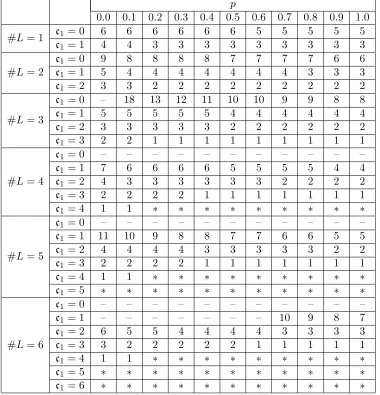
Definition 7 Let G= (N,w, q) be a weighted majority voting game and L be a subset of N. We say that Gis (L,c1,c)-stable if
c= max{c:mwL(S, c) = 0 for all subsets S⊆L with#S=c1}.
For an (L,c1,c)-stable game G, the following is ensured. Consider any partition ofL intoS and L\S
with #S=c1 and suppose that the coalition S does not collude with any player in L\S. Then to win
the Attack Game the coalition S must collude with at least c−#S players from N \L.
6
A Snapshot Analysis of Bitcoin
To compute the relevant parameters of the Rule Game and the Attack Game, it is required to identify the actual players and their weights. The players are the miners and the weight of a miner is its hash rate. The hash rate of a miner is not directly available and has to be estimated. As explained earlier, under the assumption that the number of blocks mined by a miner is proportional to the hash rate of the miner, one may use the number of blocks as the weight of the miner. In this section, we proceed under the assumption that the hash rate of a miner is a constant multiple of the number of blocks mined by a miner. So, the weights of the players are taken to be the numbers of blocks mined by these players over some interval of time.
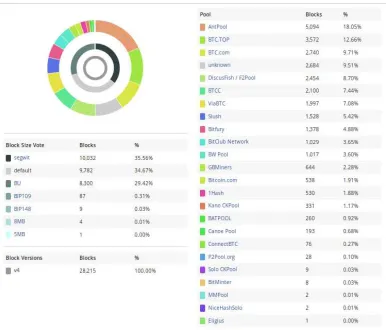
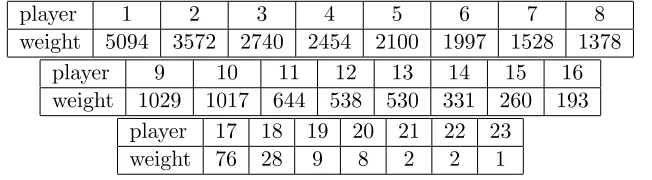
https://www.blocktrail.com/BTC. From this website, the number of mined blocks can be obtained in a specified previous interval of time. This interval can be the last 24 hours, the last week, the last month, the last six months and the last year. By fixing a particular date and an interval of time, it is possible to obtain a snapshot of the number of blocks generated in the given time interval prior to the given date. The ensuing analysis following from this data provides a snapshot analysis of the Rule and the Attack Games. To illustrate how such a snapshot analysis can be meaningfully carried out, we have done the analysis with data for the last six months from the date 7th November, 2017. This data is shown in Figure 1. Before proceeding with the actual analysis, we note the following point.
1. There is nothing special about the particular date that we have used and the analysis can be applied to data corresponding to any date; also, the analysis can be applied to data obtained for other time intervals.
2. We proceed under the assumption that the hash rate of a miner is proportional to the number of blocks mined by it based on which we have taken the weights of miners to be the numbers of blocks that they mined in a given time period. There is nothing really particular about using the number of blocks as estimates of the hash rates. Our analysis can be applied equally well if the hash rates are estimated using some other methods.
3. While we work with data for Bitcoin, similar analysis can also be applied to data obtained from other cryptocurrencies.
4. The snapshot analysis that we carry out can be performed on a cryptocurrency system at regu-lar time intervals. This will provide valuable insights into the nature of evolution of the socio-economics dynamics of the cryptocurrency system.
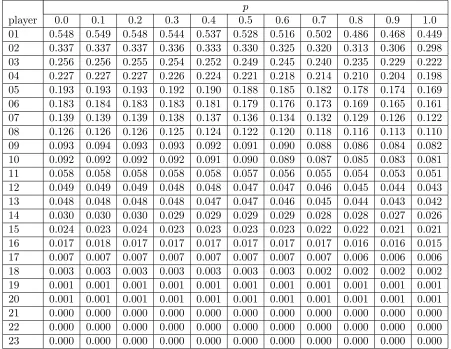
The data in Figure 1 attributes a rather high number of blocks to “Unknown”. This means that these many blocks were mined by miners whose identities are not known. It is most likely that it is not a single entity which mined these blocks. So, in the computation of the voting powers, it is not appropriate to consider “Unknown” as a player. LetU be the set of all miners in the group “Unknown”. It is reasonable to assume that the miners inU are those with limited computational resources, i.e., any one of them would have mined a small number of blocks. So, the weights of the miners inU are small, though the sum total of all these weights is quite significant. We handle the miners in “Unknown” in the following manner.
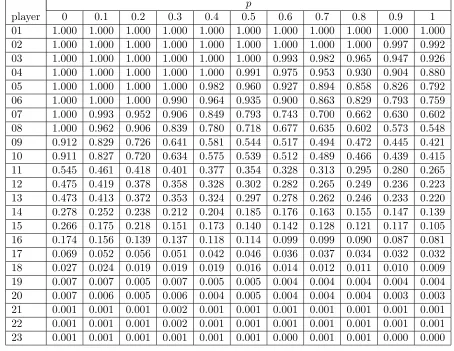
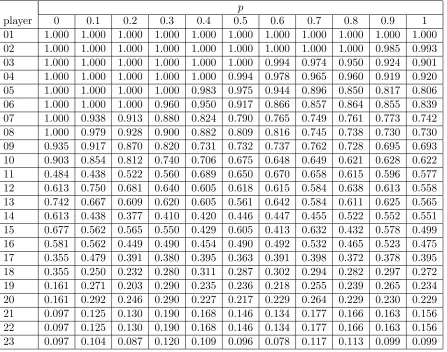
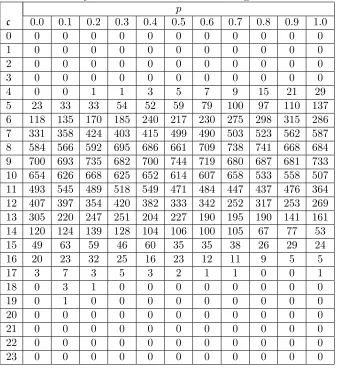
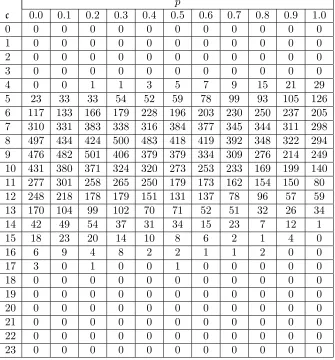
Suppose the total weight of the componentsw is ω out of which the the miners in U have a total weight of w. Suppose that a fraction p of the total weight of the miners in “Unknown” play to win the game while the other (1−p) fraction of the total weight of the miners in “Unknown” try to block the winning. By considering different values ofp in [0,1], it becomes possible to study the effect of the “Unknown” miners on the game. To capture this idea we make the following definition.
Definition 8 Given the game G = (N,w, q), a player U with weight w and p ∈ [0,1], we define the game G(p) with respect to U as G(p) = (N \ {U},w
U, q(p)) where q(p) = (q·ω−p·w)/(ω−w) and ω
is the sum of the weights of all the players in the original game G. Here wU denotes the weight vector obtained from wby leaving out the entry corresponding to U.
The miners in “Unknown” are not present in G(p) so the total weight of the miners in G(p) is ω−w.