Compositional Vector Space Models for Knowledge Base Completion
Arvind Neelakantan, Benjamin Roth, Andrew McCallum Department of Computer Science
University of Massachusetts, Amherst Amherst, MA, 01003
{arvind,beroth,mccallum}@cs.umass.edu
Abstract
Knowledge base (KB) completion adds new facts to a KB by making inferences from existing facts, for example by infer-ring with high likelihoodnationality(X,Y)
frombornIn(X,Y). Most previous methods
infer simple one-hop relational synonyms like this, or use as evidence a multi-hop re-lational path treated as an atomic feature,
likebornIn(X,Z)→containedIn(Z,Y). This
paper presents an approach that reasons about conjunctions of multi-hop relations
non-atomically, composing the implica-tions of a path using a recurrent neural network (RNN) that takes as inputs vec-tor embeddings of the binary relation in the path. Not only does this allow us to generalize to paths unseen at training time, but also, with a single high-capacity RNN, to predict new relation types not seen when the compositional model was trained (zero-shot learning). We assem-ble a new dataset of over 52M relational triples, and show that our method im-proves over a traditional classifier by 11%, and a method leveraging pre-trained em-beddings by 7%.
1 Introduction
Constructing large knowledge bases (KBs) sup-ports downstream reasoning about resolved enti-ties and their relations, rather than the noisy tex-tual evidence surrounding their natural language mentions. For this reason KBs have been of in-creasing interest in both industry and academia (Bollacker et al., 2008; Suchanek et al., 2007; Carlson et al., 2010). Such KBs typically con-tain many millions of facts, most of them (en-tity1,relation,entity2) “triples” (also known as bi-nary relations) such as (Barack Obama,
presi-dentOf, USA)and(Brad Pitt, marriedTo, Angelina
Jolie).
However, even the largest KBs are woefully in-complete (Min et al., 2013), missing many impor-tant facts, and therefore damaging their usefulness in downstream tasks. Ironically, these missing facts can frequently be inferred from other facts al-ready in the KB, thus representing a sort of incon-sistency that can be repaired by the application of an automated process. The addition of new triples by leveraging existing triples is typically known as
KB completion.
Early work on this problem focused on learn-ing symbolic rules. For example, Schoenmack-ers et al. (2010) learns Horn clauses predictive of new binary relations by exhausitively exploring re-lational paths of increasing length, and selecting those surpassing an accuracy threshold. (A “path” is a sequence of triples in which the second entity of each triple matches the first entity of the next triple.) Lao et al. (2011) introduced the Path Rank-ing Algorithm (PRA), which greatly improves ef-ficiency and robustness by replacing exhaustive search with random walks, and using unique paths as features in a per-target-relation binary classifier. A typical predictive feature learned by PRA is that
CountryOfHeadquarters(X, Y) is implied by
Is-BasedIn(X,A)andStateLocatedIn(A, B)and
Coun-tryLocatedIn(B, Y). Given IsBasedIn(Microsoft,
Seattle),StateLocatedIn(Seattle, Washington)and
CountryLocatedIn(Washington, USA), we can
in-fer the fact CountryOfHeadquarters(Microsoft, USA) using the predictive feature. In later work, Lao et al. (2012) greatly increase available raw material for paths by augmenting KB-schema rela-tions with relarela-tions defined by the text connecting mentions of entities in a large corpus (also known as OpenIE relations (Banko et al., 2007)).
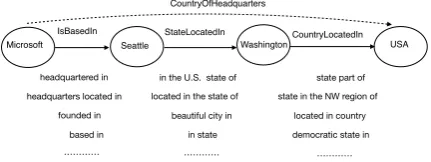
However, these symbolic methods can produce many millions of distinct paths, each of which is categorically distinct, treated by PRA as a
tinct feature. (See Figure 1.) Even putting aside the OpenIE relations, this limits the applicability of these methods to modern KBs that have thou-sands of relation types, since the number of dis-tinct paths increases rapidly with the number of re-lation types. If textually-defined OpenIE rere-lations are included, the problem is obviously far more severe.
Better generalization can be gained by operat-ing on embedded vector representations of rela-tions, in which vector similarity can be interpreted as semantic similarity. For example, Bordes et al. (2013) learn low-dimensional vector representa-tions of entities and KB relarepresenta-tions, such that vector differences between two entities should be close to the vectors associated with their relations. This approach can find relation synonyms, and thus per-form a kind of one-to-one, non-path-based relation prediction for KB completion. Similarly Nickel et al. (2011) and Socher et al. (2013a) perform KB completion by learning embeddings of rela-tions, but based on matrices or tensors. Universal schema (Riedel et al., 2013) learns to perform rela-tion predicrela-tion cast as matrix complerela-tion (likewise using vector embeddings), but predicts textually-defined OpenIE relations as well as KB relations, and embeds entity-pairs in addition to individual entities. Like all of the above, it also reasons about individual relations, not the evidence of a connected path of relations.
This paper proposes an approach combining the advantages of (a) reasoning about conjunctions of relations connected in a path, and (b) generaliza-tion through vector embeddings, and (c) reasoning non-atomically and compositionally about the el-ements of the path, for further generalization.
Our method uses recurrent neural networks (RNNs) (Werbos, 1990) to compose the semantics of relations in an arbitrary-length path. At each path-step it consumes both the vector embedding of the next relation, and the vector representing the path-so-far, then outputs a composed vector (rep-resenting the extended path-so-far), which will be the input to the next step. After consuming a path, the RNN should output a vector in the semantic neighborhood of the relation between the first and last entity of the path. For example, after con-suming the relation vectors along the pathMelinda
Gates → Bill Gates → Microsoft→ Seattle, our
method produces a vector very close to the
rela-tionlivesIn.
founded in headquartered in headquarters located in
based in
in the U.S. state of located in the state of beautiful city in
in state
state in the NW region of located in country
state part of
democratic state in
Microsoft Seattle Washington
IsBasedIn StateLocatedIn CountryLocatedIn CountryOfHeadquarters
USA
[image:2.595.309.525.63.144.2]………… ………… …………
Figure 1:Semantically similar paths connecting entity pair (Microsoft, USA).
Our compositional approach allow us at test time to make predictions from paths that were un-seen during training, because of the generaliza-tion provided by vector neighborhoods, and be-cause they are composed in non-atomic fashion. This allows our model to seamlessly perform in-ference on many millions of paths in the KB graph. In most of our experiments, we learn a separate RNN for predicting each relation type, but alterna-tively, by learning a single high-capacity composi-tion funccomposi-tion for all relacomposi-tion types, our method can perform zero-shot learning—predicting new rela-tion types for which the composirela-tion funcrela-tion was never explicitly trained.
Related to our work, new versions of PRA (Gardner et al., 2013; Gardner et al., 2014) use pre-trained vector representations of relations to alleviate its feature explosion problem—but the core mechanism continues to be a classifier based on atomic-path features. In the 2013 work many paths are collapsed by clustering paths accord-ing to their relations’ embeddaccord-ings, and substitut-ing cluster ids for the original relation types. In the 2014 work unseen paths are mapped to nearby paths seen at training time, where nearness is mea-sured using the embeddings. Neither is able to per-form zero-shot learning since there must be a clas-sifer for each predicted relation type. Furthermore their pre-trained vectors do not have the opportu-nity to be tuned to the KB completion task because the two sub-tasks are completely disentangled.
An additional contribution of our work is a new large-scale data set of over 52 million triples, and its preprocessing for purposes of path-based KB completion (can be downloaded fromhttp: //iesl.cs.umass.edu/downloads/
inferencerules/release.tar.gz). The
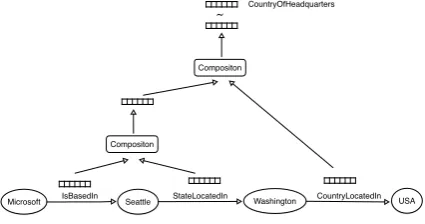
Microsoft IsBasedIn Seattle StateLocatedIn Washington CountryLocatedIn USA Compositon
Compositon
CountryOfHeadquarters
[image:3.595.75.288.65.177.2]~
Figure 2:Vector Representations of the paths are computed by applying the composition function recursively.
entity pairs, we use over 10k. All experimental comparisons below are performed on this new data set.
On this challenging large-scale dataset our com-positional method outperforms PRA (Lao et al., 2012), and Cluster PRA (Gardner et al., 2013) by 11% and 7% respectively. A further contribution of our work is a new, surprisingly strong baseline method using classifiers of path bigram features, which beats PRA and Cluster PRA, and statisti-cally ties our compositional method. Our analysis shows that our method has substantially different strengths than the new baseline, and the combi-nation of the two yields a 15% improvement over Gardner et al. (2013). We also show that our zero-shot model is indeed capable of predicting new un-seen relation types.
2 Background
We give background on PRA which we use to ob-tain a set of paths connecting the entity pairs and the RNN model which we employ to model the composition function.
2.1 Path Ranking Algorithm
Since it is impractical to exhaustively obtain the set of all paths connecting an entity pair in the large KB graph, we use PRA (Lao et al., 2011) to obtain a set of paths connecting the entity pairs. Given a training set of entity pairs for a relation, PRA heuristically finds a set of paths by perform-ing random walks from the source and target nodes keeping the most common paths. We use PRA to find millions of distinct paths per relation type. We do not use the random walk probabilities given by PRA since using it did not yield improvements in our experiments.
2.2 Recurrent Neural Networks
Recurrent neural network (RNN) (Werbos, 1990) is a neural network that constructs vector repre-sentation for sequences (of any length). For exam-ple, a RNN model can be used to construct vec-tor representations for phrases or sentences (of any length) in natural language by applying a compo-sition function (Mikolov et al., 2010; Sutskever et al., 2014; Vinyals et al., 2014). The vector representation of a phrase (w1, w2) consisting of wordsw1andw2is given byf(W[v(w1);v(w2)]) wherev(w) ∈ Rd is the vector representation of
w, f is an element-wise non linearity function,
[a;b] represents the concatenation two vectors a
andbalong with a bias term, andW ∈Rd×2∗d+1 is the composition matrix. This operation can be repeated to construct vector representations of longer phrases.
3 Recurrent Neural Networks for KB Completion
This paper proposes a RNN model for KB comple-tion that reasons on the paths connecting an entity pair to predict missing relation types. The vec-tor representations of the paths (of any length) in the KB graph are computed by applying the com-position function recursively as shown in Figure 2. To compute the vector representations for the higher nodes in the tree, the composition function consumes the vector representation of the node’s two children nodes and outputs a new vector of the same dimension. Predictions about missing rela-tion types are made by comparing the vector repre-sentation of the path with the vector reprerepre-sentation of the relation using the sigmoid function.
We represent each binary relation using a d -dimensional real valued vector. We model com-position using recurrent neural networks (Werbos, 1990). We learn a separate composition matrix for every relation that is predicted.
Letvr(δ) ∈ Rdbe the vector representation of
relationδ andvp(π) ∈Rdbe the vector
represen-tation of path π. vp(π) denotes the relation
vec-tor if pathπ is of length one. To predict relation
δ=CountryOfHeadquarters, the vector
represen-tation of the pathπ =IsBasedIn→ StateLocate-dIncontaining two relations IsBasedInand
State-LocatedInis computed by (Figure 2),
vp(π) =
where f = sigmoid is the element-wise non-linearity function, Wδ ∈ Rd∗2d+1 is the
compo-sition matrix forδ=CountryOfHeadquartersand
[a;b] represents the concatenation of two vectors
a∈ Rd, b ∈Rdalong with a bias feature to get a
new vector[a;b]∈R2d+1.
The vector representation of the path Π =
Is-BasedIn→ StateLocatedIn →CountryLocatedIn
in Figure 2 is computed similarly by,
vp(Π) =
f(Wδ[vp(π);vr(CountryLocatedIn)])
wherevp(π)is the vector representation of path
Is-BasedIn→StateLocatedIn. While computing the
vector representation of a path we always traverse left to right, composing the relation vector in the right with the accumulated path vector in the left1. This makes our model a recurrent neural network (Werbos, 1990).
Finally, we make a prediction regarding
Coun-tryOfHeadquarters(Microsoft, USA) using the
pathΠ =IsBasedIn →StateLocatedIn→
Coun-tryLocatedIn by comparing the vector
represen-tation of the path (vp(Π)) with the vector
repre-sentation of the relation CountryOfHeadquarters
(vr(CountryOfHeadquarters)) using the sigmoid
function.
3.1 Model Training
We train the model with the existing facts in a KB using them as positive examples and nega-tive examples are obtained by treating the unob-served instances as negative examples (Mintz et al., 2009; Lao et al., 2011; Riedel et al., 2013; Bor-des et al., 2013). Unlike in previous work that use RNNs(Socher et al., 2011; Iyyer et al., 2014; Irsoy and Cardie, 2014), a challenge with using them for our task is that among the set of paths connect-ing an entity pair, we do not observe which of the path(s) is predictive of a relation. We select the path that is closest to the relation type to be pre-dicted in the vector space. This not only allows for faster training (compared to marginalization) but also gives improved performance. This tech-nique has been successfully used in models other than RNNs previously (Weston et al., 2013; Nee-lakantan et al., 2014).
1we did not get significant improvements when we tried
more sophisticated ordering schemes for computing the path representations.
Algorithm 1Training Algorithm of RNN model for rela-tionδ
1: Input: Λδ = Λ+δ ∪Λ−δ,Φδ, number of itera-tionsT, mini-batch sizeB
2: Initializevr, Wδrandomly
3: fort= 1,2, . . . , T do
4: ∇vr= 0,∇Wδ= 0andb= 0 5: forλ= (γ, δ)∈Λδ do
6: µλ= arg maxπ∈Φδ(γ)vp(π).vr(δ)
7: Accumulate gradients to∇vr,∇Wδ 8: using pathµλ.
9: b=b+ 1
10: ifb=Bthen
11: Gradient Update forvr, Wδ 12: ∇vr= 0,∇Wδ= 0andb= 0
13: end if
14: end for
15: ifb >0then
16: Gradient Update forvr, Wδ 17: end if
18: end for
19: Output:vr, Wδ
We assume that we are given a KB (for exam-ple, Freebase enriched with SVO triples) contain-ing a set of entity pairsΓ, set of relations ∆and a set of observed factsΛ+ where ∀λ = (γ, δ) ∈
Λ+(γ ∈ Γ, δ ∈ ∆) indicates a positive fact that entity pairγ is in relationδ. LetΦδ(γ)denote the
set of paths connecting entity pairγgiven by PRA for predicting relationδ.
In our task, we only observe the set of paths connecting an entity pair but we do not observe which of the path(s) is predictive of the fact. We treat this as a latent variable (µλ for the fact λ)
and we assignµλ the path whose vector
represen-tation has maximum dot product with the vector representation of the relation to be predicted. For example,µλ for the factλ= (γ, δ)∈Λ+is given
by,
µλ = arg max π∈Φδ(γ)
vp(π).vr(δ)
During training, we assign µλ using the current
parameter estimates. We use the same procedure to assignµλ for unobserved facts that are used as
negative examples during training.
We train a separate RNN model for predicting each relation and the parameters of the model for predicting relationδ ∈ ∆areΘ = {vr(ω)∀ω ∈
posi-tive (Λ+δ) and negative (Λ−δ) instances2for relation
δ, the parameters are trained to maximize the log likelihood of the training set with L-2 regulariza-tion.
Θ∗= arg max
Θ
X
λ=(γ,δ)∈Λ+ δ
P(yλ = 1; Θ)+
X
λ=(γ,δ)∈Λ−
δ
P(yλ = 0; Θ)−ρkΘk2
whereyλ is a binary random variable which takes
the value1if the factλis true and0otherwise, and the probability of a factP(yλ= 1; Θ)is given by,
P(yλ = 1; Θ) =sigmoid(vp(µλ).vr(δ))
where µλ = arg max
π∈Φδ(γ)
vp(π).vr(δ)
and P(yλ = 0; Θ) = 1 −P(yλ = 1; Θ). The
relation vectors and the composition matrix are initialized randomly. We train the network us-ing backpropagation through structure (Goller and K¨uchler, 1996).
4 Zero-shot KB Completion
The KB completion task involves predicting facts on thousands of relations types and it is highly de-sirable that a method can infer facts about relation types without directly training for them. Given the vector representation of the relations, we show that our model described in the previous section is ca-pable of predicting relational facts without explic-itly training for the target (or test) relation types (zero-shot learning).
In zero-shot or zero-data learning (Larochelle et al., 2008; Palatucci et al., 2009), some labels or classes are not available during training the model and only a description of those classes are given at prediction time. We make two modifications to the model described in the previous section, (1) learn a general composition matrix, and (2) fix re-lation vectors with pre-trained vectors, so that we can predict relations that are unseen during train-ing. This ability of the model to generalize to un-seen relations is beyond the capabilities of all pre-vious methods for KB inference (Schoenmackers et al., 2010; Lao et al., 2011; Gardner et al., 2013; Gardner et al., 2014).
We learn a general composition matrix for all relations instead of learning a separate composi-tion matrix for every relacomposi-tion to be predicted. So,
2we sub-sample a portion of the set of all unobserved
in-stances.
for example, the vector representation of the path
π =IsBasedIn →StateLocatedIncontaining two
relations IsBasedIn and StateLocatedIn is com-puted by (Figure 2),
vp(π) =
f(W[vr(IsBasedIn);vr(StateLocatedIn)])
where W ∈ Rd∗2d+1 is the general composition matrix.
We initialize the vector representations of the binary relations (vr) using the representations
learned in Riedel et al. (2013) and do not update them during training. The relation vectors are not updated because at prediction time we would be predicting relation types which are never seen dur-ing traindur-ing and hence their vectors would never get updated. We learn only the general composi-tion matrix in this model. We train a single model for a set of relation types by replacing the sigmoid function with a softmax function while computing probabilities and the parameters of the composi-tion matrix are learned using the available train-ing data containtrain-ing instances of few relations. The other aspects of the model remain unchanged.
To predict facts whose relation types are unseen during training, we compute the vector represen-tation of the path using the general composition matrix and compute the probability of the fact us-ing the pre-trained relation vector. For example, using the vector representation of the pathΠ =
Is-BasedIn→ StateLocatedIn→ CountryLocatedIn
in Figure 2, we can predict any relation irrespec-tive of whether they are seen at training by com-paring it with the pre-trained relation vectors.
5 Experiments
The hyperparameters of all the models were tuned on the same held-out development data. All the neural network models are trained for 150 itera-tions using 50 dimensional relation vectors, and we set the L2-regularizer and learning rate to
0.0001and0.1respectively. We halved the learn-ing rate after every 60 iterations and use mini-batches of size 20. The neural networks and the classifiers were optimized using AdaGrad (Duchi et al., 2011).
5.1 Data
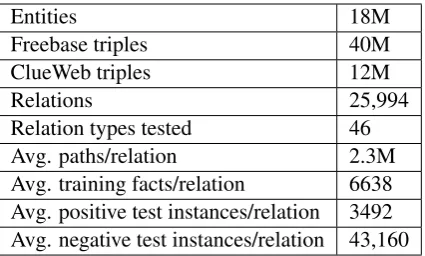
Entities 18M
Freebase triples 40M
ClueWeb triples 12M
Relations 25,994
Relation types tested 46
Avg. paths/relation 2.3M
[image:6.595.76.289.61.189.2]Avg. training facts/relation 6638 Avg. positive test instances/relation 3492 Avg. negative test instances/relation 43,160
Table 1: Statistics of our dataset.
We use the publicly available entity links to Free-base in the ClueWeb dataset (Orr et al., 2013). Hence, we create nodes only for Freebase enti-ties in our KB graph. We remove facts containing /type/object/type as they do not give useful pre-dictive information for our task. We get triples from ClueWeb by considering sentences that con-tain two entities linked to Freebase. We extract the phrase between the two entities and treat them as the relation types. For phrases that are of length greater than four we keep only the first and last two words. This helps us to avoid the time con-suming step of dependency parsing the sentence to get the relation type. These triples are similar to facts obtained by OpenIE (Banko et al., 2007). To reduce noise, we select relation types that occur at least50times. We evaluate on46relation types in Freebase that have the most number of instances. The methods are evaluated on a subset of facts in Freebase that were hidden during training. Table 1 shows important statistics of our dataset.
5.2 Predictive Paths
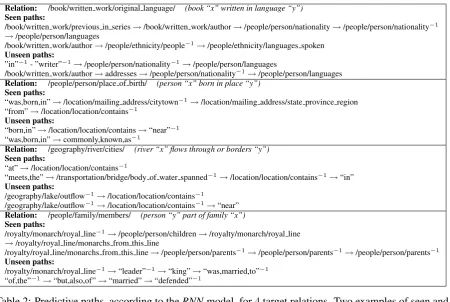
Table 2 shows predictive paths for 4 relations learned by the RNN model. The high quality of unseen paths is indicative of the fact that the RNN model is able to generalize to paths that are never seen during training.
5.3 Results
Using our dataset, we compare the performance of the following methods:
PRA Classifieris the method in Lao et al. (2012) which trains a logistic regression classifier by cre-ating a feature for every path type.
Cluster PRA Classifier is the method in Gard-ner et al. (2013) which replaces relation types from ClueWeb triples with their cluster membership in the KB graph before the path finding step.
Af-ter this step, their method proceeds in exactly the same manner as Lao et al. (2012) training a logis-tic regression classifier by creating a feature for every path type. We use pre-trained relation vec-tors from Riedel et al. (2013) and use k-means clustering to cluster the relation types to25 clus-ters as done in Gardner et al. (2013).
Composition-Adduses a simple element-wise ad-dition followed by sigmoid non-linearity as the composition function similar to Yang et al. (2014).
RNN-random is the supervised RNN model de-scribed in section 3 with the relation vectors ini-tialized randomly.
RNN is the supervised RNN model described in section 3 with the relation vectors initialized using the method in Riedel et al. (2013).
PRA Classifier-b is our simple extension to the method in Lao et al. (2012) which additionally uses bigrams in the path as features. We add a special start and stop symbol to the path before computing the bigram features.
Cluster PRA Classifier-bis our simple extension to the method in Gardner et al. (2013) which ad-ditionally uses bigram features computed as previ-ously described.
RNN + PRA Classifiercombines the predictions
ofRNNandPRA Classifier. We combine the
pre-dictions by assigning the score of a fact as the sum of their rank in the two models after sorting them in ascending order.
RNN + PRA Classifier-bcombines the predictions
ofRNN andPRA Classifier-busing the technique
described previously.
Table 3 shows the results of our experiments. The method described in Gardner et al. (2014) is not included in the table since the publicly avail-able implementation does not scale to our large dataset. First, we show that it is better to train the models using all the path types instead of using only the top1,000path types as done in previous work (Gardner et al., 2013; Gardner et al., 2014). We can see that the RNN model performs signif-icantly better than the baseline methods of Lao et al. (2012) and Gardner et al. (2013). The perfor-mance of the RNN model is not affected by initial-ization since using random vectors and pre-trained vectors results in similar performance.
Clus-Relation: /book/written work/original language/ (book “x” written in language “y”) Seen paths:
/book/written work/previous in series→/book/written work/author→/people/person/nationality→/people/person/nationality−1
→/people/person/languages
/book/written work/author→/people/ethnicity/people−1→/people/ethnicity/languages spoken Unseen paths:
”in”−1- ”writer”−1→/people/person/nationality−1→/people/person/languages
/book/written work/author→addresses→/people/person/nationality−1→/people/person/languages Relation: /people/person/place of birth/ (person “x” born in place “y”)
Seen paths:
“was,born,in”→/location/mailing address/citytown−1→/location/mailing address/state province region
“from”→/location/location/contains−1 Unseen paths:
“born,in”→/location/location/contains→“near”−1
“was,born,in”→commonly,known,as−1
Relation: /geography/river/cities/ (river “x” flows through or borders “y”) Seen paths:
“at”→/location/location/contains−1
“meets,the”→/transportation/bridge/body of water spanned−1→/location/location/contains−1→“in” Unseen paths:
/geography/lake/outflow−1→/location/location/contains−1
/geography/lake/outflow−1→/location/location/contains−1→“near” Relation: /people/family/members/ (person “y” part of family “x”) Seen paths:
/royalty/monarch/royal line−1→/people/person/children→/royalty/monarch/royal line
→/royalty/royal line/monarchs from this line
/royalty/royal line/monarchs from this line→/people/person/parents−1→/people/person/parents−1→/people/person/parents−1 Unseen paths:
/royalty/monarch/royal line−1→“leader”−1→“king”→“was,married,to”−1
“of,the”−1→“but,also,of”→“married”→“defended”−1
Table 2: Predictive paths, according to theRNNmodel, for4target relations. Two examples of seen and unseen paths are shown for each target relation. Inverse relations are marked by−1, i.e,r(x, y) =⇒
r−1(y, x),∀(x, y)∈r. Relations within quotes are OpenIE (textual) relation types.
train with
top 1000 paths train withall paths
Method MAP MAP
PRA Classifier 43.46 51.31
Cluster PRA Classifier 46.26 53.23
Composition-Add 40.23 45.37
RNN-random 45.52 56.91
RNN 46.61 56.95
PRA Classifier-b 48.09 58.13
Cluster PRA Classifier-b 48.72 58.02
RNN + PRA Classifier 49.92 58.42
[image:7.595.76.527.59.361.2]RNN + PRA Classifier-b 51.94 61.17
Table 3: Results comparing different methods on46types. All the methods perform better when trained using all the paths than training using the top 1,000 paths. When training with all the paths, RNN
performs significantly (p < 0.005) better thanPRA Classifier andCluster PRA Classifier. The small difference in performance betweenRNNand bothPRA Classifier-bandCluster PRA Classifier-bis not statistically significant. The best results are obtained by combining the predictions of RNN withPRA
Classifier-bwhich performs significantly (p <10−5) better than bothPRA Classifier-bandCluster PRA
Classifier-b.
ter PRA method. The small difference in perfor-mance between RNN and both PRA Classifier-b
and Cluster PRA Classifier-b is not statistically
significant. We conjecture that our method has
un-train with
top 1000 paths train withall paths
Method MAP MAP
RNN 43.82 50.10
zero-shot 19.28 20.61
[image:8.595.70.298.62.149.2]Random 7.59
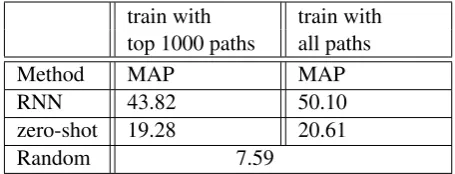
Table 4: Results comparing the zero-shot model with supervised RNN and a random baseline on
10 types. RNN is the fully supervised model de-scribed in section 3 while zero-shot is the model described in section 4. The zero-shot model with-out explicitly training for the target relation types achieves impressive results by performing signifi-cantly (p <0.05) better than a random baseline.
seen paths that are very different from the paths seen is training. Empirically, combining the pre-dictions ofRNN andPRA Classifier-bachieves a statistically significant gain overPRA Classifier-b.
5.3.1 Zero-shot
Table 4 shows the results of the zero-shot model described in section 4 compared with the fully su-pervised RNN model (section 3) and a baseline that produces a random ordering of the test facts. We evaluate on randomly selected10 (out of 46) relation types, hence for the fully supervised ver-sion we train10RNNs, one for each relation type. For evaluating the zero-shot model, we randomly split the relations into two sets of equal size and train a zero-shot model on one set and test on the other set. So, in this case we have two RNNs making predictions on relation types that they have never seen during training. As expected, the fully supervised RNN outperforms the zero-shot model by a large margin but the zero-shot model with-out using any direct supervision clearly performs much better than a random baseline.
5.3.2 Discussion
To investigate whether the performance of the RNNs were affected by multiple local optima is-sues, we combined the predictions of five different RNNs trained using all the paths. Apart fromRNN
and RNN-random, we trained three more RNNs
with different random initialization and the perfor-mance of the three RNNs individually are57.09,
57.11and56.91. The performance of the ensem-ble is 59.16 and their performance stopped im-proving after using three RNNs. So, this indicates that even though multiple local optima affects the
performance, it is likely not the only issue since the performance of the ensemble is still less than the performance ofRNN + PRA Classifier-b.
We suspect the RNN model does not capture some of the important local structure as well as the classifier using bigram features. To overcome this drawback, in future work, we plan to explore compositional models that have a longer memory (Hochreiter and Schmidhuber, 1997; Cho et al., 2014; Mikolov et al., 2014). We also plan to in-clude vector representations for the entities and develop models that address the issue of polysemy in verb phrases (Cheng et al., 2014).
6 Related Work
KB Completion includes methods such as Lin and Pantel (2001), Yates and Etzioni (2007) and Berant et al. (2011) that learn inference rules of length one. Schoenmackers et al. (2010) learn general inference rules by considering the set of all paths in the KB and selecting paths that sat-isfy a certain precision threshold. Their method does not scale well to modern KBs and also de-pends on carefully tuned thresholds. Lao et al. (2011) train a simple logistic regression classifier with NELL KB paths as features to perform KB completion while Gardner et al. (2013) and Gard-ner et al. (2014) extend it by using ptrained re-lation vectors to overcome feature sparsity. Re-cently, Yang et al. (2014) learn inference rules us-ing simple element-wise addition or multiplication as the composition function.
similar to RNNs with attention (Bahdanau et al., 2014; Graves, 2013) since we select a path among the set of paths connecting the entity pair to make the final prediction.
Zero-shot or zero-data learningwas introduced in Larochelle et al. (2008) for character recogni-tion and drug discovery. Palatucci et al. (2009) perform zero-shot learning for neural decoding while there has been plenty of work in this direc-tion for image recognidirec-tion (Socher et al., 2013b; Frome et al., 2013; Norouzi et al., 2014).
7 Conclusion
We develop a compositional vector space model for knowledge base completion using recurrent neural networks. In our challeng-ing large-scale dataset available at http: //iesl.cs.umass.edu/downloads/
inferencerules/release.tar.gz,
our method outperforms two baseline methods and performs competitively with a modified stronger baseline. The best results are obtained by combining the predictions of our model with the predictions of the modified baseline which achieves a 15% improvement over Gardner et al. (2013). We also show that our model has the ability to perform zero-shot inference.
Acknowledgments
We thank Matt Gardner for releasing the PRA code, and for answering numerous question about the code and data. We also thank the Stanford NLP group for releasing the neural networks code. This work was supported in part by the Center for Intelligent Information Retrieval, in part by DARPA under agreement number FA8750-13-2-0020, in part by an award from Google, and in part by NSF grant #CNS-0958392. The U.S. Gov-ernment is authorized to reproduce and distribute reprints for Governmental purposes notwithstand-ing any copyright notation thereon. Any opinions, findings and conclusions or recommendations ex-pressed in this material are those of the authors and do not necessarily reflect those of the sponsor.
References
Dzmitry Bahdanau, Kyunghyun Cho, and Yoshua Ben-gio. 2014. Neural machine translation by jointly learning to align and translate. InArXiv.
Michele Banko, Michael J Cafarella, Stephen Soder-land, Matt Broadhead, and Oren Etzioni. 2007. Open information extraction from the web. In Inter-national Joint Conference on Artificial Intelligence.
Marco Baroni and Roberto Zamparelli. 2010. Nouns are vectors, adjectives are matrices: Representing adjective-noun constructions in semantic space. In
Empirical Methods in Natural Language Process-ing.
Jonathan Berant, Ido Dagan, and Jacob Goldberger. 2011. Global learning of typed entailment rules. In
Association for Computational Linguistics.
Kurt Bollacker, Colin Evans, Praveen Paritosh, Tim Sturge, and Jamie Taylor. 2008. Freebase: a col-laboratively created graph database for structuring human knowledge. InProceedings of the ACM SIG-MOD International Conference on Management of Data.
Antoine Bordes, Nicolas Usunier, Alberto Garc´ıa-Dur´an, Jason Weston, and Oksana Yakhnenko. 2013. Translating embeddings for modeling multi-relational data. InAdvances in Neural Information Processing Systems.
Samuel R. Bowman, Christopher Potts, and Christo-pher D Manning. 2014. Recursive neural networks for learning logical semantics. InCoRR.
Andrew Carlson, Justin Betteridge, Bryan Kisiel, Burr Settles, Estevam R. Hruschka, and A. 2010. Toward an architecture for never-ending language learning. InIn AAAI.
Cheng, Jianpeng Kartsaklis, and Edward Grefenstette. 2014. Investigating the role of prior disambiguation in deep-learning compositional models of meaning. InIn Learning Semantics workshop NIPS.
Kyunghyun Cho, Bart van Merrienboer, Dzmitry Bah-danau, and Yoshua Bengio. 2014. On the properties of neural machine translation: Encoder–decoder ap-proaches. In Workshop on Syntax, Semantics and Structure in Statistical Translation.
John Duchi, Elad Hazan, and Yoram Singer. 2011. Adaptive subgradient methods for online learning and stochastic optimization. InJournal of Machine Learning Research.
Andrea Frome, Gregory S. Corrado, Jonathon Shlens, Samy Bengio, Jeffrey Dean, Marc’Aurelio Ranzato, and Tomas Mikolov. 2013. Devise: A deep visual-semantic embedding model. InNeural Information Processing Systems.
Matt Gardner, Partha Talukdar, Jayant Krishnamurthy, and Tom Mitchell. 2014. Incorporating vector space similarity in random walk inference over knowledge bases. InEmpirical Methods in Natural Language Processing.
Christoph Goller and Andreas K¨uchler. 1996. Learn-ing task-dependent distributed representations by backpropagation through structure. InIEEE Trans-actions on Neural Networks.
Alex Graves. 2013. Generating sequences with recur-rent neural networks. InArXiv.
Sepp Hochreiter and J¨urgen Schmidhuber. 1997. Long short-term memory. InNeural Computation.
Ozan Irsoy and Claire Cardie. 2014. Deep recursive neural networks for compositionality in language. InNeural Information Processing Systems.
Mohit Iyyer, Jordan Boyd-Graber, Leonardo Claudino, Richard Socher, and Hal Daum´e III. 2014. A neural network for factoid question answering over para-graphs. InEmpirical Methods in Natural Language Processing.
Ni Lao, Tom Mitchell, and William W. Cohen. 2011. Random walk inference and learning in a large scale knowledge base. InConference on Empirical Meth-ods in Natural Language Processing.
Ni Lao, Amarnag Subramanya, Fernando Pereira, and William W. Cohen. 2012. Reading the web with learned syntactic-semantic inference rules. InJoint Conference on Empirical Methods in Natural guage Processing and Computational Natural Lan-guage Learning.
Hugo Larochelle, Dumitru Erhan, and Yoshua Bengio. 2008. Zero-data learning of new tasks. InNational Conference on Artificial Intelligence.
Dekang Lin and Patrick Pantel. 2001. Dirt - discovery of inference rules from text. InInternational Con-ference on Knowledge Discovery and Data Mining. Tomas Mikolov, Martin Karafi´at, Lukas Burget, Jan
Cernock´y, and Sanjeev Khudanpur. 2010. Recur-rent neural network based language model. In An-nual Conference of the International Speech Com-munication Association.
Tomas Mikolov, Armand Joulin, Sumit Chopra, Micha¨el Mathieu, and Marc’Aurelio Ranzato. 2014. Learning longer memory in recurrent neural net-works. InCoRR.
Bonan Min, Ralph Grishman, Li Wan, Chang Wang, and David Gondek. 2013. Distant supervision for relation extraction with an incomplete knowledge base. InHLT-NAACL, pages 777–782.
Mike Mintz, Steven Bills, Rion Snow, and Dan Juraf-sky. 2009. Distant supervision for relation extrac-tion without labeled data. InAssociation for Com-putational Linguistics and International Joint Con-ference on Natural Language Processing.
Jeff Mitchell and Mirella Lapata. 2008. Vector-based models of semantic composition. InAssociation for Computational Linguistics.
Arvind Neelakantan, Jeevan Shankar, Alexandre Pas-sos, and Andrew McCallum. 2014. Efficient non-parametric estimation of multiple embeddings per word in vector space. InEmpirical Methods in Nat-ural Language Processing.
Maximilian Nickel, Volker Tresp, and Hans-Peter Kriegel. 2011. A three-way model for collective learning on multi-relational data. InInternational Conference on Machine Learning.
Mohammad Norouzi, Tomas Mikolov, Samy Bengio, Yoram Singer, Jonathon Shlens, Andrea Frome, Greg Corrado, and Jeffrey Dean. 2014. Zero-shot learning by convex combination of semantic em-beddings. InInternational Conference on Learning Representations.
Dave Orr, Amarnag Subramanya, Evgeniy
Gabrilovich, and Michael Ringgaard. 2013. 11 billion clues in 800 million documents: A web research corpus annotated with freebase concepts. http://googleresearch.blogspot.com/2013/07/11-billion-clues-in-800-million.html.
Mark Palatucci, Dean Pomerleau, Geoffrey Hinton, and Tom Mitchell. 2009. Zero-shot learning with semantic output codes. InNeural Information Pro-cessing Systems.
Sebastian Riedel, Limin Yao, Andrew McCallum, and Benjamin M. Marlin. 2013. Relation extraction with matrix factorization and universal schemas. In
HLT-NAACL.
Stefan Schoenmackers, Oren Etzioni, Daniel S. Weld, and Jesse Davis. 2010. Learning first-order horn clauses from web text. InEmpirical Methods in Nat-ural Language Processing.
Richard Socher, Cliff Chiung-Yu Lin, Christopher D. Manning, and Andrew Y. Ng. 2011. Parsing natu-ral scenes and natunatu-ral language with recursive neunatu-ral networks. InProceedings of the 26th International Conference on Machine Learning (ICML).
Richard Socher, Brody Huval, Christopher D. Man-ning, and Andrew Y. Ng. 2012. Semantic com-positionality through recursive matrix-vector spaces. InJoint Conference on Empirical Methods in ral Language Processing and Computational Natu-ral Language Learning.
Richard Socher, Danqi Chen, Christopher D Manning, and Andrew Ng. 2013a. Reasoning with neural ten-sor networks for knowledge base completion. In Ad-vances in Neural Information Processing Systems.
Richard Socher, Alex Perelygin, Jean Wu, Jason Chuang, Christopher D. Manning, Andrew Y. Ng, and Christopher Potts. 2013c. Recursive deep mod-els for semantic compositionality over a sentiment treebank. In Conference on Empirical Methods in Natural Language Processing.
Fabian M. Suchanek, Gjergji Kasneci, and Gerhard Weikum. 2007. Yago: A core of semantic knowl-edge. InProceedings of the 16th International Con-ference on World Wide Web.
Ilya Sutskever, Oriol Vinyals, and Quoc V. V Le. 2014. Sequence to sequence learning with neural networks. InAdvances in Neural Information Pro-cessing Systems.
Oriol Vinyals, Lukasz Kaiser, Terry Koo, Slav Petrov, Ilya Sutskever, and Geoffrey Hinton. 2014. Gram-mar as a foreign language. InCoRR.
Paul Werbos. 1990. Backpropagation through time: what it does and how to do it. InIEEE.
Jason Weston, Ron Weiss, and Hector Yee. 2013. Nonlinear latent factorization by embedding multi-ple user interests. InACM International Conference on Recommender Systems.
Bishan Yang, Wen-tau Yih, Xiaodong He, Jianfeng Gao, and Li Deng. 2014. Embedding entities and relations for learning and inference in knowledge bases. InCoRR.
Alexander Yates and Oren Etzioni. 2007. Unsuper-vised resolution of objects and relations on the web. In North American Chapter of the Association for Computational Linguistics.