Munich Personal RePEc Archive
Annex I and non-Annex I
countries’productive performance
revisited using a generalized directional
distance function under a metafrontier
framework: Is there any
convergence-divergence pattern for
technology gaps?
Kounetas, Kostas and Zervopoulos, Panagiotis
University of Patras, Department of Economics, Greece, Department
of Management, College of Business Administration, University of
Sharjah, Sharjah 27272, United Arab Emirates
15 July 2017
1
Annex I and non-Annex I countries’productive performance revisited using a
generalized directional distance function under a metafrontier framework: Is there any convergence-divergence pattern for technology gaps?
Konstantinos Kounetas a,* and Panagiotis D. Zervopoulos b
a
Department of Economics, University of Patras, Rio 26504, Patras, Greece
b
Department of Management, College of Business Administration, University of Sharjah, Sharjah 27272, United Arab Emirates
Abstract
Countries rapid economic growth, energy consumption and anthropogenic emissions (GHGs) in the atmosphere are creating serious environmental problem on both global and local scales -. This is while compiled evidence about the relationship between climate change/global warming and the amount of GHG released is present (IEA, 2010). In advance, it is generally accepted that countries production processes, should seriously, take into account environmental sustainability principles and targets. In recent years, there have been a series of studies using a directional distance function dealing with environmental efficiency with the aim of measuring the ability of decision making units (i.e regions, firms, industries, countries) to produce more with less impact on the environment. A scarcity of empirical studies appears concerning the estimation of directional distance function under a metafrontier framework. In this paper we employ a balanced panel of 103 countries from 1995-2011 to shed light on the idiosyncratic performance of countries participating in two distinct different groups (Annex I and non-Annex I) using a generalized directional distance function independent of the direction vector length -. The non-parametric metafrontier framework - used in this study, as a first stage of analysis, is exploited to account for the heterogeneity between countries participating in our sample. In the second stage, a convergence-divergence hypothesis has been examined for the technology gaps estimated for each period. Our findings reveal significant patterns between countries’ individual performance.
Key words: Metafrontier; Generalized Distance Function; Technology gaps; Annex-I
countries
*Corresponding Author Department of Economics University of Patras Rio Campus, 26504 Greece
2
1. Introduction
The Intergovernmental Panel on Climate Change (2007) has assessed that over the
last 50 years, global warming has been caused due to anthropogenic greenhouse gas
emissions (GHGs). The impact of GHGs on climate change has been the top agenda
and considered the leading issue for many governments, organizations, economists,
researchers and scholars since it threatens countries’ sustainable development (Tol,
2009; Weitzman, 2009). The significance of this problem is apparent from cases such
as the signing of the Kyoto Agreement in 1997 and subsequent efforts in Copenhagen
and Cancun (2010), Durban and Doha (2011), Warsaw (2013) and latest in Paris
(2015) to reach an international agreement aimed at reducing greenhouse gas
emissions. In the face of climate change repercussions, many countries have devoted a
large portion of their resources towards designing and implementing mitigation to
achieve a satisfactory level of sustainable development while others (headed by U.S)
criticizes insisting on a more voluntary orientation. Furthermore, it is true that Kyoto
climate policies put more attention and emphasis on the reduction of global emissions
to mitigate climate change (Yu-Ying et al., 2013).
The Kyoto protocol was negotiated in 1997 during the Third Conference of the
Parties to the United Nations framework Convention of Climate Change. During its
establishment put into discussion the reduction levels of GHGs, most notably CO2
from fossil fuel combustion, for Annex I and non-Annex I countries in an
international agreement framework (Den Elzen and Höhne, 2008). Moreover, in a
world where economies are linked by international trade and capital flows emissions
abatement of Annex I economies may have, possibly, effect on trade, carbon leakage,
3
(Den Elzen and De Moor, 2002). A further caveat, from the stance of economic
theory, considers large economic adjustment costs to Annex I coutries (Böhringer, C.,
Vogt, C. 2003) or consider possible policies (i.w preferential tarrifs reductions) for
their compesantion (Babiker et al. 2000). Furthermore, some studies report the fact
that recent Kyoto modifications, including U.S decision, boil down climate policies as
business as usual questioning its economic and enviromental impacts for the countries
participated in this commitment (Böhringer and Vogt, 2003; 2004).
The level of ambitions for reducing emissions by developed (Annex I) and
developing (non-AnnexI) countries under the Kyoto agreement was one of the most
important aspects in current climate negotiations. Although there have been many
attempts for the non-AnnexI group to ratify the agreement, several political,
institutional and economic barriers appeared to hinder them (Calbick and Gunton,
2014)1. Thus, the clear distinction for countries participating as AnnexI and
non-AnnexI gathers significant opportunity for engineers, economists, scholars and
politicians to examine the negative impact of human activity, in terms of pollution
equivalents, even at a country level through this perspective. This growing interest in
incorporating undesirable outputs in the production function under the different
technological regimes yields, on the one hand, numerous published articles (see
Zhang and Choi, 2014) while, on the other hand, introduces several methods for
asymmetrically handling the two types of outputs (i.e Tone, 2001; Cheng and
Zervopoulos, 2014).
A common characteristic of these studies is that operates under the assumption
of technological isolation (Tsekouras et al., 2016) examining a rather homogeneous
1
4
group (Feroz et al., 2009; Halkos and Tzeremes, 2014). It may also adopt a
metafrontier production function in a “mechanistic” way creating groups according to
specific criteria ignoring their technological status (Kounetas, 2015). The introduction
of the metafrontier production function (Battese et al., 2004) allows technological
heterogeneity to be incorporated in productive efficiency analysis and therefore
relaxing restrictive technological isolation conditions. In the framework of
technological heterogeneity, any positive influence of technological spillovers from
domestic mitigation strategies onto productive performance may be eliminated, if the
production units are locked-in, or if they exhibit path-dependence of the evolution of
their productive performance (Tsekouras et al., 2016).
In this paper we extent a generalized efficiency measure of a directional distance
function (Cheng and Zervopoulos, 2014) in a methodological framework which
allows the co-examination of (i) efficiency differences in terms of productive
performance for countries operating under two distinct technological regimes, (ii) any
inter-linkages and flows between the two heterogeneous technologies and more
specifically spillover effects on non-Annex I countries (iii) the convergence
hypothesis for technology gaps for the examined set of countries. This analytical
framework is applied to 103 countries over the 1995-2011 period revealing interesting
patterns of productive performance which have not been traced by previous seminal
papers on environmental efficiency.
This study unfolds as follows. Section 2 reviews the literature on directional distance
functions in conjunction with the metafrontier analysis. Section 3 presents the
methodology. Section 4 discusses the selection of input and output variables. Section
5
2. Review of the literature
In efficiency and productivity analysis, directional distance functions (hereafter DDF)
have also become popular since most production processes generate undesirable
output(s) as byproduct(s) (i.e. CO2 emissions for firms or mortality rate for health
systems). The main reason for this increased popularity is the ability of DDF to
expand good outputs while reducing bad since the production process of every entity
has not only an economic but also an environmental and social output (Färe and
Grosskopf, 2000; Färe et al., 2005; Zhang et al., 2013). In this context, many
empirical studies have used DDF to investigate the performance of individual DMUs.
Extant studies apply DDF to measure energy efficiency (Zhang et al., 2013; Zhou et
al., 2012), environmental efficiency (Kounetas, 2015; Kumar and Khanna, 2009;
Caramero et al., 2008), sustainability performance (Zhang et al., 2013) and
eco-efficiency (Oggioni et al., 2011; Picazo-Tadeo et al., 2012; Zhang et al., 2008; Färe et
al. 2007; Kuosmanen and Kortelainenn, 2005)2.
Focusing now on the methodological approaches that have been used to
estimate the abovementioned indexes, the literature classifies three groups according
to their framework. The first group contains transformations of conventional DEA
models including hyperbolic distance functions (Färe et al., 1989) radial measures
(Chambers et al., 1996) and non-radial measures. Τhe second one concerns
modifications on the slack-based measures (Tone, 2001) while the third group
contains several modifications on the directional distance function (Chung et al.,
1997).
Many studies have been recorded incorporating DDFs in order to mostly
measure energy and environmental performance of different DMUs. As mentioned
2
6
above, radial nature of DDF stimulates researchers to develop non-radial measures.
For instance, Färe and Grosskopf (2010) and Zhou et al. (2012) extended it in a
non-radial model and Mahlberg and Sahoo (2011) proposed a non-non-radial Luenberger
indicator. Extending the DDF, Zhang et al. (2013), Choi et al. (2012) and Zhou et al.
(2006) developed several slack-based measures for environmental performance while
Fukuyama and Weber (2009) proposed a slacks-based efficiency measure of
efficiency combining the ideas of DDF and SBM. In addition, Zaim and Taskin
(2000) and Cuesta et al. (2009) developed a hyperbolic efficiency measure while
Fukuyama et al. (2011) and Barros et al. (2012) with DDFs proposed slacks-based
measures and weighted Russell DDF. Sueyoshi et al. (2010) presented a
Range-Adjusted measure model for US coal-fired power plants. Finally, Chang and Hu
(2010), Färe and Grosskopf (2010) and Cheng and Zervopoulos (2014) put forth a
generalized non-radial DDF while Zhang et al. (2014) presented a sequential
generalized directional distance function.
On the other hand, very few studies have taken the potential technology
heterogeneity into consideration. First, Oh (2010) using a Malmquist-Luenberg
productivity index incorporated group heterogeneity while Kounetas (2015), Chiu et
al. (2012) and Yu-Ying Lin et al. (2013) measured, not only technology gaps, but also
environmental efficiency technology gaps exploiting the scarcity of similar studies
under the presence of heterogeneity.
3. Methodology
Our methodological framework is developed in two interconnected stages. In the
first stage, we present the theoretical and methodological underpinnings regarding the
estimation of the generalized directional distance function and we discuss the
7
inclusion. In the second stage, we present the theory concerning the convergence
hypothesis using a stochastic kernel approach.
3.1 Definitions, notation and technological gaps
The inputs
1
( ,..., ) m m
x x x are used to produce desirable outputs
1
( ,..., ) s s
y y y and undesirable outputs ( ,...,1 ) p p
b b b (i.e. CO2 emissions).
In this context, the technology is described as follows:
T x( ) {( , ) : can produce ( , )} y b x y b (1)
where m s p
T , which represents the input - desirable output - undesirable
output bundles that are technologically achievable.
The desirable outputs (y) are jointly produced with the undesirable outputs
(b), modelled as follows:
if ( , )y b T x( ) and b0 then y0 (2)
The assumptions that the technology satisfies are: (a) closedness, (b) free
disposability of inputs and desirable outputs:
( , )x y T, if 'x x and 'y y then ( ', ')x y T
, (c) weak disposability of
undesirable outputs: ( , )x b T ( ,x
b) T
1, (d) no free lunch:if ( , , )x y b T and x0 then y0 and b0, (e) doing nothing is feasible:
(0,0,0)T , and (f) convexity (Färe et al., 1994).
The technology is described by the following directional distance function
(DDF):
D x y b g g gT( , , ; x, y, b)sup{ : ( xg yx, g by, gb)T x y b( , , )} (3)
where β denotes inefficiency and the non-zero g(g g gx, y, b) expresses the direction
vector of the inputs, desirable outputs, and undesirable outputs, respectively. The
expression (3) reflects simultaneous reduction in inputs, expansion of desirable
outputs and contraction of undesirable outputs. Drawing on expression (3), the
efficiency is defined as follows: 1 1
8
In this study, a generalized directional distance function (GDDF) is applied to
measure environmental efficiency put forth by Cheng and Zervopoulos (2014).
According to this generalized DDF, which is also based on expression (3) and
satisfies the assumptions of the technology set, the efficiency is measured by the ratio:
1
1 1
1
1 /
1
1 / /
m
i io
i
s p
r ro t to
r t
g x m
g y g b
s p
where gi/xio expresses the proportion ofthe reduction in inputs, and gr /yro and gt /bto indicate the proportion of the expansion and contraction of desirable and undesirable outputs, respectively. The
efficiency measures obtained from this generalized DDF are units invariant,
monotone, translation invariant provided that the Variable Returns to Scale (VRS) technology applies, and reference set invariant (Tone, 2001; Färe and Grosskopf, 2010). Unlike the conventional DDF, the generalized DDF that is used in this study
yields efficiency scores independent of the length of the direction vector (g).
Moreover, like the conventional DDF, this generalized DDF produces efficiency
scores that are consistent with those obtained from radial models.
In the case where multiple technologies (e.g. k distinct technologies, where
1,...,
k K) are present, the input – desirable output – undesirable output sets are
grouped into k technologically feasible sets (i.e. 1 2
, ,..., K
T T T ). The collection of all
input-output feasible combinations of the operational units (e.g. countries) construct
the smallest convex set that is known as metatechnology set, denoted by meta
T
(Battese and Rao, 2002; Battese et al., 2004; O’Donnell et al., 2008). The metatechnology set is modelled as follows:
meta( ) {( , ) : can produce ( , )}
T x y b x y b (4)
and the group-specific technology set is described as follows:
k( ) {( , ) : used by operational units in group can produce ( , )}
T x y b x k y b (5)
Hence, meta( ) { ( )1 2( ) ... K} T x T x T x T .
By introducing the generalized DDF (Cheng and Zervopoulos, 2014) into the
metatechnology framework, we measure the metaefficiency and group-specific
9
1 1 1 1 1 / ( , , ; , , ) 11 / /
meta
m meta k
i io
i
k k k
x y b
T s p
meta k meta k
r ro t to
r t
g x m
D x y b g g g
g y g b
s p
1 1. . 1,...,
K n
k k k meta
j ij io x
k j
s t x x g i m
1 1 1,..., K nk k k meta
j rj ro y
k j
y y g r s
1 1 1,..., K nk k k meta
j tj to b
k j
b b g b l
1 1 1 K n k j k j
k 0 j (6)
1 1 1 1 1 / ( , , ; , , ) 11 / /
k
m k k
i io
i
k k k
x y b
T s p
k k k k
r ro t to
r t
g x m
D x y b g g g
g y g b
s p
1. . 1,...,
n
k k k k
j ij io x
j
s t v x x g i m
1 1,..., nk k k k
j rj ro y
j
v y y g r s
1 1,..., nk k k k
j tj to b
j
v b b g b l
1 1 n k j j v
k 0, 1,...,
j
v k K (7)
where kj and k j
v represent the optimal weights assigned to inputs and outputs. In our
10
Using programs (6) and (7), we can calculate the technology gap ratio (Battese
et al., 2004) or the reciprocal relationship of the metatechnology ratio (MTR) (O’Donnell et al., 2008).
1 1 1 1 1 1 1 1 / 11 / /
MTE( , , )
0 MTR( , , ) 1
1
TE( , , ) 1 /
1
1 / /
m meta k
i io
i
s meta k p meta k
r ro t to
r t
m k k
i io
i
s k k p k k
r ro t to
r t
g x m
g y g b
x y b s p
x y b
x y b
g x m
g y g b
s p
(8)where MTE expresses the technical efficiency of an operational unit with respect to
the metatechnology, and TE represents the technical efficiency of an operational unit
with respect to the k group frontier.
The metafrontier framework provides benchmarking for all operational units
independently from the group-specific frontier that each unit belongs. As a result,
drawing on the technology heterogeneity concept, we can attribute differences,
captured by technology gaps, due to: (a) the structure of national markets, (b) national
regulations and policies, (c) cultural profiles and legal and institutional frameworks
(Halkos and Tzeremes, 2011), (d) available resource endowments, (e) economic
infrastructure, (f) characteristics of the physical, social and economic environment in which production takes place (O’Donnell et al., 2008; Kounetas et al., 2009), and (g) knowledge characteristics and strategic orientation (Kontolaimou and Tsekouras,
2010). In this context, a value of the MTR closer to unity indicates smaller technology
heterogeneity while a value closer to zero denotes greater technology heterogeneity.
In addition to the identification of technology heterogeneity, the
metatechnology framework facilitates the measurement of technology gaps (TG).
Chiu et al. (2012) defined the TG inefficiency as the distance between the individual
frontier and the metafrontier. The TG is obtained as follows:
TG( , , ) TE (1 MTR( , , ))x y b x y b (9)
We present a graphical analysis (please see Fig.1) of the world metafrontier and
the two individual frontiers for the output-oriented framework. At a given input and
output level, say x and y the observed country A under the non-Annex I technology
11
frontier) between points A and B, the metatechnical inefficiency between points A
and C (MGDDF relative to the metafrontier) and the technology gap difference
denoting as TG.
3.2 The Technology Gaps’Stochastic Convergence Hypothesis
Thus we can consider technology gap (TG)3 as a continuous-time stochastic
process
X t( ), t0
and assume that the each stochastic process is acontinuous-time Markov chain with distribution function t. Each satisfies the Markovian
property Prob(Xt A Xj, jt X; x)Prob ( , ) x A , with A E where is
the space state of , i called “stochastic kernel” and under certain conditions
(Quah, 1997) satisfies the following equation t ( , ) dt
E
x A x
that leads to( ) ( ) ( )d
t t
E
f y
f y x f x x with f xt( ) and f y x( ), which are respectively the densityfunction of t and Prob, if they exist.
The empirical estimate of the marginal probability density function (pdf) of x is
given by: 2 2 1 1 2 2 1
1 1 1
ˆ( ) ˆ( , )d d
2 2 j j y x y y x x n h h
j x y
f x f x y y e e y
n h
h
2 1 2 1 1 1 2 j x x x n h j x en h
(10)where the joint distribution ( , )f x y is obtained using a product of Gaussian kernel K
(Fotopoulos, 2006): 2 2 1 1 2 2 1
1 1 1
ˆ( , )
2 2 j j y x y y x x n h h
j x y
f x y e e
n h
h
312
1
1 1 1
n
j j
j x x y y
x x y y
K K
n h h h h
(11)where hx and hy are bandwidths calculated with the direct plug method applied
separately in each dimension. In this way, a nonparametric estimation of the
stochastic kernel4 is given by:
ˆ( ) ˆ( , )ˆ ( ) f y x f y x
f x
(12)
The stochastic kernel may be interpreted as a transition matrix with a continuum
of rows and columns. Let a time interval of length ; the relationship among two
distributions over can be written as:
ft ( )y f y x f x x( ) ( )dt
(13)Following the approach developed by Johnson (2000 and 2005) and Fotopoulos
(2006), the long-run ergodic distribution is found as the solution to:
f ( )y f y x f( ) ( )dx x
(14)One possible way to face this problem is through a discretization of the time
interval [ , ] b by partitioning it in n non-overlapping subintervals, then is possible to
estimate ( | ) with midpoints of these subintervals. If ( | )
( ) are defined and is sufficiently large (which leads to ∑ ( | ) )
then the matrix { } has the same structure as a transition probabilities
matrix and { } may be seen as the conditional probability mass function. The
ergodic density can be evaluated as ( ) , where is the rescaled (unit
4
13
sum) left eigenvector corresponding to the unity eigenvalue (also the largest one) of
the matrix .
4. Data Sources and Variable Definitions
To investigate the issues surrounding our main research question we have devised a
unique dataset by employing and matching distinct, but complementary, information
sources. The resulting dataset is a balanced panel consisting of 103 countries for the
1995-2011 period and our final panel dimension comprises of 1751 observations. We
should note that our sample is affected by the events of the global financial crisis that
manifested from August 2007 onwards but also covers the period before and after
Kyoto’s implementation. It is worth adding that the sample period was chosen purely
on the basis of availability of key variables, some of which become unavailable after
1995.
For the estimation of productive efficiency with respect to each country
frontier and the specific metafrontier as well, we employ a multi-input –
single-desirable output- single-unsingle-desirable output data set. More specifically, we
approximate the output variable (Y) by the Gross Value Added of each industry as the
desirable output and CO2 emissions in metric tonnes (Mt) as the undesirable one. For
the input side, we include the capital stock (K) in million Dollars, the labor input (L)
which is captured by the total hours worked by employees, expenditure on
intermediate inputs (M) in million Dollars and the total energy consumption (E)
measured in million tons (Mt) of oil equivalent. Table 1 provides the definition,
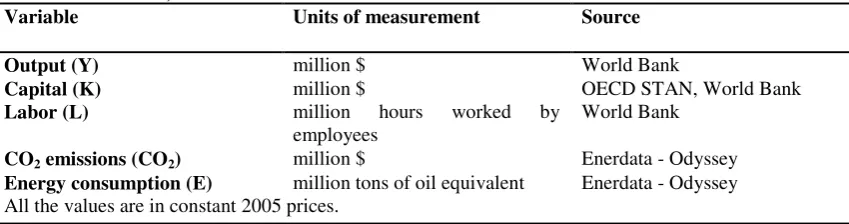
measurement and basic descriptive statistics for each variable.
As already mentioned, the data were drawn by combining several distinct sources
14
intermediate inputs were obtained from the World Bank database (World Bank
Developing Indicators), Enerdata-Odyssey database was used to collect data on
energy consumption and CO2. Finally, data on capital were acquired through OECD
Structural Analysis and World Bank databases respectively. The deflators used to
convert the current into constant 2005 prices are specific to each country. At this
point, we should mention that the distinction in two specific frontiers (AnnexI and
non-AnnexI) has been held following the distinction of Kyoto’s protocol.
5. Empirical Results and Discussion
The presentation and discussion of the empirical results follows the two stage
structure of the methodology section.The country specific efficiency scores with
respect to the two groups are firstly presented and discussed.Subsequently, the
metatechnology efficiency scores, the associated metatechnology ratios and
technology gaps which arises in the context of the metafrontier have been used for the
examination of our hypothesis. At the end, the results from the estimation of the
stochastic kernel for the technology gaps has been presented.
5.1 Efficiency,Metatechnology ratios and Technology Gap Estimates
Productive efficiency scores with respect to the specific technology and the
metatechnology, the associated metatechnology ratios and technological gaps are
estimated for the 103 countries in each of the 17 years. GAMS is used to solve the
linear problem of the generalized distance function expanding its use in also the
metatechnology (Cheng and Zervopoulos, 2014). At this point, it is crucial to note that
both the productive efficiency and technology gap estimations are grounded on a
15
individual production set. Therefore, the values of the estimated productive efficiency
and technology gap for each country encompass two dynamic factors. First is the
change of the distance from the (meta-) frontier, while the second is the movement
outwards (technical change) or inwards (technical regress) of the metafrontier itself.
Using this logic, the estimated time-series for efficiency and technology gaps reflect
the diachronic evolution of productive performance of the examined country,
considering any technological developments either in the industry-specific frontier or
in the metatechnology.
Mean values of productive efficiency for each frontier, the metafrontier and
the associated technology gaps are calculated in Table 3. The sample average of
metatechnical efficiency is 0.827. This implies that countries operate at the average
values of outputs and inputs have the potential to increase their GDP and
simultaneously, decrease their CO2 emissions by about 17.3%. Furthermore, it is
quite interesting to mention the slightly difference between AnnexI and non-AnnexI
countries regarding their efficiency performance (0.886 against 0.847) with respect to
their frontier but also the significant difference for their performance with respect to
their metafrontier (0.878 against 0.799). The same holds for technology gaps with the
corresponding values to be 0.029 for the AnnexI and 0.167 for the non-AnnexI.
Furthermore, a Kruskal-Wallis test has been applied to examine the technology
frontier differences between the AnnexI, non-AnnexI countries. The result shows that
the value of this test is 203.17 and thus, the two groups have distinct technology
frontiers with respect to their meta-efficiency productive performance.
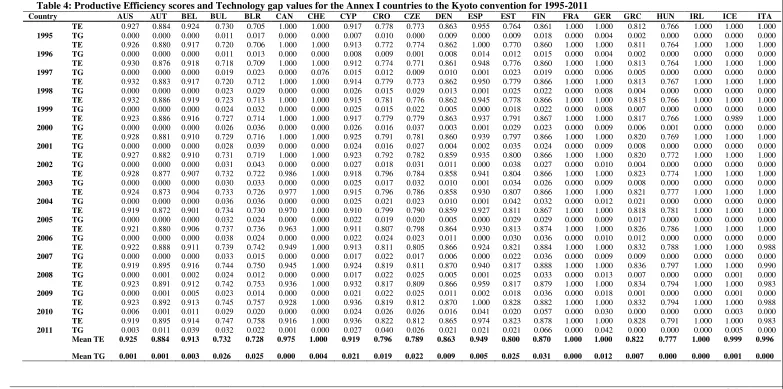
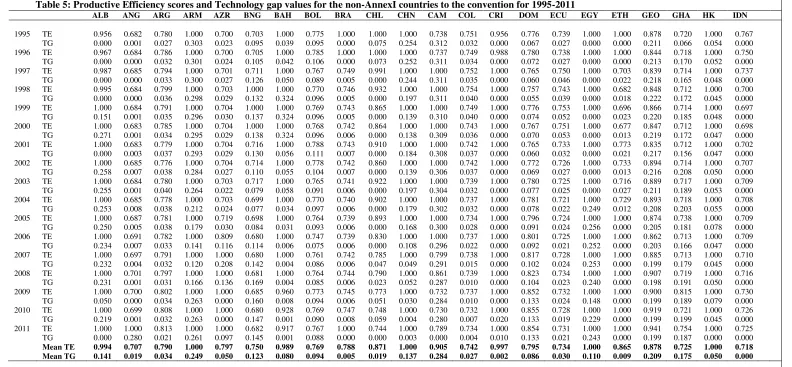
Tables 4 and 5 display the estimated values of (i) the productive efficiency
with respect to the specific technology and (ii) the technology gap with respect to the
16
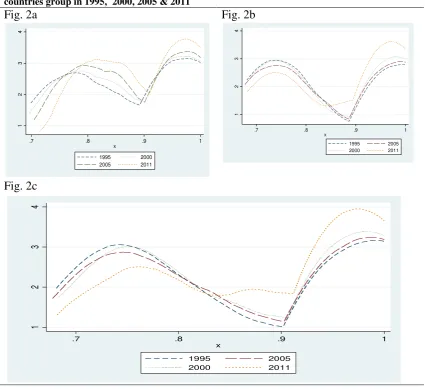
productive efficiency are also given in Fig.2 which shows kernel density estimates for
the first period of the sample (1995), two middle periods (2000 and 2005), and the last
(2011). Furthermore, the time evolution of metatechnology ratios for the two groups
and the total sample are depicted in Fig.3.
We begin by looking at the estimated productive efficiency and technology
gap values for Annex-I countries. From our results it is clear that countries like
Germany, France, the Czech Republic, Ireland, Latvia, the Netherlands, New Zealand,
Slovenia, Sweden Turkey, UK and USA exhibit the highest scores for productive
efficiency constructing the Champions group, while Bulgaria, Belarus, Croatia and
Hungary perform the worst (the laggards group). Furthermore, examining the
efficiency scores with respect to the metatechnology, Canada, France, Ireland, Italy,
Japan, Malta, Norway, Turkey, UK and USA present the smallest technology gaps
and constitute, diachronically, the metafrontier. In contrast, a group of countries like
Lithuania, Latvia, Poland, Portugal, Romania, Slovakia, and Ukraine perform worst
among the remaining ones suggesting that significant knowledge spillover effects are
not in operation within country-specific technologies. Latvia and New Zealand
interestingly, though a champion under the AnnexI frontier, also maintain a large
technology gap, suggesting some strong allocative inefficiencies.
Shifting attention towards to the non-AnnexI technological frontier given in
Table 5, the sample average productive efficiency scores reveal that Armenia, China,
Hong-Kong, Egypt, Mexico, Singapore and South Korea perform identically on
average. However, it is quite interesting that only 4 of 66 (6.02%) of them
diachronically define the metafrontier. Indonesia, Iran, Philippines and Singapore
define the metafrontier more often than any other counterpart whilst Armenia,
17
accompanied from the significant low TGs scores for the specific group support the
idea of significant knowledge incoming spillover barriers from the metatechnology
(Tsekouras et al. 2016). Possible explanations arises from the specific nature of the
agreement for non-Annex I countries (Böhringer and Vogt, 2003; 2004), the role of
appropriability conditions (Castellaci, 2007), the degree of openness to foreign
competition, mainly via globalization, the assymetric effect of technological
opportunities and the size of the market (Los and Verspagen, 2006).
The time evolution of the productive efficiency scores, using the
corresponding kernel densities, for the total sample, depicted in Fig.2c, reflect a
process of continuous and quite significant divergence only for the 2011 period. This
is reflected in the increased deviation of the distribution. The specific result provides
valuable information for the impact of the Kyoto protocol on environmental
performance since 2011 is only one year from its expiration. On the other hand, it is
quite interesting the small but noticeable deterioration in 2005 year during the Kyoto
transition period. The corresponding time evolution of the AnnexI (Fig.2a) reveals
that, although the overall picture is quite similar to the one sketched for the total
sample, a significant increase of the productive efficiency scores were especially
significant during the period. Fig.2b offers the time evolution of the productive
efficiency scores of the non-Annex I group. Notwithstanding this, the distribution
remains almost steady with no apparent divergence or convergence processes in
operation.
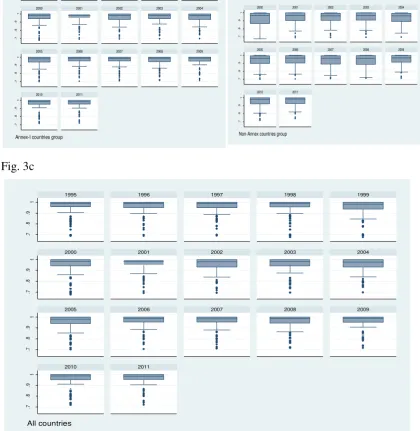
Finally, the box-plots of diachronic performance of metatechnology ratios
provide more insight into the distribution among AnnexI, non-AnnexI and the total
sample. In Fig.3c a box plot graph of the estimated metatechnology ratios of the total
18
are diachronically constant with no significant fluctuations. It is clear that Annex-I
countries yield the best average and variance of metatechnology ratios compared with
non-Annex-I and the total sample with a distribution skewed to the right (see Fig.3a).
Moreover, the metatechnology ratios slightly decrease in the 2002-2005 period but
exhibit a drastic increase over the 2005-2011. In contrast, Fig.3b mirrors a rather
different, compared to the AnnexI case, pattern of the non-AnnexI metatechnology
ratios performance. More specifically, it seems that between 1995 and 2001
technology gaps remain quite distant while for the 2002-2008 period a significant
decrease has occurred. On the contrary, in the time window from 2009 to 2011, a
considerable increase emerged. In the same direction, but more impressive, is the
picture of the total sample metatechnology ratios distribution presented in Fig.3c.
5.2 Stochastic Kernel of Annex I and non-Annex I Technology Gaps
The non parametric methodology of stochastic kernel adopted in this study,
refers to the “convergence literature”, typified by the seminal papers by Barro and
Sala-i-Martin (1991) and Mankiw et al. (1992) exploring beta-convergence.However,
according to Quah (1993) stochastic Kernels describes the law of motion of a
sequence of distribution and it serves to retrieve the evolution of the probability
distribution of a random variable (usually GDP) along time allowing it to overcome
the limitations of conventional convergence analysis focus on the dynamic properties
of the series.Stochastic Kernel (Quah, 1996, 1997) resulted in the literature from the
necessity to substitute discrete transition matrices. In this way, stochastic kernels can
be achieved by estimating the density function of a distribution over a given period,
19
We examine the convergence-divergence hypothesis for technology gaps. The
stochastic kernel in Fig.4 shows how countries’ technological gaps in 1995 evolves
into 2011.Thus, over the 17 years, a three peaks property appears. Each specific peak
reflects a comparatively substantial number of observed transitions from a part of the
distribution to another while having a constant point x-axis. We can understand the
estimated distribution of technology gapsin 2011 at its initial level in 1995. A large
portion of the probability mass is concentrated along the 45o diagonal while the
existence of three peaks along the diagonal indicates the presence of individual
convergence clubs for all the 103 countries. More specifically, there are two local
maxima in both low and high technological gaps parts and a third in the middle part of
relative ones.
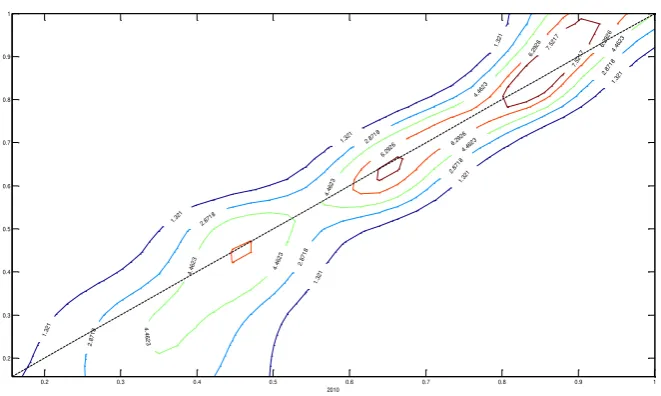
Considering the corresponding contour plot in Fig.5, we notice that during the
examined period, countries have a low probability of changing their relative position
in one year in terms of technological gaps suggesting that the mobility is low. The
three peaks phenomenon for technological gaps directly links productivity
differentials and technology structure. This could be further explained in terms of
factor accumulation deformations, factor prices change that acts as an inducement for
the introduction of new technologies (Binswanger et al., 1978) and localized
technological change (Antonelli, 2006; Mulder and DeGroot, 2012). Factor
accumulation distortions (Easterly and Levine, 2001) of the examined countries in
both physical and in terms of human capital could be important to facilitate the
objective of the three clubs creation. For instance, physical capital investment may
embody new energy saving technologies to help in catching up the frontier but this is
20 6. Conclusions
Addressing the problems arising from GHGs emissions released in the environment
and climate change calls for a better understanding of the patterns of CO2 emissions
and country efficiency performance over time. The Kyoto Protocol which imposes
emissions reduction targets on industrialized countires, has been celebrationg as a
milestone in climate protection and mitigation for the world community. In this study,
we apply a generalized efficiency measure of a directional distance function that
allows the directional vector to be independent of the length, under a metafrontier
framework. A particular, however, emphasis is on the construction of a best practice
metafrontier production function that allows for the comparison of two individual
frontiers (AnnexI and non-AnnexIcountries) with completely different technological
regimes.
It has been found that, on average, countries of AnnexI group achieved highest
values of productive efficiency and meta-efficiency performance compared with
non-AnnexI group frontier. Among the countries, Canada, France, Ireland, Italy, Japan,
Malta, Norway, Turkey, UK and USA seem to perform best in their frontier and
metafrontier. In addition, only four countries, Indonesia, Iran, Philippines and
Singapore, report the same for the non-AnnexI countries case.
Moreover, the results with respect to technological gaps report a rather
enlarged differentiation for the two groups. The specific differentiation seems to
acquire a timeless character with completely different behaviors in the two clusters.
The significantly different behavior of the two clusters, in terms of technological
gaps, could strongly depend on differences in local capabilities and on consequential
21
function. Causes of the different behavior of the two frontiers would benefit from
further investigation.
The information yielded investigating the convergence hypothesis with respect
to technological gaps reveals the significant role of spillovers and its inner-flows not
only for each country but also for the two groups. Furthermore, it is related with
general factors as different national policies, level of technology, the ambiguity of the
role of internationalization and lax regulation.
Finally, it should be notes that the results of our study are dependent on the
countires included and the variables used. Further research may be carried out to
extent this study by covering a greater number of countries with a larger period of
examination. Moreover, it is interesting to examine the possible drivers responsible
for the different groups behavior with respect to their productive performance and
22 Acknowledments
The authors are grateful to the participants of the Workshop on the
Econometrics and Statistics of Efficiency Analysis: Recent Developments and
Perspectives, held in "Dipartimento di Scienze dell'Economia" of University of
Salento (Lecce, Italy) on 20-21 June 2015, for their useful comments and suggestions
on earlier versions of this paper and to Kostas Tsekouras for his insightful comments
on earlier versions of this manuscript as well. The author would like to express their
23 References
Antonelli, C., 2006.Localized technological change and factor markets: Constraints
and inducements to innovation. Structural Change and Economic Dynamics,
17(2), 224-247.
Babiker, A., Reilly, M.J., Jacoby, D,H., 2000. The Kyoto Protocol and developing
countries. Energy Policy, 28, 525-536.
Barros, C.P., Managi, S. R. Matousek, R., 2012,. The technical efficiency of the
Japanese banks: non-radial directional performance measurement with undesirable
outputs. Omega, 40, 1–8
Barro, R.J.,Sala-i-Martin, X.,1991.Convergence Across States and Regions. Brooking
Papers on Economic Activity, 1990 (1), 107-182.
Battese, G. E., & Rao, D. P. 2002. Technology gap, efficiency, and a stochastic
metafrontier function. International Journal of Business and Economics, 1(2),
87-93.
Battese, G. E., Rao, D. P., & O'Donnell, C. J. 2004. A metafrontier production
function for estimation of technical efficiencies and technology gaps for firms
operating under different technologies. Journal of Productivity Analysis, 21(1), 91
103.
Binswanger, H.P., Ruttan, V.W., Ben-Zion, U., Janvry, A. D., Evenson, R.E., 1978.
Induced innovation; technology, institutions, and development.
Böhringer, C., Vogt, C. 2003. Economic and environmental impacts of the Kyoto Protocol. Canadian Journal of Economics/Revue canadienne d'économique, 36(2),
475-496.
Böhringer, C., Vogt, C. (2004). The dismantling of a breakthrough: the Kyoto Protocol as symbolic policy. European Journal of Political Economy, 20(3),
597-617.
Calbick, K.S., Gunton, T., 2014. Differences among OECD countries’ GHG
emissions: Causes and policy implications. Energy Policy, 67, 895–902.
24
Camarero, M., Castillo, J., Picazo-Tadeo, A.J., and Tamarit, C., 2013. Is ecofficiency
in greenhouse gas emissions converging among European Union countries.
Empirical Economics , 47(1), 143-168.
Castellacci, F., 2007. Technological regimes and sectoral differences in productivity
growth. Industrial and Corporate Change, 16(6), 1105-1145.
Cheng, G., Zervopoulos, P., 2014. Estimating the technical efficiency of health care
systems: A cross-country comparison using the directional distance function.
European Journal of Operational Research, 238 (3), 899-910.
Chambers, F.G., Chung, Y., Fare, R., 1996. Benefit and distance functions. Journal
of Economic Theory, 70, 407–419
Chiu, C.R., Liou, J.L., Wu, P.I., Fang, C.L. 2012. Decomposition of the
environmental inefficiency of the meta-frontier with undesirable output. Energy
Economics 34, 1392-1399.
Cuesta, R. A., Lovell, C. K., & Zofío, J. L. (2009). Environmental efficiency measurement with translog distance functions: A parametric approach. Ecological
Economics, 68(8), 2232-2242.
Den Elzen, M., Höhne, N. 2008. Reductions of greenhouse gas emissions in Annex I
and non-Annex I countries for meeting concentration stabilisation targets. Climatic
Change, 91(3), 249-274.
Den Elzen, M. G., De Moor, A. P. 2002. Analyzing the Kyoto Protocol under the
Marrakesh Accords: economic efficiency and environmental effectiveness.
Ecological Economics, 43(2), 141-158.
Easterly, W., Levine R., 2001. What have we learned from a decade of empirical
research on growth? It's Not Factor Accumulation: Stylized Facts and Growth
Models. World Bank Economic Review, 15 (2), 177-219.
Färe, R, S. Grosskopf, C. Pasurka 2007. Environmental production functions and
environmental directional distance functions. Energy 32 ,1055-1066.
Färe, R.,and S. Grosskopf 2010. Directional distance functions and slacks-based
measures of efficiency. European Journal of Operational Research, 200 320-322.
Färe, R., Grosskopf, S., Dong-Woon N., Weber, W., 2005. Characteristics of a
polluting technology:theory and practice. Journal of Econometrics, 126, 469-492.
Färe, R., and Grosskopf, S, 2000, Theory and Application of Directional Distance
25
Färe, R., Grosskopf, S., Lovell, C. (1994). Production frontiers. Cambridge University Press: Cambridge.
Feroz, E. H., Raab, R. L., Ulleberg, G. T., & Alsharif, K. 2009. Global warming and
environmental production efficiency ranking of the Kyoto Protocol nations.
Journal of environmental management, 90(2), 1178-1183.
Fotopoulos, G., 2006. Νonparametric Analysis of Regional Income Dynamics: the case of Greece. Economic Letters, 91, 450-457.
Fukuyama, H., Weber, W.L., 2009.A directional slacks-based measure of technical
efficiency. Socio-Economic Planning Science, 43, 274–287
Fukuyama,H., Yoshida, Y., Managi, S., 2011. Modal choice between air and rail: a
social efficiency benchmarking analysis that considers CO2 emissions.
Environment and Economic Policy Studies,13,89-102.
IEA (2010). Carbon Dioxide Emissions from Fuel Combustion. Highlights.
International Energy Agency. OCDE.
Johnson, A.P., 2000. A nonparametric analysis of income convergence across the US
states. Econ. Lett. 69, 219-223.
Johnson, A.P., 2005. A continuous state space approach to "Convergence by Parts.
Economic Letters, 86 (3), 317-321.
Halkos, G. E., Tzeremes, G.N., 2014. Measuring the effect of Kyoto protocol agreement on countries’ environmental efficiency in CO2 emissions: an application of conditional full frontiers. Journal of Productivity Analysis 41 (3),
367-382.
Halkos, G. E., Tzeremes, G.N., 2011 Modelling the effect of national culture on
multinational banks performance: a conditional robust nonparametric frontier
analysis. Economic Modeling , 28, 515–525
IPCC Climate Change 2007. In: Pachauri, R.K., Reisinger, A. (Eds.), Synthesis
Report. Contribution of Working Groups I, II and III to the Fourth Assessment
Report of the Intergovernmental Panel on Climate Change. Core Writing Team.
IPCC, Geneva, Switzerland.
Kontolaimou, A., Kounetas, K., Mourtos, I., & Tsekouras, K. 2012. Technology gaps
in European banking: Put the blame on inputs or outputs? Economic Modelling,
26
Kounetas, K. 2015. Heterogeneous technologies, strategic groups and environmental
efficiency technology gaps for European countries. Energy Policy, 83, 277-287.
Kumar, S., Khanna, N., 2009. Measurement of environmental efficiency and
productivity: a cross-country analysis. Environment and Development
Economics, 14 (4),473–495.
Kuosmanen, T and Kortelainen, M., 2005. Measuring Eco-efficiency of Production
with Data Envelopment Analysis. Journal of Industrial Ecology, 9 (4) 59-72.
Los, B., Verspagen, B., 2006. The evolution of productivity gaps and specialization
patterns. Metroeconomica, 57(4), 464-493
Mahlberg, B. Sahoo, B. K., Luptacik, M., 2011. Alternative measures of
environmental technology structure in DEA: An application. European Journal of
Operational Research, 215(3), 750-762.
Mankiw, N.G., D. Romer, D., D.N. Weil, D.N., 1992. A contribution to the empirics
of economic growth. Quarterly Journal of Economics, 107 (2), 407–437.
Mulder, P., De Groot, L.F.H., 2012.Structural change and convergence of energy
intensity across OECD countries, 1970-2005. Energ. Econ. 34, 1910-1921.
O’Donnell, C. J., Rao, D. P., & Battese, G. E. 2008. Metafrontier frameworks for the study of firm-level efficiencies and technology ratios. Empirical Economics, 34(2),
231-255.
Oggioni, G., Riccardi, R., & Toninelli, R. (2011). Eco-efficiency of the world cement
industry: a data envelopment analysis. Energy Policy, 39(5), 2842-2854.
Oh, Dong-hyun 2010. A metafrontier approach for measuring an environmentally
sensitive productivity growth index. Energy Economics 32 (1), 146-157.
Quah, D.T., 1997. Empirics for Growth and Distribution: Stratification, Polarization,
and Convergence Clubs. Journal of Economic Growth, 2, 27-59.
Quah, D.T., 1993. Galton's Fallacy and the Convergence Hypothesis. Scandinavian
Journal of Economics, 95, 427-443.
Quah, D.T., 1996. Convergence empirics across economies with (some) capital
mobility. Journal of Economic Growth, 1, 95-124.Sueyoshi, T., Goto, M. 2010.
Should the US clean air act include CO 2 emission control?: Examination by data
envelopment analysis. Energy Policy, 38(10), 5902-5911.
Tol R., 2009. The economic effects of climate change. Journal of Economic
27
Tone, K. 2001. A slacks-based measure of efficiency in data envelopment analysis.
European Journal of Operational Research 130, 498-509.
Tsekouras, K., Chatzistamoulou, N., Kounetas, K., Broadstock, D. C. 2016.
Spillovers, path dependence and the productive performance of European
transportation sectors in the presence of technology heterogeneity. Technological
Forecasting and Social Change, 102, 261-274.
Yu-Ying Lin, E., Chen Ping-Yu., Chen, Chi-Chung 2013.Measuring the
environmental efficiency of countries: A directional distance function metafrontier
approach. Journal of Environmental Management 119, 134-142.
Weitzman, M.L., (2009) On modeling and interpreting the economics of catastrophic
climate change. The Review of Economics and Statistics, 91 (1) 1-19
Taskin, F., & Zaim, O. (2001). The role of international trade on environmental
efficiency: a DEA approach. Economic Modelling, 18(1), 1-17.
Zhou,P., B.W. Ang, H. Wang 2012. Energy and CO2 emission performance in
electricity generation: a non-radial directional distance function approach.
European Journal of Operational Research, 221, 625–635
Zhang, N., P. Zhou, Choi Yongrok 2013. Energy efficiency, CO2 emission
performance and technology gaps in fossil fuel electricity generation in Korea: a
meta-frontier non-radial directional distance function analysis. Energy Policy, 56,
28 APPENDIX A
Table 1: Variables, units of measurement and sources
Variable Units of measurement Source
Output (Y) million $ World Bank
Capital (K) million $ OECD STAN, World Bank
Labor (L) million hours worked by employees
World Bank
CO2 emissions (CO2) million $ Enerdata - Odyssey
[image:29.595.88.513.107.219.2]Energy consumption (E) million tons of oil equivalent Enerdata - Odyssey All the values are in constant 2005 prices.
Table 2: Descriptive statistics by type of agreement and variable
TOTAL Annex-I Non-Annex-I
Y 203,81
(143,1)
125,16 (185,41)
14,64 (18,87)
K 1575,85
(4561,07)
745,14 (658.1)
55,48 (98,49)
L 24.05
(84.06)
12.83 (24.17)
3.91 (4.97)
CO2 231,441
(731,35)
168,15 (125,17)
89,25 (63,25)
E 93,125
(281,76)
65,47 (58,62)
22,01 (17,32)
[image:29.595.88.427.454.560.2]Note 1: Numbers indicate the mean value while parentheses correspond to the standard deviation
Table 3: Average descriptive statistics for technical, metatechnical efficiency and technology gaps for the individual groups
Technical Efficiency
Meta-technical Efficiency
Technology Gap
Annex-I 0.886
(0.102)
0.878 (0.107)
0.029 (0.011) Non-Annex-I I 0.849
(0.125)
0.799 (0.122)
0.167 (0.103)
ALL 0.869
(0.118)
0.827 (0.122)
29
Table 4: Productive Efficiency scores and Technology gap values for the Annex I countries to the Kyoto convention for 1995-2011
Country AUS AUT BEL BUL BLR CAN CHE CYP CRO CZE DEN ESP EST FIN FRA GER GRC HUN IRL ICE ITA 1995
TE 0.927 0.884 0.924 0.730 0.705 1.000 1.000 0.917 0.778 0.773 0.863 0.955 0.764 0.861 1.000 1.000 0.812 0.766 1.000 1.000 1.000
TG 0.000 0.000 0.000 0.011 0.017 0.000 0.000 0.007 0.010 0.000 0.009 0.000 0.009 0.018 0.000 0.004 0.002 0.000 0.000 0.000 0.000
1996
TE 0.926 0.880 0.917 0.720 0.706 1.000 1.000 0.913 0.772 0.774 0.862 1.000 0.770 0.860 1.000 1.000 0.811 0.764 1.000 1.000 1.000
TG 0.000 0.000 0.000 0.011 0.013 0.000 0.000 0.008 0.009 0.001 0.008 0.014 0.012 0.015 0.000 0.004 0.002 0.000 0.000 0.000 0.000
1997
TE 0.930 0.876 0.918 0.718 0.709 1.000 1.000 0.912 0.774 0.771 0.861 0.948 0.776 0.860 1.000 1.000 0.813 0.764 1.000 1.000 1.000
TG 0.000 0.000 0.000 0.019 0.023 0.000 0.076 0.015 0.012 0.009 0.010 0.001 0.023 0.019 0.000 0.006 0.005 0.000 0.000 0.000 0.000
1998
TE 0.932 0.883 0.917 0.720 0.712 1.000 1.000 0.914 0.779 0.773 0.862 0.950 0.779 0.866 1.000 1.000 0.813 0.767 1.000 1.000 1.000
TG 0.000 0.000 0.000 0.023 0.029 0.000 0.000 0.026 0.015 0.029 0.013 0.001 0.025 0.022 0.000 0.008 0.004 0.000 0.000 0.000 0.000
1999
TE 0.932 0.886 0.919 0.723 0.713 1.000 1.000 0.915 0.781 0.776 0.862 0.945 0.778 0.866 1.000 1.000 0.815 0.766 1.000 1.000 1.000
TG 0.000 0.000 0.000 0.024 0.032 0.000 0.000 0.025 0.015 0.022 0.005 0.000 0.018 0.022 0.000 0.008 0.007 0.000 0.000 0.000 0.000
2000
TE 0.923 0.886 0.916 0.727 0.714 1.000 1.000 0.917 0.779 0.779 0.863 0.937 0.791 0.867 1.000 1.000 0.817 0.766 1.000 0.989 1.000
TG 0.000 0.000 0.000 0.026 0.036 0.000 0.000 0.026 0.016 0.037 0.003 0.001 0.029 0.023 0.000 0.009 0.006 0.001 0.000 0.000 0.000
2001
TE 0.928 0.881 0.910 0.729 0.716 1.000 1.000 0.925 0.791 0.781 0.860 0.939 0.797 0.866 1.000 1.000 0.820 0.769 1.000 1.000 1.000
TG 0.000 0.000 0.000 0.028 0.039 0.000 0.000 0.024 0.016 0.027 0.004 0.002 0.035 0.024 0.000 0.009 0.008 0.000 0.000 0.000 0.000
2002
TE 0.927 0.882 0.910 0.731 0.719 1.000 1.000 0.923 0.792 0.782 0.859 0.935 0.800 0.866 1.000 1.000 0.820 0.772 1.000 1.000 1.000
TG 0.000 0.000 0.000 0.031 0.043 0.000 0.000 0.027 0.018 0.031 0.011 0.000 0.038 0.027 0.000 0.010 0.004 0.000 0.000 0.000 0.000
2003
TE 0.928 0.877 0.907 0.732 0.722 0.986 1.000 0.918 0.796 0.784 0.858 0.941 0.804 0.866 1.000 1.000 0.823 0.774 1.000 1.000 1.000
TG 0.000 0.000 0.000 0.030 0.033 0.000 0.000 0.025 0.017 0.032 0.010 0.001 0.034 0.026 0.000 0.009 0.008 0.000 0.000 0.000 0.000
2004
TE 0.924 0.873 0.904 0.733 0.726 0.977 1.000 0.915 0.796 0.786 0.858 0.930 0.807 0.866 1.000 1.000 0.821 0.777 1.000 1.000 1.000
TG 0.000 0.000 0.000 0.036 0.036 0.000 0.000 0.025 0.021 0.023 0.010 0.001 0.042 0.032 0.000 0.012 0.021 0.000 0.000 0.000 0.000
2005
TE 0.919 0.872 0.901 0.734 0.730 0.970 1.000 0.910 0.799 0.790 0.859 0.927 0.811 0.867 1.000 1.000 0.818 0.781 1.000 1.000 1.000
TG 0.000 0.000 0.000 0.032 0.024 0.000 0.000 0.022 0.019 0.020 0.005 0.000 0.029 0.029 0.000 0.009 0.017 0.000 0.000 0.000 0.000
2006
TE 0.921 0.880 0.906 0.737 0.736 0.963 1.000 0.911 0.807 0.798 0.864 0.930 0.813 0.874 1.000 1.000 0.826 0.786 1.000 1.000 1.000
TG 0.000 0.000 0.000 0.038 0.024 0.000 0.000 0.022 0.024 0.023 0.011 0.000 0.030 0.036 0.000 0.010 0.012 0.000 0.000 0.000 0.000
2007
TE 0.922 0.888 0.911 0.739 0.742 0.949 1.000 0.913 0.811 0.805 0.866 0.924 0.821 0.884 1.000 1.000 0.832 0.788 1.000 1.000 0.988
TG 0.000 0.000 0.000 0.033 0.015 0.000 0.000 0.017 0.022 0.017 0.006 0.000 0.022 0.036 0.000 0.009 0.009 0.000 0.000 0.000 0.000
2008
TE 0.919 0.895 0.916 0.744 0.750 0.945 1.000 0.924 0.819 0.811 0.870 0.940 0.817 0.888 1.000 1.000 0.836 0.797 1.000 1.000 0.990
TG 0.000 0.001 0.002 0.024 0.012 0.000 0.000 0.017 0.022 0.025 0.005 0.001 0.025 0.033 0.000 0.013 0.007 0.000 0.000 0.001 0.000
2009
TE 0.923 0.891 0.912 0.742 0.753 0.936 1.000 0.932 0.817 0.809 0.866 0.959 0.817 0.879 1.000 1.000 0.834 0.794 1.000 1.000 0.983
TG 0.000 0.001 0.005 0.023 0.014 0.000 0.000 0.021 0.022 0.025 0.011 0.002 0.018 0.036 0.000 0.018 0.001 0.000 0.000 0.001 0.000
2010
TE 0.923 0.892 0.913 0.745 0.757 0.928 1.000 0.936 0.819 0.812 0.870 1.000 0.828 0.882 1.000 1.000 0.832 0.794 1.000 1.000 0.988
TG 0.006 0.001 0.011 0.029 0.020 0.000 0.000 0.024 0.026 0.026 0.016 0.041 0.020 0.057 0.000 0.030 0.000 0.000 0.000 0.003 0.000
2011
TE 0.919 0.895 0.914 0.747 0.758 0.916 1.000 0.936 0.822 0.812 0.865 0.974 0.823 0.878 1.000 1.000 0.828 0.791 1.000 1.000 0.983
TG 0.003 0.011 0.039 0.032 0.022 0.001 0.000 0.027 0.040 0.026 0.021 0.021 0.021 0.066 0.000 0.042 0.000 0.000 0.000 0.005 0.000
Mean TE 0.925 0.884 0.913 0.732 0.728 0.975 1.000 0.919 0.796 0.789 0.863 0.949 0.800 0.870 1.000 1.000 0.822 0.777 1.000 0.999 0.996 Mean TG 0.001 0.001 0.003 0.026 0.025 0.000 0.004 0.021 0.019 0.022 0.009 0.005 0.025 0.031 0.000 0.012 0.007 0.000 0.000 0.001 0.000
JAP LTU LUX LAT MAL NLD NOR NZL POL POR ROM SVK SVN SWE TUR UKR UK USA Mean
30
1995 TE
1.000 0.739 1.000 0.736 1.000 0.938 1.000 0.823 0.758 0.794 0.711 0.762 0.795 0.851 1.000 0.699 1.000 1.000 0.879 0.111
TG 0.000 0.261 0.000 0.264 0.000 0.062 0.000 0.177 0.242 0.206 0.289 0.238 0.205 0.149 0.000 0.301 0.000 0.000 0.064 0.104
1996 TE
0.997 0.989 1.000 1.000 1.000 1.000 0.987 1.000 0.998 0.998 0.978 0.992 1.000 1.000 1.000 1.000 1.000 1.000 0.939 0.095
TG 0.000 0.257 0.000 0.261 0.000 0.067 0.000 0.182 0.240 0.207 0.288 0.236 0.199 0.152 0.000 0.305 0.000 0.000 0.064 0.104
1997
TE 0.996 0.989 1.000 1.000 1.000 1.000 0.986 1.000 0.997 0.998 0.979 0.990 1.000 1.000 1.000 1.000 1.000 1.000 0.938 0.094
TG 0.000 0.253 0.000 0.260 0.000 0.068 0.000 0.182 0.236 0.208 0.289 0.233 0.193 0.150 0.000 0.306 0.000 0.000 0.067 0.102
1998
TE 0.994 0.980 0.998 1.000 1.000 1.000 0.973 1.000 0.996 0.997 0.966 0.976 1.000 1.000 1.000 0.999 1.000 1.000 0.937 0.092
TG 0.000 0.247 0.000 0.257 0.000 0.064 0.000 0.180 0.234 0.205 0.289 0.228 0.190 0.145 0.000 0.306 0.000 0.000 0.065 0.101
1999
TE 0.989 0.968 0.987 1.000 1.000 1.000 0.963 1.000 0.995 0.996 0.957 0.967 1.000 1.000 1.000 0.999 1.000 1.000 0.936 0.091
TG 0.000 0.247 0.000 0.255 0.000 0.047 0.000 0.176 0.227 0.203 0.288 0.227 0.188 0.141 0.000 0.306 0.000 0.000 0.064 0.100
2000
TE 0.996 0.975 0.987 1.000 1.000 1.000 0.955 1.000 0.996 0.995 0.954 0.966 1.000 1.000 1.000 0.999 1.000 1.000 0.936 0.090
TG 0.000 0.242 0.000 0.248 0.000 0.050 0.000 0.181 0.223 0.204 0.288 0.226 0.187 0.141 0.000 0.304 0.000 0.000 0.064 0.099
2001
TE 0.995 0.980 0.977 1.000 1.000 1.000 0.958 1.000 0.996 0.994 0.948 0.972 1.000 1.000 1.000 0.998 1.000 1.000 0.937 0.088
TG 0.000 0.231 0.000 0.243 0.000 0.056 0.000 0.181 0.221 0.205 0.285 0.223 0.183 0.147 0.000 0.302 0.000 0.000 0.064 0.098
2002
TE 0.989 0.970 0.964 1.000 1.000 1.000 0.950 1.000 0.995 0.994 0.945 0.956 1.000 1.000 1.000 0.999 1.000 1.000 0.935 0.087
TG 0.000 0.229 0.000 0.241 0.000 0.068 0.000 0.180 0.217 0.206 0.278 0.219 0.182 0.140 0.000 0.301 0.000 0.000 0.064 0.096
2003
TE 0.986 0.962 0.957 1.000 1.000 1.000 0.946 1.000 0.995 0.993 0.939 0.953 1.000 1.000 1.000 0.999 1.000 1.000 0.935 0.086
TG 0.000 0.221 0.000 0.237 0.000 0.071 0.000 0.181 0.213 0.209 0.276 0.217 0.179 0.131 0.000 0.299 0.000 0.000 0.063 0.095
2004
TE 0.990 0.985 0.958 1.000 1.000 1.000 0.957 1.000 0.994 0.994 0.942 0.964 1.000 1.000 1.000 1.000 1.000 1.000 0.935 0.086
31
2005
TE 0.991 0.987 0.940 1.000 0.999 1.000 0.960 1.000 0.992 0.993 0.942 0.965 1.000 1.000 1.000 1.000 1.000 1.000 0.935 0.085
TG 0.000 0.208 0.000 0.229 0.000 0.069 0.000 0.188 0.211 0.211 0.269 0.210 0.173 0.000 0.000 0.295 0.000 0.000 0.058 0.093
2006
TE 0.994 0.991 0.957 1.000 0.998 1.000 0.972 1.000 0.992 0.994 0.957 0.974 1.000 1.000 1.000 1.000 1.000 1.000 0.938 0.083
TG 0.000 0.200 0.000 0.224 0.000 0.058 0.000 0.187 0.206 0.208 0.263 0.202 0.167 0.000 0.000 0.291 0.000 0.000 0.057 0.091
2007
TE 0.995 0.991 0.957 1.000 0.998 1.000 0.971 1.000 0.989 0.993 0.956 0.973 1.000 1.000 1.000 1.000 1.000 1.000 0.939 0.081
TG 0.000 0.192 0.000 0.217 0.000 0.058 0.000 0.183 0.202 0.202 0.258 0.190 0.161 0.000 0.000 0.287 0.000 0.000 0.055 0.089
2008
TE 0.997 0.994 0.982 1.000 0.998 1.000 0.979 1.000 0.990 0.994 0.972 0.984 1.000 1.000 1.000 1.000 1.000 1.000 0.942 0.079
TG 0.000 0.185 0.000 0.219