Proceedings of the 55th Annual Meeting of the Association for Computational Linguistics, pages 698–707 Vancouver, Canada, July 30 - August 4, 2017. c2017 Association for Computational Linguistics Proceedings of the 55th Annual Meeting of the Association for Computational Linguistics, pages 698–707
Vancouver, Canada, July 30 - August 4, 2017. c2017 Association for Computational Linguistics
Sequence-to-Dependency Neural Machine Translation
Shuangzhi Wu†∗, Dongdong Zhang‡, Nan Yang‡, Mu Li‡, Ming Zhou‡
†Harbin Institute of Technology, Harbin, China ‡Microsoft Research
{v-shuawu, dozhang, nanya, muli, mingzhou}@microsoft.com
Abstract
Nowadays a typical Neural Machine Translation (NMT) model generates trans-lations from left to right as a linear sequence, during which latent syntactic structures of the target sentences are not explicitly concerned. Inspired by the suc-cess of using syntactic knowledge of tar-get language for improving statistical ma-chine translation, in this paper we propose a novel Sequence-to-Dependency Neural Machine Translation (SD-NMT) method, in which the target word sequence and its corresponding dependency structure are jointly constructed and modeled, and this structure is used as context to facilitate word generations. Experimental results show that the proposed method signifi-cantly outperforms state-of-the-art base-lines on Chinese-English and Japanese-English translation tasks.
1 Introduction
Recently, Neural Machine Translation (NMT) with the attention-based encoder-decoder frame-work (Bahdanau et al., 2015) has achieved sig-nificant improvements in translation quality of many language pairs (Bahdanau et al.,2015; Lu-ong et al.,2015a;Tu et al.,2016;Wu et al.,2016). In a conventional NMT model, an encoder reads in source sentences of various lengths, and trans-forms them into sequences of intermediate hidden vector representations. After weighted by atten-tion operaatten-tions, combined hidden vectors are used by the decoder to generate translations. In most of cases, both encoder and decoder are implemented as recurrent neural networks (RNNs).
∗Contribution during internship at Microsoft Research.
Many methods have been proposed to further improve the sequence-to-sequence NMT model since it was first proposed by Sutskever et al.
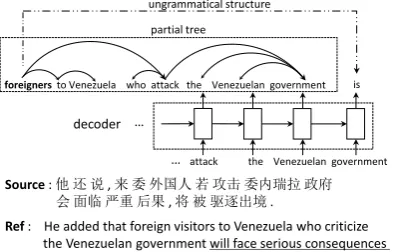
(2014) andBahdanau et al.(2015). Previous work ranges from addressing the problem of out-of-vocabulary words (Jean et al.,2015), designing at-tention mechanism (Luong et al.,2015a), to more efficient parameter learning (Shen et al., 2016), using source-side syntactic trees for better encod-ing (Eriguchi et al., 2016) and so on. All these NMT models employ a sequential recurrent neu-ral network for target generations. Although in theory RNN is able to remember sufficiently long history, we still observe substantial incorrect trans-lations which violate long-distance syntactic con-straints. This suggests that it is still very challeng-ing for a linear RNN to learn models that effec-tively capture many subtle long-range word de-pendencies. For example, Figure 1 shows an in-correct translation related to the long-distance de-pendency. The translation fragment in italic is lo-cally fluent around the wordis, but from a global view the translation is ungrammatical. Actually, this part of translation should be mostly affected by the distant plural noun foreigners rather than wordsVenezuelan governmentnearby.
Fortunately, such long-distance word corre-spondence can be well addressed and modeled by syntactic dependency trees. In Figure 1, the head wordforeignersin the partial dependency tree (top dashed box) can provide correct structural con-text for the next target word, with this informa-tion it is more likely to generate the correct word
a) syntactic trees can be used to model the gram-matical validity of translation candidates; b) par-tial syntactic structures can be used as additional context to facilitate future target word prediction.
Source : 他 还 说, 来 委 外国人 若 攻击 委内瑞拉 政府 会 面临 严重 后果, 将 被 驱逐出境.
partial tree
decoder
Ref : He added that foreign visitors to Venezuela who criticize the Venezuelan government will face serious consequences and will be deported .
NMT : He also said that foreigners to Venezuela who attack the Venezuelan government is facing serious consequences, will be deported .
…
foreigners to Venezuela who attack the Venezuelan government
attack the Venezuelan government …
[image:2.595.83.280.132.258.2]is ungrammatical structure
Figure 1: Dependency trees help the prediction of the next target word. “NMT” refers to the trans-lation result from a conventional NMT model, which fails to capture the long distance word re-lation denoted by the dashed arrow.
However, it is not trivial to build and leverage syntactic structures on the target side in current NMT framework. Several practical challenges arise:
(1) How to model syntactic structures such as dependency parse trees with recurrent neural net-work;
(2) How to efficiently perform both target word generation and syntactic structure construction tasks simultaneously in a single neural network;
(3) How to effectively leverage target syntactic context to help target word generation.
To address these issues, we propose and empir-ically evaluate a novel Sequence-to-Dependency Neural Machine Translation (SD-NMT) model in our paper. An SD-NMT model encodes source in-puts with bi-directional RNNs and associates them with target word prediction via attention mecha-nism as in most NMT models, but it comes with a new decoder which is able to jointly generate target translations and construct their syntactic de-pendency trees. The key difference from conven-tional NMT decoders is that we use two RNNs, one for translation generation and the other for de-pendency parse tree construction, in which incre-mental parsing is performed with the arc-standard shift-reduce algorithm proposed byNivre(2004).
We will describe in detail how these two RNNs work interactively in Section 3.
We evaluate our method on publicly avail-able data sets with Chinese-English and Japanese-English translation tasks. Experimental results show that our model significantly improves trans-lation accuracy over the conventional NMT and SMT baseline systems.
2 Background
2.1 Neural Machine Translation
As a new paradigm to machine translation, NMT is an end-to-end framework (Sutskever et al.,
2014;Bahdanau et al.,2015) which directly mod-els the conditional probability P(Y|X) of target
translationY =y1,y2,...,yn given source sentence
X=x1,x2,...,xm. An NMT model consists of two
parts: an encoder and a decoder. Both of them utilize recurrent neural networks which can be a Gated Recurrent Unit (GRU) (Cho et al., 2014) or a Long Short-Term Memory (LSTM) ( Hochre-iter and Schmidhuber,1997) in practice. The en-coder bidirectionally encodes a source sentence into a sequence of hidden vectorsH=h1,h2,...,hm
with a forward RNN and a backward RNN. Then the decoder predicts target words one by one with probability
P(Y|X) =
n Y
j=1
P(yj|y<j, H) (1)
Typically, for thejth target word, the probability P(yj|y<j, H)is computed as
P(yj|y<j, H) =g(sj, yj−1, cj) (2)
where g is a nonlinear function that outputs the probability ofyj, andsj is the RNN hidden state.
The context cj is calculated at each timestamp j
based onHby the attention network
cj = m X
k=1
ajkhk (3)
ajk =
exp(ejk) Pm
i=1exp(eji)
(4)
ejk = vaTtanh(Wasj−1+Uahk) (5)
where va, Wa, Ua are the weight matrices. The
2.2 Dependency Tree Construction
We use a shift-reduce transition-based dependency parser to build the syntactic structure for the target language in our work. Specially, we adopt the arc-standard algorithm (Nivre,2004) to perform incre-mental parsing during the translation process. In this algorithm, a stack and a buffer are maintained to store the parsing state over which three kinds of transition actions are applied. Let w0 and w1 be two topmost words in the stack, andw¯be the
cur-rent new word in a sequence of input, three transi-tion actransi-tions are described as below.
• Shift(SH) : Pushw¯to the stack.
• Left-Reduce(LR(d)) : Linkw0 andw1 with dependency label das w0−→dw1, and reduce them to the headw0.
• Right-Reduce(RR(d)) : Linkw0andw1with dependency label das w0←−dw1, and reduce them to the headw1.
During parsing, an specific structure is used to record the dependency relationship between dif-ferent words of input sentence. The parsing fin-ishes when the stack is empty and all input words are consumed. As each word must be pushed to the stack once and popped off once, the number of actions needed to parse a sentence is always
2n, wherenis the length of the sentence (Nivre,
2004). Because each valid transition action se-quence corresponds to a unique dependency tree, a dependency tree can also be equivalently repre-sented by a sequence of transition actions.
3 Sequence-to-Dependency Neural Machine Translation
An SD-NMT model is an extension to the con-ventional NMT model augmented with syntactic structural information of target translation. Given a source sentenceX=x1,x2,..,xm, its target
trans-lation Y = y1,y2,..,yn andY’s dependency parse
treeT, the goal of the extension is to enable us to compute the joint probability P(Y, T|X). As in
most structural learning tasks, the full prediction ofY andT is further decomposed into a chain of smaller predictions. For translation Y, it is gen-erated in the left-to-right order asy1, y2, .., yn
fol-lowing the way in a normal sequence-to-sequence model. ForY’s parse tree T, instead of directly modeling the tree itself, we predict a parsing ac-tion sequenceA which can mapY toT. Thus at
top level our SD-NMT model can be formulated as
P(Y, T|X) = P(Y, A|X)
= P(y1y2..yn, a1, a2..al|X)(6)
where A = a1,a2,..,aj,..,al 1 with length l (l = 2n),aj ∈ {SH,RR(d),LR(d)}2.
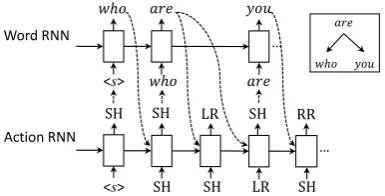
Two recurrent neural networks, Word-RNN and Action-RNN, are used to model generation pro-cesses of translation sequence Y and parsing ac-tion sequenceA respectively. Figure2 shows an example how translationY and its parsing actions are predicted step by step.
<s> Word RNN
Action RNN
𝑎𝑟𝑒 𝑦𝑜𝑢
SH
𝑤ℎ𝑜 𝑎𝑟𝑒
<s> SH SH LR
LR RR SH
SH 𝑤ℎ𝑜
𝑎𝑟𝑒
𝑦𝑜𝑢
SH 𝑤ℎ𝑜
… …
Figure 2: Decoding example of our SD-NMT model for target sentence “who are you” with tran-sition action sequence “SH SH LR SH RR”. The ending symbolEOSis omitted.
Because the lengths of Word-RNN and Action-RNN are different, they are designed to work in a mutually dependent way: a target word is only allowed to be generated when the SH action is predicted in the action sequence. In this way, we can perform incremental dependency parsing for translationY and at the same time track the par-tial parsing status through the translation genera-tion process.
For notational clarity, we introduce a virtual translation sequenceYˆ =ˆy1,yˆ2,..,yˆj,..,yˆlfor
Word-RNN which has the same lengthlwith transition action sequence.yˆj is defined as
ˆ
yj =
(
yvj δ(SH, aj) = 1
yvj−1 δ(SH, aj) = 0
where δ(SH, aj) is 1 when aj = SH, otherwise
0. vj is the index of Y, computed by vj =
Pj
i=1δ(SH, ai). Apparently the mapping fromYˆ
1In the rest of this paper,a
jrepresents the transition
ac-tion, rather than the attention weight in Equation 4.
[image:3.595.320.513.262.360.2]a
…
𝐸𝑤0 𝑏0𝑙
𝐾𝑗
𝐸𝑤1
𝐸𝑤0𝐸𝑤0𝑙 𝑏1𝑟
𝐸𝑤1𝐸𝑤1𝑟
𝑤0 𝑤1
… stack
parsing configuation
…𝑤1𝑙… 𝑤1𝑟…𝑤0𝑙… 𝑤0𝑟 𝑢𝑛𝑖𝑔𝑟𝑎𝑚
𝑏𝑖𝑔𝑟𝑎𝑚
construction of 𝐾𝑗
Attention partial tree
𝑦1 𝑦2 𝑦3 𝑦4 … 𝑦𝑗−1
𝑇𝑖𝑚𝑒𝑠𝑡𝑎𝑚𝑝 1 2 3 4 𝑗 − 1
𝑎𝑗−1 𝑎𝑗
𝑎1 𝑎2 𝑎3 𝑎𝑗−2
⊕
δ
𝑎1 𝑎2 𝑎3 𝑎4 … 𝑎𝑗−1
𝑦0
𝑎0
𝑥1 𝑥2 𝑥3 … 𝑥𝑚
0 1
Word RNN
Action RNN
Encoder
𝑦1 𝑦2 𝑦3 … 𝑦𝑣𝑗−1
…
…
…
𝑦1 𝑦2 𝑦3 𝑦𝑗−2 𝑦𝑗−1
𝑌
𝑌
𝐾𝑗
𝑦𝑗 𝑦𝑣𝑗
𝒋
(𝑎) (𝑏)
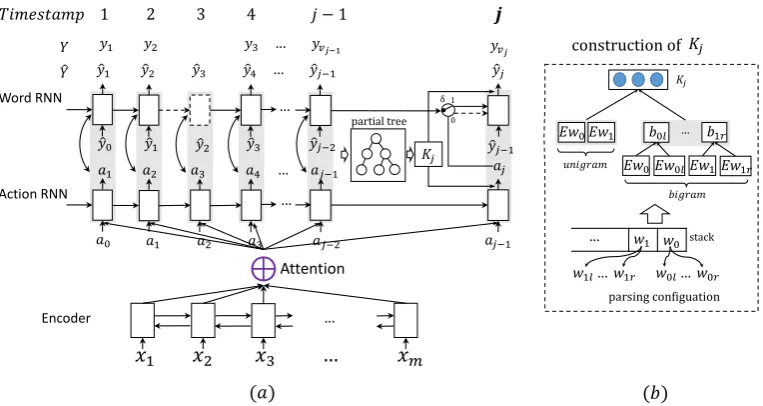
Figure 3: (a) is the overview of SD-NMT model. The dashed arrows mean copying previous recurrent state or word. The two RNNs use the same source context for prediction.aj ∈ {SH,RR(d),LR(d)}. The
bidirection arrow refers to the interaction between two RNNs. (b) shows the construction of syntactic context. The gray box means the concatenation of vectors
toY is deterministic, andY can be easily derived givenYˆ andA.
With the notation ofYˆ, the sequence probability
ofY andAcan be written as P(A|X,Yˆ<l) =
l Y
j=1
P(aj|a<j, X,Yˆ<j) (7)
P( ˆY|X, A≤l) = l Y
j=1
P(ˆyj|yˆ<j, X, A≤j)δ(SH,aj)
(8)
where Yˆ<j refers to the subsequence ˆ
y1,yˆ2, ..,yˆj−1, andA≤j toa1, a2, .., aj. Based on
Equation 7 and 8, the overall joint model can be computed as
P(Y, T|X) =P(A|X,Yˆ<l)×P( ˆY|X, A≤l) (9) As we have two RNNs in our model, the termina-tion conditermina-tion is also different from a conventermina-tional NMT model. In decoding, we maintain a stack to track the parsing configuration, and our model terminates once the Word-RNN predicts a special ending symbolEOSand all the words in the stack have been reduced.
Figure3(a) gives an overview of our SD-NMT model. Due to space limitation, the detailed inter-connections between two RNNs are only illus-trated at timestampj. The encoder of our model
follows standard bidirectional RNN configuration. At timestamp j during decoding, our model first predicts an actionaj by Action-RNN, then
Word-RNN checks the condition gateδaccording toaj.
Ifaj = SH, the Word-RNN will generate a new
state (solid arrow) and predict a new target word yvj, otherwise it just copies previous state (dashed
arrow) to the current state. For example, at times-tamp 3,a3 6=SH, the state of Word-RNN is copied
from its previous one. Meanwhile,yˆ3 =y2is used as the immediate proceeding word in translation history.
When computing attention scores, we extend Equation 5 by replacing the decoder hidden state with the concatenation of Word-RNN hidden state sand Action-RNN hidden states0 (gray boxes in Figure3). The new attention score is then updated as
ejk=vTatanh(Wa[sj−1;s0j−1] +Uahk) (10)
3.1 Syntactic Context for Target Word Prediction
Syntax has been proven useful for sentence gen-eration task (Dyer et al., 2016). We propose to leverage target syntax to help translation genera-tion. In our model, the syntactic context Kj at
[image:4.595.109.491.64.267.2]parsing configuration of Action-RNN. Denote that w0andw1are two topmost words in the stack,w0l
andw1l are their leftmost modifiers in the partial
tree,w0randw1rtheir rightmost modifiers
respec-tively. We define two unigram features and four bigram features. The unigram features arew0 and w1which are represented by the word embedding vectors. The bigram features are w0w0l, w0w0r,
w1w1l andw1w1r. Each of them is computed by
bhc = tanh(WbEwh + UbEwhc), h ∈ {0,1},
c ∈ {l, r}. These kinds of feature template have beeb proven effective in dependency parsing task (Zhang and Clark,2008). Based on these features, the syntactic context vectorKj is computed as
Kj =tanh(Wk[Ew0;Ew1] +Uk[b0l;b0r;b1l;b1r]) (11)
where Wk, Uk, Wb, Ub are the weight matrices,
E stands for the embedding matrix. Figure 2 (b) gives an overview of the construction ofKj. Note
that zero vector is used for padding the words which are not available in the partial tree, so that all theKvectors have the same input size in com-putation.
Adding Kj to Equation2, the probabilities of
transition action and word in Equation 7 and 8 are then updated as
P(aj|a<j, X,Yˆ<j) =g(s0j, aj−1, cj, Kj) (12) P(ˆyj|yˆ<j, X, A≤j) =g(sj,yˆj−1, cj, Kj) (13)
After each prediction step in Word-RNN and Action-RNN, the syntax context vectorK will be updated accordingly. Note thatK is not used to calculate the recurrent statessin this work.
3.2 Model Training and Decoding
For SD-NMT model, we use the sum of log-likelihoods of word sequence and action sequence as objective function for training algorithm, so that the joint probability of target translations and their parsing trees can be maximized:
J(θ) = X
(X,Y,A)∈D
logP(A|X,Yˆ<l)+
log P( ˆY|X, A≤l) (14)
We also use mini-batch for model training. As the target dependency trees are known in the bilin-gual corpus during training, we pre-compute the partial tree state and syntactic context at each time
stamp for each training instance. Thus it is easy for the model to process multiple trees in one batch.
In the decoding process of an SD-NMT model, the score of each search path is the sum of log probabilities of target word sequence and transi-tion actransi-tion sequence normalized by the sequence length:
score= 1
l
l
X
j=1
log P(aj|a<j, X,Yˆ<j)+
1
n
l
X
j=1
δ(SH, aj) log P(ˆyj|yˆ<j, X, A≤j) (15)
where nis word sequence length and l is action sequence length.
4 Experiments
The experiments are conducted on the Chinese-English task as well as the Japanese-Chinese-English trans-lation tasks where the same data set from WAT 2016 ASPEC corpus (Nakazawa et al., 2016) 3
is used for a fair comparison with other work. In addition to evaluate translation performance, we also investigate the quality of dependency parsing as a by-product and the effect of parsing quality against translation quality.
4.1 Setup
In the Chinese-English task, the bilingual training data consists of a set of LDC datasets, 4 which
has around 2M sentence pairs. We use NIST2003 as the development set, and the testsets contain NIST2005, NIST2006, NIST2008 and NIST2012. All English words are lowercased.
In the Japanese-English task, we use top 1M sentence pairs from ASPEC Japanese-English cor-pus. The development data contains 1,790 sen-tences, and the test data contains 1,812 sentences with single reference per source sentence.
To train SD-NMT model, the target dependency tree references are needed. As there is no golden annotation of parse trees over the target training data, we use pseudo parsing results as the tar-get dependency references, which are got from an in-house developed arc-eager dependency parser based on work in (Zhang and Nivre,2011).
3http://orchid.kuee.kyoto-u.ac.jp/ASPEC/
Settings NIST 2005 NIST 2006 NIST 2008 NIST 2012 Average
HPSMT 35.34 33.56 26.06 27.47 30.61
RNNsearch 38.07 38.95 31.61 28.95 34.39
SD-NMT\K 38.83 39.23 31.92 29.72 34.93
SD-NMT 39.38 41.81 33.06 31.43 36.42
Table 1: Evaluation results on Chinese-English translation task with BLEU% metric. The “Average” column is the averaged result of all test sets. The numbers in bold indicate statistically significant differ-ence (p <0.05) from baselines.
In the neural network training, the vocabulary size is limited to 30K high frequent words for both source and target languages. All low fre-quent words are normalized into a special token
unkand post-processed by following the work in (Luong et al., 2015b). The size of word embed-ding and transition action embedembed-ding is set to 512. The dimensions of the hidden states for all RNNs are set to 1024. All model parameters are initial-ized randomly with Gaussian distribution (Glorot and Bengio,2010) and trained on a NVIDIA Tesla K40 GPU. The stochastic gradient descent (SGD) algorithm is used to tune parameters with a learn-ing rate of 1.0. The batch size is set to 96. In the update procedure, Adadelta (Zeiler, 2012) algo-rithm is used to automatically adapt the learning rate. The beam sizes for both word prediction and transition action prediction are set to 12 in decod-ing.
The baselines in our experiments are a phrasal system and a neural translation system, denoted by HPSMT and RNNsearch respectively. HPSMT is an in-house implementation of the hierarchical phrase-based model (Chiang, 2005), where a 4-gram language model is trained using the mod-ified Kneser-Ney smoothing (Kneser and Ney,
1995) algorism over the English Gigaword corpus (LDC2009T13) plus the target data from the bilin-gual corpus. RNNsearch is an in-house implemen-tation of the attention-based neural machine trans-lation model (Bahdanau et al., 2015) using the same parameter settings as our SD-NMT model including word embedding size, hidden vector di-mension, beam size, as well as the same mecha-nism for OOV word processing.
The evaluation results are reported with the case-insensitive IBM BLEU-4 (Papineni et al.,
2002). A statistical significance test is performed using the bootstrap resampling method proposed by Koehn (2004) with a 95% confidence level. For Japanese-English task, we use the official
eval-uation procedure provided by WAT 2016.5, where
both BLEU and RIBES (Isozaki et al.,2010) are used for evaluation.
4.2 Evaluation on Chinese-English Translation
We evaluate our method on the Chinese-English translation task. The evaluation results over all NIST test sets against baselines are listed in Table
1. Generally, RNNsearch outperforms HPSMT by 3.78 BLEU points on average while SD-NMT surpasses RNNsearch 2.03 BLUE point gains on average, which shows that NMT models usually achieve better results than SMT models, and our proposed sequence-to-dependency NMT model performs much better than traditional sequence-to-sequence NMT model.
We also investigate the effect of syntactic knowledge context by excluding its computation in Equation 12 and 13. The alternative model is denoted by SD-NMT\K. According to Table 1, SD-NMT\K outperforms RNNsearch by 0.54
BLEU points but degrades SD-NMT by 1.49 BLEU points on average, which demonstrates that the long distance dependencies captured by the target syntactic knowledge context, such as left-most/rightmost children together with their depen-dency relationships, really bring strong positive effects on the prediction of target words.
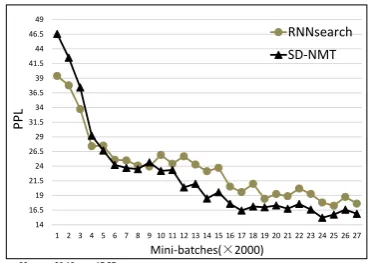
In addition to translation quality, we compare the perplexity (PPL) changes on the development set in terms of numbers of training mini-batches for RNNsearch and SD-NMT in Figure4. We can see that the PPL of SD-NMT is initially higher than that of RNNsearch, but decreased to be lower over time. This is mainly because the quality of parse tree is too poor at the beginning which degrades translation quality and leads to higher PPL. After some training iterations, the SD-NMT
BLEU RIBES System Description
SMT Hiero 18.72 0.6511 Moses’ Hierarchical Phrase-based SMT SMT Phrase 18.45 0.6451 Moses’ Phrase-based SMT
SMT S2T 20.36 0.6782 Moses’ String-to-Tree Syntax-based SMT
Cromieres(2016)(Single model) 22.86 - Single-layer NMT model without ensemble
Cromieres(2016)(Self-ensemble) 24.71 0.7508 Self-ensemble of 2-layer NMT model
Cromieres(2016)(4-Ensemble) 26.22 0.7566 Ensemble of 4 single-layer NMT models
RNNsearch 23.50 0.7459 Single-layer NMT model
[image:7.595.75.525.62.193.2]SD-NMT 25.93 0.7540 Single-layer SD-NMT model
Table 2: Evaluation results on Japanese-English translation task.
model learns reasonable inferences of parse trees which begins to help target word generation and leads to lower PPL.
iter RNNsearch SD-NMT 1 39.39 46.57 2 37.78 42.5 3 33.73 37.43 4 27.4 29.21 5 27.5 26.67 6 25.09 24.22 7 24.99 23.7 8 24.1 23.5 9 23.94 24.66 10 25.92 23.19 11 24.41 23.35 12 25.67 20.38 13 24.28 21 14 23.14 18.49 15 23.73 19.57 16 20.51 17.58 17 19.58 16.43 18 20.98 17.13 19 18.43 17 20 19.25 17.31 21 18.87 16.75 22 20.18 17.57 23 19.27 16.6 24 17.8 15.2 25 17.26 15.74 26 18.76 16.58 27 17.62 15.88
14 16.5 19 21.5 24 26.5 29 31.5 34 36.5 39 41.5 44 46.5 49
1 2 3 4 5 6 7 8 9 10 11 12 13 14 15 16 17 18 19 20 21 22 23 24 25 26 27
PPL
Mini-batches(×2000)
[image:7.595.87.276.287.419.2]RNNsearch SD-NMT
Figure 4: Perplexity (PPL) changes in terms of numbers of training mini-batches.
In our experiments, the time cost of SD-NMT is two times of that for RNNsearch due to a more complicated model structure. But we think it is a worthy trade to pursue high quality translations.
4.3 Evaluation on Japanese-English Translation
In this section, we report results on the Japanese-English translation task. To ensure fair compar-isons, we use the same training data and follow the pre-processing steps recommended in WAT 20166.
Table2shows the comparison results from 8 sys-tems with the evaluation metrics of BLEU and RIBES. The results in the first 3 rows are pro-duced by SMT systems taken from the official WAT 2016. The remaining results are produced by NMT systems, among which the bottom two row results are taken from our in-house NMT systems and others refer to the work in (Cromieres,2016;
6http://lotus.kuee.kyoto-u.ac.jp/WAT/baseline/data PreparationJE.html
Cromieres et al., 2016) that are the competitive NMT results on WAT 2016. According to Table
2, NMT results still outperform SMT results simi-lar to our Chinese-English evaluation results. The SD-NMT model significantly outperforms most other NMT models, which shows that our pro-posed approach to modeling target dependency tree benefit NMT systems since our RNNsearch baseline achieves comparable performance with the single layer attention-based NMT system in (Cromieres, 2016). Note that our SD-NMT gets comparable results with the 4 single-layer ensem-ble model in (Cromieres,2016;Cromieres et al.,
2016). We believe SD-NMT can get more im-provements with an ensemble of multiple models in future experiments.
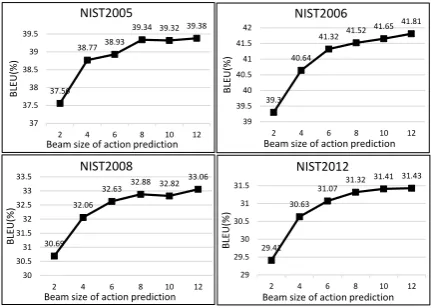
4.4 Effect of the Parsing Accuracy upon Translation Quality
beamsize NIST2005 NIST2006 NIST2008 NIST2012 2 37.56 39.3 30.69 29.41 4 38.77 40.64 32.06 30.63 6 38.93 41.32 32.63 31.07 8 39.34 41.52 32.88 31.32 10 39.32 41.65 32.82 31.41 12 39.38 41.81 33.06 31.43
37.56 38.7738.93
39.34 39.32 39.38
37 37.5 38 38.5 39 39.5
2 4 6 8 10 12
BL
EU(%
)
Beam size of action prediction NIST2005
39.3 40.64
41.32 41.52 41.65 41.81
39 39.5 40 40.5 41 41.5 42
2 4 6 8 10 12
BL
EU(%
)
Beam size of action prediction NIST2006
30.69 32.06
32.63 32.88 32.82 33.06
30 30.5 31 31.5 32 32.5 33 33.5
2 4 6 8 10 12
BL
EU(%
)
Beam size of action prediction NIST2008
29.41 30.63
31.07 31.32 31.41 31.43
29 29.5 30 30.5 31 31.5
2 4 6 8 10 12
BL
EU(%
)
Beam size of action prediction NIST2012
Figure 5: Translation performance against the beam size of action prediction.
words, and vice versa we believe.
4.5 Quality Estimation of Dependency Tree Construction
As a by-product, the quality of dependency trees not only affects the performance of target word generation, but also influences the possible down-stream processors or tasks such as text analyses. The direct evaluation of tree quality is not feasible due to the unavailable golden references. So we resort to estimating the consistency between the by-products and the parsing results of our stand-alone dependency parser with state-of-the-art per-formance. The higher the consistency is, the closer the performance of by-product is to the stand-alone parser. To reduce the influence of ill-formed data as much as possible, we build the evaluation data set by heuristically selecting 360 SD-NMT translation results together with their dependency trees from NIST test sets where both source- and target-side do not containunk and have a length of 20-30. We then take the parsing results of the stand-alone parser for these translations as ref-erences to indirectly estimate the quality of by-products. We get a UAS (unlabeled attachment score) of 94.96% and a LAS (labeled attachment score) of 93.92%, which demonstrates that the de-pendency trees produced by SD-NMT are much similar with the parsing results from the stand-alone parser.
4.6 Translation Example
In this section, we give a case study to explain how our method works. Figure6 shows a trans-lation example from the NIST testsets. SMT and RNNsearch refer to the translation results from the
baselines HPSMT and NMT. For our SD-NMT model, we list both the generated translation and its corresponding dependency tree. We find that the translation of SMT is disfluent and ungram-matical, whereas RNNsearch is better than SMT. Although the translation of RNNsearch is locally fluent around word “have” in the rectangle, both its grammar is incorrect and its meaning is inaccu-rate from a global view. The word “have” should be in a singular form as its subject is “safety” rather than “workers”. For our SD-NMT model, we can see that the translation is much better than baselines and the dependency tree is reasonable. The reason is that after generating the word “work-ers”, the previous subtree in the gray region is transformed to the syntactic context which can guide the generation of the next word as illustrated by the dashed arrow. Thus our model is more likely to generate the correct verb “is” with sin-gular form. In addition, the global structure helps the model correctly identify the inverted sentence pattern of the former translated part and make bet-ter choices for the future translation (“only when .. can ..” in our translation, “only when .. will ..” in the reference), which remains a challenge for conventional NMT model.
5 Related Work
Incorporating linguistic knowledge into machine translation has been extensively studied in Statistic Machine Translation (SMT) (Galley et al.,2006;
Shen et al., 2008; Liu et al., 2006). Liu et al.
(2006) proposed a tree-to-string alignment tem-plate for SMT to leverage source side syntactic in-formation. Shen et al. (2008) proposed a target dependency language model for SMT to employ target-side structured information. These methods show promising improvement for SMT.
Recently, neural machine translation (NMT) has achieved better performance than SMT in many language pairs (Luong et al.,2015a;Zhang et al., 2016; Shen et al., 2016; Wu et al., 2016;
Neubig, 2016). In a vanilla NMT model, source and target sentences are treated as sequences where the syntactic knowledge of both sides is neglected. Some effort has been done to incor-porate source syntax into NMT. Eriguchi et al.
[image:8.595.73.289.63.217.2][Source] 只有 施工 人员 的 安全 得到 了 保证, 才能 继续 施 工.
[Reference] only when the safety of the workers is guaranteed will they continue with the project . [HPSMT] only safety is assured of construction personnel , to continue construction .
[RNNsearch] only when the safety of construction workers have been guaranteed to continue construction . [SD-NMT] only when the safety of the workers is guaranteed can we continue to work .
nsubjpass
nsubj
auxpass punct
advmod
pobj
aux
prep xcomp
the of
workers
safety is continue
guaranteed
can we work
. only when
the
to
dep
aux det
det
ccomp
Figure 6: Translation examples of SMT, RNNsearch and our SD-NMT on Chinese-English transla-tion task. The italic words on the arrows are dependency labels. The ending symbolEOS is omitted. RNNsearch fails to capture the long dependency which leads to an ungrammatical result. Whereas with the help of the syntactic tree, our SD-NMT can get a much better translation.
NMT is straightforward, because the source sen-tence is definitive and easy to attach extra informa-tion. However, it is non-trivial to add target syn-tax as target words are uncertain in decoding pro-cess. Up to now, there is few work that attempts to build and leverage target syntactic information for NMT.
There has been work that incorporates syntactic information into NLP tasks with neural networks.
Dyer et al.(2016) presented a RNN grammar for parsing and language modeling. They replaced SH with a set of generative actions to generate words under a Stack LSTM framework (Dyer et al.,
2015), which achieves promising results for lan-guage modeling on the Penn Treebank data. In our work, we propose to involve target syntactic trees into NMT model to jointly learn target trans-lation and dependency parsing where target syn-tactic context over the parse tree is used to improve the translation quality.
6 Conclusion and Future Work
In this paper, we propose a novel string-to-dependency translation model over NMT. Our model jointly performs target word generation and arc-standard dependency parsing. Experimental results show that our method can boost the two procedures and achieve significant improvements on the translation quality of NMT systems.
In future work, along this research direction, we will try to integrate other prior knowledge, such as
semantic information, into NMT systems. In addi-tion, we will apply our method to other sequence-to-sequence tasks, such as text summarization, to verify the effectiveness.
Acknowledgments
We are grateful to the anonymous reviewers for their insightful comments. We also thank Shujie Liu and Zhirui Zhang for the helpful discussions.
References
Dzmitry Bahdanau, Kyunghyun Cho, and Yoshua Ben-gio. 2015. Neural machine translation by jointly learning to align and translate. ICLR 2015.
David Chiang. 2005. A hierarchical phrase-based model for statistical machine translation. In Pro-ceedings of ACL 2005.
Kyunghyun Cho, Bart van Merrienboer, Caglar Gul-cehre, Dzmitry Bahdanau, Fethi Bougares, Holger Schwenk, and Yoshua Bengio. 2014. Learning phrase representations using rnn encoder–decoder for statistical machine translation. In Proceedings of ENMLP 2014.
Fabien Cromieres. 2016. Kyoto-nmt: a neural machine translation implementation in chainer. In Proceed-ings of COLING 2016.
Chris Dyer, Miguel Ballesteros, Wang Ling, Austin Matthews, and Noah A. Smith. 2015. Transition-based dependency parsing with stack long short-term memory. InProceedings of ACL 2015.
Chris Dyer, Adhiguna Kuncoro, Miguel Ballesteros, and Noah A. Smith. 2016. Recurrent neural network grammars. InProceedings of the NAACL 2016.
Akiko Eriguchi, Kazuma Hashimoto, and Yoshimasa Tsuruoka. 2016. Tree-to-sequence attentional neu-ral machine translation. In Proceedings of ACL 2016.
Michel Galley, Jonathan Graehl, Kevin Knight, Daniel Marcu, Steve DeNeefe, Wei Wang, and Ignacio Thayer. 2006. Scalable inference and training of context-rich syntactic translation models. In Pro-ceedings of ACL 2006.
Xavier Glorot and Yoshua Bengio. 2010. Understand-ing the difficulty of trainUnderstand-ing deep feedforward neural networks. InAistats. volume 9, pages 249–256.
Sepp Hochreiter and J¨urgen Schmidhuber. 1997. Long short-term memory.Neural computation9(8).
Hideki Isozaki, Tsutomu Hirao, Kevin Duh, Katsuhito Sudoh, and Hajime Tsukada. 2010. Automatic eval-uation of translation quality for distant language pairs. InProceedings of EMNLP.
S´ebastien Jean, Kyunghyun Cho, Roland Memisevic, and Yoshua Bengio. 2015. On using very large tar-get vocabulary for neural machine translation. In Proceedings of ACL 2015.
Reinhard Kneser and Hermann Ney. 1995.
Im-proved backing-off for m-gram language model-ing. In Acoustics, Speech, and Signal Processing, 1995. ICASSP-95., 1995 International Conference on. IEEE, volume 1, pages 181–184.
Philipp Koehn. 2004. Statistical significance tests for machine translation evaluation. In EMNLP. Cite-seer, pages 388–395.
Yang Liu, Qun Liu, and Shouxun Lin. 2006. Tree-to-string alignment template for statistical machine translation. InProceedings of ACL 2006.
Thang Luong, Hieu Pham, and Christopher D. Man-ning. 2015a. Effective approaches to attention-based neural machine translation. In Proceedings of EMNLP 2015.
Thang Luong, Ilya Sutskever, Quoc Le, Oriol Vinyals, and Wojciech Zaremba. 2015b. Addressing the rare word problem in neural machine translation. In Pro-ceedings of ACL 2015.
Toshiaki Nakazawa, Manabu Yaguchi, Kiyotaka Uchi-moto, Masao Utiyama, Eiichiro Sumita, Sadao Kurohashi, and Hitoshi Isahara. 2016. Aspec: Asian scientific paper excerpt corpus. In Nico-letta Calzolari (Conference Chair), Khalid Choukri,
Thierry Declerck, Marko Grobelnik, Bente Mae-gaard, Joseph Mariani, Asuncion Moreno, Jan Odijk, and Stelios Piperidis, editors, Proceedings of the Ninth International Conference on Language Resources and Evaluation (LREC 2016). European Language Resources Association (ELRA), Portoroz, Slovenia, pages 2204–2208.
Graham Neubig. 2016. Lexicons and minimum risk training for neural machine translation: NAIST-CMU at WAT2016. In Proceedings of the 3nd Workshop on Asian Translation (WAT2016). Osaka, Japan.
Joakim Nivre. 2004. Incrementality in deterministic dependency parsing. InProceedings of the Work-shop on Incremental Parsing: Bringing Engineering and Cognition Together.
Kishore Papineni, Salim Roukos, Todd Ward, and Wei-Jing Zhu. 2002. Bleu: a method for automatic evalu-ation of machine translevalu-ation. InProceedings of ACL 2002.
Libin Shen, Jinxi Xu, and Ralph M Weischedel. 2008. A new string-to-dependency machine translation al-gorithm with a target dependency language model. InACL. pages 577–585.
Shiqi Shen, Yong Cheng, Zhongjun He, Wei He, Hua Wu, Maosong Sun, and Yang Liu. 2016. Minimum risk training for neural machine translation. In Pro-ceedings of ACL 2016.
Ilya Sutskever, Oriol Vinyals, and Quoc V Le. 2014. Sequence to sequence learning with neural net-works. InAdvances in neural information process-ing systems.
Zhaopeng Tu, Zhengdong Lu, Yang Liu, Xiaohua Liu, and Hang Li. 2016. Modeling coverage for neural machine translation. InProceedings of ACL 2016. Yonghui Wu, Mike Schuster, Zhifeng Chen, Quoc V
Le, Mohammad Norouzi, Wolfgang Macherey, Maxim Krikun, Yuan Cao, Qin Gao, Klaus Macherey, et al. 2016. Google’s neural ma-chine translation system: Bridging the gap between human and machine translation. arXiv preprint arXiv:1609.08144.
Matthew D Zeiler. 2012. Adadelta: an adaptive learn-ing rate method.arXiv preprint arXiv:1212.5701. Biao Zhang, Deyi Xiong, jinsong su, Hong Duan, and
Min Zhang. 2016. Variational neural machine trans-lation. InProceedings of EMNLP 2016.
Yue Zhang and Stephen Clark. 2008. A tale of two parsers: Investigating and combining graph-based and transition-graph-based dependency parsing. In EMNLP2008.