68
Predicting the presence of a Matrix Language in code-switching
Barbara E. Bullock, Gualberto Guzm´an, Jacqueline Serigos Vivek Sharath, Almeida Jacqueline Toribio
{gualbertoguzman,vivek.sharath}@utexas.edu {bbullock,toribio}@austin.utexas.edu
{jserigos}@gmu.edu
Abstract
One language is often assumed to be dom-inant in code-switching (C-S), but this as-sumption has not been empirically tested. We operationalize the matrix language (ML) at the level of the sentence, us-ing three common definitions. We test whether these converge and then model this convergence via a set of metrics that together quantify the nature of C-S. We conduct our experiment on four differ-ent Spanish-English corpora. Our results demonstrate that our model can separate some corpora according to whether they have a dominant ML or not but that the corpora span a range of mixing types that cannot be sorted neatly into an insertional vs. alternational dichotomy.
1 Introduction
From Joshi (1982) forward, many researchers as-sume that one of the participating languages in code-switching (C-S) is dominant. This notion is theorized in linguistics as the Matrix Language Frame model (MLF) (Myers-Scotton,1997). The MLF assumes an asymmetry between the lan-guages involved in C-S, with the matrix language (ML) providing the frame into which embedded language elements (EL) from the contact language are inserted, as well as an asymmetry between system vs. content morphemes. System mor-phemes in the MLF comprise a subset of closed class morphemes that neither assign nor receive a thematic role (e.g., determiners, quantifiers, aux-iliaries, conjunctions). Constraints on language mixing follow from the asymmetry: The ML pro-vides the grammatical elements and framing while the EL provides merely content morphemes. Nev-ertheless, there are two long-standing criticisms of
the ML: (1) the criteria for the identification of the ML are not straightforward (Winford, 2003;
Meakins, 2011; Bhat et al., 2016); and (2) the consistent identification of a single ML might not be possible (Auer and Muhamedova, 2005;Bhat et al., 2016;Liu, 2008;Adamou,2016). To this we add a third concern: In ascertaining an ML, researchers often rely on selected, decontextual-ized example sentences. With some exceptions, most in NLP (Gamb¨ack and Das,2016;Bhat et al.,
2016;Vyas et al.,2014), few scholars have calcu-lated the ML for each sentence or utterance in a sizable dataset (Blokzijl et al.,2017). Thus, tests of the MLF using replicable methods are lacking, despite the fact that the determination of an ML has consequences for linguistic analyses and for accurate models of multilingual texts for language processing (Bhat et al., 2016; Solorio and Liu,
2008a,b) and for applications like TTS (Sitaram and Black, 2016; Sitaram et al., 2015) and ASR (Li et al.,2012).
result (i.e., point to a unique ML) as a function of our corpus metrics. Our result is a model that classifies C-S data according to how likely it is that all three measures of the ML agree on the same language label. Our contribution is three-fold: first, we show that one can ascribe a single ML with a high degree of likelihood given a par-ticular pattern of C-S and that a simple word-count method is sufficient to do so; secondly, we em-pirically demonstrate that there is a cline of C-S such that corpora cannot always be neatly sepa-rated into insertional and alternational types as is generally claimed in the sociolinguistic literature; thirdly, we find that measures designed to assess the time-course of complex systems like C-S are lacking for small datasets.
2 Related Work
2.1 Debates about the MLF Model
Studies of C-S commonly distinguish between insertional and alternational patterns (Muysken,
2000). With insertional switching, speakers are said to know which one language an utterance is “coming from” (Joshi, 1982; Romaine, 1995;
Sitaram and Black, 2016). In the MLF model (Myers-Scotton, 1997), this language is formal-ized as the ML. Insertional C-S, which may be indistinguishable from borrowing (Poplack et al.,
1988), is encountered in many sociolinguistic set-tings irrespective of the typologies of the language pairing studied (Poplack et al., 1988; Muysken,
2000; Li and Fung, 2013; Vyas et al., 2014;
Adamou, 2016). In Sentence 1, Marathi is the ML, identified by the relative ordering of words in the clause and by the language of the system or closed-class morphemes, such as the quantifier kahi and the light verb kar; English contributes only the EL lexeme paint. Hindi is argued to be the ML in Sentence 2 (Bhat et al.,2016) , which presents an EL Island (ELI), an English-language embedded constituent with its own internal struc-ture.1
• Sentence 1
mula kahi khurcyapaintkartat
1
In the NLP literature, insertionanal mixing is often re-ferred to ascode-mixing (CM), following Gumperz (1982) (Vyas et al.,2014;Bali et al.,2014), though some researchers employ CM as an umbrella term for both insertional and al-ternational mixing (Sequiera et al.,2015). Others use CM for any switching that occurs within an utterance (and C-S for switching at or above the utterance level) (Gamb¨ack and Das,
2016).
[boys some chairs paint do+TNS]
• Sentence 2
Shanivar neeras hai from that perspective [Saturday boring is from that perspective]
The means by which the ML of a clause or ex-tended discourse is determined remains debated. The ML has been variously associated with the numerically dominant language, (Myers-Scotton,
1997;Gamb¨ack and Das,2016;Sharma and Mot-lani, 2015), with the language of the finite verb (Klavans, 1985; Treffers-Daller, 1994; Meakins,
2011), or with the first language in a left-to-right parsing (Doron,1983). It should be noted that the ML, as defined by Myers-Scotton, operates over a unit she calls the CP, which is co-extensive with the clause. For the purpose of this paper, we define the ML over a sentence, which may contain more than one clause. Since the majority of the corpora to be examined are from natural conversations, it is likely that most sentences consist of a single clause, as sentences are known to be shorter and syntactically less complex in spoken language.
The ML is not argued to be applicable to alter-national switching, because speakers move from one grammar to another within an utterance. But it is often not clear from cited examples whether a new language span constitutes the alternation of MLs, as appears to be the case in Sentence 3 from the bilingual memoireKiller Cr`onicas, or whether the span is an ELI inserted into an ML, as is argued to be the case for Sentence 2. For instance, ex-amining natural Japanese-English data within the MLF, Namba (2012) could not determine the ML of C-S utterances such as Sentence 4, which ac-counted for 42% of the clauses in the corpus.
• Sentence 3
Anyway, just leave himplantado, al taxista este, or throw some money at him y salir [stranded that taxi-driver ... and leave]
• Sentence 4
I want to begoorukiipaa ni nari-tai [goalkeeperRESULTATIVEbecome]
2.2 Measuring the complexity of code-switching
the nature of C-S (Auer and Muhamedova,2005). There have been recent attempts to quantify mix-ing complexity with the aim of arrivmix-ing at empir-ically reliable comparisons of C-S between cor-pora (Gamb¨ack and Das,2016;Das and Gamb¨ack,
2014;Jamatia et al., 2015;Guzman et al., 2016;
Guzm´an et al.,2017a). Each aims to capture the fact that C-S may vary along multiple planes. We follow Guzm´an et al. (2016, 2017a) who quantify mixing in terms of several parameters calculated from language labels at the word level: (1) the ratio of languages represented; (2) the probabil-ity of switching language between any two words; (3) the burstiness of switching as characterized by the distribution of the length of spans; and (4) the sequential ordering of alternating monolingual spans.
3 Data
Bhat et al. (2016) built models for generating C-S sentences based on input sentences and the con-straints of the MLF and of the Equivalence Con-straint, a symmetrical model for alternating C-S (Poplack, 1980). When the sentences were sub-mitted to human evaluation, there was significant variance in acceptability, potentially attributable to discrepancies in the register of some of the words used, as C-S tends to be informal and conversa-tional. For our study, we avoid confounds that can be introduced by generated C-S by drawing on C-S data generated by bilingual speakers them-selves. We were restricted in our choice of data by the requirement that all data bear a language label and a POS tag. As is commonly observed, POS tagged bilingual data are rare because the accu-racy of monolingual taggers is reduced when the context is broken by C-S (Vyas et al.,2014).
The corpora that we use reflect degrees of mix-ing so that we test the viability of the MLF hy-pothesis across varying types of C-S. Each corpus was previously tagged for language and POS by its creators. In order to be able to compare between, the original POS tags used for each datasets were mapped to the core POS tagset from the Univer-sal Dependencies (UD) framework (Nivre et al.,
2016). The corpora to be modeled are the follow-ing.
1. S7 was created by Thamar Solorio (2008a;
2008b). It documents a conversation among three Spanish-English bilinguals, resulting in approximately 8,000 words. It was tagged
for language and POS, using TreeTagger’s English and Spanish parameters (Solorio and Liu,2008a).
2. Miamiconsists of files from the Bangor Mi-ami Corpus, transcripts of informal conversa-tions between Spanish-English bilinguals in Miami. The data was automatically anno-tated for language and POS, using the Bangor Autoglosser (Donnelly and Deuchar,2011).
3. SpinTX comprises selected transcripts of speakers from the Spanish in Texas Corpus, a set of recorded interviews between Spanish-English bilinguals residing in Texas ( Bul-lock and Toribio,2013;Toribio and Bullock,
2016). The corpus in its entirety was auto-matically tagged for POS using the English and Spanish versions of TreeTagger (Schmid,
1995) applied sequentially.2
4. KCis an excerpt of the epistolary workKiller Cr´onicas: Bilingual Memoires by Susana Chavez-Silverman. Nearly evenly balanced between English and Spanish, the POS anno-tated segment contains approximately 8,000 words. It was automatically tagged for lan-guage following Guzm´an et al. (2016) and then manually annotated for POS using the UD tagset.
4 Procedures
In order to examine the viability and agreement of the MLF across the four corpora, we converted all POS labels to the core UD tagset. ForS7, Mi-ami, andSpinTX, we remapped the existing POS-tagset from either TreeTagger or the Bangor Auto-glosser using a lookup table. In the case ofKC, we manually tagged every token according to the UD framework since we had no previous tagging. The POS annotations were completed by a Spanish-English bilingual, professional linguist and then each annotation was checked by two others.
Each corpus was submitted to sentence tok-enization, breaking on full or sentential stops. For S7, Miami, and SpinTX, we followed the exist-ing sentence end markers, such as “SENT” and “FS”, from the original POS tagging before con-version to UD. For KC, we performed a manual
2The Spanish in Texas Corpus is available through
Table 1: Anyway,al taxistaright awayle not´e un acentito, not too specific
ML Definition English Spanish ML
Word Count 6 6 Tie
Verb 0 1 Spanish
Functional words 2 3 Spanish
sentence-tagging since the UD tagset collapses all punctuation under the “.” tag, which loses all sen-tence boundary information. There are currently no workable sentence tokenizers for C-S data.
As it is designed to permit the comparison of syntax in a language independent manner, the 17-tag core UD provides adequate POS annotations for capturing the system morphemes for Spanish-English. But the core level does not provide the level of granularity to distinguish finite verbs from non-finite ones (infinitives, participles and gerunds). Thus, we operationalized the ML for each sentence using three methods: the numeri-cally dominant language of all tokens (TOTAL), the numerically dominant language of all verbs (VERB), and the numerically dominant language of functional elements (FUNC), i.e. DET, SCONJ, CCONJ, PRON, and AUX. Each of these three methods predicted “English”, “Spanish”, or “Tie” as the ML for each sentence in our datasets. We quantified agreement between these measures us-ing the logical AND of all three. If at least one method predicted a different ML than the other two, then the agreement was 0 for DISAGREE.
As an example, consider Sentence 5 in Table1. Since there is an equal number of tokens from English and Spanish, the word count or TOTAL method predicts a Tie. However, both VERB and FUNC predict a Spanish ML because of the higher number of Spanish verbs and functional elements. In this case, the sentence-level agreement is DIS-AGREE because the measures do not all concur.
We operationalize the nature of mixing via three metrics: M-Index, I-Index and Burstiness, each defined below.
1. The Mixing Index (M-Index), developed by the LIPPES Group (Barnett et al., 2000) from the Gini coefficient defines the ratio of languages in a text. It is bounded by 0 (a monolingual text) and 1 (a text with an even distribution of languages).
2. The Integration Index, (I-Index), created by Guzm´an et al. (2016; 2017b; 2017a) de-scribes the probability of switching. It ranges from 0 (monolingual text) to 1 (a text in which every other word is drawn from a dif-ferent language).
3. Burstiness, proposed by Goh and Barab´asi for complex systems (2008), defines the regu-larity of switching. It is adapted here to apply to the interevent level of sequences of mono-lingual tokens, called spans, after every C-S. It is bounded within the interval of -1 (anti-bursty, periodic dispersion of switching) and 1 (predictable patterns of switching).
A fourth metric, Memory (Goh and Barab´asi,
2008), which models the temporal order of the spans, is desirable for examining C-S in larger corpora (Guzman et al., 2016; Guzm´an et al.,
2017b,a), and was calculated at the sentence level over the test corpora. We were forced to ex-clude it from further consideration because the sentences were short and often included spans of equal length, yielding a standard deviation of zero. Since the multiplicand and the multiplier in the di-visor of the Memory function are standard devia-tions, our sentences yielded many divisors of 0.
We tested our ML methods only on the subsets of the datasets that contained C-S, i.e. we elimi-nated all monolingual sentences from our corpora. This has the consequence of removing conversa-tional disfluencies such as restarts, which are un-likely to to demonstrate a C-S. In addition, we ex-cluded all parts of the SpinTX and Miami corpora that did not contain a base-line amount of mix-ing. For Miami, we removed the herring11 and maria21 conversations. Similarly, in SpinTX we removed all conversations with an I-index of less than 0.1. The final test corpus contained 7,879 C-S sentences, each coded for the three sentence-level metrics described above, for the ML predictions from each of the three numerical methods TOTAL, VERB, and FUNC, and for whether the numerical ML predictions agreed or not.
Figure 1: Effects Plot for Corpus and I-index
Figure 2: Agreement by Predictor Value
5 Methods
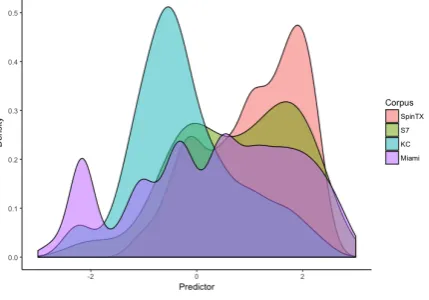
We fit a logistic regression to predict AGREE (i.e., there is an ML upon which all three measures agree) with three continuous predictor variables (M-Index, I-Index, Burstiness) and one categori-cal predictor (Corpus). An analysis of the model output revealed significant variability as to the ef-fect of the I-index depending on the corpus, vi-sualized in Figure1. To capture this variability, an interaction between Corpus * I-Index was added to the model. The updated model is able to correctly predict AGREE or DISAGREE across all corpora with an F1-score of 69.3%, as shown in predictor density plot of Figure2. All three metrics and the corpus as a categorical variable were significant in predicting agreement. The strongest predictors are the M-Index and Burstiness, with opposite effects, as seen in Figure3. The M-Index inversely affects agreement; as the M-Index increases, the determi-nations of the ML are less likely to agree. Con-versely, as the Burstiness increases, all three ML methods are more likely to agree. Plotting the
pre-dictors for each sentence yields Figure 4, which shows the model’s prediction of agreement for the data from all four corpora.
Although the model does not cleanly split all sentences of KC and SpinTX by agreement, we do see a clear preference for predicting AGREE for SpinTX and DISAGREE for KC. However, we also find that the model predicts multi-modal agreement distributions for the S7 and Miami cor-pora. The small peaks around 0 indicate that the model does not have sufficient information to distinguish between predicting AGREE or DIS-AGREE for a small amount of data, which we dis-cuss below.
Figure 3: Odds Ratio Plot
Figure 4: Agreement Density over all Corpora
6 Discussion
[image:5.595.312.527.494.644.2]demonstrated that, collectively, these corpora span a range of types with some clearly intermediary between insertion and alternation. These interme-diary patterns may correspond to instances of con-gruent lexicalization, a mix of insertion and alter-nation (Muysken,2014).
Our model performance across all four corpora leads us to believe that language tagging is much more useful than previously thought and it may suffice in many cases for determining the ML. In fact, we can reliably predict the agreement of dif-ferent ML methods with an accuracy of 69.3% us-ing our metrics on language tags. The implica-tion is that researchers in linguistics and in NLP could use word-count alone to determine the ML as a good first-approximation depending on the type of mixing in their data. Corpora with spo-radic embeddings present an ideal case where the linguistic methods of determining ML often agree with word-count and these are likely to be prolific. In the Pangloss Collection of endangered Slavic languages in Europe, three of the six corpora contain less than 5% borrowed words (Adamou,
2016), a percentage that parallels the findings in other contact corpora of naturally produced speech (Treffers-Daller, 1994; Bullock et al., 2016; Ca-coullos and Aaron, 2003;Varra, 2013). But, the performance of the model on the S7 and Miami datasets indicate that our current metrics are not sufficient to predict agreement even when cor-pora have characteristics that indicate that they are largely insertional (low M-Index + high Bursti-ness). The uncertainty in the model predictions leads us to conclude that there is a continuum of mixing types within the existing typology of alter-national and insertional mixing.
7 Future Research
In on-going work, we need to examine the meth-ods of determining the ML in natural interactions in finer detail in order to determine which method is most likely to diverge from the other two. To further examine the viability of the MLF hypoth-esis, we are exploring other language pairings and analyzing the effectiveness of our current met-rics at clustering and comparing across corpora, although we are hampered by the lack of POS-tagged bilingual data from natural speech. In ad-dition, we are currently testing the performance of entropy-based measures (Guzm´an et al.,2017a) as predictors for ML agreement. Finally, the
per-formance of our model requires deeper syntac-tic analysis of the nature of mixing types and of the grammatical structures of the S7 and Miami datasets in particular.
References
Evangelia Adamou. 2016. A corpus-driven approach
to language contact: Endangered languages in a comparative perspective, volume 12. Walter de Gruyter GmbH & Co KG.
Peter Auer and Raihan Muhamedova. 2005. Embedded language’and ‘matrix language’in insertional
lan-guage mixing: Some problematic cases. Rivista di
linguistica, 17(1):35–54.
Kalika Bali, Jatin Sharma, Monojit Choudhury, and
Yogarshi Vyas. 2014. ”i am borrowing ya
mix-ing?” an analysis of english-hindi code mixing in
facebook. In Proceedings of the First Workshop
on Computational Approaches to Code Switching, pages 116–126.
Ruthanna Barnett, Eva Cod´o, Eva Eppler, Montse
Forcadell, Penelope Gardner-Chloros, Roeland
van Hout, Melissa Moyer, Maria Carme Torras, Maria Teresa Turell, Mark Sebba, et al. 2000. The lides coding manual: A document for preparing and analyzing language interaction data version 1.1–
july 1999. International Journal of Bilingualism,
4(2):131–271.
Gayatri Bhat, Monojit Choudhury, and Kalika Bali. 2016. Grammatical constraints on intra-sentential code-switching: From theories to working models.
arXiv preprint arXiv:1612.04538.
Jeffrey Blokzijl, Margaret Deuchar, and M Couto.
2017. Determiner asymmetry in mixed
nomi-nal constructions: The role of grammatical factors
in data from miami and nicaragua. Languages,
2(4):20.
Barbara E Bullock, Jacqueline Serigos, and
Almeida Jacqueline Toribio. 2016. The stratifica-tion of english-language lone-word and multi-word material in puerto rican spanish-language press
outlets. Spanish-English Codeswitching in the
Caribbean and the US, 11:171.
BE Bullock and AJ Toribio. 2013. The spanish in
texas corpus project. Center for Open Education
Resources and Language Learning (COERLL).
Rena Torres Cacoullos and Jessi Elana Aaron. 2003. Bare english-origin nouns in spanish: Rates,
con-straints, and discourse functions. Language
Varia-tion and Change, 15(3):289–328.
Kevin Donnelly and Margaret Deuchar. 2011. Using constraint grammar in the bangor autoglosser to dis-ambiguate multilingual spoken text.
Edit Doron. 1983. On a formal model of
code-switching. In Texas Linguistic Forum Austin, Tex., 22, pages 35–59.
Bj¨orn Gamb¨ack and Amitava Das. 2016. Comparing the level of code-switching in corpora. InLREC.
K-I Goh and A-L Barab´asi. 2008. Burstiness and mem-ory in complex systems. EPL (Europhysics Letters), 81(4):48002.
John J Gumperz. 1982.Discourse strategies, volume 1. Cambridge University Press.
Gualberto Guzm´an, Joseph Ricard, Jacqueline Serigos, Barbara E Bullock, and Almeida Jacqueline Toribio. 2017a. Metrics for modeling code-switching across corpora. Proc. Interspeech 2017, pages 67–71.
Gualberto A Guzm´an, Joseph Ricard, Jacqueline Seri-gos, Barbara Bullock, and Almeida Jacqueline
Toribio. 2017b. Moving code-switching research
toward more empirically grounded methods. In
CDH@ TLT, pages 1–9.
Gualberto A Guzman, Jacqueline Serigos, Barbara E Bullock, and Almeida Jacqueline Toribio. 2016. Simple tools for exploring variation in code-switching for linguists. InProceedings of the Sec-ond Workshop on Computational Approaches to Code Switching, pages 12–20.
Anupam Jamatia, Bj¨orn Gamb¨ack, and Amitava Das.
2015. Part-of-speech tagging for code-mixed
english-hindi twitter and facebook chat messages. InProceedings of the International Conference Re-cent Advances in Natural Language Processing, pages 239–248.
Aravind K Joshi. 1982. Processing of sentences with
intra-sentential code-switching. In Proceedings of
the 9th conference on Computational linguistics-Volume 1, pages 145–150. Academia Praha.
Judith L Klavans. 1985. The syntax of code-switching: Spanish and english. InProceedings of the Linguis-tic Symposium on Romance Languages, pages 213– 231. Benjamins.
Ying Li and Pascale Fung. 2013. Language model-ing for mixed language speech recognition usmodel-ing
weighted phrase extraction. In Interspeech, pages
2599–2603.
Ying Li, Yue Yu, and Pascale Fung. 2012. A
mandarin-english code-switching corpus. In LREC, pages
2515–2519.
Yu Liu. 2008. Evaluation of the matrix language
hypothesis: Evidence from chinese-english
code-switching phenomena in blogs. Journal of Chinese
Language and Computing, 18(2):75–92.
Felicity Meakins. 2011.Case-marking in contact: The
development and function of case morphology in Gurindji Kriol, volume 39. John Benjamins Pub-lishing.
Pieter Muysken. 2000. Bilingual speech: A typology
of code-mixing, volume 11. Cambridge University Press.
Pieter Muysken. 2014. Deja voodoo or new trails
ahead. Linguistic Variation: Confronting Fact and
Theory, page 242.
Carol Myers-Scotton. 1997. Duelling languages:
Grammatical structure in codeswitching. Oxford University Press.
Kazuhiko Namba. 2012. Non-insertional
code-switching in english–japanese bilingual children: al-ternation and congruent lexicalisation.International Journal of Bilingual Education and Bilingualism, 15(4):455–473.
Joakim Nivre, Marie-Catherine de Marneffe, Filip Ginter, Yoav Goldberg, Jan Hajic, Christopher D Manning, Ryan T McDonald, Slav Petrov, Sampo Pyysalo, Natalia Silveira, et al. 2016. Universal de-pendencies v1: A multilingual treebank collection.
InLREC.
Shana Poplack. 1980. Sometimes i’ll start a sentence in spanish y termino en espanol: toward a typology of code-switching1.Linguistics, 18(7-8):581–618.
Shana Poplack, David Sankoff, and Christopher Miller. 1988. The social correlates and linguistic processes of lexical borrowing and assimilation.
Suzanne Romaine. 1995. Bilingualism.
Wiley-Blackwell.
Helmut Schmid. 1995. Treetagger— a language
independent part-of-speech tagger. Institut f¨ur
Maschinelle Sprachverarbeitung, Universit¨at Stuttgart, 43:28.
Royal Sequiera, Monojit Choudhury, and Kalika Bali. 2015. Pos tagging of hindi-english code mixed text from social media: Some machine learning
exper-iments. In Proceedings of the 12th International
Conference on Natural Language Processing, pages 237–246.
Arnav Sharma and Raveesh Motlani. 2015. Pos tag-ging for code-mixed indian social media text: Sys-tems from iiit-h for icon nlp tools contest.
Sunayana Sitaram and Alan W Black. 2016. Speech synthesis of code-mixed text.
Thamar Solorio and Yang Liu. 2008a. Learning to
pre-dict code-switching points. In Proceedings of the
Conference on Empirical Methods in Natural Lan-guage Processing, pages 973–981. Association for Computational Linguistics.
Thamar Solorio and Yang Liu. 2008b. Part-of-speech tagging for english-spanish code-switched text. In
Proceedings of the Conference on Empirical Meth-ods in Natural Language Processing, pages 1051– 1060. Association for Computational Linguistics.
Almeida J Toribio and Barbara E Bullock. 2016. A new look at heritage spanish and its speakers. Advances in Spanish as a Heritage Language, 49:27–50.
Jeanine Treffers-Daller. 1994. Mixing two languages:
French-Dutch contact in a comparative perspective, volume 9. Walter de Gruyter.
Rachel Marie Varra. 2013. The Social Correlates of
Lexical Borrowing in Spanish in New York City.
ERIC.
Yogarshi Vyas, Spandana Gella, Jatin Sharma, Ka-lika Bali, and Monojit Choudhury. 2014. Pos tag-ging of english-hindi code-mixed social media
con-tent. In Proceedings of the 2014 Conference on
Empirical Methods in Natural Language Processing (EMNLP), pages 974–979.