Proceedings of the BioNLP 2019 workshop, pages 319–327 319
ScispaCy: Fast and Robust Models
for Biomedical Natural Language Processing
Mark Neumann, Daniel King, Iz Beltagy, Waleed Ammar
Allen Institute for Artificial Intelligence, Seattle, WA, USA
{markn,daniel,beltagy,waleeda}@allenai.org
Abstract
Despite recent advances in natural language processing, many statistical models for pro-cessing text perform extremely poorly un-der domain shift. Processing biomedical and clinical text is a critically important applica-tion area of natural language processing, for which there are few robust, practical, publicly available models. This paper describes scis-paCy, a new Python library and models for practical biomedical/scientific text processing, which heavily leverages the spaCy library. We detail the performance of two packages of models released in scispaCy and demonstrate their robustness on several tasks and datasets. Models and code are available athttps:// allenai.github.io/scispacy/.
1 Introduction
The publication rate in the medical and biomedical sciences is growing at an exponential rate ( Born-mann and Mutz, 2014). The information over-load problem is widespread across academia, but is particularly apparent in the biomedical sciences, where individual papers may contain specific dis-coveries relating to a dizzying variety of genes, drugs, and proteins. In order to cope with the sheer volume of new scientific knowledge, there have been many attempts to automate the process of ex-tracting entities, relations, protein interactions and other structured knowledge from scientific papers (Wei et al.,2016;Ammar et al.,2018;Poon et al.,
2014).
Although there exists a wealth of tools for processing biomedical text, many focus primar-ily on named entity recognition and disambigua-tion. MetaMap and MetaMapLite (Aronson,2001;
[image:1.595.308.529.222.388.2]Demner-Fushman et al., 2017), the two most widely used and supported tools for biomedical text processing, support entity linking with nega-tion detecnega-tion and acronym resolunega-tion. However,
Figure 1: Growth of the annual number of cited ref-erences from 1650 to 2012 in the medical and health sciences (citing publications from 1980 to 2012). Fig-ure from (Bornmann and Mutz,2014).
tools which cover more classical natural language processing (NLP) tasks such as the GENIA tag-ger (Tsuruoka et al., 2005;Tsuruoka and Tsujii,
2005), or phrase structure parsers such as those presented inMcClosky and Charniak(2008) typi-cally do not make use of new research innovations such as word representations or neural networks.
In this paper, we introduce scispaCy, a spe-cialized NLP library for processing biomedical texts which builds on the robust spaCy library,1 and document its performance relative to state of the art models for part of speech (POS) tag-ging, dependency parsing, named entity recogni-tion (NER) and sentence segmentarecogni-tion. Specifi-cally, we:
• Release a reformatted version of the GENIA 1.0 (Kim et al., 2003) corpus converted into Universal Dependencies v1.0 and aligned with the original text from the PubMed ab-stracts.
Model Vocab Size Vector Count
Min Word Freq
Min Doc Freq
[image:2.595.307.516.63.189.2]en core sci sm 58,338 0 50 5 en core sci md 101,678 98,131 20 5
Table 1: Vocabulary statistics for the two core packages in scispaCy.
• Benchmark 9 named entity recognition mod-els for more specific entity extraction ap-plications demonstrating competitive perfor-mance when compared to strong baselines.
• Release and evaluate two fast and convenient pipelines for biomedical text, which include tokenization, part of speech tagging, depen-dency parsing and named entity recognition.
2 Overview of (sci)spaCy
In this section, we briefly describe the models used in the spaCy library and describe how we build on them in scispaCy.
spaCy. The Python-based spaCy library ( Hon-nibal and Montani, 2017)2 provides a variety of practical tools for text processing in multiple lan-guages. Their models have emerged as the defacto standard for practical NLP due to their speed, ro-bustness and close to state of the art performance. As the spaCy models are popular and the spaCy API is widely known to many potential users, we choose to build upon the spaCy library for creating a biomedical text processing pipeline.
scispaCy. Our goal is to develop scispaCy as a robust, efficient and performant NLP library to satisfy the primary text processing needs in the biomedical domain. In this release of scispaCy, we retrain spaCy3models for POS tagging, depen-dency parsing, and NER using datasets relevant to biomedical text, and enhance the tokenization module with additional rules. scispaCy contains two core released packages: en core sci sm and
en core sci md. Models in the en core sci md
package have a larger vocabulary and include word vectors, while those inen core sci smhave a smaller vocabulary and do not include word vec-tors, as shown in Table1.
2
Source code at https://github.com/ explosion/spaCy
3scispaCy models are based on spaCy version 2.0.18
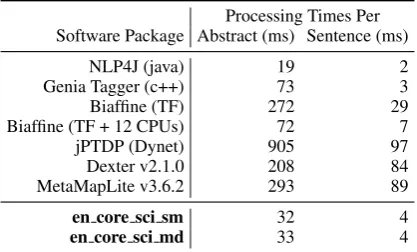
Processing Times Per Software Package Abstract (ms) Sentence (ms)
NLP4J (java) 19 2 Genia Tagger (c++) 73 3 Biaffine (TF) 272 29 Biaffine (TF + 12 CPUs) 72 7 jPTDP (Dynet) 905 97 Dexter v2.1.0 208 84 MetaMapLite v3.6.2 293 89
en core sci sm 32 4
en core sci md 33 4
Table 2: Wall clock comparison of different publicly available biomedical NLP pipelines. All experiments run on a single machine with 12 Intel(R) Core(TM) i7-6850K CPU @ 3.60GHz and 62GB RAM. For the Biaffine Parser, a pre-compiled Tensorflow binary with support for AVX2 instructions was used in a good faith attempt to optimize the implementation. Dynet does support the Intel MKL, but requires compilation from scratch and as such, does not represent an “off the shelf” system. TF is short for Tensorflow.
Processing Speed. To emphasize the efficiency and practical utility of the end-to-end pipeline pro-vided by scispaCy packages, we perform a speed comparison with several other publicly available processing pipelines for biomedical text using 10k randomly selected PubMed abstracts. We report results with and without segmenting the abstracts into sentences since some of the libraries (e.g., GENIA tagger) are designed to operate on sen-tences.
As shown in Table 2, both models released in scispaCy demonstrate competitive speed to pipelines written in C++ and Java, languages de-signed for production settings.
Whilst scispaCy is not as fast as pipelines designed for purely production use-cases (e.g., NLP4J), it has the benefit of straightforward in-tegration with the large ecosystem of Python li-braries for machine learning and text processing. Although the comparison in Table2is not an ap-ples to apap-ples comparison with other frameworks (different tasks, implementation languages etc), it is useful to understand scispaCy’s runtime in the context of other pipeline components. Running scispaCy models in addition to standard Entity Linking software such as MetaMap would result in only a marginal increase in overall runtime.
3 POS Tagging and Dependency Parsing
The joint POS tagging and dependency parsing model in spaCy is an arc-eager transition-based parser trained with a dynamic oracle, similar to
Goldberg and Nivre (2012). Features are CNN representations of token features and shared across all pipeline models (Kiperwasser and Goldberg,
2016;Zhang and Weiss,2016). Next, we describe the data we used to train it in scispaCy.
3.1 Datasets
GENIA 1.0 Dependencies. To train the depen-dency parser and part of speech tagger in both released models, we convert the treebank of Mc-Closky and Charniak(2008),4 which is based on the GENIA 1.0 corpus (Kim et al., 2003), to Universal Dependencies v1.0 using the Stanford Dependency Converter (Schuster and Manning,
2016). As this dataset has POS tags annotated, we use it to train the POS tagger jointly with the de-pendency parser in both released models.
As we believe the Universal Dependencies con-verted from the original GENIA 1.0 corpus are generally useful, we have released them as a sep-arate contribution of this paper.5 In this data re-lease, we also align the converted dependency parses to their original text spans in the raw, un-tokenized abstracts from the original release,6and include the PubMed metadata for the abstracts which was discarded in the GENIA corpus re-leased by McClosky and Charniak (2008). We hope that this raw format can emerge as a resource for practical evaluation in the biomedical domain of core NLP tasks such as tokenization, sentence segmentation and joint models of syntax.
Finally, we also retrieve from PubMed the orig-inal metadata associated with each abstract. This includes relevant named entities linked to their Medical Subject Headings (MeSH terms) as well as chemicals and drugs linked to a variety of on-tologies, as well as author metadata, publication dates, citation statistics and journal metadata. We hope that the community can find interesting prob-lems for which such natural supervision can be used.
4
https://nlp.stanford.edu/˜mcclosky/ biomedical.html
5
https://github.com/allenai/ genia-dependency-trees
6Available athttp://www.geniaproject.org/
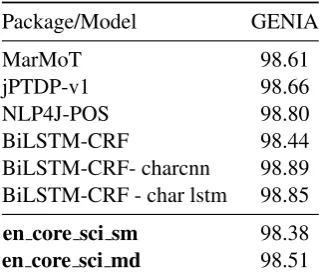
Package/Model GENIA
MarMoT 98.61
jPTDP-v1 98.66
NLP4J-POS 98.80 BiLSTM-CRF 98.44 BiLSTM-CRF- charcnn 98.89 BiLSTM-CRF - char lstm 98.85
en core sci sm 98.38
[image:3.595.336.498.62.200.2]en core sci md 98.51
Table 3: Part of Speech tagging results on the GENIA Test set.
Package/Model UAS LAS
Stanford-NNdep 89.02 87.56 NLP4J-dep 90.25 88.87
jPTDP-v1 91.89 90.27
Stanford-Biaffine-v2 92.64 91.23 Stanford-Biaffine-v2(Gold POS) 92.84 91.92
en core sci sm - SD 90.31 88.65
en core sci md - SD 90.66 88.98
en core sci sm 89.69 87.67
[image:3.595.308.523.248.406.2]en core sci md 90.60 88.79
Table 4: Dependency Parsing results on the GENIA 1.0 corpus converted to dependencies using the Stanford Universal Dependency Converter. We additionally pro-vide evaluations using Stanford Dependencies(SD) in order for comparison relative to the results reported in (Nguyen and Verspoor,2018).
OntoNotes 5.0. To increase the robustness of the dependency parser and POS tagger to generic text, we make use of the OntoNotes 5.0 corpus7 when training the dependency parser and part of speech tagger (Weischedel et al.,2011;Hovy et al.,2006). The OntoNotes corpus consists of multiple genres of text, annotated with syntactic and semantic in-formation, but we only use POS and dependency parsing annotations in this work.
3.2 Experiments
We compare our models to the recent survey study of dependency parsing and POS tagging for biomedical data (Nguyen and Verspoor,2018) in Tables3and4. POS tagging results show that both models released in scispaCy are competitive with state of the art systems, and can be considered of
7Instructions for download at http://cemantix.
equivalent practical value. In the case of depen-dency parsing, we find that the Biaffine parser of
Dozat and Manning (2016) outperforms the scis-paCy models by a margin of 2-3%. However, as demonstrated in Table2, the scispaCy models are approximately 9x faster due to the speed optimiza-tions in spaCy.8
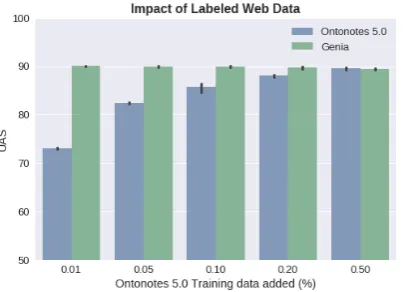
[image:4.595.75.278.408.554.2]Robustness to Web Data. A core principle of the scispaCy models is that they are useful on a wide variety of types of text with a biomedical fo-cus, such as clinical notes, academic papers, clin-ical trials reports and medclin-ical records. In order to make our models robust across a wider range of domains more generally, we experiment with incorporating training data from the OntoNotes 5.0 corpus when training the dependency parser and POS tagger. Figure2demonstrates the effec-tiveness of adding increasing percentages of web data, showing substantially improved performance on OntoNotes, at no reduction in performance on biomedical text. Note that mixing in web text dur-ing traindur-ing has been applied to previous systems - the GENIA Tagger (Tsuruoka et al., 2005) also employs this technique.
Figure 2: Unlabeled attachment score (UAS) perfor-mance for anen core sci md model trained with in-creasing amounts of web data incorporated. Table shows mean of 3 random seeds.
4 Named Entity Recognition
The NER model in spaCy is a transition-based system based on the chunking model from Lam-ple et al. (2016). Tokens are represented as hashed, embedded representations of the prefix, suffix, shape and lemmatized features of
individ-8We refer the interested reader toNguyen and Verspoor
(2018) for a comprehensive description of model architec-tures considered in this evaluation.
ual words. Next, we describe the data we used to train NER models in scispaCy.
4.1 Datasets
The main NER model in both released packages in scispaCy is trained on the mention spans in the MedMentions dataset (Murty et al., 2018). Since the MedMentions dataset was originally designed for entity linking, this model recog-nizes a wide variety of entity types, as well as non-standard syntactic phrases such as verbs and modifiers, but the model does not predict the entity type. In order to provide for users with more specific requirements around entity types, we release four additional packages
en ner {bc5cdr|craft|jnlpba|bionlp13cg} md
with finer-grained NER models trained on BC5CDR (for chemicals and diseases; Li et al.,
2016), CRAFT (for cell types, chemicals, pro-teins, genes;Bada et al.,2011), JNLPBA (for cell lines, cell types, DNAs, RNAs, proteins; Collier and Kim, 2004) and BioNLP13CG (for cancer genetics;Pyysalo et al.,2015), respectively.
4.2 Experiments
As NER is a key task for other biomedical text pro-cessing tasks, we conduct a through evaluation of the suitability of scispaCy to provide baseline per-formance across a wide variety of datasets. In par-ticular, we retrain the spaCy NER model on each of the four datasets mentioned earlier (BC5CDR, CRAFT, JNLPBA, BioNLP13CG) as well as five more datasets inCrichton et al.(2017): AnatEM, BC2GM, BC4CHEMD, Linnaeus, NCBI-Disease. These datasets cover a wide variety of entity types required by different biomedical domains, in-cluding cancer genetics, disease-drug interactions, pathway analysis and trial population extraction. Additionally, they vary considerably in size and number of entities. For example, BC4CHEMD (Krallinger et al., 2015) has 84,310 annotations while Linnaeus (Gerner et al., 2009) only has 4,263. BioNLP13CG (Pyysalo et al.,2015) anno-tates 16 entity types while five of the datasets only annotate a single entity type.9
Table5provides a thorough comparison of the scispaCy NER models compared to a variety of models. In particular, we compare the models to
9For a detailed discussion of the datasets and their
strong baselines which do not consider the use of 1) multi-task learning across multiple datasets and 2) semi-supervised learning via large pretrained language models. Overall, we find that the scis-paCy models are competitive baselines for 5 of the 9 datasets.
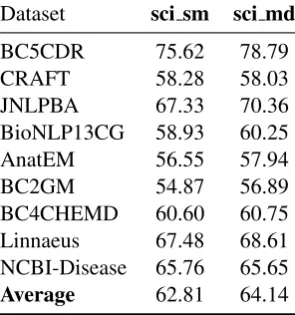
Additionally, in Table 6 we evaluate the recall of the pipeline mention detector available in both scispaCy models (trained on the MedMentions dataset) against all 9 specialised NER datasets. Overall, we observe a modest drop in average re-call when compared directly to the MedMentions results in Table7, but considering the diverse do-mains of the 9 specialised NER datasets, achieving this level of recall across datasets is already non-trivial.
Dataset sci sm sci md
BC5CDR 75.62 78.79 CRAFT 58.28 58.03 JNLPBA 67.33 70.36 BioNLP13CG 58.93 60.25 AnatEM 56.55 57.94 BC2GM 54.87 56.89 BC4CHEMD 60.60 60.75 Linnaeus 67.48 68.61 NCBI-Disease 65.76 65.65
Average 62.81 64.14
Table 6: Recall on the test sets of 9 specialist NER datasets, when the base mention detector is trained on MedMentions. The base mention detector is available in bothen core sci smanden core sci mdmodels.
Model Precision Recall F1
en core sci sm 69.22 67.19 68.19
[image:5.595.107.255.294.452.2]en core sci md 70.44 67.56 68.97
Table 7: Performance of the base mention detector on the MedMentions Corpus.
5 Candidate Generation for Entity Linking
In addition to Named Entity Recognition, scis-paCy contains some initial groundwork needed to build an Entity Linking model designed to link to a subset of the Unified Medical Language System (UMLS;Bodenreider,2004). This reduced subset is comprised of sections 0, 1, 2 and 9 (SNOMED) of the UMLS 2017 AA release, which are publicly
distributable. It contains 2.78M unique concepts and covers 99% of the mention concepts present in the MedMentions dataset (Murty et al.,2018).
5.1 Candidate Generation
To generate candidate entities for linking a given mention, we use an approximate nearest neigh-bours search over our subset of UMLS concepts and concept aliases and output the entities asso-ciated with the nearest K. Concepts and aliases are encoded using the vector of TF-IDF scores of character 3-grams which appears in 10 or more en-tity names or aliases (i.e., document frequency≥
10). In total, all data associated with the candi-date generator including cached vectors for 2.78M concepts occupies 1.1GB of space on disk.
Aliases. Canonical concepts in UMLS have
aliases - common names of drugs, alternative spellings, and otherwise words or phrases that are often linked to a given concept. Importantly, aliases may be shared across concepts, such as “cancer” for the canonical concepts of both “Lung Cancer” and “Breast Cancer”. Since the nearest neighbor search is based on the surface forms, it returns K string values. However, because a given string may be an alias for multiple concepts, the list of K nearest neighbor strings may not translate to a list of K candidate entities. This is the correct implementation in practice, because given a pos-sibly ambiguous alias, it is beneficial to score all plausible concepts, but it does mean that we can-not determine the exact number of candidate enti-ties that will be generated for a given value of K. In practice, the number of retrieved candidates for a given K is much lower than K itself, with the ex-ception of a few long tail aliases, which are aliases for a large number of concepts. For example, for K=100, we retrieve54.26±12.45candidates, with the max number of candidates for a single mention being 164.
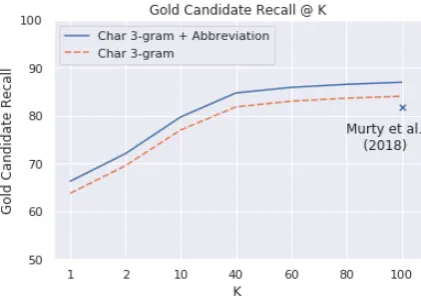
Abbreviations. During development of the can-didate generator, we noticed that abbreviated men-tions account for a substantial proportion of the failure cases where none of the generated candi-dates match the correct entity. To partially rem-edy this, we implement the unsupervised abbrevi-ation detection algorithm ofSchwartz and Hearst
(2002), substituting mention candidates marked as abbreviations for their long form definitions before searching for their nearest neighbours. Figure 3
Dataset Baseline SOTA + Resources sci sm sci md
BC5CDR (Li et al.,2016) 83.87 86.92b 89.69bb 78.83 83.92 CRAFT (Bada et al.,2011) 79.55 - - 72.31 76.17 JNLPBA (Collier and Kim,2004) 68.95 73.48b 75.50bb 71.78 73.21 BioNLP13CG (Pyysalo et al.,2015) 76.74 - - 72.98 77.60 AnatEM (Pyysalo and Ananiadou,2014) 88.55 91.61** - 80.13 84.14 BC2GM (Smith et al.,2008) 84.41 80.51b 81.69bb 75.77 78.30 BC4CHEMD (Krallinger et al.,2015) 82.32 88.75a 89.37aa 82.24 84.55 Linnaeus (Gerner et al.,2009) 79.33 95.68** - 79.20 81.74 NCBI-Disease (Dogan et al.,2014) 77.82 85.80b 87.34bb 79.50 81.65
[image:6.595.77.288.334.482.2]bb: LM model fromSachan et al.(2017)b: LSTM model fromSachan et al.(2017) a: Single Task model fromWang et al.(2018)aa: Multi-task model fromWang et al.(2018) **Evaluations use dictionaries developed without a clear train/test split.
Table 5: Test F1 Measure on NER for the small and medium scispaCy models compared to a variety of strong baselines and state of the art models. TheBaselineandSOTA(State of the Art) columns include only single models which do not use additional resources, such as language models, or additional sources of supervision, such as multi-task learning.+ Resourcesallows any type of supervision or pretraining. All scispaCy results are the mean of 5 random seeds.
Figure 3: Gold Candidate Generation Recall for differ-ent values of K. Note that K refers to the number of nearest neighbour queries, and not the number of con-sidered candidates. Murty et al.(2018) do not report this distinction, but for a given K the same amount of work is done (retrieving K neighbours from the index), so results are comparable. For all K, the actual number of candidates is considerably lower on average.
for various values of K nearest neighbours. Our candidate generator provides a 5% absolute im-provement over Murty et al.(2018) despite gen-erating 46% fewer candidates per mention on av-erage.
6 Sentence Segmentation and Citation Handling
Accurate sentence segmentation is required for many practical applications of natural language processing. Biomedical data presents many
dif-ficulties for standard sentence segmentation algo-rithms: abbreviated names and noun compounds containing punctuation are more common, whilst the wide range of citation styles can easily be misidentified as sentence boundaries.
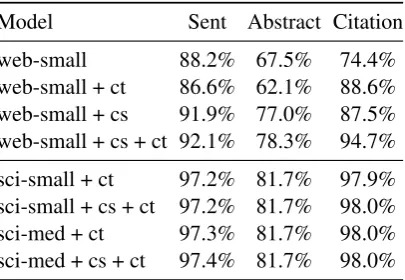
We evaluate sentence segmentation using both sentence and full-abstract accuracy when seg-menting PubMed abstracts from the raw, unto-kenized GENIA development set (the Sent/Ab-stractcolumns in Table8).
Additionally, we examine the ability of the seg-mentation learned by our model to generalise to the body text of PubMed articles. Body text is typically more complex than abstract text, but in particular, it contains citations, which are consid-erably less frequent in abstract text. In order to ex-amine the effectiveness of our models in this sce-nario, we design the following synthetic experi-ment. Given sentences from Cohan et al.(2019) which were originally designed for citation in-tent prediction, we run these sentences individu-ally through our models. As we know that these sentences should be single sentences, we can sim-ply count the frequency with which our models segment the individual sentences containing cita-tions into multiple sentences (theCitationcolumn in Table8).
a brittle, time consuming process, which we have replaced with a domain specific version of an ex-isting pipeline component.
Both scispaCy models are released with the cus-tom tokeniser, but without a cuscus-tom sentence seg-menter by default.
Model Sent Abstract Citation
web-small 88.2% 67.5% 74.4% web-small + ct 86.6% 62.1% 88.6% web-small + cs 91.9% 77.0% 87.5% web-small + cs + ct 92.1% 78.3% 94.7%
[image:7.595.81.284.155.295.2]sci-small + ct 97.2% 81.7% 97.9% sci-small + cs + ct 97.2% 81.7% 98.0% sci-med + ct 97.3% 81.7% 98.0% sci-med + cs + ct 97.4% 81.7% 98.0%
Table 8: Sentence segmentation performance for the core spaCy and scispaCy models. cs =custom rule based sentence segmenter andct=custom rule based tokenizer, both designed explicitly to handle citations and common patterns in biomedical text.
7 Related Work
Apache cTakes (Savova et al., 2010) was de-signed specifically for clinical notes rather than the broader biomedical domain. MetaMap and MetaMapLite (Aronson, 2001;Demner-Fushman et al., 2017) from the National Library of Medicine focus specifically on entity linking using the Unified Medical Language System (UMLS) (Bodenreider,2004) as a knowledge base. Buyko et al. adapt Apache OpenNLP using the GENIA corpus, but their system is not openly available and is less suitable for modern, Python-based work-flows. The GENIA Tagger (Tsuruoka et al.,2005) provides the closest comparison to scispaCy due to it’s multi-stage pipeline, integrated research con-tributions and production quality runtime. We im-prove on the GENIA Tagger by adding a full de-pendency parser rather than just noun chunking, as well as improved results for NER without com-promising significantly on speed.
In more fundamental NLP research, the GENIA corpus (Kim et al., 2003) has been widely used to evaluate transfer learning and domain adapta-tion. McClosky et al. (2006) demonstrate the ef-fectiveness of self-training and parse re-ranking for domain adaptation. Rimell and Clark (2008) adapt a CCG parser using only POS and lexical categories, whileJoshi et al.(2018) extend a
neu-ral phrase structure parser trained on web text to the biomedical domain with a small number of partially annotated examples. These papers focus mainly of the problem of domain adaptation it-self, rather than the objective of obtaining a robust, high-performance parser using existing resources. NLP techniques, and in particular, distant su-pervision have been employed to assist the cu-ration of large, structured biomedical resources.
Poon et al.(2015) extract 1.5 million cancer path-way interactions from PubMed abstracts, lead-ing to the development of Literome (Poon et al.,
2014), a search engine for genic pathway inter-actions and genotype-phenotype interinter-actions. A fundamental aspect ofValenzuela-Escarcega et al.
(2018) andPoon et al.(2014) is the use of hand-written rules and triggers for events based on de-pendency tree paths; the connection to the appli-cation of scispaCy is quite apparent.
8 Conclusion
In this paper we presented several robust model pipelines for a variety of natural language process-ing tasks focused on biomedical text. The scis-paCy models are fast, easy to use, scalable, and achieve close to state of the art performance. We hope that the release of these models enables new applications in biomedical information extraction whilst making it easy to leverage high quality syn-tactic annotation for downstream tasks. Addition-ally, we released a reformatted GENIA 1.0 cor-pus augmented with automatically produced Uni-versal Dependency annotations and recovered and aligned original abstract metadata. Future work on scispaCy will include a more fully featured entity linker built from the current candidate generation work, as well as other pipeline components such as negation detection commonly used in the clinical and biomedical natural language processing com-munities.
References
Alan R. Aronson. 2001. Effective mapping of biomed-ical text to the UMLS Metathesaurus: the MetaMap program. Proceedings. AMIA Symposium, pages 17–21.
Michael Bada, Miriam Eckert, Donald Evans, Kristin Garcia, Krista Shipley, Dmitry Sitnikov, William A. Baumgartner, K. Bretonnel Cohen, Karin M. Ver-spoor, Judith A. Blake, and Lawrence Hunter. 2011. Concept annotation in the CRAFT corpus. InBMC Bioinformatics.
Olivier Bodenreider. 2004. The unified medical lan-guage system (UMLS): integrating biomedical ter-minology. Nucleic acids research, 32 Database issue:D267–70.
Lutz Bornmann and R¨udiger Mutz. 2014. Growth rates of modern science: A bibliometric analysis. CoRR, abs/1402.4578.
Ekaterina Buyko, Joachim Wermter, Michael Poprat, and Udo Hahn. Automatically adapting an NLP core engine to the biology domain. In Proceedings of the ISMB 2006 Joint Linking Literature, Informa-tion and Knowledge for Biology and the 9th Bio-Ontologies Meeting.
Arman Cohan, Waleed Ammar, Madeleine van Zuylen, and Field Cady. 2019. Structural scaffolds for ci-tation intent classification in scientific publications. CoRR, abs/1904.01608.
Nigel Collier and Jin-Dong Kim. 2004. Introduction to the bio-entity recognition task at JNLPBA. In NLP-BA/BioNLP.
Gamal K. O. Crichton, Sampo Pyysalo, Billy Chiu, and Anna Korhonen. 2017. A neural network multi-task learning approach to biomedical named entity recog-nition. InBMC Bioinformatics.
Dina Demner-Fushman, Willie J. Rogers, and Alan R. Aronson. 2017. MetaMap Lite: an evaluation of a new Java implementation of MetaMap. Journal of the American Medical Informatics Association : JAMIA, 24 4:841–844.
Rezarta Islamaj Dogan, Robert Leaman, and Zhiyong Lu. 2014. NCBI disease corpus: A resource for dis-ease name recognition and concept normalization. Journal of biomedical informatics, 47:1–10.
Timothy Dozat and Christopher D. Manning. 2016. Deep biaffine attention for neural dependency pars-ing. CoRR, abs/1611.01734.
Martin Gerner, Goran Nenadic, and Casey M. Bergman. 2009. LINNAEUS: A species name iden-tification system for biomedical literature. InBMC Bioinformatics.
Yoav Goldberg and Joakim Nivre. 2012. A dynamic oracle for arc-eager dependency parsing. InColing 2012.
Matthew Honnibal and Ines Montani. 2017. spaCy 2: Natural language understanding with bloom embed-dings, convolutional neural networks and incremen-tal parsing. To appear.
Eduard H. Hovy, Mitchell P. Marcus, Martha Palmer, Lance A. Ramshaw, and Ralph M. Weischedel. 2006. OntoNotes: The 90% solution. In HLT-NAACL.
Vidur Joshi, Matthew Peters, and Mark Hopkins. 2018. Extending a parser to distant domains using a few dozen partially annotated examples. InACL.
Jin-Dong Kim, Tomoko Ohta, Yuka Tateisi, and Jun’ichi Tsujii. 2003. GENIA corpus - a semanti-cally annotated corpus for bio-textmining. Bioinfor-matics, 19 Suppl 1:i180–2.
Eliyahu Kiperwasser and Yoav Goldberg. 2016. Sim-ple and accurate dependency parsing using bidirec-tional lstm feature representations. Transactions of the Association for Computational Linguistics, 4:313–327.
Martin Krallinger, Florian Leitner, Obdulia Rabal, Miguel Vazquez, Julen Oyarz´abal, and Alfonso Va-lencia. 2015. CHEMDNER: The drugs and chemi-cal names extraction challenge. InJ. Cheminformat-ics.
Guillaume Lample, Miguel Ballesteros, Sandeep Sub-ramanian, Kazuya Kawakami, and Chris Dyer. 2016. Neural architectures for named entity recognition. InHLT-NAACL.
Jiao Li, Yueping Sun, Robin J. Johnson, Daniela Sci-aky, Chih-Hsuan Wei, Robert Leaman, Allan Peter Davis, Carolyn J. Mattingly, Thomas C. Wiegers, and Zhiyong Lu. 2016. BioCreative V CDR task corpus: a resource for chemical disease relation extraction. Database : the journal of biological databases and curation, 2016.
David McClosky and Eugene Charniak. 2008. Self-training for biomedical parsing. InACL.
David McClosky, Eugene Charniak, and Mark John-son. 2006. Reranking and self-training for parser adaptation. InACL.
Shikhar Murty, Patrick Verga, Luke Vilnis, Irena Radovanovic, and Andrew McCallum. 2018. Hi-erarchical losses and new resources for fine-grained entity typing and linking. InACL.
Dat Quoc Nguyen and Karin Verspoor. 2018. From POS tagging to dependency parsing for biomedical event extraction.arXiv preprint arXiv:1808.03731.
Hoifung Poon, Kristina Toutanova, and Chris Quirk. 2015. Distant supervision for cancer pathway ex-traction from text. Pacific Symposium on Biocom-puting. Pacific Symposium on Biocomputing, pages 120–31.
Sampo Pyysalo and Sophia Ananiadou. 2014. Anatomical entity mention recognition at literature scale. InBioinformatics.
Sampo Pyysalo, Tomoko Ohta, Rafal Rak, Andrew Rowley, Hong-Woo Chun, Sung-Jae Jung, Sung-Pil Choi, Jun’ichi Tsujii, and Sophia Ananiadou. 2015. Overview of the cancer genetics and pathway cu-ration tasks of BioNLP shared task 2013. InBMC Bioinformatics.
Laura Rimell and Stephen Clark. 2008. Adapting a lexicalized-grammar parser to contrasting domains.
InEMNLP.
Devendra Singh Sachan, Pengtao Xie, Mrinmaya Sachan, and Eric P. Xing. 2017. Effective use of bidirectional language modeling for transfer learn-ing in biomedical named entity recognition. In MLHC.
Guergana K. Savova, James J. Masanz, Philip V. Ogren, Jiaping Zheng, Sunghwan Sohn, Karin Kip-per Schuler, and Christopher G. Chute. 2010. Mayo clinical text analysis and knowledge extraction sys-tem (cTAKES): architecture, component evaluation and applications. Journal of the American Medical Informatics Association : JAMIA, 17 5:507–13.
Sebastian Schuster and Christopher D. Manning. 2016. Enhanced english universal dependencies: An im-proved representation for natural language under-standing tasks. InLREC.
Ariel S. Schwartz and Marti A. Hearst. 2002. A sim-ple algorithm for identifying abbreviation definitions in biomedical text. Pacific Symposium on Biocom-puting. Pacific Symposium on Biocomputing, pages 451–62.
Larry Smith, Lorraine K. Tanabe, Rie Johnson nee Ando, Cheng-Ju Kuo, I-Fang Chung, Chun-Nan Hsu, Y Lin, Roman Klinger, Christoph M. Friedrich, Kuzman Ganchev, Manabu Torii, Hongfang Liu, Barry Haddow, Craig A. Struble, Richard J. Povinelli, Andreas Vlachos, William A. Baumgart-ner, Lawrence E. Hunter, Bob Carpenter, Richard Tzong-Han Tsai, Hong-Jie Dai, Feng Liu, Yifei Chen, Chengjie Sun, Sophia Katrenko, Pieter Adri-aans, Christian Blaschke, Rafael Torres, Mariana Neves, Preslav Nakov, Anna Divoli, Manuel Ma˜na-L´opez, Jacinto Mata, and W. John Wilbur. 2008. Overview of BioCreative II gene mention recogni-tion. Genome Biology, 9:S2 – S2.
Yoshimasa Tsuruoka, Yuka Tateishi, Jin-Dong Kim, Tomoko Ohta, John McNaught, Sophia Ananiadou, and Jun’ichi Tsujii. 2005. Developing a robust part-of-speech tagger for biomedical text. InPanhellenic Conference on Informatics.
Yoshimasa Tsuruoka and Jun’ichi Tsujii. 2005. Bidi-rectional inference with the easiest-first strategy for tagging sequence data. InHLT/EMNLP.
Marco Antonio Valenzuela-Escarcega, Ozgun Babur, Gus Hahn-Powell, Dane Bell, Thomas Hicks, En-rique Noriega-Atala, Xia Wang, Mihai Surdeanu, Emek Demir, and Clayton T. Morrison. 2018. Large-scale automated machine reading discovers new cancer-driving mechanisms. InDatabase.
Xuan Wang, Yu Zhang, Xiang Ren, Yuhao Zhang, Marinka Zitnik, Jingbo Shang, Curtis P. Langlotz, and Jiawei Han. 2018. Cross-type biomedical named entity recognition with deep multi-task learn-ing.Bioinformatics.
Chih-Hsuan Wei, Yifan Peng, Robert Leaman, Al-lan Peter Davis, Carolyn J. Mattingly, Jiao Li, Thomas C. Wiegers, and Zhiyong Lu. 2016. As-sessing the state of the art in biomedical relation ex-traction: overview of the BioCreative V chemical-disease relation (CDR) task.Database : the journal of biological databases and curation, 2016.
Ralph Weischedel, Eduard Hovy, Martha Palmer, Mitch Marcus, Robert Belvin adn Sameer Prad-han, Lance Ramshaw, and Nianwen Xue. 2011. OntoNotes: A large training corpus for enhanced processing. In Joseph Olive, Caitlin Christian-son, and John McCary, editors,Handbook of Natu-ral Language Processing and Machine Translation. Springer.