Macroscopic Quantum Tunneling
Qiao Bi1, Kongzhi Song2
1Physics Department, Wuhan University of Technology, Wuhan, China 2Institute of Space Medico-Engineering, Beijing, China
Email: [email protected]
Received November 9, 2012; revised December 10, 2012; accepted December 18, 2012
ABSTRACT
In this work, a mechanism of macroscopic quantum tunneling is studied, which shows this sort of phenomena may exist even in the bio-field system. The relevant Davydov solitons fields and the Feynman digraph have been constructed based on the nonlinear Green function theory, which allows one to get a synchronous resonance model to explain the macroscopic quantum tunneling, such as in double potential wells system. Furthermore, the functional of quantum in-formation density can also be applied to drive the object into a type of soliton structure of quantum inin-formation density, which allows the system to possess property of the macroscopic quantum tunneling.
Keywords: Quantum Tunneling; Soliton; Quantum Information Density
1. Introduction
Since quantum mechanics established a theory that themicroscopic particles have certain probability to tunnel through a finite or infinity potential this issue has become a standard model described in the text book of quantum mechanics [1]. However, as development of recent years in many experiments for the Bose-Einstein condensation (BEC), nano-particle in quantum dots system, and so-matic science, the phenomena of macroscopic quantum tunneling (MQT) have been discovered in many works [2-9]. These results motivate a strongly disputed question that macroscopic tunneling is possible, so that after many years the investigation of mechanism for MQT become more and more significant. In this work, we firstly study a model of MQT for BEC in double potential wells de-scribed by the Grosse-Pitaevskii equation, then extend the model to a general situation by introducing a nonlin-ear quantum field considering a sort of nonlinnonlin-ear Green functions and a Feynman digraph. This allows a mecha-nism of MQT for a bio-solitons system interaction with the object to be proposed. Moreover, a driven model which generalize the above process by quantum informa-tion density (QID) descripinforma-tion is presented. We hope that the theory provided is useful to explain the phenomena of MQT, especially in the bio-solitons field system [10].
2. Macroscopic Quantum Tunneling of BEC
Let us consider two BEC systems are confined in the double potential wells, respectively. The BEC is de-scribed by the Grosse-Pitaevskii equation as
2
2
i ,
2 Vext g
t m
r (1)
where
4π ,
g m
(2)
is a
s wave scattering length among atoms. Then
there exist MQT happening as type of Josephson oscilla-tion for this system [3], so that a distribuoscilla-tion of the wave functions between two well sides is supposed as
,t a t
1 b t 2 , r r r (3)
1 and
r
where 2 r
are the wave function ofba-sic states, and a t
and b t
are the probability am- plitudes in two wells, respectively. Then, by replacing this equation into the Grosse-Pitaevskii Equation (1), one gets2 1
2 2
d 2 2
i ,
d
2 2
v c a
a a
b b
t v
c b
c
(4)
and v are defined by
where notice , 4
1 2
d , ,
cg
r (5)
2
21
d , 1, 2, 2
j j Vext j j
m
r r r r (6)and
1 2 1 2
1
2 d .
2 ext
v V
m
Since the solution for the equation
d i
dt b v
2 2 2 2 v a a b
a b ,
1,0(8)
at the initial condition , is given by [4]
2 2 2 2 22 2
1 sin ,
2
v t
a t v
v
(9)
2 22 2sin
v t b t v
hence a solution for Equation 4 is constructed as form
2 2 2 ,
2 v
(10) 2 2 2 2i sin ,
2 b
v t
f t v
v
(11)
which satisfies
23 2 2 2
2 2 d i d sin , 2 b b f t t v t
cf t v
v (12) and gives
2 2 22 2 2 2
2 2
2 2
2 2 2
2 2 2 2
1 2 2 3
d 1 2 i sin 1 2 2 2
2 2 1sin cos ,
2 2 2 2
b
t
v
v t
f t c v
v v
t
v
v t t
c v v
v
b (13)f t in Equation (11) is obtained as so that a solution
1 2 1
2 v2 3
v
2
2 2 2 2 2 2
1
i .
2 sin cos
2 2 2
b
f t
t t t
v c v v (14)
In the same way, one can get
3
2 2 2 22 2
d
i 1 sin ,
d a a 2
v t
f t cf t v
t v
(15)
which gives
2 2 2 2 22 2 2 2
2 2 3
d
cos ,
2 2 2 2
t v v t v v v 2
2 2 2
2 2
2 2
2
1
1 2
i 1 sin
1
2 2
2
2 2 1sin
a
v t
f t c v
v t v v t c t
(16)and allows one to obtain fa
t as
1 2 i . v 22 2 2 2 2 2
1 2 2 3
1 1
2
sin cos
2 2 2
a
f t
c v t t t
t v v
Therefore one has
3 2
2
2 2
2 2
d d
d d d
i i
d d
d
d d
2 2
2 2
2 2
2 2
a a
a
b
b b
a a a
b b
a
a
a b
a t f t f t a t
f t a t t t
f t b t
t
b t f t f t b t
t t
v
f t a t ca t f t a t f t b t
v 3 2
b
f t a t f t b t cb t
v
c f a
a t f t
b t f t
v
c f b
,
f t b t
(18)
which proves that the solutions for Equation (4) are expressed by
, .
a
b
f t a t
f t b t
a tb t
(19)
From the solution
a t b t,
we find that the nonlinear BEC tunneling oscillation is not like the linear Josephson sin oscillation because it contains kind of en-velop functions fa
t and fb
t
i ,ˆ , , e t ,
t t
r
r r
. This shows a soliton type of structure in the oscillation which may have self confinement phenomena appearance under strongly nonlinear situation as support from the experiments pre-sented in Ref. [4].
The above result explains that the system of EBC which satisfies the Grosse-Pitaevskii equation described micro-particles self confined as local solitons can be as the quasiparticles. Thus the symmetry of total system automatic broken and energy decrease to low level so that the particles together create coherence to condensate into the lower momentum state as solitons of BEC. These solitons can tunnel as sort of nonlinear oscillation through high potentials.
3. Nonlinear Quantum Field
The previously studied model can be extended as a gen-eral frame of biological quantum field to interact with object. This biological field assumed to consists of D-P solitons, nonlinear excitations, and so on [10] as men-tioned in the previously works [11,12]. For simplicity, here we only call them as “soliton”. One of important techniques to study this quantum field needs to be able to handle operator series product. Although the Green func-tion theory to describe quantum field have made plentiful progresses [13], however, it currently can only handle the linear operator series product, while the handling of the nonlinear operator series product remains great chal-lenges. Actually, using the linear approximation methods
lead to the relevant calculation procedures which is quit complicated and enables some information for new nonlinear biological excitation easily to be lost in the process. This provides an inspiration to search new nonlinear mathematical methods and establish nonlinear propagator theory [14,15]. Consequently, the nonlinear Green function and the slash product are introduced. For this let us second quantize a state of soliton as a nonlin-ear quantum field operator
(20)
which satisfies a quantum nonlinear Schrödinger equa-tion
2 2
ˆ ˆ ˆ
i , , ,
ˆ , ˆ , ˆ ,
ext
t t V t
t x
g t t t
r r r
r r r
(21)
with the commutation relations
ˆ , , ˆ , ˆ , ˆ ,
,
t t t t
r r r r
r r
(22)
and
ˆ ,t ˆ ,t ˆ ,t ˆ ,t 0,
r r r r (23)
where r,t
is an amplitude and
r,t is a phaseoperator, and
a b a b b a , a ba
is defined as the slash product introduced by Charles Schwartz [12] be-tween and b:
20 1
lima b a
a b O
(24)
For example, if a creation operator (annihilationop-erator) is given by the Fourier transformation of ˆ ,
r t
i1 ˆ , e d
2π t
, ,a t
r r
r (25)and
i1 ˆ
, e
2π t
d
, ,a t
rr r (26)
then the commutation relations are
, , ,
a t a t
r r r r (27)
and
, ,
,
, 0,a t a t a t a t
r r r r (28)
Thus in the Schrödinger picture, Equation (21) is ex-pressed as
i t S t ,
t
S
(29)
where is defined as
ˆ ˆ
ˆ ˆ ˆ ˆ
d .
S c
r r r r r r r
r r (30)
Furthermore, if Equation (29) can be written as
0 int
ˆ , ˆi
t
a,b
U t t
(31)
then a nonlinear propagator is constructed by
0
0
ˆ int; ,t ta b U t ta, b ˆ ; ,t ta b ,
(32) which gives
1 1 2
, d d , , , ,
a b n int a n int a n int a int a b
n
U t t
t
t t t t t t t t tint
exp ad , ,
b t
a t
T t t t
(33)
where T
1
b n b
t t t t
is defined as a time order operator for the
slash product at . is defined as
the Heaviside function. So, a operator in the interac-tion picture can be introduced by
S
0 0
† †
0 , 0 exp d , exp d ,0 exp d ,
t t t
int int int
t t t
U t t T t t t T t t t T t
,
SU t t
. (34)Thus, the various of Green functions can be introduced based on the above formalism, such as for any operator A and , the Bogoliubov retarded Green function is defined as
B
, i
r
G t t tt A t B t
,
0,
= ; ,
i A t B t B t A t t t
t t
A t B t
(35)
where represents expectation under the interaction picture in the statistical ensembles, i.e. in the canonical
ensembles
e H
,1
A Z Tr A
e H
Z Tr
(36)
(37)
with 1
B k T
. Moreover, a n-points Green function can
also be defined as
1, ,
i n 1 0 ˆ
1 ˆ
0 ,H H H H
G n T n
0
(38)
where H is a Heisenberg basic state; then a 2-point
Green function is given by
0 0
0 0
0 0
ˆ ˆ
1, 2 i 1 2
ˆ 1 ˆ 2
i ,
H H H H
I I
G T
T S
S
(39)
where ,0 0
S0 U H is introduced in the adia-batic hypothesis. Moreover, a spectral theorem in the form of the slash product is given by
2 Im 1
d ,
2π e 1
r
G
B A
(40)
G tr t 0r
G is the Fourier transformation of
where .
4. Nonlinear Synchronous Resonance
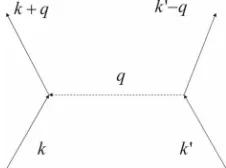
of solitons by micro-vibration of its atoms or molecules is emerged in the nonlinear excitation field. The surround NEF can interact with the solitons in the object by ad-justing its solitons to have almost the same state, energy, information and shape as that of the object through “breath” virtual Bose (such as phonon). This process is shown in Figure 1. When the solitons from NEF
[image:5.595.365.478.87.171.2]propa-gate to the range of the solitons of object, the solitons of NEF emit quanta as imaginary Bose (such as phonon) into the solitons of the object, so that the both soliton amplitudes and velocities appear to have strong coher-ence. This virtual phonon exchange constitutes a similar “breathing” of the interaction. In this process, the syn-chronous resonance among them happen. Consider the above assumption of model, here we firstly define the soliton in the object as O-soliton and the solitons in NEF as
Figure 1. The exchange of a virtual quanta q between soli-ton k and solisoli-ton k’.
, ,
sd q k q k q k q k
k k q
H Aa C C Ba C C
. (41)The exchange interaction can be described by the Figure 1, which shows, in the microscopic level, it is possible by
adjusting k represented a wave vector of the soliton from
NEF emits a , to permit the wave vector of soliton from the object to be equal to after absorption of a , so that
q
k q
k q k q
F-soliton. Since the surround -solitons are highly coherent with
O
F-soliton in the local position, the
-soliton can easily absorb quanta from the surround
O
F -soliton field, and then emit quanta to return the F-soliton field, as “breath”. When the quanta from F- soliton field transmit into a -soliton, it allows the
-soliton to expand and re-excit the weak part with O
O
F-soliton. In fact, it is known that the vibration of the D-P soliton in local position is as kind of electromagnetic wave in the sub-millimeter wave or far-infrared wave whose frequency change with the composition change of the frequency of partial chain of protein. If the fre-quency of the quanta is the same as the frefre-quency in partial chain of protein, then there is a resonance to ex-cite the partial chain of solitons in the object. Hence, the exchange process of the quanta allows -soliton to have the same status with the
O
F-soliton in NEF. The interaction Hamiltonian of the system in the momentum (wave vector k, or q) space is supposed to be given by
(42) This allows the solitons in the object are strongly cor-related with NEF and having synchronous resonances with NEF, which enable the object possibly to enter a kind of status of condensation or coherence as NEF. Then a macroscopic quantum tunneling for the object becomes possible.
This can still be described by the above double poten-tial wells model as the distribution of the wave functions appear in two potential wells, e.g.
1 2ˆ ,t a t ˆ b t ˆ
r r r (43)
where 1 r
represents a wave function of the solitonin NEF, and 2
r represents a wave function ofsoli-ton in the object. Then, by using quantum nonlinear Schrodinger equation again, one gets the solution being similar to Equation (19), thus we obtain
2
2 2 2
2 2
2 2
2
2 2 2 2 2 2
1 2 2 3
1 sin
1 2 ,
2 sin cos
2 2 2
v t
v v
a
c v t t t
t v v v
v
2
a
a f (44)
and
2 2
13 2 2 22 2
2
2 2
2 2 2 2 2 2
1 sin
1 2 ,
2 sin cos
2 2 2
t
v v
v
b f b
t t t
c
v v v
b (45)
which shows it is a complicated anharmonic oscillation with many frequencies. One amplitude is
2 2 2 3
1
2c v
c
(46)
showing , , and increase with the amplitude decrease. Where notice here
v
j
and may be not
related to ,
v
ext
V
21
d , 1, 2, 2
j j j
m
[image:5.595.126.537.524.658.2]
1 2
2 r r dr,
c
1 2
v
m
(48)and reflects a nonlinear coupling. This means an ob-ject with small mass finally will be easier to confine in another well (or tunneling out of its original well) by a strong nonlinear interaction (from NEF) under the condi-tion of the double potential wells distribucondi-tion of the soli-tons plus NEF. This is supposed by the phenomena of the self-trapping in BEC experiments as mentioned before. While here we want to emphasize that this model is also supported by many phenomena from experiments of the somatic science, such as Refs. [7,8,16].
5. QID Driving
Generally, the above model can be extended by using of the concept of quantum information density described by the Liouville equation [12]. Indeed, the Liouville equa-tion for quantum informaequa-tion can be derived by directly starting from quantum Liouville equation: by using power series of expansion of the density operator , one gets a Liouville equation for the general functional of
, such as I
ln constructed by
,
.H I
i I
t
(49)
The physical meaning of the above equation can be explained as “a QID representation of Liouville equa- tion”, where I
corresponding to a sort of generalQID, especially I
ln [17]. In this sense can be considered as a minimum unit of the quantum infor-mation density. Besides, the classical situation can also be proved by using the same way.The above derived QID representation of Liouville equation coincides with the traditional Liouville equation, therefore it can not describe an irreversible process since its time evolution is symmetric by inheriting from the Liouville equation [13], however, from the point of view of thermodynamical second law we can introduce a dif-ference (or gradient) of QID to allow
d ln ln
i ,
dt t H
ln V
0,
V
(50)
where is assumed to be introduced by a differ-ence (or gradient) of QID.
Because QID is just the negative entropy density, the above expression is like a microscopic representation of thermodynamical second law: when the QID in the two coupled systems are not equal to each other, then there exists a difference (or gradient) of QID will spontane-ously drive the higher QID to transmit to the lower QID until the both arriving at equilibrium. Moreover, if
V is a functional of of the object, (such as)
through a mechanism of synchronous resonance
pro-posed above, then it can drive the object to enter kind of soliton status so that MQT is possible. In fact for a quan-tum system, if one supposes a non-equilibrium Liouville equation is expressed as
0
d i , ,
dt t H R
e
(51)
F
where the density operator given by , then using the Baker-Hausdorf formula and applying the Magnus lemma [13] gives
d ln ,ln ,
dt R 1
times
, , , , ,
n n
(52)
where
x y x y y y
(53)
This allows one to gain
d ln
ln ln , ,
dt R R 1 V
(54)
R is chosen to satisfy
where
ln 0,R
(55)
ln
, 0.
1
R
Then a nonlinear Liouville equation is obtained as
0
i H , R ,
t
(56)
lnV R , such as, if V
sin lnwhere ,
then
0
i L sin .
t
(57)
This sort of nonlinear Liouville equation may have soliton type of solution. In this sense, the influence of NEF to the object can be realized through an information density driving R
. This arises a possibility: usingfunctional of as nonlinear driving, R
, from cer-tain natural or artificial source of NEF, then an object will enter sort of macroscopic quantum status to have possible MQT. This even can be realized by a series of nonlinear pules of . For instance, if a series of multi-plied pulses series can be transmitted from a source of NEF [18,19],
2 2
1 2
3 3
3
sin ,sin ,
sin , ,
t t
t
(58)
R expressed by
which allows a driving
sin
exp sin ,
n n
n n
n
R A t
t
(59)
where 1 !
n
n n
n
A , is adjusted by NEF. This
makes a complicated nonlinear oscillation of the QID to drive the original object probably to have soliton type of structure, hence the MQT is possible.
6. Conclusion
In conclusions, the macroscopic quantum tunneling (MQT) for the BEC system or solitons system are possible. One possible mechanism of MQT orientates from the syn-chronous resonance between the NEF and the object as the two potential wells system. This MQT shows com-plicated anharmonic oscillations and to have many dif-ferent frequencies. Moreover, the model can be extended as QID representation. The functional of nonlinear QID can be applied to drive the object into a type of soliton structure of QID, so that the MQT is possible.
REFERENCES
[1] D. J. Griffiths, “Introduction to Quantum Mechanics,” 2nd Edition, Addison-Wesley Press, Boston, 2004. [2] A. Smerzi, S. Fantoni, S. Giovanazzi, et al., “Quantum
Coherent Atomic Tunneling between Two Trapped Bose-Einstein Condensates,” Physical Review Letters,
Vol. 79, No. 25, 1997, pp. 4950-4953.
[3] M. Albiez, R. Gati, J. Fölling, et al., “Direct Observation of Tunneling and Nonlinear Self-Trapping in a Double Bosonic Josephson Junction,” Physical Review Letters,
Vol. 95, No. 1, Article ID: 010402.
[4] J. Liu, “Dynamics for the Bose-Einstein Condensation,” Science Press, Bejing, 2009.
[5] Z. L. Duan, B. X. Fan, et al., “Quantum Tunneling Time of a Bose-Einstein Condensate Traversing through a La-ser-Induced Potential Barrier,” Physical Review A, Vol. 81, No. 5, 2010, Article ID: 055602.
[6] G. Dekela, O. V. Farberovichb, A. Sofferc and V. Fleurov, “Nonlinear Dynamic Phenomena in Macroscopic Tun-neling,” Physica D, Vol. 238, No. 15, 2009, pp. 1475-
1481. doi:10.1016/j.physd.2008.06.013
[7] K. Z. Song, “The Existence and Significance of
Parapsy-Life Information Science (ISLIS), Vol. 17, No 1, 1999, pp.
198-214. [8] K. Z. Son
chological Function,” Journal of International Society of
g, R. L. Lan, X. G. Li and L. Z. Zhou, “The
ook of Nanophysics 3:
Nanoparti-tum Mechanics in
ons Return Life,” International Review
cteristics of
. Sondheimer, “Green’s Functions for reen Functions for Nonlinear Research of the Break through Spacial Obstacle Function, Create Somatic Science, 705-717,” Sichuan Educate Pub-lisher, Beijing, 1989.
[9] K. D. Sattler, “Handb
cles and Quantum Dots, Volume 3,” Taylor & Francis Group, CRC Press, New York, 2011.
[10] X. F. Pang and Y.-P. Feng, “Quan
Nonlinear Systems,” World Scientific Publishing, Singa-pore City, 2005.
[11] Q. Bi, “Bio-Solit
of Physics, Vol. 3, No. 5, 2009, pp. 278-288.
[12] Q. Bi, K. Z. Song and H. E. Ruda, “Chara
Coherence and Information for the Davydov Soliton Field,” Journal of Modern Physics, Vol. 3, No. 12, 2012,
pp. 1907-1913. [13] S. Doniach and E. H
Solid State Physicists,” The Benjamin/Cummings Com-pany, Inc., London, 1982.
[14] Q. Bi and H. E. Ruda, “G
Operators and Application to Quantum Computing,” Phy- sica A, Vol. 334, No. 3, 2004, pp. 459-476.
doi:10.1016/j.physa.2003.10.077
[15] Charles Schwartz, “Nonlinear Operators and Their Propa-gators,” Journal of Mathematical Physics, Vol. 38, No. 1,
1997, pp. 484-500. doi:10.1063/1.531829
[16] B. H. Wu, et al., “Introduction to Science of Human X. S. Xing and H. E. Ruda, “Dynamical Equations
A. D. Greentree, V. Ramakrishna and H.
. Steuernagel, J. Bo- Body,” Sichuan University Publishing House, Chengdu, 1998.
[17] Q. Bi,
for Quantum Information and Application in Information Channel,” Chinese Physics Letters, Vol. 7, No. 7, 2005,
pp. 1618-1621. [18] S. G. Schirmer,
Rabitz, “Quantum Control Using Sequences of Simple Control Pulses,” quant-ph/0105155.
[19] V. Ramakrishna, R. Ober, X. Sun, O