Nearest neighbor vector analysis of SDSS DR5
galaxy distribution
Yongfeng Wu1*, Weike Xiao2, Rongjun Mu2, David Batuski3, Andre Khalil4
1American Physical Society, Maryland, USA; *Corresponding Author: [email protected] 2Department of Astronautics Engineering, Harbin Institute of Technology, Harbin, China 3Department of Physics, University of Maine, Orono, USA
4Department of Mathematics, University of Maine, Orono, USA
Received 25 October 2012; revised 28 November 2012; accepted 10 December 2012
ABSTRACT
We present the nearest neighbor distance (NND) analysis of SDSS DR5 galaxies. We give NND results for observed, mock and random sample, and discuss the differences. We find the ob-served sample gives us a significantly stronger aggregation characteristic than the random sam-ples. Moreover, we investigate the direction of NND and find the direction has close relation with the size of the NND for the observed sam-ple.
Keywords:Nearest Neighbor Distance; Nearest Neighbor Vector; Anisotropy; SDSS DR5; Galaxy Distribution
1. INTRODUCTION
By the end of the 30s of last century, from the analysis of the position of galaxies on photographic film, Refer-ence [1] found that the distribution of galaxies is not random and they aggregate obviously. Reference [2] sta-tistically built simple galaxy clusters model with random distributions, but mismatched with the observation sig-nificantly. In the 50s, people [3,4] observed thousands of clusters, many constituted by large numbers of galaxies. Even when the galaxies seemed isolated, they still have kind of correlation and can be described by correlation function, power spectrum, and other mathematical tools. The use of correlation functions to describe galaxy clus-tering has become widespread in recent years [5,6]. The nearest neighbor [7,8] distance is an especially powerful tool to describe small scales structures, because it de-pends on all the moments of the correlation function [9], thus it is extremely useful for revealing some aspects hidden in the correlation functions [7]. Even if it only provides information of the clusters pattern within a rather restricted range of scales [10], interesting results were obtained when this method was applied to galaxy
data and also mock galaxy catalogs draw from N-body simulations [11].
Compared to previous research, a significant differ-ence of this paper is to develop the application of the Nearest Neighbor Vector (NNV) direction. Reference [12] mentioned that the angle of the two nearest neighbors of each galaxy can be used to discover the filaments. Here we regard the displacement between a galaxy and its nearest neighbor as a vector and discuss the direction distribution in the whole sphere. The motivation of this article is try to answer this question: is the universe clus-tered (by NND analysis)? If so, do galaxies have direc-tional preference to select the nearest neighbor? By the size and direction analysis of the nearest neighbor, we could get more recognition about the hierarchical uni-verse.
Our article is organized as follows: In Section 2 we present the nearest neighbor statistical scheme. In Sec-tion 3 we study the data from the SDSS DR5. We sum-marize the results in Section 4 and have conclusions in Section 5.
2. NEAREST NEIGHBOR VECTOR
ANALYSIS
Reference [13] proposed the concept of the distance field. Suppose a given galaxy is in a three-dimensional coordinate system with Cartesian coordinates x, y, z. Let
j be any other SDSS galaxy with Cartesian coordinates xj,
yj, zj. For each galaxy the distance to its nearest neigh- boring object ri is computed as [14]
2
2
min
i j j
r x x y y z zj 2
(1)
In this paper we simply use
i r r
n
(2)
total number of particles. According to [15], the random sample should have a value rE equal to 1 2
, theratio R r r E could be used to measure the deviation
from the random sample. For a random sample R = 1, for an extreme aggregation distribution (all points together),
R = 0.
We also consider the direction of each NND in the distance field; we call it NNV (nearest neighbor vectors). We first construct a sphere to include all samples and then split the whole sphere into 180 triangles and inves- tigate the distribution of NNV passing through each tri-angle. By analyzing the anisotropy of the NNV, we can find the footprint of the filaments and compare different samples in this way. The detailed description is in Sec-tion 4.
3. DATA
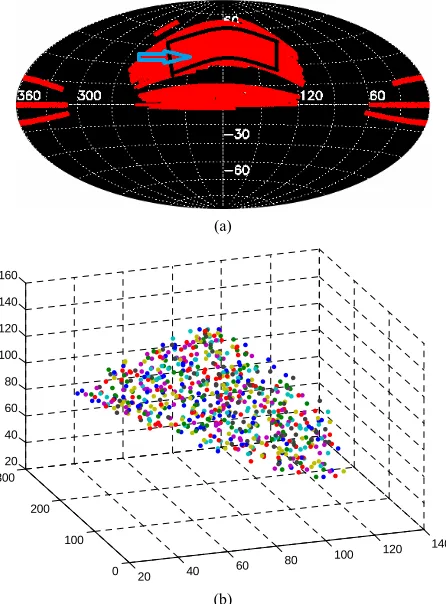
The Sloan Digital Sky Survey (SDSS) is one of the most ambitious and influential surveys in the history of astronomy. It is a major multi-filter imaging and spec-troscopic redshift survey using a dedicated 2.5-m wide- angle optical telescope at Apache Point Observatory in New Mexico, United States. We use the SDSS Data Re-lease 5 as our galaxy sample, the detailed information (include the Redshift-distance formula, and a mock sam-ple from Millennium Run Semianalytic Galaxy Cata-logue [16] can be found from the paper of [17,18]. About 35,700 galaxies have been used after applying volume- limiting selection (e.g., [19]), which will ensure the se-lected galaxy sample is substantially complete to our absolute magnitude limit M = −19.9. See Figure 1 for the geometry of the sample.
4. RESULTS
For the observed sample we get 1.95 Mpc for average nearest neighbor distance, for the mock sample, we get 2.3 Mpc, and for the random sample we get rE = 3.5 ± 0.005 Mpc (11 random samples with different seeds). Then we have
1.95 = =0.58
3.5 E r R
r
(3)
Clearly we can see observed sample has pronounced clustering on small scales compared with the random sample. Considering the extreme aggregation condition will have R = 0 and random sample has an R = 1, this observed sample is almost midway toward extreme ag-gregation. The clustering property of SDSS galaxies has been verified from various methods, such as two point correlation function [20-22]. The correlation length is about 5 - 7 Mpc [22] for Quasar and Luminous Red Gal-axies (QSO-LRG). Our results of the average NND focus on more kinds of galaxies than QSO-LRG and support
(a)
20 40
60 80 100
120 140
0 100 200 300
20 40 60 80 100 120 140 160
(b)
Figure 1. (a) SDSS sample geometry. The region inside the black “rectangle” of the figure is what we used; (b) 3D galaxy distribution, randomly (keep the original shape) selected hun-dreds galaxies from the observed sample.
this clustering property on small scale from a new way. The mock sample has a R = 0.66 in this measure value and is thus close to the observed sample.
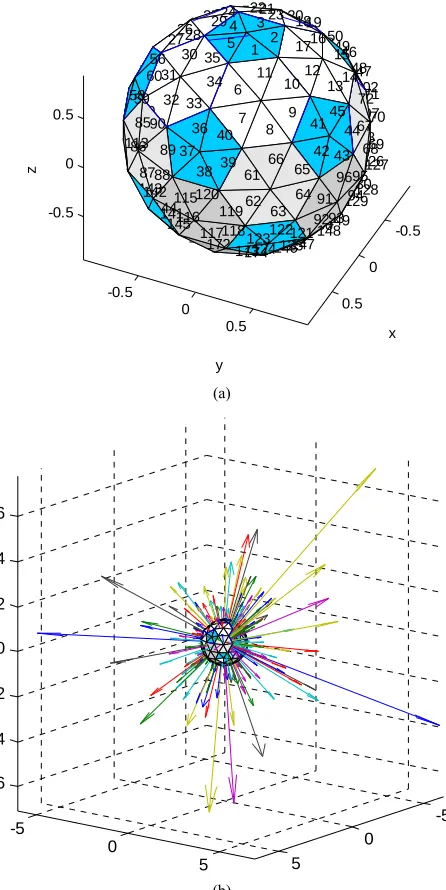
Interestingly our analysis of the direction of the NND for each galaxy shows that the observed sample has an anisotropy property. To investigate the directional prop-erty of the NNV, we assumed all directions begin from a single point at origin, we split the whole surface of a sphere around the origin into 180 triangles (we could use the healpix method [23] to partition the surface into equal area “pixels”, but the pixels are different triangular shape) displayed from the top to the bottom in the se-quence, see Figure 2.
[image:2.595.312.535.85.387.2]-0.5 0 0.5 -0.5 0 0.5 -0.5 0 0.5 x 129 130 126127 102 98 97 49 48 100 101 99 70 69 150 152 149 153 146151 156 157 155154 71 68 72 67 47 128 78 75 73 74 131 135 132 134 133 77 76 50 95 94 44 14 46 96 43 15 45 93 13 51
54555352 20
163 179 158 180 161 162 160 159 178 177 176 91 148 42 92 41 105 104 107 106 108 103 16 170 175 19 12 18 17 64 65 147 121 9 10 125 21 63 2 122 66 23 8 174 3 11 124 1 22 123 167 168 164 169 166165 62 61 139 136 137 140 138 8479 82 83 81 80 25 7 173 6 4 5 171 y 118 24 39 119 40 29 172 34 35 117 38 120 36 26 33 28 30 37 114 112 109 111 110 144 116 115 27 145 32 31 57 141 89 88 143 56 90 60 142 87 85 59 86 58 113 z (a) -5 0 5 -5 0 5 -6 -4 -2 0 2 4 6 (b)
Figure 2. (a) The triangle surface of the sphere, the blue parts are pentagons and the white parts are hexagons; (b) An example of a NNV figure, each arrow represents the direction of the nearest neighbor of each galaxy and the length of the arrow represents the value of the NND, here we only plot 270 NNVs.
We collect the NNV for all galaxies first, and then as we know the 3-D coordinates of the three vertexes of the each triangle and the direction of NNV, we could pre-cisely calculate which nearest neighbor vector crosses and plot them with the sequence of 180 triangles and get the distribution in Figure 3.
We also compute 11 random samples with different seeds to estimate the deviation. For all angles, mean value is 210 and we find that the average standard devia-tion (σ) is around 14 (maximum is 20) for all angles, in the following places all σare taken from here.
Here some peaks are separated only because the ar-rangement of 180 triangles is arbitrary, so even two ad-jacent triangles may have dozens of serial number dif-ference. Observed sample and mock sample looks very different at some specific triangles, but this is normal as the N-body simulation only simulate universe statistically, not exactly same with all details, such as the orientation of filaments. So we only focus on the global statistical properties from Figure 3(a), not specific angles.
From Figure 1, our sample geometry looks like a dis-torted solid angle; how does this affect the NNV analysis? Figure 3 clearly tells us we do not need to worry about it as random samples have almost same distribution on all 180 triangles with the same geometry of observe and mock sample.
In Figure 3 we clearly see observed sample has a
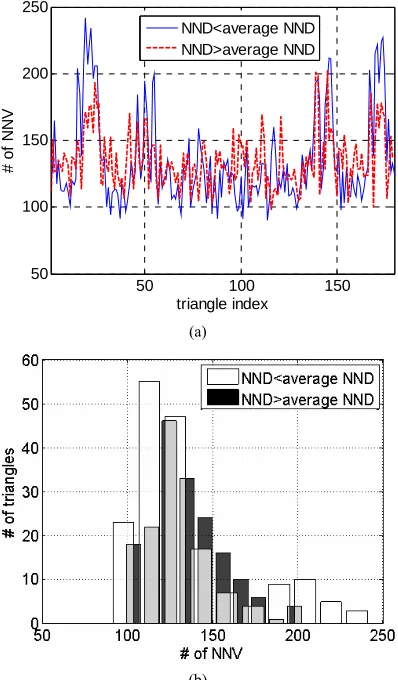
strong NNV distribution on some triangles, which are around triangle 20, 50 and corresponding opposite direc-tion triangle 140 and 170 (for pairs of galaxies, two NNV directions are opposite). To investigate the relation be-tween NNV and NND, we split galaxies into two groups, one has a smaller NND than average, and another has a
50 100 150
150 200 250 300 350 400 triangle index # o f NNV observe mock random (a) (b)
[image:3.595.61.284.86.531.2] [image:3.595.325.522.365.699.2]larger NND than average. We plot them in Figure 4 (two groups are normalized to have the same total number of NNVs).
We can see for smaller NND less than average, it dis-plays a stronger anisotropy than galaxies have larger NND than average from Figures 4(a) and (b).
5. CONCLUSIONS
We have calculated the average NND of the SDSS galaxy sample and mock samples. We find the observed sample has a lightly smaller NND than mock sample, but much smaller than random sample. This result indicates observed sample is more clustered in a special way. Moreover, we use a new method to investigate the direc-tion distribudirec-tion of NNV and find the NNV of observed sample has a global anisotropy and is similar with mock sample, but clearly different from random sample on some angles. Figure 3(b) shows the distribution of the random sample is like a delta function and this reflects the expected isotropic distribution. The result from the
50 100 150
50 100 150 200 250
triangle index
# o
f
N
N
V
NND<average NND NND>average NND
(a)
(b)
Figure 4. (a) NNV distribution for two kinds of galax-ies: one kind has NND < 1.95 (average NND), another has NND >1.95; (b) Corresponding histogram for 2 kinds of sample.
observed sample is more like a Poisson distribution and this leads us think about the Gaussian fluctuations of cosmic microwave background (CMB). Both of them show the anisotropy resulting from the evolution of the universe, but with somewhat different statistical property. Maybe it is because our sample size is limited and needs further observations.
As both NNV and NND display significant difference between observed and random sample, this makes us think whether the NNV and NND are correlated. Figures 4(a) and (b) show that galaxies with smaller NND have stronger antistrophic NNV.
To better understand the physical sense of the results above, we shall check on the hypothesis about a global isotropic universe. There is a distinct hierarchy on a lar-ger scale from a few hundred kpc to a few hundred Mpc [24]. Galaxies build up groups, clusters and superclusters, which in turn form a cellular structure of the Universe. We would expect the observed sample has strong clus-tering property and a smaller NND than random sample; this is coincident with the NND results we find. However, the results of NNV reflect the anisotropy of a hierarchi-cal universe in a very way more than the cluster property. Even in a much clustered point distribution, we still could get an isotropic NNV distribution, say, some sym-metric spherical galaxy clusters, or some thin filaments (assume the thickness only includes one galaxy) uni-formly distributed on all directions. So the NNV analysis provides a new way to distinguish how hierarchy is or-ganized for the universe and we find galaxies do have a directional preference to select the nearest neighbor in universe.
6. ACKNOWLEDGEMENTS
The project is supported by key laboratory opening funding of the Harbin Institute of Technology (HIT.KLOF. 2012.077).
REFERENCES
[1] Hubble, E.P. (1937) The observational approach to cos-mology. The Clarendon Press, Oxford.
[2] Neyman, J., Scott, E.L. and Shane, C.D. (1953) On the spatial distribution of galaxies: A specific model. Astro- physical Journal, 117, 92. doi:10.1086/145671
[3] Abell, G.O. (1958) The distribution of rich clusters of galaxies. A catalogue of 2712 rich clusters found on the National Geographic Society Palomar Observatory Sky Survey. Astrophysical Journal, 3, 211.
[4] Zwicky, F., Karpowicz, M., Kowal, C.T., Herzog, E. and Wild, P. (1961) Catalog of galaxies and of clusters of galaxies (CGCG) Calif. Institute of Technology, Pasadena, 196.
[image:4.595.73.272.344.684.2]185, 413-440.
[6] Cao, L., Liu, J.R. and Fang, L.Z. (2007) Estimating power spectrum of Sunyaev-Zeldovich effect from the cross-correlation between the wilkinson microwave anis-tropy probe and the two micron all sky survey. Astro- physical Journal, 661, 641-649. doi:10.1086/516775
[7] Ripley, B.D. (1981) Spatial statistics. Wiley, New York.
doi:10.1002/0471725218
[8] Baddeley, A.J., Kerscher, M., Schladitz, K. and Scott, B. (2000) Estimating the J function without edge correction. Statistica Neerlandica, 54, 1-14.
doi:10.1111/1467-9574.00143
[9] Bahcall, J. and Soneira R.M. (1981) The distribution of stars to V = 16th magnitude near the north galactic pole— Normalization, clustering properties, and counts in vari- ous bands. Astrophysical Journal, 246, 122-135.
doi:10.1086/158905
[10] Cressie, N. (1991) Statistics for spatial data. John Wiley & Sons, New York.
[11] Kerscher, M., et al. (1999) A global descriptor of spatial pattern interaction in the galaxy distribution. Astrophysi- cal Journal, 513, 543-548. doi:10.1086/306902
[12] Batuski, D.J. and Burns, J.O. (1985) A possible 300 megaparsec filament of clusters of galaxies in Perseus- Pegasus. Astrophysical Journal, 299, 5-14.
[13] Stavrev, K.Y. (1990) Large voids of rich clusters of gal- axies. Eötvös University, Eötvös, 115.
[14] Allam, S.S. (2005) A catalog of very isolated galaxies from the sloan digital sky survey data release 1. The As- tronomical Journal, 129, 2062-2073.
doi:10.1086/428754.
[15] Clark, P.J. and Evans, F.J. (1954) Distance to nearest neighbor as a measure of spatial relationships in popula-
tions. Ecology, 35, 445-453. doi:10.2307/1931034
[16] Croton, D.J., et al. (2006)The many lives of active galac-tic nuclei: Cooling flows, black holes and the luminosities and colours of galaxies. Monthly Notices of the Royal As-tronomical Society, 365, 11-28.
doi:10.1111/j.1365-2966.2005.09675.x
[17] Wu, Y., Batuski, D.J. and Khalil. A. (2009) Multi-scale morphological analysis of SDSS DR5 survey—Using the metric space technique. Astrophysical Journal, 707, 1160- 1167. doi:10.1088/0004-637X/707/2/1160
[18] Wu, Y., Batuski, D.J. and Khalil. A. (2012) Three dimen- sional filamentation analysis of SDSS DR5 Survey. ISRN Astronomy, 2012, Article ID: 171829.
[19] Davis, M. and Peebles, P.J.E. (1983) A survey of galaxy redshifts. V. The two-point position and velocity correla- tions. Astrophysical Journal, 267, 465-482.
doi:10.1086/160884
[20] Vasilyev, N.L. (2008) Correlation analysis of large-scale structure using data from the SDSS DR5 LRG catalog. Astrophysics, 51, 320-335.
[21] Ross, N.P., et al. (2009) Clustering of low-redshift (z ≤
2.2) quasars from the Sloan Digital Sky Survey. Astro- physical Journal, 697, 1634.
[22] Mountrichas, G., et al. (2009) QSO-LRG two-point cross- correlation function and redshift-space distortions. Mon- thly Notices of the Royal Astronomical Society, Vol. 394, 2050-2064.
[23] Calabretta, M.R. and Roukema, B.F. (2007) Mapping on the HEALPix grid.Monthly Notices of the Royal Astro- nomical Society, 1-8.
[24] Weinberg, D.H. (2005) Mapping the large-scale structure of the universe. Science, 309, 564.