Proceedings of the 55th Annual Meeting of the Association for Computational Linguistics, pages 1547–1556 Vancouver, Canada, July 30 - August 4, 2017. c2017 Association for Computational Linguistics Proceedings of the 55th Annual Meeting of the Association for Computational Linguistics, pages 1547–1556
Vancouver, Canada, July 30 - August 4, 2017. c2017 Association for Computational Linguistics
Combating Human Trafficking with Deep Multimodal Models
Edmund Tong*
Language Technologies Institute Carnegie Mellon University
Amir Zadeh*
Language Technologies Institute Carnegie Mellon University [email protected]
Cara Jones Marinus Analytics, LLC
Louis-Philippe Morency Language Technologies Institute
Carnegie Mellon University [email protected]
Abstract
Human trafficking is a global epidemic af-fecting millions of people across the planet. Sex trafficking, the dominant form of hu-man trafficking, has seen a significant rise mostly due to the abundance of escort web-sites, where human traffickers can openly advertise among at-will escort advertise-ments. In this paper, we take a major step in the automatic detection of advertise-ments suspected to pertain to human traf-ficking. We present a novel dataset called Trafficking-10k, with more than 10,000 ad-vertisements annotated for this task. The dataset contains two sources of informa-tion per advertisement: text and images. For the accurate detection of trafficking ad-vertisements, we designed and trained a deep multimodal model called the Human Trafficking Deep Network (HTDN).
1 Introduction
Human trafficking “a crime that shames us all” (UNODC,2008), has seen a steep rise in the United States since 2012. The number of cases reported rose from 3,279 in 2012 to 7,572 in 2016—more than doubling over the course of five years ( Hot-line). Sex trafficking is a form of human trafficking, and is a global epidemic affecting millions of peo-ple each year (McCarthy,2014). Victims of sex trafficking are subjected to coercion, force, and con-trol, and are not able to ask for help. Put plainly, sex trafficking is modern-day slavery and is one of the top priorities of law enforcement agencies at all levels.
A major advertising ground for human traffickers is the World Wide Web. The Internet has brought
* Authors contributed equally.
traffickers the ability to advertise online and has fostered the growth of numerous adult escort sites. Each day, there are tens of thousands of Internet advertisements posted in the United States and Canada that market commercial sex. Hiding among the noise of at-will adult escort ads are ads posted by sex traffickers. Often long undetected, traffick-ing rtraffick-ings and escort websites form a profit cycle that fuels the increase of both trafficking rings and escort websites.
For law enforcement, this presents a significant challenge: how should we identify advertisements that are associated with sex trafficking? Police have limited human and technical resources, and manually sifting through thousands of ads in the hopes of finding something suspicious is a poor use of those resources, even if they know what they are looking for. Leveraging state-of-the-art machine learning approaches in Natural Language Processing and computer vision to detect and re-port advertisements suspected of trafficking is the main focus of our work. In other words, we strive to find the victims and perpetrators of trafficking who hide in plain sight in the massive amounts of data online. By narrowing down the number of advertisements that law enforcement must sift through, we endeavor to provide a real opportunity for law enforcement to intervene in the lives of victims. However, there are non-trivial challenges facing this line of research:
Adversarial Environment. Human trafficking rings are aware that law enforcement monitors their online activity. Over the years, law enforcement officers have populated lists of keywords that fre-quently occur in trafficking advertisements. How-ever, these simplistic queries fail when traffickers use complex obfuscation. Traffickers, again aware of this, move to new keywords to blend in with the at-will escort advertisements. This trend creates an adversarial environment for any machine learning
system that attempts to find trafficking rings hiding in plain sight.
Defective Language Compositionality.Online escort advertisements are difficult to analyze, be-cause they lack grammatical structures such as constituency. Therefore, any form of inference must rely more on context than on grammar. This presents a significant challenge to the NLP commu-nity. Furthermore, the majority of the ads contain emojis and non-English characters.
Generalizable Language Context. Machine learning techniques can easily learn unreliable cues in training sets such as phone numbers, keywords, and other forms of semantically unreliable discrim-inators to reduce the training loss. Due to limited similarity between the training and test data due to the large number of ads available online, relying on these cues is futile. Learned discriminative features should be generalizable and model semantics of trafficking.
Multimodal Nature.Escort advertisements are composed of both textual and visual information. Our model should treat these features interdepen-dently. For instance, if the text indicates that the escort is in a hotel room, our model should con-sider the effect that such knowledge may have on the importance of certain visual features.
We believe that studying human trafficking ad-vertisements can be seen as a fundamental chal-lenge to the NLP, computer vision, and machine learning communities dealing with language and vi-sion problems. In this paper, we present the follow-ing contributions to this research direction. First, we study the language and vision modalities of the escort advertisements through deep neural model-ing. Second, we take a significant step in automatic detection of advertisements suspected of sex traf-ficking. While previous methods (Dubrawski et al.,
2015) have used simplistic classifiers, we build an end-to-end-trained multimodal deep model called the Human Trafficking Deep Network (HTDN). The HTDN uses information from both text and images to extract cues of human trafficking, and shows outstanding performance compared to pre-viously used models. Third, we present the first rigorously annotated dataset for detection of human trafficking, called Trafficking-10k, which includes more than 10,000 trafficking ads labeled with like-lihoods of having been posted by traffickers.1
1Due to the sensitive nature of this dataset, access can only
be granted by emailing Cara Jones. Different levels of access
2 Related Works
Automatic detection of human trafficking has been a relatively unexplored area of machine learning research. Very few machine learning approaches have been proposed to detect signs of human traf-ficking online. Most of these approaches use sim-plistic methods such as multimedia matching (Zhou et al., 2016), text-based filtering classifiers such as random forests, logistic regression, and SVMs (Dubrawski et al.,2015), and named-entity recog-nition to isolate the instances of trafficking (Nagpal et al.,2015). Studies have suggested using statis-tical methods to find keywords and signs of traf-ficking from data to help law enforcement agencies (Kennedy,2012) as well as adult content filtering using textual information (Zhou et al.,2016).
Multimodal approaches have gained popularity over the past few years. These multimodal models have been used for medical purposes, such as detec-tion of suicidal risk, PTSD and depression (Scherer et al.,2016;Venek et al.,2016;Yu et al.,2013; Val-star et al.,2016); sentiment analysis (Zadeh et al.,
2016b; Poria et al., 2016; Zadeh et al., 2016a); emotion recognition (Poria et al.,2017); image cap-tioning and media description (You et al., 2016;
Donahue et al.,2015); question answering (Antol et al.,2015); and multimodal translation (Specia et al.,2016).
To the best of our knowledge, this paper presents the first multimodal and deep model for detection of human trafficking.
3 Trafficking-10k Dataset
In this section, we present the dataset for our stud-ies. We formalize the problem of recognizing sex trafficking as a machine learning task. The input data is text and images; this is mapped to a measure of how suspicious the advertisement is with regards to human trafficking.
3.1 Data Acquisition and Preprocessing
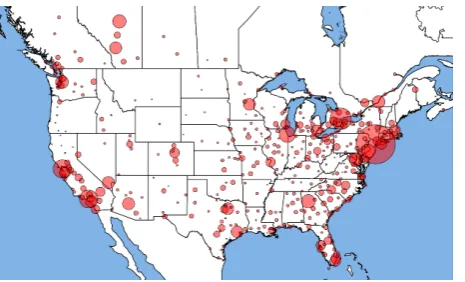
A subset of 10,000 ads were sampled randomly from a large cache of escort ads for annotation in Trafficking-10k dataset. The distribution of adver-tisements across the United States and Canada is shown in Figure1, which indicates the diversity of advertisements in Trafficking-10k. This diversity ensures that models trained on Trafficking-10k can be applicable nationwide. The 10,000 collected ads
Figure 1: Distribution of advertisements in Trafficking-10k dataset across United States and Canada.
each consist of text and zero or more images. The text in the dataset is in plain text format, derived by stripping the HTML tags from the raw source of the ads. The set of characters in each advertise-ment is encoded as UTF-8, because there is ample usage of smilies and non-English characters. Ad-vertisements are truncated to the first 184 words, as this covers more than 90% of the ads. Images are resized to224×224pixels with RGB channels.
3.2 Trafficking Annotation
Detecting whether or not an advertisement is suspi-cious requires years of practice and experience in working closely with law enforcement. As a result, annotation is a highly complicated and expensive process, which cannot be scaled using crowdsourc-ing. In our dataset, annotation is carried out by two expert annotators, each with at least five years of experience, in detection of human trafficking and another annotator with one year of experience. In our dataset, annotations were done by three experts. One expert has over a year of experience, and the other two have over five years of experience in the human trafficking domain. To calculate the inter-annotator agreement, each inter-annotator is given the same set of 1000 ads to annotate and the nomi-nal agreement is found: there was a 83% pairwise agreement (0.62 Krippendorff’s alpha). Also, to make sure that annotations are generalizable across the annotators and law enforcement officers, two law enforcement officers annotated, respectively, a subset of 500 and 100 of the advertisements. We found a 62% average pairwise agreement (0.42 Krippendorff’s alpha) with our annotators. This gap is reasonable, as law enforcement officers only have experience with local advertisements, while
Trafficking-10k annotators have experience with cases across the United States.
Annotators used an annotation interface specifi-cally designed for the Trafficking-10k dataset. In the annotation interface, each advertisement was displayed on a separate webpage. The order of the advertisements is determined uniformly ran-domly, and annotators were unable to move to the next advertisement without labeling the cur-rent one. For each advertisement, the annotator was presented with the question: “In your opin-ion, would you consider this advertisement suspi-cious of human trafficking?” The annotator is pre-sented with the following options: “Certainly no,” “Likely no,” “Weakly no,” “Unsure,”2“Weakly yes,” “Likely yes,” and “Certainly yes.” Thus, the degree
to which advertisements are suspicious is quantized into seven levels.
3.3 Analysis of Language
The language used in these advertisements intro-duces fundamental challenges to the field of NLP. The nature of the textual content in these adver-tisements raises the question of how we can make inferences in a linguistic environment with a con-stantly evolving lexicon. Language used in the Trafficking-10k dataset is highly inconsistent with standard grammar. Often, words are obfuscated by emojis and symbols. The word ordering is in-consistent, and there is rarely any form of con-stituency. This form of language is completely different from spoken and written English. These attributes make escort advertisements appear some-what similar to tweets, specifically since these ads are normally short (more than 90% of the ads have at most 184 words). Another point of complex-ity in these advertisements is the high number of unigrams, due to usage of uncommon words and obfuscation. On top of unigram complexity, ad-vertisers continuously change their writing pattern, making this problem more complex.
3.4 Dataset Statistics
There are 106,954 distinct unigrams, 353,324 distinct bigrams, and 565,403 trigrams in the Trafficking-10k dataset. There are 60,337 images. The total number of distinct characters including whitespace, punctuations, and hex characters is 182. The average length of an ad is 137 words, with a
2This option is greyed out for 10 seconds to encourage
[image:3.595.72.305.60.201.2]0 40 80 120 160 200 0
500 1,000 1,500
+
Number of unigrams Advertisement lengths
[image:4.595.89.279.63.215.2]Positive Negative
Figure 2: Distribution of the length of advertise-ments in Trafficking-10k. There is no significant difference between positive and negative cases purely based on length.
standard deviation of 74, median 133. The short-est advertisement has 7 unigrams, and the longshort-est advertisement has 1810 unigrams. There are of 106,954 distinct unigrams, 353,324 distinct bi-grams and 565,403 tribi-grams in the Trafficking-10k dataset. The average number of images in an ad-vertisement is 5.9; the median is 5, the minimum is 0, and the maximum is 90.
The length ofsuspectedadvertisements is 134 unigrams; the standard deviation is 39, the mini-mum is 12, and the maximini-mum is 666. The length ofnon-suspectedads is 141; the standard deviation is 85, the minimum is 7, and the maximum is 1810. The total number of suspected ads is 3257; and the total number of non-suspected ads is 6992. Fig-ure2shows the histogram of number of ads based on their length. Both the positive and negative dis-tributions are similar. This means that there is no obvious length difference between the two classes. Most of the ads have a length of 80–180 words.
4 Model
In this section, we present our deep multimodal net-work called the Human Trafficking Deep Netnet-work (HTDN). The HTDN is a multimodal network with language and vision components. The input to the HTDN is an ad, text and images. The HTDN is shown in Figure3. In the remainder of this section, we will outline the different parts of the HTDN, and the input features to each component.
4.1 Trafficking Word Embeddings
Our approach to deal with the adversarial environ-ment of escort ads is to use word vectors, defining
words not based on their constituent characters, but rather based on their context. For instance, consider the two unigrams “cash” and “©a$h.” While these contain different characters, semantically they are the same, and they occur in the same context. Thus, our expectation is that both the unigrams will be mapped to similar vectors. Word embeddings pre-trained on general domains do not cover most of the unigrams in Trafficking-10k. For instance, the GloVe embedding (Pennington et al., 2014) trained on Wikipedia covers only 49.7% of our unigrams. The first step of the HTDN pipeline is to train word vectors (Mikolov et al., 2013) based on the skip-gram model. This is especially suitable for escort ads, because skip-gram mod-els are able to capture context without relying on word order. We train the word embedding using 1,000,000 unlabeled ads from a dataset that does not include the Trafficking-10k data. For each ad-vertisement, the input to the trained embedding is a sequence of wordswˆ = [ ˆw1, . . . ,wˆt], and the
out-put is a sequence of100-dimensional word vectors
w= [w1, . . . , wt], wheretis the size of the
adver-tisement andwi∈R100. Our trained word vectors
cover 94.9% of the unigrams in the Trafficking-10k dataset.
4.2 Language Network
Our language network is designed to deal with two challenging aspects of escort advertisements: (1) violation of constituency, and (2) presence of irrelevant information not related to trafficking but present in ads. We address both of these issues by learning a time dependent embedding at word level. This allows the model to not rely on con-stituency and also remember useful information from the past, should the model get overwhelmed by irrelevant information. Our proposed language network, Fl, takes as input a sequence of word
vectorsw = [w1, . . . , wt], and outputs a neural
language representationhl. As a first step,Fluses
the word embeddings as input to a Long-Short Term Memory (LSTM) network and produces a new supervised context-aware word embedding u = [u1, . . . , ut]where ui ∈ R300 is the output
of the LSTM at timei. Then,uis fed into a fully connected layer with dropoutp= 0.5to produce
the neural language representationhl ∈ R300
Language NetworkFl
d0ll@r
to .. .
g r 8
skype
· · · LSTM
· · · LSTM
· · · LSTM
· · · LSTM
hl∈R300 Trafficking
embedding
..
. ... ...
300σ
Visual NetworkFv ˆı1
ˆı2 ˆı3 ˆı4 ˆı5
Trafficking
VGG ... ... ...
200σ200σ200σ
hv∈R5×200
Convolutional Decision Network Fd
conv
hm∈R5×200×300
⊗
5×200×300 max pooling
conv
5×100×150 max pooling
150 linear .. .
P[τ|hm;Wd]
[image:5.595.100.515.69.275.2]σ
Figure 3: Overview of our proposed Human Trafficking Deep Network (HTDN). The input to HTDN is text and a set of 5 images. The text goes through the Language NetworkFlto get the language representation
hland the set of 5 images go through the Vision NetworkFvto get the visual representationhv.hlandhv
are then fused together to get the multimodal representationhm. The Convolutional Decision NetworkFd
conditioned on thehmmakes inference about whether or not the advertisement is suspected of trafficking
connected layers, which we represent byFC:
ui=LSTM(i, wi;Wl) (1)
u= [u1, . . . , ut] (2)
hl=FC(u). (3)
The generatedhlis then used as part of the HTDN
pipeline, and is also trained independently to as-sess the performance of the language-only model. The language networkFlis the combination of the
LSTM and the fully-connected network.
4.3 Vision Network
Parallel to the language network, the vision net-workFv takes as input advertisement images and
extracts visual representationshv. The vision
net-work takes at most five images; the median num-ber of images per advertisement in Trafficking-10k is5. To learn contextual and abstract information
from images, we use a deep convolutional neural network called Trafficking-VGG (T-VGG), a fine-tuned instance of the well-known VGG network (Simonyan and Zisserman,2014). T-VGG is a deep model with13consecutive convolutional layers
fol-lowed by2fully connected layers; it does not
in-clude the softmax layer of VGG. The procedure for fine-tuning T-VGG maps each individual image to a label that comes from the advertisement, and then performs end-to-end training. For example, if there
are five images in an advertisement with positive label, all five images are mapped to positive label. After fine-tuning, three fully connected layers of 200 neurons with dropoutp = 0.5 are added to
the network. The combination of T-VGG and the fully connected layers is the vision networkFl. We
consider five imagesˆı = {ˆı1, . . . ,ˆı5}from each
input advertisement. If the advertisement has fewer than five images, zero-filled images are added. For each image, the output ofFv is a representation
of five imagesi={i1, . . . , i5}. The visual
repre-sentationhv ∈R5×200is a matrix with a size-200
representation of each of the5images:
hv =Fv(ˆı;Wv). (4) 4.4 Multimodal Fusion
Escort advertisements have complex dynamics be-tween text and images. Often, neither linguistic nor visual cues alone can suffice to classify whether an ad is suspicious. Interactions between linguistic and visual cues can be non-trivial, so this requires an explicit joint representation for each neuron in the linguistic and visual representations. In our multimodal fusion approach we address this by cal-culating an outer product between language and visual representationshl andhv to build the full
space of possible outcomes:
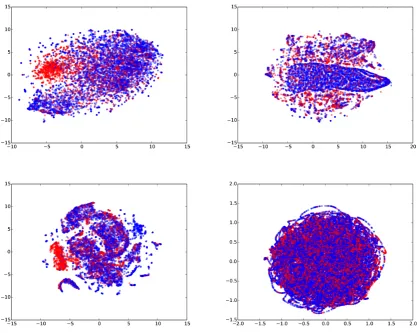
Figure 4: 2D t-SNE representation of different input features for baseline models. Clockwise from top left: one hot vectors with expert data, one hot vectors without expert data, visual features from Vision Network Fv, and average word vectors. These representations show that inference is not trivial in Trafficking-10k
dataset.
where⊗is an outer product of the two representa-tions. This creates a joint multimodal tensor called hmfor language and visual modalities. In this
ten-sor, every neuron in the language representation is multiplied by every neuron in vision representa-tion, thus creating a new representation containing the information of both of them. Thus, the final fusion tensorhm∈R5×200×300contains
informa-tion from the joint interacinforma-tion of the language and visual modalities.
4.5 Convolutional Decision Network
The multimodal representationhmis used as the
input to the convolutional decision networkFd.Fd
has two layers of convolution and max pooling with a dropout rate ofp= 0.5, followed by a fully
con-nected layer of150neurons with a dropout rate of
p= 0.5. Performing convolutions in this space
en-ables the model to attend to small areas of linguistic and visual cues. It can thus find correspondences
between specific combinations of the linguistic and visual representations. The final decision is made by a single sigmoid neuron.
5 Experiments
In our experiments, we compare the HTDN with previously used approaches for detection of traf-ficking suspicious ads. Furthermore, we compare the HTDN to the performance of its unimodal com-ponents. In all our experiments we perform binary classification of whether the advertisement is sus-pected of being related to trafficking. The main comparison method that we use is the weighted ac-curacy and F1-score (due to imbalance it dataset). The formulation for weighted accuracy is as fol-lows:
Wt.Acc.= TP×N/P + TN
Model Wt. Acc. (%) F1 (%) Acc. (%) Precision (%) Recall (%)
Random 50.0 - 68.2 -
-Keywords
Random Forest 67.0 55.2 78.1 78.2 42.6
Logistic Regression 69.9 57.8 78.4 75.5 46.8
Linear SVM 69.5 57.0 78.6 78.0 44.9
Average Trafficking Vectors
Random Forest 67.3 54.1 78.0 79.3 41.1
Logistic Regression 72.2 61.7 80.2 79.2 50.6
Linear SVM 70.3 57.7 79.2 80.7 44.9
108 One-Hot
Random Forest 62.4 60.7 72.6 61.5 60.0
Logistic Regression 62.5 45.1 72.2 60.0 36.1
Linear SVM 61.7 45.1 71.8 58.6 36.7
Bag of Words
Random Forest 57.6 24.5 70.4 63.2 15.2
Logistic Regression 71.1 24.5 70.4 63.2 15.2
Linear SVM 71.2 24.5 70.4 63.2 15.2
HTDN Unimodal
Fl 74.5 65.8 78.8 69.8 62.3
Fv [VGG] 69.1 58.4 74.2 66.7 52.0
Fv [T-VGG] 70.4 59.5 77.3 78.3 48.0
HTDN 75.3 66.5 80.0 71.4 62.2
[image:7.595.87.506.63.431.2]Human 83.7 73.7 84.0 76.7 70.9
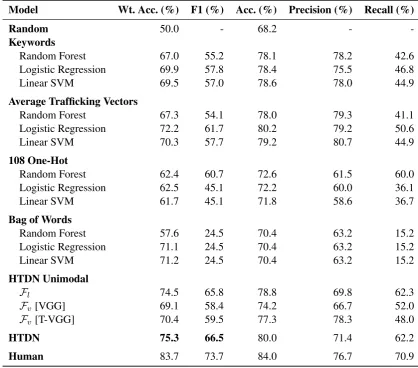
Table 1: Results of our experiments. We compare our HTDN model to various baselines using different inputs. HTDN ourperforms other baselines in both weighted accuracy and F-score.
where TP(resp.TN) is true positive (resp. true
negative) predictions, andP(resp.N) is the total number of positive (resp. negative) examples.
5.1 Baselines
We compare the performance of the HTDN network with baseline models divided in 4 major categories
Bag-of-Words Baselines.This set of baselines is designed to assess performance of off-the-shelf basic classifiers and basic language features. We train random forest, logistic regression and linear SVMs to show the performance of simple language-only models.
Keyword Baselines. These demonstrate the per-formance of models that use a set of 108 keywords, all highly related to trafficking, provided by law enforcement officers.3 A binary one-hot vector representing these keywords is used to train the
3Not presented in this paper due to sensitive nature of these
keywords.
random forest, logistic regression, and linear SVM models.
108 One-Hot Baselines. Similar to Keywords Baseline, we use feature selection technique to fil-ter the most informative 108 words for detection of trafficking. We compare the performance of this baseline to Keywords baseline to evaluate the use-fulness of expert knowledge in keywords selection vs automatic data-driven keyword selection.
Average Trafficking Vectors Baselines.We as-sess the magnitude of success for the trafficking word embeddings for different classifiers. For the random forest, logistic regression, and linear SVM models, the average word vector is calculated and used as input.
HTDN Unimodal. These baselines show the performance of unimodal components of HTDN. For language we only useFl component of the
pipeline and for visual we useFv, using both
Random and Human. Random is based on as-signing the more frequent class in training set to all the test data, and can be considered a lower bound for our model. Human performance metrics are upper bounds for this task’s metrics.
We visualize the different inputs to our baseline models to show the complexity of the dataset when using different feature sets. Figure4shows the 2D t-SNE (Maaten and Hinton,2008) representation of the training data in our dataset according to the Bag-of-Words (top right) models, expert keywords (top left), average word vectors (bottom right), and the visual representationhvbottom left. The
distri-bution of points suggests that none of the feature representations make the classification task trivial.
5.2 Training Parameters
All the models in our experiments are trained on the Trafficking-10k designated training set and tested on the designated test set. Hyperparameter eval-uation is performed using a subset of training set as validation set. The HTDN model is trained us-ing the Adam optimizer (Kingma and Ba,2014). The neural weights were initialized randomly using Xavier initialization technique (Glorot and Bengio,
2010). The random forest model uses10estimators,
with no maximum depth, and minimum-samples-per-split value of 2. The linear SVM model uses an`2-penalty and a square hinge loss withC = 1.
6 Results and Discussion
The results of our experiments are shown in Table1. We report the results on three metrics: F1-score, weighted accuracy, and accuracy. Due to the imbal-ance between the numbers of positive and negative samples, weighted accuracy is more informative than unweighted accuracy, so we focus on the for-mer.
HTDN. The first observation from Table 1 is that the HTDN model outperforms all the pro-posed baselines. There is a significant gap between the HTDN (and variants) and other non-neural ap-proaches. This better performance is an indicator of complex interactions in detecting dynamics of human trafficking, which is captured by the HTDN.
Both Modalities are Helpful. Both modalities are helpful in predicting signs of trafficking (Fland
Fv [T-VGG]). Fine-tuning VGG network
param-eters shows improvement over pre-trained VGG parameters.
Language is More Important. SinceFlshows
better performance thanFv[T-VGG], the language
modality appears to be the more informative modal-ity for detecting trafficking suspicious ads.
7 Conclusion and Future Work
In this paper, we took a major step in multimodal modeling of suspected online trafficking advertise-ments. We presented a novel dataset, Trafficking-10k, with more than 10,000 advertisements anno-tated for this task. The dataset contains two modal-ities of information per advertisement: text and im-ages. We designed a deep multimodal model called the Human Trafficking Deep Network (HTDN). We compared the performance of the HTDN to various models that use language and vision alone. The HTDN outperformed all of these, indicating that using information from both sources may be more helpful than using just one.
Exploring language through character mod-eling.In order to eliminate the need for retraining the word vectors as the language of the domain evolves, we plan to use character models to learn a better language model for trafficking. As new obfuscated words are introduced in escort adver-tisements, our hope is that character models will stay invariant to these obfuscations.
Understanding images. While CNNs have proven to be useful for many different computer vision tasks, we seek to improve the learning ca-pability of the visual network. Future direction involves using graphical modeling to understand in-teractions in the scene. Another direction involves working to understand text in images, which can provide more information about the subjects of the images.
Given that the current state of the art in this area generally does not use deep models, this may be a major opportunity for improvement. To this end, we encourage the research community to reach out to Cara Jones, an author of this paper, to obtain a copy of Trafficking-10k and other training data.
Acknowledgements
advertise-ments for the dataset, and for allowing us to use their advertisement data.
References
Stanislaw Antol, Aishwarya Agrawal, Jiasen Lu, Mar-garet Mitchell, Dhruv Batra, C Lawrence Zitnick, and Devi Parikh. 2015. Vqa: Visual question an-swering. InProceedings of the IEEE International Conference on Computer Vision. pages 2425–2433.
Jeffrey Donahue, Lisa Anne Hendricks, Sergio Guadar-rama, Marcus Rohrbach, Subhashini Venugopalan, Kate Saenko, and Trevor Darrell. 2015. Long-term recurrent convolutional networks for visual recogni-tion and descriprecogni-tion. In Proceedings of the IEEE conference on computer vision and pattern recogni-tion. pages 2625–2634.
Artur Dubrawski, Kyle Miller, Matthew Barnes, Benedikt Boecking, and Emily Kennedy. 2015. Leveraging publicly available data to discern pat-terns of human-trafficking activity. Journal of Hu-man Trafficking1(1):65–85.
Xavier Glorot and Yoshua Bengio. 2010. Understand-ing the difficulty of trainUnderstand-ing deep feedforward neural networks. InAistats. volume 9, pages 249–256.
National Human Trafficking Hotline. ???? Hotline statistics.
Emily Kennedy. 2012. Predictive patterns of sex traf-ficking online. Dietrich College Honors Theses.
Diederik Kingma and Jimmy Ba. 2014. Adam: A method for stochastic optimization. arXiv preprint arXiv:1412.6980.
Laurens van der Maaten and Geoffrey Hinton. 2008. Visualizing data using t-sne. Journal of Machine Learning Research9(Nov):2579–2605.
Lauren A McCarthy. 2014. Human trafficking and the new slavery. Annual Review of Law and Social Sci-ence10:221–242.
Tomas Mikolov, Ilya Sutskever, Kai Chen, Greg S Cor-rado, and Jeff Dean. 2013. Distributed representa-tions of words and phrases and their compositional-ity. InAdvances in neural information processing systems. pages 3111–3119.
Chirag Nagpal, Kyle Miller, Benedikt Boecking, and Artur Dubrawski. 2015. An entity resolution ap-proach to isolate instances of human trafficking on-line. arXiv preprint arXiv:1509.06659.
Jeffrey Pennington, Richard Socher, and Christopher D Manning. 2014. GloVe: Global vectors for word representation. InEMNLP. volume 14, pages 1532– 1543.
Soujanya Poria, Erik Cambria, Rajiv Bajpai, and Amir Hussain. 2017. A review of affective computing: From unimodal analysis to multimodal fusion. In-formation Fusion1:34.
Soujanya Poria, Iti Chaturvedi, Erik Cambria, and Amir Hussain. 2016. Convolutional mkl based mul-timodal emotion recognition and sentiment analy-sis. In2016 IEEE 16th International Conference on Data Mining (ICDM). IEEE, pages 439–448.
Stefan Scherer, Gale M Lucas, Jonathan Gratch, Al-bert Skip Rizzo, and Louis-Philippe Morency. 2016. Self-reported symptoms of depression and ptsd are associated with reduced vowel space in screening in-terviews. IEEE Transactions on Affective Comput-ing7(1):59–73.
Karen Simonyan and Andrew Zisserman. 2014. Very deep convolutional networks for large-scale image recognition.arXiv preprint arXiv:1409.1556.
Lucia Specia, Stella Frank, Khalil Sima’an, and Desmond Elliott. 2016. A shared task on multi-modal machine translation and crosslingual image description. InProceedings of the First Conference on Machine Translation, Berlin, Germany. Associa-tion for ComputaAssocia-tional Linguistics.
UNODC. 2008. Human trafficking:
An overview. Web, New York.
http://www.ungift.org/doc/knowledgehub/resource-centre/GIFT˙Human˙Trafficking˙An˙Overview˙2008.pdf.
Michel Valstar, Jonathan Gratch, Bj¨orn Schuller, Fa-bien Ringeval, Dennis Lalanne, Mercedes Tor-res TorTor-res, Stefan Scherer, Giota Stratou, Roddy Cowie, and Maja Pantic. 2016. Avec 2016: De-pression, mood, and emotion recognition workshop and challenge. In Proceedings of the 6th Inter-national Workshop on Audio/Visual Emotion Chal-lenge. ACM, pages 3–10.
Verena Venek, Stefan Scherer, Louis-Philippe Morency, Albert Rizzo, and John Pestian. 2016. Adolescent suicidal risk assessment in clinician-patient interac-tion. IEEE Transactions on Affective Computing.
Quanzeng You, Hailin Jin, Zhaowen Wang, Chen Fang, and Jiebo Luo. 2016. Image captioning with seman-tic attention. InProceedings of the IEEE Conference on Computer Vision and Pattern Recognition. pages 4651–4659.
Amir Zadeh, Rowan Zellers, Eli Pincus, and Louis-Philippe Morency. 2016a. Mosi: Multimodal cor-pus of sentiment intensity and subjectivity anal-ysis in online opinion videos. arXiv preprint arXiv:1606.06259.
Amir Zadeh, Rowan Zellers, Eli Pincus, and Louis-Philippe Morency. 2016b. Multimodal sentiment in-tensity analysis in videos: Facial gestures and verbal messages. IEEE Intelligent Systems31(6):82–88.