Proceedings of the 55th Annual Meeting of the Association for Computational Linguistics, pages 1063–1072 Proceedings of the 55th Annual Meeting of the Association for Computational Linguistics, pages 1063–1072
Diversity driven attention model for query-based abstractive
summarization
Preksha Nema† Mitesh M. Khapra† Anirban Laha∗† Balaraman Ravindran† †Indian Institute of Technology Madras, India
∗IBM Research India
{preksha,miteshk}@cse.iitm.ac.in
[email protected] [email protected]
Abstract
Abstractive summarization aims to gen-erate a shorter version of the document covering all the salient points in a com-pact and coherent fashion. On the other hand, query-based summarization high-lights those points that are relevant in the context of a given query. The encode-attend-decode paradigm has achieved notable success in machine translation, extractive summarization, dialog sys-tems, etc. But it suffers from the draw-back of generation of repeated phrases. In this work we propose a model for the query-based summarization task based on the encode-attend-decode paradigm with two key additions (i) a query attention model (in addition to doc-ument attention model) which learns to focus on different portions of the query at different time steps (instead of using a static representation for the query) and (ii) a new diversity based attention model which aims to allevi-ate the problem of repeating phrases in the summary. In order to enable the testing of this model we introduce a new query-based summarization dataset building on debatepedia. Our experi-ments show that with these two addi-tions the proposed model clearly out-performs vanilla encode-attend-decode models with a gain of 28% (absolute) in ROUGE-L scores.
1 Introduction
Over the past few years neural models based on the encode-attend-decode (Bahdanau et al.,
2014) paradigm have shown great success in various natural language generation (NLG) tasks such as machine translation (Bahdanau et al., 2014), abstractive summarization ((Rush et al., 2015),(Nallapati et al., 2016)) dialog (Li et al.,2016),etc. One such NLG problem which has not received enough attention in the past is query based abstractive text summarization where the aim is to generate the summary of a document in the context of a query. In gen-eral, abstractive summarization, aims to cover all the salient points of a document in a compact and coherent fashion. On the other hand, query focused summarization highlights those points that are relevant in the context of the query. Thus given a document on “the super bowl”, the query “How was the half-time show?”, would result in a summary that would not cover the ac-tual game itself.
Note that there has been some work on query based extractive summarization in the past where the aim is to simply extract the most salient sentence(s) from a document and treat these as a summary. There is no natural lan-guage generation involved. Since, we were in-terested in abstractive (as opposed to extractive) summarization we created a new dataset based on debatepedia. This dataset contains triplets of the form (query, document, summary). Further, each summary is abstractive and not extractive in the sense that the summary does not neces-sarily comprise of a sentence which is simply copied from the original document.
Using this dataset as a testbed, we focus on a recurring problem in models based on the encode-attend-decode paradigm. Specifically, it is observed that the summaries produced by such models contain repeated phrases. Table1
shows a few such examples of summaries
Document Snippet:The “natural death” alter-native to euthanasia is not keeping someone alive via life support until they die on life sup-port. That would, indeed, be unnatural. The natural alternative is, instead, to allow them to die off of life support.
Query: Is euthanasia better than withdrawing life support (non-treatment)?
Ground Truth Summary: The alternative to euthanasia is a natural death without life sup-port.
Predicted Summary: the large to euthanasia is
a natural deathlife lifeuse
Document Snippet:Legalizing same-sex mar-riage would also be a recognition of basic Amer-ican principles, and would represent the cul-mination of our nation’s commitment to equal rights. It is, some have said, the last major civil-rights milestone yet to be surpassed in our two-century struggle to attain the goals we set for this nation at its formation.
Query:Is gay marriage a civil right?
Ground Truth Summary: Gay marriage is a fundamental equal right.
Predicted Summary: gay marriage is a
appro-priateright right
Table 1: Examples showing repeated words in the output of encoder-decoder models
ated by such a model when trained on this new dataset. This problem has also been reported by (Chen et al.,2016) in the context of summariza-tion and by (Sankaran et al.,2016) in the context of machine translation.
We first provide an intuitive explanation for this problem and then propose a solution for alleviating it. A typical encode-attend-decode model first computes a vectorial representation for the document and the query and then pro-duces a contextual summary one word at a time. Each word is produced by feeding a new con-text vector to the decoder at each time step by attending to different parts of the document and query. If the decoder produces the same word or phrase repeatedly then it could mean that the context vectors fed to the decoder at these time steps are very similar.
We propose a model which explicitly pre-vents this by ensuring that successive context vectors are orthogonal to each other. Specifi-cally, we subtract out any component that the
current context vector has in the direction of the previous context vector. Notice that, we do not require the current context vector to be orthog-onal to all previous context vectors but just its immediate predecessor. This enables the model to attend to words repeatedly if required later in the process. To account for the complete history (or all previous context vectors) we also pro-pose an extension of this idea where we pass the sequence of context vectors through a LSTM (Hochreiter and Schmidhuber,1997) and ensure that the current state produced by the LSTM is orthogonal to the history. At each time step, the state of the LSTM is then fed to the decoder to produce one word in the summary.
Our contributions can be summarized as fol-lows: (i) We propose a new dataset for query based abstractive summarization and evaluate encode-attend-decode models on this dataset (ii) We study the problem of repeating phrases in NLG in the context of this dataset and pro-pose two solutions for countering this problem. We show that our method outperforms a vanilla encoder-decoder model with a gain of 28% (ab-solute) in ROUGE-L score (iii) We also demon-strate that our method clearly outperforms a re-cent state of the art method proposed for han-dling the problem of repeating phrases with a gain of 7% (absolute) in ROUGE-L scores (iv) We do a qualitative analysis of the results and show that our model indeed produces outputs with fewer repetitions.
2 Related Work
Summarization has been studied in the con-text of con-text ((Mani, 2001), (Das and Martins,
2007), (Nenkova and McKeown,2012)) as well as speech ((Zhu and Penn, 2006), (Zhu et al.,
2009)). A vast majority of this work has focused on extractive summarization where the idea is to construct a summary by selecting the most rele-vant sentences from the document ((Neto et al.,
the field.
Recent research in abstractive summarization has focused on data driven neural models based on the encode-attend-decode paradigm ( Bah-danau et al., 2014). For example, (Rush et al.,
2015), report state of the art results on the Gi-gaWord and DUC corpus using such a model. Similarly, the work ofLopyrev(2015) uses neu-ral networks to generate news headline from short news stories. Chopra et al. (2016) ex-tend the work of Rush et al.(2015) and report further improvements on the two datasets. Hu et al. (2015) introduced a dataset for Chinese short text summarization and evaluated a simi-lar RNN encoder-decoder model on it.
One recurring problem in encoder-decoder models for NLG is that they often repeat the same phrase/word multiple times in the sum-mary (at the cost of both coherency and fluency).
Sankaran et al.(2016) study this problem in the context of MT and propose a temporal attention model which enforces the attention weights for successive time steps to be different from each other. Similarly, and more relevant to this work,
Chen et al. (2016) propose a distraction based attention model which maintains a history of at-tention vectors and context vectors. It then sub-tracts this history from the current attention and context vector. When evaluated on our dataset their method performs poorly. This could be be-cause their method is very aggressive in deal-ing with the history (as explained later in the Experiments section). On the other hand, our method has a better way of handling history (by passing context vectors through an LSTM recur-rent network) which gives us the flexibility to forget/retain some portions of the history and at the same time produce diverse context vectors at successive time steps.
We evaluate our method in the context of query based abstractive summarization - a prob-lem which has received almost no attention in the past due to unavailability of datasets. We create a new dataset for this task and show that our method indeed produces better output by reducing the number of repeated phrases pro-duced by encoder decoder models.
Average number of words per Document Summary Query
66.4 11.16 9.97
Table 2: Average length of
docu-ments/queries/summaries in the dataset
3 Dataset
As mentioned earlier, there are no existing datasets for query based abstractive summariza-tion. We create such a dataset from Debatepe-dia an encyclopeDebatepe-dia of pro and con arguments and quotes on critical debate topics. There are 663 debates in the corpus (we have considered only those debates which have at least one query with one document). These 663 debates belong to 53 overlapping categories such as Politics, Law, Crime, Environment, Health, Morality, Re-ligion, etc. A given topic can belong to more than one category. For example, the topic “Eye for an Eye philosophy” belongs to both “Law” as well as “Morality”. The average number of queries per debate is 5 and the average number of documents per query is 4. Please refer to the dataset url1for more details about number of
de-bates per category.
For example, Figure 1shows the queries as-sociated with the topic “Algae Biofuel”. It also lists the set of documents and an abstractive summary associated with each query. As is obvious from the example, the summary is an abstractive summary and not extracted directly from the document. We crawled 12695 such
{query, document, summary} triples from de-batepedia (these were all the triples that were available). Table 2 reports the average length of the query, summary and documents in this dataset.
We used 10 fold cross validation for all our experiments. Each fold uses 80% of the docu-ments for training, 10% for validation and 10% for testing.
4 Proposed model
Given a query q = q1, q2, ..., qk containing
k words, a document d = d1, d2, ..., dn con-taining n words, the task is to generate a
con-textual summaryy = y1, y2, ..., ym containing
1http://www.cse.iitm.ac.in/˜miteshk/
Figure 1: Queries associated with the topic “algae biofuel”
Figure 2: Documents and summaries for a given query
mwords. This can be modeled as the problem of finding a y∗ that maximizes the probability
p(y|q,d)which can be further decomposed as:
y∗ = arg max y
m
Y
t=1
p(yt|y1, ..., yt−1,q,d) (1)
We now describe a way of modeling
p(yt|y1, ..., yt−1,q,d)using the neural
encoder-attention-decoder paradigm. The proposed model contains the following components: (i) an encoder RNN for the query (ii) an encoder RNN for the document (iii) attention mecha-nism for the query (iv) attention mechamecha-nism for the document and (v) a decoder RNN. All the RNNs use a GRU cell.
Encoder for the query:We use a recurrent neu-ral network with Gated Recurrent Units (GRU) for encoding the query. It reads the queryq =
q1, q2, ..., qk from left to right and computes a hidden representation for each time-step as:
hqi =GRUq(hqi−1, e(qi)) (2)
where e(qi) ∈ Rd is thed-dimensional embed-ding of the query wordqi.
Encoder for the document: This is similar to the query encoder and reads the documentd =
d1, d2, ..., dn from left to right and computes a hidden representation for each time-step as:
hdi =GRUd(hdi−1, e(di)) (3)
wheree(di) ∈ Rdis thed-dimensional embed-ding of the document worddi.
Attention mechanism for the query : At each time step, the decoder produces an output word
by focusing on different portions of the query (document) with the help of a query (document) attention model. We first describe the query attention model which assigns weights αqt,i to
each word in the query at each decoder timestep using the following equations.
aqt,i =vqT tanh(Wqst+Uqhqi) (4)
αqt,i = exp(a q t,i)
Pk
j=1exp(a
q t,j)
(5)
where st is the current state of the decoder at time stept(we will see an exact formula for this
soon). Wq ∈ Rl2×l1, Uq ∈ Rl2×l2, vq ∈ Rl2,
l1 is the size of the decoder’s hidden state, l2
is both the size of hqi and also the size of the
final query representation at time stept, which
is computed as:
qt = k
X
i=1
αt,iq hqi (6)
Attention mechanism for the document : We now describe the document attention model which assigns weights to each word in the docu-ment using the following equations.
adt,i =vTd tanh(Wdst+Udhdi +Zqt) (7)
αdt,i = exp(a d t,i)
Pn
j=1exp(adt,j)
soon). Wd ∈ Rl4×l1,Ud ∈ Rl4×l4,Z ∈ Rl4×l2,
vd ∈ Rl2, l4 is the size ofhdi and also the size of the final document representationdtwhich is passed to the decoder at time steptas:
dt= n
X
i=1
αdt,ihdi (8)
Note that dtnow encodes the relevant informa-tion from the document as well as the query (see Equation (7)) at time stept. We refer to this as
thecontext vectorfor the decoder.
Decoder: The hidden state of the decoderstat each time tis again computed using a GRU as follows:
st =GRUdec(st−1,[e(yt−1), dt−1]) (9)
where, yt−1 gives a distribution over the
vocab-ulary words at timestept−1and is computed as:
yt=softmax(Wof(Wdecst+Vdecdt)) (10)
where Wo ∈ RN×l1, Wdec ∈ Rl1×l1, Vdec ∈ Rl1×l4, N is the vocabulary size, y
t is the final output of the model which defines a probability distribution over the output vocabulary. This is exactly the quantity defined in Equation (1) that we wanted to model (p(yt|y1, ..., yt−1,q,d)).
Further, note that,e(yt−1)is the d-dimensional
embedding of the word which has the highest probability under the distribution yt−1. Also
[e(yt−1), dt−1] means a concatenation of the
vectorse(yt−1), dt−1. We chosefto be the
iden-tity function.
The model as described above is an instanti-ation of the encoder-attention-decoder idea ap-plied to query based abstractive summarization. As mentioned earlier (and demonstrated later through experiments), this model suffers from the problem of repeating the same phrase/word in the output. We now propose a new attention model which we refer to as diversity based at-tention model to address this problem.
4.1 Diversity based attention model
As hypothesized earlier, if the decoder pro-duces the same phrase/word multiple times then it is possible that the context vectors being fed to the decoder at consecutive time steps are
Document Encoder
support . . . same Legalizing
Gay marriage is a fundamental equal right
Decoder
Is gay marriage a civil right?
Query Encoder
Document
Attention
Di
versity
Cell
[image:5.595.310.535.67.265.2]Query Attention
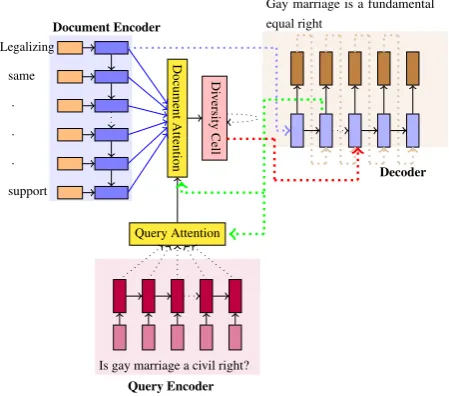
Figure 3: Proposed model for Query based Ab-stractive Summarization with (i) query encoder (ii) document encoder (iii) query attention model (iv) diversity based document attention model and (v) decoder. The green and red arrows show the con-nections for timestep 3 of the decoder.
very similar. We propose four models (D1,D2,
SD1,SD2) to directly address this problem.
D1: In this model, after computing dt as de-scribed in Equation (8), we make it orthogonal to the context vector at timet−1:
d0t=dt−
dT td
0
t−1 d0tT−1d
0
t−1
d0t−1 (11)
SD1: The above model imposes a hard or-thogonality constraint on the context vector(d0t).
We also propose a relaxed version of the above model which uses a gating parameter. This gat-ing parameter decides what fraction of the pre-vious context vector should be subtracted from the current context vector using the following equations:
γt =Wgdt−1+bg
d0t =dt−γt
dT td
0
t−1 d0tT−1d0t−1d
0
t−1
whereWg ∈ Rl4×l4,bg ∈ Rl4, l4 is the
dimen-sion ofdtas defined in equation (8).
a modified LSTM cell to compute the new state at each time step. Specifically, we use the fol-lowing set of equations to compute a diverse context at timet:
it=σ(Widt+Uiht−1+bi)
ft=σ(Wfdt+Ufht−1+bf)
ot=σ(Wodt+Uoht−1+bo)
ˆ
ct= tanh(Wcdt+Ucht−1 +bc) ct=itcˆt+ftct−1
cdiverset =ct−
ctTct−1 cT
t−1ct−1
ct−1 (12)
ht=ottanh(cdiverset )
d0t=ht (13)
where Wi, Wf, Wo, Wc ∈ Rl5×l4,
Ui, Uf, Uo, Uc ∈ Rl5×l4, dt is the l4
-dimensional output of Equation (8); l5 is
number of hidden units in the LSTM cell. This final d0t from Equation (13) is then used in Equation (9). Note that Equation (12) ensures that state of the LSTM at time stept is orthog-onal to the previous history. Figure 3 shows a pictorial representation of the model with a diversity LSTM cell.
SD2: This model again uses a relaxed ver-sion of the orthogonality constraint used inD2. Specifically, we define a gating parametergtand replace (12) above by (14) as define below:
gt=σ(Wgdt+Ught−1+bo)
cdiverset =ct−gt
ctTct−1 cT
t−1ct−1
ct−1 (14)
whereWg ∈Rl5×l4,Ug ∈Rl5×l4 5 Baseline Methods
We compare with two recently proposed base-line diversity methods (Chen et al.,2016) as de-scribed below. Note that these methods were proposed in the context of abstractive summa-rization (not query based abstractive summariza-tion) and we adapt them for the task of query based abstractive summarization. Below we just highlight the key differences from our model in computing the context vector d0t passed to the decoder.
M1: This model accumulates all the previous context vectors as Pt−1
j=1d 0
j and incorporates
this history while computing a diverse context vector:
d0t = tanh(Wcdt−Uc t−1
X
j=1
d0j) (15)
where Wc, Uc ∈ Rl4×l4 are diagonal matrices. We then use this diversity driven context d0t in Equation (9) and (10).
M2: In this model, in addition to computing a diverse context as described in Equation (15), the attention weights at each time step are also forced to be diverse from the attention weights at the previous time step.
α0t,i =vTa tanh(Was
0
t+Uadt−ba t−1
X
j=1 α0j,i)
whereWa ∈Rl1×l1,Ua ∈ Rl1×l4,ba, va ∈ Rl1,
l1 is the number of hidden units in the decoder
GRU. Once again, they maintain a history of at-tention weights and compute a diverse atat-tention vector by subtracting the history from the cur-rent attention vector.
6 Experimental Setup
We evaluate our models on the dataset de-scribed in section 3. Note that there are no prior baselines on query based abstractive summariza-tion so we could only compare with different variations of the encoder decoder models as de-scribed above. Further, we compare our diver-sity based attention models with existing mod-els for diversity by suitably adapting them to this problem as described earlier. Specifically, we compare the performance of the following models:
• Vanilla e-a-d: This is the vanilla encoder-attention-decoder model adapted to the problem of abstractive summarization. It contains the following components (i) doc-ument encoder (ii) docdoc-ument attention model (iii) decoder. It does not contain an encoder or attention model for the query. This helps us understand the importance of the query.
• Queryatt: This model contains the query attention model in addition to all the com-ponents inQueryenc.
• D1: The diversity attention model as de-scribed in Section 4.1.
• D2: The LSTM based diversity attention model as described in Section 4.1.
• SD1: The soft diversity attention model as
described in Section 4.1
• SD2: The soft LSTM based diversity
atten-tion model as described in Secatten-tion 4.1
• B1: Diversity cell in Figure3is replaced by
the basic LSTM cell (i.e. cdiverse
t = ct in-stead of using Equation (12). This helps us understand whether simply using an LSTM to track the history of context vectors (with-out imposing a diversity constraint) is suffi-cient.
• M1: The baseline model which operates on the context vector as described in Section 5.
• M2: The baseline model which operates on
the attention weights in addition to the con-text vector as described in Section 5.
We used 80% of the data for training, 10% for validation and 10% for testing. We create 10 such folds and report the average Rouge-1, Rouge-2, Rouge-L scores across the 10 folds. The hyperparameters (batch size and GRU cell sizes) of all the models are tuned on the valida-tion set. We tried the following batch sizes : 32, 64 and the following GRU cell sizes 200, 300, 400. We used Adam (Kingma and Ba,2014) as the optimization algorithm with the initial learn-ing rate set to 0.0004, β1 = 0.9, β2 = 0.999.
We used pre-trained publicly available Glove word embeddings2 and fine-tuned them during
training. The same word embeddings are used for the query words and the document words.
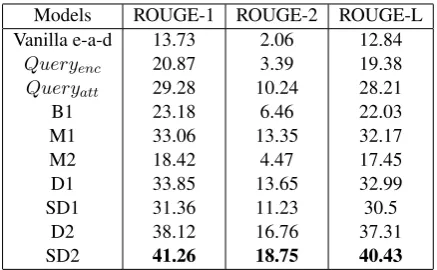
Table3summarizes the results of our experi-ments.
2http://nlp.stanford.edu/projects/glove/
Models ROUGE-1 ROUGE-2 ROUGE-L Vanilla e-a-d 13.73 2.06 12.84
Queryenc 20.87 3.39 19.38
Queryatt 29.28 10.24 28.21
B1 23.18 6.46 22.03
M1 33.06 13.35 32.17
M2 18.42 4.47 17.45
D1 33.85 13.65 32.99
SD1 31.36 11.23 30.5
D2 38.12 16.76 37.31
[image:7.595.306.525.61.196.2]SD2 41.26 18.75 40.43
Table 3: Performance on various models using full-length ROUGE metrics
7 Discussions
In this section, we discuss the results of the experiments reported in Table3.
1. Effect of Query: Comparing rows 1 and 2 we observe that adding an encoder for the query and allowing it to influence the outputs of the de-coder indeed improves the performance. This is expected as the query contains some keywords which could help in sharpening the focus of the summary.
2. Effect of Query attention model: Compar-ing rows 2 and 3 we observe that usCompar-ing an atten-tion model to dynamically compute the query representation at each time step improves the re-sults. This suggests that the attention model in-deed learns to focus on relevant portions of the query at different time steps.
3. Effect of Diversity models:All the diversity models introduced in the paper (rows 7, 8, 9, 10) give significant improvement over the non-diversity models. In particular, the modified LSTM based diversity model gives the best re-sults. This is indeed very encouraging and Table
4shows some sample summaries comparing the performance of different models.
4. Comparison with baseline diversity mod-els: The baseline diversity model M1 performs at par with our models D1 and SD1 but not as good as D2 and SD2. However, the model M2 performs very poorly. We believe that simulta-neously adding a constraint on the context vec-tors as well as attention weights (as is indeed the case with M2) is a bit too aggressive and leads to poor performance (although this needs further investigation).
num-Source:Although cannabis does indeed have some harmful effects, it is no more harmful than legal substances like alcohol and tobacco. As a matter of fact, research by the British Medical Association shows that nicotine is far more addictive than cannabis. Furthermore, the consumption of alcohol and the smoking of cigarettes cause more deaths per year than does the use of cannabis (e.g. through lung cancer, stomach ulcers, accidents caused by drunk driving etc.). The legalization of cannabis will remove an anomaly in the law whereby substances that are more dangerous than cannabis are legal whilst the possession and use of cannabis remains unlawful.
Query:is marijuana harmless enough to be considered a medicine
G:marijuana is no more harmful than tobacco and alcohol
Queryattn: marijuana is no thedrug drugfortobacco and tobacco
D1:marijuana is no more harmful than tobacco and tobacco
SD1:marijuana is more for evidence than tobacco and health
D2:marijuana is no more harmful than tobacco and use
SD2:marijuana is no more harmful than tobacco and alcohol
Source:Fuel cell critics point out that hydrogen is flammable, but so is gasoline. Unlike gasoline, which can pool up and burn for a long time, hydrogen dissipates rapidly. Gas tanks tend to be easily punctured, thin-walled containers, while the latest hydrogen tanks are made from Kevlar. Also, gaseous hydrogen isn’t the only method of storage under consideration–BMW is looking at liquid storage while other researchers are looking at chemical compound storage, such as boron pellets.
Query:safety are hydrogen fuel cell vehicles safe
G:hydrogen in cars is less dangerous than gasoline
Queryattn: hydrogen ishydrogen hydrogen hydrogenfuel energy
D1:hydrogen in cars is less natural than gasoline
SD1:hydrogen in cars is reduce risk than fuel
D2:hydrogen in waste is less effective than gasoline
SD2:hydrogen in cars is less dangerous than gasoline
Source:The basis of all animal rights should be the Golden Rule: we should treat them as we would wish them to treat us, were any other species in our dominant position.
Query:do animals have rights that makes eating them inappropriate
G:animals should be treated as we would want to be treated
Queryatt: animals should betreatedas we would protect to betreated
D1:animals should betreatedas we most individual to betreated
SD1:animals should betreatedas we would physically to be treated
D2:animals should betreatedas we would illegal to betreated
SD2:animals should betreatedas those would want to betreated
Table 4: Summaries generated by different models. In general, we observed that the baseline models which do not use a diversity based attention model tend to produce more repetitions. Notice that the last example shows that our model is not very aggressive in dealing with the history and is able to produce valid repetitions (treated ... treated) when needed
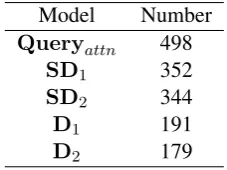
ber of sentences containing repeated words gen-erated by different models. Specifically for the 1268 test instances we counted the number of sentences containing repeated words as gener-ated by different modes. Table 5 summarizes this analysis.
8 Conclusion
In this work we proposed a query-based sum-marization method. The unique feature of
Model Number
Queryattn 498
SD1 352
SD2 344
D1 191
[image:8.595.359.473.618.703.2]D2 179
the model is a novel diversification mechanism based on successive orthogonalization. This gives us the flexibility to: (i) provide diverse context vectors at successive time steps and (ii) pay attention to words repeatedly if need be later in the summary (as opposed to existing mod-els which aggressively delete the history). We also introduced a new data set and empirically verified we perform significantly better (gain of 28% (absolute) in ROUGE-L score) than apply-ing a plain encode-attend-decode mechanism to this problem. We observe that adding an atten-tion mechanism on the query string gives signif-icant improvements. We also compare with a state of the art diversity model and outperform it by a good margin (gain of 7% (absolute) in ROUGE-L score). The diversification model proposed is general enough to apply to other NLG tasks with suitable modifications and we are currently working on extending this to dia-log systems and general summarization.
References
Dzmitry Bahdanau, Kyunghyun Cho, and Yoshua Ben-gio. 2014. Neural machine translation by jointly learning to align and translate. arXiv preprint arXiv:1409.0473.
Qian Chen, Xiaodan Zhu, Zhenhua Ling, Si Wei, and Hui Jiang. 2016. Distraction-based neural networks for modeling documents. In Proceedings of the Twenty-Fifth International Joint Conference on Ar-tificial Intelligence (IJCAI-16). pages 2754–2760.
Sumit Chopra, Michael Auli, Alexander M Rush, and SEAS Harvard. 2016. Abstractive sentence sum-marization with attentive recurrent neural networks. Proceedings of NAACL-HLT16pages 93–98.
Carlos A Colmenares, Marina Litvak, Amin Mantrach, and Fabrizio Silvestri. 2015. Heads: Headline gen-eration as sequence prediction using an abstract feature-rich space. InHLT-NAACL. pages 133–142.
Dipanjan Das and Andr´e FT Martins. 2007. A survey on automatic text summarization. Literature Survey for the Language and Statistics II course at CMU 4:192–195.
G¨unes Erkan and Dragomir R Radev. 2004. Lexrank: Graph-based lexical centrality as salience in text summarization.Journal of Artificial Intelligence Re-search22:457–479.
Katja Filippova and Yasemin Altun. 2013. Overcom-ing the lack of parallel data in sentence compression. InEMNLP. Citeseer, pages 1481–1491.
Sepp Hochreiter and J¨urgen Schmidhuber. 1997. Long short-term memory. Neural computation9(8):1735– 1780.
Baotian Hu, Qingcai Chen, and Fangze Zhu. 2015. Lc-sts: A large scale chinese short text summarization dataset. arXiv preprint arXiv:1506.05865.
Diederik Kingma and Jimmy Ba. 2014. Adam: A method for stochastic optimization. arXiv preprint arXiv:1412.6980.
Jiwei Li, Michel Galley, Chris Brockett, Georgios P Spithourakis, Jianfeng Gao, and Bill Dolan. 2016. A persona-based neural conversation model. arXiv preprint arXiv:1603.06155.
Konstantin Lopyrev. 2015. Generating news head-lines with recurrent neural networks. arXiv preprint arXiv:1512.01712.
Inderjeet Mani. 2001. Automatic summarization, vol-ume 3. John Benjamins Publishing.
Ramesh Nallapati, Bowen Zhou, Caglar Gulcehre, Bing Xiang, et al. 2016. Abstractive text summariza-tion using sequence-to-sequence rnns and beyond. arXiv preprint arXiv:1602.06023.
Ani Nenkova and Kathleen McKeown. 2012. A sur-vey of text summarization techniques. In Mining text data, Springer, pages 43–76.
Joel Larocca Neto, Alex A Freitas, and Celso AA Kaestner. 2002. Automatic text summarization us-ing a machine learnus-ing approach. InBrazilian Sym-posium on Artificial Intelligence. Springer, pages 205–215.
Ricardo Ribeiro, Lu´ıs Marujo, David Martins de Matos, Joao P Neto, Anatole Gershman, and Jaime Car-bonell. 2013. Self reinforcement for important pas-sage retrieval. In Proceedings of the 36th inter-national ACM SIGIR conference on Research and development in information retrieval. ACM, pages 845–848.
Korbinian Riedhammer, Benoit Favre, and Dilek Hakkani-T¨ur. 2010. Long story short–global unsu-pervised models for keyphrase based meeting sum-marization. Speech Communication 52(10):801– 815.
Alexander M Rush, Sumit Chopra, and Jason We-ston. 2015. A neural attention model for ab-stractive sentence summarization. arXiv preprint arXiv:1509.00685.
Baskaran Sankaran, Haitao Mi, Yaser Al-Onaizan, and Abe Ittycheriah. 2016. Temporal attention model for neural machine translation. arXiv preprint arXiv:1608.02927.
Xiaodan Zhu and Gerald Penn. 2006. Comparing the roles of textual, acoustic and spoken-language fea-tures on spontaneous-conversation summarization. In Proceedings of the Human Language Technol-ogy Conference of the NAACL, Companion Volume: Short Papers. Association for Computational Lin-guistics, pages 197–200.