One for All: Towards Language Independent Named Entity Linking
Avirup Sil and Radu Florian IBM T. J. Watson Research Center
1101 Kitchawan Road Yorktown Heights, NY 10598
[email protected], [email protected]
Abstract
Entity linking (EL) is the task of dis-ambiguating mentions in text by associ-ating them with entries in a predefined database of mentions (persons, organiza-tions, etc). Most previous EL research has focused mainly on one language, English, with less attention being paid to other lan-guages, such as Spanish or Chinese. In this paper, we introduce LIEL, a Lan-guage Independent Entity Linking system, which provides an EL framework which, once trained on one language, works re-markably well on a number of different languages without change. LIEL makes a joint global prediction over the entire document, employing a discriminative re-ranking framework with many domain and language-independent feature func-tions. Experiments on numerous bench-mark datasets, show that the proposed sys-tem, once trained on one language, En-glish, outperforms several state-of-the-art systems in English (by 4 points) and the trained model also works very well on Spanish (14 points better than a competi-tor system), demonstrating the viability of the approach.
1 Introduction
We live in a golden age of information, where we have access to vast amount of data in various forms: text, video and audio. Being able to ana-lyze this data automatically, usually involves fill-ing a relational database, which, in turn, requires the processing system to be able to identify actors across documents by assigning unique identifiers to them. Entity Linking (EL) is the task of map-ping specific textual mentions of entities in a text
document to an entry in a large catalog of entities, often called a knowledge base or KB, and is one of the major tasks in the Knowledge-Base Popula-tion track at the Text Analysis Conference (TAC) (Ji et al., 2014). The task also involves grouping together (clustering) NIL entities which do not have any target referents in the KB.
Previous work, pioneered by (Bunescu and Pasca, 2006; Cucerzan, 2007; Sil et al., 2012; Ratinov et al., 2011; Guo et al., 2013), have used Wikipedia as this target catalog of entities be-cause of its wide coverage and its frequent updates made by the community. As with many NLP ap-proaches, most of the previous EL research have focused on English, mainly because it has many NLP resources available, it is the most prevalent language on the web, and the fact that the English Wikipedia is the largest among all the Wikipedia datasets. However, there are plenty of web docu-ments in other languages, such as Spanish (Fahrni et al., 2013; Ji et al., 2014), and Chinese (Cao et al., 2014; Shi et al., 2014), with a large num-ber of speakers, and there is a need to be able to develop EL systems for these languages (and oth-ers!) quickly and inexpensively.
In this paper, we investigate the hypothesis that we can train an EL model that is entirely un-lexicalized, by only allowing features that com-pute similarity between the text in the input docu-ment and the text/information in the KB. For this purpose, we propose a novel approach to entity linking, which we call Language Independent En-tity Linking (henceforth LIEL). We test this hy-pothesis by applying the English-trained system on Spanish and Chinese datasets, with great suc-cess.
This paper has three novel contributions: 1) ex-tending a powerful inference algorithm for global entity linking, built using similarity measures, cor-pus statistics, along with knowledge base
tics, 2) integrates many language-agnostic and domain independent features in an exponential framework, and 3) provide empirical evidence on a large variety of popular benchmark datasets that the resulting model outperforms or matches the best published results, and, most importantly, the trained model transfers well across languages, out-performing the state-of-the-art (SOTA) in Spanish and matching it in Chinese.
We organize the paper as follows: the next section motivates the problem and discusses the language-independent model along with the fea-tures. Section 3 describes our experiments and comparison with the state-of-the-art. Section 4 il-lustrates the related previous work and Section 5 concludes.
2 Problem Formulation
2.1 Motivation for Language Independence
Our strategy builds an un-lexicalized EL system by training it on labeled data, which consists of pairs of mentions in text and entries in a database extracted from a Wikipedia collection in English. Unlike traditional EL, however, the purpose here is to be able to perform entity linking with respect to any Wikipedia collection. Thus the strategy must take care to build a model that can transfer its learned model to a new Wikipedia collection, without change.
At a first glance, the problem seems very challenging - learning how to
dis-criminate Lincoln, Nebraska and
Abraham Lincoln 1, the former US
Pres-ident, seemingly bears little resemblance to disambiguating between different Spanish person entities named “Ali Quimico”. The crux of the problem lies in the fact that Wikipedia-driven fea-tures are language-specific: for instance, counting how many times the category 2010 Deaths appears in the context of an entity is highly useful in the English EL task, but not directly useful for Spanish EL. Also, learning vocabulary-specific information like the list of “deaths”, “presidents”, etc. is very useful for disambiguating person entities like “Lincoln” in English, but the same model, most likely, will not work for mentions like “李娜” in a Chinese document which might either refer to the famous athlete李娜(网球运动 员) or the singer李娜(歌手).
1Teletype font denotes Wikipedia titles and categories.
Practically we assume the existence of a knowl-edge base that defines the space of entities we want to disambiguate against, where each entry contains a document with the entity; Wikipedia is a stan-dard example for this2. If there are other
proper-ties associated with the entries, such as categories, in-links, out-links, redirects, etc., the system can make use of them, but they are theoretically not required. The task is defined as: given a mention min a documentd, find the entryein the knowl-edge base thatmmaps to.
We expand on the architecture described in (Sil and Yates, 2013) (henceforth NEREL), because of the flexibility provided by the feature-based exponential framework which results in an En-glish SOTA EL system. However, we design all our features in such a way that they measure the similarity between the context where the mention m appears in dand the entries in the knowledge base. For example, instead of counting how often the category 2010 Deaths 3 appears
in the context around an entity mention, we create a feature function such as CATEGORY FREQUENCY(m, e), which counts how often
any category of entity referent e appears in the context of mention m. For entities like Lincoln, Nebraska in the English EL,
CATEGORY FREQUENCY will add together
counts for appearances of categories likeCities in Lancaster County, Nebraska and Lincoln metropolitan area, among other categories. At the same time, in the Spanish EL domain, CATEGORY FREQUENCY will add
together counts for Pol´ıticos de Irak and Militares de Irak for the KB id corresponding to “Ali Quimico”. This feature is well-defined in both domains, and larger values of the feature indicate a better match betweenm ande. As mentioned earlier, it is our hypothesis, that the parameters trained for such features on one language (English, in our case) can be successfully used, without retraining, on other languages, namely Spanish and Chinese.
While training, the system will take as input a knowledge base in source languageS, KBS (tracted from Wikipedia) and a set of training ex-amples (mi, ei, gi), where instancesmi are men-tions in a document of language S, ei are en-tity links, ei ∈ KBS, and gi are Boolean
val-2We will assume, without loss of generality, that the
knowledge base is derived from Wikipedia.
ues indicating the gold-standard match / mismatch between mi and ei. During decoding, given language T4, the system must classify examples
(mj, ej) drawn from a target language T and knowledge-baseKBT.
2.2 LIEL: Training and Inference
Our language-independent system consists of two components: 1. extracting mentions of named-entities from documents and 2. linking the de-tected mentions to a knowledge base, which in our case is Wikipedia (focus of this paper). We run the IBM Statistical Information and Relation Ex-traction (SIRE) 5 system which is a toolkit that
performs mention detection, relation extraction, coreference resolution, etc.We use the system to extract mentions and perform coreference resolu-tion: in particular, we use the CRF model of IBM SIRE for mention detection and a maximum en-tropy clustering algorithm for coreference reso-lution. The system identifies a set of 53 entity types. To improve the mention detection and res-olution, case restoration is performed on the in-put data. Case restoration is helpful to improve the mention detection system’s performance, es-pecially for discussion forum data. Obviously, this processing step is language-dependent, as the in-formation extraction system is - but we want to emphasize that the entity linking system is lan-guage independent.
In the EL step, we perform a full document entity disambiguation inference, described as fol-lows. Given a documentd, and a selected mention m∈d, our goal is to identify its labeleˆthat max-imizes
ˆ
e = P(e|m, d) (1)
= arg max
e:m
X
k,m∈mk
1,ek1
Pmk 1|m, d
Pek
1|mk1, d
wheremk
1are mentions found in documentd, and
ek
1 are some label assignment. In effect, we are
looking for the best mention labeling of the en-tire document mk
1 (that contains m) and a label
to these mentions that would maximize the infor-mation extracted from the entire document. Since direct inference on Equation 1 is hard, if not in-tractable, we are going to select the most likely
4Language prediction can be done relatively accurately,
given a document; however, in this paper, we focus on the EL task, so we assume we know the identity of the target languageT.
5The IBM SIRE system can be currently accessed at :
http://www.ibm.com/smarterplanet/us/en/ibmwatson/ developercloud/relationship-extraction.html
mention assignment instead (as found by an in-formation extraction system): we will only con-sider the detected mentions (m1, . . . , mk), and other optional information that can be extracted from the document, such as links l, categoriesr, etc. The goal becomes identifying the set of labels
(e1, . . . , ek)that maximize
Pek1|mk1, d (2) Since searching over all possible sets of (mention, entity)-pairs for a document is still intractable for reasonable large values of k, typical approaches to EL make simplifying assumption on how to compute the probability in Equation 2. Sev-eral full-document EL approaches have investi-gated generating up to N global tuples of en-tity ids (e1, . . . , ek), and then build a model to rank these tuples of entity ids (Bunescu and Pasca, 2006; Cucerzan, 2007). However, Ratinov et al. (Ratinov et al., 2011) argue that this type of global model provides a relatively small im-provement over the purely-local approach (where P ek
1|mk1, d
= QiP(ei|mi, d)). In this paper, we follow an approach which combines both of these strategies.
Following the recent success of (Sil and Yates, 2013), we partition the full set of extracted mentions,(mi)i= ¯1,nof the input documentdinto smaller subsets of mentions which appear near one another: we consider two mentions that are closer then 4 words to be in the same connected component, then we take the transitive closure of this relation to partition the mention set. We refer to these sets as the connected components
of d, or CC(d). We perform classification over the set of entity-mention tuples T(C) =
n
ei1, . . . , einC|mi1, . . . , minC
|eij ∈KB,∀j
o
6 that are formed using candidate entities within
the same connected component C ∈ CC(d). Consider this small snippet of text:
“. . . Home Depot CEO Nardelli quits . . . ” In this example text, the phrase “Home Depot CEO Nardelli” would constitute a connected component. Two of the entity-mention tu-ples for this connected component would be: (Home Depot, Robert Nardelli
|”Home Depot”, “Nardelli”) and (Home Depot, Steve Nardelli|”Home Depot”,“Nardelli”).
6For simplicity, we denote by (e|m) the tuple (e, m),
written like that to capture the fact thatmis fixed, whilee
2.2.1 Collective Classification Model
To estimateP(t|d, C), the probability of an entity-mention tuple t for a given connected compo-nentC∈CC(d), LIEL uses a maximum-entropy model:
P(t|d, C) = P exp (w·f(t, d, C))
t0∈T(C)exp (w·f(t0, d, C)) (3) wheref(t, d, C)is a feature vector associated with t,d, andC, andwis a weight vector. For training, we use L2-regularized conditional log likelihood (CLL) as the objective
CLL(G,w) = X (t,d,C)∈G
logP(t|d, C,w)−σkwk2 2
(4) where G is the gold-standard training data, con-sisting of pairs(t, d, C), wheretis the correct tu-ple of entities and mentions for connected compo-nent C in document d, and σ is a regularization parameter. Given that the function 4 is convex, we use LBFGS (Liu and Nocedal, 1989) to find the globally optimal parameter settings over the train-ing data.
2.3 Extracting potential target entities
From the dump of our Wikipedia data, we extract all the mentions that can refer to Wikipedia titles, and construct a set of disambiguation candidates for each mention (which are basically the hyper-links in Wikipedia). This is, hence, an anchor-title index that maps each distinct hyperlink anchor-text to its corresponding Wikipedia titles and also stores their relative popularity score. For example, the anchor text (or mention) “Titanic” is used in Wikipedia to refer both to the ship or to the movie. To retrieve the disambiguation candidateseifor a given mention mi, we query the anchor-title in-dex that we constructed and use lexical sub-word matching. ei is taken to be the set of titles (or en-tities, in the case of EL) most frequently linked to with anchor text mi in Wikipedia. We use only the top 40 most frequent Wikipedia candidates for the anchor text for computational efficiency pur-poses for most of our experiments. We call this step “Fast Search” since it produces a bunch of candidate links by just looking up an index.
2.3.1 Decoding
At decoding time, given a document d, we iden-tify its connected componentsCC(d)and run in-ference on each component C containing the de-sired input mentionm. To further reduce the run
time, for each mention mj ∈ C, we obtain the set of potential labels ej using the algorithm de-scribed in Section 2.3, and then exhaustively find the pair that maximizes equation 3. For each can-didate link, we also add a NIL cancan-didate to fast match to let the system link mentions to ids not in a KB.
2.4 Language-Independent Feature Functions
LIEL makes use of new as well as well-established features in the EL literature. However, we make sure to use only non-lexical features. The local and global feature functions computed from this extracted information are described below.
Generically, we have two types of basic fea-tures: one that takes as input a KB entry e, the mention m and its document and a second type that scores two KB entries,e1ande2. When
com-puting the probability in Equation 3, where we consider a set of KB entriest7, we either sum or
apply a boolean AND operator (in case of boolean features) among all entitiese∈t, while the entity-entity functions are summed/and’ed for consecu-tive entities int. We describe the features in these terms, for simplicity.
2.4.1 Mention-Entity Pair Features
Text-based Features: We assume the existence of a document with most entries in the KB, and the system uses similarity between the input document and these KB documents. The basic intuition behind these features, inspired by Rati-novet al.(2011), is that a mentionm ∈dis more likely to refer to entityeif its KB page,W(e), has high textual similarity to input documentd. Let T ext(W(e)) be the vector space model associ-ated withW (e),T op(W (e))be the vector of the top most frequently occurring words (excluding stop-words) fromW(e), andContext(W(e))be the vector space of the 100 word window around the first occurrence of m in W(e). Similarly, we create vector space models T ext(m) and Context(m). We then use cosine similarity over these vector space models as features:
i. cosine(T ext(W(e)), T ext(m)), ii. cosine(T ext(W (e)), Context(m)), iii. cosine(Context(W (e)), T ext(m)), iv. cosine(Context(W(e)), Context(m)), v. cosine(T op(W (e)), T ext(m)),
7Recall that the probability is computed for all the entity
vi. cosine(T op(W (e)), Context(m)).
KB Link Properties: LIEL can make use of ex-isting relations in the KB, such as inlinks, outlinks, redirects, and categories. Practically, for each such relation l, a KB entry e has an associated set of strings I(l, e)8; given a mention-side set M
(ei-ther T ext(m) or Context(m)), LIEL computes FREQUENCY feature functions for the names of
the Categories, Inlinks, Outlinks and Redirects, we compute
f(e, m, d) =|I(l, e)∩M|
Title Features: LIEL also contains a number of features that make use of the Wikipedia title of the entity links int(remembert= entity mention tu-ples and not a Wikipedia title) :
• NILFREQUENCY: Computes the frequency
of entities that link toNIL
• EXACTMATCH FREQUENCY: returns 1 if
the surface form ofmis a redirect fore;
• MATCH ALL: returns true ifmmatches ex-actlythe title ofe;
• MATCH ACRONYM: returns true ifmis an
acronym for a redirect ofe;
• LINK PRIOR: the prior link probability
P(e|m), computed from anchor-title pairs in KB (described in Section 2.3).
2.4.2 Entity-Entity Pair Features
Coherence Features: To better model consecu-tive entity assignments, LIEL computes a coher-ence feature function called OUTLINK OVER -LAP. For every consecutive pair of entities(e1, e2)
that belongs to mentions in t, the feature com-putesJaccard(Out(e1), Out(e2)), whereOut(e)
denotes the Outlinks ofe. Similarly, we also com-puteINLINKOVERLAP.
LIEL also uses categories in Wikipedia which exist in all languages. The first feature EN -TITYCATEGORYPMI, inspired by Sil and Yates
(2013), make use of Wikipedia’s category infor-mation system to find patterns of entities that com-monly appear next to one another. Let C(e) be the set of Wikipedia categories for entity e. We manually inspect and remove a handful of com-mon Wikipedia categories based on threshold fre-quency on our training data, which are associ-ated with almost every entity in text, likeLiving
8For instance, redirect strings for “Obama” are “Barack
Obama”, “Barack Obama Jr.” and “Barack Hussein Obama”.
Peopleetc., since they have lower discriminat-ing power. These are analogous to all WP lan-guages. From the training data, the system first computes point-wise mutual information (PMI) (Turney, 2002) scores for the Wikipedia categories of pairs of entities,(e1, e2):
P MI(C(e1),C(e2)) =
nXtC−1
j=1
1[C(e1) =C(eij)∧ C(e2) =C(eij+1)]
X
j
1[C(e1) =C(eij)]×
X
j
1[C(e2) =C(eij)]
• ENTITY CATEGORY PMI adds these PMI
scores up for every consecutive(e1, e2) pair
int.
• CATEGORICAL RELATION FREQUENCY
We would like to boost consecutive entity as-signments that have been seen in the training data. For instance, for the text “England cap-tain Broad fined for..”, we wish to encourage the tuple that links “England” to the entity id of the team name England cricket team, and “Broad” to the entity id of the person Stuart Broad. Wikipedia con-tains a relation displayed by the category called English cricketers that indi-cates thatStuart Broadis a team mem-ber of England cricket team, and counts the number of such relations between every consecutive pair of entities in(e, e0)∈
t.
• TITLE CO-OCCURRENCE FREQUENCY
feature computes for every pair of consecu-tive entities(e, e0) ∈ t, the number of times
thate0appears as a link in the Wikipedia page
for e, and vice versa (similar to (Cucerzan, 2007). It adds these counts up to get a single number fort.
3 Experiments
We evaluate LIEL’s capability by testing against several state-of-the-art EL systems on English, then apply the English-trained system to Spanish and Chinese EL tasks to test its language tran-scendability.
3.1 Datasets
English: The 3 benchmark datasets for the En-glish EL task are:i)ACE (Ratinov et al., 2011),ii)
Name |M| In KB Not in KB
ACE 257 100% 0
MSNBC 747 90% 10%
TAC En14 5234 54% 46%
TAC Es13 2117 62% 38%
TAC Es14 2057 72% 28%
TAC Zh13 2155 57% 43%
WikiTrain 158715 100% 0%
Table 1: Data statistics: number of mention queries, % of mention queries that have their referents present in the Wikipedia/KB, and % of mention queries that have no referents in Wikipedia/KB as per our datasets. En=English, Es=Spanish and Zh=Chinese for the evaluation data for TAC for the years 2013 and 2014.
al., 2014)9, which contain data from diverse genre
like discussion forum, blogs and news. Table 1 provides key statistics on these datasets. In the TAC10evaluation setting, EL systems are given as
input a document and a query mention with its off-sets in the input document. As the output, systems need to predict the KB id of the input query men-tion if it exists in the KB or NILif it does not. Further, they need to cluster the mentions which contain the sameNILids across queries.
The training dataset, WikiTrain, consists of 10,000 random Wikipedia pages, where all of the phrases that link to other Wikipedia articles are treated as mentions, and the target Wikipedia page is the label. The dataset was made avail-able by Ratinov et al. and (Sil and Yates, 2013), added Freebase to Wikipedia mappings resulting in 158,715 labeled mentions with an average of 12.62 candidates per mention. The total number of unique mentions in the data set is 77,230 with a total of 974,381 candidate entities and 643,810 unique candidate entities. The Wikipedia dump that we used as our knowledge-base for English, Spanish and Chinese is the April 2014 dump. The TAC dataset involves the TAC KB which is a dump of May 2008 of English Wikipedia. LIEL links entities to the Wikipedia 2014 dump and uses the redirect information to link back to the TAC KB.
Spanish: We evaluate LIEL on both the 2013
9This is the traditional Entity Linking (EL) task and not
Entity Discovery and Linking (EDL), since we are comparing the linking capability in this paper.
10For more details on TAC see
http://nlp.cs.rpi.edu/kbp/2014/index.html
and 2014 benchmark datasets of the TAC Spanish evaluation.
Chinese: We test LIEL on the TAC 2013 Chi-nese dataset.
3.2 Evaluation Metric
We follow standard measures used in the litera-ture for the entity linking task. To evaluate EL accuracy on ACE and MSNBC, we report on a Bag-of-Titles (BOT) F1 evaluation as introduced by (Milne and Witten, 2008; Ratinov et al., 2011). In BOT-F1, we compare the set of Wikipedia tles output for a document with the gold set of ti-tles for that document (ignoring duplicates), and compute standard precision, recall, and F1 mea-sures. On the TAC dataset, we use standard met-ricsB3+variant of precision, recall and F1. On
these datasets, the B3 +F1 metric includes the
clustering score for the NILentities, and hence systems that only perform binaryNILprediction would be heavily penalized11.
3.3 Comparison with the State-of-the-art
To follow the guidelines for the TAC NIST evalu-ation, we anonymize participant system names as System 1 through 9. Interested readers may look at their system description and scores in (Ji et al., 2014; Fahrni et al., 2013; Miao et al., 2013; May-field, 2013; Merhav et al., 2013). Out of these systems, System 1 and System 7 obtained the top score in Spanish and Chinese EL evaluation at TAC 2013 and hence can be treated as the current state-of-the-art for the respective EL tasks. We also compare LIEL with some traditional “wiki-fiers” like MW08 (Milne and Witten, 2008) and UIUC (Cheng and Roth, 2013) and also NEREL (Sil and Yates, 2013) which is the system which LIEL resembles the most.
3.4 Parameter Settings
LIEL has two tuning parameters: σ, the regular-ization weight; and the number of candidate links per mention we select from the Wikipedia dump. We set the value ofσby trying five possible values in the range [0.1, 10] on held-out data (the TAC 2009 data). We foundσ = 0.5 to work best for our experiments. We chose to select a maximum of 40 candidate entities from Wikipedia for each candidate mention (or fewer if the dump had fewer than 40 links with nonzero probability).
11For more details on the scoring metric used for TAC EL
0.728
0.853 0.859 0.862
0.685
0.812
0.846 0.850
0.500 0.550 0.600 0.650 0.700 0.750 0.800 0.850 0.900
MW08 UIUC NEREL LIEL
BO
T-F1
BOT-F1: LIEL vs. The State-of-the-art
[image:7.595.72.294.62.184.2]ACE MSNBC
Figure 1: LIEL outperforms all its competitors on both ACE and MSNBC.
3.5 Results
English:Figure 1 compares LIEL with previously reported results by MW08, UIUC and NERELon the ACE and MSNBC datasets in (Cheng and Roth, 2013; Sil and Yates, 2013). LIEL achieves an F1 score of 86.2 on ACE and 85.0 on MSNBC, clearly outperforming the others e.g. 3.8% abso-lute value higher than UIUC on MSNBC. We be-lieve that LIEL’s strong model comprising rela-tional information (coherence features from large corpus statistics), textual and title lets it outper-form UIUC and MW08 where the outper-former uses re-lational information and the latter a naive version of LIEL’s coherence features. Comparison with NEREL is slightly unfair (though we outperform them marginally) since they use both Freebase and Wikipedia as their KB whereas we are comparing with systems which only use Wikipedia as their KB.
To test the robustness of LIEL on a diverse genre of data, we also compare it with some of the other state-of-the-art systems on the latest bench-mark TAC 2014 dataset. Figure 2 shows our re-sults when compared with the top systems in the evaluation. Encouragingly, LIEL’s performance is tied with the top performer, System 6, and out-performs all the other top participants from this challenging annual evaluation. Note that LIEL ob-tains 0.13 points more than System 1, the only other multi-lingual EL system and, in that sense, LIEL’s major competitor. Several other factors are evident from the results: System 1 and 2 are sta-tistically tied and so are System 3, 4 and 5. We also show the bootstrapped percentile confidence intervals (Singh and Xie, 2008) for LIEL which are [0.813, 0.841]: (we do not have access to the other competing systems).
0.69 0.70
0.76 0.76 0.77
0.82 0.82
0.5 0.55 0.6 0.65 0.7 0.75 0.8 0.85
Ax
is
T
itl
e
[image:7.595.324.511.62.189.2]EnglishEL Test: LIEL vs. other TAC EL systems
Figure 2: Comparison of several state-of-the-art English EL systems along with LIEL on the latest TAC 2014 dataset and LIEL obtains the best score. * indicates systems that perform multilingual EL.
0.55
0.65
0.71 0.74
0.66
0.80
0.50 0.55 0.60 0.65 0.70 0.75 0.80 0.85
System9 System7 System1 LIEL
as
das
da
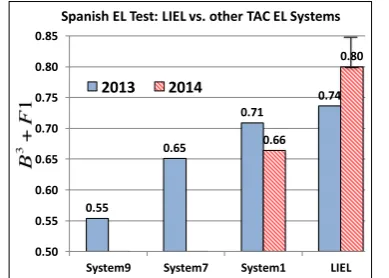
Spanish EL Test: LIEL vs. other TAC EL Systems
2013 2014
Figure 3: System performance on the TAC 2013 and 2014 Spanish datasets are shown. LIEL out-performs all the systems in terms of overall F1 score.
3.5.1 Foreign Language Experiments
Note that LIEL wastrained only on the English Wikitrain dataset (Section 3.1), and then applied,
unchanged, to all the evaluation datasets across languages and domains described in Section 3.1. Hence, it is the same instance of the model for all languages. As we will observe, this one sys-tem consistently outperforms the state of the art, even though it is using exactly the same trained model across the datasets. We consider this to be the take-away message of this paper.
[image:7.595.321.516.253.392.2]0.60 0.60
0.63 0.63
0.5 0.52 0.54 0.56 0.58 0.6 0.62 0.64
System 1 LIEL System 8 System 7
Ax
is
T
itl
e
[image:8.595.91.271.62.196.2]Chinese EL Test: LIEL vs. other TAC EL Systems
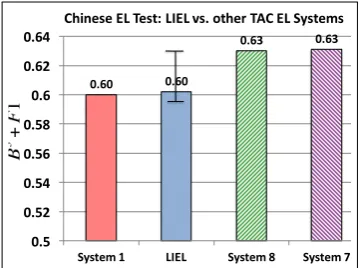
Figure 4: LIEL achieves competitive performance in Chinese EL further proving its robustness to multilingual data.
Chinese: Figure 4 shows the results of LIEL’s performance on the Chinese benchmark dataset compared to the state-of-the-art. Systems 7 and 8 obtains almost similar scores. We observe that LIEL is tied with System 1 and achieves com-petitive performance compared to Systems 7 and 8 (note that LIEL has a confidence interval of [0.597, 0.632]) which requires labeled Chinese TAC data to be trained on and the same model does not work for other languages. Emphasizing again: LIEL is trained onlyonce, on English, and tested on Chinese unchanged.
3.5.2 Error Analysis
While we see LIEL’s strong multi-lingual empiri-cal results, it is important to note some of the areas which confuses the system. Firstly, a major source of error which affects LIEL’s performance is due to coreference resolutione.g. from the text “ Bel-tran Leyva, also known as “The Bearded One,” is ...”, TAC’s mention query asks the systems to provide the disambiguation forThe Bearded One. LIEL predicts that the The Bearded One refers to the entityRichard Branson, which is the most common entity in Wikipedia that refers to that nickname (based on our dump), while, clearly, the correct entity should have beenBeltran Levya. We believe that this type of an error can be han-dled by performing joint EL and coreference res-olution, which is a promising future research area for LIEL.
Contextual information can also hurt system performance e.g. from the text, “.. dijo Alex S´anchez , analista..”, LIEL predicts the Wikipedia title Alex S´anchez (outfielder) for the mention Alex S´anchez since the document talks about sports and player names. The query men-tion was actually referring to a journalist, not in
the KB, and hence aNIL. Handling sparse en-tities, similar to this, are also an important future direction.
4 Related Work
2013), is the state-of-the-art for Chinese EL as it obtained the top score in TAC 2013. The FU-JITSU system (Miao et al., 2013) obtained similar scores. It is worth noting that these systems, unlike LIEL, are heavily language dependent, e.g. per-forming lexicon specific information extraction, using inter-language links to map between the lan-guages or training using labeled Chinese data.
In more specialized domains, Daiet al.(2011) employed a Markov logic network for building an EL system with good results in a bio-medical domain; it would be interesting to find out how their techniques might extended to other lan-guages/corpora. Phan et al. (2008) utilize topic models derived from Wikipedia to help classify short text segment, while Guoet al.(2013) investi-gate methods for disambiguating entities in tweets. Neither of these methods do show how to transfer the EL system developed for short texts to differ-ent languages, if at all.
The large majority of entity linking research outside of TAC involves a closely related task -wikification (Bunescu and Pasca, 2006; Cucerzan, 2007; Ratinov et al., 2011; Guo et al., 2013), and has been mainly performed on English datasets, for obvious reasons (data, tools availability). These systems usually achieve high accuracy on the language they are trained on. Multilingual studies, e.g. (McNamee et al., 2011), use a large number of pipelines and complex statistical ma-chine translation tools to first translate the original document contexts into English equivalents and transform the cross-lingual EL task into a mono-lingual EL one. The performance of the entity linking system is highly dependent on the exis-tence and potential of the statistical machine trans-lation system in the given pair of languages.
5 Conclusion
In this paper we discussed a new strategy for multilingual entity linking that, once trained on one language source with accompanying knowl-edge base, performs without adaptation in multi-ple target languages. Our proposed system, LIEL is trained on the English Wikipedia corpus, af-ter building its own knowledge-base by exploit-ing the rich information present in Wikipedia. One of the main characteristics of the system is that it makes effective use of features that are built ex-clusively around computing similarity between the text/context of the mention and the document text
of the candidate entity, allowing it to transcend language and perform inference on a completely new language or domain, without change or adap-tation.
The system displays a robust and strong empir-ical evidence by not only outperforming all state-of-the-art English EL systems, but also achieving very good performance on multiple Spanish and Chinese entity linking benchmark datasets, and it does so without the need to switch, retrain, or even translate, a major differentiating factor from the existing multi-lingual EL systems out there.
Acknowledgments
We would like to thank the anonymous review-ers for their suggestions. We also thank Salim Roukos, Georgiana Dinu and Vittorio Castelli for their helpful comments. This work was funded under DARPA HR0011-12-C-0015 (BOLT). The views and findings in this paper are those of the authors and are not endorsed by DARPA.
References
R. Bunescu and M. Pasca. 2006. Using encyclope-dic knowledge for named entity disambiguation. In EACL.
Ziqiang Cao, Sujian Li, and Heng Ji. 2014. Joint learning of chinese words, terms and keywords. In EMNLP.
X. Cheng and D. Roth. 2013. Relational inference for wikification. In Proc. of the Conference on Empirical Methods in Natural Language Processing (EMNLP).
R.L. Cilibrasi and P.M.B. Vitanyi. 2007. The google similarity distance. IEEE Transactions on Knowl-edge and Data Engineering, 19(3):370–383.
Silviu Cucerzan and Avirup Sil. 2013. The MSR Sys-tems for Entity Linking and Temporal Slot Filling at TAC 2013. InText Analysis Conference.
Silviu Cucerzan. 2007. Large-scale named entity dis-ambiguation based on wikipedia data. In EMNLP-CoNLL, pages 708–716.
Hong-Jie Dai, Richard Tzong-Han Tsai, Wen-Lian Hsu, et al. 2011. Entity disambiguation using a markov-logic network. InIJCNLP.
Stephen Guo, Ming-Wei Chang, and Emre Kıcıman. 2013. To link or not to link? a study on end-to-end tweet entity linking. InNAACL.
Heng Ji, HT Dang, J Nothman, and B Hachey. 2014. Overview of tac-kbp2014 entity discovery and link-ing tasks. In Proc. Text Analysis Conference (TAC2014).
D.C. Liu and J. Nocedal. 1989. On the limited memory method for large scale optimization. Mathematical Programming B, 45(3):503–528.
James Mayfield. 2013. Overview of the kbp 2013 en-tity linking track.
Paul McNamee, James Mayfield, Douglas W Oard, Tan Xu, Ke Wu, Veselin Stoyanov, and David Do-ermann. 2011. Cross-language entity linking in maryland during a hurricane. InText Analysis Con-ference.
Yuval Merhav, Joel Barry, James Clarke, David Mur-gatroyd, and One Alewife Center. 2013. Basis tech-nology at tac 2013 entity linking.
Qingliang Miao, Ruiyu Fang, Yao Meng, and Shu Zhang. 2013. Frdc’s cross-lingual entity linking system at tac 2013.
David Milne and Ian H. Witten. 2008. Learning to link with wikipedia. InCIKM.
Xuan-Hieu Phan, Le-Minh Nguyen, and Susumu Horiguchi. 2008. Learning to classify short and sparse text & web with hidden topics from large-scale data collections. In Proceedings of the 17th international conference on World Wide Web. L. Ratinov, D. Roth, D. Downey, and M. Anderson.
2011. Local and global algorithms for disambigua-tion to wikipedia. InProc. of the Annual Meeting of the Association of Computational Linguistics (ACL). Xing Shi, Kevin Knight, and Heng Ji. 2014. How to
speak a language without knowing it. InACL. Avirup Sil and Alexander Yates. 2013. Re-ranking
for Joint Named-Entity Recognition and Linking. In CIKM.
Avirup Sil, Ernest Cronin, Penghai Nie, Yinfei Yang, Ana-Maria Popescu, and Alexander Yates. 2012. Linking Named Entities to Any Database. In EMNLP-CoNLL.
Kesar Singh and Minge Xie. 2008. Bootstrap: a statis-tical method.