warwick.ac.uk/lib-publications
A Thesis Submitted for the Degree of PhD at the University of Warwick
Permanent WRAP URL:
http://wrap.warwick.ac.uk/79963
Copyright and reuse:
This thesis is made available online and is protected by original copyright.
Please scroll down to view the document itself.
Please refer to the repository record for this item for information to help you to cite it.
Our policy information is available from the repository home page.
Quantitative electrochemical EPR
By
Mika Tamski
Thesis
Submitted to the University of Warwick
for the degree of
Doctor of Philosophy
Department of Physics
i
List of figures ... v
Acknowledgements ... viii
Declaration and published work ... ix
Abstract ... x
Abbreviations and symbols ... xi
Chapter 1 – Electrochemistry ... 1
1.1. The electrochemical interface ... 1
1.1.1. Structure and dimensions ... 1
1.1.2. Properties ... 3
1.2. The electrochemical setup ... 7
1.3. Electrochemical experiments ... 8
1.3.1. Step methods ... 9
1.3.2. Cyclic voltammetry ... 10
1.4. Mass transport ... 11
1.4.1. Modes of mass transport ... 12
1.5. Ultramicroelectrodes (UMEs) ... 16
1.5.1. Geometry ... 17
1.5.2. Wire electrodes ... 19
References ... 22
Chapter 2 - Electron paramagnetic resonance ... 24
2.1. Uses of EPR... 24
2.2. The Zeeman effect ... 24
2.3. The g-factor ... 28
2.4. Hyperfine interaction ... 30
2.5. EPR spectrometer ... 31
2.6. Microwave power saturation ... 33
ii
2.9. The EPR resonator ... 39
2.9.1. Loop gap resonator (LGR) ... 41
2.9.2. EPR sample classification ... 44
2.9.3. Sensitivity comparison ... 46
2.10. The absolute sensitivity ... 47
References ... 49
Chapter 3 - Electrochemical EPR (EC-EPR) ... 51
3.1. Perturbation functions ... 51
3.2. The motivation for EC-EPR ... 53
3.3. Quantitative EC-EPR (QEC-EPR) ... 56
3.4. Review of EC-EPR cell designs ... 57
3.4.1. Performance criteria and challenges ... 57
3.4.2. Ex situ cells with flow ... 59
3.4.3. In situ cells with flow ... 65
3.4.4. Stationary in situ cells ... 68
References ... 76
Chapter 4 - Quantitative EPR (Q-EPR) ... 80
4.1. The magnetic susceptibility ... 81
4.2. Quantification methods ... 82
4.3. Dielectric properties and resonator Q-value ... 85
4.4. Effective filling factor ... 86
4.5. Magnetic field modulation ... 87
4.6. Microwave power ... 90
4.7. Scan width and double integration ... 92
4.8. Optimising the spectrometer settings ... 95
4.8.1. Setting up phases ... 95
4.8.2. Filter time constant and scan time ... 96
4.9. Referencing ... 97
4.10. What accuracy is achievable ... 97
4.11. Additional challenges due to electrochemistry ... 99
iii
Chapter 5 - The EC-EPR cell and the experimental setup ... 104
5.1. The cell material ... 105
5.2. The cell design ... 106
5.2.1. The first generation EC-EPR cell ... 106
5.2.2. The second generation EC-EPR cell ... 107
5.2.2.1. The cell design ... 107
5.2.2.2. The cell assembly ... 109
5.2.3. The EC-EPR setup ... 111
5.2.4. Benefits of the setup ... 113
5.2.5. Practical advice ... 114
References ... 116
Chapter 6 - The EPR and EC performance of the setup ... 117
6.1. Matherials and methods ... 117
6.2. The EPR performance ... 118
6.2.1. Degassing ... 118
6.2.2. The effect of the sample tube ID towards the EPR performance ... 120
6.2.3. EPR sensitivity comparison between LGR and cylindrical resonator ... 120
6.3. The electrochemical performance ... 123
6.3.1. Finite element simulations ... 123
6.3.2. Experimental results ... 126
6.4. The electrochemical EPR performance ... 129
6.5. Conclusions ... 137
References ... 139
Chapter 7 - Analytical measurements in quantitative EC-EPR ... 140
7.1. Experimental section ... 140
7.1.1. Materials ... 140
7.1.2. Methods ... 141
7.2. Results and discussion ... 142
7.2.1. 1,4-benzoquinone electrochemistry ... 142
iv
7.2.4. SQ-• generation efficiency ... 155
7.3. Conclusions ... 160
References ... 162
Chapter 8 - 1,4-benzoquinone electrochemistry in unbuffered aqueous solutions ... 164
8.1. Background ... 164
8.2. Aims... 173
8.3. Experimental ... 174
8.3.1. Materials ... 174
8.3.2. Methods ... 174
8.4. Results ... 175
8.4.1. Saturation study ... 175
8.4.2. BQ electrochemistry ... 176
8.4.3. pH dependency of radical generation efficiency ... 177
8.4.4. Radical generation efficiency across [BQ] ... 179
8.4.5. Decay kinetics ... 181
8.4.6. Comparison of results ... 186
8.4.7. Spin trapping in BQ solutions ... 187
8.5. Conclusions ... 189
References ... 191
v
Figure 1.1. The electrode-solution interface ... 2
Figure 1.2. A schematic representation of the electric double layer ... 3
Figure 1.3. Three electrode arrangement for resistance compensation ... 7
Figure 1.4. EC-EPR cell based on flat cell design ... 8
Figure 1.5. A potential step experiment for a reduction of electroactive species ... 9
Figure 1.6. A cyclic voltammetry (CV) experiment for reduction of electroactive species ... 10
Figure 1.7. A concentration profile for [Ox] of the electroanalyte at the WE surface ... 15
Figure 1.8. A diffusion profile for a macro and micro size disc electrodes ... 16
Figure 1.9. Different UME geometries ... 18
Figure 1.10. Cylindrical geometry with axial symmetry for wire electrode ... 20
Figure 2.1. The Zeeman Effect ... 27
Figure 2.2. Hyperfine interaction ... 31
Figure 2.3. The microwave bridge of a CW EPR spectrometer ... 32
Figure 2.4. A schematic representation of the magnetic field modulation ... 34
Figure 2.5. The effect of the width of the absorption line to the height of the line ... 35
Figure 2.6. The effect of increasing radical concentration towards the line broadening ... 38
Figure 2.7. The orientation of electric E1 and magnetic H1 fields in TE102 cavity resonator ... 39
Figure 2.8. One loop two gap resonator ... 42
Figure 2.9. Different LGR topologies ... 43
Figure 2.10. Classification of EPR samples ... 45
Figure 2.11. The sensitivity comparison between one loop one gap LGR and TE102 ... 47
Figure 3.1. The electrochemical interface ... 53
Figure 3.2. The Albery tube electrode ... 60
Figure 3.3. Cylindrical TE011 mode resonator ... 63
Figure 3.4. The schematic representation of the channel electrode cell ... 66
vi
Figure 3.7. Allendoerfer electrochemical cell based on LGR ... 74
Figure 4.1. Frequency dependence of (ε’) and (ε’’) of the dielectric constant of water ... 85
Figure 4.2. Normalised peak-to-peak amplitude (ΔSpp) for first derivatives of Lorenzian and Gaussian lines ... 88
Figure 4.3. Variation of ΔSpp for homogeneously and inhomogeneously broadened lines ... 91
Figure 4.4. The effect of incident microwave power to the double integrated signal intensity of TEMPOL ... 92
Figure 4.5. Double integration ... 93
Figure 4.6. The effect of a finite scan width towards the error related to double integration ... 94
Figure 5.1. 1st generation cell ... 106
Figure 5.2. The cell designed for a LGR ... 108
Figure 5.3. Assembled cell. ... 110
Figure 5.4. A schematic representation of the EC-EPR setup... 113
Figure 6.1. Deoxygenation test ... 119
Figure 6.2. Saturation curves for aqueous 10 μM TEMPOL solution ... 121
Figure 6.3. Comparison of physical sizes ... 122
Figure 6.4. The comparison of aqueous 10 μM TEMPOL EPR spectra ... 122
Figure 6.5. 2D axisymmetric COMSOL model... 124
Figure 6.6. Electrochemical characterization of cells ... 127
Figure 6.7. Cyclic voltammogram for methyl viologen... 129
Figure 6.8. EPR spectrum of MV+• ... 130
Figure 6.9. 5 scan average of EPR transient. ... 131
Figure 6.10. Dynamic EC-EPR ... 133
Figure 6.11. EPR signal intensity vs time for comproportionation ... 135
Figure 6.12. EC-EPR in organic solvent ... 137
Figure 7.1. Saturation curves for (a) TEMPOL and (b) SQ - • ... 141
Figure 7.2. EC-EPR of SQ-• in acetonitrile ... 143
Figure 7.3. The effects of static field in transient measurements ... 145
vii
Figure 7.6. The dependency of the SQ-• centre line width on EPR behaviour ... 150
Figure 7.7. The EPR intensity of H1 and Hmod across the LGR in z-direction ... 154
Figure 7.8. Quantification method ... 156
Figure 7.9. Quantification results ... 157
Figure 7.10. Rate of change of coulombs and EPR SA of a transient ... 159
Figure 8.1. “Nine membered square” for BQ reduction ... 165
Figure 8.2. Possible reduction mechanisms for BQ ... 166
Figure 8.3. Reduction of BQ in unbuffered aqueous solutions ... 167
Figure 8.4. Saturation curve for 100 μM TEMPOL and 1.2 mM BQ ... 175
Figure 8.5. pH dependency of the reduction mechanism of BQ ... 176
Figure 8.6. The pH dependency of radical generation efficiency in 0.9 mM BQ solution ... 178
Figure 8.7. Amount of SQ-• generated vs bulk [BQ] ... 180
Figure 8.8. Decay behaviour of 0.7 mM BQ ... 182
Figure 8.9. The offset relative to the [BQ-•] ... 183
Figure 8.10. An average of 10 transient measurements at 0.1 mM BQ solution ... 183
Figure 8.11. t1/2 vs [BQ] ... 184
viii
ix
I declare that the work presented in this thesis is my own except where stated otherwise, and was carried out at the University of Warwick, during the period of October 2011 and October 2015 under the supervision of Professor M. E. Newton. The research reported here has not been submitted, either wholly or in part, in this or any other academic institution for admission to a higher degree.
Some parts of the work reported and other work not reported in this thesis have been published, as listed below:
Published papers
M. A. Tamski, J. V. Macpherson, P. R. Unwin and M. E. Newton, Physical chemistry chemical physics : PCCP, 2015, 17, 23438-23447.
Conference presentations
I. M. A. Tamski, J. V. Macpherson, P. R. Unwin and M. E. Newton, Loop gap resonators in electrochemical electron paramagnetic resonance, The 6th EFEPR Winter School on Advanced EPR Spectroscopy, Weizmann Institute of Science, Israel, poster presentation (2013)
II. M. A. Tamski, J. V. Macpherson, P. R. Unwin and M. E. Newton, Electrochemical electron paramagnetic resonance utilising microelectrodes and loop gap resonators, The 46th Annual International Meeting of the ESR Spectroscopy Group of the Royal Society of Chemistry, poster presentation (2013)
III. M. A. Tamski, J. V. Macpherson, P. R. Unwin and M. E. Newton, Electrochemical electron paramagnetic resonance utilizing microelectrodes and loop gap resonators,
The 47th Annual International Meeting of the ESR Spectroscopy Group of the Royal Society of Chemistry, University of Dundee, oral presentation (2014)
x
Electron paramagnetic resonance (EPR) is a spectroscopic technique sensitive to unpaired electrons present in paramagnetic species such as free radicals and organometallic complexes.
Electrochemistry (EC) is an interfacial science, where reduction and oxidation processes are studied. A single electron reduction or oxidation generates a paramagnetic species with an unpaired electron, thus making EPR a valuable tool in the study of electrochemical systems.
In this work a novel electrochemical cell was designed and developed to be used with a specific type of EPR resonator, called loop gap resonator (LGR). After building and characterising the performance of the EC-EPR setup, it was adapted for quantitative measurements in electrochemical EPR (QEC-EPR).
xi
Abbreviations
AC Alternating current
AQS Anthraquinonesulfonate
BQ Benzoquinone
CE Counter electrode
CV Cyclic voltammetry
CW Continuous Wave
DC Direct current
DI Double integrated signal intensity of 1st derivative EPR spectrum
DMF Dimethylformamide
DPPH a,a’-diphenyl-β-picrylhydrazyl
EC Electrochemistry
EPR Electron paramagnetic resonance
EC-EPR Electrochemical electron paramagnetic resonance
FcTMA (Ferrocenylmethyl) trimethylammonium hexafluorophosphate
FWHH Full width half height
HOMO Highest occupied molecular orbital
HQ Hydroquinone
LGR Loop gap resonator
LOD Limit of detection
LOQ Limit of quantification
LUMO Lowest unoccupied molecular orbital
MO Molecular orbital
MV Methyl viologen
MW Microwave
NMR Nuclear magnetic resonance
RE Reference electrode
RMS Root mean square
xii WE Working electrode
TBAP tetra-N-butylammonium perchlorate
TEMPAMINE 4-Amino-2,2,6,6-tetramethylpiperidino-1-oxyl
TEMPOL 4-hydroxy-2,2,6,6-tetramethylpiperidin-1-oxyl
TMPD N,N,N’, N’-tetramethyl-para-phenylenediamine
UMEA Ultramicroelectrode array
xiii
a Hyperfine splitting factor
A Electrode surface area
Ap Capacitor plate area
b Band width of the entire detecting and amplifying system
C Concentration
𝐶𝑗 Concentration of species j
c Resonator conversion factor
Cd Capacitance of the double layer
cr constant from “one time” measurement of a reference standard
ct Filter time constant
𝐶∗ Bulk concentration
𝑑 Distance between capacitor plates
D Diffusion coefficient
𝐷𝑗 Diffusion coefficient of species j
DO Diffusion coefficient of oxidised form
𝜖 Dielectric constant
εr Relative permittivity of material
E Energy of an electron in an applied field
E1 Electric field of MW irradiation
E Electric potential applied to the electrode
EAppl Applied potential
Eeff Effective potential
EOhm Ohmic drop
Eλ Switching potential
eV Electron volt
ΔE Energy difference of two spin states
ΔE Magnitude of potential perturbation to WE
ΔEp Peak to peak separation
Fn Noise factor for sources other than thermal
F Faraday constant
𝑔 g-factor of a free electron
𝑔𝑒𝑓𝑓 Effective g-factor of a given radical
xiv
ℎ Width of an external magnetic field
ΔHpp peak to peak line width of a 1st derivative EPR line
H0 External magnetic field
Hr Effective magnetic field at resonance
Hmod Modulation amplitude of H0
H1 magnetic field component of the microwave irradiation
HI Magnetic field introduced by a nucleus
i Current
iC Capacitive current
iF Faradaic current
ip Peak current
ipox Anodic peak current
ipred Cathodic peak current
iR Ohmic drop
I Nuclear quantum number
𝐼𝑠 Steady state current at ultramicroelectrode
𝐽𝑗 Flux of species j
𝑗𝑝 Peak current density
kB Boltzmann constant
𝐿 Orbital angular momentum
L Inductance
me Electron mass
ms Spin state of an electron, projection of 𝜇𝑒 in z-direction
n population of an energy state
𝑛 Number of electrons transferred in electrode reaction
𝑛𝐵 Boltzmann factor for temperature dependence
nS number of scans
Nmin Minimum no. of spins detectable
N Number of spins
NV Sample’s spin volume density
[𝑂]𝑏𝑢𝑙𝑘 Bulk concentration of oxidised form
𝑃↑ Probability of upward transition
xv
q Charge (in Coulombs)
Q Quality factor of the resonator
QL Loaded Quality factor of the resonator
QU Effective unloaded Quality factor of the resonator
R Universal gas constant
Rc Compensated resistance
Rs Solution resistance
Ru Uncompensated resistance
R Resonator radius
𝑟0 Radius of cylinder or disc electrode
S Electron spin quantum number
S Width of an experimental scan
ΔSpp peak to peak signal amplitude of a 1st derivative EPR line
t scan time of an EPR spectrum
𝑡 Time (in seconds)
t1/2 Half-life of a radical
tmean Mean lifetime of radical
T Temperature
T1 Spin-lattice relaxation time
T2 Spin-spin relaxation time
Td Detector temperature
Ts Temperature of the sample
v Frequency of the electromagnetic radiation in Hertz
vmod Modulation frequency
𝑣𝑠 Potential Sweep Rate
𝑣𝑟𝑒𝑠 Resonator frequency
𝑣𝑠𝑜𝑙 Velocity of volume element
∆𝑣 Width of the resonator dip at half height
V Signal voltage at the end of the transmission line
Vc Volume of the cavity
Vr Volume of the resonator
Vs Volume of the sample
xvi
Z0 Characteristic impedance of the transmission line
ɀ𝑗 Electric charge of the species j
𝚲 Resonator efficiency parameter
λ Wavelength of electromagnetic radiation
ƞ Resonator filling factor
τ spin lifetime
𝜏 Cell time constant
Γ line width of the absorption line (half-width half-height)
μB Bohr Magneton
𝜇𝑒 Magnetic moment of a free electron
𝜇𝑁 Nuclear Magnetic Moment
μ0 Magnetic constant (permeability of vacuum)
𝛾𝑒 Gyromagnetic ratio of an isolated electron
𝛿 Diffusion layer thickness
Χ0 Static magnetic susceptibility
Χ’ In-phase component of a dynamic magnetic susceptibility
χ" Out-of-Phase component of the magnetic susceptibility
∅ Electric potential
ω Angular frequency
ε’ Real part of sample’s dielectric constant
1
Chapter 1
– Electrochemistry
Electrochemistry is an old science originating from the work of scientists like Volta and
Galvani, although the utilization of electrochemical phenomena has been traced back to
Parthans (250 B.C.). Modern electrochemistry has develop into a science of interfaces and
has recently been defined as: “Electrochemistry is the study of structures and processes at
the interface between an electronic conductor (the electrode) and the ionic conductor (the
electrolyte) or at the interface between two electrolytes”.1
1.1. The electrochemical interface
At the heart of an electrochemical (EC) experiment is the interface between the electrode
and the sample solution, also called the electric double layer. Several reviews of the electric
double layer have been published in recent years2-4 despite the apparent maturity of the
field. Below the structure and properties of the electrochemical interface are summarised,
before moving on to issues related to mass transport and electrode properties, the main
topics of this chapter.
1.1.1. Structure and dimensions
Although various types electrochemical interfaces exist, the most typical - and relevant to
this thesis - is that between a metallic conductor (electrode) and a solution, the
2
such as salt, acid or base (KCl, HCl, KOH etc.). The interface between the electrode and a
solution acts as a capacitor (Figure 1.1a), where the charge at the metal surface is counter
balanced by ions in the solution. In electrochemical experiments the potential of a working
electrode (WE) and thus the energy of electrons at the metal surface is adjusted with
respect to a reference electrode (RE). When a negative enough potential with respect to
the species of interest (an analyte) is applied to the WE, an electro-reduction of the species
occurs, and an electron is transferred to the lowest unoccupied molecular orbital (LUMO)
(Figure 1.1b). On the other hand, for electro-oxidation, the potential of the WE can be
adjusted to a value positive enough so that an electron is removed from the highest
occupied molecular orbital (HOMO) of the analyte.5
The region across which the charge separation occurs is called the electric double layer, the
structure, dimensions and thus the EC behaviour of which are strongly dependent on the
system under study.6 A schematic representation of the double layer is presented in Figure
1.2, where the net positive charge due to electron deficiency at the metal surface is
confined to an extremely thin layer with a typical thickness of ca. 0.1 Å. At the solution side
3
the equal negative charge is “smeared out” into the solution and thus the potential
gradient across the double layer is more gradual than would be the case with a capacitor
consisting of two parallel metal plates.
The effective dimensions of the double layer are extremely dependent on the system. For
example the concentration and type of the supporting electrolyte affect the distance on
the solution side across which the charge is balanced, ranging from tens of ångstroms in
the case of 0.1 to 1.0 M solutions of strong electrolytes to ca. 100 Å in the case of diluted
systems. None the less, as the voltage applied across the double layer is typically measured
around 1 V, and the separation of the capacitor “plates” is extremely narrow, electric fields
up to 109 V m-1 are realised making the capacitance of the double layer significant.1, 7
1.1.2. Properties
As mentioned above the electric double layer at WE/solution interface, to a good
approximation, acts as a parallel plate capacitor, for which the capacitance can be defined
as:8
Metal (+ve) Solution (-ve)
̴ 0.1 Å 5-20 Å
4 𝐶𝑑=
𝜀𝑟𝐴𝑝
𝑑 , (1.1)
where εr is the relative permittivity of the material between the plates (F m-1) , Ap is the
plate area (m2) and d is the distance between the two plates. The behaviour of the
capacitor can be expressed as:
𝑞
𝐸 = 𝐶𝑑 , (1.2)
where q is the charge stored in the capacitor in Coulombs (C), E is the potential applied
across the capacitor plates in Volts (V) and Cd is the capacitance of the double layer in
Farads (F). When a potential perturbation is applied to the electrode, a current must flow
until the double layer has adjusted to match the new condition of q determined by Cd. It
should be noted that the potential perturbation applied to the electrode introduces
re-distribution of charged particles and solvent dipoles on the solution side, thus effectively
changing the composition and geometry of the other “plate” of the capacitor, and
therefore the capacitance of the electric double layer can be proportional to the applied
potential, unlike in the case of normal capacitors.7 As the potential of the WE is
manipulated during an electrochemical experiment, the charging and discharging of the
capacitor affects the observed signal in the following ways:
The RC time constant
The magnitude of the charging current is dependent on the resistance of the system, and
5
𝜏 = 𝑅𝑠𝐶𝑑 , (1.3)
where τ is the time constant (in seconds) determining the time taken to charge the
capacitor through the solution resistance Rs in Ohms (Ω). For a potential step the behaviour
of the capacitive current (iC) measured in amperes (A), can be expressed as:9
𝑖𝑐=
𝛥𝐸
𝑅𝑠𝑒𝑥𝑝 (−
𝑡
𝑅𝑠𝐶𝑑) , (1.4)
where ΔE is the magnitude of the potential perturbation and t is time (sec). As can be seen,
the iC decays exponentially over time and will distort the analytical Faradaic current (iF), the
recording of which is the aim of EC measurements based on manipulation of the potential.
Therefore a minimum time interval of at least 5τ must be waited for a full establishment of
the potential step, after which the electrochemical interface is charged to a point at which
the desired potential gradient exists at the interface and analytical measurements can be
performed.
Therefore to perform measurements on the shortest timescales possible, the τ should be
minimised. This can be achieved by making the double layer capacitance as small as
possible by minimising the surface area of the WE, and in the case of electrochemical cell
design making sure that the cell geometry does not introduce unnecessary resistance to
the measurements. Because of these requirements it turns out that each individual EC cell
design has a characteristic time constant associated to it, which determines the shortest
6
The Ohmic Drop (iR-drop)
When current (i) flows during an electrochemical experiment, the measured potential
between WE and RE is distorted due to the Ohmic resistance (EOhm) of the solution:
𝐸𝑂ℎ𝑚= 𝑖𝑅𝑠 , (1.5)
The EOhm term represents the difference between the applied potential (Eappl) and the
effective one (Eeff) established across the electric double layer:9
𝐸𝑒𝑓𝑓= 𝐸𝑎𝑝𝑝𝑙− 𝐸𝑂ℎ𝑚 , (1.6)
Where all of the terms can have a time dependency, whether the potential is stepped to a
constant value or swept linearly.
Large currents and solution resistance makes the EOhm more pronounced, and thus
non-polar organic solvents tend to be prone to distorted potential control. Ways to minimise
the effect are to minimise the current by making the WE as small as possible and
decreasing the solution resistance by adding an excess of supporting electrolyte to the
sample solution, which for organic solvents is often not possible due to lack of suitably
soluble supporting electrolytes.7 None the less, the significance of the Rs should not be
ignored, as it contributes to both τ and EOhm.
Decreasing the size of the WE will not only lead to smaller Ohmic drop effect and better
potential control as smaller currents are generated, but also reduce τ due to the smaller Cd.
Therefore the electrochemical performance will improve through the miniaturization of the
7
1.2. The electrochemical setup
So far only a two electrode setup with WE and RE has been considered, which can be
utilised as long as EOhm < 1-2 mV, for example in the case of Rs = 2 kΩ and i = 1 μA (EOhm = 2
mV). In systems where the EOhm due to i, Rs or the cell geometry become significant, a three
electrode configuration can be employed by adding a counter electrode (CE) to the setup.
In this case the current flows between the WE and CE, and the potential of the WE is
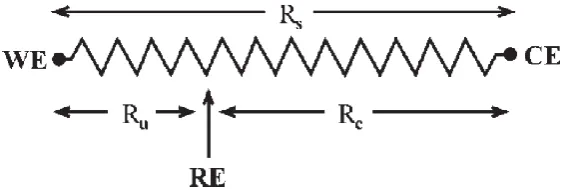
controlled relative to the RE. By placing the RE as close to the WE as possible, the overall Rs
can be divided into compensated resistance (Rc) and uncompensated resistance (Ru), thus
minimising most of the potential drop (Figure 1.3).11
The extent to which a three electrode setup can minimise Ohmic drop depends completely
on the application. For electrochemical EPR, several restrictions in terms of electrochemical
cell geometry, placement of the electrodes and the choice of solvent exist, which affect the
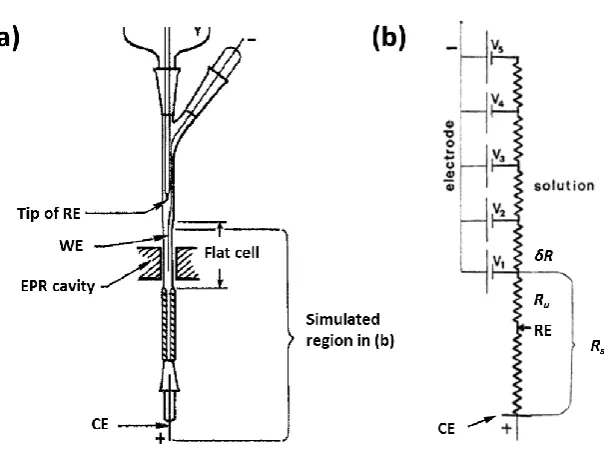
EC performance. For example, in the case of flat cell geometry the current path is limited to
a small cross sectional area making the resistance significant. Furthermore, in a real EC-EPR
cell (Figure 1.4a) the RE is often situated above the WE and the CE below it, making the
[image:25.595.182.467.86.181.2]Ohmic drop compensation insignificant.
8
Furthermore a second source for the Ohmic drop exists, as the potential across the WE
surface varies depending on the distance from the CE (V1 to V5, Figure 1.4b) especially with
organic solvents, and thus the current density along the WE is not uniform, as it drops in
magnitude moving from segment to segment away from the CE by the amount determined
by δR. Therefore, for large surface area electrodes inside a cell with a small cross section
the placement of the RE close to the WE cannot remove all of the Ru, even if situated
between the WE and CE as shown in Figure 1.4b.12
1.3. Electrochemical experiments
The most common EC techniques utilised with EPR are cyclic voltammetry (CV), potential
steps and current steps, although square wave voltammetry13 and other potential
[image:26.595.168.476.71.299.2]modulation techniques14 also have been employed.15
9
1.3.1. Step methods
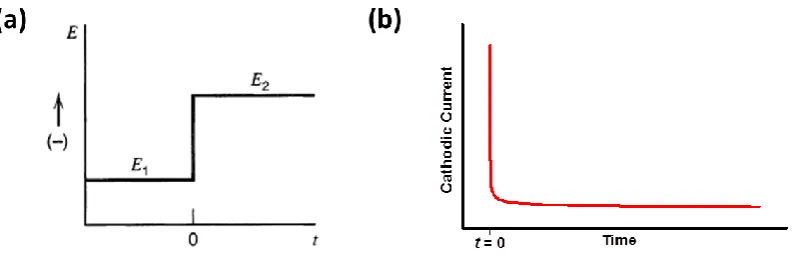
In potential step method (chronoamperometry) the potential of the WE is stepped from an
initial value (E1) where Faradaic processes do not occur to a final potential (E2), where
reduction (or oxidation) of the species of interest does take place (Figure 1.5a). The
corresponding current response is shown in Figure 1.5b for stationary solution, where
diffusion is the only active method of mass transport. After applying the potential E2, the
electrolysis current decays rapidly from the initial high value, as the electroactive species is
depleted from the electrode surface and a relatively slow process of diffusion starts to
transport analyte to the electrode from the bulk solution.5, 16
The Cottrell equation predicts the current behaviour as a function of time in stationary
solutions, where the only mechanism of mass transport is diffusion:
𝑖 =𝑛𝐹𝐴𝐷𝑂
1/2[𝑂] 𝑏𝑢𝑙𝑘
𝜋1/2𝑡1/2 , (1.7)
where n is the number of electrons transferred, F is Faraday’s constant, A is the surface
area of the electrode (cm2) , DO is the diffusion coefficient of the electroactive species (cm2
s-1) , [O]bulk is the bulk concentration of the electroactive species (mol cm-3) and t is time
[image:27.595.125.522.583.714.2](sec).
Figure 1.5. A potential step experiment for a reduction of electroactive species. (a) The potential of the WE is stepped instantaneously from E1 where no Faradaic current is generated to a value E2 where the analyte is
10
In EC-EPR, potential steps have been used mainly in electrolysis to generate the desired
amount of paramagnetic species for EPR investigation, either to study the EPR spectrum of
the species, or to monitor the EPR signal amplitude as a function of potential and time.17-19
Instead of a potential step, a constant current pulse can be applied, where the WE is set to
deliver a desired current for a specific period of time. In comparison to potential step, this
method allows a better control over the amount of radical species generated for EPR
detection, although decomposition of the solvent can occur if the current pulse is too long,
especially in systems where the Ohmic drop effect is significant.20-23
1.3.2. Cyclic voltammetry
In a cyclic voltammetry (CV) experiment, the potential of the WE is swept linearly from an
initial value to a switching potential (Eλ), where the direction of the sweep is reversed and
scanned back to the original value, as shown in Figure 1.6a. In Figure 1.6b a cathodic
current starts to flow as the potential at the WE reaches a negative enough value for the
reduction to occur. The current increases initially as the electron transfer rate gets faster
with more negative potentials, until a peak value is obtained (ipred), as the diffusion is
Figure 1.6. A cyclic voltammetry (CV) experiment for reduction of electroactive species. (a) The potential of the WE is swept from an initial valuewhere no Faradaic current is generated to a value Eλ, where the sweep
11
unable to supply the WE with fresh analyte at a fast enough rate. During the return sweep
an oxidative peak (ipox) is observed, as the analyte reduced during the first scan is oxidized
back to its original form.5 A voltammetric experiments can also be conducted as a linear
sweep, where only the first potential sweep is applied to the electrode, and thus only the
first current peak recorded.
For large planar electrodes the peak current of the forward scan can be predicted:
𝑖𝑝= 0.46633/2𝐴𝐹𝐷
𝑂1/2𝑣𝑠1/2[𝑂]𝑏𝑢𝑙𝑘(
𝐹 𝑅𝑇)
1/2
, (1.8)
where 𝑣𝑠 is the potential sweep rate (V s-1), R is the universal gas constant (J mol-1 K-1) and T
is temperature in Kelvins (K).
In EC the shape and location of the voltammogram on the X-axis can be used to obtain
kinetic and thermodynamic data of the system under study, which in the case of EC-EPR
can then be related to radical generation efficiencies and kinetics of the radical decay.21, 24,
25
1.4. Mass transport
Central to evaluating an EC-EPR cell design and relating the EPR signal behaviour against
processes taking place at the WE surface is the understanding of mass transport
phenomena occurring in electrochemical systems. The electrochemical interface is dynamic
by its very nature, distinguishing it from solid state EPR experiments where the EPR signal
intensity does not change over time due to redistribution of the paramagnetic centres
within the resonator. Below the modes of mass transport are considered, allowing a better
understanding of the EC-EPR technique and challenges towards absolute quantification in
12
1.4.1. Modes of mass transport
Mass transport mechanisms in EC can be divided into diffusion, migration and convection
according to the Nernst-Planck equation, which for a flux in one direction (𝑥) can be
described as:11
𝐽𝑗(𝑥) = −𝐷𝑗
𝜕𝐶𝑗(𝑥)
𝜕𝑥 −
ɀ𝑗𝐹 𝑅𝑇 𝐷𝑗𝐶𝑗
𝜕𝜙(𝑥)
𝜕𝑥 + 𝐶𝑗𝜈𝑠𝑜𝑙(𝑥) , (1.9)
where 𝐽𝑗 is flux of species j (mol cm-2 sec-1) at distance 𝑥 from the electrode surface, 𝐷𝑗
(cm2 sec-1), ɀ𝑗 and 𝐶𝑗 (mol cm-3) are the diffusion coefficient, charge and concentration of
species j, respectively; 𝑣𝑠𝑜𝑙(𝑥) (cm sec-1) is the rate at which a volume element moves in a
solution; 𝜕𝐶𝑗(𝑥) 𝜕𝑥⁄ is the concentration gradient and 𝜕𝜙(𝑥) 𝜕𝑥⁄ is the electric field
gradient along the x-axis.
Convection
The third term on the right hand side of Equation 1.9 represents the effects of convection.
In EC two types of convection are usually considered. The first type is called natural
convection due to thermal and density gradients that exist within the sample solution.
Natural convection is more typical for macro sized electrodes (mm or more) for
experiments lasting 10-20 sec and more, where the diffusion field starts to collapse
introducing local convective fluxes that are hard to predict or simulate, making analytical
work impossible.
The natural convection can be avoided by introducing a deliberate forced convection to the
EC system, for example by pumping the solution through a channel containing the WE, or
13
through natural convection, allowing the extension of time-scales beyond 10-20 sec. As
long as the hydrodynamic conditions are well defined, it is possible to predict the mass
transport pattern to the electrode surface quantitatively, thus facilitating analytical work.5
As will be discussed in Chapter 3, many EC-EPR cell designs are based on flat cell design,
where natural convection manifests, and thus setups based on forced convection have
been successfully utilised in the study of paramagnetic reaction products.
Migration
The second term on the right hand side of Equation 1.9 represents the effects of migration.
The 𝜕𝜙 𝜕𝑥⁄ existing at the WE/solution interface will have an electrostatic effect, repulsive
or attractive, to charged species present at the interfacial region, thus introducing a
migratory flux to electrochemical systems. For example, during electrolysis, the
concentration of charged species will change at the electrode surface, affecting the ionic
strength at the interface, and thus the strength of 𝜕𝜙 𝜕𝑥⁄ . Therefore, as the electrolysis
proceeds, the migrational flux and hence the overall mass transport conditions will change
over time, making the system difficult to interpret and quantify.
To avoid migration effects is another reason to add a chemically inert background
electrolyte to the solution. When in large enough excess (typically 100 times relative to the
reactants), the complications due to migration can be avoided, as charge neutrality at the
electrode surface can be assumed and 𝜕𝜙 𝜕𝑥⁄ will not change as the electrolysis proceeds.
As discussed above, the addition of background electrolyte also makes the solution
electrically more conducting diminishing the Ohmic drop effect, ensuring that the current
flowing through the cell during electrolysis is not limited by the conductivity of the bulk
14
Diffusion
The first term in Equation 1.9 represents Fick’s first law of diffusion, relating flux of species j
to its concentration gradient (how concentration varies over distance 𝑥) at a specific time t.
The second law relates the change in the concentration of species j over time at a given
point:11
𝜕𝐶𝑗
𝜕𝑡 = 𝐷𝑗( 𝜕2𝐶
𝑗
𝜕𝑥2) , (1.10)
Often the aim of the EC experiment is to make the diffusion the only means of mass
transport. This can be achieved by setting the experiment such that the effects from
convection and migration are negligible by using quiescent solutions, where stirring of the
solution does not occur and adding supporting electrolyte to avoid the migration as
explained above. This greatly simplifies the equation for mass transport (Eq. 1.9), making
the analysis and interpretation of the EC data more feasible.
For simple electrode reactions involving only an electron transfer between the WE and the
species of interest, the Nernst-Planck equation can be used to relate the Eappl to the relative
concentrations of oxidized [Ox] and reduced [Red] species, assuming a reversible system
with fast kinetics so that [Ox] and [Red] are at equilibrium at the electrode surface:11
𝐸𝑎𝑝𝑝𝑙 = 𝐸0+𝑅𝑇
𝑛𝐹𝑙𝑛 [𝑂𝑥]
[𝑅𝑒𝑑] , (1.11)
where E0 is the standard potential. It is assumed that the concentrations of species in
15
Figure 1.7a shows the concentration profile of oxidized species as a function of applied
potential at the WE surface for elementary reduction process according to the
Nernst-Planck equation:
𝑂 + 𝑒−⇌ 𝑅 , (1.12)
where the standard potential for the reduction is -0.2 V. Applying a potential of -0.4 V, for
example, will take the concentration of oxidized species [Ox] to zero at the WE surface,
introducing a concentration gradient between the surface and the bulk of the solution, a
mechanism that establishes the diffusion of more oxidized species towards the electrode.
Whether the potential is swept or stepped to -0.4 V, the concentration gradient will
develop over time getting shallower between the WE surface and the bulk solution [Ox]bulk
as time proceeds and the diffusion layer grows thicker, as shown in Figure 1.7b, where 𝑥 is
the distance from the WE surface. The diffusion layer thickness for linear diffusion can be
estimated from:26
𝛿 = (𝜋𝐷𝑡)1/2 , (1.13)
Figure 1.7. (a) a concentration profile for [Ox] of the electroanalyte at the WE surface as a function of electrode potential according to the Nernst-Planck equation. (b) The growth of the diffusion field and shallowing of the concentration gradient from the WE surface as a function of time for potential where the [Ox] goes to zero. (Modified from ref. [16] pp. 432)
Increasing time
[Ox]bulk
[Ox]
-0.5 -0.4 -0.3 -0.2 -0.1 0.0 0.1 0.0
0.2 0.4 0.6 0.8 1.0
[Ox]
(mM)
Applied potential (V)
E
0 [image:33.595.119.512.482.714.2]16
showing a square root relationship of the diffusion layer thickness with t.
The size of the WE and its geometry will determine the shape of the diffusion field and thus
the magnitude of the diffusive flux to the electrode surface. For example, for a large disk
shaped electrode the diffusive flux is essentially normal or “axial” to the WE surface (Figure
1.8a), whereas for a very small disc (Figure 1.8b) there is a significant radial component to
the diffusion. This results in much increased flux of analyte per unit surface area, giving
small electrodes distinct advantages relative to large electrodes.
1.5. Ultramicroelectrodes (UMEs)
Depending on the geometry of the electrode, the characteristic dimension of a UME should
be around 20 µm at maximum. The benefits of UMEs are:27
I. Small currents are produced, as the electrode is small in size, reducing the
Ohmic-drop as discussed above.
II. The small size of the capacitance and application of smaller over potentials also
decrease the cell time constant. This makes it possible to perform experiments on a
time scale much shorter than with macro electrodes and allows fast-scan
17 voltammetry.
III. The rate of diffusive flux to the electrode increases significantly, and a steady state
concentration of analyte at the electrode surface establishes quickly. The larger
flux of analyte also diminishes the effect of natural convection.
The greatly enhanced mass transport results in high charge densities at the electrode,
producing large Faradaic currents compared to the capacitance and thus high S/N. The
benefits above have enabled electrochemistry to be applied in solid28 and gas phase29, as
well as with non-polar organic solvents without a supporting electrolyte.30
The increased rate of mass transport is caused by the change of the shape of the diffusion
field in the timescale of the experiment.31-33 If the electrode is small enough and of correct
shape, a radial component of the diffusion starts to have a significant effect and the flux of
analyte to the electrode surface is increased. In steady state the rate of reaction is
dependent on electrode kinetics rather than diffusion of the analyte to the electrode
surface, enabling the study of electrode kinetics independently from mass transport. The
exact current response during an experiment is dependent on the geometry of the
electrode via the shape of the diffusion field.34
1.5.1. Geometry
Probably the most common shape of a UME is a disc surrounded by an insulating material
such as glass. A similar geometry is that of a ring, which can be combined with a disc or
rings with different diameter for various applications (Figure 1.9a). Other typical
geometries include those of a cylindrical and a hemispherical, as shown in Figure 1.9b top
and bottom, respectively, and that of a band (Figure 1.9c left). Each of the geometries have
18
homogeneity of the current density across the electrode surface etc. For true steady state
to develop, the electrode geometry must have a convergence factor above 0.5, which is
achieved when the electrode is finite in two dimensions as in the case of a sphere. The
shapes of cylinder and band will not satisfy this requirement being infinite in one
dimension, whereas disc and ring shapes for example can obtain a steady state under
semi-infinite diffusion conditions, as the dimensions are finite provided that the electrode is
small enough.32
Although the very small currents are favourable for electrochemistry, the analytical signal
measured can be of the order of pA or nA, depending on the actual size of the electrode. To
amplify the analytical current, several UMEs can be assembled into an array (UMEA) as
shown for band geometry in Figure 1.9c on the right hand side, which enables the
amplification of the measured signal.35 This increase in the signal is exploited for example in
biosensors36,37, where UMEAs can offer a cheap, fast and reliable method of pesticide and
toxicity testing.38,39
19
1.5.2. Wire electrodes
The electrode geometry relevant to the work in this thesis is the cylindrical one, for which
the Fick’s second law of diffusion, assuming no end effects, can be written as:9
𝜕𝐶 𝜕𝑡 = 𝐷 (
𝜕2𝐶
𝜕𝑟2 +
1 𝑟
𝜕𝐶
𝜕𝑟) , (1.14)
As seen from equation 1.14, assuming symmetry along the length of the electrode
(z-direction), the diffusion is dependent only on a single dimension (r) in an xy-plane, and
therefore simple to solve mathematically.
Of a cylindrical geometry, metal wire acting as an electrode is one of the simplest and
easiest to manufacture, and the critical dimension characterising the time dependent
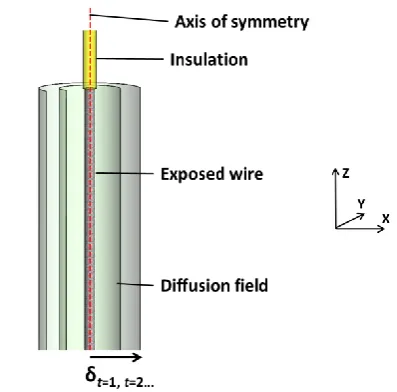
behaviour is the radius of the cylinder. Figure 1.10 shows a schematic of a cylindrical wire
electrode, where an axis of symmetry dominates the geometry along the length of the wire
in z-direction, prepared by removing insulation from around a central conductor. Also
shown is the development of the diffusion layer thickness as a function of time, growing
concentrically around the electrode. Over time, the curvature of the diffusion layer
becomes shallower when compared to the curvature at the electrode surface, giving rise to
a radial component to the diffusion, and thus an enhanced flux of analyte to the electrode
surface. None the less, as shown below, it is not possible to obtain true steady state
20
The theory for the diffusion of electro active species to a thin cylindrical electrode has been
developed for potential step42, 43 and linear sweep experiments.40 Provided that the length
of the cylinder is large compared to the radius, the current during a potential step is:
𝑖 =
𝑛𝐹𝐴𝐷𝑜𝐶∗𝑟0
[
2𝑒𝑥𝑝(−0.05𝜋1/2𝜃1/2)
𝜋1/2𝜃1/2
+
1
𝑙𝑛(5.2945+0.7493𝜃1/2)
] ,
(1.15)with 𝜃 = 4𝐷𝑜𝑡/𝑟02 where r0 is the radius of the cylinder, A the surface area of the electrode
and 𝐶∗ is the bulk concentration (mol cm3). For short timescales 𝜃 is small the current is
essentially Cottrellian, as the first term in the parentheses (Equation 1.15) dominates. The
diffusion remains Cottrellian within 4 % until the diffusion field has become ca. 10 % of r0,
deviating only after the diffusion length becomes large relative to the curvature of the
electrode surface. At this point the radial component of the diffusion causes the current to
increase from that expected for planar macro electrode, as the second term in the
[image:38.595.210.409.70.266.2]parentheses becomes dominant. Because the current is dependent of time (through 𝜃), no
21
true steady state is ever reached. None the less, as the time manifests only as an inverse
logarithmic function for long time scales, a quasi-steady state is achievable.7
For a linear sweep the empirically obtained peak current density is:
𝑗
𝑝=
𝑛2𝐹2𝐶∗𝑟0𝑣𝑠𝑅𝑇
(
0.446
𝑝
+
0.335
𝑝1.85
)
,
(1.16)Where 𝑣𝑠 is the scan rate. The value of p characterises the voltammogram, representing
the ratio of the potential scan rate (nF/RT)a𝑣 to the diffusion rate D/a, defined as:
𝑝 = √𝑛𝐹𝑟02𝑣
𝑠/𝑇𝑅𝐷 , (1.17)
For high scan rates or large electrode diameters the values of p are also large, and the
behaviour is similar with linear sweep voltammograms at a large planar electrode, whereas
for very slow scan rates and small electrode diameters the p is small and the behaviour
approaches the steady state solution given by equation 𝐼𝑠= 4𝑛𝐹𝐶∗𝐷𝑟0 for a UME disc.44
None the less, the possibility of adjusting the length of the cylinder allows the utilisation of
currents typical to macro electrodes with some of the benefits of UMEs through radial
22
References
1. E. S. Wolfgang Schmickler, Interfacial Electrochemistry Springer, Heidelberg, London, Germany, 2010.
2. E. Gileadi, J. Solid State Electrochem., 2011, 15, 1359-1371.
3. B. B. Damaskin and O. A. Petrii, J. Solid State Electrochem., 2011, 15, 1317-1334. 4. W. R. Fawcett, J. Solid State Electrochem., 2011, 15, 1347-1358.
5. A. C. Fisher, Electrode Dynamics, Oxford University Press, Oxford, 1996.
6. R. Greef, R. Peat, L. M. Peter, D. Pletcher and J. Robinson, Instrumental Methods in Electrochemistry Ellis Horwood, Chichester, 1985.
7. A. J. Bard and L. R. Faulkner, Electrochemical Methods: Fundamentals and Applications, 2nd edn., JOHN WILEY & SONS, INC., 2001.
8. B. I. Bleaney and B. Bleaney, Electricity and Magnetism, 3rd edn., Oxford University Press, London, 1976.
9. J. Heinze, Angew. Chem. Int. Edit. Engl., 1993, 32, 1268-1288. 10. J. O. Howell and R. M. Wightman, Anal. Chem., 1984, 56, 524-529. 11. M. Ciobanu, J. P. Wilburn, M. L. Krim and D. E. Cliffel, in Handbook of
Electrochemistry, ed. C. G. Zoski, Elsevier, Oxford, UK, 2007, pp. 3-29.
12. I. B. Goldberg, A. J. Bard and S. W. Feldberg, J. Phys.Chem., 1972, 76, 2550-2559. 13. R. D. Allendoerfer, G. A. Martinchek and S. Bruckenstein, Anal.Chem., 1975, 47,
890-894.
14. L. Zhuang and J. T. Lu, J. Electroanal. Chem., 1997, 429, 115-120. 15. R. N. Bagchi, A. M. Bond and F. Scholz, Electroanal., 1989, 1, 1-11.
16. G. Denuault, M. Sosna and K.-J. Williams, in Handbook of Electrochemistry, ed. C. G. Zoski, Elsevier, Amsterdam, Netherlands, 2007, pp. 431-469.
17. R. N. Bagchi, A. M. Bond, F. Scholz and R. Stosser, J. Electroanal. Chem., 1988, 245, 105-112.
18. D. A. Fiedler, M. Koppenol and A. M. Bond, J. Electrochem. Soc., 1995, 142, 862-867.
19. J. G. Gaudiello, P. K. Ghosh and A. J. Bard, J. Am. Chem. Soc., 1985, 107, 3027-3032. 20. R. G. Compton, P. J. Daly, P. R. Unwin and A. M. Waller, J. Electroanal. Chem., 1985,
191, 15-29.
21. I. B. Goldberg and A. J. Bard, J. Phys. Chem., 1971, 75, 3281-3290. 22. I. B. Goldberg and A. J. Bard, J. Phys. Chem., 1974, 78, 290-294.
23. I. B. Goldberg, D. Boyd, R. Hirasawa and A. J. Bard, J. Phys. Chem., 1974, 78, 295-299.
24. W. J. Albery, R. G. Compton and C. C. Jones, J. Am. Chem. Soc., 1984, 106, 469-473. 25. L. Zhuang and J. Lu, Rev. Sci. Instrum., 2000, 71, 4242-4248.
26. C. M. A. Brett and A. M. O. Brett, Electrochemistry: Principles, Methods and Applications, Oxford University Press, Oxford, UK, 1993.
27. S. Pons and M. Fleischmann, Anal. Chem., 1987, 59, A1391-A1399.
23
29. J. Ghoroghchian, F. Sarfarazi, T. Dibble, J. Cassidy, J. J. Smith, A. Russell, G. Dunmore, M. Fleischmann and S. Pons, Anal. Chem., 1986, 58, 2278-2282. 30. A. M. Bond and T. F. Mann, Electrochim. Acta, 1987, 32, 863-870.
31. M. Fleischmann and S. Pons, J. Electroanal. Chem., 1987, 222, 107-115.
32. A. M. Bond, K. B. Oldham and C. G. Zoski, Anal. Chim. Acta, 1989, 216, 177-230. 33. C. G. Zoski, J. Electroanal. Chem., 1990, 296, 317-333.
34. R. M. Wightman, Science, 1988, 240, 415-420.
35. J. Orozco, C. Fernandez-Sanchez and C. Jimenez-Jorquera, Sensors, 10, 475-490. 36. G. A. Evtugyn, H. C. Budnikov and E. B. Nikolskaya, Talanta, 1998, 46, 465-484. 37. M. J. Dennison and A. P. F. Turner, Biotechnol. Adv., 1995, 13, 1-12.
38. D. M. Yong, C. Liu, D. B. Yu and S. J. Dong, Talanta, 2011, 84, 7-12. 39. C. Liu, T. Sun, X. Xu and S. Dong, Anal. Chim. Acta, 2009, 641, 59-63.
40. K. Aoki, K. Honda, K. Tokuda and H. Matsuda, J. Electroanal. Chem., 1985, 182, 267-279.
41. K. Aoki, K. Tokuda and H. Matsuda, J. Electroanal. Chem., 1986, 206, 47-56. 42. K. Aoki, K. Honda, K. Tokuda and H. Matsuda, J. Electroanal. Chem., 1985, 186,
79-86.
43. A. Szabo, D. K. Cope, D. E. Tallman, P. M. Kovach and R. M. Wightman, J. Electroanal. Chem., 1987, 217, 417-423.
24
Chapter 2
- Electron paramagnetic resonance
2.1. Uses of EPR
Electron paramagnetic resonance (EPR) as a technique is sensitive to paramagnetic species
with unpaired electrons only (radical, bi-radical, triplet etc.), and thus provides specific
information on the paramagnetic centre and its environment. Uses of EPR range from the
detection and characterisation of small organic and inorganic radicals in liquids and solids
to organometallic complexes and molecule-based magnetic materials.1
Industrially significant applications of EPR range from polymer formation and degradation
studies2-4 to the food industry, where sterilization through irradiation can be used to
increase hygiene and extend shelf life,5-8 or to measure antioxidant properties of different
foodstuffs.9-11 Other uses of EPR are found from fields such as biology and medicine12, 13,
catalysis14-17 and semiconductor applications.18-21
Below the fundamental theory of continuous wave (CW) EPR is discussed in terms of
phenomena that allow and facilitate the recording of the EPR spectrum.
2.2. The Zeeman effect
A quantum particle such as an electron has an intrinsic spin angular momentum, which is a
vector property having a magnitude and direction. This angular momentum is indicated by
a spin quantum number S and in case of an electron has a value of ½. The electron spin
angular momentum is associated with a magnetic moment μe which for a free electron can
25
𝝁𝒆= −𝑔 𝜇𝐵 𝑺 , (2.1)
where ɡ is the ɡ-factor discussed in a section below with a value of 2.002319 in a vacuum,
µB is the Bohr magneton, a natural unit of an electron’s magnetic moment given by µB =
-|e|h/4πme = -9.27410-24 J T-1, where e is the electron charge, h is the Planck constant
(6.626×10⁻³⁴ Js) and me is electron mass.
When an external magnetic field (H0 or B0) is applied to an electron spin, the energy is given
as a scalar product between μe and H0:
𝐸 = −𝝁𝒆∙ 𝑯𝟎= 𝑔|𝜇𝐵|𝑺 ∙ 𝑯𝟎 , (2.2)
which assuming that the H0 field orientates along z-direction then becomes:
𝐸 = 𝑔|𝜇𝐵|𝐻0𝑆𝑧 , (2.3)
The projection of μe in z-direction is designated with symbol ms, and for a spin ½ particle
can have only two values: ms= + ½ or ms = – ½, where the negative value represents the
alignment of the magnetic moment along the external magnetic field, and the positive
value against it.
When the external magnetic field is interacting with the electron’s magnetic moment, the
difference in energy (ΔE) between ms = - ½ and ms = + ½ spin states is given by equation:23
26
where Δms has values ±1. ΔE is also the energy required to achieve a transition between
the two spin states. In EPR this energy comes from oscillating magnetic field (H1 or B1) of
microwave (MW) irradiation, where H1 is oriented perpendicular to the H0:
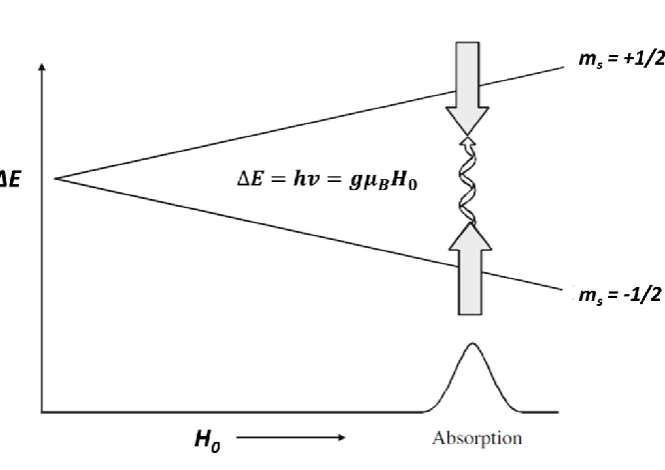
ΔE = ℎ𝜈 = 𝑔 𝜇𝐵𝐻0 , (2.5)
where v is the frequency in Hertz. In a typical EPR experiment at X-band the frequency of
the exciting radiation is around 9.5 GHz. Due to using a resonant cavity coupled to a specific
frequency, it is practical to fix the frequency and sweep the H0 with a laboratory magnet, so
that at resonance the absorption of MW energy occurs according to Equation 2.5 above.
The interaction of the electron magnetic moment with the external magnetic field is called
The Zeeman Effect. When an external magnetic field is applied it introduces a net
magnetization in the sample along the H0 (z-direction), while the components
perpendicular to the H0 (x- and y-directions) are averaged out. In the absence of the
external magnetic field the two mS states are degenerate, i.e. have same energy. Figure 2.1
summarises the interaction between MW irradiation (hν) and μe during an EPR experiment,
when the H0 field is swept and the degeneracy lifted. A resonance condition is achieved
when the energy of the irradiation matches the energy difference between the ms = - ½ and
ms= + ½ spin states.
The population difference Δn of the states can be represented as:24
𝛥𝑛 = 𝑛−1/2− 𝑛+1/2 , (2.6)
Where n-1/2 = ½(N + Δn), n+1/2 = ½(N - Δn) and N = n-1/2 + n+1/2. Assuming that spins are
27 𝑑∆𝑛
𝑑𝑡 = −2𝑛−1/2𝑃↑+ 2𝑛1/2𝑃↓ , (2.7)
Where P↑ and P↓ are the probabilities of upward and downward transitions, respectively
and the factor 2 appears because a single transition upwards or downwards changes Δn by
2. It has been shown that in steady state where dΔn/dt = 0:
𝛥𝑛𝑠𝑠= 𝑛
−1/2𝑠𝑠− 𝑛+1/2𝑠𝑠= 𝑁
𝑃↓− 𝑃↑
𝑃↓+ 𝑃↑ ,
(2.8)
i.e. population difference exists due to Boltzmann distribution even if the probabilities of
the upward and downward transitions are equal, which can be represented by the
[image:45.595.147.480.464.699.2]Boltzmann distribution:
Figure 2.1. The Zeeman Effect during an EPR experiment. External magnetic field (H0) is swept while the
microwave radiation (hv) is kept constant. At resonance the energy difference between the spin states match the exciting energy, an absorption of magnetic component of the microwave radiation occurs, and an electron is promoted from parallel ms = - ½ to a higher energy antiparallel ms = + ½ spin state.
28 𝑛+1/2
𝑛−1/2= 𝑒
− ∆𝐸𝑘
𝐵𝑇𝑠 , (2.9)
where n+1/2 and n-1/2 denotes the populations of anti-parallel (ms = +1/2) and parallel (ms =
-1/2) states under thermal equilibrium, respectively, kB is the Boltzmann constant and Ts is
the sample temperature in Kelvins.
Because ΔE is very small, only about 6.2×10⁻²⁴ J at X-band (H0 = 334 mT, Equation 2.5) and
the thermal energy available at room temperature is relatively large (4.1×10⁻²¹ J), the
population difference is only ca. 1/1000 larger for the ms-1/2 state, making net absorption of
energy and thus the EPR signal inherently very weak. An obvious way to increase the signal
intensity is by increasing the population of the ms = -1/2 state relative to ms = +1/2. This can
be accomplished for example by lowering the temperature (Equation 2.9) or increasing the
ΔE by moving to higher frequencies and H0 strengths.22, 23
2.3. The g-factor
In addition to spin angular momentum, an unpaired electron in a molecule also has an
orbital angular momentum associated with it due to the electron’s orbital motion.
Therefore the magnetic moment of a free electron (Equation 2.1) must be modified to
account for this additional source of magnetic moment:22
𝝁 = 𝜇𝐵(𝑳 + 𝑔𝑒𝑺) , (2.10)
where 𝐿 is the orbital angular momentum, taking integer values depending on the orbital
29
momentum are independent from each other. In practise, although orbital angular
momentum is often quenched and the electron’s angular momentum is only due to its spin,
spin-orbit coupling restores some of the orbital angular momentum, and the g-factor is
adjusted from that of a free electron:
𝑔𝑒𝑓𝑓 =
ℎ𝑣
𝜇𝐵𝐻𝑟 , (2.11)
where geff is the effective ɡ-factor accounting for the orbital angular contribution and Hr is
the effective magnetic field at resonance. The geff is unique to any radical species because
the orbital angular momentum of the electron is sensitive to the electron’s surroundings
depending on the molecule in question, and also varies according to which atom the
electron is centred on.
As a result the resonance frequency in Equation 2.5 shifts from that of the free electron to
account for the geff, and therefore the g-factor, in addition to hyperfine couplings discussed
below, can be used as a fingerprint to identify a given molecule. For example an electron in
a vicinity of carbon atom has a ɡ-factor close to the free electron in a vacuum, whereas an
electron close to a heteroatom can have ɡ-factors around 2.004-2.006 and for metal
centres can go up to 9 or 10 in some cases.25
Due to its relation to orbital motion, the spin-orbit coupling is an anisotropic (orientation
dependent) interaction, meaning that the angular momentum varies depending on the
direction of molecular frame relative to H0. This orientation dependency is an important
feature of EPR spectra for single crystal and powder samples in solid form, but also for large
molecules in solvents with high viscosity. For small free radicals in solvents of low viscosity,
ɡ-30
factor anisotropy is averaged out and only the isotropic ɡ-factor needs to be accounted
for.22
2.4. Hyperfine interaction
Certain nuclei such as hydrogen possess a nuclear magnetic moment, μN. The angular
momentum of the unpaired electron spin couples with the magnetic moments of nuclei
present in the molecule, a phenomenon which is called hyperfine interaction. The magnetic
moment of the nucleus induces a small local magnetic field that is experienced by the
unpaired electron and can either enhance or oppose the external magnetic field of the
laboratory magnet. In the simplest case a single hydrogen nucleus with a spin number I = ½
couples with the unpaired electron. Depending on the orientation of the μN of the nucleus,
either more or less external magnetic field is required to introduce the transition between
the electron’s energy state, and therefore two peaks are observed for the electron, one at
lower magnetic field and the other at higher. This is depicted in Figure 2.2, where originally
a single absorption peak is split into two, each centred HI away from the original peak,
where a is the hyperfine coupling factor describing the strength of the interaction between
the electron and nucleus’s magnetic moments.
Depending on the number and nature of the atomic nuclei with I≠0 in the paramagnetic
species, the EPR absorption peak splits in a pattern characteristic to the molecule. This fact
can be used as a fingerprint to identify the radical species and measure the localisation of
the electron spin density within a molecule. As with the ɡ-factor, the hyperfine interaction
displays anisotropy in solids and for large molecules in viscous solvents, but for small free
![Figure 1.7. (a) a concentration profile for [Ox] of the electroanalyte at the WE surface as a function of electrode potential according to the Nernst-Planck equation](https://thumb-us.123doks.com/thumbv2/123dok_us/9531366.458166/33.595.119.512.482.714/figure-concentration-electroanalyte-function-electrode-potential-according-equation.webp)