Master Thesis report
Enhancing the risk management process in the tender phase of
infrastructure projects
3
Master Thesis report
Enhancing the risk management process in the tender phase of
infrastructure projects
Author
Name: T. (Timo) Rodink
Education: Construction Management and Engineering (CME) E-mail: [email protected]
Phone: +31683245337
Version
Document: Master Thesis Version: V2.0 – Final report
University of Twente
First Supervisor: Prof. dr. ir. J.I.M (Joop) Halman E-mail: [email protected] Second Supervisor: Drs. Ing. J. (Hans) Boes E-mail: [email protected] Third supervisor: Dr. S.H.S. Al-Jibouri
E-mail: (retired from the University of Twente)
Heijmans Infra B.V.
Supervisor: H.J.D.T. van der Meer Email: (Former Heijmans employee)
Supervisor: K. Morren
5
Preface
Before you lies the Master Thesis: “Enhancing the risk management process in the tender phase of infrastructure projects”. It has been written to fulfil the graduation requirements of the Master Construction Management and Engineering at the University of Twente and has been conducted on behalf of Heijmans Infra B.V.
The writing of this Master Thesis took me from January 2017 to April 2019. The reason for this long period is the fact that I accepted a job offer from Heijmans while I was still working on my thesis. Due to the fact it was harder to combine working and finishing my thesis as expected, and several
personal issues I am glad to finish my thesis in the end.
I would like to thank my supervisors Prof. dr. ir. J.I.M. (Joop) Halman and Dr. S.H.S. (Saad) Al-Jibouri for their guidance and support during this long process. Besides Prof. dr. ir. J.I.M. (Joop) Halman and Dr. S.H.S. Al-Jibouri I would like to thank Drs. Ing. J. (Hans) Boes for assessing my thesis, because Mr. Al-Jibouri has retired from the University of Twente.
Besides my supervisors of the University of Twente I would like to thank Joris van der Meer and William Cornuyt, my supervisors from Heijmans, for their trust, help and feedback. I also would like to thank all my other colleagues at Heijmans Infra who provided me with information by means of documents or interviews.
Specials thanks to my partner Anouk Aaldering for her constant faith and patience in me during my Thesis.
I hope you enjoy reading my thesis.
Timo Rodink
6
Management Summary
The profit margins in the Dutch infrastructure market are low compared to for example the ICT or automotive sector. While the profit margins are low the risks for the contractor can be very high. When risks occur, it can lead to significant budget overruns. Which in the worst case can result in bankruptcy for the contractors. In recent years almost all big infrastructure contractors made the headlines in the newspapers with large budget overruns as a result of risks which occurred during their projects. Therefore it is extremely important to identify the risks early and manage them effectively. In order to do so it is important to share and maintain the knowledge about risk
management within the organisation. Heijmans infra faces a problem in sharing and maintaining the knowledge about risk management.
One of the possible solutions to overcome this problem is the development of a risk database. The desirability of developing a risk database is investigated in a preliminary research. This is done by interviewing tender and risk managers within the organisation of Heijmans Infra. The interviews led to the following conclusions. There is no explicit exchange of knowledge about risks within the organisation. For example each tender starts with a blank risk register. Also at the end of the project there is no evaluation, to compare the initial tender process, with the development of the risks over the lifecycle of the project. It is concluded that a risk database can be a useful tool to store and maintain knowledge about risks in a practical way. Despite the fact that developing a risk database can be useful in the development of risk management a more urgent problem came forward during the preliminary research.
According to the Risk and Tender managers the risk management process in the tender phase of infrastructure projects is not structured. As a result risks are not identified in the tender phase, risks are not managed effectively and risks lead to budget overruns during the lifecycle of a project. This lead to the following research problem:
The risk management process currently applied by Heijmans Infra in the tender phase is unstructured and of insufficient quality to identify, analyse and manage potential project risks.
This research problem resulted in the following main research question of this research:
What are the reasons for the unstructured, incomplete and inefficient risk management process, in the tender phase of Heijmans Infra, and how can these problems be overcome?
To answer this research question a theoretical and empirical research has been executed. A literature review, based on scientific literature, is held to determine how the risk management process can be structured to be complete and reliable in construction tendering. At first the terms risk and project risk have been investigated to determine a baseline for this research. Thereafter risk categorizing and risk management are extensively investigated. This resulted in the following process steps to come to a complete and reliable risk management process:
1. Risk management planning: deciding how to approach and plan the risk management activities
2. Risk identification: determining which risks might affect the project and documenting their characteristics.
3. Qualitative risks analysis to prioritize the effects on project objectives
7 5. Risk response planning: developing procedures and techniques to enhance opportunities and
reduce threats to the project’s objectives.
6. Risk monitoring and control: monitoring residual risks, identifying new risks, executing risk reduction plans, and evaluating their effectiveness throughout the project lifecycle.
The empirical research consisting of case studies and interviews gave an answer to the question why the current risk management process is unstructured, incomplete and inefficient. In the case studies five projects were analysed. These case studies gave more understanding in the result of the risk management process during the tender. Based on the analysis the following conclusion have been made:
1. Risks are missed during the risk identification in the tender phase.
2. The risk management analysis is not complete because control measures are missing. 3. On average only 50% percent of the risks is financially quantified in the tender phase 4. The risk budget from the tender phase coffers on average only 22% of the top-10 financial
budget overruns.
The tender and project managers explained the results of the case studies during interviews. This led to the following conclusions why the risk management process is unstructured, incomplete and inefficient.
1. The role of the risk manager during the tender phase is not explicit enough
2. The tender team is not the same from the start of the tender until the end, which makes it difficult to instruct the tender team.
3. The format of the risk register used in the tender phase is not suited to quantify the risk effectively and not suited to register the control measures.
4. The main reason for de incompleteness of the risk register is related to the period of economic crisis, in which Heijmans was desperate for work. As a result, risks were deleted from the risk register, which resulted in a lower risk budget. Which resulted in the
construction phase that when risks occurred there was no budget for the corrective control measures which resulted in the cost overruns.
8
Management Samenvatting
De winstmarges in de Nederlandse zijn laag vergeleken met bijvoorbeeld de ICT sector of de auto-industrie. De winstmarges zijn laag maar de risico’s voor de aannemers kunnen heel hoog zijn. Wanneer risico’s optreden kan dit leiden tot significante kostenoverschrijdingen. In het ergste geval kan dit leiden tot het faillissement van de aannemer. In de afgelopen jaren hebben de grotere aannemers in de Nederlandse infrasector de voorpagina’s van de kranten gehaald doordat projecten vele malen duurder werden als gevolg van het optreden van risico’s. Het is daarom heel erg
belangrijk dat risico’s in een zo vroeg mogelijk stadium worden geïdentificeerd en effectief worden gecontroleerd. Hiervoor is het belangrijk om kennis over risico management te delen en te borgen binnen de organisatie. Heijmans Infra heeft een probleem in het delen en het borgen van de kennis over risicomanagement binnen de organisatie.
Een van de mogelijke oplossingen voor dit probleem is het ontwikkelen van een risicodatabase. De wens om een risicodatabase te ontwikkelen is onderzocht in een voorbereidend onderzoek. Dit is gedaan middels interviews met tendermanagers en risicomanager werkzaam binnen Heijmans Infra. Deze interviews hebben geleid tot de volgende conclusies. De kennis over risico’s en
risicomanagement wordt onvoldoende gedeeld en geborgd binnen de organisatie. Een bijbehorend voorbeeld is dat elke tender begint met een leeg risicoregister, waarbij de enige inbreng de kennis is van het betreffende tenderteam. Ook is er aan het eind van het project geen evaluatie over hoe de risico’s zich hebben ontwikkeld gedurende de looptijd van het project. Uit de interviews is
geconcludeerd dat het ontwikkelen van een risicodatabase een nuttige bijdragen kan leveren bij de ontwikkeling van het risicomanagement proces. Echter is er tijdens het voorbereidende onderzoek een meer urgent probleem naar voren gekomen.
Volgens de tender- en risicomanagers is het risicomanagementproces in de tenderfase van infrastructuur projecten onvoldoende gestructureerd. Het gevolg hiervan is dat risico’s niet in de tenderfase worden geïdentificeerd en risico’s onvoldoende worden gemanaged wat leidt tot
kostenoverschrijdingen op de projecten. Dit heeft geleid tot de volgende probleembeschrijving voor dit onderzoek:
Het huidige risicomanagementproces wat momenteel door Heijmans Infra wordt toegepast is niet
gestructureerd en van onvoldoende kwaliteit om de mogelijke project risico’s te identificeren, te
analyseren en te controleren.
Deze probleembeschrijving heeft geleid tot de volgende onderzoekvraag voor dit onderzoek:
Wat zijn de redenen dat het risicomanagement proces, in de tenderfase van Heijmans infra, niet gestructureerd, compleet en efficiënt is en hoe kunnen deze problemen worden verholpen?
Om deze onderzoeksvraag te beantwoorden is een onderzoek uitgevoerd bestaande uit een theoretisch en een empirisch gedeelte. Een literatuur studie, gebaseerd op wetenschappelijke literatuur, is uitgevoerd om te bepalen hoe het risicomanagementproces gestructureerd kan worden om te komen tot een zo volledig en betrouwbaar mogelijk risicodossier tijdens de tenderfase. Hiervoor zijn eerst de begrippen risico en projectrisico onderzocht. Hierna zijn de onderdelen risico categorisering en risicomanagement uitgebreid onderzocht op basis van de wetenschappelijke literatuur. Dat heeft geresulteerd in de volgende proces stappen om te komen tot een zo compleet mogelijk en betrouwbaar risicomanagement proces.
9 2. Risico identificatie: bepalen welke risico’s een effect kunnen hebben op het project en
daarbij het vastleggen van de kenmerken van de risico’s.
3. Kwalitatieve risicoanalyse om de gevolgen van de risico’s te bepalen
4. Kwantitatieve risicoanalyse om te kans van optreden en de mogelijke gevolgen van de risico’s te bepalen.
5. Risicobeheersing: bepalen hoe de risico’s beheerst kunnen worden gerelateerd aan de projectdoelstellingen.
6. Het blijven monitoren van de ontwikkeling van de risico’s en het doorvoeren van beheersmaatregelen en uiteindelijk het evalueren van de ontwikkeling van de risico’s gedurende het project.
Het empirische onderzoek, bestaande uit case studies en interviews heeft geleid tot een antwoord op de vraag waarom het huidige risicomanagementproces niet gestructureerd, compleet en efficiënt is. In de case studies zijn 5 projecten geanalyseerd. Hierin is gekeken naar de risicodossiers uit de tenderfase, de realisatiefase en de relatie tussen de risico’s en de kostenoverschrijdingen op de projecten gerelateerd aan de risico’s. Dit heeft geleid tot een beter inzicht in de resultaten van het risicomanagementproces tijdens de tenderfase. Op basis van de case studies zijn onder ander de volgende conclusies getrokken:
1. De risico identificatie tijdens de tenderfase is onvolledig.
2. The beoordeling en classificering van de risico’s in onvolledig, bijvoorbeeld de beheersmaatregelen ontbreken.
3. Gemiddeld wordt slechts 50% van de risico’s financieel gekwantificeerd in de tenderfase. 4. Het risicobudget dat in de tenderfase word vastgesteld dekt gemiddeld slechts 22% van de
top-10 kostenoverschrijdingen aan het eind van het project.
Op basis van de resultaten uit de case studies zijn de tender en projectmanagers van de betreffende projecten geïnterviewd om een nadere onderbouwing te geven bij de resultaten uit de case studies en een antwoord te geven waarom het huidige risicomanagement proces in de tenderfase niet gestructureerd, compleet en volledig is. Dat heeft geleid tot de volgende conclusies.
1. De rol van risicomanager is vaak 1 van de taken van een van de tenderteamleden, hierdoor ontbreekt er onvoldoende stuur op het risicomanagementproces.
2. Tevens is het tenderteam niet gelijk vanaf het begin van de tender tot het eind van de tender. Hierdoor is het lastig om het team op één lijn te krijgen betreffende het risicomanagementproces.
3. Het huidige format voor het risicodossier wat gebruikt wordt in de tenderfase bied
onvoldoende mogelijkheden om de risico’s en de beheersmaatregelen goed vast te leggen en (financieel) te kwantificeren.
4. Een van de hoofoorzaken genoemd door de tender en project managers van de betreffende projecten is dat alle projecten zijn aangenomen ten tijde van de economische crisis. In deze tijd had Heijmans projecten nodig om zijn medewerkers aan het werk te houden. Als gevolg hiervan zijn risico’s in de tenderfase uit het risicodossier geschrapt of onderkent. Dit heeft geleid tot een laag risicobudget en aanneemsom, waardoor de projecten wel zijn
aangenomen. Maar door het optreden van risico’s heeft dit uiteindelijk gezorgd voor flinke kostenoverschrijdingen.
10
Index
Preface ... 5
Management Summary ... 6
Management Samenvatting ... 8
1. Introduction ... 12
1.1. Motive for research ... 12
1.2. Heijmans Infra ... 12
1.3. Risk management in the tender phase ... 13
2. Research design and methodology ... 15
2.1. Problem description: ... 15
2.2. Research goal ... 17
2.3. Research Question ... 17
2.4. Research scope ... 17
2.5. Research Methodology ... 18
2.5.1. Answering research question 1 ... 18
2.5.2. Answering research question 2 ... 18
2.5.3. Answering research question 3 ... 18
2.5.4. Answering main research question ... 18
2.6. Research Process Framework... 19
3. Theoretical framework ... 21
3.1. Methodology ... 21
3.2. Risk ... 22
3.3. Project Risk ... 23
3.4. Risk categorizing ... 24
3.5. Risk Management ... 25
3.6. Knowledge Management ... 29
3.7. Conclusion ... 29
4. Case Study ... 31
4.1. Goal case studies ... 31
4.2. Research method ... 31
4.3. Risk registers at Heijmans ... 32
4.3.1. Risk register tender phase ... 32
4.3.2. Construction phase risk register ... 33
4.4. Project control in relation to risk management ... 35
11
4.5.1. Projects ... 36
4.5.2. Cross-case analysis tender and construction phase risk register ... 37
4.6. Interviews ... 44
4.7. Conclusions case studies ... 45
5. Process plan risk management tender phase ... 47
5.1. Validation of the process plan ... 55
6. Conclusions & Discussion ... 56
12
1.
Introduction
1.1.
Motive for research
The reason for the instigation of this research lies in the Heijmans Risk management year plan 2016 (Ebskamp & van der Meer, 2016). Investigating the desirability of developing a risk database for Heijmans infra is part of this plan. According to the department of process- and environment management, knowledge about risks within the organization is not sufficiently shared and
maintained. As a consequence of this, the risk management process within the organisation becomes inefficient and many of the risks of projects will be difficult to identify early in the process. This could have negative impacts on achieving the project objectives.
1.2.
Heijmans Infra
This section describes the background of this research and its context within Heijmans’
[image:12.595.179.410.345.497.2]organisational structure. Heijmans was founded in 1923 by Jan Heijmans and is considered now as one of the largest contractors in the Netherlands. Originally the company was specialised in road pavement works using bitumen. The post-war reconstruction period provided plenty of opportunities for the organisation to grow through repairs and laying of roadways and airfields. In 1993, Heijmans was listed on the Amsterdam Exchange. This made further growth possible. The organizational structure of Heijmans is visualised in Figure 1.
Figure 1: Organizational structure Heijmans N.V. (Heijmans)
At present Heijmans is operating in four main fields of work; property development, residential and non-residential buildings, as well as in Infrastructures. This research is instigated by Heijmans Infra. Heijmans infra is responsible for all infrastructure projects within the company. The infra business unit was created through the merger of the two business units, Heijmans roads and Heijmans Civil. Heijmans Infra has its own managing board, who is responsible for 3 main disciplines; Specialists; Regional Projects and Central Projects. These 3 disciplines are further subdivided into 26
departments. The organizational chart of Heijmans Infra is depicted in Figure 2.
[image:12.595.197.395.624.722.2]13 This research work is carried out within the department of Process- and Environment management which will be referred to in the rest of the thesis as PROM. PROM is a department of the discipline Central projects, as shown in Figure 2. The organizational chart of the department PROM is shown in Figure 3. The focus of this research is on the application of risk management in the tender phase. Risk management is one of the processes within PROM. The other processes include systems engineering, planning and process management. The next section will explain how the topic of this research is tied to the rest of the organizational structure.
Figure 3: Organizational Structure Heijmans Infra: PROM (Heijmans)
The tender phase and project acquisition are, like PROM, a department of the discipline Central projects. Project tendering takes place in the acquisition department and when the project is awarded to Heijmans the project is executed by the realisation department.
As mentioned earlier, this master thesis focuses on risk management in the tender phase and hence it is carried out within PROM. However, the work is also related to two other departments within Heijmans Infra, Project Acquisition and Realisation.
1.3.
Risk management in the tender phase
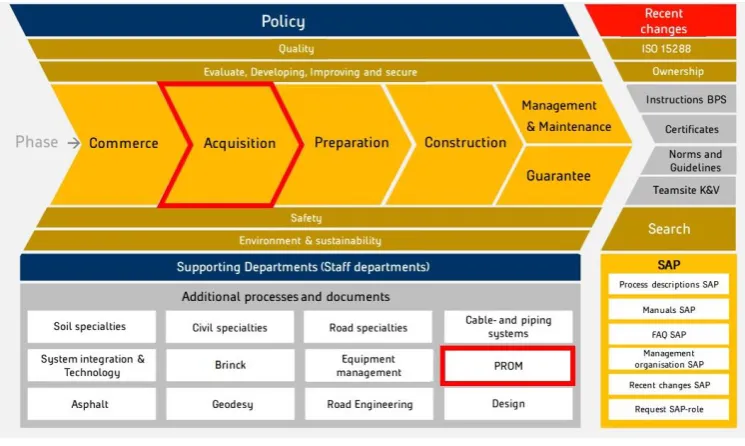
The following section describes how risk management is implemented in the tender phase (Acquisition) of projects at Heijmans Infra. This is currently carried out according to the business process system (BPS) of Heijmans. BPS describes how various processes, including risk management, should be carried out with links to norms and guidelines. Standard documents, manuals and
14 Figure 4: BPS Heijmans Infra, (Heijmans BPS)
Project acquisition is one of the main processes included in the BPS Infra. The main process is subdivided into several sub-processes as indicated in Figure 5. These sub-processes are divided by Go/No Go milestones. At these stages it is determined if the tender can go through the next sub-process.
Figure 5: sub-Processes of the main process project acquisition, (Heijmans BPS)
The inputs or outputs of some of the steps in the various sub-processes are linked to the document “Kansen en Risicodossier” (Translated: The Opportunity and Risk register) which contains a collection of risks and opportunities. The document “Kansen en Risicodossier” is a standard risk management format used in the tender phase. In this document, the risks and opportunities are assigned to their risk owners. The risk owner is responsible for defining the control measures required, and for
quantifying the risk. Having risks and opportunities stored in a “Kansen en Risicodossier” document is only mandatory for projects/tenders of values more than €100.000. In the tender phase, it is
mandatory for category 2 (projects between €5-20 million, not RAW contracts) and category 3 (projects above €20million) to be analysed using a Monte Carlo simulation. A Monte Carlo simulation simulates the project by choosing at random the values for each of the variables and then uses them to calculate the outcome of the project. This is repeated many times to produce a distribution of the possible outcomes of the project (Al-Jibouri, 2016). In the BPS, the document “Kansen en
[image:14.595.73.523.387.494.2]15
2.
Research design and methodology
2.1.
Problem description:
The problem description is the outcome of sequential steps to define the research problem. The first step describes the motive for this research. Secondly the purpose and outcome of the preliminary research is discussed. The third part further investigates the outcome of the preliminary research, which results in the problem definition for this research.
As mentioned earlier the motive for this research originates from the Heijmans risk management year plan 2016 (Ebskamp & van der Meer, 2016). Investigating the usefulness or necessity for developing a risk database for Heijmans infra, as part of sharing risk knowledge, is part of this plan. According to an investigation carried out by the department of process- and environment
management (PROM) knowledge related to risks is not sufficiently shared or maintained within the organization. In this work, a preliminary research has been executed to verify these observations by PROM as well as to investigate the need and necessity for developing a risk database for Heijmans Infra.
The preliminary research findings seem to concur with the observations by PROM. For instance, the orientation study shows that there is no explicit exchange of knowledge about risk within the organisation. In practice, the risk management process for each tender starts with a blank sheet and the only input used is the risk knowledge of the project team members. Also at the end of the project there is no evaluation, to compare the initial tender process, with the development of the risks over the lifecycle of the project. A risk database could be a useful tool to store and maintain the risk knowledge in a practical way. However, the structure, input and output of the database is yet required to be developed. It is believed that by not sharing and
retaining the acquired risk knowledge, many of the risks will not be identified which leads to budget and duration overruns in many projects.
A second cause of the missed risks and budget overruns of projects came forward during the preliminary research. The way risk management is incorporated in the tender phase is described in section 1.3. However, the risk management itself is not structured in the tender phase. For example, not in all tenders a risk session is organised, or the risk sheet is filled at the end of the tender. This unstructured risk management process includes that, risks are missed, risks are not already controlled in the tender, and risks lead to budget overruns during the life cycle of a project.
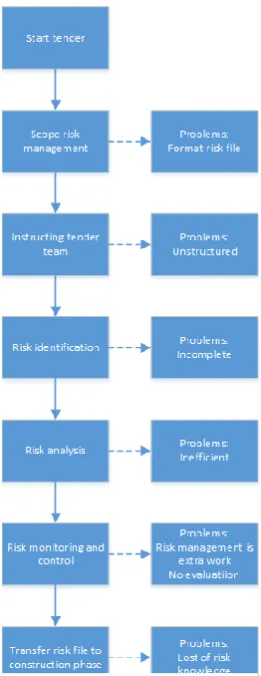
The current risk management process and its problems have been identified by interviewing tender managers and risk managers, who are responsible for the risk management process in the tender. The risk management process and its problems are visualised in Figure 6.
The first step in the risk management process is defining the scope of risk management in the tender. In this step, the risk management process for the tender is defined. The main problem in this step is the use of the mandatory risk register. The format risk register does not provide sufficient depth to control the risk management process.
The second step is instructing the tender team about risk
[image:15.595.392.523.397.736.2]management. There is no guideline how to instruct the tender team
16 about the risk management process, this is the main problem in this step. This is related to the fact that employees join the tender at different moments in time.
Risk identification is the third step in the current risk management process. Previous research concluded that on average only 2 of the top 10 risks at the end of a project, were identified in the tender phase. This means that risk identification in the tender phase is incomplete. Knowledge from previous projects and from the construction phase is barely used in the risk identification phase.
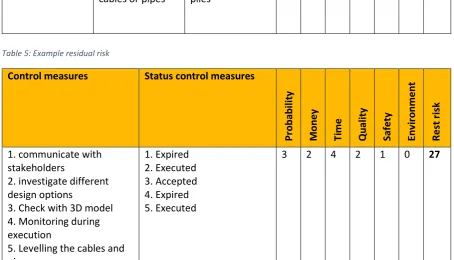
The risk analysis step includes quantifying the risks and defining the control measures. The first problem about the quantification is consistent with the problem in the first step. In the construction phase risk register it is only possible to use a quantification of 1, 2 or 3, this is perceived as
insufficient depth in the quantification of the risks. The second problem is determining the
probability of occurrence. The tender managers find it hard to see a difference in a probability ration from 1% to 15%.
There are several problems with defining the control measures. The first problem is defining the control measures SMART. To control the risk efficiently the control measures should be SMART formulated, but the current process often lacks a SMART formulation. A second problem related to the control measures is the check if the cost related to the measures are included in the budget, this check is not always done. A third problem is the lack of knowledge about the effectiveness of the control measures.
The fifth step is the risk monitoring and control. The main problem related to this step is that the employees in the tender team often see risk management as extra work in addition to their own work. As a result, the tender/risk manager needs to encourage the employees to identify and analyse the risks as an iterative process. A second problem related to the step monitoring and control is the evaluation of the development of the risks during the project. There is no evaluation of the risks which is used in new tender projects.
The last step in the current risk management process is the transfer of the risk register to the construction phase. The main problem related to this step is whether the risk manager, or every member of the tender team, proceed in the construction phase. When this is not the case, project specific risk knowledge is lost.
To summarise, the current risk management process in the tender phase seems to be unstructured and no lessons learned are used or documented. The results are that many projects encounter a variety of unidentified risks that lead to budget and duration overruns. The research problem can be formulated as follows:
17
2.2.
Research goal
From Heijmans’ perspective the goal of this research is to:
Increasing the successful completion of projects for Heijmans Infra by enhancing the risk management process in the tender phase.
The goal within this research is to:
Structure the risk management process in the tender phase and the procedure to maintain, share and use of existing risk knowledge and information during the process.
2.3.
Research Question
Main research question:
What are the reasons for the unstructured, incomplete and inefficient risk management process, in the tender phase of Heijmans Infra, and how can these problems be overcome?
Research questions:
1. How can the risk management process be structured to be complete and reliable in construction tendering?
1.1. How can the risk identification be carried out? 1.2. How can the risk analysis be performed?
1.3. How can the risk register be monitored and evaluated? 1.4. How can risk knowledge be retained within the organisation?
2. Why is the current risk management process, in the tender phase at Heijmans Infra, unstructured, incomplete and inefficient?
2.1. Why is the risk management process in the tender phase unstructured? 2.2. Why is the current risk identification incomplete?
2.3. Why is the risk analysis inefficient?
3. What changes can be made to make the risk management process in the tender phase better structured, complete and reliable?
2.4.
Research scope
• The research is carried out within Heijmans Infra in the departments, process- and environment management and acquisition.
• The research involves only the risk management process during the tender phase. This means from the start of the tender up until the transfer of the risk files to the construction phase. In this work, the term risk management process is used to refer to the risk
management process in the tender phase.
• The risk documents that are used in this research are those submitted at the end of the tender and at the end of the project.
18
2.5.
Research Methodology
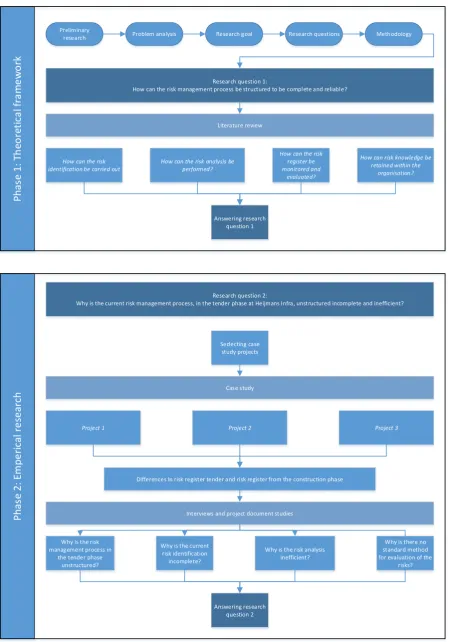
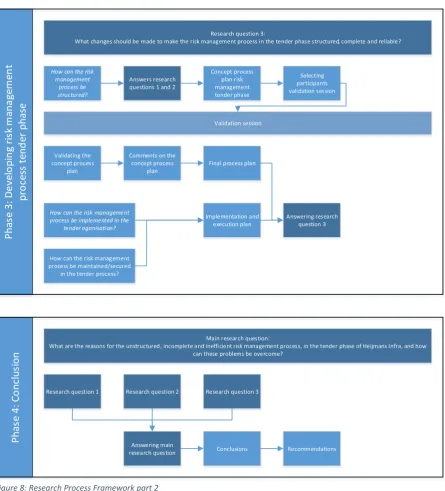
The research strategy and data collection required to address the different parts of the research are described in this section. The section includes descriptions of how each research question will be answered. The research process framework is shown in Figure 7 and 8.
2.5.1.
Answering research question 1
How can the risk management process be structured to be complete and reliable in construction
tendering?
This research question will be answered based on a study of the literature and available techniques. The literature study addresses the different topics related to the sub-questions derived from this first main research question. Scientific literature is gathered using the “platform risicomanagement”, a platform for sharing information about risk management between (old) students and professors. Other scientific literature is gathered using scientific search engines, mainly Scopus. In addition to this books and corporate documents provided by Heijmans will be used.
2.5.2.
Answering research question 2
Why is the current risk management process, in the tender phase at Heijmans Infra, unstructured, incomplete and inefficient?
The second research question and its sub questions are answered using document studies, case studies and interviews. In the case studies, five projects will be investigated. The risk register from the tender phase will be compared to the top 10 risks at the end of the project. Based on the
differences in the risk registers the tender and risks managers will be interviewed to identify why the problems arises in the current risk management process. The interviews will also be used to gather information on how the problems can be overcome.
2.5.3.
Answering research question 3
What changes can be made to make the risk management process in the tender phase better structured, complete and reliable?
A modified process for the risk management in the tender phase will be developed based on the findings in the two previous phases. The modified process will then be validated by experts. The results of the validation will be processed to produce the final proposed process to be used for the risk management in de tender phase.
2.5.4.
Answering main research question
What are the reasons for the unstructured, incomplete and inefficient risk management process, in the tender phase of Heijmans Infra, and how can these problems be overcome?
The main research question, stated above, will be answered when all three research questions are answered. In short, the main research question will be answered using literature review followed by analysis of the current risk management process to produce a modified and verified process plan for the risk management in construction tendering. This will represent the proposed final risk
19
2.6.
Research Process Framework
Preliminary
research Problem analysis Research goal Research questions Methodology
How can the risk identification be carried out
How can the risk analysis be performed?
How can risk knowledge be retained within the
organisation? How can the risk
register be monitored and
evaluated? Research question 1:
How can the risk management process be structured to be complete and reliable?
P h as e 1 : Th eo re ti ca l fr a m e w o rk Literature review Answering research question 1
Research question 2:
Why is the current risk management process, in the tender phase at Heijmans Infra, unstructured incomplete and inefficient?
P h as e 2 : E m pe ri cal re se arc h Seclecting case study projects Case study
Project 1 Project 2 Project 3
Differences In risk register tender and risk register from the construction phase
Interviews and project document studies
Why is the risk management process in
the tender phase unstructured?
Why is the current risk identification
incomplete?
Why is the risk analysis inefficient?
Why is there no standard method for evaluation of the
risks?
[image:19.595.74.524.97.740.2]Answering research question 2
20 Research question 3:
What changes should be made to make the risk management process in the tender phase structured, complete and reliable?
P h as e 3 : D e ve lo p in g ri sk m an a ge m en t p ro ce ss te n d er p h ase
How can the risk management
process be structured?
Answers research questions 1 and 2
Concept process plan risk management tender phase Validation session Selecting participants validation session Validating the concept process plan
Comments on the concept process
plan
Final process plan
How can the risk management process be implemented in the
tender oganisation?
Implementation and execution plan
How can the risk management process be maintained/secured
in the tender process?
Answering research question 3 P h as e 4 : C o n cl u si o n
Research question 1
Main research question:
What are the reasons for the unstructured, incomplete and inefficient risk management process, in the tender phase of Heijmans Infra, and how can these problems be overcome?
Research question 2 Research question 3
Answering main
[image:20.595.76.522.64.556.2]research question Conclusions Recommendations
21
3.
Theoretical framework
The theoretical framework describes the background of the identified problems based on scientific literature. It also aims to answer the first research questions and its sub questions.
➢ How can the risk management process be structured to be complete and reliable?
➢ How can the risk identification be carried out?
➢ How can the risk analysis be performed?
➢ How can the risk register be monitored and evaluated?
➢ How can risk knowledge be retained within the organisation?
3.1.
Methodology
Scientific literature related to this research is gathered in two steps. The first step is the use of the “Platform Risicomanagement”, which is a digital platform, from the University of Twente, for sharing information about risk management between (old) students, professors and experts from the field of work. The platform contains bachelor and master thesis reports about risk management, a folder with strongly advised scientific literature about risk management and a folder with dissertations in the field of risk management.
The second step in gathering scientific literature is the use of the university library. The university library is used to access the different online databases which offer access to all digital scientific literature available. The mainly used database is Scopus to gather scientific literature, however also ScienceDirect and GoogleScholar are used.
The master thesis report “Best practices in risico-inventarisatie” by van der Meer (2015) is the result of the research by Joris van der Meer at Heijmans Integrated Projects. The report answers his main question: “What input, heuristics, and organizational assets of Heijmans Integrated Projects deliver the best results relating to risk management and how can this be used to improve the risk
management in the future?”. This report is the starting point of this literature review.
The folder with strongly advised scientific literature, from the “platform Risicomanagement”, is used to form a scientific substantiation for the terms risk and risk management. Thereafter the literature review elaborates on the identified problems in the current risk management process of Heijmans Infra. To gather the scientific literature the following key words are used, in combination and apart from each other: risk, risk management, risk identification, risk analysis, risk register, risk repository, knowledge management, construction, infrastructure, tendering, process.
The used papers are selected based on several criteria. At first the papers which have the most interfaces with this research have been looked at. A second selection criterion is the number of citations of the papers, the more the paper is cited in other papers, the higher the acceptance is in scientific research. When a paper is found which is relevant for this research, there is also looked at the papers which quote the relevant paper to find more current information on the topic.
22
3.2.
Risk
The origin of the word risk is thoroughly investigated by Althaus (2005). Early notations of the word risk are often related to the maritime context, this also applies to the origin of the word risk
according to Bernstein (1996). According to Bernstein (1996) the word risk derives from the Italian word risicare, which means to dare. It was used by sailors to warn the helmsman that rocks might be near (Aven, 2012).
In contemporary scientific literature, risk is defined in many ways. It is even impossible to present and discuss all the risk concepts suggested in scientific research. This might relate to the fact that there is no agreed definition of the concept of risk (Aven, 2012).
Although there is no agreed definition of risk, the concept of risk can be explained by its
characteristics. The terms events, consequences and probabilities are included in the definition of risk, by for example Kaplan & Garrick (1981), Kaplan (1991) and Lowrance (1976). A risk consists of an event, which has a consequence and is associated by probabilities. The use of the term probability in the definition of risk has been discussed by several authors, probabilities are used as a tool to express uncertainties (Aven, 2010).
The term uncertainty is also used in the definition of risk according to the ISO 31000 and the ISO guide 73 on risk terminology (ISO, 2009a) (ISO, 2009b). In the ISO guide the following definitions are given for risk, probability and uncertainty:
Risk: Risk is the effect of uncertainty on objectives.
Probability: Probability is defined as a measure of the chance of occurrence expressed as a number between 0 and 1.
Uncertainty: Uncertainty is considered the state, even partial, of deficiency of information related to, understanding or knowledge of, an event, its consequences or likelihood These definitions are discussed by Aven (2011) and other definitions are suggested:
Risk: Uncertainty about and severity of the consequences of an activity or the two-dimensional combination of consequences (of the activity studied) and associated
uncertainties (what will the consequences of the activity be). (These consequences could be more or less severe, and defined in relation to expected values, objectives or other
reverences).
Probability: A measure for representing or expressing uncertainty, following the rules of probability criteria.
Uncertainty: Uncertainty means that we do not know what the consequences of the activity will be or the value of unknown quantities.
Al-Jibouri (2016) defines uncertainty as “an event whose outcome cannot be accurately predicted”. The outcome of an event cannot be accurately predicted, however it is possible to assess the outcomes of the event. Based on the nature of the consequences, uncertainty has two possible outcomes. The outcome is a risk or an opportunity.
Risk: The possibility that an uncertain event, whose consequence is damaging, will occur
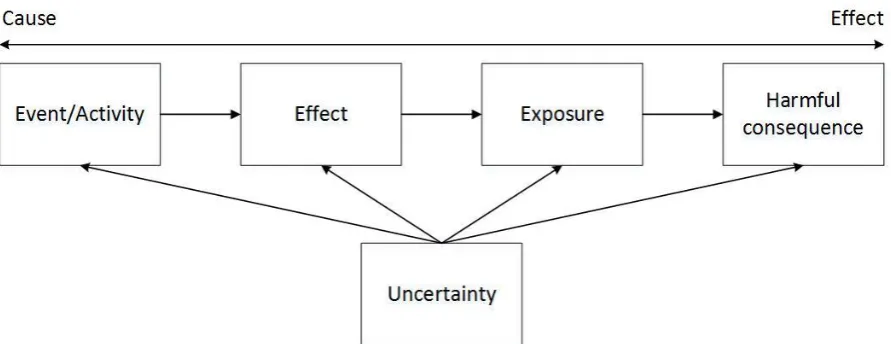
23 Halman (1994) describes risk as a process chain, including cause, exposure and a harmful effect which are all related to each other and all are affected by uncertainty.
Figure 9: Risk as a process chain, based on Halman 1994 & Van der Meer 2015
Based on the scientific literature above, risk is defined for this research as:
➢ Risk is an event that has an effect and exposure which result in a harmful consequence.
➢ Risk is the uncertainty of an event and the uncertainty about the consequence.
➢ Uncertainty is measured by probability.
3.3.
Project Risk
In the above section the concept of risk is discussed. Project risks will be discussed in more detail in this section. The Project Management Body of Knowledge (PMBOK) (Project Management Insititute, 2000) defines risk as “An uncertain event or condition that, if it occurs, has a positive or negative effect on an objective”. This definition is used by Karimiazari, Mousavi, Mousavi, & Hosseini (2011),Zayed, Amer, & Pan (2008) and El-Sayegh (2008). In this section, a definition is given for the term project risk and the focus is on the effect on project objectives and the categorization of the risk.
Risk event is considered to be any fact or event whose occurrence can have some
impact/consequence on at least one of the project objectives: time, final costs and performance of the project (Mehdizadeh, Taillandier, & Breysse, 2012). The definition of a project risk is given by Breysse et al. (2013), project risk can be defined as the possibility that a project does not run as expected in time, in cost and in quality. Time, cost and quality are common project objectives, as can be seen in table 1.
Table 1: Project objectives
Time Cost Quality Safety Environmental sustainability
Function
Akintoye & MacLeod (1997)
v v V
Zou, Zhang, & Wang (2007)
v v v v V
Baloi & Price (2003)
v v v V
Zhao, Hwang, & Phng (2014)
v v v
Ebrahimnejad, Mousavi, &
24 Seyrafianpour
(2010) Eybpoosh, Dikmen, & Birgonul (2011)
v v v v
Chapman (2001) v V v
3.4.
Risk categorizing
Mehdizadeh et al. (2012):
Risk Breakdown Structure (RBS) is a hierarchically organised depiction of the identified project risks arranged by risk category and subcategory that identifies the various areas and causes of potential risks.
However, RBS suffers several drawbacks such as lack of consensus on how to develop an RBS for a new project, lack of clarity and inconsistencies in definition of risk categories and lack of rules enabling transfer of qualitative/quantitative information of risks across the tree.
Many different classifications of risk have been developed over the years, however, most of these have considered the source criteria as the most important. Following these criteria, a broad classification of construction project risks could be: technical, construction, legal, natural, logistic, social, economic, financial, commercial and political. However, apart from the source criteria, there have been other forms of classifying risks, which take different perspectives. A classification
considering the location of the impact of risks in the elements of the project was suggested by Tah. It is also usual to categorise risks into dynamic/static, corporate/individual, internal/external,
positive/negative, acceptable/unacceptable and insurable/non-insurable. (Baloi & Price, 2003).
Risk that may affect the project for better or worse can be identified and organized into risk
categories. Risk categories should be well defined and should reflect common sources of risk for the industry or application area (Project Management Institute Inc, 2000). Categories include the following:
• Technical, quality, or performance risks • Project-management risks
• Organizational risks • External risks
25
3.5.
Risk Management
Risk management is the systematic process of identifying, analysing, and responding to project risk. It includes maximizing the probability and consequences of positive events and minimizing the
probability and consequences of adverse events to project objectives (Project Management Institute Inc, 2000).
Risk management is nowadays a critical factor to successful project management, as projects tend to be more complex and competition increasingly tougher. There is a direct relationship between effective risk management and project success since risks are assessed by their potential effect on the objectives of the project.
Project risk management aims to identify possible causes of threat and opportunity that may affect the project objectives (cost, time, quality), to analyse risks qualitatively and quantitively, and to propose a plan of action and monitoring indicators of risks considered critical (Breysse et al., 2013).
The risk management process aims to identify and assess risks in order to enable the risks to be understood clearly and managed effectively (Hillson, 2002).
To be successful, the organization must be committed to addressing risk management throughout the project. One measure of the organizational commitment is its dedication to gathering high-quality data on project risks and their characteristics (Project Management Institute Inc, 2000).
The risk management process is thoroughly described in scientific literature. The content of the information available is very similar, the difference is the level at which risk management is
described. Risk management is commonly described as a three-step process of risk identification, risk assessment and risk mitigation (Zayed et al., 2008)(Karimiazari et al., 2011)(Zou et al., 2007). The project risks management process by Project Management Institute Inc (2000) is used in this research, the risk management process is divided in six major processes:
➢ Risk management planning – deciding how to approach and plan the risk management activities for a project.
➢ Risk identification – determining which risks might affect the project and documenting their characteristics.
➢ Qualitative risk analysis – performing a qualitative analysis of risks and conditions to prioritize their effects on project objectives.
➢ Quantitative risk analysis – measuring the probability and consequences of risks and estimating their implications for project objectives.
➢ Risk response planning – developing procedures and techniques to enhance opportunities and reduce threats to the project’s objectives.
➢ Risk monitoring and control – monitoring residual risks, identifying new risks, executing risk reduction plans, and evaluating their effectiveness throughout the project life cycle.
26 Risk management planning:
“Risk management planning is the process of deciding how to approach and plan the risk
management activities for a project. It is important to plan for the risk management processes that follow to ensure that the level, type, and visibility of risk management are commensurate with both the risk and importance of the project to the organization.” (Project Management Institute Inc, 2000).
Risk identification:
“Risk identification involves determining which risks might affect the project and documenting their characteristics. Risk identification is an iterative process. Often simple and effective risk responses can be developed and even implemented as soon as the risk is identified.”(Project Management Institute Inc, 2000).
The risk identification stage is considered the most important and perhaps the most difficult stage. It is important because it defines the aspects of the problem to be studied. It is difficult as all projects, which risk management is commonly applied to, are prototypes. Risk identification is of great importance as the following stages are of little use if the uncertainties were not correctly identified (Al-Jibouri, 2016).
Many researchers suggest a categorised system of classification to aid in the identification process. This categorisation is based on the nature of uncertainties and can be shown as a hierarchy of uncertainty (Al-Jibouri, 2016).
Standard checklist like tables are suggested as a means of documenting the uncertainties identified as it is thought this helps to focus the mind. This is intended to identify those uncertainties which would otherwise be ignored in the unformalized system (Al-Jibouri, 2016).
Qualitative risk analysis:
“Qualitative risk analysis is the process of assessing the impact and likelihood of identified risks. This process prioritizes risks according to their potential effect on project objectives. Qualitative risk analysis is one way to determine the importance of addressing specific risks and guiding risk responses. Qualitative risk analysis requires that the probability and consequences of the risks be evaluated using established qualitative-analysis methods and tools. Qualitative risk analysis should be
revisited during the project’s life cycle to stay current with changes in the project risks.”(Project Management Institute Inc, 2000).
Quantitative risk analysis:
“The quantitative risk analysis process aims to analysis process aims to analyse numerically the probability of each risk and its consequence on project objectives, as well as the extent of overall project risk. This process uses techniques such as Monte Carlo simulation and decision analysis to:
➢ Determine the probability of achieving a specific project objective.
➢ Quantify the risk exposure for the project, and determine the size of cost and schedule contingency reserves that may be needed
➢ Identify risks requiring the most attention by quantifying their relative contribution to project risk.
➢ Identify realistic and achievable cost, schedule, or scope targets.
27 Risk response planning:
“Risk response planning is the process of developing options and determining actions to enhance
opportunities and reduce threats to the project’s objectives. The effectiveness of response planning
will directly determine whether risk increases or decreases for the project. Risk response planning must be appropriate to the severity of the risk, cost effective in meeting the challenge, timely to be successful, realistic within the project context, agreed upon by all parties involved, and owned by a responsible person.”(Project Management Institute Inc, 2000).
Four prerequisites defined by Hillson (1999) should be in place before effort is spent on risk response development:
➢ List of identified and assessed risks, screened to ensure that only genuine risks remain, assessed for probability and impacts, and categorised by source of risk and area affected. Where time for response planning is limited, it will be helpful to prioritise the list of risks, so that available time can be spent on the most significant risks first.
➢ List of potential responses (if previously identified during the risk identification stage), to be reviewed and confirmed.
➢ List of project stakeholders, able to act as owners of risk responses.
➢ Agreed risk threshold for the project, to define the “acceptable” level of risk as a target for risk responses to meet.
If any of these prerequisites are missing, the effectiveness of response development is likely to be compromised (Hillson, 1999).
To be effective, risk responses must meet a number of important criteria, all responses must be (Hillson, 1999):
➢ Appropriate – the correct level of response must be determined, based on the “size” of the risk. This ranges from a crisis response where the project cannot proceed without the risk being addressed, through to a “do nothing” response for minor risks. It is important not to spend inordinate amounts of time or effort developing inappropriate responses for minor risks, but also not to spend too little time considering how to respond to key risks.
➢ Affordable – the cost-effectiveness of responses must be determined, so that the amount of time, effort and money spent on addressing the risk does not exceed the available budget or the degree of risk exposure. Each risk response should have an agreed budget.
➢ Actionable – an action window should be determined, defining the time within which responses need to be completed to address the risk. Some risks require immediate action, while others can safely be left until later.
➢ Achievable – there is no point in describing responses which are not realistically achievable or feasible, either technically or within the scope of the respondent’s capability and responsibility.
➢ Assessed – all proposed responses must work! The effectiveness of a response is best determined by making a “post-response risk assessment” of the size of the risk assuming effective implementation of the response.
➢ Agreed – the consensus and commitment of stakeholders should be obtained before agreeing responses.
➢ Allocated & Accepted – each response should be owned and accepted to ensure a single point of responsibility and accountability for implementing the response.
Each proposed response should be tested against these seven criteria before it is accepted.
Four key risk response strategies are described in scientific literature, for example by Akintoye & MacLeod (1997); Hillson (1999); Project Management Institute Inc. (2000); Zou et al. (2007):
28 eliminate all risk events, some specific risks may be avoided. (Project Management Institute Inc, 2000).
➢ Risk Transference. Risk transfer is seeking to shift the consequence of a risk to a third party together with ownership of the response. Transferring the risk simply gives another party responsibility for its management; it does not eliminate it(Project Management Institute Inc, 2000).
➢ Risk mitigation/reduction. Mitigation seeks to reduce the probability and/or consequences of an adverse risk event to an acceptable threshold. Taking early action to reduce the
probability of a risk occurring or its impact on the project is more effective than trying to repair the consequences after it has occurred. Mitigation costs should be appropriate, given the likely probability of the risk and its consequences(Project Management Institute Inc, 2000).
➢ Risk acceptance/retention. Risk acceptance indicates that the project team has decided not to change the project plan to deal with a risk or is unable to identify any other suitable response strategy. Active acceptance may include developing a contingency plan to execute, should a risk occur. Passive acceptance requires no action, leaving the project team to deal with the risks as they occur(Project Management Institute Inc, 2000).
Risk monitoring and control:
“Risk monitoring and control is the process of keeping track of the identified risks, monitoring residual risks and identifying new risks, ensuring the execution of risk plans, and evaluating their effectiveness in reducing risk. Risk monitoring and control is an ongoing process for the life of the project. The risks change as the project matures, new risks develop, or anticipated risks disappear. Good risk monitoring and control processes provide information that assists with making effective decisions in advance of the risk’s occurring. Communication to all project stakeholders is needed to assess periodically the acceptability of the level of risk on the project.”(Project Management Institute Inc, 2000).
Karimiazari et al. (2011) presents numerous methods that can be used for risk assessment. These methods can be divided in quantitative methods and fuzzy risk assessment methods.
Quantitative methods:
➢ Monte Carlo Simulation
➢ Sensitivity Analysis
➢ Critical path method
➢ Fault tree analysis
➢ Event tree analysis
➢ Failure mode, effects and criticality analysis
Fuzzy risk assessment methods as explained by the following authors:
➢ Mustafa and Al-Bahar (1991)
➢ Mohammad & Al-Bahar (1991)
➢ Halman & Keizer (1994)
➢ Sadiq and Husain (2005)
➢ Carr and Tah (2001)
➢ Cho, Choi, and Kim (2002)
➢ Choi, Cho, and Seo (2004)
➢ Zeng et al. (2007)
➢ Zayed et al. (2008)
29 These methods differ in a variety of ways and they have their own advantages and disadvantages. So an ideal risk assessment method which would suit all organizations does not exist, as each of the organizations and projects possesses its own unique characteristics (Lichtenstein, 1996), so, an organization and project management team need to select the most appropriate methodology on its specific (Karimiazari et al., 2011).
3.6.
Knowledge Management
The term knowledge management and the application in the construction industry, specifically risk management, are explained by Malhotra (1998) and Tah & Carr (2001).
I explain Knowledge management by caters to the critical issues of organisational adaption, survival, and competence in face of increasingly discontinuous environmental change. Essentially, it embodies organisational processes that seek synergistic combination of data and information processing capacity of information technologies, and the creative and innovative capacity of human beings” (Malhotra, 1998).
The increasing complexity and dynamism of major construction projects can decrease a project manager’s ability to identify and manage risks effectively. Project managers cannot afford to inadvertently repeat past mistakes because they were unaware of successful risk management strategies applied elsewhere or on previous projects. A smart use of information technology designed to capture risk management experience lets project managers learn form and share with others by readily tapping into a centralised or distributed corporate knowledge repository using emerging knowledge management techniques (Tah & Carr, 2001).
To incorporate risk and knowledge management successfully it has to meet several requirements, Tah & Carr (2001) listed the following requirements. An environment must be created where data can be stored and organised so that individuals and teams can:
➢ Access it easily and intuitively
➢ Evaluate it using intelligent systems and tools
➢ Share that analysis with colleagues
➢ Act upon those findings effortlessly
Such an environment would be integrated and built on a scalable infrastructure necessary to allow distributed knowledge-enabled software components to thrive and grow across the entire
enterprise. The biggest challenge to realise such an environment is to gather all pertinent data that flows through an enterprise, and transforming information technology systems from mere databanks into true institutional memory (Tah & Carr, 2001).
Lessons learnt and experiences from the past are essential to support risk identification and management. Therefore, there is need to manage risks by retaining and maintaining knowledge about past project risks in the form of informal or formal databases which then could be used in the future (Karningsih, Kayis, & Kara, 2010).
3.7.
Conclusion
Scientific literature is used to answer the first research question: “How can the risk management process be structured to be complete and reliable in construction tendering?”.
The literature review resulted in the following process steps to come to complete and reliable risk management process in construction tendering:
➢ Risk management planning – deciding how to approach and plan the risk management activities for a project.
30
➢ Qualitative risk analysis – performing a qualitative analysis of risks and conditions to prioritize their effects on project objectives.
➢ Quantitative risk analysis – measuring the probability and consequences of risks and estimating their implications for project objectives.
➢ Risk response planning – developing procedures and techniques to enhance opportunities and reduce threats to the project’s objectives.
➢ Risk monitoring and control – monitoring residual risks, identifying new risks, executing risk reduction plans, and evaluating their effectiveness throughout the project life cycle.
31
4.
Case Study
The case study is the follow-up of the interviews which leads to the problem analysis and the literature research. The first research question answered how the risk management process can be structured to be complete and reliable. The case study research methodology is used to answer the second research question and its sub questions:
➢ Why is the current risk management process, in the tender phase at Heijmans Infra,
unstructured, incomplete and inefficient?
➢ Why is the risk management process in the tender phase unstructured?
➢ Why is the current risk identification incomplete?
➢ Why is the risk analysis inefficient?
This chapter starts with the goal of the case study and the methodology on how the research questions are answered. After the methodology a description is given about risk assessment at Heijmans and how the risks are financially controlled by the project controller.
4.1.
Goal case studies
The goal with the case studies is to investigate if the perceived problems in the problem analysis are consistent with the actual project data. The second goal of the case study research is to identify the reasons why the current risk management process, in the tender phase at Heijmans Infra, is
unstructured, incomplete and inefficient.
4.2.
Research method
In the case study five different projects are analysed. These are all Heijmans infrastructural projects which have been completed in recent years or are almost complete. At first the required documents have been requested from the risk managers and project controllers, as explained below. After gathering the documents, the risk registers from the tender and the construction phase risk register have been analysed to determine the completeness of the risk identification during the tender phase. The third step is the analysis of the top-10 cost overruns of the respective project. Thereafter the relations between the cost overruns and the risks from the risk register tender phase are
discussed. The outcome of the analysis is discussed in an interview with the project manager to determine why the risk/cost overrun occurred. Subsequently the tender manager of the project is interviewed to determine why he could not have foreseen the risk, and how the risk/cost overrun could be avoided in the future. Finally, a conclusion is given which serves as input for the risk management process in the tender phase.
After selecting the projects, three documents have been requested, from the risk managers and project controllers, for each project:
➢ Risk register tender: This document contains all the risks and opportunities that have been identified and quantified during the tender phase. This document contains the probability of occurrence and the expected costs when the risk occurs, for every risk and opportunity in the risk register. This information is the input for the Monte Carlo analysis to determine the risk budget for the project.
32
➢ Top 10 with the budget overruns on the project: The top-10 budget overruns are requested because they had the most impact on the financial outcome of the project. In the analysis will be determined if the risk related to the cost overrun was identified and if so why the quantification is incorrect. The cost overrun is not linked to every risk individually, so it is not possible to immediately select the top 10 risks with the biggest cost overrun. The project controllers record the cost overruns per activity, this is further explained in the section “Project control in relation to risk management”. For the case study analysis, the top 10 activities with the biggest cost overruns have been requested from the project controllers for each project.
The quality and consistency of the received documents differs between the projects. The risk register from the tender phase differs with the construction phase risk register, for example in the used format. The risk register from the tender phase is commonly documented in Excel, however the construction phase risk register is commonly documented in Relatics. Also, the types of information recorded in the risk register per risk differ between the tender and construction phase risk register. This also differs between the projects.
4.3.
Risk registers at Heijmans
This analysis uses two different risk registers. First the risk register which is made in the tender phase of the project. The second risk register is the construction phase risk register, this register is
extracted from the Relatics environment of the project. Relatics is a web-based environment where risks can be registered and monitored. The Relatics environment is also used for the verification and validation of the contract requirements. The following sections elaborate on the content of the different risk registers.
4.3.1.
Risk register tender phase
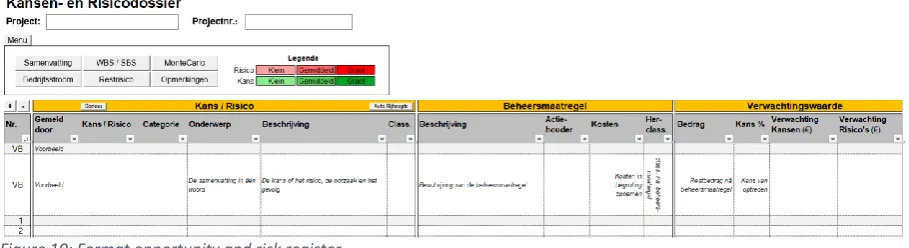
Currently a standard format risk register is used for all tenders at Heijmans. The risk register is documented in Excel, as shown in Figure 10. This format is not only used within the business unit infra, but also within the business areas property development, residential building and non-residential. The format contains the following aspects:
➢ Identification number
➢ Name of the initiator
➢ Opportunity or Risk
➢ Category → choice between: client, environment, technical, financial, planning, safety and organisation
➢ Topic, this is a description of the risk/opportunity in one word
➢ Description, this includes a description of the risk/opportunity, the cause and the effect.
➢ Classification, this indicates the importance of the risk/opportunity → choice between 1,2 and 3
➢ Description control measure, both a description of the preventive control measure and the corrective control measure
➢ Name of the person responsible for the fulfilment of the control measure
➢ Costs of the preventive control measure
➢ New classification, classification of the risk/opportunity after fulfilment of the preventive control measure → choice between 1,2 and 3
➢ The cost of the risk/opportunity if it occurs, after fulfilment of the preventive control measure.
➢ The probability of occurrence of the risk/opportunity in percentage
33 There are several aspects that can be added to the format, which are:
➢ Business area or business unit
➢ WBS (Work Breakdown Structure) or SBS (System Breakdown Structure) code
➢ Residual risk, including a description, name of the person responsible for the fulfilment and a new classification
➢ Monte Carlo, by using this function a minimum and maximum are added for the probability of occurrence and the cost of the risk/opportunity. As well as the name of the board member who must approve the input for the Monte Carlo simulation
[image:33.595.71.526.208.332.2]➢ Comments can be added to the risks/opportunities
Figure 10: Format opportunity and risk register
4.3.2.
Construction phase risk register
In the execution phase of the project the risks and opportunities are registered in a risk register in Relatics. The risk registers differ in output, because the Relatics template has changed by the years and not all aspects where mandatory. In the current Relatics template the following aspects can be documented:
➢ Risk Identification number
➢ Risk identification number for client
➢ Risk/Opportunity grouping
➢ Title
➢ Description
➢ Aspect
➢ Date drafted
➢ Date occurred
➢ Date discharged
➢ Risk/opportunity type (intern/extern)
➢ Status
➢ Risk carrier
➢ Risk owner
➢ Board member
➢ Agreed with allocation
➢ Comment if not agreed
➢ Urgency
➢ Incorporate in quarterly figures
➢ Cause
➢ Effect
➢ Preventive control measure
➢ Preventive control measure status
➢ Preventive control measure actionee
➢ Preventive control measure date accomplished
➢ Corrective control measure
➢ Corrective control measure status
➢ Corrective control measure actionee
➢ Corrective control measure date accomplished
➢ Quantification initial, actual and rest according to the RISMAN method, which will be explained below.
➢ Requirement ID
➢ Requirement
➢ ID
➢ Object
➢ ID
➢ Work package
➢ ID
➢ Work package activity
➢ Comment